Sunday, 13 October 2013

Gamespot & the "High" Grand Theft Auto V Score

IMPORTANT: This blog post contains spoilers for Grand Theft Auto V. Read at your own risk.

I know for a fact this blog is going to be posted later than I wanted. College work is now getting on top of me in a huge way. Doing homework has turned into a constant level grind, without the satisfying rewards when I level up.

It's been almost a month since the release of Grand Theft Auto V and when it was released, Gamespot's Carolyn Petit faced a lot of criticism for giving the game a 9.0 score. That's right, a 9.0 out of 10. As high a score as that might seem, there is a good reason why Carolyn faced a backlash; she seemingly deducted points from her score based on the claim that GTAV is "politically muddled and profoundly misogynistic".

I should say that I don't think GTAV is a ten-out-of-ten game. However, if I was deducting points from the game, I would do so based on the inability to map "accelerate" to the X button on the PS3 version and because I think the gameplay can feel a bit flat and aimless after the story is over. There are also a bunch of online issues but online play wasn't available at the time of the review. I feel like these are sensible reasons to deduct points from the game but, other than those issues, it's a phenomenal game. I compare the game's tone to a description of The Social Network I once read on TV Tropes; it "captures the spirit of the time it was made". Everything from reality television to politics is perfectly parodied. I feel like it couldn't have been made at any other time in gaming history, nor could it have been done as a medium other than video games. Although, as I say, it's not perfect.

So what's the big deal about Carolyn claiming that the game is "profoundly misogynistic" if I don't think it's perfect either? Well there's a difference between the game having flaws that could be improved and the game having content that offends you personally. People read mainstream reviews because they want impartiality, not ideologically-driven arguments.

Here's an example; I've sometimes come across Christian review sites that award games a score based on how highly they promote Christian values. This site, for example, gives two scores; a "game score" and a "morality score". That's fine for a niche site but not a mainstream one. The problem is that if I was a reviewer who said "Grand Theft Auto V is a good game but it doesn't promote Christian values. 9/10", I'd face criticism for that review. Not because the critics necessarily had anything against Christianity but because the reviewer is judging a game using personally-held beliefs and not professional impartiality.

There's also the fact that Grand Theft Auto V makes a point about not singling out any group for parody. Men, women, liberals, conservatives, religious people, atheists and others are all equally satirised. It'd be one thing to say "contains content that may offend" and deduct points for that but to single out only offense to only one group as a negative point for a review just reeks of personal bias. I might've used this quote before but in the words of Trey Parker and Matt Stone, creators of South Park, on offensive humour, "either it's all okay, or none of it is".

Carolyn's supporters -- or those who agree that GTAV is misogynist -- have created a strawman argument by making out like her critics are actually complaining about the 9.0 score and not the reasons behind the score. It's easy to persuade people that the critics are crazy when the score is so high (and then there are the typical claims that the backlash is because Carolyn is a woman and because she's transgender). In actual fact, the critics have two problems with Carolyn's review scores; the first is that this isn't the first time Carolyn's personal beliefs have influenced review scores.

A month before GTAV was released, a PC game was released called Gone Home. Personally, I thought it was quite bad. The gameplay involved walking around a big house, examining items to determine what happened to your character's parents and sister. I thought the environment interactivity was well-done but apart from that, it had nothing to offer except a very schmaltzy, romanticised view of an immature teenage lesbian love story. Personally, I felt like the story was meant to come across this way, since it was narrated by the main character's younger sister, reading from excerpts in her own diary about falling in love with a girl, but it also made it hard to care about this romance in the slightest. Plus, the ending was about as anticlimactic as it can get.

The lesbian angle also played no role in the story whatsoever; one of the lesbian characters wanted to join the military and Don't Ask, Don't Tell was mentioned ... but also quickly ignored. I imagine this would be the case for gay people who wanted to join the military when DADT was still in effect, so there must be some truth to it, but it seemed like an odd thing to shrug off. There was a mention of the parents disapproving of their daughter's girlfriend but their reaction to this rebellious young woman didn't seem any different from a reaction they'd have if she was dating a rebellious young man instead.

So in spite of the fact that this game's storyline revolved around a lesbian romance, it didn't seem to have any relevance in-and-of itself ... except when it came to review scores, including Carolyn's. It scored a 9.5 out of 10, which is only 0.1 below the highest score Gamespot has ever given (for the original Diablo) and a full 0.5 points ahead of GTAV. Did I mention that Gone Home is only two hours long at the most and costs twenty dollars to buy? That means Gone Home earns ten dollars an hour, which is more than minimum wage in the US.

The second problem that the critics have with Carolyn's review scores is that they don't want one rule for women and another for everyone else, which is what Carolyn is promoting by listing "profoundly misogynistic" as a negative point.

Case in point, would you like to know a few ways men are negatively portrayed in GTAV? Well, there's the basic stuff about their portrayals; men are stupid, perverted, short-tempered, drug addicts, drug dealers, murderers, thieves and doormats. The radio commercials aimed at men try to appeal to masculinity by promoting domestic violence.

Those are just the basics. That's the kind of general parody that all demographics face in GTAV and that's the kind of parody that Carolyn is complaining about in regards to women. When we get into more complicated territory, consider this; we're forced to see a brutal torture of a clearly innocent man and, shortly after, we're forced to torture him ourselves. As usual, the victim of torture in a game is male. In typical video game fashion, absolutely every enemy you kill in the main storyline is male. Oh, and there's a threat of rape against a male character when we first meet Trevor, there's the implied rape of Floyd if you switch back to Trevor while staying at his hideout (although it isn't certain) and you can see a billboard for this television show in downtown Los Santos:

Prison Bitches: Break Out Before They Break You In

Incidentally, of the few blogs I've read criticising GTAV for misogyny and transphobia, I haven't read the words "rape culture" once. Because who cares when men are the victims, right?

In contrast to all of this, the only female villain I can think of is a woman working for the government who threatens to anally-violate the torture victim from earlier with a flashlight. Even though our heroes "rescue" the victim (to torture him themselves later), this woman escapes ... while about a dozen of her male colleagues get shot by Michael and Franklin. The only other unpleasant female character worth mentioning is Debra, the girlfriend of Wade's cousing Floyd. She appears for all of one cutscene to insult Floyd and mockingly tell him she's been cheating on him. She and Floyd are both killed off-screen by Trevor. Oh, and then there's Molly Schultz, who works with one of the villains but doesn't seem to be evil herself. In fact, Michael genuinely seems to regret her death, insisting that he just wanted to talk to her.

None of this is likely to be covered by Carolyn Petit or anyone else complaining about GTAV. I've seen complaints about GTAV having misogynist content and being transphobic but when men are the ones who are the victims of negative portrayals, violence and rape jokes, it isn't misandry; it's just typical video game content.

The thing is, I don't really care about how GTAV portrays men. The billboard made me cringe but it seems that I realise what Carolyn and other critics don't (thanks to Anita Sarkeesian for that link, by the way. Nothing like posting a link to a Tumblr called "Fuck NO Video Games" to show how much you love the medium); complaining about the comedy in Grand Theft Auto V is completely pointless because playing with the boundaries of bad taste is the entire point of the humour.

For goodness' sake, we're adults, or we're supposed to be. If people can't handle the mature themes in GTA -- handled in a sometimes-hilariously immature fashion -- then why are they playing the game? What did they expect? Buying a Grand Theft Auto game and complaining that it contains controversial content is like whining that a Metal Gear Solid game has a sexualised female character. Oh, wait ...

As far as I can see, buying Grand Theft Auto and then complaining about how morally bankrupt it is places us firmly in Jack Thompson territory. In fact, it's a textbook example of the way he used to campaign against video games. Yet we still see site after site falling back on Jack's arguments, without even reappropriating them for a different purpose; these arguments are still being made because people object to the content of a game and want them to change.

Although the more cynical part of me thinks that maybe they wanted to take advantage of the hits that they would get from creating clickbait articles about a game that made a billion dollars in three days. No, that's not why I wrote this blog. Shush.

As much as I don't want to give this guy video views, you can watch this video if you want to hear a basic defence of Carolyn's review, complete with strawman defence. However, he spends the majority of the video comparing Anita Sarkeesian to Rosa Parks, if you can believe it. It's hard to believe, considering Twitter was embroiled in the "#SolidarityIsForWhiteWomen" controversy about a month ago -- a movement all about how non-white women have been underrepresented or mistreated by the feminist movement, which made for interesting reading if you've ever been lectured on intersectionality by white feminists -- but this is the stage we've come to when it comes to defending Anita. Perhaps I should've written about that video instead but, if you watch it, I'm sure you'll understand why I didn't.

Feel free to leave a comment or send me an e-mail at themalesofgames@gmail.com. When I checked my e-mails at the beginning of October, I realised I hadn't checked for a month, so forgive me if I don't get back to you for a while (and I apologise to the few people who sent me e-mails who it took me a while to respond to).

Tuesday, 1 October 2013

Jade Raymond: "What can a bunch of identical white men offer that's new?"

"What can a bunch of identical, white, 32-year-old males who shop at Gap or wear the same free games t-shirt offer that's new?" - Jade Raymond, Managing Director of Ubisoft Toronto, Develop Magazine #128, June 2012

Two blog posts ago, I mentioned an Understanding Industry class at my college where I was placed into a group that had to come up with points about diversity within games and the games industry. As well as having access to the internet, some magazines were also handed out as research materials. On the front cover of one of them -- Develop Magazine #128 -- was a picture of Jade Raymond and the teaser "on starting a studio from scratch, being a parent, and diversity in games". I asked if I could look at the magazine and, quickly reading the interview, I came across the quote above.


Right from the start, it should be clear what's wrong with this statement. The thing about diversity as a definition is that it suggests inclusivity. Having a work environment with a rich variety of ethnicities, genders, sexual orientations, religious backgrounds, a mix of able-bodied and disabled people, etc. is how I would describe "diversity". Unfortunately, it feels like Jade Raymond's quote is the definition that the games industry goes by nowadays; one of exclusion rather than inclusion.

I'm a white male. I'm studying game development in college and, in the two groups I've been in, only four students have been female (out of thirty-four). None have been non-white. Which leaves thirty white guys aged between sixteen and twenty-six (and I actually think there are only two people over the age of twenty). We all have different opinions and influences. Different ideas for games and different areas we'll excel and struggle in.

Before anyone criticises me for this, I should point out that I am not saying, "us white guys have it so hard!" However, it's hard not to feel insulted by the fact that there are prominent members in the games industry who assign a lower value to my ideas because I'm a white male. It means my ideas aren't judged on their own merits but based on my sex and skin colour. The same applies for a non-white or non-male (or both) person, although their ideas would be given a higher value rather than a lower one. It makes me wonder how, say, a black woman in the games industry might feel about this attitude; were her ideas taken on board because they're good or just because the ideas of a black woman are "something new"? Is she an individual or has she been reduced to nothing but her sex and skin colour in the same way I'm dismissed because of mine?

The bottom line is that Jade Raymond doesn't get to define "diversity" the way she wants to, to exclude the people with the skin colours and genders that she dislikes. This seems to be a trend with so-called "social justice warriors", if I can borrow a Tumblr term. It's fine to support groups that they feel are underrepresented ... but they take an extra step and feel free to badmouth the groups they feel are the "wrong" sex, "wrong" sexuality, with the "wrong" skin colour. Who cares, it's just white guys, right? Either they won't care or they're offended, in which case they're not worth listening to anyway. The writer of this Tumblr response says it better than I could.

While researching topics on financial issues in the games industry today, I came across more dismissiveness towards men in this article on gamesindustry.biz. The whole thing isn't important so here's the relevant part:
"There are uncharitable explanations which often point to uncomfortable truths - self-styled "gamers" have built something of a boys' treehouse over the years, and dislike the invasion of new demographics which can include such unwelcome treehouse guests as women, homosexuals, trans people, ethnic and religious minorities, and even - gasp! - their own mothers and relatives. Is nothing sacred?!"
It's actually becoming very tiresome to have to constantly defend myself as a male gamer. To have to clarify how open I am to different groups "joining in" on gaming (not that I have any idea how they could be kept out; it's gaming, for goodness' sake). Yet no matter how many male gamers clearly state they disagree with online abuse and hostility, we still find ourselves painted with the same "dudebro" brush. Develop Magazine and gamesindustry.biz aren't just gaming journalist sites. They're specifically about the industry. So I have to face up to a frustrating truth that I'm training to enter an industry that I've loved since I was four years old and yet that industry doesn't care one bit about me. Either they constantly reinforce the idea that straight white male gamers like me are the villain in the real-life game of diversity or they tell me that I'm actually rather useless and unwelcome, as Jade Raymond did above. All in the name of diversity!

The thing is, if the writer of that article, Rob Fahey, really wants to talk about "uncomfortable truths" and treehouses, here's one that it's time to grow up and acknowledge; I picture feminist gamers sitting in the gender issues treehouse. They get to have their say on the subject as much as they want. They've pulled up the ladder. They've nailed a "no boyz allowed" sign on the door. Yet when us boys come to the bottom of the tree, asking to share the treehouse, we get insulted and told we're unimportant, our issues don't exist and we're all misogynist assholes or self-centered slobs. To be honest, I'm getting pretty sick of it.

In answer to Jade Raymond's question -- what can I, as a white male, offer that's new? -- I would have to say, "the same new ideas that other men and women, regardless of their ethnicity, have brought to the table before me". If you'll allow me to state the obvious for a moment, the whole point of equality is that we're all equal, regardless of sex, ethnicity and sexual orientation. I have literally no idea how "supporting diversity" became so distorted to mean "male-bashing" and, worryingly, how it became so accepted by figures in the gaming industry as high-profile as Jade Raymond.

Here are the facts; white male gamers are not a final boss to be slain to bring peace and happiness to the diversity kingdom. Nor are white male employees in the games industry a group to be torn down simply to build up the benefits of a diversity. A diverse work environment can be praised without dismissing and denigrating one of the groups that would be in any diverse work environment. I don't see how anyone could fail to see that without being incredibly ignorant.

Besides, just place any other group in that quote and see how it sounds. Imagine how it would read if a male developer casually said, "women? Pfft! What can they offer the industry that's new?!" or, "black people are all identical, what new ideas do they have?"

Then again, this is Jade Raymond. A person who I was actually very fond of when the first Assassin's Creed game was released. She seemed friendly and insightful during interviews, which were a far cry from the insulting dismissiveness of the Develop Magazine quote. However, according to Wikipedia, Jade Raymond is on the Board of Directors of Women In Film And Television International, "dedicated to advancing professional development and achievement for women working in all areas of film, video, and other screen-based media". So at the very least, I think white men working in the games industry would be able to offer at least one thing new, specifically for Jade; how to gain employment based on their abilities and not on whether they belong to any organisations that exist only to give them a headstart because they're female.

*


I need somewhere to vent my frustrations with college; I completely hate the games development course I'm on. Last week was possibly the most boring week of my life, thanks to a ton of homework and being bogged down with theory classes the entire week. There are only four real practical classes right now and one of them, modelling 3D characters, was cancelled and the other, Animation, has been cancelled permanently. Supposedly, we'll be able to make up what we miss in the Animation class elsewhere and everyone will be given work experience placements to compensate, which sounds kind of cool. Unfortunately, right now, it's awful. We had a Sound & Music class last week that was more like a physics and biology lesson, since we learned about what sound is and how we hear it. I dislike that class as it is; the first twenty minutes of every lesson is spent listening to a song that a student in the group has chosen, while the tutor switches the lights off. I'm not very musical, so I'm bored senseless the entire time and, honestly, if I wanted to sit in a dark room and listen to loud or depressing music, I could do that at home.

Plus, remember when I mentioned that I switched groups to get a better timetable? I wish I hadn't. I preferred the people in my old group. They seemed more mature, were quieter during classes and were more interested in talking about games. I can't go back to my old group either; I made too big a deal over what a hassle the travelling schedule was. And I have to imagine that if I stayed in my first group, I'd be thinking how much better my own group had it because of the schedule. It seems like every decision I've made since starting college has made my situation worse.

I have been able to find a couple of bright spots, if you want to call them that. The first was the only girl in my group, who I finally had the chance to chat to about Anita Sarkeesian, albeit briefly. We caught each other walking to college one morning and I asked what she thought about Anita on the way. "Well, what do you think about her?" she asked me straight away. "I'm not a fan," I said honestly. She smiled and said she wasn't a fan either. While we made our way inside, she said that she found Anita to be too picky and, even though there are some poor examples of female characters, there are plenty of good ones too. She summed things up with "we've got bigger problems". I suspect people will think her turning the question around and asking me what I thought of Anita first was odd but her answer seemed to be genuine.

Finally, it's worth looking at this comic on a Tumblr titled "Social Justice Stupidity". It's very simple and remarkably accurate. (Edit: Unless I'm much mistaken, it seems like that entire Tumblr account has been deleted since this blog was written) I'm actually very pleased that there are artists willing to draw anti-feminist cartoons and comics because it seems like they get the point across far better than long-winded blogs like my own. I feel like this particular blog could've had more depth to it but there's only so much I can criticise when I'm repeatedly saying that there's a right way to use diversity and avoiding using the phrase "diversity has gone too far" because I think it sounds kind of racist.

The thing is, this issue is horrible. It's insulting. Demeaning. It's even quite intolerant. Yet nobody is interested in criticising Jade Raymond for her comments because all that's at stake is the feelings of a bunch of straight white gamers. The boogeyman of diversity in the games industry.

Comments and e-mails, as always, are welcome. themalesofgames@gmail.com is my email address.

Friday, 20 September 2013

Anita Sarkeesian is Not a Real Gamer

I should've written about this sooner but, for the very first time, I can legitimately say, "I have a lot going on in my personal life right now", which is the blog-writer's way of saying, "college is time-consuming".

So let's get right into it with this: Anita Sarkeesian is not a real gamer. In her own words.


Back in 2010, Anita gave a lecture at Santa Monica College in California, where she stated, "I would love to play video games but I don't want to go around shooting people and ripping off their heads. It's just gross". So there we have it. In her own words, Anita states she doesn't -- or didn't, at least -- play video games. In spite of the photo of herself playing a Nintendo game as a child that she likes to show at every opportunity.

The video above became popular enough to gain 140,000 views (and counting). I'm a bit out of the loop so I don't know how this happened or who linked to it but I'm pleased it has received so much attention. In fact, it was popular enough for Anita to actually make a response (of sorts) to it.


A bunch of other tweets followed these that were in a similar vein. If you want to read them all, Anita helpfully posted the tweets to her Tumblr account, for reasons I'm not quite clear about. To clear the air, perhaps? Regardless of the reasons, it's silly that even while Anita herself said she wasn't a gamer and the original uploader of the video made it very clear he didn't hold any malice towards her, she still feels the need to blame "angry gamer dudes" (and games themselves, later on). I suppose it's natural to want to go on the attack when you're against the ropes.

It's worth noting that Anita may be telling the truth when she says she fell in and out of love with gaming. It's possible but we just don't know and the video footage of her saying "I would love to be a gamer" is greater evidence against her being a gamer than her word is for her being a gamer.

So what does this prove? Well, as the creator of the original video said, no, the fact that Anita isn't a gamer doesn't disprove or debunk her arguments in any way. People with no prior involvement in a subject can still research and investigate it. So if her arguments could be acceptable one way or the other, why go as far as to pretend to be a gamer?

My theory is that it adds legitimacy to her claims. Critics of Anita, like myself, have compared her to Jack Thompson in the past because of her insistence that video games have some non-descript influence on real-life behaviours and attitudes. However, Anita's arguments have been accepted and praised by mainstream sites and publications while Jack's were condemned and ignored. There are a few reasons for this; Anita doesn't make claims as outlandish as Jack's, for example, and isn't as aggressive in her delivery. There's still plenty of hostility and condescension but no claims that video games are "murder simulators". Her view is also politically correct, while Jack was openly homophobic. That's a big reason for it.

Anita being a gamer is certainly a factor here though; let's say someone was in her shoes who admitted to not being a gamer. "Feminist gamer criticises sexist tropes in games" is going to be given more coverage than "feminist criticises sexist tropes in games, in spite of having never held a controller in her life".

I've already ran into comments on Youtube defending Anita, obviously, although I suspect the ones I've seen are trolls. Naturally, I haven't seen any mainstream gaming sites pick up on this -- although the number of views for the video suggests that somewhere with a large readership reported on it -- and I doubt they will. They'll just quietly file it alongside the misquoted studies and use of other people's footage to continue to portray Anita as a figure who can do no wrong.

Still, at least we know why Anita doesn't like her lectures to be filmed now.

In other news, I've been doing a bunch of gender issues-related things at college. Today, we dealt with the stereotyping of certain groups in games. It wasn't at all in-depth, unfortunately, and men weren't mentioned. It was just basic stuff and the reason we were told not to do it, rather than because we should care about offending people, was because large-chested female characters simply aren't used in a portfolio when trying to get a job in the games industry. The same goes other things, including T-Rexes, for reasons that we haven't been told yet.

Also in college, a prick ruined GTAV for the entire class by revealing parts of the story. Just thought I'd mention that.

Oh, and I found an eyebrow-raising Jade Raymond quote from Develop magazine that I'll write about next time.

Thursday, 12 September 2013

News from College!

Hey all. I know I updated a lot last month so I'm sorry that things have slowed down this month. This is actually the first time I've even logged in for a week.

As you probably know, I've started my games development course at college and, to be brutally honest, I hate it. What little I've done so far has been a mixed bag; playing with 3ds Max and Maya has been pretty good but the more academic side of things leaves me feeling cold. The course tutors have outlined the projects for the year and workload is overwhelming. I shouldn't have a problem writing essays, given the length of some of my blog posts, but I inject a lot of myself into this blog and when I have to cite references, I just link to other places. Plus, there's no strict deadline. It doesn't translate very well to a course where we have to examine market trends in the gaming industry and give examples of different ways digital art is used. Maybe it's just because I'm older or because I have little patience for hand-written notes and using "Harvard Referencing" to cite sources but I'm certainly not as passionate about the theory rather than the practical. If I feel like it isn't helping me improve my skills of creating content, it gets a thumbs-down from me.

There are a few little things to say about gender issues but nothing major yet. First of all, the number of boys on the course obviously outweighs the number of women but by how many, it's hard to say. There are over two hundred students on this particular course, each doing different levels and in different groups, so I couldn't begin to give you any numbers. What I do know is that my own group has three girls in it, out of a class of seventeen. However, two of the girls -- a pair of sisters -- have been absent for the last two days and, although I don't like to assume, I suspect a pair of sisters both being absent at this early stage means they decided the course wasn't for them. They are the only people in my group that did this.

I'd also like to say that I am not knocking either their ability or willingness to stay on the course. Partly because, as I mentioned above, I hate the course so far and have thought about dropping out myself already but also because they were the two people in the class I got on best with. In fact, I'm switching groups next week -- all the timetables are pretty screwed up and, living over an hour away from the college, it wasn't practical to stick with the group I'm in right now -- and the possibility of the two of them coming back was actually one of the reasons I was tempted to stay with my group. Unfortunately, if I'm to survive this course, switching timetables was a must, but I want to make it clear that I'm not saying that their leaving (if they have left) is representative of either women's or even their own lack of enthusiasm in the games industry. The course is just a pain. I'm only pointing it out because people tend to obsess over how "male-dominated" certain fields are or how sexist the games industry is but maybe the reality is that people just decide the course isn't for them.

So it's fair to say I haven't been making too many friends and no conversation about gender issues in video games has cropped up yet. In fact, aside from a wide-ranging discussion in a particularly laid-back substitute class today, games haven't come up much at all. However, while flicking some subject briefs for a class I had today -- Understanding Industry, an academic and homework-heavy class that I suspect I'm going to really hate -- I came across what looks like the lesson plan for the entire year. Listed for the week of 2/12/13 and 13/1/14 are a pair of lessons titled "Ethics - Games Debate". I'm going to take a wild guess and say that one of them will be about violence and the other will be about gender issues, based on something the tutor mentioned in the class; when talking about current trends she casually threw out, "maybe a current trend is about having more females working in the industry". At the foot of another brief, when giving an example of how to use Harvard Referencing, the book she happened to use was "Feminist Film Studies: Writing the Woman into Cinema" by Janet McCabe. It could be coincidence but possibly not.

Unfortunately, that means I have to wait until December (at the very least) to actually voice my opinions about gender issues in games in a real-life forum. By then, I'll be neck-deep in essays and probably as stressed as I can possibly be, so I certainly have to suffer through a few things to get to that slight improvement. And I do mean slight; as optimistic as I am that I can talk about this with a new audience, the drawbacks of the course are keeping me from jumping for joy.

Update: As it turns out, the two girls didn't drop out, which I'm happy about. We chatted a little, they seem nice, they're still the two people I find easiest to get along with at the college. Unfortunately, now that I've switched groups, I won't be able to spend time with them as often.

Having said that, the group I'm in right now seems okay too. Remember "Understanding Industry", the class that I said I suspected I would hate? Today, I had my first "real" Understanding Industry class and I really enjoyed it. The students were split into four groups and each given a different market trend to discuss and brainstorm. Believe it or not, the market trend that my particular group was asked to discuss was Diversity.

Me!

We didn't get to go as in-depth as I would've liked but I had all the information I needed at my fingertips. The class was so varied that I heard the names "Pewdiepie" and "Anita Sarkeesian" within fifteen minutes of each other. The female tutor even raised a point about portrayals of men, which I was pleased to hear.

Speaking of Anita, even though there hasn't really been any "real" discussion of her work yet, I did manage to sneak in a quick minute-long conversation about her with another guy in the class. All I really said was "I'm surprised you've heard of Anita Sarkeesian. I didn't think she was that well-known". This was based off a few posts and comments I've seen around the internet that more or less just said "I've never heard of her". This young man, on the other hand, summed her up with the following (paraphrased) sentence: "it's clearly a business that she's running but she's saying 'I don't know what I'm doing'. I just think 'yes you clearly do, you lying f*cking b*tch'."

As always, I'm not exactly condoning abuse but considering it wasn't publicly aimed at Anita, we weren't having an in-depth discussion about her and we're talking about informal, earthy teenagers here, it makes sense to let this one slide. He was one of the people in my group and actually raised plenty of good points about diversity, so if I was ever under any doubts that someone being anti-Anita doesn't make them anti-woman, that would have reassured me. This gentleman also said that he'd watched most of Anita's other Youtube videos and couldn't see where the money went. One other person -- the only girl -- in the class had also heard of Anita Sarkeesian but I didn't have the opportunity to speak with her about it.

As for the lesson, I'm sure some of the essays will frustrate me and when I have to deal with non-gender-related topics, I'll struggle. For the moment, however, this particular lesson seems tailor-made for me. Let's just hope I don't get so wrapped up in being a know-it-all that I end up missing crucial pieces of information and gaining fewer marks.

Thursday, 5 September 2013

I sense an incoming Metal Gear Solid backlash.

Earlier today, Hideo Kojima -- creator of the Metal Gear Solid series -- tweeted about wanting some of the characters of MGSV redesigned to be more "erotic". He cited appealing to cosplayers and selling more figurines of the game's characters as the reasons why he wanted these redesigns.

I suspect we'll be seeing some vexed responses to this in the next few days. Personally, I'm delighted.

First of all, I love how different the attitude towards sexualisation is in Japan compared to the West. When I wrote about Dragon's Crown, I brought up how the most sexualised characters broke my immersion in the game. From what I hear, the only mention of the exaggerated character designs in Japan was joking about how big a deal was made of it outside the country. Unfortunately, I haven't been able to find any Japanese articles saying that directly (obviously because the Japanese language isn't my forté and English isn't much use at finding Japanese articles in search engines) but I'd like to read some of them first-hand if I get the chance.

I'd love to be able to have that same nonchalant attitude towards sexualised characters in the media that they have in Japan. Logically, I can see why people would argue that living in a culture with so much fiction featuring sexualised women would lead people within that culture to have a lower opinion of real women; women being sex objects in games could lead to people viewing them as such in real life. Having said that, I completely disagree. If anything, I think that Japan's line between fiction and reality is more distinct; Dragon's Crown's art style can be joked about because it's clear that a sexualised, anime-esque mermaid doesn't represent real women in any way. The connection hasn't been made between reality and fiction in the same way it has in the West, so it's easier to view sexualised characters purely as entertainment.

That's just a guess, so don't quote it as if it's fact. The point is that I see the integration of sexual characters in everyday media to be a far healthier attitude than trying to stamp it out because we dislike it. There are times when I don't think it'd be appropriate but providing it fit in with the setting/art style and wasn't aimed at kids, I think it'd be fine.

Luckily, Metal Gear Solid isn't a series that has ever had to worry about a Dragon's Crown-level of controversy but it's odd to see so many people in the comments section on Gamespot condemning Hideo Kojima for his decision. I'm surprised at that and, even though I don't like to play the "they've probably never played the game" card, I feel it's appropriate in this case; for those of you who don't know, the Metal Gear Solid series has always had a light-hearted, almost Benny Hill-esque approach to eroticism. From figuring out which soldier is female by staring at their behinds to distracting lustful guards with non-nude erotica magazines, the Metal Gear Solid series, more often than not, treats eroticism as being funny. So why this response to Metal Gear Solid V?

Assuming Kojima's critics have played previous games in the Metal Gear series, it could simply be because Kojima is being so blatant. "I want to appeal to cosplayers and to sell figurines". Making decisions based on merchandising has left a bitter taste in the mouths of fanbases in the past, most notably for Star Wars. Perhaps it's because he joked that the CG model for Quiet -- the female sniper seen in the Metal Gear Solid V trailer -- being revealed this Friday would be "uncosplayable". Personally, I think that statement was just to create some hype for the reveal and possibly to get a rise out of people. If that's the case, it seems to have worked.

Quiet is dressed beneath the border of this picture, I should point out.

It's also very possible that they think eroticism has no place in video games; there are certainly a few comments underneath that Gamespot article that make the typical comments we saw during the Dragon's Crown controversy, such as erotica "only appealing to twelve-year-olds". There's also at least one mention of this kind of attitude preventing games from being "art".

I've never been particularly interested in the "are games art?" debate because, to me, it seems inconsequential; I enjoy games and that's all that really matters. I don't particularly care if they're recognised as art or not. Having said that, I have to wonder why featuring eroticism is enough to categorise a game as not being art. Not that I think the Metal Gear Solid V erotica -- if there is any, apart from Quiet's character design -- is going to be at all serious, in which case I have to ask why should MGSV change? If you've played the previous games in the series, noticed the light-hearted attitude towards sex (as well as other immature content like one character being the victim of constant diarrhoea jokes), then why should the next game in the series be any different?

As for erotica "only appealing to twelve-year-olds", I've often thought that an inability to handle erotica -- especially the comedic take MGS puts on it -- is a greater sign of immaturity than enjoying it. The Metal Gear Solid series is for adults, so why shouldn't adult themes be present? I can't help but feel that not featuring the light-hearted erotica in MGS would be comparable to putting your hands over a child's ears whenever you mention something sexual. Or trying to convince people that storks deliver babies. It exists, we might as well laugh at it.

I'd also quickly like to mention that Kojima stated he'd be revealing Quiet's CG model on Friday but he may not have been talking about her when he mentioned the erotic redesign; anyone who remembers MGS2's naked Raiden will know that the gentlemen of Metal Gear Solid aren't immune to comedic sexualisation either. I'd still place bets on Quiet but you never know.

Anyway, it'll be interesting to see how this develops over the next couple of days, before Quiet's CG model is revealed, and the fallout afterwards, until it's engulfed (hopefully) with news from the Tokyo Game Show.

Thanks for all the comments last time, by the way. Very interesting reading.

Added on 6th September 2013 - And, to the surprise of absolutely nobody, someone has complained! Someone rather high-profile too.

David Ellis, a designer on Halo, commented on Twitter after seeing Quiet's design "our industry should be better than this" and the "industry is full of man-babies". Take a look at the article here and I highly recommend reading the highest-rated comments below. They say everything better than I could. I'd never heard of David Ellis before this article but when I was in high school, Halo was the game that everyone talked about playing online. It was the precursor to games played by so-called "man-baby" audiences such as Call Of Duty so who is David Ellis to point the finger at anyone else?

And remember, boys and girls; designing a scantily-clad female sniper who works in the middle of the desert is wrong. On the other hand, designing a needlessly large-chested and scantily-clad female character who is literally an object is just fine!


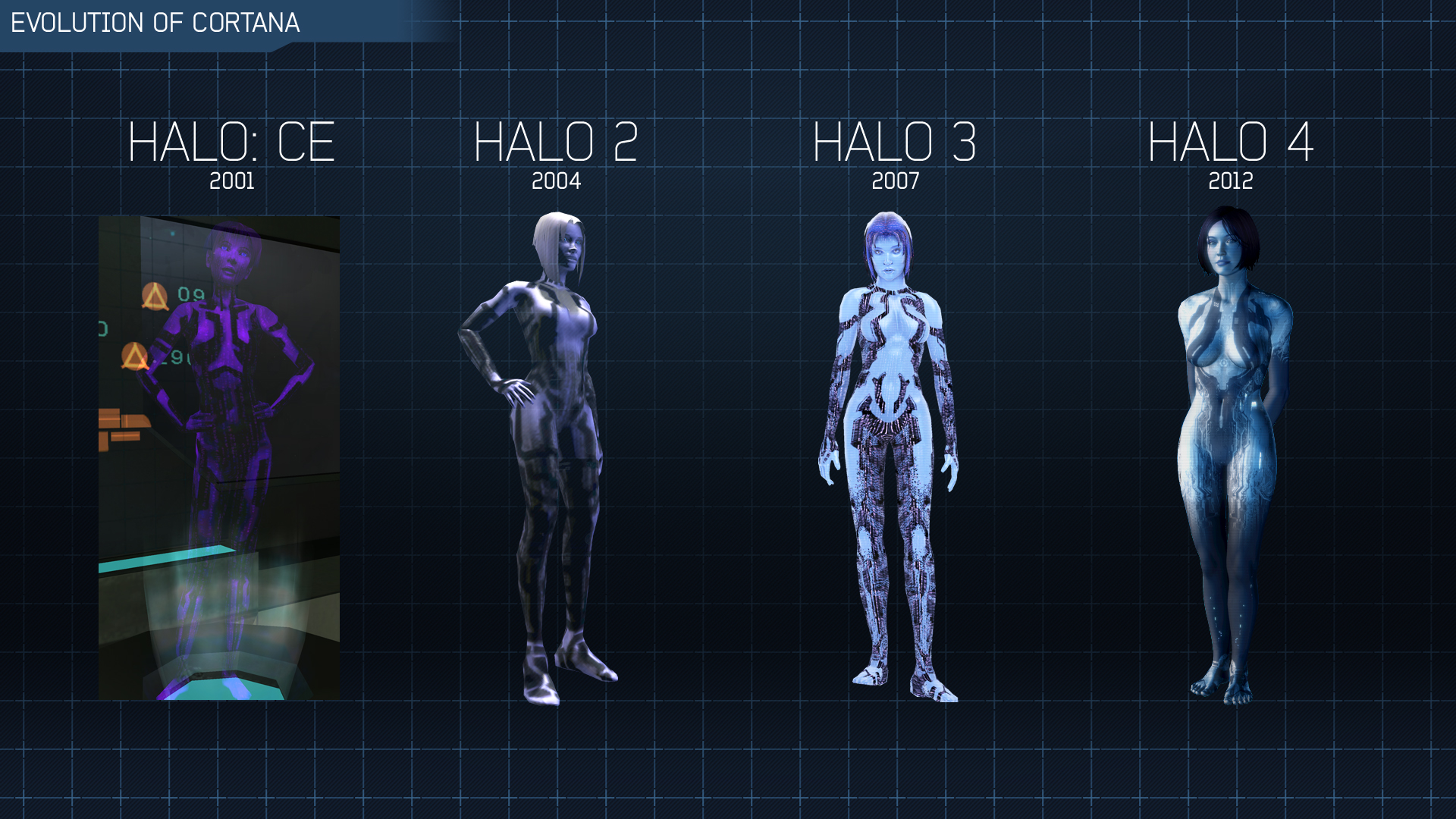
This picture is worth looking at if you want to see how Cortana became more sexualised when David Ellis and 343 Industries got their hands on Halo. A member of the NeoGAF forums also made a short and simple post about male sexualisation in the Metal Gear Solid series that didn't even mention naked Raiden. It's worth pointing to if anyone ever thinks Hideo Kojima only ever sexualises female characters.

As for David Ellis, I have no idea how anyone can be so hypocritical and yet so completely unaware, about both his own series' character designs and its "man-baby" influence. Speaking of which, it's disheartening to see just how many gamers, journalists and even developers casually throw out insults about immaturity towards people who have a different opinion to them.

I'm sorry for stating the obvious but there is nothing immature about people holding opinions different from your own, regardless of what the subject is. Insulting those people for having a different opinion, on the other hand, is very immature. That's something children do in playgrounds. If David Ellis really wants to talk about how "our industry should be better", I'd start with that.

Saturday, 31 August 2013

Is Jonathan McIntosh behind Anita Sarkeesian's views?

No. That's the short answer to that question.

In case you don't follow, one of Anita's critics conducted something of an investigation into her internet past, uncovering little details about her former website, former career and a look into a man called Jonathan McIntosh. Up until now, McIntosh's name didn't mean much other than being a name that showed up next to Anita's in the credits of the Tropes Vs Women in Games series with the credits "Produced By" and "Written By". Looking into his other sites more, there's more to it than that.

[It seems this video has since been removed.]

In short, McIntosh was already expressing strong feminist viewpoints while Anita was still selling PR services online, before her own viewpoints ever became known. She went as far as to use some of his statements about Lego in her own videos. They've apparently known each other for at least five years or so. Today, McIntosh still expresses the same viewpoints on Twitter, still works with Anita Sarkeesian and you can see if you scroll far enough down his Twitter page, uses very similar language as Anita when talking about gender issues, albeit more argumentative.

There was a lot more revealed on a Tumblr page than in that video above but I'm afraid I won't be linking to that page here; there's a lot that can be said about Anita Sarkeesian -- and trust me, before the end of this blog, I will be saying plenty -- but when you're posting links to her mother's website, you really have to call it a day.

So why do I think McIntosh isn't responsible for Anita's arguments? Well in short, it isn't conclusive. I absolutely think Anita was influenced by McIntosh's viewpoints but there's nothing to say that she didn't already have feminist views herself. It isn't like McIntosh had a background in feminism, Anita had a background in pyramid schemes and one fateful day, the two met and Feminist Frequency was born. Anita has also performed college talks by herself and I'm sure she wouldn't be going out there on her own if she didn't think she could handle any questions on gender issues tossed in her direction. Not that I think she's been asked any challenging questions, mind you, and the no-recording policy is obviously in place just in case she ever is.

I don't want it to sound like I'm being too harsh on anyone who is in full support of the information dug up on Anita. In fact, she could learn a lot from people so thorough and hey, for all we know, I could be wrong and McIntosh really could be pulling the strings. However, I think the desire to uncover information on the notoriously closed-off Anita Sarkeesian won out over the need to argue sensibly in this case.

It's also worth noting that Anita acknowledged the discovery on Twitter:


In a way, she has a point. Except for the victim blaming, which is complete twaddle. I'm not even sure who the "victim" is that she's describing here. Jonathan McIntosh? Herself?

Something I've noticed is that, even though I've said before that Anita doesn't respond to criticism, that's not quite true; she actually responds to criticism that's very easy to dismiss. For example, it's incredibly easy to dismiss the information that people dug up on her either because it doesn't appear to be relevant to her current videos -- I don't want to speculate on how much or how little of Anita's slightly shady "Success Secrets Of Self-Made Millionaires" course have influenced her current work, although the case is certainly building -- or because it really does sound like a conspiracy theory. Still, it certainly is the pot calling the kettle black when a person who blames everything on the patriarchy blames other people for concocting conspiracy theories ...

It isn't the first time Anita has responded to the "easy" criticism. Earlier this month, Doug Walker, who some of you may know as The Nostalgia Critic, posted a criticism of Anita on his Facebook page where he expressed his disappointment that Anita hadn't focused on any strong female characters yet. Now I'm happy that Doug, as a high-profile internet personality, is voicing his concerns over the Tropes Vs Women in Games series but I think most of us know that Anita will be devoting an episode of her series to positive female examples.

So naturally, this was one of the few criticisms that could easily be answered and dismissed:


And the only video response to the Damsel in Distress videos that Anita has made the wider audience aware of is MovieBob's reply, which was full of praise and dismissed the critics as trolls and abusers. It didn't break any new ground, in other words.

On-topic, it doesn't really matter if McIntosh is behind all of Anita's arguments. The fact that such biased and one-sided arguments are being given such recognition by the mainstream gaming media is the larger problem. In the last two weeks alone, she's been featured in Wired magazine and gave a talk at The Conference 2013 in Sweden. The online abuse crops up in what little of the Wired article is available to read online -- as does her example of Dinosaur Planet from the first Damsel In Distress video, with zero mention of the male playable character this time around -- and Anita's talk at The Conference revolved around it.

So yes, I know it's frustrating. We're talking about a person who has refused to face up to the majority of criticism aimed in her direction for the last year and a third, yet has been making the most of whatever publicity she can garner from the original abuse in that entire time. I know it's frustrating that mainstream gaming sites have never printed an article critical of Anita in the slightest (although the Wired article is the first in some time, so I guess no news is good news apart from that) or posted links or interviews with anyone who disagrees with her.

Although even with all that, we shouldn't go looking for a quick-fix to discredit Anita. You could say that bits and pieces of the information have merit but the fact is that educating people on why Anita's arguments are flawed, hypocritical and biased is always going to be necessary, if a pain in the neck more often than not. The thing is, as stupid as this sounds -- and writing it down now, it occurs to me that maybe I'm making a bigger deal out of this than is necessary -- I think that if we're not going to be listened to, we shouldn't be listened to for all the right reasons rather than the wrong ones.

Besides, having chatted to Anita's supporters online, we could uncover evidence that she's a killer robot from the future and they'd try to find a way to justify it. That's what they did after the video-stealing affair and the Randy Pitchford murder fanfic hypocrisy.

In other news, I got banned from the TV Tropes forum a while ago for talking about Anita Sarkeesian ... in a Feminist Frequency thread. Seriously, that was more or less the reason ("derailing" was the actual term used, in spite of the fact that I didn't start the derail and other members weren't talking about Feminist Frequency anyway). I wouldn't normally broadcast that here but I know I have at least one private message that I'm unable to answer. So I'm sorry to that person.

Also, I start my game development course at college in a little over a week. I've been playing around with Unity and the Unreal Development Kit and they're both terrifyingly daunting. I also don't get much information from the college, so I'm petrified that other students will be better than me even though I figured we'd all be at the same level. I'm hoping that's not the case.

Saturday, 24 August 2013

Reversing The Sexes

I've been really bored lately, even with Dragon's Crown. I played Gone Home recently too but thought that was a letdown. While I suspect there'll be something to write about following Gamescom, it's all very slow-going right now. Not that there's a shortage of gender issues concerning men in video games to write about but, it has to be said, it's so much easier to write about current issues and have links at my fingertips than it is to hunt down pictures and videos myself. Still, with nothing else to do, let's talk about reversing the sexes.

A few days ago, I read a comment on Youtube that said something along the lines of "reversing the sexes is  a standard defensive, kneejerk response to accusations of sexism in video games". I can't recall the video I saw it under (and after spending most of the day searching, can't find it either) but that statement left me scratching my head. Hypothetically reversing the sexes of a situation has always, to me at least, seemed like an easy and effective way to examine whether it's sexist or not. In fact, people like me who get involved in the bubble of gender issues can forget how easy it is to become bogged-down with complicated terms (like "patriarchy", "hypoagency", "rape culture" and other phrases that I like to steer clear of while writing this blog) so reversing the sexes is actually an incredibly useful, accessable tool to people who aren't as interested in gender issues; it's easy to do and doesn't overcomplicate any issues. So let's try a few.

There's a moment in Star Wars: Knights Of The Old Republic that always confused me; the player character meets a hunter on Tatooine who is stranded and needs the player's help. The wife of this hunter has rigged his hunting droids to explode if he takes another step. He had no choice but to wait for help, possibly dying of thirst in the process. The hunter isn't smart enough to figure out how to disarm them, so he asks the player character for help. It isn't the situation itself that's questionable -- even if it is the Star Wars equivalent of a bumbling husband being at the mercy of his more intelligent wife -- but if the player chose Bastila Shan, a female Jedi and something of a mentor to your own character, to accompany them, she has some eyebrow-raising things to say about the hunter's situation:


Bastila says, "I say leave him". The hunter replies with, "you're pretty heartless for such a pretty lady, you know?" Bastila responds, "I take it back. Let's congratulate his wife".

To me, this always seemed like a huge overreaction, especially for the supposedly good-natured Bastila. So much for "the Jedi do not believe in killing their prisoners", as she states earlier. Leaving prisoners to die of thirst, however, is apparently completely acceptable.

The uploader of that Youtube video comments that, as out-of-character as it may seem, it hints at Bastila having anger issues that would later be used to turn her to the dark side. Personally, I find it a bit hard to connect "irritation over clumsy come-ons" with "dark lord of the Sith". Not that I think the uploader is incorrect but it seems like an odd thing to foreshadow side-switching with.

So do you think it's sexist? I'm torn. The hunter isn't portrayed as a sympathetic character; using droids to hunt is a no-no in KOTOR and he has a habit of flirting with women in spite of being married. Plus, in spite of Bastila's comments, the player earns Light Side points for helping the hunter, so it doesn't seem like the game is encouraging punishing the hunter for his comments. On the other hand, it takes a lot to advocate murder (and congratulate the murderer) just because you're irritated over someone's pick-up lines.

Reverse the sexes and I think there's only one big difference; it sounds a lot more harsh to me to think of a male Jedi offering to congratulate an unintelligent woman's husband for plotting to murder her. It would come across as unbelievably petty for a male character to be so irritated by some (admittedly obnoxious) come-ons to advocate such a serious act of domestic violence. As we know, however, domestic violence against men isn't awarded the same seriousness as it is against women. Having said that, I'm still coming down on the side of "not sexist", solely because the player is rewarded with Light Side points for helping the hunter.

Helpfully, there are a few games that provide surprisingly accurate gender-flipped counterparts to each other in spite of the fact they're more-or-less unrelated. Take Heavenly Sword and Resident Evil 4 as an example:


And back when I wrote "The Violence Double Standard", I brought up a moment in Final Fantasy XIII when Lightning punched Snow -- her sister's boyfriend -- twice in the face for failing to keep her sister safe.


I went on to say, "according to Square-Enix, she was conceived as "a female version of Cloud", from Final Fantasy VII. I must've missed the version of Final Fantasy VII where Cloud clocks Tifa in the jaw angrily. Twice." It was only this month that I received a long reply in the comments that ended with a link to this video from Final Fantasy VII, where Cloud attacks Aeris in a moment of stress. Skip to 14:40:


Comparing these four moments is a good way to highlight the differences when violence is portrayed against colleagues in games. They are, more or less, gender-flipped versions of each other.

The big difference, first of all, is that the men aren't in control of their actions when they attack the women. In Resident Evil 4, Leon is being controlled by the parasite inside his body and in Final Fantasy VII, Cloud's stress causes him to have an out-of-body experience; literally, a ghostly image of Cloud appears that the player controls while the corporeal Cloud attacks Aeris and the player is unable to stop him in any way. In contrast to the two of them, both Nariko in Heavenly Sword and Lightning in Final Fantasy XIII are well aware that they're harming their own colleagues. So it's acceptable for female characters to hit male ones (which is shocking, I know) but for male ones to hit female ones requires a trance of some kind.

It's also worth noting the reaction to each one. Nariko's choking of her fellow clanmember is broken up quickly but there isn't any concern shown for the man. Lightning punching Snow is practically ignored by their fellow teammates. Certainly, no concern is shown for Snow. On the other hand, Ada reacts to being choked by kneeing Leon in the ribs and stabbing him in the thigh to break him out of his trance. He ends up thanking her for this. So no matter who is being choked and who is doing the choking, violence against the male character ends up being acceptable in both situations. In Final Fantasy VII's case, the remaining party member (Barret, in the video above) quickly rushes in to knock Cloud out and prevent him from hurting Aeris any further.

It seems like trances are an easy way to have violence stay reasonably inoffensive; reverse the sexes of either the Leon or Cloud attacks and they're practically the same. The hero doesn't come across as any worse because of the attack, regardless of his/her sex or the sex of the victim. Part of the reason for that is because the attack isn't the important part, whereas the trance is; both Leon and Cloud attack women because it's such an extreme action, it shows how far their sanity is slipping. Women attacking male characters on their own side is just ... a quality. Game audiences aren't supposed to think anything of it, except perhaps "I'm glad that guy got taught a lesson". As a result, reversing the sexes of the Heavenly Sword and Final Fantasy XIII attacks does make things seem worse; a male character in complete control of his faculties choking or punching a woman who refuses to fight back is just asking to be called out for its misogyny.

I suspect its moments like these -- strikes against male characters by female ones -- that make up the majority of examples that don't really stand out until we reverse the sexes. They're so quickly dismissed when they're against a male character that either we ignore them or we're supposed to ignore them. Take Bioshock Infinite. It's a very basic example but Elizabeth strikes Booker DeWitt in the face with a wrench that isn't brought up again after it happens. It knocks him out-cold, giving Elizabeth enough time to flee but Booker still doesn't have a word to say about it.


I don't know if the gaming public is prepared to see a male character doing this to a woman, although I think it's possible to give gamers a bit more credit. Take the Mass Effect series as an example. It's possible for the main character, Commander Shepard, to punch a female reporter attempting to smear his/her (although for this example, let's go with "him") reputation in all three games. Sure, it's not the same thing, in quite a few significant ways; the reporter isn't on Shepard's side, punching her is a "Renegade" option and, as previously mentioned, Shepard can be either male or female. Each of those points lessens the impact and controversy of a male character punching a woman. Even so, there doesn't seem to have been any backlash at all against the Mass Effect series for this. In fact, it's been praised because the reporter is intentionally unlikeable. Who knows if a male character intentionally punching, choking or bludgeoning a stubborn (like Snow) or sexist (like the clanmember) woman on their side could be as accepted as women doing it to men is now (irritatingly)?

As always, feel free to leave a comment or send me an e-mail at themalesofgames@gmail.com.