Three days ago, a new character was announced for Tekken 7. If you're familiar with Japanese idols, the new character, Lucky Chloe, appears to draw a lot of inspiration from them; her fun, unique outfit, bubbly personality and slightly forced use of English phrases ("Engrish") is somewhat reminiscent of idol stereotypes.
She looks like a fun character. Her moveset is entertaining to watch and, in my opinion, her outfit and personality both have a ton of charm.
Yet at the moment, there's a rumour going around that due to fan complaints, Lucky Chloe isn't going to be released in the U.S. Only Europe and Asia.
Because this is a rumour, it may be debunked in a few days and this will all become a moot point. For the time being though, it's started a conversation.
You can read TechRaptor's article on this story but basically, when the character trailer was released, there was a backlash against the character on both Youtube -- read the comments of the video above -- as well as NeoGAF and even directed at the games director, Katsuhiro Harada, on Twitter. I'll come to why this backlash occurred later on but Harada's response is the issue; responding to people bothering him on Twitter, he made the claim that Lucky Chloe would be exclusive to Europe and Asia.
I should say that I'm in Europe so even if this is true, it shouldn't affect me. Having said that, I feel bad for U.S. Tekken fans who aren't getting a character because of a vocal minority of complainers.
The complaints themselves were bafflingly varied. Some said that Lucky Chloe didn't fit in with the rest of Tekken's cast, which is ridiculous. As a long-time Tekken fan, Lucky Chloe wouldn't even be in my top ten ridiculous characters. From fighting bears, kangaroos and dinosaurs to robot girls and old men doing somersaults, Tekken's cast has always been more ludicrous than serious. The only reason we don't consider characters like Yoshimitsu and Devil more ridiculous is because they look cool.
For people making the claim that she doesn't fit in, Tekken has had cutesy, anime-esque female characters since 3. Just look at Ling Xiaoyu's Tekken 3 ending. The central Mishima family storyline and conflict is like something straight out of an anime. People acting like Lucky Chloe is a step too far seem to be making excuses. Being too "moe" or fanservice-y is not new to the series at all.
Those aren't the most worrying complaints though. Read this NeoGAF post:
Left-click to enlarge.
Once again, people have been complaining about how a female character in a game is dressed. In this case, this poster went as far as say she was only included to appeal to fetishists (specifically singling out Harada himself and claiming that's the reason for Lucky Chloe's inclusion). There's also a ton of cultural insensitivity towards Japan and Japanese gamers.
The reason I'm writing about this at all is because this is the same type of entitled attitude that we see from modern game critics. This demanding nature is becoming frighteningly common. I apologise for bringing up Anita Sarkeesian but in her case, she directed her ire at Toru Iwatani, creator of Pac-Man; in her "Ms. Male Character" video, Sarkeesian brought up Iwatani's desire to appeal to women by making a game based around food. In spite of the fact that this worked -- likely bringing more women into gaming than Anita herself ever will -- Anita referred to Iwatani's "regressive personal or cultural notions about women". Basically, saying either he or Japan as a whole had negative views about women. So either he's sexist or the entire nation is. Once again, cultural insensitivity (possibly outright xenophobia).
Another example that I think is most comparable to the Tekken 7 situation is when Kotaku's Jason Schreier lambasted Vanillaware's George Kamitani over the design of the Sorceress in Dragon's Crown. He referred to him as "a fourteen-year-old boy" and, in a follow-up article, laid the entirety of sexism towards women in the games industry at Kamitani's feet (including such issues as booth babes, yet Schreier himself had no problem dismissing male con-goers as "sweaty male attendees" and ranting about "male power fantasies"). I went over this at the time but there is no reason or excuse for insulting a developer just because you disagree with his creative direction. Again, as sexualisation is less of an issue in Japan, insulting him just because he's more used to drawing what he wants instead of what you want reeks of cultural insensitivity.
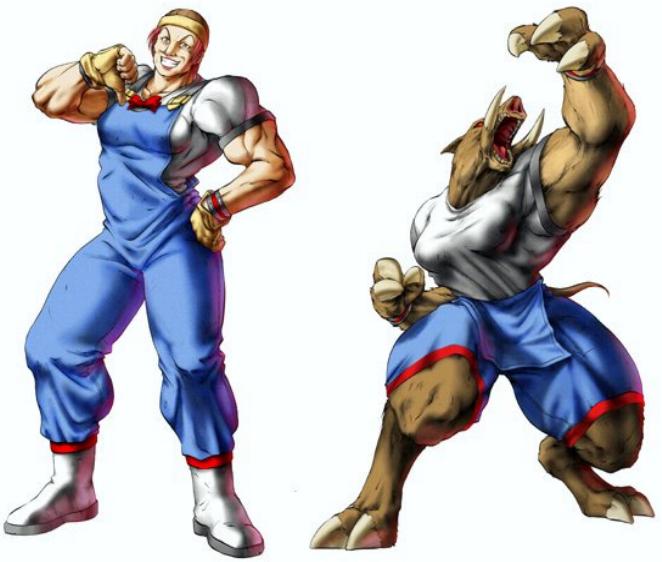
The reason I draw parallels between the situation with Harada and the Lucky Chloe critics is because after Schreier complained, Kamitani responded by posting a picture of three of the Dragon's Crown Dwarf's palette-swaps in a possibly-suggestive pose (it's a long story but I cover it in the previous paragraph's link. Schreier added to his insensitivity by branding Kamitani homophobic).
In this case, Harada has responded too and this is where I think Harada may just be playing a joke on the haters. His joke about giving the U.S. audience a "well-muscled skinhead" seems like the same kind of jab as Kamitani's towards Schreier, so don't be surprised if Lucky Chloe is included. On the other hand, his comment about the characters being region-exclusive seems sincere. It's hard to say at this point.
The point is that in the face of this kind of dogmatic insensitivity and outright bigotry towards an entire nation over something as ridiculous a female video game character that we've seen a total of 46 seconds of, who could blame Harada if he decided to take his ball and go home? He'd have every right to. In the face of insulting, entitled critics who think every game developer owes them a favour, why shouldn't he say "screw it" and do as he wants, rather than what they want? It isn't like Phil Fish, who had a Twitter blow-up every two weeks and supposedly cancelled projects left and right in the face of minor criticism, insulting sexual assault victims along the way. This is like a parent teaching his spoiled children some manners using the "'I want' never gets" phrase.
Honestly, what did the critics even think would happen? Did they believe that if they complained enough, Harada would change Lucky Chloe to suit them? Look at the entitlement on one of the comments Harada responded to: "Please add an option to delete any character you do not want to play against in Arcade battle". Did that person really expect that to happen?
I have every sympathy for American Tekken fans who wanted to play a complete version of Tekken 7 without having to import but at the same time, if this is true, it would be a good wake-up call to an entitled crowd who've never been told "no" in their lives. The same people who preach about not judging women on their attires or attitudes in real life are the same ones who love to dictate what women wear and how they act in fiction. I find that unacceptable.
UPDATE: As I was writing this, TechRaptor added a couple of updates in the article above. Still nothing concrete but it seems likely that Harada was referring only to the arcade versions of Tekken 7, rather than the console versions. Fingers crossed.
-----
I didn't update last month, which I'd like to apologise for. Very hectic schedule but on the plus side, I'm now decent at using Adobe Flash. Trying to figure out if I could use it for this blog, somehow. If I ever make a "gender issues in gaming"-related game, I'll post it here. Unlikely though.
I have to give a big, big thank you to Milo Yiannopoulos for linking to this blog in his article "An Open Letter to Bloomberg's Sheelah Kolhatkar, on the Delicate Matter of Anita Sarkeesian" on Breitbart. I've spoken to Milo a few times on Twitter -- although I doubt he remembered me, so him linking to this blog is just a coincidence -- and he's a nice guy. Give his article a read. It's excellent and very comprehensive. At this stage, why anyone continues to give Anita the time of day is a mystery to me.
Also, thank you to the influx of visitors who've stopped by over the past month due to wanting to learn more about Jonathan McIntosh. I've only written about McIntosh a couple of times because I've never thought of him as being especially significant. However, people have become more aware of him because of his penchant for posting unusual, often-nonsensical things on Twitter (such as "we need to see some games that are not fun" because he thinks that's the only way they'll be able to have as much depth and artistic merit as other forms of entertainment). More recently, he's become known for appearing in Feminist Frequency's "25 Invisible Benefits of Gaming While Male" video, which I haven't watched but I did post a brief rebuttal to it back when McIntosh wrote it as an article.
I don't have much to add, although I'm finding it very telling that many of the items they rattled off were less about describing "gaming while male" and more involved with talking about women's experiences. McIntosh and the others in the video seemed content to speak on behalf of female gamers and tell the world what they experience. TechRaptor have another good article on this where the female contributors to the site (and other female gamers) leave their responses to the video. Watch the Youtube videos posted in the comments section too. It's eye-opening stuff.
As time has gone on, it's becoming more and more clear the social justice method of being "pro-woman" makes zero sense. They have zero interest in listening to the voices of women who say there's nothing wrong with the games industry or the gaming community. Women like Christine Phelan (Valve) and Gabrielle Toledano (EA) both work in the games industry and say the industry is nothing but welcoming towards women. Likewise, female gamers speak up regularly about feeling nothing but welcomed into gaming communities. I'm currently enrolled on a games design course and can confirm that both are the case.
So why is it that the group considered "pro-woman" are the ones engaging in scaremongering? Telling women there's nothing but horrible portrayals, sexist male "virgin basement-dwellers" to abuse them and an industry that wants to drive them out? Likewise, consider the opposite; why is it that those of us who say "these female characters are great, female developers are awesome and gaming is a great pasttime for people no matter their physical characteristics" are considered "anti-woman"? Why is driving women out of the industry considered "progressive" by these people? Because we don't stomp our feet and throw tantrums about game content?
It's too late now but I was going to write about Polygon's Bayonetta 2 review, talking about this exact thing. A great game, featuring a strong female character, designed by a woman and appreciated by women on the development team ... yet a male Polygon reviewer dismisses her as "sexualised". Apparently, strong female characters and the hard work of women is irrelevant if a guy playing it feels offended and needs to preach about how hard women have it.
Akiko Kuroda, Producer on Bayonetta 2.
Leave a comment below, follow me @TheMalesOfGames on Twitter or send an e-mail to themalesofgames@gmail.com.
Even though my pageviews always spike whenever I write about Anita Sarkeesian's videos, I've decided to follow in the footsteps of other Feminist Frequency critics and not watch the video. The fact is that at this stage, even if I did watch it, I would just be making the same arguments that I have for her previous four videos. Lack of context when providing examples. Cherry-picking examples. Not acknowledging male examples of the same issue, only focusing on women. Claiming something without evidence -- damsels in distress being considered property, for example -- and making further arguments based on that assumption.
However, I would like to thank beste36 and gwadahunter2222 for their comments about Anita's latest video on my last blog. It's interesting to hear that Anita managed to offend sex workers and supporters of sex workers by referring to them as "prostituted women" (while giving male sex workers the courtesy of being referred to as "gigolos"). This criticism isn't specific to Feminist Frequency but anti-feminists often criticise feminism for portraying women as being unequal to men; saying "women need help, such as specific programs to get into STEM fields" while someone who considered men and women equal would say "women make their own choices to stay out of STEM fields and are more than capable of making their own decisions to enter or not".
This is what Anita did by using the term "prostituted women" instead of "sex workers". She deprived women of their agency and portrayed them as helpless objects rather than capable adults. The thing is, Anita does this a lot -- before her Damsels in Distress videos, I had always heard "objectification" used in conjunction with sexualisation; Anita was the first person I'd heard posit the theory that female characters are basically objects to be taken and "won" back, rather than fully-rounded characters that the protagonist cares about because he/she does not want to see them harmed -- but she picked the wrong industry to do it with this time.
The reasons why are clear; Anita is a sex-negative feminist, having criticised the "SlutWalk" marches in Toronto and describing herself as feeling alienated from feminism for embracing the word "slut". She's also been criticised by sex-positive feminists on Youtube. The problem, which Anita seems to have missed, is that sex workers have received an extremely bad rap over the years, with the struggle to have sex work recognised as a legitimate occupation, as a legal occupation, the problems with higher rates of violence in such a career, the problems with non-consensual sex (rape) being recognised by law when you're in a career that provides consensual sex to clients and just the general stigma of earning money through sex work in the first place. For that matter, an issue discussed in feminist circles is how female sexuality is often not recognised, supported or taken seriously (which I would argue is not the case), with straight male sexuality being "the norm".
With all this in mind, it's no wonder there was a backlash against a prominent feminist like Anita Sarkeesian portraying sex workers as the very objects and victims they fight against being stereotyped and stigmatised as. Although I'm afraid I have some bad news for everyone who is annoyed with Anita for referring to sex workers as "prostituted women"; your criticism will never be acknowledged by Anita, in the same way that she has not responded to any criticism directed at her since she's leapt into the spotlight. You're now part of the group that goes completely ignored by Anita unless she needs a reason to talk about how abusive people are being.
The other thing I learned about Anita's latest video from my last blog's comments section was that she made the following statement:
"[NPC women's] status as disposable objects is reinforced by the fact
that in most games discarded bodies will simply vanish into thin air a
short time after being killed."
Yeah.
There are some occasions when watching the Tropes Vs Women series when I haven't played a certain game (this happened a lot with Mario and Legend of Zelda games) and need to read some other people's explanations to know how and why Anita is incorrect. However, this is one of those things that everyone has seen in games and everyone knows is not specific to women. It is the one thing in all of Anita's videos that every single person watching can point at and say, "I know that's complete nonsense". To say that disappearing bodies reinforces women's status as disposable objects is verifiably, demonstrably false by doing nothing more than observing the same thing happening to men. Unless Anita has magically come across a game where it only happens to women.
Weirdly, this is probably one of the few occasions where even non-gamers can understand the problem; understanding why bodies disappear in games is very, very simple. I've actually just finished writing a couple of essays detailing, amongst other things, why this happens but here's the TL;DR version, only three sentences long (and I'll explain it in greater detail if anyone cares that much): you know how, at E3, many developers were pushing the fact that their games will run in "1080p, 60 frames per second (fps)"? Well, if there are a lot of things on-screen at once, that can slow the game down. Making bodies disappear helps the game to run smoother and reach that 60fps framerate because there's less stuff on the screen.
Oh yeah, and it happens to both men and women. Okay, that was a fourth sentence.
-----
Without a new Tropes Vs Women video to watch, I decided to watch another video that I've been putting off for about a month, ever since I discovered it existed. At the end of March, I wrote about a talk at the Game Developers Conference called "Fewer Tifas or More Sephiroths: Male Sexualisation in Games" by Michelle Clough. At the time, I don't believe the video of Clough's presentation was online but it is now and I believe it has been for a while. If you're not interested in watching it, you can read Michelle Clough's notes for the speech here -- sorry, no transcript as far as I know -- and the slideshow is posted on its own here. If you're just interested in skimming through it, that could be the best option.
Back in March, I assumed the best of Clough's talk and gave her the benefit of the doubt. After watching it? Well, if I had to sum it up in a word, that word would be "entitled".
Looking back at the first blog post I wrote about this, prior to having seen the presentation, a lot of my initial assumptions about the talk haven't changed (the "male power fantasy" argument -- although more frequently referred to as "male gaze" here, "power fantasy" does get name-checked at the end -- the idea that Clough's talk didn't rise much higher than "I want more of these character types in games just because I like 'em" and I still object to the idea that androgynous male characters are rare). However, my position on quite a few things have changed after seeing the talk and, I'm disappointed to say that most of them have changed for the worse.
There were some things I liked about the talk, albeit only a couple. I liked the way Clough compared various types of male heroes from different cultures to their modern counterparts. I felt as if that dug a little deeper than most. I also think Clough gave a good explanation of "male gaze", being more comprehensive and logical than other people I've heard discuss the issue. Having said that, I ended up disliking Clough's take on both for the simple reason that I wasn't convinced by either one.
When discussing European examples of gallant male heroes, for example, Clough compared the dapper Mr. Darcy from Pride & Prejudice to the suave and sophisticated James Bond as an example of a male character of a similar archetype in the present day. The thing is though, this one example isn't especially representative of European male heroes as a whole and even Bond himself has undergone many reinventions over the years. Plus, I found it interesting that Pierce Brosnan was the Bond chosen for Clough's example. Speaking as a British citizen, the biggest "fangirling" (for lack of a better term) over Bond in recent memory was Daniel Craig's scene in Casino Royale where he emerges from the sea in a pair of tight swimming trunks. Yet Craig's Bond is definitely in the running for the most rugged, placing him further from Mr. Darcy and closer to action heroes from American culture. However, Clough doesn't expand beyond male characters from Westerns, even though there are plenty of male characters from modern films -- or at least the eighties -- who fit the mould. This could be due to a lack of time, as Clough went on to rush her talk towards the end, but it still wasn't as comprehensive as it could be.
I'd also like to say that when it comes to film, the UK's male protagonists again stray from the romanticised and elegant image of Mr. Darcy that Clough displayed during the presentation; if there's one genre that UK film has excelled in over the last few decades, it's the crime genre. It's also the genre that Bob Hoskins, Ray Winstone and Jason Statham got their starts in, thanks largely to the presence of "celebrity criminals" in the UK such as the Kray Twins. Could they be dapper at times? Sure. Were they even close to Mr. Darcy? Far from it. I understand that Clough was discussing European courtly narratives as a whole but I'm failing to see the parallel between those and male characters in the present day. Bond (and Mr. Darcy) could be the exceptions rather than the rules. It's only a minor thing and isn't actually about any sexualised male characters in games but it bothered me slightly.
As for not being convinced by Clough's explanation of male gaze, it's the same criticism that I had with some of Anita Sarkeesian's arguments; I have to take Clough's word for it being the case but I don't see a guarantee that it (A) exists, (B) is the reason why certain "rugged" male characters are designed the way they are and (C) is the reason why certain situations, either involving sexualised women, or "awkward or comedic" non-sexualised naked men exist. And once again, I have to take someone else's word for it that I want to be these rugged male characters and any attraction straight women or gay men may have to them is accidental (Clough's words).
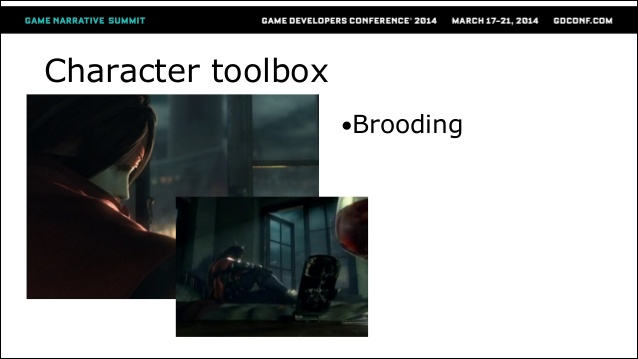
This is just my interpretation but what bothered me about this -- and the talk in general -- is the undertone that Clough's opinions and love of bishonen characters is "right" and to choose to create characters that don't appeal to her is "wrong". When you have sections called "who's doing it right?", it gives the impression that there's only one "correct" way of making sexually-appealing male characters. The same goes for when dimissing Max Payne as a brooding character done poorly while praising Final Fantasy VII's Vincent Valentine as a brooding character done well, while I would say the two characters are the other way around (although to Clough's credit she did use an image of Max Payne 3, which I've never played ... although after watching the first ten minutes on Youtube, that particular incarnation was one I could've done without seeing. What happened to all of Max's metaphors and similes? What happened to him making his peace with his family's deaths at the end of Max Payne 2?).
The problem with this assertion is that, obviously, there are women who find rugged male characters attractive and plenty of male gamers who don't relate to them at all. The opposite can obviously apply to bishonen characters, with not all female gamers being as enamored of them as Clough and it goes without saying that men can play as them without thinking twice about it. A female commenter on my last blog about Clough's talk actually said, "I never found the Sephiroth or Marluxia type of bishounen appealing.
Like maybe when I was 14." She also mentioned stumbling across some Call Of Duty yaoi once. If you have time, go to Google or DeviantArt and search for "call of duty yaoi". It exists!
It should be clear by now that there's no one big problem I had with Michelle Clough's presentation but a lot of small ones. For example, in my previous blog, I objected to Clough thinking that androgynous male characters were rare. Now that I've seen it, I've learned that the issue wasn't with sexualised being rare but them not being in any "core" games. To me, this led to a very muddled argument; firstly, Clough praised characters such as Thane (and others) in Mass Effect, which I would describe as a "core game". Secondly, she would go on to say "make sure sexualised characters are right for your game", before showing a mock-up of a Call Of Duty cover with a bunch of shirtless, muscular guys on the box, indicating an example of a game where it wouldn't be appropriate. I understand that Call Of Duty isn't the only "core" game out there but I would've been interested in hearing some suggestions from Clough. Thirdly, Final Fantasy VII was referred back to many times throughout the talk but the thing is ... the Final Fantasy series is still out there and still features androgynous characters. It's not exactly the fault of the developer that it's no longer the "core" series that it once was, so even though Clough is correct in that respect, it's also not through lack of trying that Final Fantasy isn't as popular as it used to be (or any game series for that matter; I'm sure most developers would give an arm and a leg for their games to be considered a "core" series like CoD or Assassin's Creed). So what point is being made by mentioning the lack of "core" games featuring sexualised male characters? Is someone to blame? Is it an example of how unfairly female characters have it in games, just because Square-Enix haven't been able to achieve the same success that they used to?
I don't want to ramble too much about this, particularly since it turns out I have as many criticisms as I do with the average Anita Sarkeesian video, but one final thing I noticed that disappointed me was how the slides on sexualised male characters were talked about with a light-hearted attitude while the rare occasions when sexualised female characters were the topic of conversation, Clough adopted a more serious tone; slides about Male Gaze,why sexualisation can be good while objectification is bad (focusing entirely on female characters, of course), comparing a male Starcraft character to a female one and comparing a shot of Jacob's buttocks in Mass Effect 2 to one of Miranda's were all treated as serious issues. Talking about male video game characters was the opportunity for Clough to crack some jokes and get a few chuckles from the audience.
My issue with that wasn't that jokes were being made at the expense of male characters. Having a funny presentation isn't the problem. It doesn't even bother me that the first talk about sexualised male characters ever wasn't taken seriously. Hell, you try condensing a subject down into twenty-five minutes when it's never been spoken about in such a prominent venue. It's not enough time to cover everything.
What bothers me is that it was purely from a feminist point-of-view. By that, I mean that Clough's stance wasn't one we haven't seen before. The idea of sexualised men was still a joke, in spite of Clough finding them appealing. In fact, it was considered a good thing, with Clough believing sexualised male characters could attract more women and gay men to gaming. Meanwhile, Clough reserved a modicum of seriousness when talking about female characters and I'd say the only time she mentioned them positively was in passing, when discussing how sexualised characters had to have traits other than their attractive appearance. Even then, it was glossed over, focusing on both Sephiroth and Tifa from Final Fantasy VII, rather than just Tifa.
I don't want it to seem like I'm against Clough having a feminist point-of-view just because it's a feminist point-of-view and give the impression that I'm foaming at the mouth with rage over it. I dislike it because it's a standpoint that seems dead-set against the idea that men can be portrayed negatively. One perfect example of it is when Michelle Clough mentions that when it comes to male nudity in games, it is always portrayed as "awkward or comedic". Hey, you'll get no argument on that from me. Where Clough and I differ, however, is where Clough sees the prominence of comedic nude male characters in games as being unequal treatment for women, as there were plenty of sexualised female characters but a lack of male ones, I see it as being unfair treatment of men.
This doesn't apply as much in games as it does in films, television shows and even real life but it's very rare for male sexuality to be treated as anything close to desirable, including in shows aimed at women; men are constantly portrayed as bumbling comedy figures when it comes to romance, someone for the down-to-earth female characters to roll their eyes at. Women are always portrayed as the desirable, effortlessly sexy party who useless male characters want to (and fail to) be with. Take a look at this advert from Wowcher in the UK for an example (which also portrays violence against men as comedy):
Or how about this advert for "Mullerlight Greek Style Luscious Lemon" yoghurt, which does show a male character as being desirable ... before he stumbles and the female main character (and narrator) laughs at his stupidity? I apologise but for some reason, the video isn't showing up when I try to embed it. Here's the link:
Then there's Harpic White & Shine, a lavatory cleaner. In this advert, a suave man in a white suit walks through some mist while words like "Dazzling", "Brilliant" and "Wow!" appear on the screen ... then he looks dejected as it turns out the words were referring to the lavatory cleaner and not him:
The reason I'm showing all of these television commercials is because Clough used a quote to make it seem as if the only reason why male sexuality is used as comedy is because "man is reluctant to gaze at his exhibitionist like". It's because of Male Gaze, in other words. However, these television commercials are all aimed at women; its "heroes" are female, the voiceover artists are female and hapless male figures are the butt of the joke. None of these adverts have anything to do with Male Gaze, so why does Clough believe that must be the case in games?
The funny thing is that treating male sexuality as comedy is actually the least offensive way of expressing a lack of desirability for men. When male sexuality is portrayed as being disgusting or even dangerous, it stops being comedy and actually creeps into prejudice; we end up with campaigns like "teach men not to rape", which is about as sexist as it gets and I'm not willing to go into it any further than that. This blog's long enough.
Finally, and this is a bit of a nitpick, but using Jin Kazama from Tekken as an example of a "power fantasy" when it comes to shirtless scenes? Literally any other shirtless Tekken character would've been a better option for Clough to pick if she wanted to make the "power fantasy" argument. Aside from Hwoarang, I'd say Jin fits Clough's criteria for a sexualised male character better than anyone else on the roster. He even has the same broodiness that Clough likes, which Namco Bandai plays up when Jin is the object of Ling Xiaoyu's affections:
Even though that ending turns out to be a dream, it's not that far from Jin's regular attitude.
I also have to point out something that I mentioned all the way back in September 2012; that Jin is one of several characters created to be a younger, better-looking successor to an existing character.
So like I said, it's nitpicking but I don't agree that Jin is close to a male power fantasy at all, particularly due to the standards that are usually used by feminists (Kratos and Marcus Fenix, for example).
Overall, and to summarise my problem with Michelle Clough's talk, in my previous blog on the presentation I gave her the benefit of the doubt because the topic of men being sexualised was never acknowledged. Now that I've watched the talk, I don't feel like it offered anything new at all. It didn't offer another side to the issue of sexualised characters, it just bolstered the position of the side that already controls the conversation on sexualisation (and other gender issues). And in spite of the fact that Clough was strapped for time, I have an unpleasant feeling that even if the presentation was twice as long, we wouldn't see sexualised male characters taken seriously (except to point out how good it is for straight women and gay men).
... The presentation was still more watchable than Tropes Vs Women though ...
-----
In other news, I finally took the plunge and joined Twitter. You can see my feed in the sidebar and I'm always happy for more followers.
You can also leave comments below or send me an e-mail at themalesofgames@gmail.com.
Even though I spend a lot of my time agonising over the treatment and portrayal of male characters in video games, they're not the only ones who get the short end of the stick. There are lots of very strong, interesting and intelligent female characters in games. Lots of them. However, they're often dismissed because of the way they look, the way they're dressed or simply because they're not in a game made by Valve.
By now, I'm sure you know that Aliens: Colonial Marines wasn't well-received. Well, last week on Gamespot, writer Carolyn Petit posted an article of hers, "Fear of a Woman Warrior", that, among other things, criticised Aliens: Colonial Marines for adding female multiplayer characters late in development:
"First, there's the ill-fated Aliens: Colonial Marines. A Reddit post, picked up and reported on by Kotaku,
indicated that female marines, rather than being part of the game from
the earliest stages of development, were a last-minute feature request.
Let that sink in for a second. Female marines were a feature request, a
special addition, a change made to the game at the last minute. This is
difficult for me to wrap my head around. During Colonial Marines'
development, people working on the game declared their abiding reverence
for the film Aliens. It's hard for me to believe in this
reverence, not just because the game ultimately failed to deliver an
experience worthy of the Aliens name on any level, but because any
reasonable understanding and appreciation of what made Aliens a
great film acknowledges the important role of women in it. Women are not
hard to come by in the film. In fact, they're pretty damn important.
One might even say that they're the equals of their male counterparts.
Crazy, I know! The notion of a vision of the Aliens universe without
women in it seems like about as major a betrayal of the source material
as I can imagine.
And yet, somehow, for years and years, development on Aliens: Colonial
Marines progressed, apparently without anyone stopping to say, 'Hey. You
know how there are women in Aliens? Remember Vasquez, the
tough-as-nails marine? Remember Ferro, the dropship pilot who says, "We're in the pipe, five by five"? Remember how Sigourney Weaver was the
star of all the Alien movies? Well, I just had this crazy thought. What
if we put some women…in the game?!'
Women should not be an afterthought in an Aliens game."
The funny thing about this is that I already knew female marines were added to Aliens: Colonial Marines late in development and not because of a Reddit post, which was then reported on Kotaku. I knew about it because last July, Gamespot posted news about the fan petition to include female multiplayer characters in Aliens: CM. So how on earth did it take Carolyn this long and another website to learn about it when it was posted on her very own site, eight months ago?
That's besides the point though. For all of the failings of Gearbox Software, the developer of Aliens: Colonial Marines, adding female characters is not one of them. Ideally, yes, they would've had enough intelligence to realise the significance of women in the Alien series and added them early on, but they didn't. When it came to their attention that they'd dropped the ball,
however, they went out of their way to add them. And yet even that
effort is criticised in articles like this one. Why? They should be praised for listening to the fans and correcting their mistake, not criticised for the original error.
It isn't just the female characters in Aliens: Colonial Marines that suffer. Appearance is one of the major deciding factors for the critics about whether a female character is good or bad. In Carolyn's article, she praises Lara Croft and Samus for being two examples of female characters from highly successful franchises, only to dismiss them for their sex appeal just two paragraphs later. Or at least their sex appeal being used as a reward players/to advertise the game (which I find highly hypocritical, considering Gamespot has adverts for affiliate sites at the foot of the article, advertising features like "The 20 Hottest Daughters From The Sports World" and "Hottest WAG of Each NFL Team". Apparently, criticising female video game characters for their sex appeal is fine but Gamespot'll be damned if it's going to refuse to objectify real women to gain money from referrals!).
Lara Croft is a particularly strong example of this, much like the Aliens: Colonial Marines one. This is a character who, for years, has been held up as a (if not the) prime example of objectification in video games. In some circles, her appearance would be more important than the games she starred in. So when Crystal Dynamic made the effort to revamp her appearance, giving her a more realistic figure, it would presumably be well-received, wouldn't it? Not the case, at least for Tomb Raider. After the game was displayed at E3, she was immediately faced with criticisms such as "she suffers sexual assault" and "she makes orgasm noises when hurt". Neither of which are true, of course; it's the critics seeing what they want to see. It was the same with Aliens: Colonial Marines; if Gearbox Software leave out female marines, they're blamed for leaving out female
marines. If they include female marines, they're blamed for not having them in
the first place.
What feminist critics of the gaming industry, such as Carolyn Petit, are doing is creating a no-win situation. I don't want to spend too much longer on Carolyn's article but she goes on to write about a man I'm not familiar with called Ryan Creighton:
"In a blog entry
posted on Gamasutra last month, Ryan Creighton, a designer on
Spellirium, confessed that his game is dominated by white male
characters 'for fear of someone calling me out for my non-white or
non-male character being stereotypical, offensive, or - at the absolute
worst - outright racist or sexist.'
"The world of writing and designing games is tremendously male-dominated;
sadly, this absurd fear of creating complex, human women who star in
games is not limited to Creighton, but is a widespread problem."
Carolyn criticises Ryan Creighton's decision to leave out non-white and non-male characters, calling it "an absurd fear" but given that she just wrote an entire article about the pitfalls of creating female characters -- criticising some of the examples that fall into them -- how is it absurd in the slightest? At some point, game developers like Ryan Creighton just ask "why
bother?" and don't add female characters at all because women like
Carolyn Petit have created a no-win situation. And we're going to see a
lot more attitudes like Ryan Creighton's in the future if feminist gamers
don't start appreciating that the entire industry is bending over
backwards to make them feel welcome and all they're doing is throwing it back in the industry's face. They're biting the hand that feeds them, so developers will naturally start doing what's sensible and avoid female characters altogether because they don't want to navigate the minefield of getting female characters "right". As a result, female characters are the ones who are going to suffer, as feminist critics can't appreciate the good qualities of the characters that they're given.
That's enough about the article but certainly not the end of the good female characters. Let's talk about Soul Calibur because there's no shortage of good female characters there. Yet nobody ever praises Talim, Xianghua, Seung Mina, Hilde, Amy, Cassandra and (at a push) Tira because they're too busy criticising the breast sizes of Ivy, Taki and Sophitia. Three great characters, all dismissed by feminist critics because of the
way they look. It baffles me that women would do that, since they're
judging other women on their looks far, far more harshly than any male
gamer ever would. They're the ones seeing them as sex objects to get rid
of rather than interesting characters to keep. The same applies to the Dead Or Alive series, albeit to a lesser extent; the women are the poster girls for the series and the men receive far less recognition. However, the makers of Dead Or Alive have also made no effort to hide the titillating aspects of the series, with titles like Dead Or Alive: Extreme Beach Volleyball under their belts.
Women in fighting games in general tend to be given the "they're objectified, so they're no good" dismissive attitude. I'm going to take a moment to discuss the double-edged sword that comes with a phrase like that; male characters who are judged on their appearance aren't taken seriously. I think being a female character who is dismissed because of her appearance is much worse, however, because there are so many great ones out there who don't receive the recognition they deserve because of their outfit or breast size.
Take Tekken as an example. For Tekken Tag Tournament 2, Namco Bandai offered a swimsuit alternate costume for every character in the game as a pre-order bonus (and later through a free update). They did provide swimsuit costumes for both male and female characters, interestingly -- here's the trailer, if you want some examples -- but what surprised me was the differences between swimsuits for different male characters. Attractive, muscular male characters, like ninety percent of the Tekken cast, are given the skimpy fundoshi outfit (which you can see a real-life version of here, if you don't mind seeing a man's behind). Then there are the characters like Wang, Dr. Bosconovitch, Bob and Ganryu; old or overweight. Unattractive, in other words. They're given old-fashioned beachwear that completely covers their entire body, like the kind seen on this TV Tropes page.
As surprising as it might sound, I was actually mildly offended that they'd do something like that. The Ganryu outfit, in particular, is confusing, since he only wears a sumo mawashi for his regular costume anyway. It was the costume for Bob that irritated me though, in no small part because Tekken Tag 2 added Slim Bob; a thin version of the normally-overweight Bob. He first appeared in Bob's Tekken 6 ending and was added as a playable character in TTT2.
You can customise each character's appearance in Tekken Tag Tournament 2 and Slim Bob, like most of the other male characters, has an option to be shirtless. Regular Bob doesn't. As mentioned above, Slim Bob has a fundoshi swimsuit costume, like all the other attractive male characters. Regular Bob doesn't. Slim Bob even has an outfit reminiscent of Lee Chaolan's bondage outfit (which I've featured on this blog before), as it has a similar emphasis on his perfectly-sculpted abs:
Call me picky but I can't help feeling that there's something ... unjust about giving a thin version of a fat character some alluring costumes and not giving the fat version the same treatment. So for all the talk from feminist critics that male characters are a lot more varied than female ones, that's true but they also face the barbed treatment of being judged on their looks. Attractive men are given outfits to emphasise their physical attractiveness, unattractive ones are given a sheet to put over their hideousness, essentially. Maybe this is all just a personal gripe I have with Tekken.
Would I like to see more varied female characters in video games? Yes. Does that mean game developers are doing something wrong right now? No. They could just be doing things more right, if that makes sense (although I certainly will say that Gearbox Software messed up by not giving female characters a larger role in Aliens: Colonial Marines from the start). So I recommend feminist video game critics stop judging characters like Soul Calibur's Ivy based on their looks because they're only hurting female characters in general. We could certainly use a few more characters like the wonderful Mitsuko from Bloody Roar but that doesn't mean we need fewer Ivys. If appearance was taken out of the equation, I think feminist critics would be a lot more appreciative of how many great female characters there really are and how judging them on their appearance is actually very petty. Hell, even Nariko from Heavenly Sword has faced criticism for her appearance and the most skin she shows is her midriff. Small-chested, no shots of her rear, no sexual dialogue ... and yet I've still seen her turn up on lists of sexualised female characters, presumably by people who've never played the game. Although if you've read anything I've written on Heavenly Sword before, you'll understand why I don't consider her a great female character.
And that's before we get to the great female characters who don't face this kind of dismissive criticism. Chell from Portal. Jade from Beyond Good And Evil. Jennifer Mui from Mercenaries. Mona Sax from Max Payne. Elena Fisher from Uncharted. Alyx Vance from Half-Life. Zelda. Jill Valentine and Claire Redfield from Resident Evil. Almost every female Final Fantasy character.
A lot of these characters aren't given the recognition they deserve because they're overshadowed by talk of how video games feature nothing but women with big boobs and a tendency to get kidnapped. Not only do I think that does a disservice to the developers who worked so hard on these characters, I think it does a disservice to the characters. If great female characters are truly what you want in games, feminist critics, try to realise it when you have them. Understand that being sexually attractive doesn't negate the other qualities of a character and -- it's been said before but never hurts to hear it again -- male video game characters are sexually appealing too. Not because it's a "male power fantasy", which is an eye-rolling explanation I hear batted around far too often nowadays, but because traits given to our male heroes, whether muscular and square-jawed or androgynous with perfect hair, look appropriate to gamers in the West or Japan, depending on the game.
And if you're looking for more great female characters, Awesome Lady Tropes has you covered.
As always, feel free to leave a comment or send me an e-mail at themalesofgames@gmail.com.
For anyone who isn't a member of Twitter, a few days ago, a man by the name of Luke Crane posted this tweet:
It's a simple enough question, with a simple enough answer (that we'll come to later on). I doubt Luke Crane, or anyone else, could've predicted the response he received to this single tweet. Many, many, many people waded in with their answers, each stating one reason why there were so few lady game creators (hence the hashtag "#1ReasonWhy"). These came from all manner of people from inside and outside the gaming industry.
Obviously, I didn't read them all. I don't even have a Twitter account, since I prefer to read long messages rather than short ones. Thankfully, however, there were plenty of articles on the subject, all showing some of the examples of #1ReasonWhy tweets. The hashtag even earned its own site. All-in-all, there's been an astounding outpouring of support for and from women in the gaming industry.
With it, there's also been an astounding outpouring of hypocrisy, biased arguments and double standards, to the point that its difficult to even know where to begin. Before we go into the tweets themselves, take a look at a couple of the articles that I've been perusing.
This article from Gamespot was where the #1ReasonWhy hashtag first caught my attention. This article, by Carolyn Petit and Laura Parker, does a decent job of explaining what the hashtag is but doesn't really go beyond the "we have to do something!" attitude. They don't reach any conclusions on what to do but overall, the attitude expressed is a step up from the sentiments expressed elsewhere.
Case in point: this article by Nathan Grayson on Rock, Paper, Shotgun. To sum up, it's one big call-to-arms "for men to stop acting like self-centered slobs. It’s time
for men to stop turning every step of progress into an agonizing uphill
battle". It has a rather disturbing, "you're either with us or against us" attitude, so men who disagree or just don't wish to help are targets of Grayson's ire. In spite of the writer's claim that he is "not trying to propose some damsel-in-distress “let’s handsomely save the day” argument," this may be one of the biggest examples of "White Knighting" I've ever seen online. It's a condescending pep talk that assumes the worst of men and, coincidentally, is a real-life example of what I mentioned in my previous two blog posts; it suggests that men are only valuable based on how useful they are to women. If they're not being useful to women, they're "self-centered slobs".
I haven't got into the actual reasons given by the #1ReasonWhy hashtags yet. Something I should make clear is that there isn't enough time in the world to go through every single tweet, obviously, and there may be some good, legitimate reasons that I haven't seen. However, just browsing through the reports on #1ReasonWhy, I didn't find a single tweet I cared for and most of them highlight exactly why people like myself take issue with the focus on women in gaming. Let's jump right in. What's a reason why there are so few lady game creators?
There's going to be more from Rhianna Pratchett before this blog is over with but this is as good a place as any to start. Creating appropriately-dressed female characters is a rarity, rather than the norm, according to Pratchett. This is a reason why there are so few lady game creators.
The first thought that sprung to mind when reading this was, "isn't that an incentive for women to join the video game industry rather than avoid it?" Presumably, if there's something women want to change in the gaming industry, staying out of it and complaining isn't as effective a method as getting involved and being able to influence things. So it doesn't make sense for the lack of appropriately-dressed female characters to be a reason why women aren't creating video games and, if Pratchett thinks it is, she paints women as a very illogical bunch.
The second thought I had about this was one that I had been thinking about before I ever saw the tweet. When having various debates about gender issues elsewhere online, it felt like the critics of the portrayal of women in video games would cherry pick their examples and use them of evidence of a wider issue. For example, using Ivy from Soul Calibur as an example of sexualised women while ignoring the same series' Talim, Cassandra, Hilde, Amy and Seung Mina. They'll acknowledge the notoriously misogynistic Metroid: Other M without necessarily singing the praises of Samus herself as an example of positive female portrayals in games. And no matter what great strides the industry makes in "appropriately-dressed female characters" -- Alyx Vance from Half-Life 2. Elena Fisher from Uncharted. Jennifer Mui from Mercenaries. Jade from Beyond Good & Evil. Amaterasu from Okami. Lara Croft's latest redesign. Various RPGs from both Japan and the West -- the industry will always, always, always still be stereotyped as one filled with scantily-clad female designs by the same women who should be pleased by the progress.
Next:
You might know Ashly Burch from the "Hey Ash, Whatcha Playin'" video series on Gametrailers (and maybe elsewhere; I don't follow them very closely). And after reading this tweet, you'd be forgiven for thinking that she's new to the internet.
Look, I'm not saying that threats of rape and violence isn't a good reason for women to avoid the video game industry. It's a good reason for anyone to avoid the industry of whoever is making those threats. However, like I said, this is the internet and these comments come with the territory. I've been on messageboards where I've suffered both threats before. Well, I can't quite recall a rape threat but I can recall other threats of sexual violence very vividly.
I dealt with this by using the ignore functions of certain forums and avoiding others entirely. It works well. Also, yes, I developed a thicker skin. Which is an argument I hate having to use because I've been given that "helpful" piece of advice before and it's an incredibly irritating thing to read. It implies there's something wrong with you rather than the obnoxious moron throwing you insults. However, keep something in mind here; Ashly Burch is a public figure, thanks to her videos. All public figures receive mindless insults. Did she think she'd escape the insults simply because she's female? More worryingly, does she think that's a good reason that she should?
If anyone wants to crack down on the trolls that make these comments, be my guest. However, you'd have to be a pretty despicable person to only do it for half the gaming population while leaving the other half to suffer the insults and threats.
Wow, talk about stereotypical.
While I'd certainly agree there's not enough investment in AAA games about something other than war -- I'm not sure about the other three. I can think of one AAA western, a few contenders for AAA racing games and absolutely no sports ones, let alone football -- there's some unfortunate implications here. There's a disturbing undertone that paints the majority of the "male-dominated" video game industry as being incredibly stereotypically male. For that matter, it paints the women already in the video game industry with the exact same brush.
I assume Samit Sarkar is talking about this particular press release:
What a Character 2 (400 Microsoft
Points) – Kasumi hops into a black bunny swimsuit, Mila masquerades as Bass
while Zack transforms into an alien, and Christie turns heads in black leather
bondage gear.
First of all, let's get the obvious out the way; we've now completely ignored common, if stereotypical, criticisms of the gaming industry and devolved completely into speculation. Unless we're meant to assume that Sarkar knows the sexual interests of every woman interested in joining the gaming industry, I think he's clutching at straws here. Secondly, it's just like the Rhianna Pratchett example above; joining the industry would give women a better chance to have their voices heard. It's an incentive to join and the costume is hardly going to disappear simply because they choose to remain gamers rather than developers/journalists, is it?
Thirdly, and this is an important point, it's an example of the hypocrisy and lack of research done to support the #1ReasonWhy campaign (if it can be called that). Take a look at this Lee Chaolan costume from Tekken 6:
That's Lee in his "bondage gear" costume. I was searching for the Tekken Tag Tournament 2 version -- I didn't even know it appeared in Tekken 6 -- but the fact that it was featured in two games in the series supports my argument more; two Tekken games where Lee sports a costume that emphasies his abs and yet the one worn by a woman in a game known for its sexualised female characters is the eyebrow-raiser? Sex-negative feminists like to pounce on games that sexualise female characters but the poor research and hypocrisy shown by Sarkar above shows that they really couldn't care less about the men. "Oh, there are other examples of bondage gear in games? Oh, who cares, it's on a man."
This was actually one of the first tweets about the #1ReasonWhy issue I saw and, almost immediately, it made me realise why I disliked the campaign.
In spite of the fact that I criticise a lot of supposedly-feminist arguments here on this blog, I have a lot of love and respect for women. A lot. I think if women want to achieve their goals, they have the intelligence and talent to do so. That goes for the gaming industry as well. Although feminist arguments have always been subjects of my criticism, women themselves never have been. I'll come back to this in a second.
Going back to Rhianna's tweet; "But what if the player is female?" Let's assume she's talking about a stereotypically masculine game, such as Gears Of War. A squad of burly men who curse in every sentence, walking around in heavy sci-fi armour and blasting aliens. It seems like a game that would warrant Rhianna's question. "But what if the player is female?"
My response would have to be, "she'll enjoy the game as much as a male player". If I was a female gamer, I know that I would be tremendously insulted by Pratchett's statement that there's something different about me that needs to be catered to by developers. Simply because of my sex, a new question needs to be asked because there's an assumption that I should be treated differently. That unless something is added or changed to suit me, I'll see a gameplay video and say, "oh, I can't play this. I'm female!"
So although feminist arguments have always been subjects of my criticism, women themselves never have been and I would never hold such a low opinion of women to think that they can't adapt to play any game. This is what struck me about the #1ReasonWhy campaign as a whole; it treats women like children who need to be catered to rather than rational and mature adults who can adapt. These tweets are not asking for equality, for women to be treated the same as the men. These are asking for special treatment. They demand the industry adapt to them rather than they adapt to it.
In the sidebar, I link to a men's rights activist on Youtube called GirlWritesWhat. She once said something that I think describes this situation quite well: "Anti-feminism is the radical notion that women are adults". There is nothing in these tweets to make women seem strong or independent. If these tweets were to be listened to, the women demanding change would, effectively, be children; needing other people to give them change rather than changing things for themselves. And I completely despair at this whole fiasco because of it.
There are honestly so many eyebrow-raising tweets for #1ReasonWhy that I've had to decide against using some of them that I've had saved specifically for this blog. That's irritating but it's probably for the best; this blog post would never end if I took the time out to respond to every single one. There are a few other things I wanted to mention though.
"It certainly seems as though Phelan’s experiences in the industry
have been overwhelmingly positive thus far. And she’s not afraid to
express her disgruntlement when FMV – referring to recent allegations
that the video game industry is too male-dominated and even sexist –
asks whether she has faced any particular challenges or obstacles in her
career due to her gender.
“Aaaah, I really hate this question!” she replies. “I think asking it
only serves to highlight the fact that I am a minority in my industry,
and there are so many more interesting questions that could be asked
instead!
“There are a ton of dudes in the games industry, yes – it’s a bit of a
pickle jar. I have never, however, been treated as anything but a team
member and an equal by my coworkers and it’s a major disservice to them
that folks automatically assume they will treat me differently because I
am a woman. At the end of the day I am the work I produce, not a pair
of boobs. It’s individuals who may or may not be sexist, and
those are folks who reside in the broader ‘asshole’ category that
applies to all things, not just games.
“I think the only challenge, if it can be called one, is that people
assume I am challenged because I am a woman in this industry. I am a
game developer first, and my gender has nothing to do with it.”
I know for a fact people will say "well, it's Valve. They know how to treat people!" which I think does more to undermine Phelan's point than highlight it. I can't help thinking that painting all developers as sexist assholes except "internet-approved" ones is something to be avoided. As Phelan says, it's a disservice to her coworkers. She raises some other good points. "It's individuals who may or may not be sexist, and
those are folks who reside in the broader ‘asshole’ category that
applies to all things, not just games". For example, is Ashly Burch under the impression that it's only gamers who make impolite comments? Likewise, a bunch of tweets I didn't post mentioned being groped at conventions. Holding up the gaming industry as an example of this rather than specific "assholes" in every industry doesn't do anybody any favours. In fact, it's exactly what Jack Thompson used to do.
When I read the scapegoat reasons people use -- and that's really all the #1ReasonWhy campaign is -- I can't help but shake my head. Not because of the branding of an industry I love as "sexist" but the fact that it comes across as incredibly unprofessional. This might seem like an odd tangent but I'm a fan of The Apprentice (the UK version). A few seasons ago, one of the final five candidates was criticised by an interviewer for his reliance on "blame culture"; he blamed his parents for their lack of support and he blamed his former business partner for their business going under. He was unable to take responsibility for himself. That's what my mind kept going back to when reading some of these tweets; "blame culture" would be a perfect term to describe it.
Remember back at the start of this blog? Luke Crane asked "where are there so few lady creators?" I said this was a simple enough question with a simple enough answer. The simple enough answer is this: "there aren't enough women who are interested in games development enough to get involved in it". That's it. The #1ReasonWhy tweets are looking for reasons why women aren't interested in games development but in spite of the silly stereotyping of an entire sex based on things like outfits, hurtful comments and "but what if the player is female?" but while these people are all looking for scapegoats, the fact is that it's simply an industry that appeals to more men than women. Let's say I enrolled in a games development course and saw a greater number of men than women. Would my logical mind say, "more men than women. Must be sexism," or, "more men than women. Women mustn't have been as interested"?
Luckily, someone brought this point up on Twitter:
This is a Twitter user called Jason Clem talking to Kevin VanOrd, senior editor at Gamespot. First of all, I was glad to finally find out why Gamespot posts so many articles about women in games on their website, but I was a lot more pleased to find that someone called a #1ReasonWhy-er out on the illogical argument. What we see here is the typical treatment of women as children from the feminist, VanOrd, when the sensible, rational critic actually suggests a way to help them out. The whole argument can be summed up like this:
Clem: "Well, maybe more women should get involved and take more prominent roles in the industry then." VanOrd: "No, no, they can't! The industry needs to be fixed first, those poor dears just can't handle it as it is!"
Looks very different when it's written down like that, doesn't it? Yet that's the message being sent out every time women in the video game industry play the victim card.
Clem himself gave me permission to post this conversation and, according to him, VanOrd blocked him after this short exchange. When looking through the #1ReasonWhy topic I spoke to him in, however, I came across this fantastic post by a fellow member of the AVoiceForMen forums (username "Crow"). Frankly, it blows my "simple enough explanation" out of the water:
"One of the largest issues I tend to come across in these sorts of
communal outbursts is the complete and utter disregard for any notion of
progression or any understanding of how time works. Yes, you read that
right, feminists just don't seem to understand the notion of "time".
Yes, most game development is male-dominated. Why? It's pretty simple:
Ten years ago, the individuals who developed games were almost 100% male
because they grew up in the '70's and early 80's. They were raised and
found their hobby in gaming at a time when it was very, very male
dominated. These individuals grew up loving games, and then they put in their time to work their way up the ladder or start their own studios. Simply put: how would we expect anything else?
Now these rants and raves about women in gaming is evidence of the progress
of the industry. They show that more women are involved now than ten or
twenty years ago. This is progress, and it is easily evidence of
greater diversity in gaming.
So what will happen now? give it another ten years and the legions of
women who entered gaming as an industry in the last ten years (and even
more contemporaneously) will put in their time and get promoted and have a shot at making their own games.
This is the very sort of progress that the feminists are telling everyone doesn't exist.
Time + investment = change. It's simple. It's why media outlets aren't
inundated with stories of homophobia, because that movement achieved
it's goals wonderfully are is now in a post-achievement era where their
injustices are acute and made up of smaller battles (of course not
entirely finished, but comparatively). The Gay Rights movement won their
battles a decade ago, and we're beginning to see the evidence and
payoff for that community now.
A lot of this "gaming is sexist!" crud smells greatly of entitlement.
The idea I get from wading through the articles, comments and Twitter
hashtags is that women want the power, and they want it now. There's no
concern that it takes time and investment, they're sick of being seen as
what they are: overwhelmingly a younger, less-industry-advanced group
who do not yet have power and control because very, very few women went
into gaming as a career from the generation that sits in charge now.
Give it ten years and it'll be very different.
Hell, it somewhat upsets me because there's no understanding that gaming
has only been a very profitable industry for a short while. The
individuals and companies who took the risks and often the awful results
were men, and they paved the roads so that the entitled, whiny women of
today can feel harassed and discriminated against in an industry that
is profitable and popular."
So there we are. If there's a more sensible explanation for the lack of female creators in the video game industry, I've never read it. Crow's post highlights the logical reasons why there are so few female creators and does it without resorting to scapegoats.
There's more to be said on the bombardment of biased comments from the #1ReasonWhy campaign. A lot more. I'll leave it here for now though but before I do, I'd like to give some advice to any women who are in -- or thinking about getting into -- the video game industry.
First of all, just do it. There is no reason for you not to. #NoReasonWhy
Don't wait for things to change to suit you. There's a female comedian here in the UK called Sarah Millican who said something I think is appropriate here: "Don't look for the light at the end of the tunnel. Stomp along there and turn the fucker on yourself". You're a grown woman, not a child. You can change things.
There's a Margaret Thatcher quote I've been trying to work in here somewhere but could never find the right place for it. She famously said, "I owe nothing to women's lib". While searching for a good source for this quote, I actually found a better one:
American attorney, political commentator and Thatcher fan Carol Platt Liebau agrees. "Unfortunately feminism has become associated with a specific set of
left-wing policy views centering around government-imposed solutions to
perceived gender-based inequities, rather than simply with true female
liberation – the opportunity, regardless of gender, to make one’s own
choices and use one’s abilities to the fullest."
Whatever your stance on Thatcher's political career, I think both of these statements are appropriate. Thatcher's "I owe nothing to women's lib" made me think about Christine Phelan's view above. She, of course, didn't say that. The closest she said was, "at the end of the day I am the work I produce, not a pair
of boobs," and, "I am a
game developer first, and my gender has nothing to do with it." For all the begging for change and blaming of the current state of the game industry by the #1ReasonWhy-ers, there are women who have been successful in the industry. Not because things were changed to suit them but because of their own skills. Getting where they were on their own merits is something to be proud of and, believe it or not, exactly what the men in the industry have to do too. If I were female, I know I'd prefer that to the idea that I only got where I was because I had help.
So that's Thatcher's quote in a nutshell. Liebau's practically sums up the entire #1ReasonWhy campaign in a nutshell (but the critics in this case expect the gaming industry, rather than the government, to be the one with the solutions). "The opportunity, regardless of gender, to make one’s own
choices and use one’s abilities to the fullest," is what everyone should bear in mind here. Women, you have that opportunity. You can use your abilities to their fullest in the video game industry and by insisting that you can't, that something must change, you're effectively creating your own glass ceiling.
Please feel free to leave a comment or write to me at themalesofgames@gmail.com.
The very first blog I wrote on gender issues in video games
was about two things; a “Games For Girls” advertising campaign here in the UK at
the time and the subject of attractive men and women in video games. This was way back in January of 2008 on Gamespot. First of all, I'd like to point out that I did object to women being objectified in video games if it was particularly blatant, such as Dead Or Alive: Xtreme Beach Volleyball or a Metal Gear Solid 4 trailer from the 2007 Tokyo Game Show that featured Dr Naomi Hunter talking into a video camera and it just happened to bump into her cleavage. You can watch it in the first fifteen seconds of this video, if you're interested.
However, outside of extreme examples, I was reasonably indifferent to the idea of attractive women in videogames. While I know there are certain parties who react strongly to every female character who shows a bit of skin or has a large bust, I don't fit into that group. Here's a paragraph from my old blog on Gamespot:
"The traditional heroine in a videogame is, apparently, any lead female
character with large breasts. This stereotype presumably comes from Lara
Croft but it's astonishing how few female characters follow this model.
In so many developer videos discussing character design and the lead
female character, it's often said that they seek to "break the
stereotype" of the videogame heroine. Aside from Lara, there are very
few noteworthy cases of this. Nariko, despite being scantily-clad, had
small breasts. Jennifer Mui from the Mercenaries games, Alyx Vance from
Half-Life 2 and Elena Fisher from Uncharted: Drake's Fortune were all
fully clothed with a normal, proportionate physique. As are all of the
Final Fantasy women up until FFX-2. In fact, Lara Croft herself's
breasts were reduced in size for Tomb Raider Legend, although more of
her midriff was shown and her bum was "peachier" than ever as a
compromise."
Even five years ago, Lara and Nariko were my go-to female examples. Although that last line about Lara is even truer today than it was then; the Tomb Raider reboot seems to have dispensed with Lara's exaggerated physical attributes entirely. Here's a picture that was hosted on GamesRadar:
So while I do object to the more blatant examples of objectification in games, I don't see anything particularly wrong with scantily-dressed female characters or women with an emphasis on the more sexually-appealing parts of their body. Such as Lara, or the majority of female fighting game characters, sans boob jiggle. I could do without that, even if the majority of fighting games don't do it to the same level as Dead Or Alive.
I don't see it as damaging or detrimental to the female characters who are portrayed this way. After all, Lara Croft was awarded "Most Successful Video Game Heroine" by the Guinness Book
Of Records. That says more than enough to state that Lara has done well enough
to stand on her own two feet as a character, rather than just as an
attractive fictional woman. Basically, I think the critics need to get over their dislike of female characters who show more skin than they'd like or have a body type they disagree with or "grunt in a sexual manner when hurt". None of those qualities are anywhere near as detrimental to a female character as the critics think.
We also need to deal with the fact that, yes, there are issues with the appearance of men in video games. I'll say right off the bat that I don't feel anywhere near as strongly about the appearance of men in games as I do about violence against them. That's obviously the more significant issue. I'll also say that I have absolutely no doubt that women are sexually objectified more than men in games. However, that's not to say that the appearance of men doesn't play a role in video games at all and I have taken issue with the appearances of some male characters in games before.
Top row, L-R: Cloud, Reno, Sephiroth, Vincent (Final Fantasy VII),
Squall (Final Fantasy VIII), Zidane (Final Fantasy IX), Tidus (Final
Fantasy X).
Bottom row, L-R: Vaan, Larsa (Final Fantasy XII), Dante (Devil May Cry 3), Octavianus (Shadow Of Rome), Jutah (Silent Bomber), Sion (The Bouncer), Wander (Shadow Of The Colossus).
I don't want it to seem like I'm picking on the Final Fantasy series in the above image. I was just looking at my games collection when making that picture and the Final Fantasy games were the first ones my eyes went to.
I'm not as irritated by the young male "pretty boy" characters, or "bishonen", in video games as I used to be. The first time I read about size zero models and Barbie dolls creating an "unrealistic standard of beauty" (keep that sentence in mind) for women was when I was a teenager. However, this was also the period when the Final Fantasy series was at its peak and that was my main exposure to the characters above. For me to be irritated by them, they had to have two qualities: handsomeness (obviously) and "Mary Sue" characteristics. For those who don't know what a Mary Sue is, here's an excerpt from TV Tropes to describe it:
"She's exotically beautiful, often having an unusual hair or eye color, and has a similarly cool or exotic name. She's exceptionally talented in an implausibly wide variety of areas,
and may possess skills that are rare or nonexistent in the canon
setting. She also lacks any realistic, or at least story-relevant,
character flaws — either that or her "flaws" are obviously meant to be
endearing."
"The canon protagonists are all overwhelmed with admiration for her
beauty, wit, courage and other virtues, and are quick to adopt her as
one of their True Companions, even characters who are usually antisocial and untrusting; if any character doesn't love her, that character gets an extremely unsympathetic portrayal."
That paragraph describes a female character but a male variant -- the "Marty Stu" -- exists. So appearance alone wasn't enough for me to be irritated by bishonen characters. They also had to display Mary Sue characteristics. Sure enough, some of the characters above don't display those traits (but they'll be just as relevant later on), such as Octavianus and Wander, but there are also several who do. And I apologise to Final Fantasy fans but their main characters were often prime offenders.
Let's start with Squall, since his example is the best, in my opinion. When I was a teenager, I was a lot more shy than I am now and Squall was a very aloof character in FFVIII. I read his dialogue and thought, "OMG I can sooooo relate". Then I grew a bit older, played FFVIII again and realised that Squall was actually a stand-offish jerk. Yet over the course of the game, Squall is made "commander" of Balamb Garden (the headquarters of FFVIII's good guys), in spite of the fact that, as far as I know, he was only made a SeeD (special forces agent) that year. One of the most recent promotions to SeeD, in other words, so he wouldn't be qualified to lead. At another point, Rinoa, the love interest, is lecturing Squall on how the party all wishes he would trust them enough to talk to them more, to the point that she eventually says, "we all love you. There, I said it". But why does the rest of the party love Squall? You could argue that he's done things worth respecting as their leader but love? That was too farfetched for me, especially since he insulted most of them at various points during the game.
I don't want to go into every single one but the other characters have similar examples; Jutah lectures his female commanding officer (and love interest) to prove how battle-hardened he is to the player. Tidus is a cocky douchebag who irritates strangers by climbing all over them and stealing their binoculars but Yuna (the love interest, again) still wants to make him one of her "Guardians" only two days after meeting him and after they've had only a few conversations. Dante, especially in his Devil May Cry 3 incarnation, was the most ridiculous show-off you could ever see in a video game. He gets stabbed by demons to no effect, spouts silly lines and nods his head to awful music on his jukebox ... all at the same time. Be honest, DMC fans; if you met a guy in real life who acted like Dante -- not a demon hunter, just a random guy in your office -- you would think, "what a jackass", right? In fact, I was probably the only person who was happy about his DmC redesign. Not because I thought it was good but because everyone finally hated him as much as me! There are more examples for each character but I get the feeling this blog will be long enough as it is.
Now why is all this important? Well being a bishonen on its own is fine but when it's combined with the traits of a Mary Sue, it becomes a problem. It equates good looks with success because a character like Squall is awarded a huge promotion when there are, presumably, people far more qualified for the job. It equates good looks with popularity because love interests and party members immediately gravitate towards these feminine male characters regardless of negative qualities, such as Tidus being made Yuna's guardian in spite of the fact that he's a boastful ass who she barely knows. For anyone who's not a perfect-looking specimen of humanity and has the same flaws that everyone else does, all these infallible male models can become annoying after a while.
To show that I'm not being unfair towards bishonen characters, I'll give you a few examples that I don't mind because they lack the Mary Sue qualities. Octavianus in the above image is one. His femininity actually plays a role in the gameplay; all but one of his gameplay sections involve stealth and he can adopt disguises to avoid detection. One of the disguises he can use is a maid's uniform, so it'd look very odd if he was a burly hero. He also displays a knack for speaking in a woman's voice during a cutscene. This is a far cry from FFVII's Cloud, who, during his crossdressing adventure, is described as "a tough-looking guy like that". Besides, Shadow Of Rome is a game that doesn't skimp on masculine male characters; the other player character, Agrippa, is a mountain of a man. Likewise, I mentioned in a previous blog that I'm probably one of the few people who liked Final Fantasy XIII and one of the bishonen characters in FFXIII was Hope, a teenage boy. During the game, Hope blames fellow party member Snow for allowing his mother to die and mentions how much of a jerk his father is. He's wrong on both counts. So for once, the teenage idiot in an FF game is treated like a teenage idiot. That's a realistic and praiseworthy portrayal of a teenager who blows things out of proportion and misunderstands the situation, rather than silly stoic/arrogant warriors that teenagers in other FF games are.
There's also an issue with series' that replace their masculine male characters with more feminine ones after several games to appeal to the demographic that is used to bishonen main characters. While the West equates square jaws, broad shoulders and big muscles with masculinity, Japan is the opposite, seeing more feminine characteristics as the height of masculinity instead. So, as an example, Devil May Cry 3 was a prequel, so DMC2's masculine Dante was replaced with a more feminine one. However, Capcom didn't want Devil May Cry 4 to be another prequel, so they aged Dante up and added -- surprise, surprise -- cocky smartarse Nero into the mix too.
Seem familiar?
So with all my criticism of bishonen characters, you'd think I'd love masculine male characters, right? Not quite. Earlier, I wrote, "I'm not as irritated by the young male "pretty boy" characters, or "bishonen", in video games as I used to be." That's because they've largely become a minority in the current generation of consoles, to be replaced by this:
That's an image from IGN called "The devolution of character design". You can see their point.
In recent years, games have become home to the "gritty" and "badass" characters over other types. They'll talk in a gruff voice, they'll probably mix a few curse words into their sentences and, the worst part in my opinion, they'll deliver "joke" lines that aren't actually funny ... but aren't meant to be either. They're meant to add to the character's "badass" persona and nothing else. They'll have a slight edge and they're intended to make the player smile, but in a "OMG that person is so badass" way rather than a "OMG that line was so funny" way. I don't know about everyone else but this character archetype doesn't appeal to me; rather than finding them "badass", I find them boring.
Let's just focus on appearance for the meantime though. Take a look at this bunch:
Clockwise from top left: Chris Redfield (Resident Evil), King (Tekken), Nathan Hale (Resistance), Marcus Fenix (Gears Of War).
These are all examples of various face and body types you're likely to see on male characters in games:
Chris Redfield is your typical modern Hollywood action hero; not the most masculine hero you'll ever see but, hey, he's athletic, he's got stubble and he speaks in a dull voice. He fits the criteria.
King is an odd one. According to Tekkenpedia -- not the most reliable source, I know -- he's 6'6". I used to watch wrestling (don't judge me) and, even though it's not impossible for a wrestler that tall and with a perfectly-sculpted muscular body to perform standing moonsaults and flipover hurricanranas (Frankensteiner), it's rare. Mexican wrestlers are usually shorter and with more lithe physiques than King. Still, this is a game with fighting robots and people who can transform into devils, so maybe we're not meant to take it seriously.
Nathan Hale is a prime example of a modern video game hero. He emphasises the "gritty" nature of the archetype, more than Chris Redfield, and Resistance was a PS3 launch title, meaning he predates many of the IGN characters above. In fact, at the time of Resistance's release, he may have been the most generic example of this type of character.
Marcus Fenix is a square-jawed mass of muscles who, along with his squadmates, slips "F-bombs" into every sentence. I would be fine with this if he was parodying this kind of gritty character in some way, just as Duke Nukem was for eighties action heroes, but he seems to be intended to be a serious example. Sure, the Gears Of War dialogue is less serious than that of most sci-fi games but Fenix is still intended to be an example of the ultimate "badass" character.
I know this blog is long enough already but trust me, I'm building up to a point with all of this. However, before we get to it, there's one more video game hero we need to mention:
Yep. Ryu of Street Fighter fame.
The reason I've singled out Ryu is because, as you can see above, he's run the gamut of appearances of the years, from feminine to masculine. Compare the first image to the second and third ones. The hair and cheeks are rounder, softer. His body is muscular, without question, but it suits his youthful features. The second picture is ... odd, to say the least. His hair is more spiky but curved at the back, his jaw is lower and his cheeks more angular. His body, on the other hand, is frighteningly muscular! I'm not quite sure what the artist was going for but I'm reasonably confident that they didn't want him to look like he was hooked on steroids. Just focus on the face instead. The third picture continues the trend. The third Ryu's jaw is the lowest of all and his hair is spiky all over. His neck is the thickest and his cheeks aren't curved at all.
Now, I'm sure there are plenty of people reading everything I've written here and thinking, "well so what? This doesn't really prove anything about the appearance of men in video games. All you've said so far is that bishonen Mary Sues annoy you. The Ryu pictures were even just different art styles and you used that as proof!" Yes, and that's the point; no matter who the developer or character designer is, they all have one thing in common; they all have a different idea about what masculinity is. If you asked five different character designers to all design their idea of a masculine male hero, they would return to you with five different male characters with very different physical attributes emphasised.
To the critics who would either (A) criticise Lara Croft as a bad female character because of her breast size (or any other female character) or (B) say that male objectification in games doesn't happen, can you honestly look at any of the pictures above and say that certain male physical attributes aren't emphasised over others? Can you say that Ryu's muscles in the second picture aren't more prominent than the ones in the first because the artist had a different idea of how to emphasise Ryu's masculinity? Or that the first one doesn't have softer features than the first because both artists had different definitions on what a male hero should look like? Can you say that King's muscles make much sense for a man who can perform standing moonsaults, rather than them simply being aesthetically pleasing for the designer? Or Cloud -- "a tough-looking guy like that" -- giving off a different idea of "masculine" than Nathan Hale?
Basically, we've got the whole gamut of face and body types here and a whole mess of "unrealistic standards of beauty", exactly like female characters in video games. You could argue that it doesn't show their sexual characteristics as prominently but their masculine ones? That's all there is to any of these characters, even the ones who, by our Western standards, seem feminine. Half the characters look androgynous and half should be filling the pages of Muscle & Fitness. They're all bombarding us with the message: "This is what a male hero looks like. This is masculinity".
I'd like to point out one final thing that a reader said to me in an e-mail. He said, "just to be clear, I don't believe any game designers are evil because they use ideal or powerful features in characters". I completely agree with that. Game developers are allowed to make the game they want to make. For all the talk of "gamer's entitlement" surrounding something like the complaints about the Mass Effect 3 ending or DLC on release, what is demanding a change in character designs if not gamer's entitlement? Let's just try and deal with it because you know what? I'd hate it if games featured nothing but realistic characters. We're on the road to that already with the IGN examples above and I dread to think where we'll be in years to come if the trend towards realism continues.
As always, leave comments below or contact me at themalesofgames@gmail.com if you have any feedback or suggestions.