Showing posts with label halo. Show all posts

Thursday, 5 September 2013

I sense an incoming Metal Gear Solid backlash.

Earlier today, Hideo Kojima -- creator of the Metal Gear Solid series -- tweeted about wanting some of the characters of MGSV redesigned to be more "erotic". He cited appealing to cosplayers and selling more figurines of the game's characters as the reasons why he wanted these redesigns.

I suspect we'll be seeing some vexed responses to this in the next few days. Personally, I'm delighted.

First of all, I love how different the attitude towards sexualisation is in Japan compared to the West. When I wrote about Dragon's Crown, I brought up how the most sexualised characters broke my immersion in the game. From what I hear, the only mention of the exaggerated character designs in Japan was joking about how big a deal was made of it outside the country. Unfortunately, I haven't been able to find any Japanese articles saying that directly (obviously because the Japanese language isn't my forté and English isn't much use at finding Japanese articles in search engines) but I'd like to read some of them first-hand if I get the chance.

I'd love to be able to have that same nonchalant attitude towards sexualised characters in the media that they have in Japan. Logically, I can see why people would argue that living in a culture with so much fiction featuring sexualised women would lead people within that culture to have a lower opinion of real women; women being sex objects in games could lead to people viewing them as such in real life. Having said that, I completely disagree. If anything, I think that Japan's line between fiction and reality is more distinct; Dragon's Crown's art style can be joked about because it's clear that a sexualised, anime-esque mermaid doesn't represent real women in any way. The connection hasn't been made between reality and fiction in the same way it has in the West, so it's easier to view sexualised characters purely as entertainment.

That's just a guess, so don't quote it as if it's fact. The point is that I see the integration of sexual characters in everyday media to be a far healthier attitude than trying to stamp it out because we dislike it. There are times when I don't think it'd be appropriate but providing it fit in with the setting/art style and wasn't aimed at kids, I think it'd be fine.

Luckily, Metal Gear Solid isn't a series that has ever had to worry about a Dragon's Crown-level of controversy but it's odd to see so many people in the comments section on Gamespot condemning Hideo Kojima for his decision. I'm surprised at that and, even though I don't like to play the "they've probably never played the game" card, I feel it's appropriate in this case; for those of you who don't know, the Metal Gear Solid series has always had a light-hearted, almost Benny Hill-esque approach to eroticism. From figuring out which soldier is female by staring at their behinds to distracting lustful guards with non-nude erotica magazines, the Metal Gear Solid series, more often than not, treats eroticism as being funny. So why this response to Metal Gear Solid V?

Assuming Kojima's critics have played previous games in the Metal Gear series, it could simply be because Kojima is being so blatant. "I want to appeal to cosplayers and to sell figurines". Making decisions based on merchandising has left a bitter taste in the mouths of fanbases in the past, most notably for Star Wars. Perhaps it's because he joked that the CG model for Quiet -- the female sniper seen in the Metal Gear Solid V trailer -- being revealed this Friday would be "uncosplayable". Personally, I think that statement was just to create some hype for the reveal and possibly to get a rise out of people. If that's the case, it seems to have worked.

Quiet is dressed beneath the border of this picture, I should point out.

It's also very possible that they think eroticism has no place in video games; there are certainly a few comments underneath that Gamespot article that make the typical comments we saw during the Dragon's Crown controversy, such as erotica "only appealing to twelve-year-olds". There's also at least one mention of this kind of attitude preventing games from being "art".

I've never been particularly interested in the "are games art?" debate because, to me, it seems inconsequential; I enjoy games and that's all that really matters. I don't particularly care if they're recognised as art or not. Having said that, I have to wonder why featuring eroticism is enough to categorise a game as not being art. Not that I think the Metal Gear Solid V erotica -- if there is any, apart from Quiet's character design -- is going to be at all serious, in which case I have to ask why should MGSV change? If you've played the previous games in the series, noticed the light-hearted attitude towards sex (as well as other immature content like one character being the victim of constant diarrhoea jokes), then why should the next game in the series be any different?

As for erotica "only appealing to twelve-year-olds", I've often thought that an inability to handle erotica -- especially the comedic take MGS puts on it -- is a greater sign of immaturity than enjoying it. The Metal Gear Solid series is for adults, so why shouldn't adult themes be present? I can't help but feel that not featuring the light-hearted erotica in MGS would be comparable to putting your hands over a child's ears whenever you mention something sexual. Or trying to convince people that storks deliver babies. It exists, we might as well laugh at it.

I'd also quickly like to mention that Kojima stated he'd be revealing Quiet's CG model on Friday but he may not have been talking about her when he mentioned the erotic redesign; anyone who remembers MGS2's naked Raiden will know that the gentlemen of Metal Gear Solid aren't immune to comedic sexualisation either. I'd still place bets on Quiet but you never know.

Anyway, it'll be interesting to see how this develops over the next couple of days, before Quiet's CG model is revealed, and the fallout afterwards, until it's engulfed (hopefully) with news from the Tokyo Game Show.

Thanks for all the comments last time, by the way. Very interesting reading.

Added on 6th September 2013 - And, to the surprise of absolutely nobody, someone has complained! Someone rather high-profile too.

David Ellis, a designer on Halo, commented on Twitter after seeing Quiet's design "our industry should be better than this" and the "industry is full of man-babies". Take a look at the article here and I highly recommend reading the highest-rated comments below. They say everything better than I could. I'd never heard of David Ellis before this article but when I was in high school, Halo was the game that everyone talked about playing online. It was the precursor to games played by so-called "man-baby" audiences such as Call Of Duty so who is David Ellis to point the finger at anyone else?

And remember, boys and girls; designing a scantily-clad female sniper who works in the middle of the desert is wrong. On the other hand, designing a needlessly large-chested and scantily-clad female character who is literally an object is just fine!


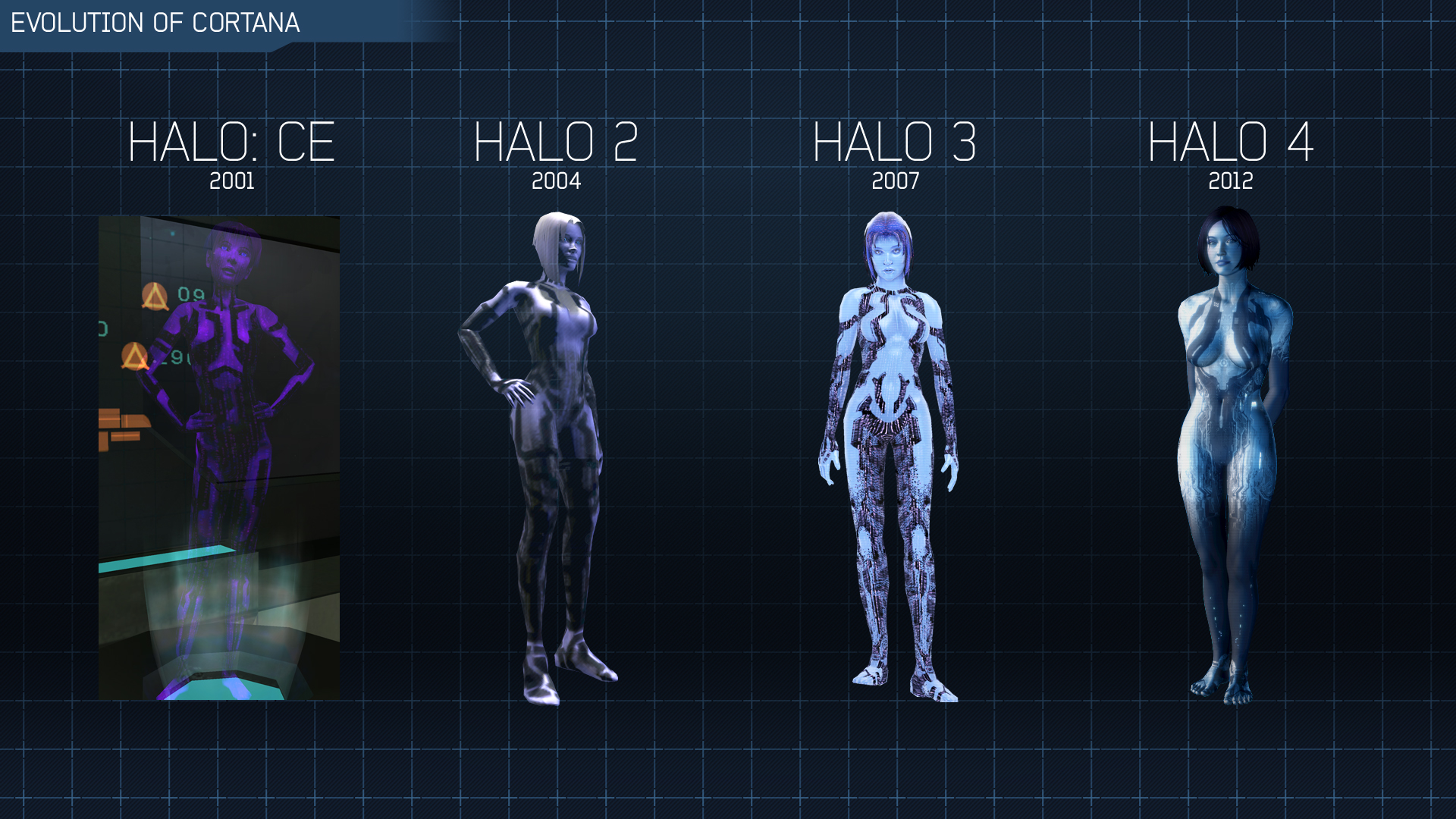
This picture is worth looking at if you want to see how Cortana became more sexualised when David Ellis and 343 Industries got their hands on Halo. A member of the NeoGAF forums also made a short and simple post about male sexualisation in the Metal Gear Solid series that didn't even mention naked Raiden. It's worth pointing to if anyone ever thinks Hideo Kojima only ever sexualises female characters.

As for David Ellis, I have no idea how anyone can be so hypocritical and yet so completely unaware, about both his own series' character designs and its "man-baby" influence. Speaking of which, it's disheartening to see just how many gamers, journalists and even developers casually throw out insults about immaturity towards people who have a different opinion to them.

I'm sorry for stating the obvious but there is nothing immature about people holding opinions different from your own, regardless of what the subject is. Insulting those people for having a different opinion, on the other hand, is very immature. That's something children do in playgrounds. If David Ellis really wants to talk about how "our industry should be better", I'd start with that.

Saturday, 17 November 2012

No "Off Switch"

PLEASE NOTE: This post contains spoilers for Dishonored.

This one's not going to be an analysis of men's issues in video games but I'd like to spend at least one post writing about what goes through my mind when I come across a sexist issue in games. I started thinking about it when I saw this Tweet from Anita Sarkeesian:
"Just waited in line to pick up a copy of Halo 4 at midnight. Gearing up for some serious Sexy Sidekick trope research!"
It made me think about the different reaction I have to sexism in games compared to Anita. I don't know if this was a one-off for Anita or not but gender issues are probably the last thing on my mind whenever I pick up a game. You could say that it was more justified in Halo 4's case; Cortana is more prevalent in Halo than, say, Elena's punching of Drake was in Uncharted, so it makes sense that "Sexy Sidekick" is on Anita's mind while picking up Halo 4 more than female-on-male abuse was on mine when I purchased Uncharted 2.

Other games might have a different effect. If there was a sequel to Heavenly Sword, I'm confident that I'd think back to the sexism in the first game because it was so prominent. If the trailer for Metal Gear Solid: Ground Zeroes suddenly showed Meryl (which I know is impossible because of the time period), I'd probably think back to her misandric behaviour in Metal Gear Solid 4.

However, for the most part, gender issues don't cross my mind while purchasing games. I get the feeling critics of men's rights would say something along the lines of, "well that's because there are fewer men's rights issues to worry about in gaming" but the answer is simpler than that; I see games as entertainment first and worry about the gender issues second.

So I don't consider gender issues before buying the game, which leaves me to do it while playing, when it occurs. It isn't ideal, since real-life issues tend to take you out of the game's universe, but it can't be helped. There isn't an off switch where you decide not to consider gender issues. I'll give you an example of when this happened to me recently, with Dishonored. There will be spoilers ahead, so only read if you've completed the game or don't care about the game's story being spoiled.


Basically, Dishonored is about a group of evil politicians who conspire to murder an Empress and frame her Royal Protector, Corvo (the player character), in order to seize power for themselves. As Corvo, your job is to subdue or murder all the conspirators and rescue the Empress' daughter, Emily, so she can ascend to the throne.

Corvo isn't alone in his plan to save Emily. He's joined by the Loyalists, people who believe that Corvo wasn't responsible for the Empress' murder. Around three-quarters of the way through the game, the big twist is that the Loyalists betray Corvo because they want to further their own interests too.

At first, this took me out of the game because the "main" Loyalists were all male, so it seemed like we were going down the "all men are scumbags" route once again. It was as if Corvo was being set up as the only good male in the game, solely because he was loyal to women (the Empress and Emily). Luckily, this wasn't the case; the game changes depending on whether you cause a lot of chaos or not and in my Low Chaos playthrough, three male characters remained heroic. So it seems like I was worrying over nothing.

If anything, Bethesda, the makers of Dishonored, seemed to make an effort to avoid gender issues in Dishonored. As well as making sure there was a reasonable mix of good and evil with the men, they did the same with the women (although the evil men outnumber the evil women by a long way). While Emily is kidnapped twice in the game, two men are also held captive at certain points during the game. And with the Empress being lionised throughout the game and Emily being a tomboyish princess, it seems like the feminist audience don't need to worry about the lack of good female characters.

... Or do they?

To paraphrase someone from a forum I frequent, "the women in Dishonored are plot devices. The Empress does nothing but get killed. The princess gets captured. Things happen to them, they don't do things. Lack of agency".

The agency argument is always an odd one. It doesn't matter that so many men in the game are scumbags compared to only two women. It doesn't matter that the majority of deaths are of men, as always. Women lacking agency is considered to be a significant issue for feminists in games.

There's precisely one character in Dishonored who has anything that I could describe as "agency" and that's Corvo. Although he suffers the exact same pitfall that most men rescuing "damsels-in-distress" fall into; his worth is only defined by how valuable he is to women. Corvo has no personality of his own and exists solely to take orders from others (usually the Loyalists, although he does it all to benefit Emily). He could easily be compared to Mario, as could Emily be compared to Princess Peach. The female character is the valuable one in both of these situations and the man's worth is defined only by how useful he is at any given time. If he's about to rescue the Princess, he's valuable. If he's about to fall to his death, he's disposable. The woman is still the important one.

The lack of agency isn't necessarily true of the women in Dishonored anyway. A morally ambiguous character by the name of Granny Rags can be fought late in the game if you go off the beaten track and she's by far the most powerful enemy in the game. Likewise, one of the Loyalists who doesn't betray Corvo -- Cecelia -- was the only person sensible enough to create a safehouse away from the pub that the Loyalists use as a hideout. It comes in handy.

I didn't intend for this to be a lengthy analysis of Dishonored so I'll finish quickly; all-in-all, I concluded that Dishonored had a reasonably even split, favouring women slightly. In spite of the fact that the lone female assassination target reeks of tokenism, at least Bethesda made the effort to include a female target. That's something to be praised. The trio of male Loyalists who betray Corvo is questionable but the three remaining good male Loyalists are strong enough characters for it to be less of an issue. One male is killed during the betrayal but so is a female. Emily is kidnapped twice in the game but two male characters are held captive too.

Anyway, I went off on a bit of a tangent with the agency talk there. The point was that even though I've never considered gender issues while buying a game, like Anita, I've considered them while playing. In Dishonored's case, it was during the Loyalists' betrayal and occasionally when Emily made her tomboyish statements. Although if I was paid $160,000 to make videos about gender issues, like Anita, I'd probably think about about them more often.

As always, leave a comment below or send me an e-mail at themalesofgames@gmail.com.

Thursday, 8 November 2012

A Sexist Start for Halo 4

IMPORTANT: This was intended to be a blog about 343 Industries -- the developers of Halo 4 -- cracking down on misogynistic comments from online players. However, while writing this blog and looking over the Gamespot article, I realised that I was mistaken; the Gamespot article uses only gender-neutral terms, such as "sexism" and "gender-specific slanderous comments". So I wrote much of this article based on my misunderstanding of the original article.

However, I don't wish to waste what I've written for several reasons; firstly, my issues with the idea of cracking down on sexist verbal abuse online may still turn out to be true. It may only be for misogynistic comments. We don't know at this point and I can't imagine many people actually receiving lifetime bans for being sexist against men, so my arguments here may still apply. I certainly respect 343 Industries more for using gender-neutral terms but we'll have to wait and see what the outcome is. Secondly, all the arguments about racism and homophobia are definitely relevant and I didn't want to discard them. Thirdly, and this might sound strange, but it felt misleading to backtrack and say "oh, no, really, I knew all along what they were going for". I didn't and I want you to read my honest thoughts on the subject as I wrote them. As of this writing, I still haven't finished writing this blog post, so I intend to continue under my original (presumably incorrect) assumption; if 343 Industries were only cracking down on sexism against women. Knowing what I know now, it's difficult to write as if I don't know the language used was gender-neutral -- it's a bit like trying to do an impression of myself -- but I'll do my best.

So here it is. Hope you enjoy it.


It should come as no shock to anybody reading this blog that verbal abuse during online multiplayer games is a big problem. So fortunately, 343 Industries, the developer of Halo 4, has finally decided to do something about the problem:

http://uk.gamespot.com/news/halo-4-devs-speak-out-against-sexism-6399205

You can probably tell what it's about from the name of the link but for those of you who didn't click it, it states that discriminatory language during online play will be punished with a lifetime ban ... but only if it's sexist. And by "sexist", I mean "sexist against women".

I don't play online very much but I've experienced plenty of online abuse. The one I recall most clearly is, "you, you're a butch lesbian and I'm going to stamp on your f***ing head". Being threatened by people during online games is easy to laugh about though -- if it wasn't, there wouldn't be so many Youtube videos featuring Call Of Duty players getting angry -- so it doesn't bother me. I'd be very surprised if there was anybody who played online who hadn't heard abuse at some point, if not experienced it themselves.

Now, I'm going to put the idea that men can be verbally abused online to one side for now. The only thing I'll say on that particular subject is that men are the vast majority of online players and as a result, receive the vast majority of the abuse. Picture the scene; someone hurling insult after insult towards a male online player, as harsh as they want for as long as they want, and the player being unable to make his abuser face a punishment. We don't know how many sexist insults a female player has to receive before her abuser receives the lifetime ban but the fact that the abuser can be banned in this scenario but not the previous one is discrimination based on sex in itself. So by attempting to crack down on sexism, 343 Industries are endorsing it in a much worse way.

The way the article is written, I actually have to question whether the developers have ever played a game online or not. Have they experienced any abusive language first-hand or are they going off the information of people who say "there's lots of sexist language against women online"? I can't believe that's the case ... but what are we meant to think, if not that? That's the only logical explanation.

The elephant in the room here is the discrimination of other groups, such as gay people and non-whites. I'm not quite sure how 343 Industries could be aware of abuse online but not be aware of discriminatory language against people with those characteristics. Because I certainly can't accept that they have heard that abuse and are simply refusing to take action against racists and homophobes.

This is the implication from the article that frustrates me the most; before now, I had no idea that developers had a way to punish the verbally abusive online players. I figured players could file complaints but I also believed verbal abuse was unable to be proven. If it could be, then why is it so prevalent? Wouldn't it have been stamped out earlier? So what we have now is an from a developer that they can punish verbally abusive people online ... but they will only cater to the groups that they care about. You're gay? Sorry, if someone calls you a "fag", they're allowed to do so as much as he or she wishes. You're black? If you were just called a "n*gger", you have no choice but to put up with it. You've been putting up with it for centuries now. You're female? Oh, excuse us while we put our cloaks over this puddle, so you don't get your shoes wet ...

This is when a case of supposedly "positive discrimination" -- or female privilege, to use its proper term -- is actually very damaging. It's this kind of special treatment of women that really irks me. The little things. The benefits that are granted to them when they aren't needed, solely because of their sex. If you want to frame this debacle in terms of how it affects women, it's cases like this where women are infantilised the most and treated like children who need protection. If 343 Industries want to do something about online verbal abuse, fine, but stamp out all verbal abuse. If they're cherry-picking the minority groups they want to support while they could help out the rest anyway, they might as well be insulting those people themselves.

One thing I'll say in defence of the above article on discrimination, if it could be called a defence, is that we don't have enough information on this yet. The article is vague enough that 343 Industries may be considering lifetime bans for other forms of discrimination. That's the closest that this issue gets to a silver lining. However, unlike with Rhianna Pratchett and Lara Croft's portrayal, this is a significant real-life issue rather than a quibble about a video game characterisation, so I'm not willing to give 343 Industries the benefit of the doubt on this one. Sexism is still the issue focused on, rather than racism or homophobia. Take a look at one of the turns of phrase used:
"Speaking to GameSpot, Ross and Wolfkill said there is zero tolerance for Xbox Live players who are found to be making sexist or discriminatory comments against others, with a lifetime ban from the network as penalty."
That's the one mention of discrimination that has nothing to do with sexism in the entire article. With the way gender issues dominate the article, I'm lost as to whether this includes all discriminatory language or not.

Maybe we don't know enough yet to come to a proper conclusion. If female online gamers make sexist comments against women, will they receive lifetime bans too? Or will they not be deemed sexist because it was a woman who made the comment?

If ever there were examples of why the stamping-out of verbal abuse online should (A) not be confined to a single sex, whether abuser or victim and (B) certainly not be confined to gender discrimination, here's a female Call Of Duty player who threatens a fellow player with violence and uses the homophobic slur "poofs" at one point. Even worse, here's a female CoD player who is apparently unable to string a sentence together without a homophobic or racist slur. Both videos feature strong language, so watch at your own discretion.

I'll leave it at that. Feel free to leave a comment or contact me at themalesofgames@gmail.com.


Reminder: Most of this article was written when I was under the assumption that 343 Industries considered "sexism" to be "misogyny", rather than something gender-neutral. This may still be the case, which is one of the reasons I posted the article. Everything after the Gamespot quote was written after I was made aware of the gender-neutral language used by Kiki Wolfkill and Bonnie Ross of 343 Industries. Although I tried to make it as accurate as possible, it may not reflect my original feelings on the matter.