Showing posts with label dragon's crown. Show all posts

Wednesday, 10 December 2014

Tekken's Lucky Chloe - Not Coming to the US?

Three days ago, a new character was announced for Tekken 7. If you're familiar with Japanese idols, the new character, Lucky Chloe, appears to draw a lot of inspiration from them; her fun, unique outfit, bubbly personality and slightly forced use of English phrases ("Engrish") is somewhat reminiscent of idol stereotypes.

She looks like a fun character. Her moveset is entertaining to watch and, in my opinion, her outfit and personality both have a ton of charm.


Yet at the moment, there's a rumour going around that due to fan complaints, Lucky Chloe isn't going to be released in the U.S. Only Europe and Asia.

Because this is a rumour, it may be debunked in a few days and this will all become a moot point. For the time being though, it's started a conversation.

You can read TechRaptor's article on this story but basically, when the character trailer was released, there was a backlash against the character on both Youtube -- read the comments of the video above -- as well as NeoGAF and even directed at the games director, Katsuhiro Harada, on Twitter. I'll come to why this backlash occurred later on but Harada's response is the issue; responding to people bothering him on Twitter, he made the claim that Lucky Chloe would be exclusive to Europe and Asia.


I should say that I'm in Europe so even if this is true, it shouldn't affect me. Having said that, I feel bad for U.S. Tekken fans who aren't getting a character because of a vocal minority of complainers.

The complaints themselves were bafflingly varied. Some said that Lucky Chloe didn't fit in with the rest of Tekken's cast, which is ridiculous. As a long-time Tekken fan, Lucky Chloe wouldn't even be in my top ten ridiculous characters. From fighting bears, kangaroos and dinosaurs to robot girls and old men doing somersaults, Tekken's cast has always been more ludicrous than serious. The only reason we don't consider characters like Yoshimitsu and Devil more ridiculous is because they look cool.

For people making the claim that she doesn't fit in, Tekken has had cutesy, anime-esque female characters since 3. Just look at Ling Xiaoyu's Tekken 3 ending. The central Mishima family storyline and conflict is like something straight out of an anime. People acting like Lucky Chloe is a step too far seem to be making excuses. Being too "moe" or fanservice-y is not new to the series at all.

Those aren't the most worrying complaints though. Read this NeoGAF post:

Left-click to enlarge.
Once again, people have been complaining about how a female character in a game is dressed. In this case, this poster went as far as say she was only included to appeal to fetishists (specifically singling out Harada himself and claiming that's the reason for Lucky Chloe's inclusion). There's also a ton of cultural insensitivity towards Japan and Japanese gamers.

The reason I'm writing about this at all is because this is the same type of entitled attitude that we see from modern game critics. This demanding nature is becoming frighteningly common. I apologise for bringing up Anita Sarkeesian but in her case, she directed her ire at Toru Iwatani, creator of Pac-Man; in her "Ms. Male Character" video, Sarkeesian brought up Iwatani's desire to appeal to women by making a game based around food. In spite of the fact that this worked -- likely bringing more women into gaming than Anita herself ever will -- Anita referred to Iwatani's "regressive personal or cultural notions about women". Basically, saying either he or Japan as a whole had negative views about women. So either he's sexist or the entire nation is. Once again, cultural insensitivity (possibly outright xenophobia).

Another example that I think is most comparable to the Tekken 7 situation is when Kotaku's Jason Schreier lambasted Vanillaware's George Kamitani over the design of the Sorceress in Dragon's Crown. He referred to him as "a fourteen-year-old boy" and, in a follow-up article, laid the entirety of sexism towards women in the games industry at Kamitani's feet (including such issues as booth babes, yet Schreier himself had no problem dismissing male con-goers as "sweaty male attendees" and ranting about "male power fantasies"). I went over this at the time but there is no reason or excuse for insulting a developer just because you disagree with his creative direction. Again, as sexualisation is less of an issue in Japan, insulting him just because he's more used to drawing what he wants instead of what you want reeks of cultural insensitivity.

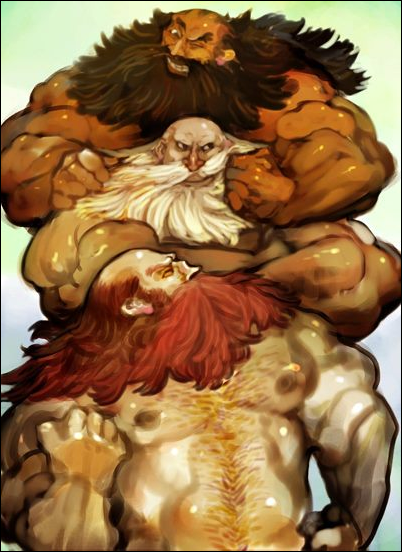
The reason I draw parallels between the situation with Harada and the Lucky Chloe critics is because after Schreier complained, Kamitani responded by posting a picture of three of the Dragon's Crown Dwarf's palette-swaps in a possibly-suggestive pose (it's a long story but I cover it in the previous paragraph's link. Schreier added to his insensitivity by branding Kamitani homophobic).

In this case, Harada has responded too and this is where I think Harada may just be playing a joke on the haters. His joke about giving the U.S. audience a "well-muscled skinhead" seems like the same kind of jab as Kamitani's towards Schreier, so don't be surprised if Lucky Chloe is included. On the other hand, his comment about the characters being region-exclusive seems sincere. It's hard to say at this point.

The point is that in the face of this kind of dogmatic insensitivity and outright bigotry towards an entire nation over something as ridiculous a female video game character that we've seen a total of 46 seconds of, who could blame Harada if he decided to take his ball and go home? He'd have every right to. In the face of insulting, entitled critics who think every game developer owes them a favour, why shouldn't he say "screw it" and do as he wants, rather than what they want? It isn't like Phil Fish, who had a Twitter blow-up every two weeks and supposedly cancelled projects left and right in the face of minor criticism, insulting sexual assault victims along the way. This is like a parent teaching his spoiled children some manners using the "'I want' never gets" phrase.

Honestly, what did the critics even think would happen? Did they believe that if they complained enough, Harada would change Lucky Chloe to suit them? Look at the entitlement on one of the comments Harada responded to: "Please add an option to delete any character you do not want to play against in Arcade battle". Did that person really expect that to happen?

I have every sympathy for American Tekken fans who wanted to play a complete version of Tekken 7 without having to import but at the same time, if this is true, it would be a good wake-up call to an entitled crowd who've never been told "no" in their lives. The same people who preach about not judging women on their attires or attitudes in real life are the same ones who love to dictate what women wear and how they act in fiction. I find that unacceptable.

UPDATE: As I was writing this, TechRaptor added a couple of updates in the article above. Still nothing concrete but it seems likely that Harada was referring only to the arcade versions of Tekken 7, rather than the console versions. Fingers crossed.

-----

I didn't update last month, which I'd like to apologise for. Very hectic schedule but on the plus side, I'm now decent at using Adobe Flash. Trying to figure out if I could use it for this blog, somehow. If I ever make a "gender issues in gaming"-related game, I'll post it here. Unlikely though.

I have to give a big, big thank you to Milo Yiannopoulos for linking to this blog in his article "An Open Letter to Bloomberg's Sheelah Kolhatkar, on the Delicate Matter of Anita Sarkeesian" on Breitbart. I've spoken to Milo a few times on Twitter -- although I doubt he remembered me, so him linking to this blog is just a coincidence -- and he's a nice guy. Give his article a read. It's excellent and very comprehensive. At this stage, why anyone continues to give Anita the time of day is a mystery to me.

Also, thank you to the influx of visitors who've stopped by over the past month due to wanting to learn more about Jonathan McIntosh. I've only written about McIntosh a couple of times because I've never thought of him as being especially significant. However, people have become more aware of him because of his penchant for posting unusual, often-nonsensical things on Twitter (such as "we need to see some games that are not fun" because he thinks that's the only way they'll be able to have as much depth and artistic merit as other forms of entertainment). More recently, he's become known for appearing in Feminist Frequency's "25 Invisible Benefits of Gaming While Male" video, which I haven't watched but I did post a brief rebuttal to it back when McIntosh wrote it as an article.

I don't have much to add, although I'm finding it very telling that many of the items they rattled off were less about describing "gaming while male" and more involved with talking about women's experiences. McIntosh and the others in the video seemed content to speak on behalf of female gamers and tell the world what they experience. TechRaptor have another good article on this where the female contributors to the site (and other female gamers) leave their responses to the video. Watch the Youtube videos posted in the comments section too. It's eye-opening stuff.

As time has gone on, it's becoming more and more clear the social justice method of being "pro-woman" makes zero sense. They have zero interest in listening to the voices of women who say there's nothing wrong with the games industry or the gaming community. Women like Christine Phelan (Valve) and Gabrielle Toledano (EA) both work in the games industry and say the industry is nothing but welcoming towards women. Likewise, female gamers speak up regularly about feeling nothing but welcomed into gaming communities. I'm currently enrolled on a games design course and can confirm that both are the case.

So why is it that the group considered "pro-woman" are the ones engaging in scaremongering? Telling women there's nothing but horrible portrayals, sexist male "virgin basement-dwellers" to abuse them and an industry that wants to drive them out? Likewise, consider the opposite; why is it that those of us who say "these female characters are great, female developers are awesome and gaming is a great pasttime for people no matter their physical characteristics" are considered "anti-woman"? Why is driving women out of the industry considered "progressive" by these people? Because we don't stomp our feet and throw tantrums about game content?

It's too late now but I was going to write about Polygon's Bayonetta 2 review, talking about this exact thing. A great game, featuring a strong female character, designed by a woman and appreciated by women on the development team ... yet a male Polygon reviewer dismisses her as "sexualised". Apparently, strong female characters and the hard work of women is irrelevant if a guy playing it feels offended and needs to preach about how hard women have it.

Akiko Kuroda, Producer on Bayonetta 2.

Leave a comment below, follow me @TheMalesOfGames on Twitter or send an e-mail to themalesofgames@gmail.com.

Thursday, 5 September 2013

I sense an incoming Metal Gear Solid backlash.

Earlier today, Hideo Kojima -- creator of the Metal Gear Solid series -- tweeted about wanting some of the characters of MGSV redesigned to be more "erotic". He cited appealing to cosplayers and selling more figurines of the game's characters as the reasons why he wanted these redesigns.

I suspect we'll be seeing some vexed responses to this in the next few days. Personally, I'm delighted.

First of all, I love how different the attitude towards sexualisation is in Japan compared to the West. When I wrote about Dragon's Crown, I brought up how the most sexualised characters broke my immersion in the game. From what I hear, the only mention of the exaggerated character designs in Japan was joking about how big a deal was made of it outside the country. Unfortunately, I haven't been able to find any Japanese articles saying that directly (obviously because the Japanese language isn't my forté and English isn't much use at finding Japanese articles in search engines) but I'd like to read some of them first-hand if I get the chance.

I'd love to be able to have that same nonchalant attitude towards sexualised characters in the media that they have in Japan. Logically, I can see why people would argue that living in a culture with so much fiction featuring sexualised women would lead people within that culture to have a lower opinion of real women; women being sex objects in games could lead to people viewing them as such in real life. Having said that, I completely disagree. If anything, I think that Japan's line between fiction and reality is more distinct; Dragon's Crown's art style can be joked about because it's clear that a sexualised, anime-esque mermaid doesn't represent real women in any way. The connection hasn't been made between reality and fiction in the same way it has in the West, so it's easier to view sexualised characters purely as entertainment.

That's just a guess, so don't quote it as if it's fact. The point is that I see the integration of sexual characters in everyday media to be a far healthier attitude than trying to stamp it out because we dislike it. There are times when I don't think it'd be appropriate but providing it fit in with the setting/art style and wasn't aimed at kids, I think it'd be fine.

Luckily, Metal Gear Solid isn't a series that has ever had to worry about a Dragon's Crown-level of controversy but it's odd to see so many people in the comments section on Gamespot condemning Hideo Kojima for his decision. I'm surprised at that and, even though I don't like to play the "they've probably never played the game" card, I feel it's appropriate in this case; for those of you who don't know, the Metal Gear Solid series has always had a light-hearted, almost Benny Hill-esque approach to eroticism. From figuring out which soldier is female by staring at their behinds to distracting lustful guards with non-nude erotica magazines, the Metal Gear Solid series, more often than not, treats eroticism as being funny. So why this response to Metal Gear Solid V?

Assuming Kojima's critics have played previous games in the Metal Gear series, it could simply be because Kojima is being so blatant. "I want to appeal to cosplayers and to sell figurines". Making decisions based on merchandising has left a bitter taste in the mouths of fanbases in the past, most notably for Star Wars. Perhaps it's because he joked that the CG model for Quiet -- the female sniper seen in the Metal Gear Solid V trailer -- being revealed this Friday would be "uncosplayable". Personally, I think that statement was just to create some hype for the reveal and possibly to get a rise out of people. If that's the case, it seems to have worked.

Quiet is dressed beneath the border of this picture, I should point out.

It's also very possible that they think eroticism has no place in video games; there are certainly a few comments underneath that Gamespot article that make the typical comments we saw during the Dragon's Crown controversy, such as erotica "only appealing to twelve-year-olds". There's also at least one mention of this kind of attitude preventing games from being "art".

I've never been particularly interested in the "are games art?" debate because, to me, it seems inconsequential; I enjoy games and that's all that really matters. I don't particularly care if they're recognised as art or not. Having said that, I have to wonder why featuring eroticism is enough to categorise a game as not being art. Not that I think the Metal Gear Solid V erotica -- if there is any, apart from Quiet's character design -- is going to be at all serious, in which case I have to ask why should MGSV change? If you've played the previous games in the series, noticed the light-hearted attitude towards sex (as well as other immature content like one character being the victim of constant diarrhoea jokes), then why should the next game in the series be any different?

As for erotica "only appealing to twelve-year-olds", I've often thought that an inability to handle erotica -- especially the comedic take MGS puts on it -- is a greater sign of immaturity than enjoying it. The Metal Gear Solid series is for adults, so why shouldn't adult themes be present? I can't help but feel that not featuring the light-hearted erotica in MGS would be comparable to putting your hands over a child's ears whenever you mention something sexual. Or trying to convince people that storks deliver babies. It exists, we might as well laugh at it.

I'd also quickly like to mention that Kojima stated he'd be revealing Quiet's CG model on Friday but he may not have been talking about her when he mentioned the erotic redesign; anyone who remembers MGS2's naked Raiden will know that the gentlemen of Metal Gear Solid aren't immune to comedic sexualisation either. I'd still place bets on Quiet but you never know.

Anyway, it'll be interesting to see how this develops over the next couple of days, before Quiet's CG model is revealed, and the fallout afterwards, until it's engulfed (hopefully) with news from the Tokyo Game Show.

Thanks for all the comments last time, by the way. Very interesting reading.

Added on 6th September 2013 - And, to the surprise of absolutely nobody, someone has complained! Someone rather high-profile too.

David Ellis, a designer on Halo, commented on Twitter after seeing Quiet's design "our industry should be better than this" and the "industry is full of man-babies". Take a look at the article here and I highly recommend reading the highest-rated comments below. They say everything better than I could. I'd never heard of David Ellis before this article but when I was in high school, Halo was the game that everyone talked about playing online. It was the precursor to games played by so-called "man-baby" audiences such as Call Of Duty so who is David Ellis to point the finger at anyone else?

And remember, boys and girls; designing a scantily-clad female sniper who works in the middle of the desert is wrong. On the other hand, designing a needlessly large-chested and scantily-clad female character who is literally an object is just fine!


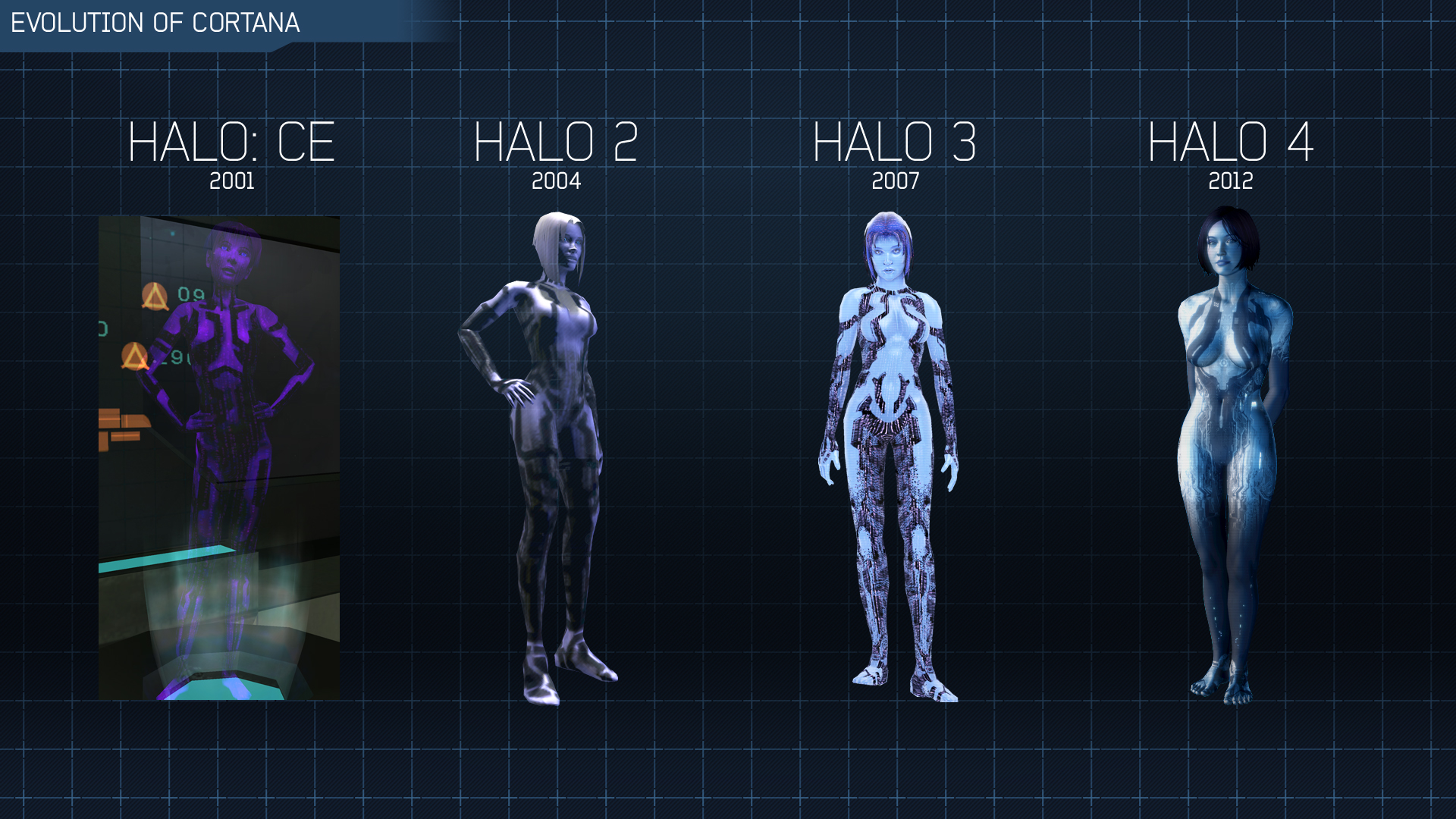
This picture is worth looking at if you want to see how Cortana became more sexualised when David Ellis and 343 Industries got their hands on Halo. A member of the NeoGAF forums also made a short and simple post about male sexualisation in the Metal Gear Solid series that didn't even mention naked Raiden. It's worth pointing to if anyone ever thinks Hideo Kojima only ever sexualises female characters.

As for David Ellis, I have no idea how anyone can be so hypocritical and yet so completely unaware, about both his own series' character designs and its "man-baby" influence. Speaking of which, it's disheartening to see just how many gamers, journalists and even developers casually throw out insults about immaturity towards people who have a different opinion to them.

I'm sorry for stating the obvious but there is nothing immature about people holding opinions different from your own, regardless of what the subject is. Insulting those people for having a different opinion, on the other hand, is very immature. That's something children do in playgrounds. If David Ellis really wants to talk about how "our industry should be better", I'd start with that.

Thursday, 15 August 2013

Dragon's Crown: Impressions So Far (NSFW)


I want to get a lot of this out now, while it's still fresh in my mind; Dragon's Crown arrived through my door today. I've played it for a few hours and I think it's ... kind of repetitive, actually (although that may be because I'm playing as the Fighter; I briefly played as the Dwarf and had a great time but replaying all the levels I've already completed is a hassle). Certainly not the must-buy I thought it'd be based on gameplay videos. It's certainly not bad ... but it's not great. I haven't completed it yet though so hopefully I'll enjoy it more later on.

Right off the bat, I'd like to say this: I can see why some people are offended. I'm happy to defend Dragon's Crown's art style and character designs but only up to a certain point. When the artwork actually breaks my immersion from the game because the sexualisation is so blatant, that point is reached.

To explain, I think there are acceptable levels of sexualising characters in games and ... I don't want to say "unacceptable" levels -- I'm not in charge of what should and shouldn't be in games, nor would I want to be -- but levels where it seems less like the sexualisation is part of the game's universe and more part of our universe but an artist wanted to put it into the game anyway.

I'll give you some examples from other games. While I've heard a lot of criticism against the scantily-clad women of Soul Calibur, I've never had an issue with any of the series' content. Take Ivy, for example. Possibly the most heavily-criticised character but as far as I'm concerned, her dominatrix-esque outfit matches her dominant personality. Her dialogue is sexualised but she's the only character in the game with sexual lines. She's deliberately set up as the "fanservice" character, in spite of the large chests and "jiggle physics" of the rest of the female roster.

In my opinion, Ivy and the rest of the female characters in Soul Calibur are examples of acceptable sexualisation. Well, I could do without the chests expanding game after game but the female characters are more than just their sexualisation. Ivy included! Their backstories, fighting styles, relationships, etc. go towards making them fully-rounded. Plus, it's worth bearing this in mind when talking about sexualisation in fighting games:


I've played plenty of fighting games and noticed this a lot, particularly in games where you can customise/create your own fighters. I never got to enjoy them because I was always looking at my opponent.

Then there are moments of sexualisation that detract from the game. I don't feel like Ivy or any other female character in Soul Calibur detracts from the game because their sexualisation isn't focused on. I can't say the same for a game like ... Resonance Of Fate.

Resonance Of Fate is a Japanese RPG that came out a few years ago but I only bought this year. There's a minor character in the game called Cardinal Barbarella who only appears in one cutscene (although she can be spoken to and gives a few missions later on in the game) and that one cutscene sexualises the hell out of her.


(Blogspot's Youtube search was acting funny, so I had to download this, then upload it again myself. Credit to ReneidKlein for the video. Click his username if you'd prefer to watch on Youtube.)

For those of you who don't want to watch, the heroes -- three guns-for-hire -- visit the young and sexy Cardinal Barbarella and heroic pervert Vashyron is so overcome by her jiggling breasts and orgasm noises that he agrees to go into harsh danger to fetch her a bottle of wine.

Even though Barbarella's sexiness did serve a purpose -- Vashyron wouldn't have accepted the mission if Barbarella wasn't so attractive -- it was still enough to break my immersion from the game world. I don't usually mind "jiggle physics" but in this case, Barbarella's breasts had a mind of their own. Her orgasm noises were uncalled for. Vashyron, too, is the classic anime pervert archetype turned up to eleven. It certainly made playing as him for the rest of the game uncomfortable (and the other two characters were annoying in their own little ways too).

Dragon's Crown is closer to Resonance Of Fate than Soul Calibur. In fact, it's probably worse.

Now, in all the same ways that sexualisation didn't matter in Soul Calibur, they don't matter in Dragon's Crown either; you're not paying any attention to the Sorceress' jiggling breasts when you're in the middle of a hectic battle that takes up the entire screen. During the quieter moments, such as in the town, you start to notice a few things. The jiggling breasts while running around, for example. The one female civilian who always starts outside the tavern who has jiggling breasts while walking too. Morgan, the female shopkeeper who wears little more than strips of flowing cloth.

Truth be told, I could probably deal with all of that if they were the only examples. Unfortunately, there are times where the sexualisation goes even further than that. I can think of no better example than when the mermaid shows up in the middle of a level:


Every single mermaid I've seen before this one was very specifically "a fish from the waist-down" (or sometimes from the waist-up, when writers wanted to buck the trend). This mermaid, however, is a fish from the buttocks-down. As soon as I saw this, I immediately thought about how the "mermaid problem" -- mermaids are beautiful but men can't mate with them because they lack the appropriate parts -- probably doesn't apply to her. Which made the picture even less wholesome and made me wonder if that's why she was designed this way.

Like Barbarella, the mermaid doesn't play any significant role in the game (at least not as far as I've played) but she's not the only one. It struck me that a lot of Dragon's Crown is similar to a visual novel, especially when shopping or taking quests. We normally see a bright and colourful character taking up the entire screen and the narrator explaining the situation. As a result, we have a few characters cropping up out of the blue in the middle of missions. The mermaid is one. A hobgoblin chef is another. A female warrior monk in a very suggestive pose is another. She, in particular, looks like she was traced from a pornographic picture, something that artists such as Greg Land have been criticised for in the past. I may like George Kamitani's art far more than Greg Land's but I wouldn't let Greg off the hook. I can't do the same for George, no matter how impressive his art is.

Take it from me, his art is impressive. Especially in motion. It's phenomenal, in fact. There are occasions in Dragon's Crown when I won't progress the dialogue just because I want to see the animation repeat itself (like seeing the wizard Lucain smoking his pipe). I'm glad I bought the game just to see a few of the characters alone, such as the Phantom Knight. Unfortunately, some of these characters, such as the three mentioned in the previous paragraph, only play a very small role in the quest the player meets them in. So characters like the sexualised mermaid -- and the hideous hobgoblin -- showing up can feel like they're there just for the sake of being there.

So again, I understand why people can be offended by Dragon's Crown. It doesn't offend me but it does break my immersion in the game world when a naked mermaid shows up in the middle of the quest just for a chat.

I hope my regular readers aren't too disappointed in me for not fighting Dragon's Crown's corner on this particular issue but what can I say? This all just occurred to me while playing, so I thought I'd let you know. Still, maybe I'm being premature. Maybe my view has been tainted from not being enthused with the gameplay. Maybe I'll stop seeing it as an issue in time. I can only hope, for the sake for immersion, that it's the case.

So where does this leave male characters? Well, every criticism against journalists such as Jason Schreier is still valid and my blog post about the game during development is still correct; with regards to the six playable characters, the men are just as exaggerated as the women. George Kamitani's art is still incredible and, even though I feel some of the pictures are too blatantly inserted into the game, I'm more convinced than ever that he's an unparalleled artist and certainly not deserving of the insults Schreier fired in his direction. Nothing has changed.

Other than that, there isn't much to say about the male characters. There are exaggerated examples, the most prominent being Roland The Brave; a hulking, barbarian-esque man with a lantern jaw and the hair from a L'Oréal commercial. The majority of the other male characters are built like Greek Gods too, from Samuel the Guildmaster to the Monk who offers resurrection services in the temple. It has to be said though, it's not the same. In my opinion, those characters are closer to the Soul Calibur example of sexualisation; acceptable because there's more to them than the sexualisation, with Roland as the Ivy of Dragon's Crown (if the Fighter hasn't already taken that spot). In fact, it's closer to say that Roland is the only one sexualised, with the others being victims of unrealistic body standards.

Then again, it's Dragon's Crown. Everyone is exaggerated. That's the argument I used when it was in development and I have to hold my own criticisms to the same standard.

I've been enjoying the comments I've received lately, so I'm looking forward to seeing what I get for this.

Important Note: I wrote this yesterday but thought I'd wait a day to see how I felt after I'd continued playing. After playing for a few hours today, I'm happy to say that firstly, I'm enjoying Dragon's Crown a lot more. It's a game that takes a while to introduce every element and now, the gameplay is starting to feel a lot less linear and a lot more challenging. It's closer to what I was hoping for at the start.

As for the objectification, I really have got used to it a lot more. The sexualised characters do break my immersion in the game but not as much as they used to. A few characters, like Morgan the shopkeeper, don't bother me at all anymore. Plus, I've played as the Amazon a little and she may be my favourite character.

Do I wish there were a few fewer sexualised characters? Yeah, sure. Particularly the mermaid. I wish there was more variation in the female character designs too, since I'm a big fan of the Amazon having a different body type from what we usually see on female characters. Having said that, just playing through the game a bit more has helped me to stop seeing the exaggerated designs as a hindrance and more as part of the charm. There are exceptions but for the most part, that's the case. It just took some time. Imagine jumping into a cold swimming pool; at first, you're freezing but you become used to it in time and it stops bothering you. It's the same thing with Dragon's Crown; the sexualisation stands out a lot at first but the more you play, the more you accept it as part of the game world that George Kamitani created.

Monday, 29 April 2013

The Dragon's Crown Controversy

Another lengthy gap between updates. Sorry about that.

Dragon's Crown is an upcoming action RPG by Vanillaware, as a spiritual successor to a 1997 Atlus game called Princess Crown. The gameplay is reminiscent of old side-scrolling beat-em-ups like Golden Axe and Streets Of Rage and a big part of the game's appeal is that all of the characters and enemies are hand-drawn.

Male characters, top to bottom - Wizard, Fighter, Dwarf. Female characters, top to bottom - Sorceress, Elf, Amazon.


They look phenomenal. In an age where most video game characters are bland, shaved-headed space marines, such exaggerated characters are a very welcome break. You don't often see characters so varied anymore. Muscular female characters extremely rare, for example, and although you can't see it underneath that helmet, the Fighter has more feminine features than we usually associate with such muscular characters, similar to the typical bishounen Japanese hero. Surely, in an age where, I'd say, ninety percent of characters belong to a standard "realistic" archetype with very little variation, everyone would welcome some fun character designs like these.

As if. A big deal was made over the Sorceress (and, to a lesser extent, the Amazon) character for her large breasts. Jason Schreier of Kotaku fired the most significant shot at the character but mainly, it was an insult towards the Art Director of Dragon's Crown, George Kamitani. In a very short piece, Schreier stated, "as you can see, the sorceress was designed by a 14-year-old boy".

Kamitani responded on Twitter by posting a message on Twitter saying, "It seems that Mr. Jason Schreier of Kotaku is pleased also with neither sorceress nor amazon. The art of the direction which he likes was prepared." It accompanied the following image:

It should be pointed out that while Kamitani's message and the above image might seem like a gay joke, that's apparently not what he intended; his message was translated from Japanese using an online translator and, according to Kamitani:
"In regards to the Dwarf image I posted on my Facebook page: This image was never intended to attack Jason. Originally, it was a promotional image that I created for my fan base in Japan, which I posted to the official Vanillaware Twitter account earlier.
We receive many requests from companies to create publicity illustrations for the game, but we never received any requests for the Dwarf. Also, as the game’s street date nears, most retail shops start requesting exclusive art for their retailer-exclusive bonus items. In Japan, these illustration requests can even be as specific as something like female characters in swimwear. In these requests as well, the Dwarf was nowhere to be seen.

So, I decided to unofficially draw a sweaty Dwarf in a bathing suit, with a bit of cynicism towards those retailer requests. I drew 3 of them to show that there are character color variations available."
So the image predated the tweet and, while there may be homosexual undercurrents, it's meant to be a jab at retailers who didn't show enough love for the Dwarf character.

Anyway, following the image being posted but before Kamitani's explanation, Jason Schreier released a follow-up article to explain his position on the Sorceress character more clearly. It was titled "The Real Problem With That Controversial, Sexy Video Game Sorceress".

In this one, Schreier singles out this one character, the Sorceress ... and proceeds to rant illogically about gaming being a "boy's club", about #1ReasonWhy, about women in the gaming industry being mistaken for receptionists at PAX East and how the Sorceress is representative of a much bigger problem. He does apologise for calling George Kamitani a fourteen-year-old boy but goes on to deliver far worse -- and more questionable -- criticism. Also, believe it or not, Schreier does use the phrase "male power fantasy" while writing about the Dwarf:
"Some have pointed out that the dwarf character—a shirtless warrior with disproportionate muscles—is just as sexualized and over-exaggerated as the sorceress. That's true. He's also straight out of a straight male power fantasy, tailored for men just like the sorceress's skimpy clothing and ridiculously jiggly breasts. The design comes across as juvenile, like a hackneyed comic book or a God of War game."
As ridiculous examples of "male power fantasies" go, the Dwarf really takes the cake. This is not an attractive character or, as far as we know, a popular character or a particularly powerful character. It's a short old man with so many muscles that he'd have difficulty moving his limbs in real life. Yet he's a fantasy for men?

However, the main point of Schreier's rant is to portray the Sorceress' design as representative of all the sexism against women in the video game industry. At one point, Schreier goes so far as to say, "hordes of sweaty male attendees trample one another in order to get the best photos of booth babes". So in trying to denounce a fictional female character for being sexist, Schreier uses sexist insults against men in real life.

Let's start with that; Schreier already made it clear that he wasn't above insulting others, including people in the gaming industry like George Kamitani -- which is about as unprofessional as it gets, in my opinion -- and cements this reputation by going on to stereotype male con-goers. Why? To protect the integrity of fictional women. Jason Schreier wants to see a change; he's fed up of the stereotype of the large-chested female video game character. So fed up, in fact, that he's willing to sell everyone down the river for the sake of this principle; original video game art, the artist responsible for them and male gamers.

Schreier's justification for this is "I don't want to look at this game in a vacuum, or laugh off the sorceress as harmless sexual exaggeration, or accept that this is just Vanillaware's style". However, the big question is, why Dragon's Crown? All Schreier has done by complaining about it is give publicity to a game that likely would've slipped under most people's radars before he criticised it. I certainly intend to buy it. Trying to make Dragon's Crown into some kind of anti-martyr -- using the game's art style to rant about the treatment of women in the game industry -- all Schreier has done is shoot himself in the foot. People who weren't going to buy it before still won't and plenty of new people will.

It has to be pointed out that Schreier is not even right; we're used to seeing this response by now. It's reminiscent of Anita Sarkeesian and the idea that "I don't like it so it must be wrong". While female characters in gaming may be stereotyped as simply being large-chested sexualised objects, it's nowhere close to the truth; I'm sure anyone reading this right now could come up with at least ten video game series featuring small-chested and non-sexualised female characters. Mario, Zelda, Metroid, the Final Fantasy series, Half-Life, Portal, Uncharted, the Tomb Raider reboot, Resident Evil, The Sims ... and those are just the high-profile ones I could come up with. Lesser-known series, take your pick; just looking at the small collection of games next to my PC, I spy Freedom Force, Star Wars: Knights Of The Old Republic and Fable.

Going back to Dragon's Crown, the problem with Schreier's reaction -- and he's not the only one -- is that his opinion stops dead in its tracks as soon as he sees that the game has a sexualised female character. It happens often. People see what they want to see, to maintain a victimhood narrative; it's why there was a backlash against Bayonetta, in spite of the fact that the character's sexualisation was meant to be over-the-top to the point of parody. It's why people heard Lara Croft making "orgasm noises" when she got hurt in the Tomb Raider reboot. And now ... Dragon's Crown.

With three male and three female characters, all with varied body types, and all the focus from Jason Schreier is on one of them (or two of them at the most; the Amazon sometimes receives flack, for the same reasons as the Sorceress). It doesn't matter that the men are as exaggerated as the women or that two characters -- the Wizard and the Elf, male and female respectively -- aren't exaggerated at all (and never mentioned by Schreier, incidentally), the mission seems to be "stamp out all examples of sexualised female characters", even if there are non-sexualised examples in the same game and men are treated the same way. I saw a comment on Kotaku that pointed out that the Sorceress would have back problems if she had breasts that large in real life. Nobody pointed out that the Fighter's legs wouldn't even be able to carry his colossal torso. People don't seem to realise that these characters are meant to be exaggerated; that's the point.


Thankfully, in spite of many Kotaku comments agreeing with Schreier, there are plenty of people who disagree with him. Schreier himself said that he likes the art style, just not the Sorceress' and Amazon's character designs. I have two big problems with this; firstly, it's completely sex-negative. In spite of Schreier's insults towards Kamitani about being a fourteen-year-old boy, isn't Schreier's reaction towards a woman with large breasts rather childish? Isn't being unable to handle mildly erotic content in a game a sign of immaturity? If a game developer goes so far as to put pornographic content in their games, I think it'd be fine to complain. I wouldn't consider that sex-negative at all. That's not the case here, however. In this case, the art director for Dragon's Crown created one character with deliberately exaggerated sexual characteristics and several people are now reacting like he should be ashamed for drawing what he wanted instead of what they wanted. After the controversy above, George Kamitani even went on to apologise in an e-mail to Kotaku. That's not right. It leads me to my second point.

My second point is why did Jason Schreier think he knew better? In fact, why was he given the time of day? It disturbs me to know that game journalists have the power to sway game developers just by throwing a few insults in their direction. It certainly seems that way from Kamitani's e-mail to Kotaku:
"I am not sure if I can implement the critiques from him and others around the internet into my future artistic creations, but I will definitely keep in mind that these opinions are out there and affect people on a personal level."
Those of you who weren't following the Dragon's Crown controversy at the time might find this hard to believe but there was something deeply shameful about the way Kamitani was treated; first as a sexist, then as a homophobe. Although it was Schreier's entitlement that started it all. In spite of the fact that there was at least one other female character without a large chest, Schreier felt that this one also shouldn't ... because he didn't like it. And the sake of all the women in gaming was at stake!

As for the Sorceress? She wasn't necessarily intended to be sexualised anyway. In George Kamitani's own words:
"I exaggerated the silhouettes of all the masculine features in the male characters, the feminine features in female characters, and the monster-like features in the monsters from many different angles until each had a unique feel to them. I apologize to those who were made uncomfortable by the art’s appearance, and did not see the same light-hearted fantasy in my designs."
So there you have it. More than that, however, someone on Kotaku named RPGFan copied a post by a blogger named HokutoAndy that shed a lot of light on Dragon's Crown's character designs. The level of detail is astounding; for both the Dwarf and the Sorceress, HokutoAndy brings up imagery from historical works and other Vanillaware games. An incredible trend that he noticed is that in many of George Kamitani's works -- Odin Sphere, Grim Grimoire and now Dragon's Crown -- several women with something in common have large breasts; the Queen of the Underworld, two professors of necromancy and now, the skeleton-summoning Sorceress. Why? Well in his words; "the functional purpose of breasts in mammals is to provide milk for offspring, they give life. George Kamitani uses this motif for his characters who give life to the dead." He compares them to fertility statues and analyses the poses. It's remarkable. I can say without any fear of contradiction that it gives better counter-arguments to Schreier's complaints than my petty rant.

As for Jason Schreier, and all video game journalists, in fact, I'd like to say this; if you want to change the video game industry, learn to write, draw or code and do it yourself. Just don't use high-profile websites as a soapbox to air your personal issues. You don't speak for everyone. While I was looking for the Sorceress picture above, I came across a lot of fanart for Dragon's Crown, even at this early stage. There were even some Sorceress and Elf cosplayers. There are people, women included, who are mature enough to deal with characters who have large breasts and even -- shock, horror -- like them. Stop insulting your audience. Stop trying to "dumb down" character design.

Edit: Everyone must read this article from Giuseppe Nelva of DualShockers. It's perfect. It encapsulates what an ugly situation Jason Schreier created and I think "when an artist feels compelled to apologize for his art style it’s a clear sign that video game journalism has reached a new low" says it all.

Let's finish with something cheerful; a video of Dragon's Crown! For the love of God, buy this game in August!