Showing posts with label bayonetta. Show all posts

Wednesday, 10 December 2014

Tekken's Lucky Chloe - Not Coming to the US?

Three days ago, a new character was announced for Tekken 7. If you're familiar with Japanese idols, the new character, Lucky Chloe, appears to draw a lot of inspiration from them; her fun, unique outfit, bubbly personality and slightly forced use of English phrases ("Engrish") is somewhat reminiscent of idol stereotypes.

She looks like a fun character. Her moveset is entertaining to watch and, in my opinion, her outfit and personality both have a ton of charm.


Yet at the moment, there's a rumour going around that due to fan complaints, Lucky Chloe isn't going to be released in the U.S. Only Europe and Asia.

Because this is a rumour, it may be debunked in a few days and this will all become a moot point. For the time being though, it's started a conversation.

You can read TechRaptor's article on this story but basically, when the character trailer was released, there was a backlash against the character on both Youtube -- read the comments of the video above -- as well as NeoGAF and even directed at the games director, Katsuhiro Harada, on Twitter. I'll come to why this backlash occurred later on but Harada's response is the issue; responding to people bothering him on Twitter, he made the claim that Lucky Chloe would be exclusive to Europe and Asia.


I should say that I'm in Europe so even if this is true, it shouldn't affect me. Having said that, I feel bad for U.S. Tekken fans who aren't getting a character because of a vocal minority of complainers.

The complaints themselves were bafflingly varied. Some said that Lucky Chloe didn't fit in with the rest of Tekken's cast, which is ridiculous. As a long-time Tekken fan, Lucky Chloe wouldn't even be in my top ten ridiculous characters. From fighting bears, kangaroos and dinosaurs to robot girls and old men doing somersaults, Tekken's cast has always been more ludicrous than serious. The only reason we don't consider characters like Yoshimitsu and Devil more ridiculous is because they look cool.

For people making the claim that she doesn't fit in, Tekken has had cutesy, anime-esque female characters since 3. Just look at Ling Xiaoyu's Tekken 3 ending. The central Mishima family storyline and conflict is like something straight out of an anime. People acting like Lucky Chloe is a step too far seem to be making excuses. Being too "moe" or fanservice-y is not new to the series at all.

Those aren't the most worrying complaints though. Read this NeoGAF post:

Left-click to enlarge.
Once again, people have been complaining about how a female character in a game is dressed. In this case, this poster went as far as say she was only included to appeal to fetishists (specifically singling out Harada himself and claiming that's the reason for Lucky Chloe's inclusion). There's also a ton of cultural insensitivity towards Japan and Japanese gamers.

The reason I'm writing about this at all is because this is the same type of entitled attitude that we see from modern game critics. This demanding nature is becoming frighteningly common. I apologise for bringing up Anita Sarkeesian but in her case, she directed her ire at Toru Iwatani, creator of Pac-Man; in her "Ms. Male Character" video, Sarkeesian brought up Iwatani's desire to appeal to women by making a game based around food. In spite of the fact that this worked -- likely bringing more women into gaming than Anita herself ever will -- Anita referred to Iwatani's "regressive personal or cultural notions about women". Basically, saying either he or Japan as a whole had negative views about women. So either he's sexist or the entire nation is. Once again, cultural insensitivity (possibly outright xenophobia).

Another example that I think is most comparable to the Tekken 7 situation is when Kotaku's Jason Schreier lambasted Vanillaware's George Kamitani over the design of the Sorceress in Dragon's Crown. He referred to him as "a fourteen-year-old boy" and, in a follow-up article, laid the entirety of sexism towards women in the games industry at Kamitani's feet (including such issues as booth babes, yet Schreier himself had no problem dismissing male con-goers as "sweaty male attendees" and ranting about "male power fantasies"). I went over this at the time but there is no reason or excuse for insulting a developer just because you disagree with his creative direction. Again, as sexualisation is less of an issue in Japan, insulting him just because he's more used to drawing what he wants instead of what you want reeks of cultural insensitivity.

The reason I draw parallels between the situation with Harada and the Lucky Chloe critics is because after Schreier complained, Kamitani responded by posting a picture of three of the Dragon's Crown Dwarf's palette-swaps in a possibly-suggestive pose (it's a long story but I cover it in the previous paragraph's link. Schreier added to his insensitivity by branding Kamitani homophobic).

In this case, Harada has responded too and this is where I think Harada may just be playing a joke on the haters. His joke about giving the U.S. audience a "well-muscled skinhead" seems like the same kind of jab as Kamitani's towards Schreier, so don't be surprised if Lucky Chloe is included. On the other hand, his comment about the characters being region-exclusive seems sincere. It's hard to say at this point.

The point is that in the face of this kind of dogmatic insensitivity and outright bigotry towards an entire nation over something as ridiculous a female video game character that we've seen a total of 46 seconds of, who could blame Harada if he decided to take his ball and go home? He'd have every right to. In the face of insulting, entitled critics who think every game developer owes them a favour, why shouldn't he say "screw it" and do as he wants, rather than what they want? It isn't like Phil Fish, who had a Twitter blow-up every two weeks and supposedly cancelled projects left and right in the face of minor criticism, insulting sexual assault victims along the way. This is like a parent teaching his spoiled children some manners using the "'I want' never gets" phrase.

Honestly, what did the critics even think would happen? Did they believe that if they complained enough, Harada would change Lucky Chloe to suit them? Look at the entitlement on one of the comments Harada responded to: "Please add an option to delete any character you do not want to play against in Arcade battle". Did that person really expect that to happen?

I have every sympathy for American Tekken fans who wanted to play a complete version of Tekken 7 without having to import but at the same time, if this is true, it would be a good wake-up call to an entitled crowd who've never been told "no" in their lives. The same people who preach about not judging women on their attires or attitudes in real life are the same ones who love to dictate what women wear and how they act in fiction. I find that unacceptable.

UPDATE: As I was writing this, TechRaptor added a couple of updates in the article above. Still nothing concrete but it seems likely that Harada was referring only to the arcade versions of Tekken 7, rather than the console versions. Fingers crossed.

-----

I didn't update last month, which I'd like to apologise for. Very hectic schedule but on the plus side, I'm now decent at using Adobe Flash. Trying to figure out if I could use it for this blog, somehow. If I ever make a "gender issues in gaming"-related game, I'll post it here. Unlikely though.

I have to give a big, big thank you to Milo Yiannopoulos for linking to this blog in his article "An Open Letter to Bloomberg's Sheelah Kolhatkar, on the Delicate Matter of Anita Sarkeesian" on Breitbart. I've spoken to Milo a few times on Twitter -- although I doubt he remembered me, so him linking to this blog is just a coincidence -- and he's a nice guy. Give his article a read. It's excellent and very comprehensive. At this stage, why anyone continues to give Anita the time of day is a mystery to me.

Also, thank you to the influx of visitors who've stopped by over the past month due to wanting to learn more about Jonathan McIntosh. I've only written about McIntosh a couple of times because I've never thought of him as being especially significant. However, people have become more aware of him because of his penchant for posting unusual, often-nonsensical things on Twitter (such as "we need to see some games that are not fun" because he thinks that's the only way they'll be able to have as much depth and artistic merit as other forms of entertainment). More recently, he's become known for appearing in Feminist Frequency's "25 Invisible Benefits of Gaming While Male" video, which I haven't watched but I did post a brief rebuttal to it back when McIntosh wrote it as an article.

I don't have much to add, although I'm finding it very telling that many of the items they rattled off were less about describing "gaming while male" and more involved with talking about women's experiences. McIntosh and the others in the video seemed content to speak on behalf of female gamers and tell the world what they experience. TechRaptor have another good article on this where the female contributors to the site (and other female gamers) leave their responses to the video. Watch the Youtube videos posted in the comments section too. It's eye-opening stuff.

As time has gone on, it's becoming more and more clear the social justice method of being "pro-woman" makes zero sense. They have zero interest in listening to the voices of women who say there's nothing wrong with the games industry or the gaming community. Women like Christine Phelan (Valve) and Gabrielle Toledano (EA) both work in the games industry and say the industry is nothing but welcoming towards women. Likewise, female gamers speak up regularly about feeling nothing but welcomed into gaming communities. I'm currently enrolled on a games design course and can confirm that both are the case.

So why is it that the group considered "pro-woman" are the ones engaging in scaremongering? Telling women there's nothing but horrible portrayals, sexist male "virgin basement-dwellers" to abuse them and an industry that wants to drive them out? Likewise, consider the opposite; why is it that those of us who say "these female characters are great, female developers are awesome and gaming is a great pasttime for people no matter their physical characteristics" are considered "anti-woman"? Why is driving women out of the industry considered "progressive" by these people? Because we don't stomp our feet and throw tantrums about game content?

It's too late now but I was going to write about Polygon's Bayonetta 2 review, talking about this exact thing. A great game, featuring a strong female character, designed by a woman and appreciated by women on the development team ... yet a male Polygon reviewer dismisses her as "sexualised". Apparently, strong female characters and the hard work of women is irrelevant if a guy playing it feels offended and needs to preach about how hard women have it.

Akiko Kuroda, Producer on Bayonetta 2.

Leave a comment below, follow me @TheMalesOfGames on Twitter or send an e-mail to themalesofgames@gmail.com.

Monday, 24 June 2013

My Dealings With Feminist Frequency

Perhaps "my lack of dealings with Feminist Frequency" would be a better title, since getting into contact with either Anita Sarkeesian herself or any of the colleagues she works with on her video series is more difficult than performing brain surgery, but I think it's worth writing about my attempts to do so. It's probably more accurate to say that this blog post is about Anita's propensity to silence her critics not through rebuttals and counter-arguments but through stonewalling and dismissal.

Why is this so important to spotlight? Well, Anita has made a lot of self-congratulatory statements about how the abusive comments on her video "failed to silence her", such as at her TEDxWomen talk and on her blog. Let's put aside the fact that Anita faced an obligation from Kickstarter to continue with her project or she could've faced legal action according to the site's terms and conditions -- so she could've ended up on the receiving end of a lawsuit if she was "silenced" -- and focus on how Anita and/or her Feminist Frequency colleagues don't have any issue with silencing others.

There are a few problems with this; Anita's fans probably think it's petty of me to bring this up and are sure that Anita only silences people who send abusive messages in her direction. Anita's critics, meanwhile, have probably already seen that the comments on her Youtube videos have been disabled, so there's no point in writing about this. I'm preaching to the choir.

Well to Anita's fans, I promise I'm not pointing this out to be petty. There is a serious point to be made and I have proof that Anita does not only silence abusive messages. As for Anita's critics, I understand why you'd be skeptical but there's a lot more to Feminist Frequency's censorship than disabling Youtube comments, so maybe there'll be some new information you're unfamiliar with.

Let's start with that though; if you've been following Anita's videos at all, you'll know that she disables comments on her Youtube videos, ostensibly because she doesn't want to receive abusive comments. She does the same on feministfrequency.com too.


You probably already know about those two but that's just the start. There's a contact page on feministfrequency.com where, obviously, you can get in touch with Anita. In the middle of last year, before I started writing this blog, that's exactly what I did.

Since this was before I knew I'd be writing a blog like this, I didn't take any screenshots of my message to Anita (and because contacting Anita involves filling out a form, there isn't a record in my own "sent" folder). Basically, I wrote a message to Anita that was very respectful and asked if she would be interested in answering a few questions and I did make it clear that they would involve facing some of the criticism that had been sent in her direction. Also, because Anita specifies that members of the press and people who want to book her for lectures and workshops should say so in their messages, I wrote that I was interested in reading her answers to a few questions because I was hoping to get a job with my regional newspaper. At the time, that was true; my regional newspaper rarely updated its "Games & Technology" section, so I figured I'd be a good fit. As it turned out, neither they nor Anita responded to my e-mails, so it was all a moot point anyway.

As it stands now, nothing I've written above sounds like too big a deal; Anita is free to do what she likes with her videos and website, so disabling comments is her prerogative, isn't it? As for the e-mails, perhaps Anita's inbox was so clogged with messages that she never had a chance to read mine, or maybe she read it and wasn't interested, so she never sent a reply. She doesn't owe me a reply, after all.

While that's all true, things take a darker turn when we look at the Feminist Frequency Facebook page. The Facebook page is significant because it's the only place online that's run by Anita or her Feminist Frequency colleagues where you can actually comment on Feminist Frequency. The comments are open, unlike on the Feminist Frequency Youtube videos and feministfrequency.com. Unfortunately, they're also heavily moderated and very quick to start blocking people and not just to stamp out abuse.

The first time I noticed the comments on the Feminist Frequency page were open, it had just been updated with a link to an article on "Mansplaining" and I decided to stop by to voice my opinion. I was blocked after three comments. Once again, I'm sorry, but I didn't take any screenshots of my comments; it was only after this that I realised I should keep a record every time I was in contact with Feminist Frequency because it might not be there the next time I looked. Firstly, I asked if it was "mansplaining" to suggest that Anita answered the criticism that had been directed towards her. I received a reply saying that Anita didn't have to answer my criticism, to which I responded that I was actually referring to criticism from LeoPirate -- one of Anita's backers that left criticism of her on Youtube -- and not my own criticism. That was the first comment to be deleted and the person that responded to me deleted their own comment.

The third comment I left was in response to someone else, a male commenter called Nick -- his comment has since been deleted but I managed to find mine in my history -- who was full of praise for Anita but disagreed with the term "mansplaining". He felt like it was too confrontational. He would've preferred it if it was called something else, something more gender-neutral. Immediately, Nick was leapt on, he was called a mansplainer himself, I believe they questioned his right to have any say, since he was male and "mansplaining" was a term that described him perfectly according to the responses. I decided to come to his defence, with this:
"'Scuse me, Nick, I have to mansplain your response to the people below you ...
All Nick was doing was questioning if the word was helpful to the feminist movement. Are you really all jumping on him for not falling in line and pledging unquestioning allegiance to a word? That sounds closer to fascism than feminism."
I'll admit that my comments were a bit snarky but I thought it was on-point. This was the comment that ultimately got me blocked from the Feminist Frequency Facebook page. Nick replied to my comment before it was deleted and said thank you for understanding, which I was pleased about, and also made sure to repeat that he was a feminist. His comments were removed too before long and I haven't seen a comment of his since.

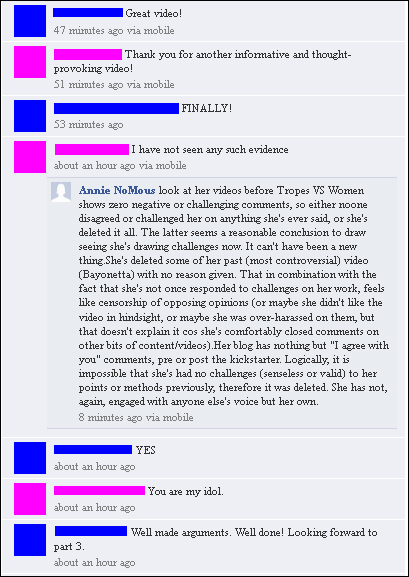
After this, I started keeping an eye out for any other comments that were likely to be removed but weren't abusive. I'm very happy to say that I found some. Spot the difference between these two screengrabs from Facebook. For the sake of privacy, I've blocked the identities of the people listed (blue for comments by men, pink for comments by women, purple if I wasn't sure):


It seems like "Annie NoMous" is a pseudonym -- not only does it sound very close to "anonymous" but I checked this person's profile at the time and it was completely blank -- but still, I can't see any reason why their comment was deleted other than the fact that it dared to question Anita Sarkeesian. "Annie" isn't alone either. Take a look at this. The first picture was taken on the 27th of May and the second one was taken yesterday:


Jason Wilkins here is an interesting case because even though his original comment was deleted, he wasn't blocked from commenting on the Facebook page. Anita -- or, if not her, whoever runs the Feminist Frequency Facebook page -- took issue with the suggestion that the Tropes Vs Women videos could be improved by (shock! Horror!) pointing out violence against men in the games featured in the video series. Incidentally, if you're interested, the video he linked to in his comment (twice, accidentally) was KiteTales' rebuttal to Anita's second Damsels In Distress video.

Regardless of how you felt about the comment from "Annie NoMous", can you honestly say that Jason Wilkins' comments deserved to be deleted? He was nothing but courteous and showered Anita's goals with praise. However, because he pointed out that Anita could be doing a better job than she was -- and a more equal job at that -- his comments were quietly, unceremoniously deleted. So how does it work? If Anita is showered with praise, her critic gets off with a warning but if they outright oppose her, they're given the full Stalin-esque "unperson" treatment?

For all of Anita's boasts about abusive comments "failing to silence" her, she has no qualms about silencing others at the drop of a hat. It's about as hypocritical as it gets but it's also no secret why she does it; if it makes Anita look bad, it's getting deleted. Think about it:
  • Youtube comments
  • feministfrequency.com comments
  • E-Mails
  • Facebook comments
Oh, and case you didn't know, Anita Sarkeesian's Wikipedia page is completely missing a "Criticism" section, unlike the vast majority of other public figures who analyse anything, not just popular culture. I'd also like to post the relevant part here, just on the off-chance that her page is updated with a Criticism section in the future but someone happens to read this blog afterwards.

(Left-click for a larger view.)
As if all that wasn't enough, Anita has censored herself on occasions when she feels like she's made herself look bad; she removed her Bayonetta video from Youtube after she realised that her dumbing-down of the story, missing the point of the main character's sexualisation and clear lack of experience actually playing the game made her come off poorly. It seems to be a similar case with her university research paper, "I'll Make A Man Out Of You: Strong Women In Science Fiction And Fantasy Television", where her famous take on masculine and feminine traits came from. It was once hosted on feministfrequency.com but she has since removed it. Feel free to download it here!

You see, Feminist Frequency is built on censorship and silencing. It's very image-based, with Anita portraying herself as an almost-flawless central figure. On its own, without Anita's boasts about the abusive critics "failing to silence her", disabling Youtube comments and not answering e-mails seems fine. That's up to her to do. With those boasts, however, censoring perfectly polite and rational criticism is the most hypocritical thing Anita could've done. People telling others that Anita's aren't all cracked up to be? That's a failing on her part, sure, but it's one that can be fixed. Censoring the people who are bringing that up, after singing your own praises about failing to be silenced? Hypocrisy.

Let's finish with something fun. After I was blocked from Facebook, I took a screenshot of the comments section of the "mansplaining" article that Anita linked to and it's interesting to see the comments that made the cut when mine were deleted. If you thought the comment Jason Wilkins was replying to above was ridiculous -- I was astounded to find that someone out there actually uses the word "womyn" -- take a look at a selection of the others that made it. I'd post all of them but the picture would be far too big:

Yeah, criticising Anita is off-limits but "going crazy with a baseball bat" is welcomed under the Feminist Frequency banner. You should see some of the comments I had to cut.

As always, feel free to leave a comment below (you won't be silenced!) or send me an e-mail at themalesofgames@gmail.com (I ... might ignore that. I don't check it every day).