Showing posts with label mgs. Show all posts

Thursday, 5 September 2013

I sense an incoming Metal Gear Solid backlash.

Earlier today, Hideo Kojima -- creator of the Metal Gear Solid series -- tweeted about wanting some of the characters of MGSV redesigned to be more "erotic". He cited appealing to cosplayers and selling more figurines of the game's characters as the reasons why he wanted these redesigns.

I suspect we'll be seeing some vexed responses to this in the next few days. Personally, I'm delighted.

First of all, I love how different the attitude towards sexualisation is in Japan compared to the West. When I wrote about Dragon's Crown, I brought up how the most sexualised characters broke my immersion in the game. From what I hear, the only mention of the exaggerated character designs in Japan was joking about how big a deal was made of it outside the country. Unfortunately, I haven't been able to find any Japanese articles saying that directly (obviously because the Japanese language isn't my forté and English isn't much use at finding Japanese articles in search engines) but I'd like to read some of them first-hand if I get the chance.

I'd love to be able to have that same nonchalant attitude towards sexualised characters in the media that they have in Japan. Logically, I can see why people would argue that living in a culture with so much fiction featuring sexualised women would lead people within that culture to have a lower opinion of real women; women being sex objects in games could lead to people viewing them as such in real life. Having said that, I completely disagree. If anything, I think that Japan's line between fiction and reality is more distinct; Dragon's Crown's art style can be joked about because it's clear that a sexualised, anime-esque mermaid doesn't represent real women in any way. The connection hasn't been made between reality and fiction in the same way it has in the West, so it's easier to view sexualised characters purely as entertainment.

That's just a guess, so don't quote it as if it's fact. The point is that I see the integration of sexual characters in everyday media to be a far healthier attitude than trying to stamp it out because we dislike it. There are times when I don't think it'd be appropriate but providing it fit in with the setting/art style and wasn't aimed at kids, I think it'd be fine.

Luckily, Metal Gear Solid isn't a series that has ever had to worry about a Dragon's Crown-level of controversy but it's odd to see so many people in the comments section on Gamespot condemning Hideo Kojima for his decision. I'm surprised at that and, even though I don't like to play the "they've probably never played the game" card, I feel it's appropriate in this case; for those of you who don't know, the Metal Gear Solid series has always had a light-hearted, almost Benny Hill-esque approach to eroticism. From figuring out which soldier is female by staring at their behinds to distracting lustful guards with non-nude erotica magazines, the Metal Gear Solid series, more often than not, treats eroticism as being funny. So why this response to Metal Gear Solid V?

Assuming Kojima's critics have played previous games in the Metal Gear series, it could simply be because Kojima is being so blatant. "I want to appeal to cosplayers and to sell figurines". Making decisions based on merchandising has left a bitter taste in the mouths of fanbases in the past, most notably for Star Wars. Perhaps it's because he joked that the CG model for Quiet -- the female sniper seen in the Metal Gear Solid V trailer -- being revealed this Friday would be "uncosplayable". Personally, I think that statement was just to create some hype for the reveal and possibly to get a rise out of people. If that's the case, it seems to have worked.

Quiet is dressed beneath the border of this picture, I should point out.

It's also very possible that they think eroticism has no place in video games; there are certainly a few comments underneath that Gamespot article that make the typical comments we saw during the Dragon's Crown controversy, such as erotica "only appealing to twelve-year-olds". There's also at least one mention of this kind of attitude preventing games from being "art".

I've never been particularly interested in the "are games art?" debate because, to me, it seems inconsequential; I enjoy games and that's all that really matters. I don't particularly care if they're recognised as art or not. Having said that, I have to wonder why featuring eroticism is enough to categorise a game as not being art. Not that I think the Metal Gear Solid V erotica -- if there is any, apart from Quiet's character design -- is going to be at all serious, in which case I have to ask why should MGSV change? If you've played the previous games in the series, noticed the light-hearted attitude towards sex (as well as other immature content like one character being the victim of constant diarrhoea jokes), then why should the next game in the series be any different?

As for erotica "only appealing to twelve-year-olds", I've often thought that an inability to handle erotica -- especially the comedic take MGS puts on it -- is a greater sign of immaturity than enjoying it. The Metal Gear Solid series is for adults, so why shouldn't adult themes be present? I can't help but feel that not featuring the light-hearted erotica in MGS would be comparable to putting your hands over a child's ears whenever you mention something sexual. Or trying to convince people that storks deliver babies. It exists, we might as well laugh at it.

I'd also quickly like to mention that Kojima stated he'd be revealing Quiet's CG model on Friday but he may not have been talking about her when he mentioned the erotic redesign; anyone who remembers MGS2's naked Raiden will know that the gentlemen of Metal Gear Solid aren't immune to comedic sexualisation either. I'd still place bets on Quiet but you never know.

Anyway, it'll be interesting to see how this develops over the next couple of days, before Quiet's CG model is revealed, and the fallout afterwards, until it's engulfed (hopefully) with news from the Tokyo Game Show.

Thanks for all the comments last time, by the way. Very interesting reading.

Added on 6th September 2013 - And, to the surprise of absolutely nobody, someone has complained! Someone rather high-profile too.

David Ellis, a designer on Halo, commented on Twitter after seeing Quiet's design "our industry should be better than this" and the "industry is full of man-babies". Take a look at the article here and I highly recommend reading the highest-rated comments below. They say everything better than I could. I'd never heard of David Ellis before this article but when I was in high school, Halo was the game that everyone talked about playing online. It was the precursor to games played by so-called "man-baby" audiences such as Call Of Duty so who is David Ellis to point the finger at anyone else?

And remember, boys and girls; designing a scantily-clad female sniper who works in the middle of the desert is wrong. On the other hand, designing a needlessly large-chested and scantily-clad female character who is literally an object is just fine!


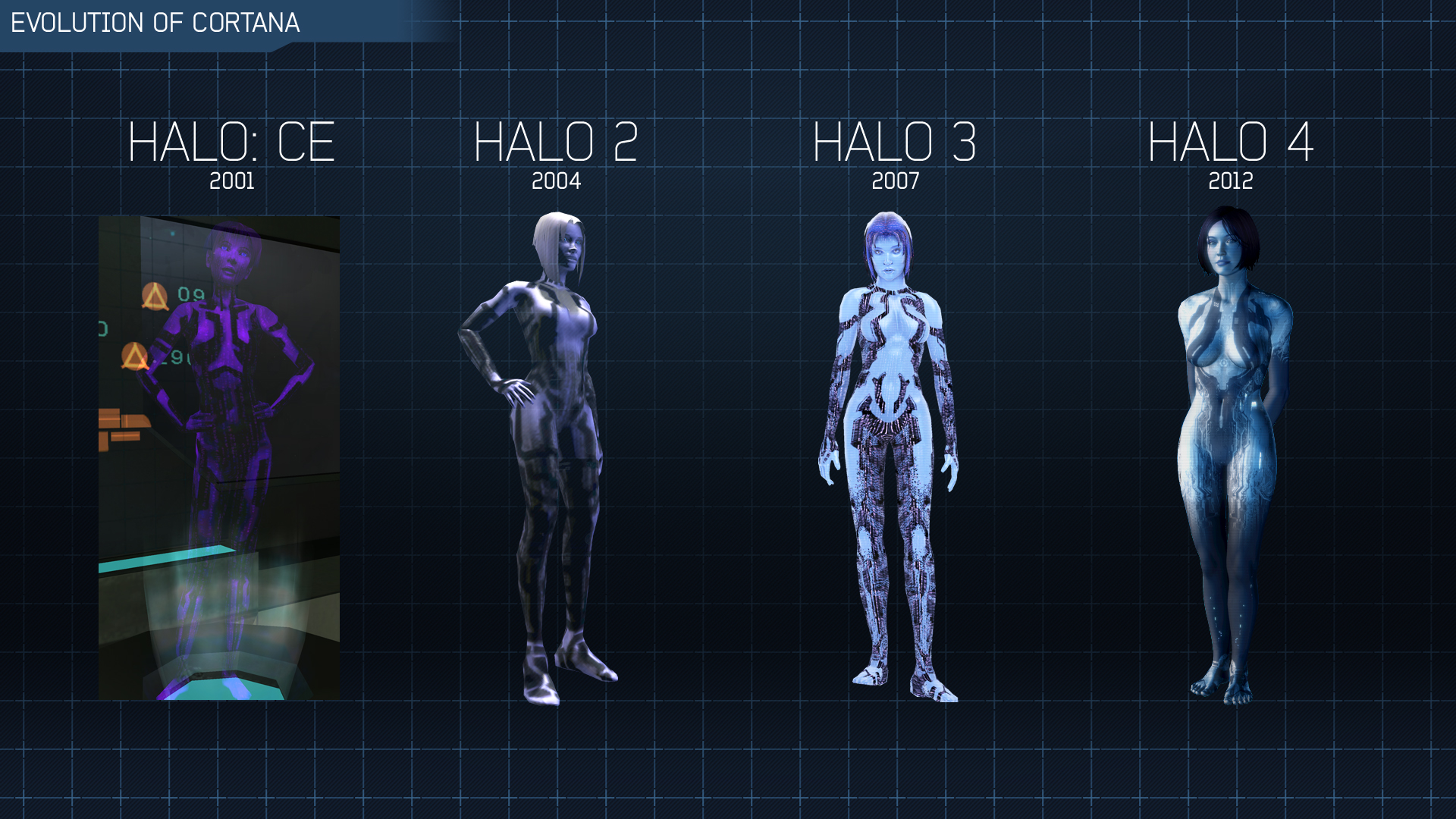
This picture is worth looking at if you want to see how Cortana became more sexualised when David Ellis and 343 Industries got their hands on Halo. A member of the NeoGAF forums also made a short and simple post about male sexualisation in the Metal Gear Solid series that didn't even mention naked Raiden. It's worth pointing to if anyone ever thinks Hideo Kojima only ever sexualises female characters.

As for David Ellis, I have no idea how anyone can be so hypocritical and yet so completely unaware, about both his own series' character designs and its "man-baby" influence. Speaking of which, it's disheartening to see just how many gamers, journalists and even developers casually throw out insults about immaturity towards people who have a different opinion to them.

I'm sorry for stating the obvious but there is nothing immature about people holding opinions different from your own, regardless of what the subject is. Insulting those people for having a different opinion, on the other hand, is very immature. That's something children do in playgrounds. If David Ellis really wants to talk about how "our industry should be better", I'd start with that.

Saturday, 3 August 2013

Damsel in Distress: Part 3 - Tropes Vs Women in Video Games

I've noticed a spike in viewers today because Dragon's Crown has been released. I'd like to get around to making another blog about that but, unfortunately, I live in Europe and our release date for the game is "Q3/Q4 2013". Amazon's estimate is October. Still, it's my birthday soon so I'll probably import it for that.

Of the three damsel in distress videos that Anita Sarkeesian has planned, this is the one I've been looking forward to the most. To me, this is the one that could make or break her arguments. As this is the video that concerns male damsels in distress -- or the "dude in distress" as she calls them -- how Anita treats this issue could be what sets the tone for the whole series.

At least to Anita's critics, this video could be the turning point. Maybe she'll try to justify the existence of male captives and attempt to dismiss it as an issue entirely. If that's the case, it's nothing particularly new and her critics have been justified in calling her arguments and examples cherry-picked and biased. On the other hand, maybe she'll treat male captives with the analytical eye they deserve; maybe she'll notice that they're not that different from female captives and perhaps she'll notice that men are tortured more often to create sympathy. If that's the case, maybe Anita can win over a few cynics. Maybe her videos won't be seen as a propaganda piece anymore and instead a more reasonable, if deeply flawed, analysis of sexism in video games for both men and women. When writing about part two of Anita's damsels in distress series, I stated, "when it comes to gender stereotypes, her heart is in the right place". That opinion has wavered a bit since then but who knows? Maybe Anita can come good at last and her silencing of others, her plagiarism of other people's videos and her misquoting of studies will just be stumbling blocks along the way.

I just hope that Anita has kept her own tweet in mind while making this video:


As of this writing, I haven't seen the video. So let's see what Anita has for us ...


Before I watched this video, I wanted Anita to say one of two things in this video; the first would be, "the dude in distress is a horrible, damaging trope because male damsels often have to go through torture and unsympathetic treatment that female damsels often don't". That's not quite my position -- I don't particularly mind damsels in distress if it makes sense in terms of the story but I do question why male characters have to be tortured to gain player sympathy -- but that would be something. The other thing I was hoping Anita might say would be, "I think having male damsels in distress is great because it's a deconstruction of gender roles and shows that the damsel plot device isn't gender-specific. It's a sensible and progressive attitude for developers to take regarding kidnapped characters".

Anita didn't take either of these stances on the subject. In fact, she didn't say much on it at all; only a third of the twenty-three-and-a-half minute video focused on the "dude in distress" and it was sharply dismissed with nothing more than a, "it's sexist when it's a woman. It's fine when it's a man". The rest of the video focused on more damsels in distress, with some focus on the use of "ironic sexism" in games.

So it looks like Anita has, in fact, chosen to be sexist by denying and dismissing the sexism against men that permeates our culture. You'd think she'd know better.

The funny thing is just how few games featuring "dudes in distress" Anita listed. She mentioned a grand total of six. I'd also like to point out that this was the first time I was made aware of the fact that, in Anita's eyes, the "distressed" character has to be the opposite sex of the hero character. Before now, I was operating under the assumption that the sex of the "damsel" was important but the sex of the hero was completely irrelevant. Even so, six games is still an incredibly small number to highlight. There was no mention of any of the games with male damsels listed in KiteTales' response to Anita's first video, all of which did feature female characters saving male ones. She didn't go into, say, Onimusha, a series that featured women saving men in all three games of the original trilogy. She didn't mention Raiden in Metal Gear Solid 2, having to be released from his torture device by a woman. Oh, and she didn't bring up this blog's favourite go-to game for sexism; Heavenly Sword. It wasn't long after she mentioned these six games that she rattled off a lengthy list of indie and mobile games featuring damsels in distress, as if to lessen the significance of the six games featuring "dudes in distress" that she brought up.

Still, let's focus on Spelunky, a game that Anita focused on because she believed it highlighted the difference between the "dudes" and the "damsels". Here's a couple of points Anita made beforehand:
"First there’s been no shortage of men in leading or heroic roles in video games or in any other creative medium for that matter. In fact one recent study found that only about 4% of modern titles are exclusively designed around a woman in the leading role. Since men are still largely the default for protagonists, the rare dude in distress plotline does not add to any longstanding gendered tradition in storytelling."
It's worth mentioning that the 4% statistic doesn't mean the other 96% of modern titles are exclusively designed around a male leading character; that 96% includes sports games and games where your character's sex is optional, bear in mind.
"Second, and perhaps more importantly, damsel’ed female characters tend to reinforce pre-existing regressive notions about women as a group being weak or in need of protection because of their gender, while stories with the occasional helpless male character do NOT perpetuate anything negative about men as a group since there is no long-standing stereotype of men being weak or incapable because of their gender."
First of all, there's nothing to suggest that damseled female characters reinforce any stereotypes about women as a whole; individual damsels do not represent women as a whole. They're also not necessarily weak or in need of protection because of their gender (and I'd be surprised if there were any games out there that outright stated that). Those are both stigmas that Anita herself has attached to female damsels. Much like her declaration that damsels in distress are more like property than people, it's a conclusion that Anita has arrived at without evidence. The stereotype may exist but a damsel in distress doesn't perpetuate it simply by existing.

Anyway, Spelunky was singled-out by Anita because the 2012 HD remake of the game featured the ability to switch out the large-chested female damsel with a "Chippendales-style hunk" or even a dog. So it was the perfect game to focus on the differences between male and female damsels. In Anita's own words:
"Setting aside the fact that – if a female character is easily interchangeable with a dog then its probably a pretty good indication that something is wrong – Merely providing an optional gender-swap is not a quick and easy fix, especially where stock character style damsels are concerned.
The two may appear the same, but they don’t mean the same thing in our culture.  This [damsel] is still a problem while this [dude] is not. Again because one reinforces pre-existing stereotypes about women, while the other does not re-enforce any pre-existing stereotypes about men."
Anita's argument is "these types of token role reversals do absolutely nothing to diminish the issues inherent in using the trope in the first place" but this is nothing more than her opinion. If anything, I think the fact that a female character being interchangeable with a man or a dog is a good indication that the gender (or even species) of the damsel isn't an issue; it is an easy fix, in that the damsel isn't particularly relevant to the story, nor is her gender and the fact is that she can't reinforce a pre-existing regressive notion about women as a group if she doesn't necessarily have to be a woman.

Not to mention that the hero doesn't have to be male, something that Anita failed to mention; even in the original game, the player could unlock a mode to play as a damsel and save spelunkers, rather than the other way around. The HD remake added playable female characters too.

This is another case of creating an unwinnable situation for developers. Regardless of the effort put in by the developer to create a more progressive game -- removing the gender issue entirely by providing the option of female playable characters and male (and animal) damsels in distress -- it's dismissed for its progressiveness and derided for its perceived sexism; when talking about "ironic sexism", Anita had no problem stating:
"In Spelunky the damsel can be knocked out, picked up, carried around and thrown at enemies before rewarding the player with an extra heart via a smooch of victory (if you manage to get her limp unconscious body to the end of each level while still alive that is)."
However, doesn't this completely ignore the facts that Anita provided above? The damsel doesn't have to be female but Anita still uses the game as an example of "ironic sexism" (in this case, parodying the uselessness typically displayed by damsels in distress). Again, I have to ask why isn't the issue removed when the genders are switched? In fact, if Anita can hold up the female Spelunky damsel as an example of a character reinforcing stereotypes about being weak and incapable, couldn't I do the same for the male Spelunky damsel and say that being thrown at enemies is an example of male disposability and reinforces the fact that we don't care about men in games? Which wouldn't make any sense because the gender of both the protagonist and damsels can be picked by the player.

Putting aside all the specifics, I can't help but call this what it is; hypocrisy. An attempt to rid gaming of female damsels while coming up with flimsy justifications -- or excuses, more accurately -- to keep male ones. We have to go back to the tweet at the beginning of this blog post; she's denying and dismissing the sexism that permeates our culture. It's Anita wanting to have her cake and eat it too. To plant her flag on the moon of victimhood and claim it for womankind, if I may use a horrible metaphor.

While that might sound like a snarky and grandiose thing to accuse Anita of, here's a couple of examples that I think will clarify it; one of the six (six!) games that featured a male damsel was a game called Primal, featuring the female protagonist's boyfriend, Lewis, being kidnapped by evil forces. The protagonist, Jen, develops some powers and goes to get him back. That's a very simplified version of the game's events but it sums up the basics. What Anita didn't mention is that Lewis, in addition to being a damsel in distress, is also the final boss of the game, having been brainwashed (again, an oversimplification), and he dies shortly after his defeat. There's a hint that he could return after his death but, if the after-credits scene is anything to go by -- Jen reading to Lewis while he is comatose -- it isn't a certainty. There isn't any movement in Lewis to hint that he'll awaken.


My big problem with Anita's coverage of this is that, while there's a hint in her video that Lewis dies, there's no mention of him being the final boss. There's no mention of Jen being the one who kills him. Given that the meat of Anita's second damsels in distress video was about the implications of domestic violence when a male protagonist attacks his brainwashed (or otherwise coerced) girlfriend in a video game, mentioning these facts would be the minimum I'd expect her to do.

Also, it really does have to be said that the lack of focus on protagonists saving damsels of their own sex damages Anita's point; like I said earlier, up until this video I was under the impression that the sex of the damsel was the only important thing, rather than the sex of the damsel and the protagonist. I'm willing to wager that more men are in need of rescue in games starring male protagonists than in games starring female protagonists. Yes, I understand that's due to a lack of female protagonists -- and more varied protagonists is something I'm entirely in favour of -- but there's a plethora of male captives to be found in games with male protagonists and by refusing to include them, Anita isn't painting a complete picture. It makes the "dude in distress" out to be rarer than it actually is.

Even worse is one of the links Anita provided as a source on her website. It's a link to a PDF file called "Spelunky & Sexism", archived from a site called "How To Not Suck At Game Design". It brings up the option to switch sexes (and species) of the protagonist and damsels in Spelunky and states "this is very progressive and forward-thinking. Great concept". After that, it quickly goes downhill (excuse the few spelling and grammatical errors. They were present in the original source):
"But in a concrete manner, it makes everything even worse. Since saving is not an option, you get to choose not who to save, but who to exploit and abuse. Since we do not have as much problems in pop culture and society with abuse of men for being men, the buff guy is not that much problematic as a damsel style. It still is kinda ugly to witness, but at least it does not endorse common real-life abuse.

Animal abuse on the other hand is quite real, so smacking a dog around and using the dog as shuriken, maybe accidentally killing him, really does not feel any better, then doing it with another human being."
If you've read some of my previous posts, you might know that concern over domestic violence against men was the "main" issue that caused me to identify as a men's rights activist. To say that the paragraphs quoted above make me uncomfortable is an understatement. In fact, I don't think I've ever read anything quite as ignorant about gender issues in the many years I've followed video game websites. This is stating the obvious but domestic violence against men is also "quite real" -- without wanting to be especially preachy about the issue, hopefully this article can shine a small spotlight on an incredibly widespread issue -- and not only is the writer of the paragraphs not above treating the abuse of men as secondary to the abuse of women but also the abuse of dogs.

None of the scenarios outlined endorse any kind of abuse -- whether the damsel is a man, a woman or a dog -- but it's quite despicable that the writer treats male victims of abuse as non-existent. I would've thought it'd be worse that the abuse of men in popular culture wasn't considered an issue and that's why it should be criticised, rather than swept under the rug as "not that much problematic". Unfortunately, the writer of the paragraphs above takes an attitude of "if it ain't broke, don't fix it" or "if the masses don't consider it an issue, I won't make it one". How a site can completely unironically be titled "How To Not Suck At Game Design" and then provide such a blatant double standard, I'll never know.

So both Anita and her sources are determined to dismiss the poor treatment of men to perpetuate the victimhood of women. Even so, this may be the first time I've been more irritated by Anita's sources than her videos. Having said that, in spite of the speech I've written above, there wasn't very much in Anita's videos to feel annoyed by. Oh, it was bad; if you thought Anita was judgmental of Shigeru Miyamoto, wait until you see how she treats indie developers. Although apart from that, the rest of the content was just there and aside from Spelunky, I'm mostly critical of what wasn't in Anita's videos rather than what was. So her sources bother me a lot; there aren't any misquoted studies this time around (as far as I'm aware) but a couple of the sites linked to are just complaints about Fat Princess.

Which leads us to the content that makes up the second two-thirds of the video and honestly, I don't have much to say about it. There are only three things I want to write about regarding Anita's commentary on "ironic sexism".

One. Personally, I've always thought that no topic should be off-limits for comedy. I hope I'm not the only one who wonders how Anita would react if she watched a controversial stand-up comedian. It's certainly within an indie developer's right to portray the damsel in distress -- or anyone else -- satirically. It doesn't have to fall within the bounds of Anita Sarkeesian's narrow view of satire; "There is a clear difference between sexist parody and parody of sexism. Sexist parody encourages the players to mock and trivialize gender issues while parody of sexism disrupts the status quo and undermines regressive gender conventions."

Some of the games listed certainly deconstructed and parodied the damsel in distress more than Anita gave them credit for but earned criticism because they didn't fit her definition of "parody". More on that in a second. This really is a case of "if you don't like it, don't play it" though. Satire is not Anita's to dictate and trying to do so just makes her seem entitled.

Two. When talking about indie games, Anita falls into the same traps as she did in her first episode when discussing retro games; rather than simply accepting that developers either don't have the time, the budget or just the wish to implement a deep storyline. Her accusations towards Super Meat Boy stand out in particular; she shows the game's intro sequence, which is an almost frame-for-frame remake of the the intro sequence from 1989's Adventures Of Lolo. Rather than accept it for the homage that it is, Anita brands it "a shallow meta-commentary" and criticises it for not "challenging or disrupting what the damsel in distress trope says about the role of women in such narratives".

... Who said the developer had to? Anita goes on to praise games such as Fez and Superbrothers: Sword & Sorcery EP simply because they don't fit this mould. The problem here is that there's nothing wrong with Super Meat Boy paying homage to a retro game with its intro sequence but it still faces Anita's ire because ... it's not the retro quality she wants to see in a game. Again, this comes across as very entitled on her part. Rather than listing examples of games with damsels in distress, she's passing judgment based on preferences. This isn't the critical analysis that Anita claimed on her blog. It's closer to a soapbox or pulpit.

Three. This quote:
"The bad ending of the indie game Eversion (2008) features a similar joke; when the hero finally reaches the princess, she turns into a monster and eats you alive.
A similar end game punchline can also be found in Castle Crashers (2008). After you’ve saved the 4th princess, and then fought and killed your friends over who gets to claim her, it turns out that she has horrible clown face.
In each case the joke derives from the fact that after completing the long and perilous journey to save his woman, our hero is hilariously cheated out of his “rightful” reward."
When I watched the video for the first time, the exact thought that ran through my head was "okay, so the male hero is the butt of the joke; he gets eaten in one ending and in the other, he's deprived of any satisfaction when it turns out the princess has a clown face (and therefore has probably tricked the hero)". So how did Anita follow that up?
"In other words the comedy comes at the damsel’s expense."
 ... How? No, really, I mean how!? Only Anita Sarkeesian could see a princess eating a male hero as a sign that the damsel is being made fun of.

If I might go off on a tangent here, a few years ago I was watching any and all US comedy that I could to see if anything caught my attention. I became a fan of a few series that I'd never seen before, like Cheers and Scrubs, while some others fell by the wayside, like King Of Queens. One of the series that didn't make the cut was a sitcom called Just Shoot Me, starring David Spade. One episode featured Spade's character faced with the prospect of having a threesome with two women and as a result, he was able to persuade every male character he ran into that day to help him out because none of them wanted to ruin every man's dream (sarcasm) of being with two women at the same time. Here's the relevant part of the episode on Youtube. It ends with him being tricked, the two women who promised to have a threesome with him orchestrating an argument so they'd have an excuse to go back on the deal.

In this case, we're supposed to laugh at Spade's character. He's the butt of the joke. His sexuality and lack of sexual gratification is the butt of the joke. All the men who help him and appear at the end to applaud him are the butt of the joke too; they've all been fooled and we're meant to laugh at men for being so gullible.

The reason I'm writing all this about Just Shoot Me is because I heard a theory that Anita said "the comedy comes at the damsel's expense" because the damsel's value is supposedly lessened in the eyes of the male heroes because they turn out to be ugly (and therefore, not what the hero wants or expected). I couldn't disagree more; the damsels are no worse off than they were when the male protagonist thought they were just regular old princesses. The male protagonists, however, are David Spade's character in Just Shoot Me. They're the dorks and losers who don't get the reward they were hoping for and we're supposed to laugh at them for it. The damsels aren't devalued in any way. The damsels win.

The male protagonist is made to look stupid in these situations (or dead, in Eversion's case). While I see them as individual instances, the fact is that if Anita really is against "reinforcing pre-existing stereotypes", she really could do worse than starting with Castle Crashers. Given that Anita somehow manages to warp even that around to being offensive to women, however, that's obviously never going to happen.

Anyway, that brings this lengthy post to an end. I'd like to say that I won't watch another Feminist Frequency video but I think we all know that's a complete lie. Besides, with a brand new topic, the next time I write about a Feminist Frequency video, it'll seem more fresh. I really can't stress enough just how little of this video interested me. If anything, I was just disappointed that Anita acted so predictably, dismissing "dudes in distress" without much of a fanfare or even an interesting argument. If not for Spelunky, this blog would be much, much shorter. Again, we just have to look back on Anita's hypocritical tweet -- which I honestly did take a screenshot of before I ever saw the video -- and realise that the chances of her ever giving men's issues a fair hearing are zero.

Well, whatever. Feel free to leave a comment or send me an e-mail at themalesofgames@gmail.com.
Wednesday, 24 July 2013

Women Are More Innocent (and more on Anita Sarkeesian)

Women aren't as evil as men. Everyone knows that! Although in case you didn't, game developers have a helpful way to educate you; if there's a female villain in a game, she's the most likely of the bunch to switch to the heroic side or she'll have been hypnotised or brainwashed into being evil instead. One of the two.

Although I try to avoid referring to TV Tropes too often -- I'm a fan of the site but I know Anita Sarkeesian is criticised for taking it at its word a few too many times -- but it has some information on this on the "High Heel Face Turn" and "Females Are More Innocent" pages. The "Sorting Algorithm Of Face Heel Turning" is also worth a quick look ("face" and "heel" are the professional wrestling terms for "good guy" and "bad guy" respectively, in case you didn't know).

The "High Heel Face Turn" trope gets the basic point across but I think it's missing something; going by the definition on that page, the female villain would have to be the lone female on a team of villains to qualify. Not that it's incorrect or any better when it's only a single female villain rather than several but I can think of a game series where all the female villains either switch sides, aren't as villainous, are coerced into being evil via brainwashing or repent how evil they are shortly before death. If you don't want to be kept waiting, I'm thinking of Metal Gear Solid.

Let's start with some others though. Back when I blogged about Batman: Arkham City, I wrote the following:
"There are barely any bad women in the game. Catwoman is an anti-hero. So is Talia Al-Ghul and her all-female army of assassins. Poison Ivy keeps to herself. Harley Quinn is the closest thing to "evil" a woman gets in the game and she plays the comic relief role."
Meanwhile, Mr. Freeze is the closest the game has to a male villain switching sides. He's a lot like Poison Ivy, in that he wants to keep to himself. Even so, he acts pretty selfishly; while Poison Ivy only attacked when Catwoman entered her territory, Mr Freeze shattered a vial of a cure that could save Batman from the illness that plagues him throughout the game purely out of spite. Well, leverage supposedly -- he wanted Batman to help get his wife back but there was nothing to suggest Batman wouldn't have done so anyway -- but clearly spite.

One of the traits that is always present in Mortal Kombat's messed-up canon is Kitana shaking off her brainwashing and joining the good guys. She's raised to believe that she is the daughter of the villain, Shao Kahn, but it doesn't take long for her to find out the truth; that Shao Kahn killed her father, forced her mother, Sindel, into marrying him and adopted Kitana himself. Kitana switches sides, as does her best friend, Jade. Jade was only siding with the villains to keep watch over her best friend. Depending on the timeline you look at for the Mortal Kombat games, Sindel may follow suit and join the heroic side too (but in that particular timeline, so do Ermac and Smoke ... and Raiden turns evil. It's a bit of a mess as the series continues). Kitana and Jade's side-switching is a mainstay of both the old and new Mortal Kombat timelines though, so it looks like there's no way of keeping them evil.

Even in games where the male and female villains are evil for the same reasons, there can be subtle differences. Take the first Mass Effect game, for example. Saren (a male Turian) and Matriarch Beneziah (a genderless Asari but physically female, like all Asari) are both evil because they're in the thrall of Sovereign, a massive ship-slash-AI with mind-controlling powers. Even then, however, Beneziah is given a more sympathetic backstory than Saren.

Then there's Metal Gear Solid, a series where all the female villains have excuses for being evil. In Metal Gear Solid 2, Olga Gurlukovich switched sides because her daughter had been taken from her by the real bad guys (which is an oversimplification but for the sake of this blog, a longer explanation isn't needed). Fortune also turned against at least one of her former villainous colleagues, going so far as to save the good guys' lives before dying of a gunshot wound. In Metal Gear Solid 3, we had The Boss. Long story short, she was never evil. She posed as being evil but the actions of one of the villains led to her plan spiralling out of control and she eventually had to be killed. In Metal Gear Solid 4, there's an all-female team of villains called the Beauty & The Beast Corps. All four women share the same backstory; they all suffer from post-traumatic stress disorder. Their fragile mental state was exploited and they were each given hi-tech suits to make them deadly soldiers. They're tragic figures more than anything else (or they would be, with a bit more character development).
Sniper Wolf from Metal Gear Solid is the only female villain who didn't either switch sides before dying or get her start by being coerced or brainwashed. Even she is given the noble death that she wants and isn't as much of an extremist as some of the other MGS villains. A few other male villains receive treatment along the same lines as Sniper Wolf -- Vulcan Raven, for example, and Grey Fox is probably more of a tragic figure than anyone in the B&B Corps -- but none along the same lines as, say, Olga or Fortune. Even characters who are supposedly doing good things resort to extremist tactics to do so; this turned out to be Revolver Ocelot's schtick by the end of the series.

This isn't to say that you won't find male villains switching sides or female heroes crossing over to join the bad guys. These few examples aren't the be-all and end-all of female turncoats either. All the games listed do have examples of male characters either switching sides or being coerced into being evil ... but often, the subtle differences between the male and female villains send out different messages. On its own, a female villain switching sides wouldn't matter very much but it raises questions when male and female villains are evil for the same reasons -- like Saren and Beneziah -- but the woman comes across more sympathetically than the man. It's hard not to wonder if there's a motive when, in a game with an even split between male and female villains -- like Arkham City or the Metal Gear Solid series -- the male villains are more evil than the female ones. There's no real reason for it and it can feel like a slightly insulting gesture.

Anyway, onto other things; there are two big important pieces of news this week. Firstly, the blog has a banner! It doesn't fit properly! I'm too lazy to fix it!

Secondly, a blog called Vicsor's Opinion rooted out something surprising about Anita Sarkeesian's damsel in distress videos; none of the game footage shown in the videos were recorded by Anita herself. They all come from Let's Play videos on Youtube and the owner of the blog, Vicsor, has comparison screenshots to prove it. He also made sure to contact some of the owners of the channels hosting the Let's Play videos and posted a reply on his blog to confirm that Feminist Frequency did not contact them to request permission to use their videos in her series.

So what does this mean for Feminist Frequency? Well it doesn't confirm anything except for the fact that Anita didn't use any of the $158,922 she received from Kickstarter to invest in a capture card. It throws up a lot of questions about how the money is being spent, however; we don't know whether there's been any investment in audio/video equipment at all, given that there's no visible or audible change in the quality of Anita's videos. The only difference is a new introduction logo. We also have to wonder if the many months in-between Anita's videos are spent playing games or simply watching Let's Plays. I know it sounds cynical and before this information came out, I wouldn't have even suggested it but hey, who's to say now that it turns out Anita didn't use her own footage?

This is just another addition to a long line of Anita's screw-ups. Questionable money-making methods. Flawed, occasionally sexist arguments with cherry-picked examples. Complete bastardisation of a study to fit the point she wanted to make. And now, stolen footage.

Anita's supporters may think I'm being too harsh. Maybe she doesn't own the games she took footage from. Maybe some were too old to get hold of and it wasn't wise to invest in dated games and consoles. Maybe they were released after she went on the initial spending spree that produced this famous picture. Even so, none of those points explain why she didn't ask permission to use other footage from other people's Let's Play videos. The only explanations for that is that she was either hiding behind "fair use", she didn't think she'd get caught or she arrogantly didn't think she had to ask permission. It's also worth mentioning that on Feminist Frequency's Kickstarter page, Anita states that she plans to reward large donations with a DVD featuring all the episodes of her Tropes Vs Women In Games series. It isn't clear whether she actually plans on selling these DVDs -- personally, I doubt it, considering how large a donation it takes for just one to be given away -- but even giving them away will probably be difficult if even one person takes offence to Anita using their footage in her series.

You know what else this means? Any one of the people whose footage was taken has a legitimate reason to flag Anita's videos as inappropriate and have them removed. I don't believe their case will be watertight but as far as I can see, they may have a chance with factor one of the fair use guidelines. Time will tell.

As always, feel free to leave a comment or e-mail me at themalesofgames@gmail.com

Saturday, 9 March 2013

Damsels In Distress: Part 1 - Feminist Frequency Returns

Anita Sarkeesian posted the first video of her Tropes Versus Women in Games project, so let's get right to it:


A transcript is also available at the Feminist Frequency site. This video deals with damsels in distress in games that were released pre-2000 (with the exception of Star Fox Adventures). Part two will highlight examples up to the present-day.

I don't have as much to say about the video as I thought I would, partly because I've gone over some of her arguments before but also because I was never a Nintendo owner. I had an Amiga and then a Playstation when I was young. I did own an N64 but my Playstation was always my priority when it came to owning games. So I can't leap to the defence of Mario and Zelda -- Anita's two staples of this video -- as much as some others can and, obviously, I don't have $158,000 at my disposable to invest in the games Anita has. I'll do my best anyway.

First of all, Anita does seem to be making an effort to be more professional than she used to be. She goes into historical examples of the damsel in distress, from Perseus to the pulp magazines of the early-to-mid-1900's. It seems to be an attempt to give the video some gravitas and her argument more weight but personally, I thought it did more to hurt the argument; it shows how ingrained the damsel in distress plot device is in our society and how unlikely it is to change because of Anita's criticism.

Let's start with Anita's critique of the writing in these games. The impression I got from the video was that Anita shows either an unwillingness or inability to understand the time period she's discussing; she refers to the hero rescuing the damsel in distress as an "excuse plot" and "lazy justification". Some of my regular readers will recall that I've actually been over this before: 
"In the case of the damsel in distress, that's a trope that was used long before video games had writers, or at least writing as a main focus, and it was used as an excuse to put the main character on an adventure ...
Should these games be held to a different standard, just because they're old? Well, I'm not saying that but it's important to recognise that storytelling wasn't as important then as it is today and gameplay was everything."
Back then, I also said, "let's just say that these are my first impressions and what I hope Anita will end up putting in the video". She did, as it turns out. So these games did have excuse plots, as Anita says, but it was intentional because gameplay was the priority. There was never an issue with how women were portrayed either because they were unlikely to be scrutinised by mainstream critics without good cause, like the violence in Mortal Kombat.

I can't help but wonder if Anita will acknowledge the ways that games have improved. Annoyingly, I've written about this before too:
"It'd do the games listed a disservice if it wasn't mentioned that so many of them have gone to great lengths to eliminate damsels in distress from their games. Take Crash Bandicoot as an example. Tawna, Crash's girlfriend from the first game, is featured on Anita's Tumblr and it's also a classic case of primitive storytelling. The second game featured vastly superior writing, got rid of Tawna and added Crash's brainy little sister Coco to the roster too. In the third game, Coco became a playable character. Even Resident Evil has come along in leaps and bounds since Resident Evil 4, adding female co-op companions in 5 and 6 in place of Ashley Graham.

Speaking of which, I have a question: does having a damsel in distress in a game somehow negate the strong female characters? If Ashley Graham is a strike against the Resident Evil series, shouldn't Jill Valentine, Claire Redfield, Ada Wong and Rebecca Chambers all work in its favour? Isn't there some leeway given to games that have a
good record for female characters? Because the problem with the way Anita is framing this trope -- and all the tropes she intends to talk about -- is "damsels in distress = bad". That's a problem. It's an attitude that limits creativity and reduces the number of elements writers are allowed to use.

I want to stress again that these are just my first impressions. So we'll wait and see what Anita actually delivers in her first video and I'll have more to say on the subject then."
I don't wish to brag but I do seem to have a good handle on Anita's presentation. Sure enough, the damsels in distress video did feature brief clips of both Tawna from Crash Bandicoot and Ashley Graham. I think we'll have to wait until next time to hear more about Ashley though.

The one game that I want to focus on that Anita did mention, however, was Prince Of Persia. She criticised both the original 1989 game (which I owned on the Amiga) and the 3D remake on modern consoles for featuring the Sultan's Daughter as a damsel in distress. I can't help but wonder if she'll include the Sands Of Time series and the reboot. Can we expect to see the strong Farah, Kaileena and Elika being praised or does the damsel in distress of the original game overshadow those three? We'll probably have to wait until Anita's "good female characters" video(s).

Prince Of Persia comes up again later but before I get to that, I want to write a little about Dinosaur Planet, a game Anita discusses at the start of the video. As she describes it:
"The game was to star a 16 year old hero named Krystal as one of the two playable protagonists. She was tasked with traveling through time, fighting prehistoric monsters with her magical staff and saving the world. She was strong, she was capable and she was heroic."
Dinosaur Planet would go on to become Star Fox Adventures, the third game in the Star Fox series, and Krystal would go from being the heroine to being the damsel in distress. I can see how it would be frustrating to have a (possibly) strong female character taken away from you like that. However, I'd like to compare Anita's reaction to Krystal to her reaction to Super Mario Bros. 2, where Princess Peach was a playable character for the first time.

There are probably some people reading this, particularly Mario fans, who know that the version of Super Mario Bros. 2 released outside of Japan was actually a game called Yume Kōjō: Doki Doki Panic that was given an overhaul and turned into a Super Mario game for the West. The original characters were changed to Mario characters instead. Take a look at what Anita has to say about it: 
"However the Japanese game already had 4 playable characters, so the designers opted to include Toad and the Princess to fill the two remaining slots, building directly on top of the older pre-existing character models. So really, if we’re honest, Peach is kinda, accidently playable in this one.
Still, she had the awesome ability to float for short distances, which came in really handy especially in the ice levels."
So Anita praises Peach's abilities in this game but dismisses her because she's "kinda accidentally playable in this one", as it wasn't originally a Mario game.

Hold on though, couldn't you say the same thing about Krystal in Star Fox Adventures? She's "kinda accidentally a damsel in distress" because it wasn't originally a Star Fox game? After all, Dinosaur Planet was another game that was revamped into a different one with more name value. So shouldn't that one not count -- or not be as bad an offender -- because it was originally a different game entirely?

I don't think so. I think the logical thing to do would be to dislike Star Fox Adventures more and consider Krystal a worse example of a damsel in distress but be more grateful that Super Mario Bros. 2 made Princess Peach a tough and fun female character to play as. For some reason, however, Anita seems determined for Peach to maintain her status as a damsel in distress; even without the Super Mario Bros. 2 example, Anita dismisses her appearances in the Smash Bros. series because they're spin-offs. "Outside the core Super Mario titles", as she states. I don't understand why Anita does this. She practically begs for fewer damsels in distress but comes up with rather superficial reasons to dismiss the characters when they're taking action. Remember the no-win situation I wrote about last time? It's still there.

One thing that Anita doesn't seem to realise about Princess Peach that even I, as a non-Mario player, understand is that she established many of the tropes for damsels in distress -- in video games, at least -- and therefore being a damsel in distress is expected of her. Anita is a fan of TV Tropes, isn't she? So how has she never heard of the "Trope Codifier"? Someone (or something) that embodies many of the traits and characteristics of a particular trope. In this case, the damsel in distress. Yet in spite of Princess Peach actually being such a notable example, Anita would like her (and Zelda) to take on a role as an action star in her own right.

I know that doesn't sound so bad -- more strong female playable characters is a good thing, isn't it? -- but why Peach in particular? Why such a notable example of a damsel in distress? Why not create a character specifically for that purpose, like Lara Croft, Alyx Vance, etc, etc. than reappropriate Princess Peach?

Well, as I wrote in my quote above, the way Anita is framing this trope is "damsels in distress = bad". They have no place in Anita's ideal view of gaming. Personally, I disagree with this. I believe there's a place for damsels in distress -- both male and female -- in gaming and to want to eliminate it as a plot device entirely is a desire to clip the wings of creativity.

One final thing I'd like to point out about this first video is, of course, the treatment of men. When talking about Double Dragon at the end of the video, Anita says:
"The now iconic opening seconds of the 1987 beat-em up arcade game Double Dragon has Marian being punched in the stomach, throwen [sic] over the shoulder of a thug and carried away. In several versions her panties are clearly shown to the player while being abducted.
The game has been remade, re-released and ported to dozens of systems over the last 25 years, ensuring that Marian will continue to be battered and damseled for each new generation to enjoy. Most recently Double Dragon Neon in 2012 re-introduced new gamers to this repressive crap yet again, this time is full HD."
The problem is that earlier on in the video, Anita shows clips of several men who are captured at certain points during the game. I know she wrote to her Kickstarter backers that the "dude in distress" was something she wanted to cover in the damsel in distress videos but I sincerely hope that this wasn't it. We saw clips from Metal Gear Solid, the original Prince Of Persia, GoldenEye, The Legend Of Zelda: The Wind Waker, Star Fox Adventures and Metal Gear. For one thing, all of the examples Anita gave from those games involved the main character, so it'd make for a poor game if the hero had to sit around and wait for someone else to rescue them (which actually was an option in Metal Gear Solid; the Cyborg Ninja would come to Snake's rescue if the player was unable to escape. Since I could never get the "ketchup as blood" or "hide under the bed" tricks to work, it was also the option I always took).

In short, if Anita doesn't mention "dude in distress" examples that even I have been able to come up with, questions will be asked. I'm confident that she will, possibly in a third video, but she'll attempt to come up with justifications for them in a way that she doesn't for damsels in distress.

Anyway, on the subject of men who are in captivity, Anita has this to say:
"Let’s compare the damsel to the archetypal Hero Myth, in which the typically male character may occasionally also be harmed, incapacitated or briefly imprisoned at some point during their journey.

In these situations, the character relies on their intelligence, cunning, and skill to engineer their own escape — or, you know, just punching a hole in the prison wall works too. [Metal Gear reference]
The point is they are ultimately able to gain back their own freedom. In fact, that process of overcoming the ordeal is an important step in the protagonist’s transformation into a hero figure.

A Damsel’ed woman on the other hand is shown to be incapable of escaping the predicament on her own and then must wait for a savior to come and do it for her."
There are three points to be made about this: firstly, because Anita is using examples of main characters and comparing them to women who aren't main characters, it's false equivalence. The two can't be compared because the developers of the six games listed above wanted their prison escapes to be playable sections in the game. It would be closer to compare something like being arrested in Grand Theft Auto; "inescapable of escaping the predicament on [his] own and then must wait for a savior to come and do it for [him]" (who usually wasn't seen but in GTA: Vice City, we occasionally heard Tommy Vercetti's lawyer, Ken Rosenberg, pleading Tommy's innocence whenever he was arrested). That's a closer comparison and that's still using a main character. For that matter, the Metal Gear Solid heroes all needed help escaping too. There was the aforementioned Cyborg Ninja in MGS1, Olga Gurlukovich releasing Raiden from the torture device in MGS2 and The Sorrow giving Snake the radio frequency to open the door to his cell in MGS3. They were all helped, or had the option to be helped.

The second point is the way Anita ignores female heroes who use their intelligence, cunning and skill to engineer their own escape. In my last blog post, I linked to a video of Rubi Malone from Wet escaping torture. Her escape happened a bit too suddenly for my liking but still, it happened. She shows no weakness or fear while being tortured either. Final Fantasy X's Yuna would qualify here too, while held captive in the Via Infinito. She starts alone but can meet up with other imprisoned party members along the way. In spite of their help against regular enemies, Yuna fights the boss of the area on her own and is more than capable of defeating him.

It's frustrating that all of my examples come from games that were released post-2000 (with the exception of Metal Gear Solid) but I'll treat it the same way I did before Anita posted the first video; these are just my first impressions, so let's wait and see if Anita actually delivers what I think she will.

The third point is simply this; if Anita takes issue with Marian being battered at the beginning of Double Dragon, how can she show Snake from Metal Gear Solid, who received much worse while he was in captivity and consider it less of an issue just because he escapes on his own? Is it because Marian is innocent while Snake is battle-hardened? I could see how that would make a difference if Snake simply received a punch in the stomach too but the severity of his torture was so much worse too. Sorry but if violence against fictional women is a serious enough issue that Anita feels the need to refer to it as "repressive crap", shouldn't the same weight be given to games where fictional men are victims of violence?

And by the way, these guys are villains! Since when has it been wrong to show villainous people doing villainous things? The game makes it clear that violence against women is discouraged and the people doing it have no redeeming qualities whatsoever.

I've spent a long time writing this and probably forgotten as much as I've written. There are a few things that I wanted to write that I've either just plain forgotten or that we have to wait until Anita's second video to find out. So I suppose that'll do for now. I would like to say that I wish Anita would stop using terms like "patriarchy" and "male power fantasy". To me, terms like those always mean the same thing: "I've finished thinking". Anita's examples have always come across as rather biased in my opinion, so the least that she could do to make them more palatable is to express them with plain English and not terms that plenty of people question anyway. Because then, all she's doing is backing up questionable research with more questionable research and wading through the first level of nonsense, such as patriarchy, to get to the second, the actual videos is something that can turn people off.

I also didn't mention much about the money she earned from the Kickstarter. Well, it doesn't look like it made much of a difference to the video quality. There's a snazzy new intro but that's about it. I was hoping the $158,000 was for more than the games and to live off but I guess that wasn't the case. Other people will have more to say on the money than me (such as this entertaining write-up, which is more informal than mine but also more entertaining) but I do have one question; what on Earth did she need the original $6,000 for?

The final thing I'll leave you with before I go is one of Anita's videos that I only got around to watching very recently, about Twilight. It's only 1:21 long. See if you find it as condescending towards men as I do:


She basically treats men like children. She claims that the guys she spotlighted wanted Edward to be "physically abusive", which was not the case. They actually said they wanted him to be "badass". She wants you to hate Twilight for the reasons she hates it and not the reason that you hate it. Different opinions apparently aren't welcome in Sarkeesia. Which is probably why she disables the comments.

According to gaming sites around the time of the Kickstarter, this is the woman we should've been supporting. We should've been decrying the sexism against women and supporting Anita's brand of sexism against men.

I wonder if there's more of that to come in future videos.

Wednesday, 20 February 2013

The Torture Double Standard


I had two topics in mind for this blog post. One was about good female characters and how they tend to get overlooked in favour of the bad ones. I can save that for next time. There were two reasons I settled on the torture double standard instead. The first was because I'd already mentioned it in my last post. The second, surprisingly, was thanks to Feminist Frequency and the Tropes Versus Women Tumblr.

I've been checking the Tumblr since it was created, just to see which games make the list. However, after my mention of torture in Dishonored in the last blog, there was one game that I was actually hoping would be added: Final Fantasy VIII. Two days ago, it was.


I wanted FFVIII to be added because if they did, in my opinion, it'd be a perfect example of the double standard that Feminist Frequency promotes when picking the games they want to catalogue. Now, Final Fantasy VIII does feature a damsel in distress; Rinoa, the love interest, pictured above. That's the picture posted on the Tropes Versus Women Tumblr, although personally, I wouldn't have picked that one. I would've chosen a moment earlier in the game, when Rinoa is backed into a corner by two Iguions (half-iguana, half-lion monsters) and the main character Squall has to rush in and save her. The moment pictured above is shortly before Rinoa would have been blasted into space in a device designed to suppress her sorceress powers (it's a long story) and Squall rushed in to get her. However, this isn't a damsel in distress moment because Rinoa actually goes willingly. It's more like a moment in a romantic comedy where the hero rushes through a crowded airport to try and stop his love interest from getting on the plane. Albeit a Final Fantasy-ised version ...

The reason I wanted to single out FFVIII for the double standard was because, with the exception of Irvine, all of the six main characters in the game are damsels in distress at one point. Except for Irvine, they're all held captive in a prison in the middle of the desert. Negotiations are made for Rinoa's release and she talks Irvine into returning to the prison to save their friends, who are pinned down by gunfire at that point.

Squall, however, is given the worst treatment. He's severely beaten by his nemesis, Seifer, and then tortured for information that he doesn't have (and, in fact, doesn't exist).


Not only is this an example of a game on the Tropes Versus Women Tumblr that features male characters in distress as well as female ones but also an issue where men are predominately the victims but isn't considered an issue; torture.

Right from the off, I'll point out that men aren't always the ones being tortured. I don't have a list as comprehensive as Feminist Frequency does, so I'm putting a lot of faith in the examples listed at TV Tropes instead. From my own experiences though, Star Wars: Knights Of The Old Republic is the only game I can recall that features a woman being tortured. It actually doles out the torture relatively equally -- the Sith like to use Force Lightning to torture prisoners and even potential recruits, both male and female -- but the most high-profile character that suffers torture is Bastila Shan, the first named Jedi the player meets.

In spite of that example, however, torture does seem to be directed at men more than women. Most people who've owned a Playstation in the last fifteen years will recall Metal Gear Solid's torture scenes very vividly. They were significant moments in MGS1, 2 and 3, to the point that it was a surprise when the fourth game didn't feature one. The first two games featured Solid Snake and Raiden, the main characters in their respective games, being bound to a metal slab -- much like Squall in the picture above, actually -- and being tortured with electricity. The third game featured a much more grisly example. It featured Naked Snake being bound from the ceiling by his wrists, suffering beatings and electric shocks until he wet himself, and it ended with his eye being shot out (albeit accidentally, although had the bullet gone where it was supposed to, Snake would've been killed).

Fans of Metal Gear Solid 1 will point out that it's possible for Meryl, Snake's naïve companion-slash-misandrist extraordinaire, to be tortured too. If the player chooses for Snake to give in to the torture, Meryl is supposedly subjected to the same treatment and dies (and the player gets an alternate ending). However, there are two reasons this doesn't really compare to the torture of the male MGS heroes, Squall or even Bastila. First of all, it happens off-camera. There's a logical reason why -- we follow Snake's story and, since he doesn't see or hear Meryl being tortured, we don't either -- but nonetheless, we're exposed to Snake's pain and not Meryl's. Secondly, it's not "canon"; Meryl isn't actually tortured according to the game's storyline, doesn't die and is still alive for Metal Gear Solid 4. So, while I don't want to say "Meryl's torture may as well not have happened", because I feel like that undermines the seriousness of the story if you take that choice, it's clearly not in the same category as the torture of Solid Snake, Squall or Bastila. Just like I'd say none of those are in the same category as Naked Snake's torture in MGS3.

One last thing to note before I move on from MGS is Tropes Versus Women's damsel in distress pictures of Meryl. They post three of them, all showing Meryl lying on the ground in various stages of distress. This implies that she's a damsel frequently in the game but, as seems to be a trend with Tropes Versus Women, this is misleading; Meryl is captured in the second picture (or shortly after, off-camera) and isn't rescued -- or found dead, depending on whether you gave in to the torture or not -- until the third. It's one long instance of being a damsel, rather than happening on separate occasions. The first picture, I don't recognise. It looks like the area before the fourth boss, Psycho Mantis, but I can't recall Meryl being a damsel in distress during that part of the game. Hypnotised, yes. Damsel in distress, no. Perhaps it's because those screenshots are from Metal Gear Solid: The Twin Snakes, which I've never played, and it's a moment that wasn't in the original.

So why is torture a fine thing to use against men in games but not women? My theory is it's used because it's one of the few ways you can shock the audience using a male character. Modern audiences don't react to male characters being killed unless it's in an especially gory manner, in games such as Mortal Kombat and Manhunt. The same goes for pain; unless it's something like Ethan cutting his finger off in Heavy Rain (which could be considered torture in itself), with its disturbing, realistic and drawn-out screaming response, then pain is normally just a small depletion of a character's health bar. It's something your character takes and then keeps on going. Torture doesn't do that. It treats the pain seriously, makes you realise it's horrific. And in the examples mentioned above, it doesn't serve to show how tough the male hero is either.

"It was hell ..." says Squall, after his friends finally release him. "I've been better," Naked Snake croaks, his voice weary and cracked. It humanises these heroes a lot but have we really come to a point that we need to show men in severe, prolonged pain to see them as human?

There is room for that, so I'm not saying I want to eliminate torture from games. Given the choice, I'd prefer it if torture did bring out a male character's emotional side rather than ignore and gloss over it quickly. That would be a mistake. In fact, all the examples above except for Metal Gear Solid 3 have all used fantastical elements -- they all use electricity but from futuristic machines and, in Star Wars' case, the hands of a Sith Lord -- so it helps separate it from reality, even making it appealing to the player. The environments are interesting, the tense dialogue has the player on the edge of his/her seat, etc.

However, I think if you want to humanise these characters, there are elements to use as well their pain and fear. Being tortured shows these characters in their moments of weakness, so do developers really want to send the message that being human is a weakness for secret agents and teenage soldiers? Or men in general? Torture has a place in games but in Final Fantasy VIII, Squall's romance with Rinoa does a better job of defrosting his icy exterior and showing his human side. It's not an either/or situation though -- FFVIII features torture and a romance plotline -- but it seems that developers enjoy sticking to gender roles, giving women the more emotional moments and men, the Hollywood one-liners.

One thing I haven't touched upon is the likelihood of more women being tortured in games. Well, it'd be an interesting thing to see, especially if it revealed their more human sides, and I say that because groups like Feminist Frequency are already heavily critical of damsels in distress because they exemplify weakness; a woman is captured and has to rely on a man to save her. Place a female character in a situation like any of the Metal Gear Solid heroes -- who, unlike Squall, don't need anyone else to rescue them -- and you'd have an interesting dynamic. Would they be criticised for their weakness by these groups? If they were shirtless like the Snakes (presumably with something covering their private parts) or completely naked, like Raiden, would they criticise the torture for being an example of violence being sexualised? Especially if Colonel Volgin, the torturer in Metal Gear Solid 3, made the same remarks about a female torture victim's body that he did about Snake's. The thing is, we've seen plenty of female characters these days delivering quips while shooting bad guys and spouting the Hollywood one-liners in the face of danger. Making these female characters vulnerable at a time when they really should be vulnerable would be the daring, courageous thing for a developer to do.

As it stands now, there's a double standard. Even if you ignore my theory of torture being used to humanise the male characters, it's strange that men are subjected to the treatment more often than women anyway.

I know this blog hasn't been as example-heavy as some of my others -- I only mentioned three series' and one of those was about a female character being tortured -- but these were the ones that raised the most issues. They went on for the longest, for example, and don't gloss over the issue. One of the other games in my collection that featured torture significantly but didn't make the cut was Condemned: Criminal Origins. There's a serial killer in the latter half of the game called the Torturer, who tortures his victims, lets them go, and then stalks them until they commit suicide. We meet one of his victims, still alive but covered in blood, missing an arm and even his lips have been removed. Very grim. The Torturer soon finds himself being tortured by the game's main villain, who copies the modus operandi of the serial killers he murders, although we only catch a glimpse of that. The Torturer eventually commits suicide by impaling himself on a fire poker. There certainly wasn't any humanising there but Condemned is meant to be dark and shocking, so I give it a pass. However, the player character, Ethan Thomas, gets his finger cut off at the start of the game's last level, so even he faces being tortured. And let's not forget Dishonored ...

I wrote this blog entirely from my own experiences with games I own, in spite of saying I'd be using TV Tropes for reference. Still, feel free to check the Cold-Blooded Torture and Electric Torture pages for examples I glanced at. I'm particularly interested in the example from Wet. From the sound of things, it seems like that example of torture is used to empower its female character while the examples I listed are used to weaken the male ones. It's times like this that it frustrates me to not have Feminist Frequency's resources because it'd be interesting to find out if that's the case with more games.

... And after thirty seconds of searching on Youtube, look what I found. The torture of Rubi Malone in Wet highlights the double standard I was writing about four paragraphs ago. While Squall in FFVIII mocked his torturer with a one-liner if you chose the right dialogue option, every one of Ruby's lines is like that. She shows no vulnerability. Just the tough-talking Hollywood one-liners I mentioned earlier. Now fair enough, I haven't played Wet. It doesn't look like the kind of game that "does" vulnerability in its heroine. It calls for an action girl, so the writers wrote Rubi as an action girl. What concerns me is that it might be an example of the way female characters should be treated in games; there are so many pitfalls concerning showing female characters as anything but strong that Rubi, and others like her, will be the standard.

As always, feel free to leave a comment or write to me at themalesofgames@gmail.com

Friday, 4 January 2013

The Rape Double Standard

This post will contain spoilers about Far Cry 3

I've written about rape once before and weighed up the pros and cons of delving into the issue in video games but didn't really write about any double standards when it comes to the subject. There was one small one involving RapeLay but I didn't think enough games featured the rape of men, nor had there been enough articles written about them, to come to a satisfactory conclusion. Now, however, as hard as it is to believe, I've recently learned that there's a significant double standard against men when it comes to rape in video games.

Specifically, because of Far Cry 3:

For those of you who don't know the story of Far Cry, the short version is that a bunch of American tourists travel to an island to celebrate and are captured by pirates. The player character, Jason Brody, escapes and sets out to rescue his friends and take revenge on the people who captured him. It may sound clichéd but it tries to mix things up by making Jason unwilling to kill, having just been a normal kid before setting foot on the island.

One of Jason's friends, Keith, is held captive by an Australian criminal by the name of Buck. Rather than explain what happens when Jason comes to his rescue, it's better to just watch it. Basically, without outright saying it, Buck has been raping Keith while he's been held prisoner. It's very blatant, they just don't say the word "rape" for some reason. The rape content itself is only around four minutes long, so I recommend watching it to see what the problem is.

I'll give my thoughts on the rape itself later in the blog but it's worth stating how I came across this first. I don't own Far Cry 3. What I know about the story is cobbled together from lots of reading, the video above, the start of a Let's Play and a video of the two endings on Youtube. That's about it. I started looking into the male-on-male rape scene a few days ago, when a friend sent me a message about it. Almost immediately, I wondered why I hadn't heard about it sooner, thanks in no small part to the one game last year that did get a lot of attention for a (non-existent) rape scene: Tomb Raider. I'm sure I don't have to give a link to the original story after all this time but here it is anyway, for the people that missed it at the time. In the process of looking up articles to research this blog, I came across two more games that featured male victims of rape. F.E.A.R 2 featured it significantly at the end of the game and Mafia 2 had a man attempt to rape the male player character while in prison.

Since Tomb Raider received so much coverage for its "non-rape" scene last year, that's the game I found myself comparing Far Cry 3 to the most. They're both AAA titles, after all, but while one received a ton of press coverage, the other went ignored. I did some searching for any comparisons between the two games but outside of being mentioned in this forum post, I couldn't find anyone else who connected the dots between the two.

This is the basis for the rape double standard in games. The reactions of the gaming media. While Tomb Raider was faced with a very public backlash, Far Cry 3 wasn't. F.E.A.R 2 and Mafia 2 slipped under the radar too. Why? Why was Far Cry 3's rape not faced with the same backlash as Tomb Raider's non-rape? Is it because Keith isn't Lara Croft or simply because he's not female? WhatCulture comes up with a very good reason too; it was because the Tomb Raider developers actually singled out rape in their E3 preview, while other games featuring rape have kept quiet about it. That's a interesting possibility and I'm willing to give gaming journalists the benefit of the doubt by picking that one. Rape isn't exactly a topic that should be talked about when you want to promote your game.

When looking for articles about the supposed Tomb Raider rape scene, I didn't find as many as I thought I would. Even articles about rape in video games in general were hard to find. Maybe it was easier to find them closer to the time of the controversy. I also had to rule out using "Tomb Raider features rape" articles, since it obviously doesn't. They'd be arguing from outdated information and some of their objections would no longer apply. The WhatCulture article is one of the few that I found that didn't depend on knee-jerk reactions and pandering to a feminist viewpoint -- put it this way; I'm not going to humour the arguments of any article that mentioned "patriarchy" or that rape in video games "contributed to rape culture". Only sensible, legitimate reasons for including or not including rape will be taken under consideration -- but even the WC article seems to move the goalposts on why Tomb Raider is supposed to be controversial.

From what I can recall of articles I saw earlier in the year, these were the reasons people raised to object to the "rape" in Tomb Raider:
  • Rape should not be in games, full-stop.
I can completely respect this attitude. If you think rape has no place in video games, that's a position I'm fine with and can accept.
  • Lara Croft is a character who should never be threatened with rape.
At a push, I can accept this too. I don't think there's anything particularly wrong with the threat being used by villains in games; provided the act itself doesn't occur, what's the problem? Bad people do bad things and in games, practically all of them commit murder. The threat alone shouldn't be an issue. Having said that, since Lara has never had to deal with this in Tomb Raider before and I can certainly sympathise with those who object to a "gritty" reboot, it's fine if people don't want Lara to even be subjected to the threat.
  • Female characters are the only ones ever threatened with rape, not male ones.
This is one of the places where I find myself disagreeing with the objections. Not least because of the Mafia 2 example; the protagonist isn't raped but the threat of rape is the reason he fights back against his attackers. So even with that one example, the objection proves to be untrue.

One of the objections that ties into this point was something that Crystal Dynamics executive producer Ron Rosenberg said while speaking to Kotaku:
"They're more like 'I want to protect her.' There's this sort of dynamic of 'I'm going to this adventure with her and trying to protect her."
Apparently, people disliked the idea of protecting Lara Croft rather than being Lara Croft. This is something I don't understand; you have the desire to protect every character when you play a game because if you don't, you die. The point of most games is to protect your character, to keep them alive until the game is completed. Yet the WhatCulture article, not without its flaws, states, "The whole idea of wanting to protect Lara is absurd. She’s able to handle her self, or we wouldn’t have a very compelling action game." To Corey Milne, who wrote that article, I'd like to suggest he plays one of the previous Tomb Raider games, guides Lara to a dangerous area, then puts the controller down on the floor and sees just how well Lara handles herself without the player there to protect her.

The desire to protect characters in games is nothing new. Take a look at that Mafia 2 video linked to above. Can anyone say that they don't want to protect the main character from being raped? Perhaps a better question would be does your desire to beat up the people threatening you outweigh your desire to protect the main character from being raped? Hopefully, your answer to that is "no" and you want to protect the main character more than you want to beat up the bad guys. Given the choice between safely walking away from unharmed rapists or beating them to a pulp but being raped anyway, I know which one I'd pick. Rape doesn't even have to be involved; imagine if it was a shooting game where you could kill that last enemy but not without him killing you. Staying alive is the sensible, logical choice, isn't it? So it doesn't make sense for anyone to be upset about wanting to protect Lara.

In Far Cry 3's case, rape is the motivator for wanting to rescue Keith from Buck. The rape in F.E.A.R 2 is an odd one; it happens while the player character is unconscious and hallucinating, but we catch glimpses and flashes of what's happening while the player faces the final boss. So in a sense, it's the worst of the bunch because the rape actually takes place to the player character in a first-person shooter and we even see bits and pieces of it. In another sense, it's actually not so bad. The rape isn't graphic and without anyone using it as a threat, it doesn't come across as blatant in the same way that the rape scenes in Far Cry 3 and Mafia 2 do. It's used for narrative purposes more than in those games. That's not to say it's not disturbing -- the villainess, Alma, places the character's hand on her womb after he regains consciousness, suggesting she got pregnant by her rape of him -- but it's a horror game and you could say that's the intention.

One final thing to bear in mind is that not everyone objected to female characters being threatened with rape in games. Those of us who are interested in video games as a serious art form -- as well as those who just didn't mind the threat of rape in a game -- made sure to voice their support. Not necessarily for there to be rape in Tomb Raider but just an openness to the inclusion in games. In my first "real" post on this blog, I posted a link to an article on Destructoid by Holly Green. I looked over it again today and found a segment I really liked:
"Given the statistics on sexual assault, rape is a pretty common experience for women. We talk so much about wanting games to grow up and feature the female perspective, and yet we shy away from the one experience that nearly all of us share. And why? Because it's too real?"
Even if, as the critics believed, that men weren't threatened with rape in games, this sounds like a good jumping-on point to open up discussions about featuring rape in video games. I remember there being more supporters of a more mature attitude to the subject of rape in games, so Green certainly isn't alone, and I hope to see more debates on it in the future.
  • Female characters are the only ones who have to be broken down to be built back up, not male ones.
This is where I think the WhatCulture article falls flat, as well as other bloggers who decided to make this argument after it turned out the Tomb Raider reboot didn't have a rape scene. It moves the goalposts to focus on weakness instead of rape. To me, that comes across as an attempt to keep criticising the Tomb Raider reboot when you've lost the original reason. I know it sounds cynical but I feel like it's an attempt to gain hits for your articles while the game is still in the public consciousness.

Anyway, WhatCulture's article sums up the point above with this statement:
"There seems to be a different set of rules when taking about male and female leads. Men are naturally talented and efficient killers where as Lara apparently needs to be broken down before she can shine."
First of all, we should eliminate the idea that showing weakness is a bad thing. Back in September, I wrote this:
"Did Sarah Connor's weakness in Terminator stop her from being strong in Terminator 2? What about Ripley in Alien? It's not even specific to women; did Peter Parker have super-strength even while being beaten up by bullies? It sounds like certain audiences wouldn't be satisfied unless Lara was clutching a pair of handguns at birth."
I stick by what I said back then. Bearing that in mind, even assuming that it was only women who were broken down and built back up, the flipside of the argument is that men always being portrayed as automatically strong isn't a good thing. Interestingly, Rhianna Pratchett, of all people, makes a good point about this in an interview with Eurogamer from November last year:
"It can be a little jarring, seeing her crying and being vulnerable, because we haven't seen this Lara before. We're taking a risk, making her appear scared and doubt herself, but that's where bravery comes from. You can't have bravery without fear. And fear is a dangerous thing to show in games, because we're so used to capable characters who can do everything."

According to Pratchett, this is not a gender issue. "Male characters are often undercooked. We probably suffer from the fact we don't think about them as being human - they're heroic and there's not much else to them. That is a problem."
I've criticised Pratchett a few times on this blog but I have to give credit where credit's due; she hits the nail on the head with the statements above. Without delving into any specific games -- pick any modern shooter, I'm sure you'll get one -- I'm very tired of seeing the "heroic and not much else to them" characters. I enjoy characters with pronounced qualities other than just heroism, whether it's humour, quirkiness and, yes, weakness. If all else fails, mute characters are great too; it allows you to project a personality of your own onto the character.

The heart of the matter, however, is that women aren't the only ones to be broken down to be built back up. Jason Brody, the protagonist of Far Cry 3, has this in spades. Faced with hordes of pirates who kidnapped his friends and murdered his brother, he's a terrified twenty-five-year-old kid from Hollywood who suddenly has to learn to kill people. Although, knowing the writer of Far Cry 3 (more on him later), this was probably some weird attempt at "meta-commentary" on the status quo of gaming and how he wanted to subvert it.

Jason Brody isn't alone. Metal Gear Solid 3's Naked Snake -- the man who would become Big Boss -- had to have his limbs broken and get thrown off a bridge before he could come back and save the day. Plus, I'm sure none of us will forget the torture scene where he was beaten so badly that he wet himself and then had his eye shot out. Heavy Rain was a game featuring nothing but the breaking down of the main character. Fable 2, even though your character could be male or female, started with the main character being kicked out of a window as a child before beginning their journey to heroism. Outside of gaming, remember how I mentioned Sarah Connor above? Well couldn't the same thing be said about her son, John? Even though he's a character who grows up to be an inspirational military leader, he wasn't that way as a teenager. He tried to act tough but his crying made for a couple of rather poignant moments in Terminator 2. He was also rather helpless, never using a gun himself but always handing ammunition to either his mother or the T-800, Arnold Schwarzeneggar's Terminator.

Saying that all the objections raised in the bullet points above are reasons why examples of male rape aren't more widely condemned in video games, like the Tomb Raider "non-rape" was, is quite a big stretch. I admit that. I'm quite happy to go with WhatCulture's explanation that Tomb Raider was singled-out because Crystal Dynamics mentioned rape in their E3 presentation and featured it prominently. However, I think my responses are worth bearing in mind if you want to discuss the pros and cons of featuring rape in video games. Leaping to the idea that rape or even weakness in video games is only something that affects women just promotes the double standard.

For more information on the positives and negatives of including rape in video games, I highly recommend this article by GamingSymmetry: Rape in Video Games: Where is the Line? It's definitely supportive of the inclusion of rape in video games but it's a fantastic read, regardless of your stance.

I don't want to seem too negative on the reactions towards rape in the gaming industry because, in spite of the backlash against Tomb Raider, I haven't noticed any other games that feature rape receiving the same attention (other than RapeLay, of course, for obvious reasons). In fact, all the articles I've seen that write about the rape in Far Cry 3 have treated it with the seriousness that it deserves:

Kotaku - Here Are Three Possible Reasons For Including Rape In Far Cry 3
Kill Screen - Why is there a rape in Far Cry 3 and why is it different from the rape scene in Pulp Fiction?
Rock, Paper, Shotgun - What I Loathe About Far Cry 3 

For Kotaku, I'd only read their third reason; "Rape as a thing that not even Ubisoft knows WTF is doing in the game". Like Patricia Hernandez, writer of that article, I think it's the most likely of the three reasons.

I was very critical of Rock, Paper, Shotgun back in my criticism #1ReasonWhy and, while I still dislike the blog post I linked to back then, I have a lot of praise for them this time around. Their opinions about the rape in Far Cry 3 gel with my own (which I'll write about towards the end of this blog post) and I think they hit the nail on the head:
"And then there’s the rapey bit. (Oddly, this paragraph is also a spoiler.) General rule: unless your game is about rape, or willing to truly deal with the subject, maybe steer clear of rape. It’s way too big of a subject to nonchalantly include, and it’s pretty abhorrent to use it as a mere plot beat. The rape in FC3 is threatened and implied, rather than witnessed, but it’s so thrown away, used to say, “This man who did it is terrible!” rather than to explore the true horror for the repeatedly abused victim. The perpetrator happens to be one of the best written and acted characters in game – especially acted. It’s a fantastic performance. And his being a monster makes that all the more affecting. But in the end, the reveal of Jason’s victimisation is flippant, and the ludicrous mystic-trippy scene in which you QTE kill Buck is just plain offensive in the context. I think it was intended to further the brutal horror faced by these rich suburban kids, but in the end it’s an awkward, potentially upsetting misfire."
This is a very welcome criticism of the rape in Far Cry 3, since I think it hits upon the important reasons why it offends and why it doesn't fit into a video game.

That'd be enough on its own but then we get to the interview that Rock, Paper, Shotgun did with the writer, Jeffrey Yohalem. Yohalem already gave an interview to Eurogamer before the one with RPS and already, his ideas seem incredibly "out-there". From what I understand, reading articles about Far Cry 3 that weren't about the rape, the story faced a lot of criticism because the plot surrounded a typical American white guy who helps save the natives of the island that he's on and becomes their chosen warrior. In popular culture, this trope is jokingly called "Mighty Whitey", in that a lone white man ends up saving the day for his black companions. You've probably already seen a bit of criticism on the three sites linked to above.

Anyway, this has to be explained because I'd like to write a little bit about one of the Far Cry 3 endings (NSFW). It doesn't have anything to do with rape but I don't want to write another blog post about Far Cry 3, so this seems like a good place to put it. According to Eurogamer:
In one ending, Jason chooses to live out his days with Citra, where he - being the ultimate badass that he is - will continue to protect the island. Only Citra has other plans and decides to murder the oblivious bloke instead.
As it turns out, Citra never really needed to be saved and the whole thing is a commentary on the princess rescuing complex that permeates the medium. "Jason conjures up this whole idea that Citra needs saving and he's gonna save her, when in reality it was all a ritual she created to find a sperm donor, and she kills him," Yohalem explained.
“Sex, violence, and the player is killed. Here are the things that satisfy our animal side as men, but they're subverted because it's a female doing it." Yohalem likened the ending to Princess Peach stabbing Mario. “Now that I'm thinking about it, that final scene should have been Citra castrating Jason. Seriously, that's the point! It is like, 'You win, motherf*****!' It's totally like, 'F*** you, you misogynist idiot!'”
I don't quite know where to begin with an argument so ... insane.

First of all, it sums up male disposability and the disregard for fathers in one fell swoop. A sentence at the beginning of the Eurogamer interview says, "Far Cry 3's questionable writing has often been criticised after writer Jeffrey Yohalem stated the game would be about 'subverting video game clichés', when in fact the game seemed to be filled with regular old video game clichés". To me, that sentence describes Yohalem's skewed view on that ending. Video games are already a medium where violence by women against men is a lot more accepted than the reverse, so what cliché is being subverted by having Citra stab Jason at the end of the game?

Presumably, Yohalem is referring to his "Princess Peach stabbing Mario" line. We never see the damsel-in-distress stabbing the hero. However, we've seen plenty of games with "sexy, violent" women so, again, what's being subverted here? If I understand this correctly, Yohalem seems to be under the impression that the player allowing Jason to have sex with Citra acts as his reward; it "satisfies our animal side as men". Not only does that show a depressingly low opinion of men but I'd like to point out that for Jason to reach this point, he has to kill his friends in order to do it. To me, that sounds (A) like a typical video game binary choice of ending, like Star Wars games tend to have if you want to turn to the dark side or not and (B) not much of a reward at all. The bad ending. It appeals to men though, right? Sex with a hot girl!

No. Reverse the sexes. While a female FPS protagonist being stabbed in the middle of sex would be an incredible subversion, it'd also be seen as incredibly insulting. As in "misogynistic beyond belief". If some insulting stereotypes about women could be added into the mix, like having the female protagonist talk about shoe shopping, that'd be perfect. The fact is that I can't imagine that scenario being faced with anything other than a backlash. Yet this scenario, the one actually in Far Cry 3, is described by Yohalem as "f*** you, you misogynist idiot"? This ending is about as misandrist as it can get, without resorting to Yohalem's even-more-ridiculous castration ending, and he thinks that this is some great act of revenge against a misogynist?

Yohalem's arguments are incredibly offensive and downright bizarre. Thankfully, Rock, Paper, Shotgun's interview with Jeffrey Yohalem is a delight to read. They pull absolutely no punches and, to me, it reads like Yohalem struggles to justify his supposed "meta-commentary" on gaming. He seems to have an inflated opinion of his writing. However, I'm just here to write about the rape, and here's what RPS and Yohalem had to say about it:
Jeffrey Yohalem: I thought we went so extreme in such a huge number of ways, that we had been totally exaggerated. I’ve played all of these games, so the shocking thing for me is that people would think this is serious. At the same time, all of the articles coming out didn’t come out for other games. So there must be some form of exaggeration, I must have succeeded at exaggerating. For example, the rape by Buck being glossed over, where he rapes Keith, or implied rape, that’s so exaggerated because it’s taking the exploitation of female characters in videogames and saying, well what if it’s a man, how do you feel then?
In most games that exploitations is glossed over, so in this case it’s glossed over. So by swapping out the Keith character for a female character, and then not having this deep emotional scene acknowledging the sadness from how these guy feels from that, it makes you really uncomfortable.
I'm going to pause here for a moment because, while I normally refrain from insulting the people making the argument, I think this quote shows just how clueless Jeffrey Yohalem really is. This idea that Keith being raped was something exaggerated, for example. It stems from the idea that men haven't been exploited and couldn't be exploited. In Yohalem's view, with all his ideas about stabbing the white male hero who fantasises about sex with a hot girl, seems to think that exploitation is something to be used against male gamers. In this case, the rape of a male character isn't any serious commentary on men being raped in real life or an acknowledgement that "yes, men are raped too and yes, it's just as horrible". It's just something to make male gamers feel uncomfortable because it doesn't fit into the "male power fantasy" that Yohalem wants to subvert so desperately.

I can't express just how ignorant this is because, obviously, men are raped in real life. The game's content is one thing, and I'll come to my thoughts on that soon enough, but what Yohalem explains in the interview here is his desire to take a serious issue (that he doesn't seem to think is serious) and use it to make his gaming audience feel uncomfortable ... just because. Because women have been exploited in games too. As if Yohalem wants to say, "so there, Far Cry 3 player, how do you feel now!?" I can't explain just how much this cheapens an important and widespread real-life issue and how anyone could be so stupid as to want to put it in the game for that reason.

Anyway, Yohalem finishes answering that particular question -- he mentions his wish to castrate Jason Brody again -- and luckily, RPS share my feelings on the subject for the next question:
RPS: You say the rape scene is critiquing how mawkishly rape scenes can be shown, but I’m not sure I understand your point when you say you changed it to a man to say something. When I played it, I saw that it was a situation where a man had been repeatedly raped. I didn’t think, “Ah, but it’s a man rather than a woman.” I didn’t find anything to make me compare it to rape scenes featuring women. What I fear with that scene is that it ends up becoming a sarcastic remark, at the expense of a really traumatising subject.
Jeffrey Yohalem: Well, I don’t think it downplays a traumatising subject. Keith is not okay after that. He says very little for the rest of the game. You know, in Assassin’s Creed II your mother is raped, and she doesn’t talk for the rest of the game. So Keith is very similar. What he says after the rape is he tells you your brother is dead. Then he doesn’t talk. I don’t think that it downplays or is sarcastic. None of this is intended to be ironic – I don’t like games, or jokes, that hold people at arm’s length – that the only emotion that people can experience is the irony or the sarcasm of it, which is something I think was going on a lot in entertainment three or four years ago, maybe even two years ago, where it was all about, “Look how funny we are – we’re making fun of this.” That’s not the point at all.
It’s not intended to be glossed over in that sense. The intent was to not allow there to be some kind of cathartic sad scene where people get to deal with the fact that Keith’s been through this. I don’t give you the satisfaction, and it is a satisfaction, when you watch a character go through experiencing the torture of what they’ve just been through, it satisfies the player’s expectations of that thing being addressed. So that scene is taken away from the player. So you have this disturbing exchange of power, something Jason and Buck experience, where Buck forces Jason to call him sir, demeans Jason and his manhood, this diminishing of who Jason is – of who the player is, because the player is in Jason’s body.
And then the player experiences what Buck did to Keith. I really do think that it being a man matters. Throughout the game you have Daisy and Lisa, and Citra, and you expect certain things, the mistreatment of those characters, because of how past videogames have treated them. I don’t think you’re expected Keith to be treated as an object in that way. The fact that Buck did that is shocking, because it hasn’t really happened in videogames before. And at the same time, videogames have a primarily male audience, so it’s very easy to have this gratuitous portrayal of women in other games be glossed over and allowed by its audience, because it’s not them. To really hit someone where they live, I think destabilises the trope. I’m hoping in the future when you encounter the objectification of women in games, you go, “Maybe this is uncomfortable, the way I felt uncomfortable in Far Cry 3.”
The first thing I'd like to point out about Yohalem's answer to this question is that he seems to contradict himself. He begins by saying "none of [Keith's rape] is intended to be ironic" but finishes by saying that the fact that he's male is meant to be ironic. This is meant to make you feel bad for the female characters who've been exploited in video games, without much concern for Keith himself. He's just a device Yohalem is using to make you think about female exploitation. That's the biggest problem here; Yohalem has trivialised an incredibly serious issue here -- rape -- in order to raise awareness about a much less serious one -- female exploitation in popular culture. I'd also like to ask any of my readers this question; has any female character ever been exploited as horribly, offensively and pointlessly as Keith in Far Cry 3? Please let me know. It'll also be interesting to find out if they were knowingly exploited, as Yohalem did to Keith, or if they were exploited purely out of ignorance, such as bad writing or character design.

It's also worth mentioning that I'm confident female gamers would feel just as uncomfortable as male gamers about Keith's rape and I'm sure there are plenty of male gamers who've felt uncomfortable about female exploitation in games before. So has Yohalem pointlessly trivialised rape for an issue that didn't really exist?

I have so much respect for Rock, Paper, Shotgun for echoing the sentiments of the gaming community in their question; seeing Keith's rape not as "rape, with a woman switched out for a man" but as "a man being raped". To me, that emphasises just how out-of-touch Yohalem is and I hope this interview comes back to bite him.

I've written all about the reactions (or lack of reactions) to rape in video games in this post but I haven't given my opinion on the rape in Far Cry 3 itself. It's worth mentioning that I wrote all of this before reading Jeffrey Yohalem's twisted interview. Well, I'm in two minds about it; on the one hand, I feel like Keith's reaction to it was reasonably well-done. It isn't played for laughs and there's one moment, just before Keith reunites with his friends, when he turns to Jason and says, "don't tell them about this". That actually made me feel uncomfortable, which I think was the intended effect; it's worth bearing in mind that Far Cry is a very mature game. It's often meant to shock and disturb. So I feel like Keith's desire to keep his rape a secret, even in the middle of a situation where he and his friends had all had to suffer the ordeal of captivity, brutal treatment and their friends and family members being killed, to be a depressingly realistic portrayal. Even in that horrible scenario, he still felt too ashamed to speak up.

On the other hand, Far Cry 3 also does a great job of showing exactly why rape shouldn't be featured in a video game. Very shortly after reuniting with Keith, the player is put back in control of Jason so he can have a knife fight with Buck. To me, this is where the whole issue falls apart. In spite of the fact that I wrote a moment ago that Far Cry is often meant to shock and disturb, there are times when it just plumbs the depths of bad taste and offensiveness. I would probably object to this happening later in the game anyway but the player is still reeling from discovering how traumatised Keith is when they're put back in control of Jason and told to have a knife fight with the bad guy.

Not only does it happen too soon but remember when there were concerns that Lara's run-in with her assailant would be a quick-time event? As in "press X to avoid rape"? Technically, that's exactly what happens in Far Cry 3. Without saying it, it's implied that failing the knife fight quick-time event would kill Jason and leave Buck to rape Keith as much as he liked. This is exactly what people were worried about with the Tomb Raider example, so where's the outcry for Far Cry 3? Also, if there's a sequence in a game that trivialises rape more than the knife fight itself, I'd be interested in seeing it; it's as if the game is saying to the player, "play this fun quick-time knife fight! Earn an achievement by killing the rapist!" And yes, you really do earn an achievement. The fact that you had to do a typical video game fetch quest in order to save a rape victim also leaves a bad taste in my mouth. Plus, as mentioned above, Keith's rape serves as our introduction to the character, is glossed over ridiculously quickly and isn't delved into for the rest of the game.

What confuses me about this whole situation is that Far Cry 3 is a prime example of all the good and bad that can come with featuring rape in a video game. It treats it seriously in some places but trivialises it in others. If the gaming community actually wants to debate the benefits vs. the downsides of portraying rape in video games, you won't find a better case for both than Far Cry 3. So we spent most of June and July debating the pros and cons of rape in a game that doesn't have any while we've completely ignored one of the ones that does. For now, let's give video game journalists and bloggers the benefit of the doubt and say that they would've reacted just as strongly if the rape scenes in Far Cry 3, F.E.A.R 2 and Mafia 2 had been known about before they were released. It's a lot to ask -- Jeffrey Yohalem has practically outright said his writing was intended to be misandric and there hasn't been an outcry yet (please, gaming journalists, can you make a bigger example of him?) -- but all the sites I've seen about Far Cry 3 have treated the male-on-male rape with the seriousness it deserves. To that end, you could even say that there isn't a double standard ... but annoyingly, Yohalem's offensive answers keep me from writing that.

Besides, who knows? Maybe a game featuring a male rape victim being taken seriously will make gamers consider the issue a little more themselves. Maybe Yohalem's incredibly offensive intentions will have the opposite reaction. I can only hope.

As always, feel free to leave a comment or send me an e-mail at themalesofgames@gmail.com.