Showing posts with label resident evil. Show all posts

Saturday, 18 January 2014

Game Revolution Asks the Right Questions

Sorry I haven't updated in a while. This was meant to be posted a few days ago but I was suddenly hit with an influx of work. Actually, I still have a half-finished blog post featuring quotes that I found while writing assignments but that one's taking some effort to get back into, since I'd basically be rehashing some stuff I did for college only a month ago.

This one will be short but it's also something I find very interesting; there's a huge gap between the number of male enemies we slaughter in games compared to female enemies, which I've written about before. Specifically, this was about the number of generic, cannon fodder mooks that players slaughter in their hundreds without giving it a moment's thought, rather than named villains and villainesses. The majority of these enemies are male, or at least are male in appearance.

Thankfully, it seems like a gaming journalist has been thinking along the same lines as me; a few days ago, Nicholas Tan of Game Revolution uploaded an article he wrote titled "Can Women Be Video Game Enemies En Masse?"

I don't want to nitpick too much because I think it's a good article. It's the kind of article that needs to be seen more on mainstream gaming sites, something that is thought-provoking and acknowledges that equality for women in gaming isn't all about stomping out online abuse and reducing breast size. You also have to acknowledge that men are unfairly portrayed too and equality works both ways; unless you take the hit and have women killed as often as men (give or take; I'm not asking for a 50/50 split. That would be ridiculous), things will be unequal.

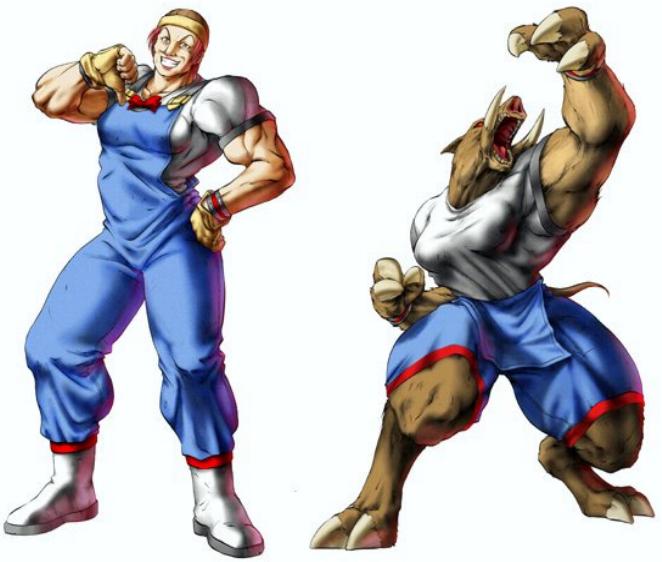
Even so, while the article gives a good overview and I hope will be enough to start a discussion, it isn't as in-depth as I would like. It would've been nice to see some more examples from games, since the only one focused on is Fallout: New Vegas (as an example of a game that gets it right). There are screenshots of Final Fight and Final Fantasy VIII but the author doesn't elaborate on either one. The picture of FFVIII's Edea raises questions, since she isn't specifically a female enemy to be killed "en masse", in the same way that Roxy and Poison from Final Fight are. Not that FFVIII isn't guilty of a lack of female enemies but I think Nicholas Tan could've provided context about why it was included.

Having said that, the author hits the nail on the head with two statements about why we don't see more female enemies in games. After writing about how enemies are more likely to be male in games designed to be realistic, Tan says the following:
"Now since most video games are not meant to be absolutely realistic, it's unnecessary that they need to follow this rule. I've blasted the heads off numerous female raiders in Fallout: New Vegas. But it's a rule that carries over, if but subconsciously, from video game developers who are predominantly men."
Apart from the "predominately men" part -- I haven't seen anything to suggest that either sex would be more or less willing to female enemies -- but the lack of female enemies in unrealistic games is due to real-world gender norms. Think of it this way; developers can introduce any number of fantastical elements into a fictional world, such as magic and monsters, but they can only do so much when it comes to subverting gender roles. If they do, it will only be to elevate the role of women and reduce the role of men; for those of you who have played the Shivering Isles expansion for The Elder Scrolls IV: Oblivion, think about the gender roles of the Golden Saints and Dark Seducers. Both are armies where the highest ranks are made up of women while males don't rise above being grunts.

So that's one of the reasons why we don't see women making up the majority of enemies in games and the second quote I'd like to use from Tan's article shows why we probably won't:
"Then of course, could you imagine a game where a male protagonist goes around murdering women and exclusively women and not just demons like harpies and hagravens? Even if the gameplay is groundbreaking and the story is told with an attention to context, it will become easy prey for the mainstream press. I mean, talk about making yourself a target and bad marketing. At best, the game would be considered a joke and be turned into an infamous meme. (Perhaps such a game would need a female protagonist killing a whole lot of other women to work.)"
Not much to say about that, other than it's correct. There's no chance of a game featuring a male protagonist massacring an all-female army being released and not becoming a target for the gaming press (or the mainstream, as Tan points out). Back when Resident Evil 5 received its first trailer, it faced controversy for featuring a white protagonist -- Chris Redfield -- gunning down black enemies, as the game is set in Africa. With gender issues being a major topic on gaming news sites, is there any way a game like the one described could exist and face a similar controversy? Is there any way it could not become the gaming community's whipping boy (or girl, if you prefer)?


As good as the rest of the Nicholas Tan article is, it ends on a silly note:
"That said, a video game where women are the primary antagonists would be an interesting experiment, so long as it's handled well (say, a devilish male scientist creates a virus that targets women because he thought it was THIS BIG but she said it was only this big)."
It's a reference to penis size, in case you don't get the joke.

I realise I'm overanalysing this but there are four things wrong with that idea:

1) It paints the male scientist as the bad guy. Nothing necessarily wrong with that, since games with all-male enemies have had female antagonists (such as Final Fantasy VIII again) but I think Tan could've used a better example.

2) I don't see how that could be considered "handled well". Surely, the best way to handle a game with women as the primary enemies would be to avoid referencing it at all. We don't acknowledge men as the primary enemies being "the norm", so why reference the female enemies as being out of the ordinary?

3) It doesn't put the female enemies in control of their own actions. Having a virus that makes them evil is a lot different than the women choosing to be evil (or at least members of the evil army, whether it's because they were intimidated into joining, they signed up because they needed money, etc.). There's already criticism from feminist circles about female characters lacking "agency"; being active participants in the game's story, rather than passive ones. So if the game is going for true equality, the women have to choose to be the bad guys.

4) The male scientist lashed out at women because a woman said he had a small penis? Really? That's like Lara Croft's quest beginning because a guy said she was fat.

I don't want it to sound like I'm criticising Nicholas Tan or the article here. Instead, let's pretend we're playing "Fantasy Video Game Storyline Writer" and coming up with our own ideas for how predominately female enemies would work instead. That's more along the lines of what I'm criticising rather than the article itself.

Like I said, I've overanalysing but there are more sensible reasons to have a character gunning down hundreds upon hundreds of men rather than hundreds upon hundreds of women. That could just be part of the fictional universe's mythology rather than for any reason for it occurring in storyline.

So if you haven't read the article, go and read it and feel free to praise Nicholas Tan for writing about a subject we don't often hear about on gaming sites. I hope it receives more exposure and makes a few more mainstream gamers think outside the box.

Saturday, 24 August 2013

Reversing The Sexes

I've been really bored lately, even with Dragon's Crown. I played Gone Home recently too but thought that was a letdown. While I suspect there'll be something to write about following Gamescom, it's all very slow-going right now. Not that there's a shortage of gender issues concerning men in video games to write about but, it has to be said, it's so much easier to write about current issues and have links at my fingertips than it is to hunt down pictures and videos myself. Still, with nothing else to do, let's talk about reversing the sexes.

A few days ago, I read a comment on Youtube that said something along the lines of "reversing the sexes is  a standard defensive, kneejerk response to accusations of sexism in video games". I can't recall the video I saw it under (and after spending most of the day searching, can't find it either) but that statement left me scratching my head. Hypothetically reversing the sexes of a situation has always, to me at least, seemed like an easy and effective way to examine whether it's sexist or not. In fact, people like me who get involved in the bubble of gender issues can forget how easy it is to become bogged-down with complicated terms (like "patriarchy", "hypoagency", "rape culture" and other phrases that I like to steer clear of while writing this blog) so reversing the sexes is actually an incredibly useful, accessable tool to people who aren't as interested in gender issues; it's easy to do and doesn't overcomplicate any issues. So let's try a few.

There's a moment in Star Wars: Knights Of The Old Republic that always confused me; the player character meets a hunter on Tatooine who is stranded and needs the player's help. The wife of this hunter has rigged his hunting droids to explode if he takes another step. He had no choice but to wait for help, possibly dying of thirst in the process. The hunter isn't smart enough to figure out how to disarm them, so he asks the player character for help. It isn't the situation itself that's questionable -- even if it is the Star Wars equivalent of a bumbling husband being at the mercy of his more intelligent wife -- but if the player chose Bastila Shan, a female Jedi and something of a mentor to your own character, to accompany them, she has some eyebrow-raising things to say about the hunter's situation:


Bastila says, "I say leave him". The hunter replies with, "you're pretty heartless for such a pretty lady, you know?" Bastila responds, "I take it back. Let's congratulate his wife".

To me, this always seemed like a huge overreaction, especially for the supposedly good-natured Bastila. So much for "the Jedi do not believe in killing their prisoners", as she states earlier. Leaving prisoners to die of thirst, however, is apparently completely acceptable.

The uploader of that Youtube video comments that, as out-of-character as it may seem, it hints at Bastila having anger issues that would later be used to turn her to the dark side. Personally, I find it a bit hard to connect "irritation over clumsy come-ons" with "dark lord of the Sith". Not that I think the uploader is incorrect but it seems like an odd thing to foreshadow side-switching with.

So do you think it's sexist? I'm torn. The hunter isn't portrayed as a sympathetic character; using droids to hunt is a no-no in KOTOR and he has a habit of flirting with women in spite of being married. Plus, in spite of Bastila's comments, the player earns Light Side points for helping the hunter, so it doesn't seem like the game is encouraging punishing the hunter for his comments. On the other hand, it takes a lot to advocate murder (and congratulate the murderer) just because you're irritated over someone's pick-up lines.

Reverse the sexes and I think there's only one big difference; it sounds a lot more harsh to me to think of a male Jedi offering to congratulate an unintelligent woman's husband for plotting to murder her. It would come across as unbelievably petty for a male character to be so irritated by some (admittedly obnoxious) come-ons to advocate such a serious act of domestic violence. As we know, however, domestic violence against men isn't awarded the same seriousness as it is against women. Having said that, I'm still coming down on the side of "not sexist", solely because the player is rewarded with Light Side points for helping the hunter.

Helpfully, there are a few games that provide surprisingly accurate gender-flipped counterparts to each other in spite of the fact they're more-or-less unrelated. Take Heavenly Sword and Resident Evil 4 as an example:


And back when I wrote "The Violence Double Standard", I brought up a moment in Final Fantasy XIII when Lightning punched Snow -- her sister's boyfriend -- twice in the face for failing to keep her sister safe.


I went on to say, "according to Square-Enix, she was conceived as "a female version of Cloud", from Final Fantasy VII. I must've missed the version of Final Fantasy VII where Cloud clocks Tifa in the jaw angrily. Twice." It was only this month that I received a long reply in the comments that ended with a link to this video from Final Fantasy VII, where Cloud attacks Aeris in a moment of stress. Skip to 14:40:


Comparing these four moments is a good way to highlight the differences when violence is portrayed against colleagues in games. They are, more or less, gender-flipped versions of each other.

The big difference, first of all, is that the men aren't in control of their actions when they attack the women. In Resident Evil 4, Leon is being controlled by the parasite inside his body and in Final Fantasy VII, Cloud's stress causes him to have an out-of-body experience; literally, a ghostly image of Cloud appears that the player controls while the corporeal Cloud attacks Aeris and the player is unable to stop him in any way. In contrast to the two of them, both Nariko in Heavenly Sword and Lightning in Final Fantasy XIII are well aware that they're harming their own colleagues. So it's acceptable for female characters to hit male ones (which is shocking, I know) but for male ones to hit female ones requires a trance of some kind.

It's also worth noting the reaction to each one. Nariko's choking of her fellow clanmember is broken up quickly but there isn't any concern shown for the man. Lightning punching Snow is practically ignored by their fellow teammates. Certainly, no concern is shown for Snow. On the other hand, Ada reacts to being choked by kneeing Leon in the ribs and stabbing him in the thigh to break him out of his trance. He ends up thanking her for this. So no matter who is being choked and who is doing the choking, violence against the male character ends up being acceptable in both situations. In Final Fantasy VII's case, the remaining party member (Barret, in the video above) quickly rushes in to knock Cloud out and prevent him from hurting Aeris any further.

It seems like trances are an easy way to have violence stay reasonably inoffensive; reverse the sexes of either the Leon or Cloud attacks and they're practically the same. The hero doesn't come across as any worse because of the attack, regardless of his/her sex or the sex of the victim. Part of the reason for that is because the attack isn't the important part, whereas the trance is; both Leon and Cloud attack women because it's such an extreme action, it shows how far their sanity is slipping. Women attacking male characters on their own side is just ... a quality. Game audiences aren't supposed to think anything of it, except perhaps "I'm glad that guy got taught a lesson". As a result, reversing the sexes of the Heavenly Sword and Final Fantasy XIII attacks does make things seem worse; a male character in complete control of his faculties choking or punching a woman who refuses to fight back is just asking to be called out for its misogyny.

I suspect its moments like these -- strikes against male characters by female ones -- that make up the majority of examples that don't really stand out until we reverse the sexes. They're so quickly dismissed when they're against a male character that either we ignore them or we're supposed to ignore them. Take Bioshock Infinite. It's a very basic example but Elizabeth strikes Booker DeWitt in the face with a wrench that isn't brought up again after it happens. It knocks him out-cold, giving Elizabeth enough time to flee but Booker still doesn't have a word to say about it.


I don't know if the gaming public is prepared to see a male character doing this to a woman, although I think it's possible to give gamers a bit more credit. Take the Mass Effect series as an example. It's possible for the main character, Commander Shepard, to punch a female reporter attempting to smear his/her (although for this example, let's go with "him") reputation in all three games. Sure, it's not the same thing, in quite a few significant ways; the reporter isn't on Shepard's side, punching her is a "Renegade" option and, as previously mentioned, Shepard can be either male or female. Each of those points lessens the impact and controversy of a male character punching a woman. Even so, there doesn't seem to have been any backlash at all against the Mass Effect series for this. In fact, it's been praised because the reporter is intentionally unlikeable. Who knows if a male character intentionally punching, choking or bludgeoning a stubborn (like Snow) or sexist (like the clanmember) woman on their side could be as accepted as women doing it to men is now (irritatingly)?

As always, feel free to leave a comment or send me an e-mail at themalesofgames@gmail.com.

Thursday, 30 May 2013

Damsel in Distress: Part 2 - Tropes vs Women in Video Games

Anita's back again, with the second part of her three-part series on the damsel in distress. Let's jump right back into it. Since this video deals with the deaths of characters, there will be spoilers throughout this blog post, mostly for older games but for some as recent as Bioshock Infinite. So read at your own peril.


I'm not a fan of Anita Sarkeesian. That should go without saying. Without going too deeply into why, let's just say that it's been a rocky road for Anita over the last year. She made a few too many questionable decisions for me to trust that her video series would be anything but one-sided. To my surprise, her latest video -- part two of three in her damsels in distress series, focusing mainly on damsels in distress who are killed, sometimes by the main character -- was one that I didn't find completely disagreeable. She hasn't won me over. I'm not convinced that Anita is a force for good in gaming and the negatives continue to outweigh the positives. What I am convinced of is that, when it comes to gender stereotypes, her heart is in the right place. Unfortunately, other points put forward by Anita are so biased and outright contradictory at times that having her heart in the right place doesn't help her case in the slightest.

Let's keep it positive though. I'll try not to quote Anita too much this time around and just give some basic summaries but at this point, I'd like to. Talking about male video game characters who lose their wives and daughters -- Max Payne and God Of War's Kratos are the two examples used -- Anita puts forward the idea that the reason these characters go on their roaring rampages of revenge is not because they're trying to avenge the loss of their wives and daughters, whom they loved very much.
"I’d argue that the true source of the pain stems from feelings of weakness and/or guilt over his failure to perform his “socially prescribed” patriarchal duty to protect his women and children.

In this way these failed-hero stories are really about the perceived loss of masculinity, and then the quest to regain that masculinity, primarily by exerting dominance and control, through the performance of violence on others.

Consequently violent revenge based narratives, repeated ad nauseum, can also be harmful to men because they help further limit the possible responses men are allowed to have when faced with death or tragedy. This is unfortunate because interactive media has the potential to be a brilliant medium for people of all genders to explore difficult or painful subjects."
That last paragraph is the important one. The one that I have plenty of praise for. Anita takes note of the fact that male gender roles are very limiting; aggression, dominance, protectiveness, chivalry, resourcefulness ... it's a risk for men to step out certain gender roles and can be frustrating for the ones who don't feel that they can.

One of the problems, however, is that Anita only seems to be stating this because she believes it supports her idea about women being objects rather than fully-rounded people that the protagonist cares about. They're property to get angry about being "taken" from them rather than people to miss. I don't think one guarantees the other. If I also might state the obvious for a moment, another problem is that these are video games. Revenge stories tend to work far better for gameplay purposes than stories about mourning and how to deal with loss. Max Payne and God Of War are based on film noir and violent Greek revenge-stroke-tragedy myths; not the kind of genres that have the heroes reaching for boxes of tissues. At the end of her video, Anita gives a few examples of games that she believes handle the subject of death in games more maturely (specifically Dear Esther, The Passage and To The Moon). Not that I hold anything against these games for doing that but they're not likely to become the standard. I adored To The Moon but haven't touched it ever since I completed it and I'm more likely to play Max Payne before I go near it again.

I'll come back to this later on but there's a much more significant reason why my goodwill towards Anita over acknowledging this hurtful gender stereotype didn't last. The big chunk of the video revolved around what Anita described as "the Euthanised Damsel". This is what happens in a game where a hero manages to catch up to a person he/she has been searching for -- usually a damsel in distress, as the name indicates -- only to find them begging the hero to kill him/her. Perhaps they've been turned into a monster or altered in some other way by the bad guys and they don't wish to live anymore. They'll beg for their rescuer to kill them and the rescuer will respect their wishes. That's the Euthanised Damsel in a nutshell.

The problem is that, while I don't want to say Anita was moving the goalposts at any time, it was a very large pool she was drawing from, based on a varied list of criteria. At one point, it was just women who were beyond saving. Then it was love interests who were too far gone and had to be killed. Then it was family members, mostly mothers. Then it was love interests who didn't have to be killed but did have to be fought to break them out of whatever spell or ailment it was that made them attack the heroes.

We have to wait for Anita's next video to hear her talk about male examples but I have a tendency to pick out a few male analogues to Anita's accusations while she's discussing them. Each time the Euthanised Damsel definition was expanded, there were a few examples that immediately sprang to mind, be they characters like Sinclair in Bioshock 2, Jecht from Final Fantasy X, Steve's father from Resident Evil: Code Veronica and plenty who only had to be attacked, rather than killed, such as Leon in Resident Evil 4 and Baralai in Final Fantasy X-2.


However, there were very few examples I could come up with featuring a male love interest being killed by a female hero. That's partly because, as Anita points out, there are so few female protagonists but even fewer with male love interests. This is slightly off-topic but I think the inclination to place female protagonists in the "strong, independent woman" archetype is a reason why male love interests aren't often featured; perhaps the belief that the heroine is motivated by a man betrays the "independent" part of that archetype. On-topic, however, I read a suggestion on a Youtube video that made me think that a woman euthanising a male "damsel" isn't the real analogue to men euthanising a female one. No, the real analogue is male heroes who die to save their damsels in distress; just like the female characters Anita brings up who request death rather than live as an abomination, male characters are often expected to have no thought for their own safety as long as the female characters are okay.

Capcom is very fond of doing this. In Onimusha 2, one of the story branches features Kotaro sacrificing himself to save Oyu, a woman who he has been largely antagonistic towards for most of the game. In Devil May Cry 4 -- which Anita brought up to point out the damsel in distress, in spite of the fact the game also features Nero being captured -- has Credo betraying his religious order in an attempt to save his sister, Kyrie, and it costs him his life. In Resident Evil: Code Veronica again, Steve is turned into an invincible monster at the end of the game but manages to fight off the transformation, his love for Claire Redfield is so strong. He dies shortly afterwards. This one is quite close to the love interest being killed by the heroine, in that Steve was a "damsel" moments earlier but he dies because his body can't take the transformation rather than because Claire pulled the trigger herself.

Then there's the huge sacrifice made by the hero of Shadow Of The Colossus (although he doesn't die). In Bioshock 2, the hero, Subject Delta, dies regardless of the ending the player receives, while the young woman he set out to save, Eleanor Lamb, lives on. Bioshock Infinite features a similar story, with many different incarnations of Elizabeth drowning her father, Booker DeWitt (who accepts his death willingly), so he doesn't go on to become the game's villain and kidnap her in the first place. That probably sounds confusing if you haven't played Bioshock Infinite and trust me, it's hard enough to understand even if you have.

One of the flaws in Anita's argument is also making the assumption that developers only use the Euthanised Damsel when they wish to shock people. I find that hard to believe. While there are doubtless examples that do exist just to be edgy, it seems like Anita isn't willing to consider the possibility that the writers wanted to create a tragic storyline. Or a storyline with a twist. I can't help but think Anita came to the conclusion that being edgy was the reason why the Euthanised Damsel existed before she looked at her many examples and then just found a way to make them fit her viewpoint.

Those are my thoughts on the "main" portion of Anita's video but in spite of my criticisms, I don't see much of a problem with Anita's dislike of the "Euthanised Damsel". Unlike her first video, Anita isn't as judgemental. There isn't any demonising of Shigeru Miyamoto, for one thing. The attitude is still there though; Anita explains why she dislikes the Euthanised Damsel -- and don't get me wrong, I completely understand why -- but I'm not really given a reason why I should care beyond conjecture and guesswork. The Jack Thompson parallels are still there, this time with regards to domestic violence. More on that later.

That's the important thing -- and, more to the point, the reason I can't get behind Anita as a force for good in gaming -- Anita states, "one of the really insidious things about systemic & institutional sexism is that most often regressive attitudes and harmful gender stereotypes are perpetuated and maintained unintentionally". Unfortunately, Anita herself had already reinforced and condoned harmful gender stereotypes herself at this point. Long story short, she talked at length about domestic violence but her definition followed the Duluth model.

If you know about domestic violence, that should say it all. For those of you who don't, however, the Duluth model is the assumption that domestic violence is "patriarchal"; domestic violence is an act done by men against women and children. If you've been following me for a long time, you'll know that hearing statistics about male victims of domestic violence on television was what interested me in men's rights in the first place. So domestic violence against men is a very prickly subject for me and I do not appreciate having male victims dismissed with gendered language in sentences like "people of all genders tend to buy into the myth that women are the ones to blame for the violence men perpetrate against them". Aside from ignoring male victims and female abusers, it also ignores violence in same-sex couples and doesn't acknowledge reciprocal violence. It is not a healthy, intelligent or accurate image of domestic violence to promote.

Aside from this major problem with Anita's argument, I find her videos peppered with smaller ones too. While Anita's latest video didn't have me shouting curses at my monitor, I did find myself sighing and shaking my head a lot. Her heart may be in the right place -- albeit deep, deep down -- but her solutions are impractical, biased and based on questionable logic and outright contradictory statements. For example, she criticises and dismisses Devil May Cry 4 (and others) for being a "crude, unsophisticated male power fantasy" but also does the same for Ico with "the most decidedly patronizing examples depictions of female vulnerability are used for an easy way for writers to trigger an emotional reaction in male players". That, in particular, made me cringe. Some time ago, Anita removed her video on Bayonetta from her channel because she thought she came across badly in it -- she shrugged off the story and dumbed it down to make it seem insignificant -- and as far as I'm concerned, she's doing the exact same thing with Ico here, with regards to the main gameplay element. You've probably already noted, as I did, Anita's inability to consider that perhaps female players could feel emotionally attached to the characters in Ico.

At one point, Anita repeats the same sentence over and over, wanting to get a point across about a trend: "In [game] your wife is brutally murdered and you then have to rescue your daughter." She seems to believe that the trend of daughters being captured is disempowering to women but apparently doesn't consider the possibility that the reason daughters are so frequently kidnapped instead of sons (and possibly husbands too) is because female characters are automatically more sympathetic than male ones, simply because they're female. Games like Heavy Rain, featuring a kidnapped son, are very rare. We feel more for Max Payne and Kratos because they lost daughters, not sons. In Bioshock 1 and 2, the reason for Little Sisters rather than Little Brothers was because it would be more difficult -- and morally questionable -- for the player to sacrifice little girls rather than little boys. In Bioshock 2 and Infinite, the protagonist's main mission is to find mistreated female characters, not male ones. It's the same principle behind "missing white woman syndrome", where the media is more willing to spotlight missing people if they're middle- or upper-class white women than if they're, say, a poor black male.

While it might seem like a good idea for Anita to decide against including violence against women who are treated as equals -- female soldiers and fighting game characters, for example -- there are a number of reasons why it carries some unfortunate implications for men. Back in February, I wrote about the sexism in Heavy Rain, comparing and contrasting two death scenes in particular; one of playable character Madison Paige, having a drill used on her genitals and one of Leland White, the villain of "The Taxidermist" DLC story, who has a chainsaw used on his. White's death is much more violent than Madison's, showing the genital mutilation in full, gory detail while Madison's is treated with more sensitivity; instead of showing the death, the camera cuts to the outside of the house and we hear a scream. The problem is that under Anita's definition, White's death is actually more acceptable than Madison's because he's not a damsel in distress at the time. The grisly nature of his death becomes irrelevant because he still has his agency. While Anita may believe helplessness is required for her definition of "violence against women", I'm afraid that I don't.

Time and again, we're asked to trust in Anita's word only because we're supposed to. We're told to believe the Euthanised Damsel is done for the sake of being edgy, just because that's what Anita thinks is the reason for it. We're told to see the damsels as objects instead of people, since that's the conclusion Anita has come to. While she points out that playing the games she features will not "magically transform players into raging sexists", she also says "media narratives do have a powerful cultivation effect helping to shape cultural attitudes and opinions". There's no explanation why she thinks video games/the trend of damsels and Euthanised Damsels contribute to these cultural attitudes though and that is when we get back into Jack Thompson territory.

This is becoming longer than I intended but I didn't want to leave anything out, so I'll wrap it up. Even without Anita's stance on domestic violence, I wouldn't be able to accept this video. There are just too many little details, too many conclusions drawn from questionable logic for me to support it. That's a shame and I genuinely mean that because, not enjoying depictions of violence against men, I can sympathise with the fact that she is so strongly against the idea of the Euthanised Damsel. However, when Anita says something like "violence against women is a serious global epidemic; therefore, attempts to address the issue in fictional contexts demands a considerable degree of respect, subtlety and nuance", she doesn't seem to realise that she's demanding special treatment. I agree that violence against women deserves to be treated respectfully but she's reading too much into a few too many situations; for example, I'm not sure how many people compare the hero having to kill his fused-with-a-monstrous-alien girlfriend when she asks him to do so in Prey with domestic violence.

Finally, it has to be said ... these are video games. As it happens, there are many important real-life issues that aren't treated with subtlety and nuance. War, for example, has been glamorised ever since Wolfenstein. To ask that all game developers consider how they treat the deaths of soldiers, however, isn't practical for video games. When all is said and done, I could be the most ardent anti-war protestor on the planet but not have any say in what developers should be doing with their own games. The final say is theirs, and rightfully so. The same goes for Anita and her feeling about violence against women in games. That's about all there is to say about it.

Addendum

If you only care about video games, you can stop reading now. This is where I put my investigative hat on and check out the resources Anita used for her video.

Anita posted the list of resources she used for this video on the Feminist Frequency site and they are very telling. Anita's sole resource for the idea that game developers must feature the deaths of women to be "edgy" is this blog post and video. If she actually believes the statement Daria makes in the video then she's actually being more judgmental than I gave her credit for earlier.

While I can't find anything that goes against the claim that "every 9 seconds a woman is assaulted or beaten in the United States and on average more than three women are murdered by their boyfriends husbands, or ex-partners every single day", the Every 9 Seconds website states "there are over 4700 U.S. women incarcerated for defending their lives". Let's just say that the founders of Every 9 Seconds may be playing fast and loose with their definition of the term "defending their lives"; I live in the UK but if any of you have been following the trial of Jodi Arias over there in the US, you may know that she claimed she was acting in self-defence and was a victim of domestic violence. Having followed a few cases of women on trial for murder or wounding charges over the years, Arias certainly isn't the first to make this claim.

One of the other resources Anita posts a link to is for the Wellspring Alliance, which looks fine. In fact, on their FAQ page, they mention that they take everyone, "regardless of race, color, national original, gender, sexual orientation, disability or age". Likewise, on the page linked to on Feminist Frequency's website, they state "Men are also victims of domestic violence, as are couples in same-sex relationships". Apparently, Anita decided to ignore that part when she talked about domestic violence herself.

The resource I'd like to focus on the most is "The normalization of violence in heterosexual romantic relationships: Women's narratives of love and violence" by Julia T. Wood. It's from looking at this study that Anita comes to the following conclusion, which she states in her video:
"Research consistently shows that people of all genders tend to buy into the myth that women are the ones to blame for the violence men perpetrate against them. In the same vein, abusive men consistently state that their female targets “deserved it”, “wanted it” or were “asking for it”."
Looking at the study itself, that is not what was said. First of all, this is a single study, with twenty heterosexual women who used to be in abusive relationships. "Consistently" and "people of all genders" are completely misleading. Nothing of the sort is written about this in Wood's research. Secondly, abusive men are not shown to have stated that their female targets "deserved it", "were asking for it" or anything similar. When these phrases come up in Wood's study, they're actually used as reasons why the female abuse victims stayed in abusive relationships:
"The women in this study described their partners' violence against them as understandable at the time it occurred. They justified it using a variety of reasons: 'I deserved it,' 'He didn't really mean it,' 'He was drinking,' 'It could have been worse,' and so forth."
It's very unpleasant, yes, but this isn't what Anita said. She made a claim about how "people of all genders" view abuse that research "consistently" shows but none of the sources provided on feministfrequency.com confirm Anita's claim. I don't know if Anita or her team at Feminist Frequency can provide sources that back up her claim but this, at least, is an outright fabrication.

Saturday, 2 March 2013

Good Female Characters

Even though I spend a lot of my time agonising over the treatment and portrayal of male characters in video games, they're not the only ones who get the short end of the stick. There are lots of very strong, interesting and intelligent female characters in games. Lots of them. However, they're often dismissed because of the way they look, the way they're dressed or simply because they're not in a game made by Valve.

By now, I'm sure you know that Aliens: Colonial Marines wasn't well-received. Well, last week on Gamespot, writer Carolyn Petit posted an article of hers, "Fear of a Woman Warrior", that, among other things, criticised Aliens: Colonial Marines for adding female multiplayer characters late in development:
"First, there's the ill-fated Aliens: Colonial Marines. A Reddit post, picked up and reported on by Kotaku, indicated that female marines, rather than being part of the game from the earliest stages of development, were a last-minute feature request. Let that sink in for a second. Female marines were a feature request, a special addition, a change made to the game at the last minute. This is difficult for me to wrap my head around. During Colonial Marines' development, people working on the game declared their abiding reverence for the film Aliens. It's hard for me to believe in this reverence, not just because the game ultimately failed to deliver an experience worthy of the Aliens name on any level, but because any reasonable understanding and appreciation of what made Aliens a great film acknowledges the important role of women in it. Women are not hard to come by in the film. In fact, they're pretty damn important. One might even say that they're the equals of their male counterparts. Crazy, I know! The notion of a vision of the Aliens universe without women in it seems like about as major a betrayal of the source material as I can imagine.
And yet, somehow, for years and years, development on Aliens: Colonial Marines progressed, apparently without anyone stopping to say, 'Hey. You know how there are women in Aliens? Remember Vasquez, the tough-as-nails marine? Remember Ferro, the dropship pilot who says, "We're in the pipe, five by five"? Remember how Sigourney Weaver was the star of all the Alien movies? Well, I just had this crazy thought. What if we put some women…in the game?!'
Women should not be an afterthought in an Aliens game."
The funny thing about this is that I already knew female marines were added to Aliens: Colonial Marines late in development and not because of a Reddit post, which was then reported on Kotaku. I knew about it because last July, Gamespot posted news about the fan petition to include female multiplayer characters in Aliens: CM. So how on earth did it take Carolyn this long and another website to learn about it when it was posted on her very own site, eight months ago?

That's besides the point though. For all of the failings of Gearbox Software, the developer of Aliens: Colonial Marines, adding female characters is not one of them. Ideally, yes, they would've had enough intelligence to realise the significance of women in the Alien series and added them early on, but they didn't. When it came to their attention that they'd dropped the ball, however, they went out of their way to add them. And yet even that effort is criticised in articles like this one. Why? They should be praised for listening to the fans and correcting their mistake, not criticised for the original error.


It isn't just the female characters in Aliens: Colonial Marines that suffer. Appearance is one of the major deciding factors for the critics about whether a female character is good or bad. In Carolyn's article, she praises Lara Croft and Samus for being two examples of female characters from highly successful franchises, only to dismiss them for their sex appeal just two paragraphs later. Or at least their sex appeal being used as a reward players/to advertise the game (which I find highly hypocritical, considering Gamespot has adverts for affiliate sites at the foot of the article, advertising features like "The 20 Hottest Daughters From The Sports World" and "Hottest WAG of Each NFL Team". Apparently, criticising female video game characters for their sex appeal is fine but Gamespot'll be damned if it's going to refuse to objectify real women to gain money from referrals!).

Lara Croft is a particularly strong example of this, much like the Aliens: Colonial Marines one. This is a character who, for years, has been held up as a (if not the) prime example of objectification in video games. In some circles, her appearance would be more important than the games she starred in. So when Crystal Dynamic made the effort to revamp her appearance, giving her a more realistic figure, it would presumably be well-received, wouldn't it? Not the case, at least for Tomb Raider. After the game was displayed at E3, she was immediately faced with criticisms such as "she suffers sexual assault" and "she makes orgasm noises when hurt". Neither of which are true, of course; it's the critics seeing what they want to see. It was the same with Aliens: Colonial Marines; if Gearbox Software leave out female marines, they're blamed for leaving out female marines. If they include female marines, they're blamed for not having them in the first place.

What feminist critics of the gaming industry, such as Carolyn Petit, are doing is creating a no-win situation. I don't want to spend too much longer on Carolyn's article but she goes on to write about a man I'm not familiar with called Ryan Creighton:
"In a blog entry posted on Gamasutra last month, Ryan Creighton, a designer on Spellirium, confessed that his game is dominated by white male characters 'for fear of someone calling me out for my non-white or non-male character being stereotypical, offensive, or - at the absolute worst - outright racist or sexist.'
"The world of writing and designing games is tremendously male-dominated; sadly, this absurd fear of creating complex, human women who star in games is not limited to Creighton, but is a widespread problem."
Carolyn criticises Ryan Creighton's decision to leave out non-white and non-male characters, calling it "an absurd fear" but given that she just wrote an entire article about the pitfalls of creating female characters -- criticising some of the examples that fall into them -- how is it absurd in the slightest? At some point, game developers like Ryan Creighton just ask "why bother?" and don't add female characters at all because women like Carolyn Petit have created a no-win situation. And we're going to see a lot more attitudes like Ryan Creighton's in the future if feminist gamers don't start appreciating that the entire industry is bending over backwards to make them feel welcome and all they're doing is throwing it back in the industry's face. They're biting the hand that feeds them, so developers will naturally start doing what's sensible and avoid female characters altogether because they don't want to navigate the minefield of getting female characters "right". As a result, female characters are the ones who are going to suffer, as feminist critics can't appreciate the good qualities of the characters that they're given.

That's enough about the article but certainly not the end of the good female characters. Let's talk about Soul Calibur because there's no shortage of good female characters there. Yet nobody ever praises Talim, Xianghua, Seung Mina, Hilde, Amy, Cassandra and (at a push) Tira because they're too busy criticising the breast sizes of Ivy, Taki and Sophitia. Three great characters, all dismissed by feminist critics because of the way they look. It baffles me that women would do that, since they're judging other women on their looks far, far more harshly than any male gamer ever would. They're the ones seeing them as sex objects to get rid of rather than interesting characters to keep. The same applies to the Dead Or Alive series, albeit to a lesser extent; the women are the poster girls for the series and the men receive far less recognition. However, the makers of Dead Or Alive have also made no effort to hide the titillating aspects of the series, with titles like Dead Or Alive: Extreme Beach Volleyball under their belts.

Women in fighting games in general tend to be given the "they're objectified, so they're no good" dismissive attitude. I'm going to take a moment to discuss the double-edged sword that comes with a phrase like that; male characters who are judged on their appearance aren't taken seriously. I think being a female character who is dismissed because of her appearance is much worse, however, because there are so many great ones out there who don't receive the recognition they deserve because of their outfit or breast size.

Take Tekken as an example. For Tekken Tag Tournament 2, Namco Bandai offered a swimsuit alternate costume for every character in the game as a pre-order bonus (and later through a free update). They did provide swimsuit costumes for both male and female characters, interestingly -- here's the trailer, if you want some examples -- but what surprised me was the differences between swimsuits for different male characters. Attractive, muscular male characters, like ninety percent of the Tekken cast, are given the skimpy fundoshi outfit (which you can see a real-life version of here, if you don't mind seeing a man's behind). Then there are the characters like Wang, Dr. Bosconovitch, Bob and Ganryu; old or overweight. Unattractive, in other words. They're given old-fashioned beachwear that completely covers their entire body, like the kind seen on this TV Tropes page.

As surprising as it might sound, I was actually mildly offended that they'd do something like that. The Ganryu outfit, in particular, is confusing, since he only wears a sumo mawashi for his regular costume anyway. It was the costume for Bob that irritated me though, in no small part because Tekken Tag 2 added Slim Bob; a thin version of the normally-overweight Bob. He first appeared in Bob's Tekken 6 ending and was added as a playable character in TTT2.

You can customise each character's appearance in Tekken Tag Tournament 2 and Slim Bob, like most of the other male characters, has an option to be shirtless. Regular Bob doesn't. As mentioned above, Slim Bob has a fundoshi swimsuit costume, like all the other attractive male characters. Regular Bob doesn't. Slim Bob even has an outfit reminiscent of Lee Chaolan's bondage outfit (which I've featured on this blog before), as it has a similar emphasis on his perfectly-sculpted abs:


Call me picky but I can't help feeling that there's something ... unjust about giving a thin version of a fat character some alluring costumes and not giving the fat version the same treatment. So for all the talk from feminist critics that male characters are a lot more varied than female ones, that's true but they also face the barbed treatment of being judged on their looks. Attractive men are given outfits to emphasise their physical attractiveness, unattractive ones are given a sheet to put over their hideousness, essentially. Maybe this is all just a personal gripe I have with Tekken.

Would I like to see more varied female characters in video games? Yes. Does that mean game developers are doing something wrong right now? No. They could just be doing things more right, if that makes sense (although I certainly will say that Gearbox Software messed up by not giving female characters a larger role in Aliens: Colonial Marines from the start). So I recommend feminist video game critics stop judging characters like Soul Calibur's Ivy based on their looks because they're only hurting female characters in general. We could certainly use a few more characters like the wonderful Mitsuko from Bloody Roar but that doesn't mean we need fewer Ivys. If appearance was taken out of the equation, I think feminist critics would be a lot more appreciative of how many great female characters there really are and how judging them on their appearance is actually very petty. Hell, even Nariko from Heavenly Sword has faced criticism for her appearance and the most skin she shows is her midriff. Small-chested, no shots of her rear, no sexual dialogue ... and yet I've still seen her turn up on lists of sexualised female characters, presumably by people who've never played the game. Although if you've read anything I've written on Heavenly Sword before, you'll understand why I don't consider her a great female character.

And that's before we get to the great female characters who don't face this kind of dismissive criticism. Chell from Portal. Jade from Beyond Good And Evil. Jennifer Mui from Mercenaries. Mona Sax from Max Payne. Elena Fisher from Uncharted. Alyx Vance from Half-Life. Zelda. Jill Valentine and Claire Redfield from Resident Evil. Almost every female Final Fantasy character.

A lot of these characters aren't given the recognition they deserve because they're overshadowed by talk of how video games feature nothing but women with big boobs and a tendency to get kidnapped. Not only do I think that does a disservice to the developers who worked so hard on these characters, I think it does a disservice to the characters. If great female characters are truly what you want in games, feminist critics, try to realise it when you have them. Understand that being sexually attractive doesn't negate the other qualities of a character and -- it's been said before but never hurts to hear it again -- male video game characters are sexually appealing too. Not because it's a "male power fantasy", which is an eye-rolling explanation I hear batted around far too often nowadays, but because traits given to our male heroes, whether muscular and square-jawed or androgynous with perfect hair, look appropriate to gamers in the West or Japan, depending on the game.

And if you're looking for more great female characters, Awesome Lady Tropes has you covered.

As always, feel free to leave a comment or send me an e-mail at themalesofgames@gmail.com.

Saturday, 9 February 2013

Anita's Back!

Hey again.

Before we go into Anita Sarkeesian -- don't worry, you haven't missed anything. Her Damsels In Distress video still hasn't been posted -- I'd like to thank a few people who've helped out the blog over the last week or so.

Permutation Of Ninjas - A great egalitarian blog that deals with a ton of injustices against men, including heavy-hitting topics like rape and domestic violence. I'm always impressed with anyone who can tackle real-life issues like that with the skill that the PoN writers do because I know that I never could. Sites such as theirs, that focus on (among other things) mainstream men's issues, are the reason that I feel like I can write about misandry in video games and not have it shrugged off with statements like "oh, men are oppressed in video games? Women are oppressed in real life!!!" So I have a great deal of respect for Permutation Of Ninjas and others like them for speaking so candidly and passionately about social injustices.

When describing this blog, they wrote "imagine Anita Sarkeesian if she a) could write, and b) had any clue what she was talking about." I grinned for the whole day when I read that. Plus, when they posted a link to this blog on their Tumblr, my number of viewers leapt by about twenty percent. That's huge.

I'd also like to give thanks to all the people who reblogged it but I have to single out a couple. Sorry if you're not mentioned, it's just that these ones made it onto my traffic sources page:

Special Snowflake Hall Of Fame - I can't say that everything on this Tumblr appeals to me but I am very interested in the "My critiques of Tropes vs Women in video games" page. I'll be keeping a close eye on that one and that's actually the subject of this blog post.

Bits of Tropes Supporting Women in Video Games - Or "Awesome Lady Tropes", if you want the short version. I love this Tumblr! You know how feminist critics of the gaming industry like to decry female characters for objectification, lack of agency and so on and so forth? It can often come across as if they're saying "female characters all suck, they're all damsels in distress, they're all sexualised", etc. Awesome Lady Tropes is the exact opposite of that. The creator of that site is saying "female characters are awesome, female characters are badass, let's celebrate female characters! Yay!"

It's such a simple idea too; a picture of a female character, followed by several Tropes that describe her (so if you're a Troper looking for positive female game characters, this is the ideal place for you). This Tumblr makes me want to play the game of every single female character listed. It's a testament to how many great female characters there are out there, instead of the typical "Alyx Vance, Chell and Faith" that you hear from most feminist critics. As far as I can tell, it's only been around a week and I love it already. I'm adding it to the sidebar.

I'm not under any illusions; I know that several of the female characters listed are probably damsels in distress at some point but, unlike the critics of female characters, I don't think that's a deal-breaker on what makes a good or bad female character. The same goes for sexualisation and, most ridiculous of all, being associated with male characters. I love this Tumblr and I can't recommend it highly enough.

Genderratic - Genderratic is a blog that I've visited from time to time, mainly because I'm a fan of Typhon Blue's Youtube videos. She offers a fun perspective on men's issues that a ton of other people don't, either by dressing as a hamster and smoking a pipe or playing her Tumblr feminist parody character, Raven Moon Dragon. It takes the edge off a touchy subject and makes her video more accessable. The Genderratic blog is a lot more serious and the lion's share of the writing seems to be done by Typhon's co-authors, Ginkgo and Xakudo. They do a good job and go so far as to call out misogyny where they see it, so it's worth checking out. They were kind enough to add me to their blogroll.

So, with the special thanks out of the way, it's time to move on to the subject of this blog: Anita Sarkeesian's making her return! Or that seems to be the case, at least.

After months of silence on the series' progress and a few updates for her backers' eyes only, Anita finally appears to be making some headway on her Tropes vs Women in Video Games project. Earlier this week, Anita set up a Tumblr account titled "Bits of Tropes vs Women in Video Games". She seems to be using it to store her findings of distressed damsels ... and it's everything we predicted it would be.

Let's start with the biased findings. Without Anita's video, we can't say whether or not she's considering male "damsels" but it certainly seems like she will, judging from the September update for her backers:

Image cropped. Shame more of Anita's backers-only updates weren't leaked.

However, nothing in the "Bits of Tropes vs Women in Video Games" Tumblr suggests that men are going to be focused upon. Maybe they'll be added later. Maybe they won't be added at all and Anita is limiting the Tumblr to just female examples. We don't know at this point and I don't really like to speculate; I'm very tempted to assume the worst and say that men will be added as afterthoughts in Anita's Damsels In Distress video but that could lead to me eating my words when the video is released. So let's just say that these are my first impressions and what I hope Anita will end up putting in the video.

Let's start with the obvious stuff; examples of damsels in video games where male characters are in distress too. Ashley Graham from Resident Evil 4, for example. I know people were irritated by having an escort mission at the centre of RE4 (although it never bothered me) and she's undoubtedly a damsel in distress. So I wonder if Luis Sera will make Anita's list too. For those who've never played Resident Evil 4, Luis was a character who was tied up in a closet the first time he appeared. He's quickly freed, then is tied up again within five minutes by one of the villains.

Of course, Ashley could get a pass because she's helpless for the majority of the game while Luis gets to defend himself with a gun from time to time. Ashley is often forced to hide (or can be commanded to) in order to stay safe. Okay, let's say that's fair enough. There are other odd choices on the list too though. I'd like to single out Princess Yuki from one of my favourite series', Onimusha. If you can find the trilogy on the PS2, I highly recommend you buy it.


Onimusha's story revolves around the hero, Samanosuke, rescuing Princess Yuki from a horde of demons. It's simple enough but, as you can see in the picture above, Princess Yuki isn't the only one being held captive. Her younger brother, Yumemaru, is also taken prisoner after an ill thought-out attempt to save his sister.

Now, in my opinion, child characters shouldn't really be held to the same standards as adult characters; there's a good reason why children can't defend themselves, after all, that can't be said for adults. They're children. If faced with evil characters, you expect them to be overpowered. Anita seems to disagree:

I've written about Dishonored before but it's interesting to see Princess Emily turn up on Anita's list. Not because Emily isn't a damsel in distress -- she is -- but it opens the list to child characters, such as Yumemaru in Onimusha. I wrote about Shaun Mars from Heavy Rain last time, so can we expect him to make the list? For that matter, the Tumblr features questionable examples such as "Many nameless women, Crime Fighters (1989)", so all the male child victims in Heavy Rain could make a male version of the list if those are the standards for inclusion.

To me, being a child in distress trumps being a damsel in distress. Children can't defend themselves because they're children; presumably, the reason Anita is compiling a database of damsels in distress is so she can say "look how prevalent these characters are. We need to have fewer of them and more women in stronger roles". If you include children in that, does that mean you want more children in stronger roles? The problem with that is the number of games set in realistic settings where it wouldn't be appropriate. Even in some games set in unrealistic settings, like Dishonored, it would be too unbelievable (although who knows? Maybe a sequel will feature child assassins). Video games can get away with imaginative scenarios much more easily than movies and television shows can and they have featured plenty of tough child characters -- young mages in Japanese RPGs, for example -- but let's be realistic; children are, and should be, damsels in distress more often than they should be heroes.

Plus, let's not forget that Dishonored featured several cases of male "damsels" in distress; Teague Martin in the first mission and the crime boss, Slackjaw, later in the game. It also occurred to me last night that the player character, Corvo, is a damsel in distress himself at the very start of the game, being imprisoned and subjected to torture with a hot iron. He only escapes with the help of the Loyalists.

Maybe we need some clarification on what does and doesn't constitute a damsel in distress; "damsel" implies helplessness and "distress" implies danger. Again, Ashley Graham would qualify but Luis would only fit the "damsel" part very briefly. Both Princess Yuki and Yumemaru would qualify. Samanosuke wouldn't when he's held captive ... but earlier in the game, there's a moment that every Onimusha player remembers and refers to as the water puzzle, where Samanosuke is stuck in a room with rising water and the player, as Kaede, has to solve a fiendishly difficult sliding-block puzzle within a time limit to free him. He'd qualify then.

Dishonored is where things get tricky; Emily could be described as being in danger at the very end of one ending. Teague Martin is in a similar situation; he's locked up and threatened but in no immediate danger. Slackjaw, on the other hand, is about to be killed and eaten. I've already mentioned Corvo being tortured too. It's even possible to attempt to torture one of the villains by filling his cell with plague-infested rats.

... Wait, why is it always male characters who are tortured? That's worth looking into ...

It might seem like I'm cherry-picking examples from the Tumblr but that's not the case at all; I just don't have the luxury of being able to play all of the games listed, thanks to a lack of both time and money. Even some of the games I own on the list are ones I haven't played in a while, such as Tenchu, so I can't comment on them. I noticed a few trends though.

I know Anita's a fan of TV Tropes, as am I, so it's worth mentioning a phrase that is often mentioned over there; "Tropes Are Not Bad". It's basically their way of saying that just because something is noteworthy enough to be listed as a trope, it doesn't mean that aspiring writers shouldn't use that trope in their stories for fear of them being clichéd or stereotypical. In the case of the damsel in distress, that's a trope that was used long before video games had writers, or at least writing as a main focus, and it was used as an excuse to put the main character on an adventure. For example, as thrilled as I was to see Chuck Rock make an appearance on the Tumblr, his wife Ophelia being kidnapped was simply an excuse to have Chuck fight dinosaurs for the next thirty minutes, or however long the game took to complete. The same goes for Double Dragon and numerous others.

Should these games be held to a different standard, just because they're old? Well, I'm not saying that but it's important to recognise that storytelling wasn't as important then as it is today and gameplay was everything. Going back to Tropes Are Not Bad, the damsel in distress trope in games from twenty years ago gave the player an objective, a reason why their character was fighting enemies rather than just for the sake of it.

It'd do the games listed a disservice if it wasn't mentioned that so many of them have gone to great lengths to eliminate damsels in distress from their games. Take Crash Bandicoot as an example. Tawna, Crash's girlfriend from the first game, is featured on Anita's Tumblr and it's also a classic case of primitive storytelling. The second game featured vastly superior writing, got rid of Tawna and added Crash's brainy little sister Coco to the roster too. In the third game, Coco became a playable character. Even Resident Evil has come along in leaps and bounds since Resident Evil 4, adding female co-op companions in 5 and 6 in place of Ashley Graham.

Speaking of which, I have a question: does having a damsel in distress in a game somehow negate the strong female characters? If Ashley Graham is a strike against the Resident Evil series, shouldn't Jill Valentine, Claire Redfield, Ada Wong and Rebecca Chambers all work in its favour? Isn't there some leeway given to games that have a good record for female characters? Because the problem with the way Anita is framing this trope -- and all the tropes she intends to talk about -- is "damsels in distress = bad". That's a problem. It's an attitude that limits creativity and reduces the number of elements writers are allowed to use.

I want to stress again that these are just my first impressions. So we'll wait and see what Anita actually delivers in her first video and I'll have more to say on the subject then. The Tumblr is a good sign that the video is on its way so we might not have long to wait

As always, feel free to leave a comment below or send me an e-mail at themalesofgames@gmail.com.

Addendum

Oh, great. I was just about to finish the blog when I noticed that the pictures on the "Bits of Tropes vs Women in Video Games" Tumblr have tags! And some of them are very interesting. I'll try to make this quick.

Let's start with Dishonored, since I've been writing about that for most of this blog. One of the tags is "womaninthefridge", which refers to the Empress, who is killed at the beginning of the game.


For those of you who don't know, being "stuffed in the fridge" is a comic book term for when a woman is killed off to create drama for a male character. That doesn't actually apply to Dishonored, so the tag is incorrect; Corvo is a mute character, so he doesn't mourn, rage and even relies on others to plot his revenge for him. If anything, the Empress' death creates drama for her daughter, Emily, and maybe the city of Dunwall itself; the Empress is revered and Dunwall's citizens wonder how on earth they'll get by without her. The only drama that comes Corvo's way is being falsely imprisoned and tortured. He's suffering just as much as the Empress, in other words.

Also, Dishonored is a game all about assassination and the Empress receives a lot more attention after her death than any of the assassination targets in the game. Most of the time, Corvo returns from a successful mission only to be told, "great! Here's your next target." I'm paraphrasing but that's more or less the case. Incidentally, all but one of the assassination targets are male.

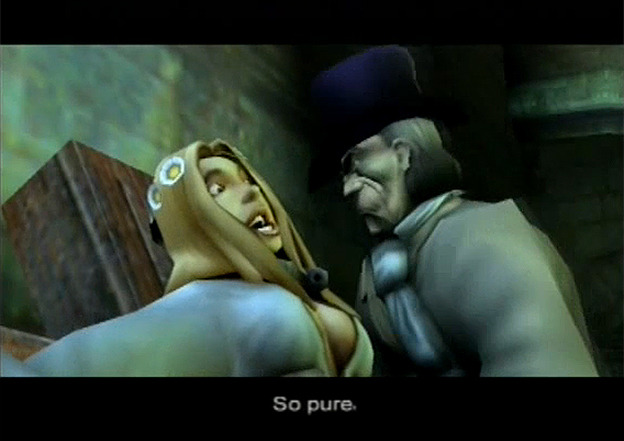
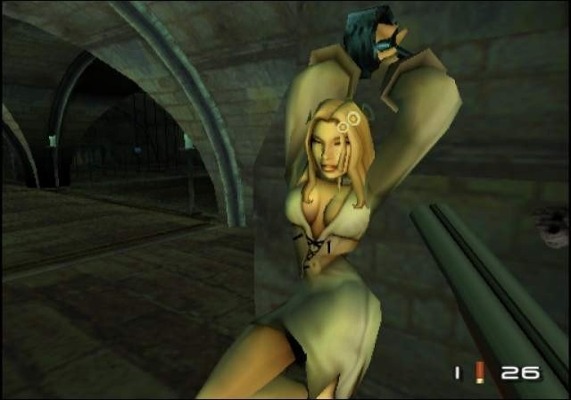
Let's move on to other games. The Timesplitters 2 pictures feature "sexualassault" as a tag, in spite of the fact that the Maiden characters -- the damsels in those pictures -- are a reference to the classic horror movie practice of occult artists sacrificing virgins for rituals. I've criticised people for complaining about sexual assault in games where there isn't any before -- Tomb Raider and Heavy Rain -- but this may be the most ridiculous example. Having the Maidens subjected to sexual assault would defeat the entire reason those characters exist! Their virginity. That's why Jacque de la Morte is saying "so pure" in that first picture.

Timesplitters 2 also offers a great example of how the damsel in distress trope can be used wonderfully. Freeing five Maidens from their shackles is an objective of the Notre Dame level ... but one of the Maidens is actually a monster called the Changeling that first-time players will probably unshackle by accident and be attacked by because they're so keen to complete the objectives. It was a clever addition and one that wouldn't exist without damsels in distress in Timesplitters 2. However, that doesn't seem to matter to Anita or one of her team operating the Tumblr; they're damsels in distress, ergo, they're bad.

Then there's Medievil 2 and the "damselinthefridge" tag.


To people who haven't played Medievil 2, this picture and tag is actually very misleading. While Kiya, the blue mummy pictured above and Sir Daniel Fortesque's love interest in Medievil 2, does die in the game, she's revived again within a few levels (well, she technically never died; using time travel, Sir Dan kills the monster who murdered her before she's murdered). Looking at the picture and tag, you would get the impression that she dies and that's all we see of her for the rest of the game. That's not the case. She dies in order to add a few extra levels to the game while Sir Dan works to save her.

There are probably lots more examples of misleading tags and I hope other people point out a few. We're discovering an inkling of the Tropes Vs Women in Video Games team seeing what they want to see though, rather than reporting examples accurately. They even take Duke Nukem 3D seriously ...
Sunday, 23 September 2012

The Objectification Double Standard


This is a very long blog. Put aside some time.

The very first blog I wrote on gender issues in video games was about two things; a “Games For Girls” advertising campaign here in the UK at the time and the subject of attractive men and women in video games. This was way back in January of 2008 on Gamespot. First of all, I'd like to point out that I did object to women being objectified in video games if it was particularly blatant, such as Dead Or Alive: Xtreme Beach Volleyball or a Metal Gear Solid 4 trailer from the 2007 Tokyo Game Show that featured Dr Naomi Hunter talking into a video camera and it just happened to bump into her cleavage. You can watch it in the first fifteen seconds of this video, if you're interested.

However, outside of extreme examples, I was reasonably indifferent to the idea of attractive women in videogames. While I know there are certain parties who react strongly to every female character who shows a bit of skin or has a large bust, I don't fit into that group. Here's a paragraph from my old blog on Gamespot:

"The traditional heroine in a videogame is, apparently, any lead female character with large breasts. This stereotype presumably comes from Lara Croft but it's astonishing how few female characters follow this model. In so many developer videos discussing character design and the lead female character, it's often said that they seek to "break the stereotype" of the videogame heroine. Aside from Lara, there are very few noteworthy cases of this. Nariko, despite being scantily-clad, had small breasts. Jennifer Mui from the Mercenaries games, Alyx Vance from Half-Life 2 and Elena Fisher from Uncharted: Drake's Fortune were all fully clothed with a normal, proportionate physique. As are all of the Final Fantasy women up until FFX-2. In fact, Lara Croft herself's breasts were reduced in size for Tomb Raider Legend, although more of her midriff was shown and her bum was "peachier" than ever as a compromise."

Even five years ago, Lara and Nariko were my go-to female examples. Although that last line about Lara is even truer today than it was then; the Tomb Raider reboot seems to have dispensed with Lara's exaggerated physical attributes entirely. Here's a picture that was hosted on GamesRadar:


So while I do object to the more blatant examples of objectification in games, I don't see anything particularly wrong with scantily-dressed female characters or women with an emphasis on the more sexually-appealing parts of their body. Such as Lara, or the majority of female fighting game characters, sans boob jiggle. I could do without that, even if the majority of fighting games don't do it to the same level as Dead Or Alive.

I don't see it as damaging or detrimental to the female characters who are portrayed this way. After all, Lara Croft was awarded "Most Successful Video Game Heroine" by the Guinness Book Of Records. That says more than enough to state that Lara has done well enough to stand on her own two feet as a character, rather than just as an attractive fictional woman. Basically, I think the critics need to get over their dislike of female characters who show more skin than they'd like or have a body type they disagree with or "grunt in a sexual manner when hurt". None of those qualities are anywhere near as detrimental to a female character as the critics think.

We also need to deal with the fact that, yes, there are issues with the appearance of men in video games. I'll say right off the bat that I don't feel anywhere near as strongly about the appearance of men in games as I do about violence against them. That's obviously the more significant issue. I'll also say that I have absolutely no doubt that women are sexually objectified more than men in games. However, that's not to say that the appearance of men doesn't play a role in video games at all and I have taken issue with the appearances of some male characters in games before.


Top row, L-R: Cloud, Reno, Sephiroth, Vincent (Final Fantasy VII), Squall (Final Fantasy VIII), Zidane (Final Fantasy IX), Tidus (Final Fantasy X).
Bottom row, L-R: Vaan, Larsa (Final Fantasy XII), Dante (Devil May Cry 3), Octavianus (Shadow Of Rome), Jutah (Silent Bomber), Sion (The Bouncer), Wander (Shadow Of The Colossus).

I don't want it to seem like I'm picking on the Final Fantasy series in the above image. I was just looking at my games collection when making that picture and the Final Fantasy games were the first ones my eyes went to.

I'm not as irritated by the young male "pretty boy" characters, or "bishonen", in video games as I used to be. The first time I read about size zero models and Barbie dolls creating an "unrealistic standard of beauty" (keep that sentence in mind) for women was when I was a teenager. However, this was also the period when the Final Fantasy series was at its peak and that was my main exposure to the characters above. For me to be irritated by them, they had to have two qualities: handsomeness (obviously) and "Mary Sue" characteristics. For those who don't know what a Mary Sue is, here's an excerpt from TV Tropes to describe it:

"She's exotically beautiful, often having an unusual hair or eye color, and has a similarly cool or exotic name. She's exceptionally talented in an implausibly wide variety of areas, and may possess skills that are rare or nonexistent in the canon setting. She also lacks any realistic, or at least story-relevant, character flaws — either that or her "flaws" are obviously meant to be endearing."

"The canon protagonists are all overwhelmed with admiration for her beauty, wit, courage and other virtues, and are quick to adopt her as one of their True Companions, even characters who are usually antisocial and untrusting; if any character doesn't love her, that character gets an extremely unsympathetic portrayal."

That paragraph describes a female character but a male variant -- the "Marty Stu" -- exists. So appearance alone wasn't enough for me to be irritated by bishonen characters. They also had to display Mary Sue characteristics. Sure enough, some of the characters above don't display those traits (but they'll be just as relevant later on), such as Octavianus and Wander, but there are also several who do. And I apologise to Final Fantasy fans but their main characters were often prime offenders.

Let's start with Squall, since his example is the best, in my opinion. When I was a teenager, I was a lot more shy than I am now and Squall was a very aloof character in FFVIII. I read his dialogue and thought, "OMG I can sooooo relate". Then I grew a bit older, played FFVIII again and realised that Squall was actually a stand-offish jerk. Yet over the course of the game, Squall is made "commander" of Balamb Garden (the headquarters of FFVIII's good guys), in spite of the fact that, as far as I know, he was only made a SeeD (special forces agent) that year. One of the most recent promotions to SeeD, in other words, so he wouldn't be qualified to lead. At another point, Rinoa, the love interest, is lecturing Squall on how the party all wishes he would trust them enough to talk to them more, to the point that she eventually says, "we all love you. There, I said it". But why does the rest of the party love Squall? You could argue that he's done things worth respecting as their leader but love? That was too farfetched for me, especially since he insulted most of them at various points during the game.

I don't want to go into every single one but the other characters have similar examples; Jutah lectures his female commanding officer (and love interest) to prove how battle-hardened he is to the player. Tidus is a cocky douchebag who irritates strangers by climbing all over them and stealing their binoculars but Yuna (the love interest, again) still wants to make him one of her "Guardians" only two days after meeting him and after they've had only a few conversations. Dante, especially in his Devil May Cry 3 incarnation, was the most ridiculous show-off you could ever see in a video game. He gets stabbed by demons to no effect, spouts silly lines and nods his head to awful music on his jukebox ... all at the same time. Be honest, DMC fans; if you met a guy in real life who acted like Dante -- not a demon hunter, just a random guy in your office -- you would think, "what a jackass", right? In fact, I was probably the only person who was happy about his DmC redesign. Not because I thought it was good but because everyone finally hated him as much as me! There are more examples for each character but I get the feeling this blog will be long enough as it is.

Now why is all this important? Well being a bishonen on its own is fine but when it's combined with the traits of a Mary Sue, it becomes a problem. It equates good looks with success because a character like Squall is awarded a huge promotion when there are, presumably, people far more qualified for the job. It equates good looks with popularity because love interests and party members immediately gravitate towards these feminine male characters regardless of negative qualities, such as Tidus being made Yuna's guardian in spite of the fact that he's a boastful ass who she barely knows. For anyone who's not a perfect-looking specimen of humanity and has the same flaws that everyone else does, all these infallible male models can become annoying after a while.

To show that I'm not being unfair towards bishonen characters, I'll give you a few examples that I don't mind because they lack the Mary Sue qualities. Octavianus in the above image is one. His femininity actually plays a role in the gameplay; all but one of his gameplay sections involve stealth and he can adopt disguises to avoid detection. One of the disguises he can use is a maid's uniform, so it'd look very odd if he was a burly hero. He also displays a knack for speaking in a woman's voice during a cutscene. This is a far cry from FFVII's Cloud, who, during his crossdressing adventure, is described as "a tough-looking guy like that". Besides, Shadow Of Rome is a game that doesn't skimp on masculine male characters; the other player character, Agrippa, is a mountain of a man. Likewise, I mentioned in a previous blog that I'm probably one of the few people who liked Final Fantasy XIII and one of the bishonen characters in FFXIII was Hope, a teenage boy. During the game, Hope blames fellow party member Snow for allowing his mother to die and mentions how much of a jerk his father is. He's wrong on both counts. So for once, the teenage idiot in an FF game is treated like a teenage idiot. That's a realistic and praiseworthy portrayal of a teenager who blows things out of proportion and misunderstands the situation, rather than silly stoic/arrogant warriors that teenagers in other FF games are.

There's also an issue with series' that replace their masculine male characters with more feminine ones after several games to appeal to the demographic that is used to bishonen main characters. While the West equates square jaws, broad shoulders and big muscles with masculinity, Japan is the opposite, seeing more feminine characteristics as the height of masculinity instead. So, as an example, Devil May Cry 3 was a prequel, so DMC2's masculine Dante was replaced with a more feminine one. However, Capcom didn't want Devil May Cry 4 to be another prequel, so they aged Dante up and added -- surprise, surprise -- cocky smartarse Nero into the mix too.

Seem familiar?

So with all my criticism of bishonen characters, you'd think I'd love masculine male characters, right? Not quite. Earlier, I wrote, "I'm not as irritated by the young male "pretty boy" characters, or "bishonen", in video games as I used to be." That's because they've largely become a minority in the current generation of consoles, to be replaced by this:

That's an image from IGN called "The devolution of character design". You can see their point.

In recent years, games have become home to the "gritty" and "badass" characters over other types. They'll talk in a gruff voice, they'll probably mix a few curse words into their sentences and, the worst part in my opinion, they'll deliver "joke" lines that aren't actually funny ... but aren't meant to be either. They're meant to add to the character's "badass" persona and nothing else. They'll have a slight edge and they're intended to make the player smile, but in a "OMG that person is so badass" way rather than a "OMG that line was so funny" way. I don't know about everyone else but this character archetype doesn't appeal to me; rather than finding them "badass", I find them boring.

Let's just focus on appearance for the meantime though. Take a look at this bunch:

Clockwise from top left: Chris Redfield (Resident Evil), King (Tekken), Nathan Hale (Resistance), Marcus Fenix (Gears Of War).
These are all examples of various face and body types you're likely to see on male characters in games:
Chris Redfield is your typical modern Hollywood action hero; not the most masculine hero you'll ever see but, hey, he's athletic, he's got stubble and he speaks in a dull voice. He fits the criteria.

King is an odd one. According to Tekkenpedia -- not the most reliable source, I know -- he's 6'6". I used to watch wrestling (don't judge me) and, even though it's not impossible for a wrestler that tall and with a perfectly-sculpted muscular body to perform standing moonsaults and flipover hurricanranas (Frankensteiner), it's rare. Mexican wrestlers are usually shorter and with more lithe physiques than King. Still, this is a game with fighting robots and people who can transform into devils, so maybe we're not meant to take it seriously.

Nathan Hale is a prime example of a modern video game hero. He emphasises the "gritty" nature of the archetype, more than Chris Redfield, and Resistance was a PS3 launch title, meaning he predates many of the IGN characters above. In fact, at the time of Resistance's release, he may have been the most generic example of this type of character.

Marcus Fenix is a square-jawed mass of muscles who, along with his squadmates, slips "F-bombs" into every sentence. I would be fine with this if he was parodying this kind of gritty character in some way, just as Duke Nukem was for eighties action heroes, but he seems to be intended to be a serious example. Sure, the Gears Of War dialogue is less serious than that of most sci-fi games but Fenix is still intended to be an example of the ultimate "badass" character.

I know this blog is long enough already but trust me, I'm building up to a point with all of this. However, before we get to it, there's one more video game hero we need to mention:


Yep. Ryu of Street Fighter fame.

The reason I've singled out Ryu is because, as you can see above, he's run the gamut of appearances of the years, from feminine to masculine. Compare the first image to the second and third ones. The hair and cheeks are rounder, softer. His body is muscular, without question, but it suits his youthful features. The second picture is ... odd, to say the least. His hair is more spiky but curved at the back, his jaw is lower and his cheeks more angular. His body, on the other hand, is frighteningly muscular! I'm not quite sure what the artist was going for but I'm reasonably confident that they didn't want him to look like he was hooked on steroids. Just focus on the face instead. The third picture continues the trend. The third Ryu's jaw is the lowest of all and his hair is spiky all over. His neck is the thickest and his cheeks aren't curved at all.

Now, I'm sure there are plenty of people reading everything I've written here and thinking, "well so what? This doesn't really prove anything about the appearance of men in video games. All you've said so far is that bishonen Mary Sues annoy you. The Ryu pictures were even just different art styles and you used that as proof!" Yes, and that's the point; no matter who the developer or character designer is, they all have one thing in common; they all have a different idea about what masculinity is. If you asked five different character designers to all design their idea of a masculine male hero, they would return to you with five different male characters with very different physical attributes emphasised.
To the critics who would either (A) criticise Lara Croft as a bad female character because of her breast size (or any other female character) or (B) say that male objectification in games doesn't happen, can you honestly look at any of the pictures above and say that certain male physical attributes aren't emphasised over others?  Can you say that Ryu's muscles in the second picture aren't more prominent than the ones in the first because the artist had a different idea of how to emphasise Ryu's masculinity? Or that the first one doesn't have softer features than the first because both artists had different definitions on what a male hero should look like? Can you say that King's muscles make much sense for a man who can perform standing moonsaults, rather than them simply being aesthetically pleasing for the designer? Or Cloud -- "a tough-looking guy like that" -- giving off a different idea of "masculine" than Nathan Hale?

Basically, we've got the whole gamut of face and body types here and a whole mess of "unrealistic standards of beauty", exactly like female characters in video games. You could argue that it doesn't show their sexual characteristics as prominently but their masculine ones? That's all there is to any of these characters, even the ones who, by our Western standards, seem feminine. Half the characters look androgynous and half should be filling the pages of Muscle & Fitness. They're all bombarding us with the message: "This is what a male hero looks like. This is masculinity".

I'd like to point out one final thing that a reader said to me in an e-mail. He said, "just to be clear, I don't believe any game designers are evil because they use ideal or powerful features in characters". I completely agree with that. Game developers are allowed to make the game they want to make. For all the talk of "gamer's entitlement" surrounding something like the complaints about the Mass Effect 3 ending or DLC on release, what is demanding a change in character designs if not gamer's entitlement? Let's just try and deal with it because you know what? I'd hate it if games featured nothing but realistic characters. We're on the road to that already with the IGN examples above and I dread to think where we'll be in years to come if the trend towards realism continues.

As always, leave comments below or contact me at themalesofgames@gmail.com if you have any feedback or suggestions.