Showing posts with label fallout. Show all posts

Thursday, 17 July 2014

Why Fallout: New Vegas is an Awesome Game for Gender Equality

I know I wasn't the best at sticking to a schedule before I went to college but it feels like I'm falling behind on writing this blog more than usual. I'm trying to catch up on the games, films and television shows I've missed while at college but I'm also working on a short game for when I go back to college, so it looks like I've done something over the summer. Finding time to write as well as do all of that can be tricky.

Today's blog came to mind a couple of weeks after reading a comment on my post about the reaction to the Rainbow Six: Siege stage demo at E3. It took a while but the comment, by Jazzby Bass, made me think about the different ways male and female sex workers were portrayed in Fallout: New Vegas. The latest Tropes Vs Women video had just been posted, so that was a topic of conversation:
"Oddly enough, my biggest beef with the video is Fallout: New Vegas, even though there's all of two seconds of it in the entire half hour.

I haven't played some of the game she's using as ammo, but FNV man. Showing off a female hooker for two seconds while conveniently forgetting there are male prostitutes(Santiago and Old Ben), and even a robot one.

[...]

My thoughts are it's not exclusively women and even the prostitutes in general aren't portrayed as sex objects in the first place. Old Ben even says it himself with his line that he quit because he felt like a piece of meat. These are, to some degree or another, fleshed out characters that even voice their thoughts on the very subject.
"
It should be said that I still haven't watched the "Women as Background Decoration" video and still have no plans to. After all, as Jazzby Bass says, there's all of two seconds of it in the entire half hour. However, one thing I did do was hop over to the Feminist Frequency website to find the video's transcript and see where and when Fallout: New Vegas was mentioned. One of the two gigolos mentioned in the comment above -- Santiago and Old Ben -- were actually mentioned by Anita. See for yourself:
"There do exist a handful of games which include a few male gigolos, though they are extremely rare…
Clip: Dragon Age: Origins
“Here they are. Aren’t they beautiful? Remember, thirty silver up front.”
Clip: Fallout: New Vegas
“Santiago is here to please, my prarie flower. Just a few caps and I’m yours.”
…and more often than not, the design and characterization is played for laughs.
Clip: Fable II
“I’m even nicer without these all clothes on.”
Clip: Fallout: New Vegas
“I wouldn’t mind takin’ a bite of you.”"
I intend for this blog to be about Fallout: New Vegas and not the Tropes Vs Women videos but, completely unintentionally, the point about male sexuality being played for laughs was something I wrote about in my last blog post, a couple of weeks ago. Remarkable coincidence.

There was a paragraph in the transcript after those quotes that gave a bunch of reasons why portrayals of male sex workers, of course, cannot compare to female ones but like I said, it's not a Tropes Vs Women blog.  It was actually pretty insulting towards female sex workers though, implicitly stating that they help to diminish women's role in our culture. Have to love how pro-woman Anita is.

The more I thought about the portrayal of sex workers in Fallout: New Vegas, the more I felt like the game didn't belong in any video called "Women as Background Decoration". Even ignoring Anita's penchant for arguing "female examples are bad, male examples don't count", it's an example of how ignoring context can give a completely imbalanced and factually-incorrect view of a game. Which is nothing new for Anita.

There are two characters from Fallout: New Vegas that I thought were great examples of how to do things right and they are Beatrix Russell and Old Ben:


These two characters are tied to a quest that involves recruiting three escorts for a casino; a smooth talker, a ghoul -- which is a type of mutant in the Fallout series, the result of being exposed to radiation over a long period of time. They take on a decaying, corpse-like appearance, as can be seen in Beatrix' picture above -- in a cowboy outfit and a robot capable of performing sexual acts. Beatrix is the only ghoul who qualifies whereas Ben is one of two "smooth talkers" that can be hired for the job. Both of these characters break stereotypes about male and female attitudes towards sex.

Starting with Beatrix, she's very open to the idea of working at the casino as a dominatrix because, as she puts it, "who doesn't enjoy a little pinch and squeal every once in a while?" However, she also makes sure to point out that she doesn't want to be "owned" by anyone and one of the ways the player can convince her is by telling Beatrix that she can be independent. Beatrix goes on to dictate her own terms -- choosing her own customers, getting to enjoy herself by being "a little rough" with them, receiving a fair cut of the money and a discount on drinks -- and then agrees to work as an escort.

Beatrix breaks the stereotype about women not enjoying sex or being more prudish than men but is also an excellent example of how positively sex workers can be portrayed. She is completely independent, isn't forced into sex work and there is more to her character than just sex. In fact, she works as a guard for a different faction when the player first meets her.

Old Ben's storyline is simpler but just as relevant; he says he's done "a bit of everything", from courier to butcher to gun-for-hire and one of the jobs he mentions is working as an escort. However, he says that he had to quit this job after a while due to feeling like a piece of meat. When attempting to hire him for the quest, he mentions that his first time doing the job left him feeling empty inside.

While Beatrix breaks stereotypes about women not enjoying sex, I feel like Ben breaks stereotypes about the assumption that men cannot be objectified and the idea that "guys are only after one thing". It's clear that he views his time as an escort negatively rather than positively.

I don't know whether Anita focused on these two examples or not but if so, it's clear that they aren't "background decoration". If not, while there are examples of strippers in Fallout: New Vegas who only add to the atmosphere -- such as at the Gamorrah casino -- there are male, female and even ghoul strippers. As with the escorts, it isn't limited to women.

The point is that Fallout: New Vegas is a game that should please everyone when it comes to gender issues, shouldn't it? It breaks down stereotypes for both sexes rather than enforces them. Everyone who is interested in equal treatment of the sexes should be pleased with Fallout: New Vegas, from sex-positive feminists to men's rights activists. However, it seems like even the inclusion of sex workers in Fallout: New Vegas is enough to warrant it a place in the "Women as Background Decoration" video.

It's one thing when a feminist critic of gaming neglects to mention examples that would damage their argument. It's another to use games with examples that are the exact opposite of their argument as examples that support their argument.

What we have here is a game that is progressive but is being branded as regressive.

This bothers me quite a lot because I don't want to see any more hand-wringing from developers about things they could've or should've done better when in reality, they haven't done anything wrong. This was the case last year, with Anthony Burch of Gearbox Software sheepishly stating that Anita was right to include Borderlands 2 in her second Damsels In Distress video (even though the player could use a female character, thereby invalidating Anita's argument about men committing violence against women). It wouldn't be right for anyone from Obsidian Entertainment to do the same when not only did they not do anything wrong, they actually did something right and are now facing a backlash from a sex-negative feminist for their inclusion in the first place.

One more kind of unrelated thing before I finish. There's a Tumblr and Facebook group called Women Against Feminism -- which posts pictures of women holding signs about why they choose not to be feminists -- that received quite a bit of attention from some not-quite-mainstream sites over the last few days, such as BuzzFeed and the Huffington Post. What I found most hilarious was the article on Raw Story by Amanda Marcotte, who seemed certain that the only reason any of the women pictured could be against feminism was because of some eeeviiil men behind the camera, forcing the women to say they disliked feminism! That's noted feminist, Amanda Marcotte, saying that these women are both (A) incapable of setting up a tripod or taking a selfie and (B) incapable of being intelligent, independent human beings who can form their own thoughts and opinions about feminism. Men must be forcing them to write bad things about feminism!

The upshot of all of this is that a lot more women have discovered Women Against Feminism and the group's Facebook page has received a lot more submissions from other women who don't identify as feminists. It's similar to the Streisand Effect in many ways; although the group hasn't been censored, attempts to point and laugh at them has only given them more publicity. I have nothing but respect and praise for the women who submitted their pictures. It's brave of them to do that at any time but it takes a special kind of courage to do so only a few days after a handful of sites showed their scorn for Women Against Feminism.

You can now follow me on Twitter @themalesofgames, send an e-mail to themalesofgames@gmail.com or leave a comment below.

Saturday, 18 January 2014

Game Revolution Asks the Right Questions

Sorry I haven't updated in a while. This was meant to be posted a few days ago but I was suddenly hit with an influx of work. Actually, I still have a half-finished blog post featuring quotes that I found while writing assignments but that one's taking some effort to get back into, since I'd basically be rehashing some stuff I did for college only a month ago.

This one will be short but it's also something I find very interesting; there's a huge gap between the number of male enemies we slaughter in games compared to female enemies, which I've written about before. Specifically, this was about the number of generic, cannon fodder mooks that players slaughter in their hundreds without giving it a moment's thought, rather than named villains and villainesses. The majority of these enemies are male, or at least are male in appearance.

Thankfully, it seems like a gaming journalist has been thinking along the same lines as me; a few days ago, Nicholas Tan of Game Revolution uploaded an article he wrote titled "Can Women Be Video Game Enemies En Masse?"

I don't want to nitpick too much because I think it's a good article. It's the kind of article that needs to be seen more on mainstream gaming sites, something that is thought-provoking and acknowledges that equality for women in gaming isn't all about stomping out online abuse and reducing breast size. You also have to acknowledge that men are unfairly portrayed too and equality works both ways; unless you take the hit and have women killed as often as men (give or take; I'm not asking for a 50/50 split. That would be ridiculous), things will be unequal.

Even so, while the article gives a good overview and I hope will be enough to start a discussion, it isn't as in-depth as I would like. It would've been nice to see some more examples from games, since the only one focused on is Fallout: New Vegas (as an example of a game that gets it right). There are screenshots of Final Fight and Final Fantasy VIII but the author doesn't elaborate on either one. The picture of FFVIII's Edea raises questions, since she isn't specifically a female enemy to be killed "en masse", in the same way that Roxy and Poison from Final Fight are. Not that FFVIII isn't guilty of a lack of female enemies but I think Nicholas Tan could've provided context about why it was included.

Having said that, the author hits the nail on the head with two statements about why we don't see more female enemies in games. After writing about how enemies are more likely to be male in games designed to be realistic, Tan says the following:
"Now since most video games are not meant to be absolutely realistic, it's unnecessary that they need to follow this rule. I've blasted the heads off numerous female raiders in Fallout: New Vegas. But it's a rule that carries over, if but subconsciously, from video game developers who are predominantly men."
Apart from the "predominately men" part -- I haven't seen anything to suggest that either sex would be more or less willing to female enemies -- but the lack of female enemies in unrealistic games is due to real-world gender norms. Think of it this way; developers can introduce any number of fantastical elements into a fictional world, such as magic and monsters, but they can only do so much when it comes to subverting gender roles. If they do, it will only be to elevate the role of women and reduce the role of men; for those of you who have played the Shivering Isles expansion for The Elder Scrolls IV: Oblivion, think about the gender roles of the Golden Saints and Dark Seducers. Both are armies where the highest ranks are made up of women while males don't rise above being grunts.

So that's one of the reasons why we don't see women making up the majority of enemies in games and the second quote I'd like to use from Tan's article shows why we probably won't:
"Then of course, could you imagine a game where a male protagonist goes around murdering women and exclusively women and not just demons like harpies and hagravens? Even if the gameplay is groundbreaking and the story is told with an attention to context, it will become easy prey for the mainstream press. I mean, talk about making yourself a target and bad marketing. At best, the game would be considered a joke and be turned into an infamous meme. (Perhaps such a game would need a female protagonist killing a whole lot of other women to work.)"
Not much to say about that, other than it's correct. There's no chance of a game featuring a male protagonist massacring an all-female army being released and not becoming a target for the gaming press (or the mainstream, as Tan points out). Back when Resident Evil 5 received its first trailer, it faced controversy for featuring a white protagonist -- Chris Redfield -- gunning down black enemies, as the game is set in Africa. With gender issues being a major topic on gaming news sites, is there any way a game like the one described could exist and face a similar controversy? Is there any way it could not become the gaming community's whipping boy (or girl, if you prefer)?


As good as the rest of the Nicholas Tan article is, it ends on a silly note:
"That said, a video game where women are the primary antagonists would be an interesting experiment, so long as it's handled well (say, a devilish male scientist creates a virus that targets women because he thought it was THIS BIG but she said it was only this big)."
It's a reference to penis size, in case you don't get the joke.

I realise I'm overanalysing this but there are four things wrong with that idea:

1) It paints the male scientist as the bad guy. Nothing necessarily wrong with that, since games with all-male enemies have had female antagonists (such as Final Fantasy VIII again) but I think Tan could've used a better example.

2) I don't see how that could be considered "handled well". Surely, the best way to handle a game with women as the primary enemies would be to avoid referencing it at all. We don't acknowledge men as the primary enemies being "the norm", so why reference the female enemies as being out of the ordinary?

3) It doesn't put the female enemies in control of their own actions. Having a virus that makes them evil is a lot different than the women choosing to be evil (or at least members of the evil army, whether it's because they were intimidated into joining, they signed up because they needed money, etc.). There's already criticism from feminist circles about female characters lacking "agency"; being active participants in the game's story, rather than passive ones. So if the game is going for true equality, the women have to choose to be the bad guys.

4) The male scientist lashed out at women because a woman said he had a small penis? Really? That's like Lara Croft's quest beginning because a guy said she was fat.

I don't want it to sound like I'm criticising Nicholas Tan or the article here. Instead, let's pretend we're playing "Fantasy Video Game Storyline Writer" and coming up with our own ideas for how predominately female enemies would work instead. That's more along the lines of what I'm criticising rather than the article itself.

Like I said, I've overanalysing but there are more sensible reasons to have a character gunning down hundreds upon hundreds of men rather than hundreds upon hundreds of women. That could just be part of the fictional universe's mythology rather than for any reason for it occurring in storyline.

So if you haven't read the article, go and read it and feel free to praise Nicholas Tan for writing about a subject we don't often hear about on gaming sites. I hope it receives more exposure and makes a few more mainstream gamers think outside the box.

Thursday, 21 March 2013

Men are the Expendable Gender

Sorry I haven't updated for a while. I know I'm a slow updater anyway but I was sick all of last week.

It's a given that if a game developer needs some generic enemies to kill of in a game, men will be the ones to fill the role. Unless the game features monsters as the primary enemies, men are the ones who will be the main victims of the hero's gun-toting, sword-swinging adventure.

It's no secret why this is the case. If I may wear my Anita Sarkeesian historian hat for a moment, we're used to society portraying men in combat roles. In real life, men make up the majority of soldiers and the most hazardous jobs are performed predominately by men. In popular culture, we see men being gunned down by James Bond in movies, Jack Bauer on television and The Punisher in comic books, just to list a few examples. Of course, they occasionally fight a female villain or two but the average person they shoot or beat up is male. The standard enemies, usually without names and who only serve to provide token resistance for the hero, who quickly kills them to show off his/her abilities. It's so frequent and the audience is so used to seeing it by now that we don't bat an eyelid when they die. This is part of being expendable. The same goes for enemies in video games.

Right away, I'll say that this isn't necessarily a bad thing. I don't want it to sound like I'm crusading against violent games or even ones that predominately feature men as enemies. That attitude leads to things like the German version of Half-Life, which featured robots instead of marines (as well as no blood and doctors/security guards who sat down and shook their heads instead of dying). It's completely fine to use men as enemies in games. They're as good as anyone else, such as women, monsters, robots, etc.

The key words there are "as good as". The problem is when game developers go out of their way to portray violence against men as more acceptable than any other victim of it.

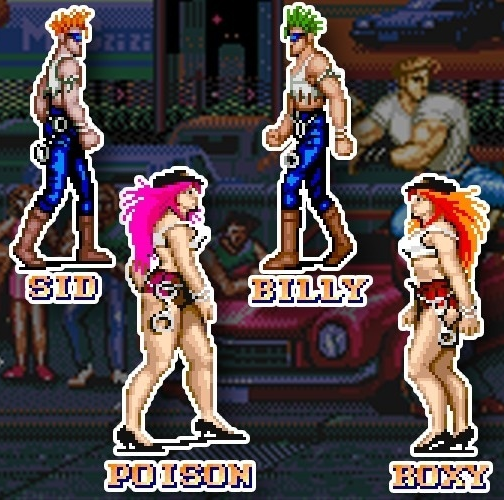
For example, back when the side-scrolling beat 'em up Final Fight was released in 1989, the Japanese version of the game featured two female enemies called Roxy and Poison. For the American release of the game, Roxy and Poison were removed from the game and replaced with two male punk characters called Sid and Billy, because "hitting women was considered rude". It was originally suggested that Roxy and Poison be considered male-to-female transsexuals -- this is how the famous confusion began over Poison's sex -- but supposedly, Capcom's developers figured that "wasn't enough" to deter critics of the two female enemies (wisely, in my opinion) so they replaced them entirely.


There's a site I found that has a good name for this trend; "Sidbillies". The writer of this article at ScrollBoss shows examples from other nineties' games like Sonic Blast Man, Ninja Warriors Again and Sunset Riders. The most interesting game mentioned, however, is Final Fight 2. The reason being that the second game in the Final Fight series had a playable female character, Maki. So it seems like the Final Fight series was embracing equality for the first time, having both heroic and villainous male and female characters ... but once again, the female enemies, Eliza and Mary, were removed in the American version and replaced with male ones, Robert and Leon.

In a way, this is actually worse than the German version of Half-Life replacing the marines with robots. That was done because someone determined that violence against human beings was completely wrong, so the human enemies were replaced with something non-human. It was ridiculous but morally, I can't fault them for it. The makers of Final Fight (and the other games listed on ScrollBoss) decided that violence against women was wrong ... but violence against men was completely fine, or at least more acceptable. It's one thing for this to be the case in the first Final Fight, where the three playable characters were all male, but it's quite another in the second, where one was female. You could justify having Sid and Billy in the first game if you were wary about encouraging male-on-female violence. The flipside to that, however, is because there's a female playable character in Final Fight 2 but there are no female enemies, Capcom are inadvertantly encouraging female-on-male violence. It makes me wonder why Maki was left in the game at all; is beating up men as a woman considered progressive in a way that men beating up women isn't?

Capcom aren't the only ones guilty of this and it certainly didn't die out with 2D games. Even though sprites are gone, so female characters can't simply be papered over with male ones, developers have come up with a much easier way of avoiding controversy; leaving out female enemies altogether. 

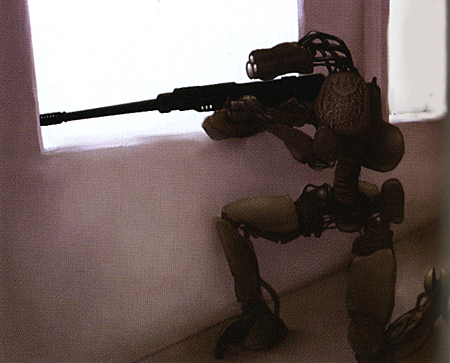
Lots of game developers seem to have (figuratively) taken their cues from Final Fight 2 by doing this. Back in one of my first blog posts, I said that the villainous Civil Protection in Half-Life 2 probably did feature women in its ranks but their voices were altered and their feminine physiques hidden underneath the Civil Protection’s bulky security outfits (or perhaps their bodies were altered too). However, this doesn't let Half-Life 2 off the hook because they still appear to be male to the audience, while the good guys -- resistance members -- feature both men and women in their ranks. During development, Valve apparently intended to make the Overwatch Sniper enemy female but, looking at the concept art, there's very little there that I could describe as "female". It looks very robotic, so there aren't many female qualities to be found. Unlike the Civil Protection in the final game, who still look human, act human and fall like human beings when they're killed.

An argument that I've heard both for and against female soldiers in games is about realism; people opposed to them argue that it'd be unrealistic because women only account for a small percentage of the military in real life (and only now in the US are being considered for combat roles). People in support of female soldiers in games point out that realism isn't really an issue when you're dealing with fiction, at least in a lot of games.

Personally, I think the realism argument doesn't make sense for either side when you think about games like Final Fight 2, Half-Life 2 or Final Fantasy VIII, which all featured female characters on the good side but only male characters on the evil one. Unless the developers of these games intended to make the villains out to be huge misogynists -- which they didn't -- there's no real reason for female characters to only be on the heroic side.

I would love to see more generic female soldiers and warriors in games, particularly on the opposing side. Because as it stands now -- and not just in the games mentioned above but Uncharted, Metal Gear Solid, Mercenaries, Tomb Raider and many, many others -- we're used to seeing men being killed. In all of those games, it's our objective to kill men, and only men (excluding the occasional boss). This is developers treating men as disposable and unimportant. So the realism argument falls flat when one side is single-sex and the other is co-ed. It's very unrealistic ... but it's also completely sexist because men are the only ones the player is meant to kill. That overshadows the realism argument.

Interestingly, Bethesda came up with another way to emphasise male disposability when making Fallout 3. One of the perks -- special abilities the player character could earn when levelling-up -- available to the player was to cause ten percent extra damage to characters of the opposite sex. However, because there were many, many more male enemies in Fallout 3 than female ones, the perk was a lot more useful if playing as a female character. It's minor but nevertheless puts a greater emphasis on killing men than women. As a result, two extra perks were added to Fallout: New Vegas to award the damage bonus against members of the same sex.

The Lady Killer and Black Widow perks.

Surprisingly, EA is one of the few developers I've seen with a decent split when it comes to the sexes of enemies in their games. Mass Effect, Dragon Age and Kingdoms Of Amalur: Reckoning all seemed to have a fair balance between male and female enemies (as well as aliens and monsters). Of course, Mass Effect heavily influenced the other two but they're all separate games nonetheless. They all serve to treat women the same as men.

There's an alternative to having an even split between male and female enemies; making everyone in the game only male or female. Surprisingly, it's not as crazy as it sounds. Starhawk only featured a single female character (who picked up a gun and joined the battle towards the end of the single-player mode, just like the men) but it worked for the setting; Starhawk was going for a "space western" theme and, given that most gunslingers were male, it suited the game. All the enemies seemed to be male too but they were just monstrous enough that it didn't really matter. Hunched over, with odd skin colours and bones that were on the outsides of their bodies. However, even though Starhawk managed to make it work, I wouldn't recommend it for every game. Although even that was better than emphasising male disposability with male enemies and mixed heroes.

Long story short, the idea that it's more acceptable to kill one sex over the other disturbs the hell out of me and I hope to see more female enemies in games in the future. This isn't a case of a lack of women in games anymore, as it was back in the days of Final Fight. Gaming has evolved to a point where women are in games now ... but developers are paranoid about making it the player's job to kill them in the same way they kill men.

To close, here's Lara Croft brutally killing men. Enjoy!