Over the past two months or so, I've been "fortunate" enough to take part in a "Critical Approaches to Creative Media Products" unit that deals with many of the same issues that we have read about and heard talked about in the games industry over the past few years. I don't know if it's anywhere close to the same as the "Social and Political Thought" class that Anita Sarkeesian took but the themes and language used are very reminiscent of her videos. The class itself isn't horrible ... but all the thoughts you have ever had about "cultural criticism" not being a real job are reinforced by it.
Let's start with the biggest reason why: there are no wrong answers. Absolutely everything is open to interpretation. Your own ideology and how much you read into things are more important than being accurate; it doesn't matter if the content creator actually did put the same spin into their work that you claim, it only matters that you make the claim and are able to justify it in some way.
Some of you may have heard of a subject known as "semiotics"; the study of the meaning behind signs and symbols. This doesn't specifically refer to signs but can refer to a body of work (a text, like a movie, game or television series). It's all about the "decoder" (the viewer) figuring out the message and the reasons why the "encoder" (the content creator) created the work the way they did.
Is it correct? Doesn't matter. Can you read something into it? If the answer is yes, then you're on the right track.
If you think I'm exaggerating, I'll use an example given by the tutor herself; when talking about the 2001 Tomb Raider movie starring Angelina Jolie, she brought up a scene near the end where Lara Croft visits her father's grave. The tutor's "decoding" of this scene is that the filmmakers and audience are only comfortable accepting a woman in a "masculine" action role if she also sticks to "her place" as a woman and outwardly displays that she's still feminine.
There's a big problem with this. Let's say Lara attended her father's grave in a suit. Couldn't I interpret that as the filmmakers refusing to show that a woman can be an action hero while also being feminine? That she has to be masculine to be believable? Only today, I looked up Jupiter Ascending on Wikipedia and read the phrase "Hollywood typically portrays strong women in action films as "Arnold Schwarzenegger with boobs"," so couldn't that standpoint be argued and be just as valid?
Of course it could. Because there are no wrong answers.
This "no wrong answers" approach is a key aspect of critical approaches that isn't picked up on by gaming journalists. It's all interpretation, based on the decoder's ideology more than the text. Gaming journalists miss this and treat the critique of people like Anita Sarkeesian as fact. Which is unsurprising, since she herself seems to have failed to grasp the fact that the critical approaches subject is based entirely around interpretation. This is why we hear blunt, insulting statements from Anita about people like Toru Iwatani, who she claimed had "regressive personal or cultural notions about women". It's her interpretation but she's stating it as fact.
More than that, and this is another major point that both gaming journalists and Sarkeesian have not acknowledged, even if your interpretation is 100% correct and you've nailed the reasons behind why a game developer did what they did ... you can still be factually incorrect about the game's content. Anita has brought that to the table in spades, cherry-picking examples that support her argument and ignoring the ones that don't (strong female examples and negative male examples). No, violence against innocent female strippers in Hitman Absolution is not "implicitly encouraged". Yes, MaleShep does have his own nickname. No, NPC bodies disappearing does not reinforce women's status as disposable objects. Even if being a "cultural critic" allows you to say whatever you like about a content creator's ideology, you can't ignore facts and evidence in order to prove your point. That is an area where there certainly are some wrong answers.
I don't want it to sound like my Critical Approaches class was horrible and I have to give my tutor credit in some areas. She wasn't on board with the nonsensical "it's impossible to be sexist against men" attitude espoused by Anita and other high-profile feminists. One other significant point she made about sub-cultures vs. the mainstream. An "out-group" vs. an "in-group". Basically, as sub-cultures become more and more of an "out-group", they become more at odds with the mainstream.
You may also have heard a phrase that goes something along the lines of "the oppressors never see themselves as oppressors". Judging from their reactions over the last year, it seems as though there are a bunch of high-profile mainstream figures in the games industry who still see themselves as being part of a downtrodden sub-culture. People like Anita, Leigh Alexander and Brianna Wu see themselves as oppressed, helpless victims being piled on by their oppressors ... but then do a great job of killing that image by landing television interviews, college talks and articles in mainstream newspapers to talk about how oppressed they are. It doesn't matter that they're wealthy. Or funded by Intel. Or the heads of PR agencies. Or were given hundreds of thousands of dollars by their parents to start their own businesses. Or have friends in high places, like film directors and mainstream journalists who are happy to promote them as being victims. They still don't see themselves as being part of the mainstream. Or they do and know how well-off they are but have to keep up appearances for the sake of profiting off their victimhood.
I want to make it clear that I'm not limiting this to those three. Gaming journalism as a whole (more or less) seems to fit this mould. It seems to be a trend with feminism as a whole too; feminist writers and bloggers appear to think that feminism is the sub-culture when, in actual fact, it's the mainstream. In his interview with TechRaptor last year, Daniel Vavra talked about how, "there is a group of people that think they know what’s right and what’s
wrong and that they have a mission to make the world a better place and
protect the oppressed by any means. They don’t even care what the “oppressed” people think". This isn't specific to games either. It's in all forms of media and ridiculously common in comic books (such as the controversy over the Milo Manara Spider-Woman cover variant). "If you don't like it, don't buy it" is not a phrase they consider acceptable. The demand is that nobody should be allowed to buy it unless it suits their sensibilities. It's very immature. Feminist critique isn't a subculture. It's the mainstream and it has been for about thirty to forty years. Critics of feminist critique are the subculture.
*
I was surprised to find that I still get at least a hundred visitors to the blog a day, even when I haven't updated for months. I apologise for that but if you read my last update, you'll know that I don't keep in touch with mainstream gaming news anymore. I get by on word of mouth and a few smaller gaming news sites that care more about the games than the politics. We all want to like games and I feel like buying the games I'm interested in is the best way of doing that. If it annoys critics because it has "regressive" portrayals of women, even better.
Regardless of whether people love or hate what I have to say, I appreciate everyone who visits and feel guilty about not updating more often. My readers (and especially commenters) are all great people and I don't want to let you down after you've done so much for me. I'm not going to stop updating, I guarantee that, but as side projects go, this blog is actually pretty draining.
I have to give a long-overdue thank you to Adrian Chmielarz for his numerous links to this blog in his "Top Ten Critiques of Feminist Frequency" article in February. It's much appreciated and his article was a great read. Thanks a lot to Adrian.
Even though my pageviews always spike whenever I write about Anita Sarkeesian's videos, I've decided to follow in the footsteps of other Feminist Frequency critics and not watch the video. The fact is that at this stage, even if I did watch it, I would just be making the same arguments that I have for her previous four videos. Lack of context when providing examples. Cherry-picking examples. Not acknowledging male examples of the same issue, only focusing on women. Claiming something without evidence -- damsels in distress being considered property, for example -- and making further arguments based on that assumption.
However, I would like to thank beste36 and gwadahunter2222 for their comments about Anita's latest video on my last blog. It's interesting to hear that Anita managed to offend sex workers and supporters of sex workers by referring to them as "prostituted women" (while giving male sex workers the courtesy of being referred to as "gigolos"). This criticism isn't specific to Feminist Frequency but anti-feminists often criticise feminism for portraying women as being unequal to men; saying "women need help, such as specific programs to get into STEM fields" while someone who considered men and women equal would say "women make their own choices to stay out of STEM fields and are more than capable of making their own decisions to enter or not".
This is what Anita did by using the term "prostituted women" instead of "sex workers". She deprived women of their agency and portrayed them as helpless objects rather than capable adults. The thing is, Anita does this a lot -- before her Damsels in Distress videos, I had always heard "objectification" used in conjunction with sexualisation; Anita was the first person I'd heard posit the theory that female characters are basically objects to be taken and "won" back, rather than fully-rounded characters that the protagonist cares about because he/she does not want to see them harmed -- but she picked the wrong industry to do it with this time.
The reasons why are clear; Anita is a sex-negative feminist, having criticised the "SlutWalk" marches in Toronto and describing herself as feeling alienated from feminism for embracing the word "slut". She's also been criticised by sex-positive feminists on Youtube. The problem, which Anita seems to have missed, is that sex workers have received an extremely bad rap over the years, with the struggle to have sex work recognised as a legitimate occupation, as a legal occupation, the problems with higher rates of violence in such a career, the problems with non-consensual sex (rape) being recognised by law when you're in a career that provides consensual sex to clients and just the general stigma of earning money through sex work in the first place. For that matter, an issue discussed in feminist circles is how female sexuality is often not recognised, supported or taken seriously (which I would argue is not the case), with straight male sexuality being "the norm".
With all this in mind, it's no wonder there was a backlash against a prominent feminist like Anita Sarkeesian portraying sex workers as the very objects and victims they fight against being stereotyped and stigmatised as. Although I'm afraid I have some bad news for everyone who is annoyed with Anita for referring to sex workers as "prostituted women"; your criticism will never be acknowledged by Anita, in the same way that she has not responded to any criticism directed at her since she's leapt into the spotlight. You're now part of the group that goes completely ignored by Anita unless she needs a reason to talk about how abusive people are being.
The other thing I learned about Anita's latest video from my last blog's comments section was that she made the following statement:
"[NPC women's] status as disposable objects is reinforced by the fact
that in most games discarded bodies will simply vanish into thin air a
short time after being killed."
Yeah.
There are some occasions when watching the Tropes Vs Women series when I haven't played a certain game (this happened a lot with Mario and Legend of Zelda games) and need to read some other people's explanations to know how and why Anita is incorrect. However, this is one of those things that everyone has seen in games and everyone knows is not specific to women. It is the one thing in all of Anita's videos that every single person watching can point at and say, "I know that's complete nonsense". To say that disappearing bodies reinforces women's status as disposable objects is verifiably, demonstrably false by doing nothing more than observing the same thing happening to men. Unless Anita has magically come across a game where it only happens to women.
Weirdly, this is probably one of the few occasions where even non-gamers can understand the problem; understanding why bodies disappear in games is very, very simple. I've actually just finished writing a couple of essays detailing, amongst other things, why this happens but here's the TL;DR version, only three sentences long (and I'll explain it in greater detail if anyone cares that much): you know how, at E3, many developers were pushing the fact that their games will run in "1080p, 60 frames per second (fps)"? Well, if there are a lot of things on-screen at once, that can slow the game down. Making bodies disappear helps the game to run smoother and reach that 60fps framerate because there's less stuff on the screen.
Oh yeah, and it happens to both men and women. Okay, that was a fourth sentence.
-----
Without a new Tropes Vs Women video to watch, I decided to watch another video that I've been putting off for about a month, ever since I discovered it existed. At the end of March, I wrote about a talk at the Game Developers Conference called "Fewer Tifas or More Sephiroths: Male Sexualisation in Games" by Michelle Clough. At the time, I don't believe the video of Clough's presentation was online but it is now and I believe it has been for a while. If you're not interested in watching it, you can read Michelle Clough's notes for the speech here -- sorry, no transcript as far as I know -- and the slideshow is posted on its own here. If you're just interested in skimming through it, that could be the best option.
Back in March, I assumed the best of Clough's talk and gave her the benefit of the doubt. After watching it? Well, if I had to sum it up in a word, that word would be "entitled".
Looking back at the first blog post I wrote about this, prior to having seen the presentation, a lot of my initial assumptions about the talk haven't changed (the "male power fantasy" argument -- although more frequently referred to as "male gaze" here, "power fantasy" does get name-checked at the end -- the idea that Clough's talk didn't rise much higher than "I want more of these character types in games just because I like 'em" and I still object to the idea that androgynous male characters are rare). However, my position on quite a few things have changed after seeing the talk and, I'm disappointed to say that most of them have changed for the worse.
There were some things I liked about the talk, albeit only a couple. I liked the way Clough compared various types of male heroes from different cultures to their modern counterparts. I felt as if that dug a little deeper than most. I also think Clough gave a good explanation of "male gaze", being more comprehensive and logical than other people I've heard discuss the issue. Having said that, I ended up disliking Clough's take on both for the simple reason that I wasn't convinced by either one.
When discussing European examples of gallant male heroes, for example, Clough compared the dapper Mr. Darcy from Pride & Prejudice to the suave and sophisticated James Bond as an example of a male character of a similar archetype in the present day. The thing is though, this one example isn't especially representative of European male heroes as a whole and even Bond himself has undergone many reinventions over the years. Plus, I found it interesting that Pierce Brosnan was the Bond chosen for Clough's example. Speaking as a British citizen, the biggest "fangirling" (for lack of a better term) over Bond in recent memory was Daniel Craig's scene in Casino Royale where he emerges from the sea in a pair of tight swimming trunks. Yet Craig's Bond is definitely in the running for the most rugged, placing him further from Mr. Darcy and closer to action heroes from American culture. However, Clough doesn't expand beyond male characters from Westerns, even though there are plenty of male characters from modern films -- or at least the eighties -- who fit the mould. This could be due to a lack of time, as Clough went on to rush her talk towards the end, but it still wasn't as comprehensive as it could be.
I'd also like to say that when it comes to film, the UK's male protagonists again stray from the romanticised and elegant image of Mr. Darcy that Clough displayed during the presentation; if there's one genre that UK film has excelled in over the last few decades, it's the crime genre. It's also the genre that Bob Hoskins, Ray Winstone and Jason Statham got their starts in, thanks largely to the presence of "celebrity criminals" in the UK such as the Kray Twins. Could they be dapper at times? Sure. Were they even close to Mr. Darcy? Far from it. I understand that Clough was discussing European courtly narratives as a whole but I'm failing to see the parallel between those and male characters in the present day. Bond (and Mr. Darcy) could be the exceptions rather than the rules. It's only a minor thing and isn't actually about any sexualised male characters in games but it bothered me slightly.
As for not being convinced by Clough's explanation of male gaze, it's the same criticism that I had with some of Anita Sarkeesian's arguments; I have to take Clough's word for it being the case but I don't see a guarantee that it (A) exists, (B) is the reason why certain "rugged" male characters are designed the way they are and (C) is the reason why certain situations, either involving sexualised women, or "awkward or comedic" non-sexualised naked men exist. And once again, I have to take someone else's word for it that I want to be these rugged male characters and any attraction straight women or gay men may have to them is accidental (Clough's words).
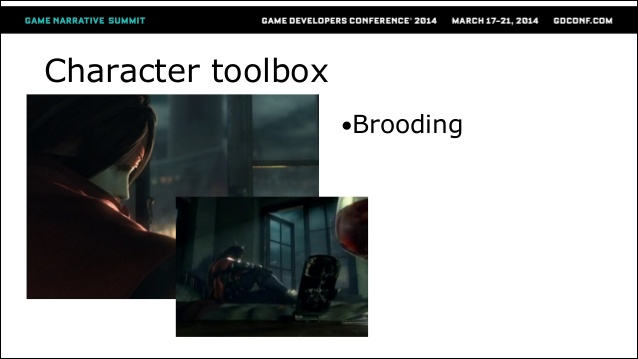
This is just my interpretation but what bothered me about this -- and the talk in general -- is the undertone that Clough's opinions and love of bishonen characters is "right" and to choose to create characters that don't appeal to her is "wrong". When you have sections called "who's doing it right?", it gives the impression that there's only one "correct" way of making sexually-appealing male characters. The same goes for when dimissing Max Payne as a brooding character done poorly while praising Final Fantasy VII's Vincent Valentine as a brooding character done well, while I would say the two characters are the other way around (although to Clough's credit she did use an image of Max Payne 3, which I've never played ... although after watching the first ten minutes on Youtube, that particular incarnation was one I could've done without seeing. What happened to all of Max's metaphors and similes? What happened to him making his peace with his family's deaths at the end of Max Payne 2?).
The problem with this assertion is that, obviously, there are women who find rugged male characters attractive and plenty of male gamers who don't relate to them at all. The opposite can obviously apply to bishonen characters, with not all female gamers being as enamored of them as Clough and it goes without saying that men can play as them without thinking twice about it. A female commenter on my last blog about Clough's talk actually said, "I never found the Sephiroth or Marluxia type of bishounen appealing.
Like maybe when I was 14." She also mentioned stumbling across some Call Of Duty yaoi once. If you have time, go to Google or DeviantArt and search for "call of duty yaoi". It exists!
It should be clear by now that there's no one big problem I had with Michelle Clough's presentation but a lot of small ones. For example, in my previous blog, I objected to Clough thinking that androgynous male characters were rare. Now that I've seen it, I've learned that the issue wasn't with sexualised being rare but them not being in any "core" games. To me, this led to a very muddled argument; firstly, Clough praised characters such as Thane (and others) in Mass Effect, which I would describe as a "core game". Secondly, she would go on to say "make sure sexualised characters are right for your game", before showing a mock-up of a Call Of Duty cover with a bunch of shirtless, muscular guys on the box, indicating an example of a game where it wouldn't be appropriate. I understand that Call Of Duty isn't the only "core" game out there but I would've been interested in hearing some suggestions from Clough. Thirdly, Final Fantasy VII was referred back to many times throughout the talk but the thing is ... the Final Fantasy series is still out there and still features androgynous characters. It's not exactly the fault of the developer that it's no longer the "core" series that it once was, so even though Clough is correct in that respect, it's also not through lack of trying that Final Fantasy isn't as popular as it used to be (or any game series for that matter; I'm sure most developers would give an arm and a leg for their games to be considered a "core" series like CoD or Assassin's Creed). So what point is being made by mentioning the lack of "core" games featuring sexualised male characters? Is someone to blame? Is it an example of how unfairly female characters have it in games, just because Square-Enix haven't been able to achieve the same success that they used to?
I don't want to ramble too much about this, particularly since it turns out I have as many criticisms as I do with the average Anita Sarkeesian video, but one final thing I noticed that disappointed me was how the slides on sexualised male characters were talked about with a light-hearted attitude while the rare occasions when sexualised female characters were the topic of conversation, Clough adopted a more serious tone; slides about Male Gaze,why sexualisation can be good while objectification is bad (focusing entirely on female characters, of course), comparing a male Starcraft character to a female one and comparing a shot of Jacob's buttocks in Mass Effect 2 to one of Miranda's were all treated as serious issues. Talking about male video game characters was the opportunity for Clough to crack some jokes and get a few chuckles from the audience.
My issue with that wasn't that jokes were being made at the expense of male characters. Having a funny presentation isn't the problem. It doesn't even bother me that the first talk about sexualised male characters ever wasn't taken seriously. Hell, you try condensing a subject down into twenty-five minutes when it's never been spoken about in such a prominent venue. It's not enough time to cover everything.
What bothers me is that it was purely from a feminist point-of-view. By that, I mean that Clough's stance wasn't one we haven't seen before. The idea of sexualised men was still a joke, in spite of Clough finding them appealing. In fact, it was considered a good thing, with Clough believing sexualised male characters could attract more women and gay men to gaming. Meanwhile, Clough reserved a modicum of seriousness when talking about female characters and I'd say the only time she mentioned them positively was in passing, when discussing how sexualised characters had to have traits other than their attractive appearance. Even then, it was glossed over, focusing on both Sephiroth and Tifa from Final Fantasy VII, rather than just Tifa.
I don't want it to seem like I'm against Clough having a feminist point-of-view just because it's a feminist point-of-view and give the impression that I'm foaming at the mouth with rage over it. I dislike it because it's a standpoint that seems dead-set against the idea that men can be portrayed negatively. One perfect example of it is when Michelle Clough mentions that when it comes to male nudity in games, it is always portrayed as "awkward or comedic". Hey, you'll get no argument on that from me. Where Clough and I differ, however, is where Clough sees the prominence of comedic nude male characters in games as being unequal treatment for women, as there were plenty of sexualised female characters but a lack of male ones, I see it as being unfair treatment of men.
This doesn't apply as much in games as it does in films, television shows and even real life but it's very rare for male sexuality to be treated as anything close to desirable, including in shows aimed at women; men are constantly portrayed as bumbling comedy figures when it comes to romance, someone for the down-to-earth female characters to roll their eyes at. Women are always portrayed as the desirable, effortlessly sexy party who useless male characters want to (and fail to) be with. Take a look at this advert from Wowcher in the UK for an example (which also portrays violence against men as comedy):
Or how about this advert for "Mullerlight Greek Style Luscious Lemon" yoghurt, which does show a male character as being desirable ... before he stumbles and the female main character (and narrator) laughs at his stupidity? I apologise but for some reason, the video isn't showing up when I try to embed it. Here's the link:
Then there's Harpic White & Shine, a lavatory cleaner. In this advert, a suave man in a white suit walks through some mist while words like "Dazzling", "Brilliant" and "Wow!" appear on the screen ... then he looks dejected as it turns out the words were referring to the lavatory cleaner and not him:
The reason I'm showing all of these television commercials is because Clough used a quote to make it seem as if the only reason why male sexuality is used as comedy is because "man is reluctant to gaze at his exhibitionist like". It's because of Male Gaze, in other words. However, these television commercials are all aimed at women; its "heroes" are female, the voiceover artists are female and hapless male figures are the butt of the joke. None of these adverts have anything to do with Male Gaze, so why does Clough believe that must be the case in games?
The funny thing is that treating male sexuality as comedy is actually the least offensive way of expressing a lack of desirability for men. When male sexuality is portrayed as being disgusting or even dangerous, it stops being comedy and actually creeps into prejudice; we end up with campaigns like "teach men not to rape", which is about as sexist as it gets and I'm not willing to go into it any further than that. This blog's long enough.
Finally, and this is a bit of a nitpick, but using Jin Kazama from Tekken as an example of a "power fantasy" when it comes to shirtless scenes? Literally any other shirtless Tekken character would've been a better option for Clough to pick if she wanted to make the "power fantasy" argument. Aside from Hwoarang, I'd say Jin fits Clough's criteria for a sexualised male character better than anyone else on the roster. He even has the same broodiness that Clough likes, which Namco Bandai plays up when Jin is the object of Ling Xiaoyu's affections:
Even though that ending turns out to be a dream, it's not that far from Jin's regular attitude.
I also have to point out something that I mentioned all the way back in September 2012; that Jin is one of several characters created to be a younger, better-looking successor to an existing character.
So like I said, it's nitpicking but I don't agree that Jin is close to a male power fantasy at all, particularly due to the standards that are usually used by feminists (Kratos and Marcus Fenix, for example).
Overall, and to summarise my problem with Michelle Clough's talk, in my previous blog on the presentation I gave her the benefit of the doubt because the topic of men being sexualised was never acknowledged. Now that I've watched the talk, I don't feel like it offered anything new at all. It didn't offer another side to the issue of sexualised characters, it just bolstered the position of the side that already controls the conversation on sexualisation (and other gender issues). And in spite of the fact that Clough was strapped for time, I have an unpleasant feeling that even if the presentation was twice as long, we wouldn't see sexualised male characters taken seriously (except to point out how good it is for straight women and gay men).
... The presentation was still more watchable than Tropes Vs Women though ...
-----
In other news, I finally took the plunge and joined Twitter. You can see my feed in the sidebar and I'm always happy for more followers.
You can also leave comments below or send me an e-mail at themalesofgames@gmail.com.
The next Tropes Vs Women video is up, so let's take a look at it:
In this episode, Anita talks about three particular tropes that she feels are harmful towards women:
The Distaff Counterpart - A character that is basically the female equivalent of an existing male character.
The Smurfette Principle - When there is only a single female character in an otherwise all-male cast.
Tertiary Sexual Characteristics - Female characters have characteristics or items that indicate that they are female -- such as bows in their hair or makeup -- while male characters have none.
Funnily enough, I've actually been critical of the Distaff Counterpart on comic book forums before, just because I think it diminishes any real creativity. I think original female characters are more interesting and having unique powers (in the case of superheroes) is a greater incentive for a new audience to pick up the book than simply using a "name" character. In all honesty, that's probably not the case and is just a personal preference because otherwise, why would Distaff Counterparts/legacy characters exist if not to sell more products? That's the reason in comic books and it's more or less stated in Anita's own video that it was also the reason for Ms. Pac-Man.
However, in spite of the fact that I have a personal distaste for Distaff Counterparts, I find that Anita's representation of them in her video doesn't paint a fair picture. In fact, for once, I feel like I'm being critical of Anita because I want her to do better when critiquing a subject I dislike, rather than being critical of her because I disagree. I've noticed other supporters of better female portrayals in video games take this stance so it's interesting to find myself in the same boat.
I think several points Anita makes at the end of her video point out one of the pitfalls that she fell into during her damsel in distress videos; either failing or refusing to acknowledge the differences in gaming between retro games and the modern era. In the case of the damsel in distress, it was praising games like The Secret Of Monkey Island without pointing out that games with Monkey Island's clever writing and narrative were the exception, rather than the rule. Game developers at the time didn't have the luxury of being able to create complex stories in every single game. Using the damsel in distress plot device gave the player a simple and understandable idea of why the character they played as was on their quest.
In this case, Anita does not acknowledge the reasons behind the female characters she praises being free of "gender signifiers" -- her term for Tertiary Sexual Characteristics, as well as a term that I actually prefer -- and the (usually) retro ones she criticises for having them. Let's use Ms. Pac-Man as an example; unlike TowerFall, Ms. Pac-Man didn't have the freedom to create female characters in a brand new setting. She was created because Midway wanted a follow-up to Pac-Man, which Anita mentioned herself. Therefore, she was limited in the designs that could be used and still remain recognisably part of the Pac-Man universe. Plus, unlike Thomas Was Alone -- another game Anita praised for featuring a positive female character without any gender signifiers -- Ms. Pac-Man didn't have a narrative that would allow for the development of a deep female character, much like Elaine in The Secret Of Monkey Island compared to other, more "regressive", examples of the damsel in distress.
Basically, there were limitations to making a female character in 1982 who was intended to be a successor to the most popular game character in the world (at that time). There's only so much you can change when the character has to be as recognisable as Pac-Man himself and with both the storytelling and graphic limitations of the time period. I don't feel that's highlighted in the video above.
It's a similar story with other games Anita mentions, such as Ice Climber (1985), Bubble Bobble (1986) and Adventures Of Lolo (1989). Another aspect that stood out to me was the divide between examples used from Japanese games and Western games. When it comes to the heavy focus on Japanese games, I'm not saying that the cultural differences excuse poorer representations of women or any other group. However, to avoid mentioning those cultural differences is to refuse to paint the whole picture. In previous episodes, Anita has singled out Shigeru Miyamoto and, in Pac-Man's case, it's Toru Iwatani's turn to be painted with the sexist brush. Here's Iwatani's quote that Anita took issue with:
"When you think about things women like, you think about fashion, or
fortune-telling, or food or dating boyfriends. So I decided to theme the
game around “eating” — after eating dinner, women like to have dessert."
It's understandable that Anita would dislike the blanket stereotyping but the cultural differences between the West and Japan aren't delved into. In fact, it's glossed over in a sentence by being described as, "Iwatani's regressive personal or cultural notions about women". I can't help but feel like this dumbs down what was, in fact, a major attempt to garner a female audience for video games. Iwatani reached out rather than pushed away. Isn't that something Anita wants?
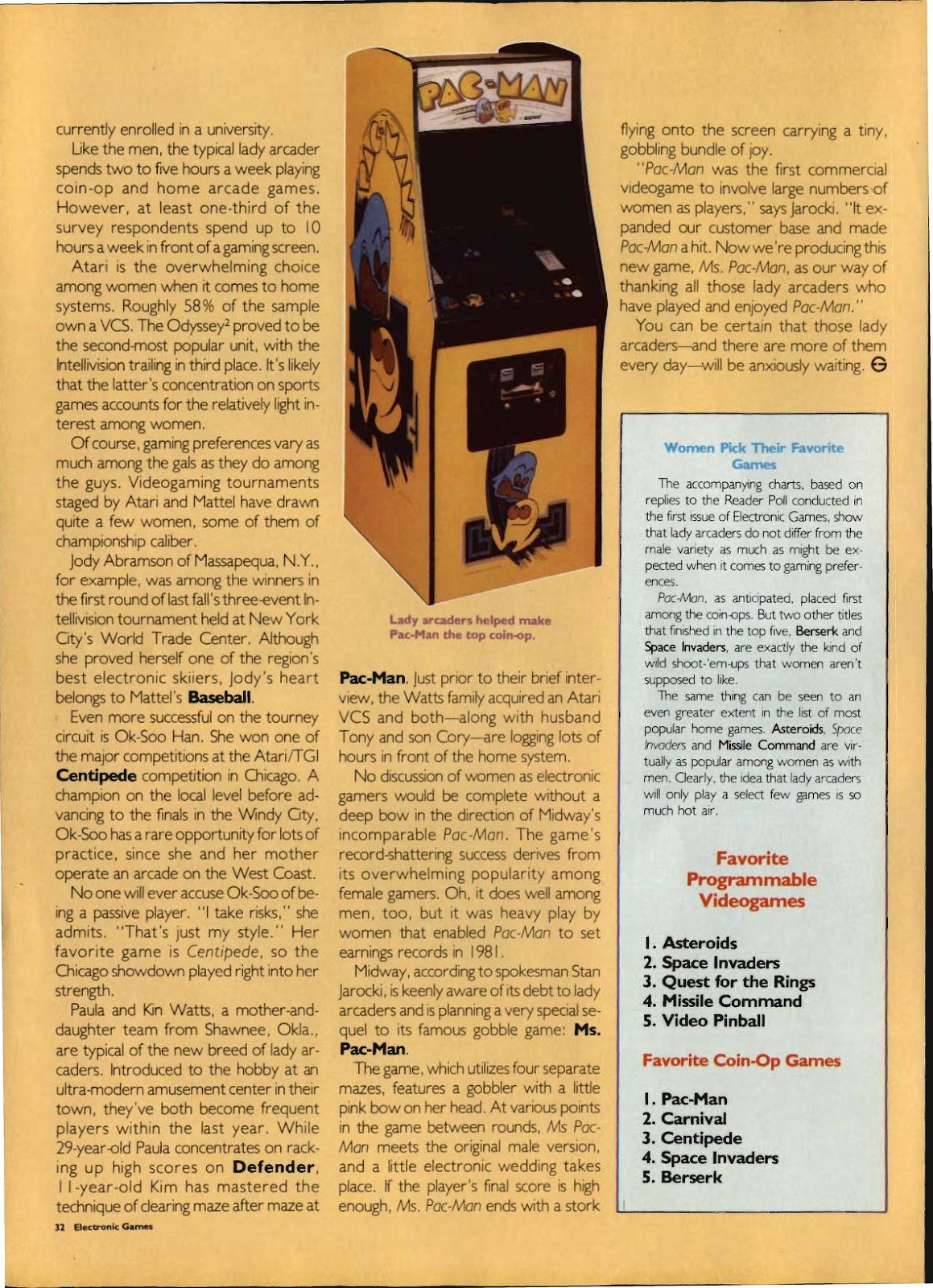
And make no mistake, it worked. Pac-Man's success and popularity amongst female gamers was one of the reasons why a female character was the protagonist in Ms. Pac-Man, according to Midway employee Stan Jarocki.
Electronic Games Magazine (May 1982). Left-click for larger view.
"Pac-Man was the first commercial videogame to involve large numbers of women as players," says Jarocki. "It expanded our customer base and made Pac-Man a hit. Now we're producing this new game, Ms. Pac-Man, as our way of thanking all those lady arcaders who have played and enjoyed Pac-Man."
In spite of my own feelings about Distaff Counterparts, there is a reason they exist; they work. They can be hugely popular in their own right, earning the ability to stand on their own two feet. To use superheroes as an example, Marvel's Carol Danvers -- better known as Captain Marvel, formerly Ms. Marvel -- is a far more prominent hero than her male predecessor, also known as Captain Marvel. In the case of Ms. Pac-Man, she was as capable as Pac-Man when it came to eating dots and ghosts and in an enormously popular game herself, to the point that she either matches Pac-Man's cultural relevance or is ridiculously close. So to have Ms. Pac-Man so passively dismissed and her contributions diminished with the following quote is only disheartening to see, regardless of Anita's claim that, "it’s entirely possible to be critical of some aspects of a piece of media while still finding other parts valuable or enjoyable":
"Ms. Pac-Man’s visual properties are simply an extension of Pac-Man’s
original design; she actually kind of is just Pac-Man with a bow. Her simple narrative reinforces the fact that she really only exists in
relationship to Pac-Man. She is both his love interest and also the
mother of his child."
Later on, Anita also provides this statement:
"Ms. Male Characters typically aren’t given their own distinctive
identities and are prevented from being fully realized characters who
exist on their own terms. This has the, perhaps unintended, effect of devaluing these characters
and often relegating them to a subordinate or secondary status inside
their respective media franchises, even when they are, on rare
occasions, given a starring role in a spin-off or sequel."
I don't know about anyone else but I feel like the only person devaluing characters such as Ms. Pac-Man is Anita. Prior to that particular quote, Anita was talking about Dixie Kong, star of Donkey Kong Country 3 and a playable character in fifteen games, and it's clear that the quote is aimed at characters such as her and Ms. Pac-Man. Dixie Kong was the start of her own title, having to save two male characters who were damsels in distress and why exactly is she receiving criticism? Because she wears pink. Because she has a ponytail. Because she's a Distaff Counterpart to Diddy Kong, according to Anita (which isn't actually true; they have similar designs but only because the two are similar in age, size and, y'know, they're apes. The two do not share abilities or similarities in their design more than that, in the same way the Pac-Man and Ms. Pac-Man do). So who, exactly, is devaluing the female characters here?
Truthfully, I'm having a hard time figuring out why, exactly, Anita takes issue with gender signifiers in games. Unless they lead to what she describes as "personality female syndrome" -- a series of characteristics that Anita believes stereotype women, including being, "vain, spoiled, bratty and quick to anger" -- I don't exactly see the issue. I thought I did but then this segment of the video completely threw me off:
"Now just to be clear, there’s no inherent problem with the color
pink, makeup, bows or high heels as design elements on their own. And of
course people of all genders may choose to wear any of them from time
to time in the real world and there is nothing necessarily wrong with
that either.
However, when designers choose to use the Ms. Male Character trope
and its associated visual stereotypes to specifically distinguish female
characters from the rest of the cast in a fictional context, it has a
few negative consequences.
One repercussion of constantly relying on feminizing signifiers for
character design is that it tends to reinforce a strict binary form of
gender expression. The gender binary is an entirely artificial and
socially constructed division of male and female into two distinctly
separate and opposing classes of human being. The gender binary also
erases the continuum of gender presentations and identities that fall
outside of the rigid masculine/feminine false dichotomy.
And within that strict binary women are “marked” while men get to remain largely “unmarked”."
In other words, Anita dislikes signifying a character's sex through certain clothing or accessories because (A) it singles out women as something different from men and (B) it automatically excludes people who don't identify as male or female, or who do but choose not to conform to gendered clothing.
The main reason this stood out to me is because, as understandable as it is to want more representations of genders outside the "gender binary" -- which simply means "male or female" -- I don't understand why it falls to gaming to show those representations. Gaming can but isn't Anita criticising the "entirely artificial and socially constructed division of male and female into two distinctly separate and opposing classes of human being" actually a criticism of society's attitudes instead?
Let's use Ms. Pac-Man as an example again. I'm not normally a person who says that Anita needs to provide good examples in addition to negative ones but in this case, I would love to hear an alternative solution to giving the character lipstick and a bow to show that she is a female character. Again, bear these factors in mind:
It's 1982 and there are "only a few pixels to work with" (Anita's own words).
The character has to look different from Pac-Man to avoid Ms. Pac-Man seeming like a knock-off.
The character has to look similar enough to show that the game is part of the same series.
I think it's reasonable, albeit not ideal, for a character designer to draw on real-life examples of women to create a female character in this case. Given that women are far more likely to wear bows and lipstick than men, it is completely fair for a character designer to use those elements for his/her female character. And that is so obvious that I can't believe I had to write it down.
On the Feminist Frequency Tumblr, the only solution, if you can call it that, was a gender-flipped version of Pac-Man and Mrs. Pac-Man that shows how the two characters would look if "Pac-Woman" became "Mr. Pac-Woman".
Personally, I don't think it's as "downright absurd" as Anita believes, not least because Pac-Man is a tricky character to take seriously in the first place. He -- or she, if we're talking about Pac-Woman -- is a yellow circle with a mouth. Putting a top hat and bow tie on it doesn't propel this light-hearted, cartoonish character into the realms of absurdity. What little ridiculousness there is only comes from the fact that, if anything, "Mr. Pac-Woman's" clothing looks very outdated. However, this still isn't a solution. It's just a gender flip.
I'm anxious to move on from this topic but I want to mention the idea that women are "marked" and men are "unmarked". I don't think Anita ever actually asked why it is done but she certainly, and probably unintentionally, provided an answer to that question:
"There are a few optional design accessories for men like neckties or
baseball caps but they don’t hold the same significance. They are not
ubiquitous or strictly enforced, and are never really used to “mark” men
as “not female” in larger fictional universes dominated by women."
First of all, I find it quite funny that Anita singled out Dixie Kong earlier in the video when both Donkey Kong and Diddy Kong wear a necktie and baseball cap respectively -- again, they're apes. It'd be tricky to tell the sex of those characters without gender signifiers -- but doesn't this quote sum up why gender signifiers aren't used as often for male characters? Certainly not because men are considered the default and women a deviation (which I'll come to later) but because there are so few gender signifiers available for male characters. Traditionally-male clothing is no longer restricted to men. Women are far less likely to receive odd looks if they went out in public in a man's suit than a man would if he did the same in a pink dress, with pigtails and makeup. The reason being that they still are items and fashions predominately associated with women. If Anita wants to take any steps changing society's perceptions on that score, I'll be right alongside her, but it's silly, pointless and actually rather petty to lay the blame of gender signifiers at the feet of video games. That goes for modern games as well as retro games.
In other words, women are more likely to have gender signifiers because they actually have them. Not because they need to be "marked" and singled-out as something different from "the norm".
Also, I actually find that turn of phrase bordering on offensive; I'm sure it was completely unintentional but think about other oppressed classes throughout history who have been marked -- literally -- as something different from what their oppressors considered "the norm" or ideal. I feel like it was a very poor choice of words to use when describing how hard female characters have it in video games, of all things.
One thing that I'm sure had everyone marvelling was Anita's analysis of Mass Effect 3's advertising. Let's deal with the mistake that even the non-Mass Effect fans probably picked up on:
"Still, the female version has a dedicated fanbase who frequently refers
to her as “FemShep”. And although this is meant as an affectionate
nickname, it does further highlight her designation as a Ms. Male
Character. She is the one with the qualifier attached to her name. She
is “Female Shepard” whereas the male version simply gets to be,
“Shepard”."
This is completely untrue. Although I hate to fall back on phrases that make it sound like Anita makes these kind of research mistakes all the time, this is a typical example of the lack of research that people criticise her videos for. It certainly is astounding that Anita can trawl through obscure mobile games and retro games to find examples but can't spend two minutes on a forum to find out information on a nickname for the main character of a AAA game.
For those of you who don't know, the male version of Mass Effect's Commander Shepard does have a nickname. Several, in fact; "MaleShep", "ManShep" and "BroShep" are all commonly used while "ShepLoo" and "VanderShep" are both used to refer to Commander Shepard's default male design, named after the Dutch model he was modelled after, Mark Vanderloo.
That's not all. Prior to this, Anita discussed the marketing of the Mass Effect series:
"In mainstream advertising of the franchise, the male commander is
used almost exclusively. His image is front and center on the box covers
for all releases including the special editions. He is the one featured
in the TV commercials, teasers, trailers, web banners, street posters
and print ads and his face appears on most of the magazine covers. All
of this positions the male Commander Shepard as the default protagonist
of the series. That is how Bioware is selling the Mass Effect experience. Nearly
everything about the advertising campaign explicitly tells players that
Commander Shepard is a man and by extension associates the official
storyline with the male version of the hero. This marketing strategy
contributes to the fact that only 18-20% of players choose the female
option (despite the fact that Jennifer Hale’s voice acting is widely
praised as being far superior)."
First of all, although the 18-20% statistic is apparently true, there's nothing to say that the marketing strategy is the reason for the 80% of players or so choosing to play as the male version of Shepard. Much like in previous videos, like assuming damsels in distress are considered property rather than people, this is a case of Anita reaching a conclusion that isn't backed up by any factual evidence. One may not neccessarily lead to the other but Anita is arguing as if that is the case.
Secondly, I take issue with the fact that Jennifer Hale's voice acting was considered "far superior". There are certainly people who make that claim but she also has her detractors (typically on the exact same forums as her supporters. There's always a healthy mix of opinions). I'm as big a fan of Jennifer Hale as the next person, particularly for her performance as Bastila Shan in Star Wars: Knights Of The Old Republic, but I wasn't a fan of her Mass Effect role. I agree with those who say her vocal performance as Commander Shepard was too butch. Trying too hard to be "badass", to fit a tough space marine persona rather than just a person. Meanwhile, Mark Meer -- the voice actor for the male version of Shepard -- had a voice that fit a wide range of races and facial features, as well as being suitably authoritative. Plus, he was widely praised for upping his performance in Mass Effect 3.
Then there's the advertising campaign, which focused only on the male version of Commander Shepard. To be more specific, the default male version of Commander Shepard, created using Mark Vanderloo's likeness. I certainly find it unusual and rather silly that BioWare -- creators of Mass Effect -- actually paid for a real person's likeness in a game where a character's facial features can be customised and that was the appearance focused on in all the marketing ... but since that's the case, why does Anita focus on the fact that he's male? Why not mention that non-whites are similarly ruled out or, for that matter, that the character customisation feature isn't shown off as much as it could be and is therefore rather poor marketing for not showing off an aspect of the game? The thing is, when only one of these points are argued -- "women aren't focused on" -- it sounds less like "not everyone is being given an equal share" and more like "it shouldn't be a male character". Something that is equally as exclusionary.
Plus, it has to be said ... the male Commander Shepard is the default protagonist of the series. "VanderShep" is the version of the character that players see when starting a new game. So criticising the series with the statement, "all
of this positions the male Commander Shepard as the default protagonist
of the series" doesn't make much sense. That's the case. Plus, for all I know -- or for all Anita knows -- having a default protagonist could help sell the game. I wouldn't want to make assumptions about why mainstream audiences bought Mass Effect.
Anita continues:
"During the advertising of Mass Effect 3, Bioware made a little more
effort to include female Shepard with items like an alternate reversible
slip cover for the game box (which features the male version by
default) as well as a special web only trailer but these gestures feel
like an afterthought or niche specialty marketing and hardly what I
would call a substantial or equitable inclusion."
This dismissive attitude when a developer makes a positive change in order to cater to women is reminiscent of Carolyn Petit's criticism of female characters being added to Aliens: Colonial Marines. All it does is send the message that the developer may as well not even try to cater to a feminist gaming audience because it's impossible to succeed. Much like Petit, Anita is creating a no-win situation by complaining about an effort BioWare made to appeal to feminist gamers in the first place. It also brings to mind the way Anita shrugged off Princess Peach's appearance as a playable character in Super Mario Bros. 2 in her damsel in distress videos because she was only in the game "by accident", since it was a makeover of Doki Doki Panic.
Finally, when talking about The Smurfette Principle, Anita argues that men are treated as the "default" sex:
"In a male identified society like ours, men are associated and become
synonymous with human beings in general. In other words, male tends to
be seen as the default for the entire species."
In all seriousness, there is some truth to this claim. Although it's more of a double-edged sword than is made out.
Let's use a real life example; political parties are always trying to gain "the female vote" by showing their support for women's issues, such as taking a pro-choice stance on abortion, pledging to stamp out the wage gap and sexism in the workplace, etc. Meanwhile, there's no "male vote". I don't think the phrase "men's issues" will ever come up in a political debate and, if it did, nobody would have a clue what it means. That's part of men being considered the "default" for the entire species. There's no need to cater to men because men are just ... there. The standard. Anything that appeals to society as a whole will be appealing to men because they don't have anything that specifically caters to them ... right?
In games, we don't care about legions of male enemies being gunned down by the player. In fact, it's not only accepted, it's expected for men to be the expendable gender. Meanwhile, we have developers committing self-flagellation over their portrayals of characters, even positive ones, thanks to criticism from the Tropes Vs Women in Video Games series, while men criticising portrayals that they feel are sexist are told to "Grow The F**k Up". Because men can't possibly be offended by portrayals because we're the default. Isn't that so?
So there's something to the idea that men are considered the default but -- and this isn't a knock on Anita -- I wouldn't expect the effects on both sexes to be covered by a video on gender issues in games. It's not an issue at the forefront of the gender issues debate, so it's not something I believe anyone would cover, regardless of their sex or involvement.
I'm hoping to read more articles on this video from others online but for the moment, that's all I have to say on it. I don't know if I was expecting Anita to change her presenting style for this video but I do know that I was disappointed to see all the flaws present in her previous videos to be back with a vengeance here; the blaming of specific developers, basing arguments off conclusions that she came to without evidence, dismissal of positive and progressive changes for women for rather shallow reasons, etc. On the plus side, she did reference a few examples this time around (although none of the gameplay videos, so it's still up in the air as to whether they were her own content or if they were taken from other Youtubers without permission or credit).
Anyway, as for what happens next ... I'm buying the Tomb Raider reboot in the near future, so hopefully I'll be able to provide another "The Sexism Of ..." blog post. I know it's a year old now but I don't often get the chance to delve into individual games anymore, so I'm looking forward to it.
Feel free to leave a comment or write to me at themalesofgames@gmail.com
I've been really bored lately, even with Dragon's Crown. I played Gone Home recently too but thought that was a letdown. While I suspect there'll be something to write about following Gamescom, it's all very slow-going right now. Not that there's a shortage of gender issues concerning men in video games to write about but, it has to be said, it's so much easier to write about current issues and have links at my fingertips than it is to hunt down pictures and videos myself. Still, with nothing else to do, let's talk about reversing the sexes.
A few days ago, I read a comment on Youtube that said something along the lines of "reversing the sexes is a standard defensive, kneejerk response to accusations of sexism in video games". I can't recall the video I saw it under (and after spending most of the day searching, can't find it either) but that statement left me scratching my head. Hypothetically reversing the sexes of a situation has always, to me at least, seemed like an easy and effective way to examine whether it's sexist or not. In fact, people like me who get involved in the bubble of gender issues can forget how easy it is to become bogged-down with complicated terms (like "patriarchy", "hypoagency", "rape culture" and other phrases that I like to steer clear of while writing this blog) so reversing the sexes is actually an incredibly useful, accessable tool to people who aren't as interested in gender issues; it's easy to do and doesn't overcomplicate any issues. So let's try a few.
There's a moment in Star Wars: Knights Of The Old Republic that always confused me; the player character meets a hunter on Tatooine who is stranded and needs the player's help. The wife of this hunter has rigged his hunting droids to explode if he takes another step. He had no choice but to wait for help, possibly dying of thirst in the process. The hunter isn't smart enough to figure out how to disarm them, so he asks the player character for help. It isn't the situation itself that's questionable -- even if it is the Star Wars equivalent of a bumbling husband being at the mercy of his more intelligent wife -- but if the player chose Bastila Shan, a female Jedi and something of a mentor to your own character, to accompany them, she has some eyebrow-raising things to say about the hunter's situation:
Bastila says, "I say leave him". The hunter replies with, "you're pretty heartless for such a pretty lady, you know?" Bastila responds, "I take it back. Let's congratulate his wife".
To me, this always seemed like a huge overreaction, especially for the supposedly good-natured Bastila. So much for "the Jedi do not believe in killing their prisoners", as she states earlier. Leaving prisoners to die of thirst, however, is apparently completely acceptable.
The uploader of that Youtube video comments that, as out-of-character as it may seem, it hints at Bastila having anger issues that would later be used to turn her to the dark side. Personally, I find it a bit hard to connect "irritation over clumsy come-ons" with "dark lord of the Sith". Not that I think the uploader is incorrect but it seems like an odd thing to foreshadow side-switching with.
So do you think it's sexist? I'm torn. The hunter isn't portrayed as a sympathetic character; using droids to hunt is a no-no in KOTOR and he has a habit of flirting with women in spite of being married. Plus, in spite of Bastila's comments, the player earns Light Side points for helping the hunter, so it doesn't seem like the game is encouraging punishing the hunter for his comments. On the other hand, it takes a lot to advocate murder (and congratulate the murderer) just because you're irritated over someone's pick-up lines.
Reverse the sexes and I think there's only one big difference; it sounds a lot more harsh to me to think of a male Jedi offering to congratulate an unintelligent woman's husband for plotting to murder her. It would come across as unbelievably petty for a male character to be so irritated by some (admittedly obnoxious) come-ons to advocate such a serious act of domestic violence. As we know, however, domestic violence against men isn't awarded the same seriousness as it is against women. Having said that, I'm still coming down on the side of "not sexist", solely because the player is rewarded with Light Side points for helping the hunter.
Helpfully, there are a few games that provide surprisingly accurate gender-flipped counterparts to each other in spite of the fact they're more-or-less unrelated. Take Heavenly Sword and Resident Evil 4 as an example:
And back when I wrote "The Violence Double Standard", I brought up a moment in Final Fantasy XIII when Lightning punched Snow -- her sister's boyfriend -- twice in the face for failing to keep her sister safe.
I went on to say, "according to Square-Enix, she was conceived as "a female version of
Cloud", from Final Fantasy VII. I must've missed the version of Final
Fantasy VII where Cloud clocks Tifa in the jaw angrily. Twice." It was only this month that I received a long reply in the comments that ended with a link to this video from Final Fantasy VII, where Cloud attacks Aeris in a moment of stress. Skip to 14:40:
Comparing these four moments is a good way to highlight the differences when violence is portrayed against colleagues in games. They are, more or less, gender-flipped versions of each other.
The big difference, first of all, is that the men aren't in control of their actions when they attack the women. In Resident Evil 4, Leon is being controlled by the parasite inside his body and in Final Fantasy VII, Cloud's stress causes him to have an out-of-body experience; literally, a ghostly image of Cloud appears that the player controls while the corporeal Cloud attacks Aeris and the player is unable to stop him in any way. In contrast to the two of them, both Nariko in Heavenly Sword and Lightning in Final Fantasy XIII are well aware that they're harming their own colleagues. So it's acceptable for female characters to hit male ones (which is shocking, I know) but for male ones to hit female ones requires a trance of some kind.
It's also worth noting the reaction to each one. Nariko's choking of her fellow clanmember is broken up quickly but there isn't any concern shown for the man. Lightning punching Snow is practically ignored by their fellow teammates. Certainly, no concern is shown for Snow. On the other hand, Ada reacts to being choked by kneeing Leon in the ribs and stabbing him in the thigh to break him out of his trance. He ends up thanking her for this. So no matter who is being choked and who is doing the choking, violence against the male character ends up being acceptable in both situations. In Final Fantasy VII's case, the remaining party member (Barret, in the video above) quickly rushes in to knock Cloud out and prevent him from hurting Aeris any further.
It seems like trances are an easy way to have violence stay reasonably inoffensive; reverse the sexes of either the Leon or Cloud attacks and they're practically the same. The hero doesn't come across as any worse because of the attack, regardless of his/her sex or the sex of the victim. Part of the reason for that is because the attack isn't the important part, whereas the trance is; both Leon and Cloud attack women because it's such an extreme action, it shows how far their sanity is slipping. Women attacking male characters on their own side is just ... a quality. Game audiences aren't supposed to think anything of it, except perhaps "I'm glad that guy got taught a lesson". As a result, reversing the sexes of the Heavenly Sword and Final Fantasy XIII attacks does make things seem worse; a male character in complete control of his faculties choking or punching a woman who refuses to fight back is just asking to be called out for its misogyny.
I suspect its moments like these -- strikes against male characters by female ones -- that make up the majority of examples that don't really stand out until we reverse the sexes. They're so quickly dismissed when they're against a male character that either we ignore them or we're supposed to ignore them. Take Bioshock Infinite. It's a very basic example but Elizabeth strikes Booker DeWitt in the face with a wrench that isn't brought up again after it happens. It knocks him out-cold, giving Elizabeth enough time to flee but Booker still doesn't have a word to say about it.
I don't know if the gaming public is prepared to see a male character doing this to a woman, although I think it's possible to give gamers a bit more credit. Take the Mass Effect series as an example. It's possible for the main character, Commander Shepard, to punch a female reporter attempting to smear his/her (although for this example, let's go with "him") reputation in all three games. Sure, it's not the same thing, in quite a few significant ways; the reporter isn't on Shepard's side, punching her is a "Renegade" option and, as previously mentioned, Shepard can be either male or female. Each of those points lessens the impact and controversy of a male character punching a woman. Even so, there doesn't seem to have been any backlash at all against the Mass Effect series for this. In fact, it's been praised because the reporter is intentionally unlikeable. Who knows if a male character intentionally punching, choking or bludgeoning a stubborn (like Snow) or sexist (like the clanmember) woman on their side could be as accepted as women doing it to men is now (irritatingly)?
As always, feel free to leave a comment or send me an e-mail at themalesofgames@gmail.com.
Women aren't as evil as men. Everyone knows that! Although in case you didn't, game developers have a helpful way to educate you; if there's a female villain in a game, she's the most likely of the bunch to switch to the heroic side or she'll have been hypnotised or brainwashed into being evil instead. One of the two.
Although I try to avoid referring to TV Tropes too often -- I'm a fan of the site but I know Anita Sarkeesian is criticised for taking it at its word a few too many times -- but it has some information on this on the "High Heel Face Turn" and "Females Are More Innocent" pages. The "Sorting Algorithm Of Face Heel Turning" is also worth a quick look ("face" and "heel" are the professional wrestling terms for "good guy" and "bad guy" respectively, in case you didn't know).
The "High Heel Face Turn" trope gets the basic point across but I think it's missing something; going by the definition on that page, the female villain would have to be the lone female on a team of villains to qualify. Not that it's incorrect or any better when it's only a single female villain rather than several but I can think of a game series where all the female villains either switch sides, aren't as villainous, are coerced into being evil via brainwashing or repent how evil they are shortly before death. If you don't want to be kept waiting, I'm thinking of Metal Gear Solid.
"There are barely any bad women in the game. Catwoman is an anti-hero. So
is Talia Al-Ghul and her all-female army of assassins. Poison Ivy keeps
to herself. Harley Quinn is the closest thing to "evil" a woman gets in
the game and she plays the comic relief role."
Meanwhile, Mr. Freeze is the closest the game has to a male villain switching sides. He's a lot like Poison Ivy, in that he wants to keep to himself. Even so, he acts pretty selfishly; while Poison Ivy only attacked when Catwoman entered her territory, Mr Freeze shattered a vial of a cure that could save Batman from the illness that plagues him throughout the game purely out of spite. Well, leverage supposedly -- he wanted Batman to help get his wife back but there was nothing to suggest Batman wouldn't have done so anyway -- but clearly spite.
One of the traits that is always present in Mortal Kombat's messed-up canon is Kitana shaking off her brainwashing and joining the good guys. She's raised to believe that she is the daughter of the villain, Shao Kahn, but it doesn't take long for her to find out the truth; that Shao Kahn killed her father, forced her mother, Sindel, into marrying him and adopted Kitana himself. Kitana switches sides, as does her best friend, Jade. Jade was only siding with the villains to keep watch over her best friend. Depending on the timeline you look at for the Mortal Kombat games, Sindel may follow suit and join the heroic side too (but in that particular timeline, so do Ermac and Smoke ... and Raiden turns evil. It's a bit of a mess as the series continues). Kitana and Jade's side-switching is a mainstay of both the old and new Mortal Kombat timelines though, so it looks like there's no way of keeping them evil.
Even in games where the male and female villains are evil for the same reasons, there can be subtle differences. Take the first Mass Effect game, for example. Saren (a male Turian) and Matriarch Beneziah (a genderless Asari but physically female, like all Asari) are both evil because they're in the thrall of Sovereign, a massive ship-slash-AI with mind-controlling powers. Even then, however, Beneziah is given a more sympathetic backstory than Saren.
Then there's Metal Gear Solid, a series where all the female villains have excuses for being evil. In Metal Gear Solid 2, Olga Gurlukovich switched sides because her daughter had been taken from her by the real bad guys (which is an oversimplification but for the sake of this blog, a longer explanation isn't needed). Fortune also turned against at least one of her former villainous colleagues, going so far as to save the good guys' lives before dying of a gunshot wound. In Metal Gear Solid 3, we had The Boss. Long story short, she was never evil. She posed as being evil but the actions of one of the villains led to her plan spiralling out of control and she eventually had to be killed. In Metal Gear Solid 4, there's an all-female team of villains called the Beauty & The Beast Corps. All four women share the same backstory; they all suffer from post-traumatic stress disorder. Their fragile mental state was exploited and they were each given hi-tech suits to make them deadly soldiers. They're tragic figures more than anything else (or they would be, with a bit more character development).
Sniper Wolf from Metal Gear Solid is the only female villain who didn't either switch sides before dying or get her start by being coerced or brainwashed. Even she is given the noble death that she wants and isn't as much of an extremist as some of the other MGS villains. A few other male villains receive treatment along the same lines as Sniper Wolf -- Vulcan Raven, for example, and Grey Fox is probably more of a tragic figure than anyone in the B&B Corps -- but none along the same lines as, say, Olga or Fortune. Even characters who are supposedly doing good things resort to extremist tactics to do so; this turned out to be Revolver Ocelot's schtick by the end of the series.
This isn't to say that you won't find male villains switching sides or female heroes crossing over to join the bad guys. These few examples aren't the be-all and end-all of female turncoats either. All the games listed do have examples of male characters either switching sides or being coerced into being evil ... but often, the subtle differences between the male and female villains send out different messages. On its own, a female villain switching sides wouldn't matter very much but it raises questions when male and female villains are evil for the same reasons -- like Saren and Beneziah -- but the woman comes across more sympathetically than the man. It's hard not to wonder if there's a motive when, in a game with an even split between male and female villains -- like Arkham City or the Metal Gear Solid series -- the male villains are more evil than the female ones. There's no real reason for it and it can feel like a slightly insulting gesture.
Anyway, onto other things; there are two big important pieces of news this week. Firstly, the blog has a banner! It doesn't fit properly! I'm too lazy to fix it!
Secondly, a blog called Vicsor's Opinion rooted out something surprising about Anita Sarkeesian's damsel in distress videos; none of the game footage shown in the videos were recorded by Anita herself. They all come from Let's Play videos on Youtube and the owner of the blog, Vicsor, has comparison screenshots to prove it. He also made sure to contact some of the owners of the channels hosting the Let's Play videos and posted a reply on his blog to confirm that Feminist Frequency did not contact them to request permission to use their videos in her series.
So what does this mean for Feminist Frequency? Well it doesn't confirm anything except for the fact that Anita didn't use any of the $158,922 she received from Kickstarter to invest in a capture card. It throws up a lot of questions about how the money is being spent, however; we don't know whether there's been any investment in audio/video equipment at all, given that there's no visible or audible change in the quality of Anita's videos. The only difference is a new introduction logo. We also have to wonder if the many months in-between Anita's videos are spent playing games or simply watching Let's Plays. I know it sounds cynical and before this information came out, I wouldn't have even suggested it but hey, who's to say now that it turns out Anita didn't use her own footage?
This is just another addition to a long line of Anita's screw-ups. Questionable money-making methods. Flawed, occasionally sexist arguments with cherry-picked examples. Complete bastardisation of a study to fit the point she wanted to make. And now, stolen footage.
Anita's supporters may think I'm being too harsh. Maybe she doesn't own the games she took footage from. Maybe some were too old to get hold of and it wasn't wise to invest in dated games and consoles. Maybe they were released after she went on the initial spending spree that produced this famous picture. Even so, none of those points explain why she didn't ask permission to use other footage from other people's Let's Play videos. The only explanations for that is that she was either hiding behind "fair use", she didn't think she'd get caught or she arrogantly didn't think she had to ask permission. It's also worth mentioning that on Feminist Frequency's Kickstarter page, Anita states that she plans to reward large donations with a DVD featuring all the episodes of her Tropes Vs Women In Games series. It isn't clear whether she actually plans on selling these DVDs -- personally, I doubt it, considering how large a donation it takes for just one to be given away -- but even giving them away will probably be difficult if even one person takes offence to Anita using their footage in her series.
You know what else this means? Any one of the people whose footage was taken has a legitimate reason to flag Anita's videos as inappropriate and have them removed. I don't believe their case will be watertight but as far as I can see, they may have a chance with factor one of the fair use guidelines. Time will tell.
As always, feel free to leave a comment or e-mail me at themalesofgames@gmail.com
Sorry I haven't updated for a while. I know I'm a slow updater anyway but I was sick all of last week.
It's a given that if a game developer needs some generic enemies to kill of in a game, men will be the ones to fill the role. Unless the game features monsters as the primary enemies, men are the ones who will be the main victims of the hero's gun-toting, sword-swinging adventure.
It's no secret why this is the case. If I may wear my Anita Sarkeesian historian hat for a moment, we're used to society portraying men in combat roles. In real life, men make up the majority of soldiers and the most hazardous jobs are performed predominately by men. In popular culture, we see men being gunned down by James Bond in movies, Jack Bauer on television and The Punisher in comic books, just to list a few examples. Of course, they occasionally fight a female villain or two but the average person they shoot or beat up is male. The standard enemies, usually without names and who only serve to provide token resistance for the hero, who quickly kills them to show off his/her abilities. It's so frequent and the audience is so used to seeing it by now that we don't bat an eyelid when they die. This is part of being expendable. The same goes for enemies in video games.
Right away, I'll say that this isn't necessarily a bad thing. I don't want it to sound like I'm crusading against violent games or even ones that predominately feature men as enemies. That attitude leads to things like the German version of Half-Life, which featured robots instead of marines (as well as no blood and doctors/security guards who sat down and shook their heads instead of dying). It's completely fine to use men as enemies in games. They're as good as anyone else, such as women, monsters, robots, etc.
The key words there are "as good as". The problem is when game developers go out of their way to portray violence against men as more acceptable than any other victim of it.
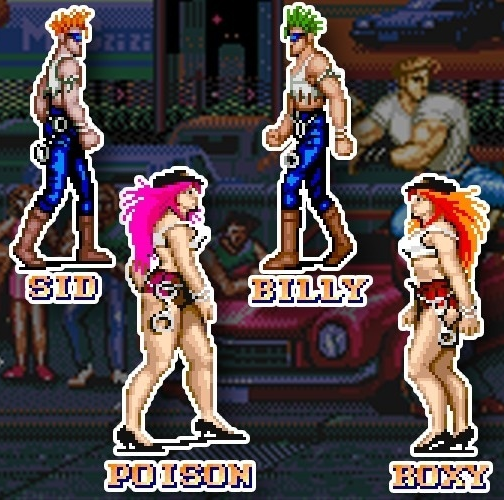
For example, back when the side-scrolling beat 'em up Final Fight was released in 1989, the Japanese version of the game featured two female enemies called Roxy and Poison. For the American release of the game, Roxy and Poison were removed from the game and replaced with two male punk characters called Sid and Billy, because "hitting women was considered rude". It was originally suggested that Roxy and Poison be considered male-to-female transsexuals -- this is how the famous confusion began over Poison's sex -- but supposedly, Capcom's developers figured that "wasn't enough" to deter critics of the two female enemies (wisely, in my opinion) so they replaced them entirely.
There's a site I found that has a good name for this trend; "Sidbillies". The writer of this article at ScrollBoss shows examples from other nineties' games like Sonic Blast Man, Ninja Warriors Again and Sunset Riders. The most interesting game mentioned, however, is Final Fight 2. The reason being that the second game in the Final Fight series had a playable female character, Maki. So it seems like the Final Fight series was embracing equality for the first time, having both heroic and villainous male and female characters ... but once again, the female enemies, Eliza and Mary, were removed in the American version and replaced with male ones, Robert and Leon.
In a way, this is actually worse than the German version of Half-Life replacing the marines with robots. That was done because someone determined that violence against human beings was completely wrong, so the human enemies were replaced with something non-human. It was ridiculous but morally, I can't fault them for it. The makers of Final Fight (and the other games listed on ScrollBoss) decided that violence against women was wrong ... but violence against men was completely fine, or at least more acceptable. It's one thing for this to be the case in the first Final Fight, where the three playable characters were all male, but it's quite another in the second, where one was female. You could justify having Sid and Billy in the first game if you were wary about encouraging male-on-female violence. The flipside to that, however, is because there's a female playable character in Final Fight 2 but there are no female enemies, Capcom are inadvertantly encouraging female-on-male violence. It makes me wonder why Maki was left in the game at all; is beating up men as a woman considered progressive in a way that men beating up women isn't?
Capcom aren't the only ones guilty of this and it certainly didn't die out with 2D games. Even though sprites are gone, so female characters can't simply be papered over with male ones, developers have come up with a much easier way of avoiding controversy; leaving out female enemies altogether.
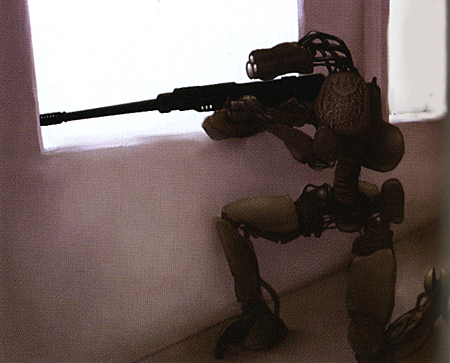
Lots of game developers seem to have (figuratively) taken their cues from Final Fight 2 by doing this. Back in one of my first blog posts, I said that the villainous Civil
Protection in Half-Life 2 probably did
feature women in its ranks but their voices were altered and their feminine
physiques hidden underneath the Civil Protection’s bulky security outfits (or perhaps their bodies were altered too). However, this doesn't let Half-Life 2 off the hook because they still appear to be male to the audience, while the good guys -- resistance members -- feature both men and women in their ranks. During development, Valve apparently intended to make the Overwatch Sniper enemy female but, looking at the concept art, there's very little there that I could describe as "female". It looks very robotic, so there aren't manyfemale qualities to be found. Unlike the Civil Protection in the final game, who still look human, act human and fall like human beings when they're killed.
An argument that I've heard both for and against female soldiers in games is about realism; people opposed to them argue that it'd be unrealistic because women only account for a small percentage of the military in real life (and only now in the US are being considered for combat roles). People in support of female soldiers in games point out that realism isn't really an issue when you're dealing with fiction, at least in a lot of games.
Personally, I think the realism argument doesn't make sense for either side when you think about games like Final Fight 2, Half-Life 2 or Final Fantasy VIII, which all featured female characters on the good side but only male characters on the evil one.Unless the developers of these games intended to make the villains out to be huge misogynists -- which they didn't -- there's no real reason for female characters to only be on the heroic side.
I would love to see more generic female soldiers and warriors in games, particularly on the opposing side. Because as it stands now -- and not just in the games mentioned above but Uncharted, Metal Gear Solid, Mercenaries, Tomb Raider and many, many others -- we're used to seeing men being killed. In all of those games, it's our objective to kill men, and only men (excluding the occasional boss). This is developers treating men as disposable and unimportant. So the realism argument falls flat when one side is single-sex and the other is co-ed. It's very unrealistic ... but it's also completely sexist because men are the only ones the player is meant to kill. That overshadows the realism argument.
Interestingly, Bethesda came up with another way to emphasise male disposability when making Fallout 3. One of the perks -- special abilities the player character could earn when levelling-up -- available to the player was to cause ten percent extra damage to characters of the opposite sex. However, because there were many, many more male enemies in Fallout 3 than female ones, the perk was a lot more useful if playing as a female character. It's minor but nevertheless puts a greater emphasis on killing men than women. As a result, two extra perks were added to Fallout: New Vegas to award the damage bonus against members of the samesex.
The Lady Killer and Black Widow perks.
Surprisingly, EA is one of the few developers I've seen with a decent split when it comes to the sexes of enemies in their games. Mass Effect, Dragon Age and Kingdoms Of Amalur: Reckoning all seemed to have a fair balance between male and female enemies (as well as aliens and monsters). Of course, Mass Effect heavily influenced the other two but they're all separate gamesnonetheless. They all serve to treat women the same as men.
There's an alternative to having an even split between male and female enemies; making everyone in the game only male or female. Surprisingly, it's not as crazy as it sounds. Starhawk only featured a single female character (who picked up a gun and joined the battle towards the end of the single-player mode, just like the men) but it worked for the setting; Starhawk was going for a "space western" theme and, given that most gunslingers were male, it suited the game. All the enemies seemed to be male too but they were just monstrous enough that it didn't really matter. Hunched over, with odd skin colours and bones that were on the outsides of their bodies. However, even though Starhawk managed to make it work, I wouldn't recommend it for every game. Although even that was better than emphasising male disposability with male enemies and mixed heroes.
Long story short, the idea that it's more acceptable to kill one sex over the other disturbs the hell out of me and I hope to see more female enemies in games in the future. This isn't a case of a lack of women in games anymore, as it was back in the days of Final Fight. Gaming has evolved to a point wherewomen arein games now ... but developers are paranoid about making it the player's job to kill them in the same way they kill men.
To close, here's Lara Croft brutally killing men. Enjoy!