A couple of weeks ago, a GamerGate and NotYourShield supporter passed away at a young age in an apparent suicide. I don't want to give out her name, just in case it gets misconstrued as politicising her death or capitalising on it for my own gain (either for clicks or just to talk about my own stuff). That isn't the case. However, her death affected me more than I thought it would.
I actually didn't know the young woman in question. I recognised her face when news of her death was posted but I can't recall ever speaking to her on Twitter. The reason her death affected me was because of something a friend of mine said about her: "She told me, nearly a year ago, she didn't feel that her voice was important". One of the reasons I wish I'd spoken to her was because in the past, I've felt the exact same way.
The thing is, whatever you're committed to fighting for -- gender equality in video games, ethics in games journalism or more mainstream stuff like combating intrusive DRM in games -- it can feel like you have a ton of great points to make but they rarely, if ever, receive the recognition or awareness you want. That sounds selfish or egotistical but everyone wants to feel like their opinion connects with someone. For example, I've no doubt that every single person reading this can formulate a perfect rebuttal to Anita Sarkeesian's Tropes Vs Women in Games videos. There are many, many videos on Youtube doing just that but some of the most well thought-out arguments end up falling to the bottom of the pile and don't often get noticed as much as they should.
I probably don't know how lucky I am; this blog doesn't set the world on fire or anything but I have a very friendly audience and a few people on Reddit who are kind enough to "signal boost" a lot of the things I write, especially the last few posts. I appreciate it a lot. Some posts have even been linked to by writers more high-profile than me, who I respect a lot. However, it still often feels like no matter what I say -- or anyone says -- about the subject of gender issues in gaming, it doesn't make a dent in the flawed "gaming is anti-woman" narrative. That can make you feel like your voice and opinion is unimportant.
It's a little more complicated than that. I don't update this blog very often anymoreand there are a variety of reasons:
Laziness
Obviously.
Other priorities
I have other commitments to deal with apart from writing this blog. I mentioned studying game design, so I have to balance continuing with that as well as work. I've had to put writing commitments on hold for other sites too.
The narrative pushed by mainstream gaming sites remaining unchanged
As mentioned above. To this day, mainstream gaming media pushes the narrative that gaming is a "boy's club" in spite of ESA statistics (page 5) that suggest it's actually fairly equal. No opinion pieces are written to rebut this claim or the idea that gaming is sexist. Women who disagree are treated as if they don't exist and men who disagree are dismissed because of "privilege", "patriarchy", "mansplaining" or another excuse to not actually answer the points made. It's reached the point where even bomb threats against GamerGate meetups receive little, if any, coverage by mainstream gaming sites. Presumably because reporting on diverse groups receiving harmful threats would damage the "harassment-endorsing boy's club" narrative that has been built up for years.
Waning interest in gender issues in gaming
Related to the above point. Seeing nothing change makes it hard to care about staying current concerning gender issues in gaming. That, and the majority of articles on the subject tend to be from mainstream gaming sites and therefore either clickbait, full of inaccuracies, incredibly dull or a mix of the three. Videos suffer from the same problem. Although I've written about articles/games/videos in great detail in the past, it feels like it can only be done for so long without regurgitating the same information.
Better/more high-profile writers than me covering the same subject
This happens quite often. Back when I started this blog, I wasn't on Twitter and since I joined, I would say there's been a big positive and negative shift when it comes to how I approach gender issues. The positive shift is that I no longer feel like one of the few people talking about the subject, which I did back when the only places I had as an outlet were Gamespot comments sections and the TV Tropes forum. There are thousands of people talking about gender issues in gaming, who roll their eyes at the claims made by outraged social justice warriors who don't care about facts. The negative shift is that I used to take to this blog whenever something annoyed me on a gaming site and needed to be responded to whereas now, I go on Twitter to see what the people I follow thought of it.
The many articles of Adrian Chmielarz on Medium are some of the standout articles that I may not have seen without being on Twitter. Liana Kerzner's five-part series "Why Feminist Frequency almost made me quit writing about video games" is another bright spot. Whether other people are more eloquent, have a platform seen more people
or simply have an interesting twist on their argument that I don't, I
find myself more tempted to direct people to their points rather than write my own nowadays.
So, with all of this in mind, why is YOUR voice important?
I've heard it mentioned a few times that movements aren't made up solely of leading figures but of many smaller voices. I always thought that sounded a bit like a cop out but it's true; with a bunch of supporters making the same argument, gamers have made a movement out of what would otherwise be a few dissenting opinions on various websites. Without the "smaller" voices, the videos and opinion pieces by more prominent figures would be easy to dismiss. With them, on the other hand, it makes it harder for game journalists to do and remain credible. Instead, it exposes them as being agenda-driven rather than reporting on issues objectively.
The reason that seems like a bit of a cop out is because you still won't receive the same acknowledgement as a lot of people making the same argument and still feel like the things you say aren't being read. Plus, if you're anything like me, you don't have any intention of making videos and you don't live anywhere close enough to attend a meetup with other like-minded people. Hell, you may not like social media or may not want to go through the effort of writing an article/filming and editing a video. However, these things don't mean that your voice isn't important or isn't being heard.
You don't know who your words affect. There are tons of people who lurk on forums without posting or browse Twitter without having an account. Who's to say that one of those people won't see your intelligent, well thought-out point and use it in their own article or video? Although I can't recall any specific occasions -- I tend to give credit for good points I've heard people made -- I'd be very surprised if it turned out I hadn't done that at least once. And I know it's definitely happened to me, with both Adrian Chmielarz, mentioned above, and Milo Yiannopoulos (in the line "leveraging a tragedy to her own political benefit").
Plus, think about this; what's the big deal about popularity anyway? There are hugely popular sites like Buzzfeed, Polygon, a bunch of Gawker sites and more that have only achieved popularity through clickbait. So many of their articles and videos offer nothing of any substance but hey, they're popular! On the other hand, there are independent news sites, blogs and gaming media sites all over the internet that offer objectivity, intelligence and substance in ways that popular sites based on clickbait can't even comprehend. If you feel like your voice isn't being heard, take solace in the fact that you're still speaking out. You are like an independent news site. You have credibility and moral fibre for expressing your opinions when you aren't even sure if anyone will ever read them.
If you want a tip for making your voice heard, here's a practical piece of advice: post on Reddit, not Twitter. Twitter is like everyone shouting over a crowd of other shouting people, trying to get noticed. Reddit, and other more conventional forums, are closer to a discussion.
Finally, don't give up. You'll never know who you could reach or what impact you could have if you give up. Your opinions are valued more than you know. Even as someone who is normally pretty cynical when it comes to people who try to be motivational, I believe that. You never know when your opinion will be the one people take notice of, rally around and support/defend, whether it's as an article or in the comments section of an article.
And I don't normally say this but I feel compelled to, given what I've been writing about; thank you for reading.
In spite of not following gender issues in gaming as closely as I used to, I still follow plenty of people on Twitter to keep myself informed of what gaming's most easily-offended critics are currently annoyed about and how gender issues play a part in gaming nowadays.
It isn't like there has been a shortage of issues to write about. For Street Fighter V, Capcom released an update that switched camera angles for two characters -- Cammy and R. Mika -- to make their poses less provocative. There have been two localisation changes for Xenoblade Chronicles X; adding more clothing to a bikini-clad thirteen-year-old character and removing a slider to change a custom female character's bust size. The Western release of the newest Fatal Frame game has several revealing alternate costumes omitted, replaced with costumes paying tribute to Samus and Zelda instead. And most recently, Koei Tecmo US has chosen not to releaseDead or Alive Xtreme 3 in the West, only for Play-Asia.com to criticise the move and pledge to sell the English-language version released in Asian markets through their website.
There are two reasons behind all of this censorship/refusal to ship games to the West. The first is specific to Xenoblade and Fatal Frame and it's due to Nintendo's steadfast family-friendly image. They're basically doing the exact same thing they did back in the late eighties and early nineties, when they would censor minor instances of nudity, as was the case in games like Final Fantasy VI, seen here:
Examples from the Japanese Super Famicom/GBA, American SNES and Western GBA releases of FFVI.
Where this falls apart is when games like Fatal Frame deal with horror, death and suicide and these are somehow considered less controversial than a woman in lingerie as an alternate costume. The number of games that feature dismemberment, disembowelings and beheadings are somehow considered acceptable compared to a game featuring women playing volleyball. The gaming media has stirred up a non-controversy to such an extent that Japanese developers are under the impression that all Western gamers are uncomfortable or offended by sexuality, rather than just a very vocal minority with high-profile positions. And no talented game developer wants to be called a 14-year-old boy by some talentless hack at Kotaku.
Which leads to the second reason: good ol' fashioned prudishness. I know I've said this before -- probably several times -- but it's remarkable that an audience who claim to want video games to "mature" as a medium have such a fundamentally immature attitude towards sexuality in games. What kind of adult feels threatened by a bunch of polygons on a screen? Essentially what we have here is a tiny contingent of critics who feel it is appropriate to bully and shame developers into making the games they want, based on what they feel is suitable for all Western audiences. Gaming critics have reached the peak of entitlement and the worrying thing is that they're the ones being pandered to by game developers now.
Obviously, there is nothing wrong with characters in games being sexually attractive. Developers have a right to create any kinds of characters they want and audiences, men and women, have the right to enjoy them (as a matter of fact, one of the criticisms against Xenoblade's removal of the bust size slider was that it prevented large-chested female gamers creating characters similar in appearance to themselves). Petty authoritarian bullies stomping their feet and throwing a tantrum because they feel uncomfortable is their issue. It isn't the developer's responsibility to change their game because of hurt feelings.
Regarding Dead or Alive Xtreme 3, game developer American McGee wrote this on Facebook regarding the whole issue. He isn't the only person to speak out against this type of censorship. Following the news that DOAX3 wasn't going to receive a Western release, a female voice actress tweeted this:
(The tweet has since been deleted so, out of respect for the voice actress, I've redacted her name. I wouldn't want her to suffer online harassment or lose voice acting work for speaking out against feminism.)
Apart from the obvious reasons why this is an issue -- games having content removed/not being localised because of puritanical outrage -- it's also an issue because of the recurring claim from gaming's Social Justice Warrior and feminist critics that "we're not coming to take your games away". Katherine Cross wrote about it on Polygon, also quoting Carolyn Petit saying the same thing. Jim Sterling said it about Anita Sarkeesian too.
Yet it's remarkable when censorship of games does occur, how quick this same crowd preaching about sexism from their soapboxes acts as if they don't have anyreal power whatsoever. As if these same journalists who have given countless column inches to Anita Sarkeesian for the past three years, who called game developers 14-year-old boys, awarded Bayonetta 2 lower scores due to being offended by a sexualised character rather than anything to do with the game's quality, warped #GamerGate to be about sexism rather than ethics in journalism and gleefully used a mass shooting to their advantage tell people to get over Dead or Alive Xtreme 3 not coming to the West are suddenly the least-influential people in the games industry.
As Anita Sarkeesian is so fond of telling us in her Tropes Vs Women videos, "these examples do not exist in a vacuum" and I've only mentioned a few examples. Do these people really think high-profile gaming sites and Kickstarter/Intel-funded Youtube critics who have been arguing against sexually-attractive women in games for years are completely unrelated to sexualised elements in games being removed for the West (or the games not being localised at all)?
If so, it sounds like another example of playing the victim to me; even with their monopoly on gaming journalism and the many years of hammering home the same warped sexism narrative, they still insist that they're helpless, silenced victims.
I actually planned on writing about Feminist Frequency's new video -- Jonathan McIntosh's "5 Ways Men Can Help End Sexism", the first video from Feminist Frequency I've watched in around two years -- but had more to say on this subject than I thought. I may write about McIntosh's video too because, even though it's more of what we've come to expect from McIntosh and Feminist Frequency -- Jonathan sounds more like Anita than Anita does, bizarrely -- it is a hilarious video.
The Conference is a yearly event in Sweden where "creators, communicators and innovators of all kinds" arrive to discuss digital media and give speeches on working in creative industries. As she did back in 2013, Anita Sarkeesian took to the stage, discussing what it's like to be the victim of abuse online. What I'd like to focus on is a follow-up article done by Wired UK, which is something of an edited highlights version of Anita's talk. Let's start with this:
There are three ways in which men attempt undermine women online, Sarkeesian tells the audience at The Conference
in Malmo: through the denial of women's earned accomplishments, the
denial of their life experience, and the denial of their professional
expertise.
Those three ways that men -- not simply critics of Anita's or the social justice warrior crowd that has chosen gaming as its scratching post, specifically men -- attempt to undermine women online are three of the things I'd like to focus on.
The Denial Of Women's Earned Accomplishments
In the case of Anita, I can see how she'd feel like she is a victim of this. People have criticised everything about her methods, from her Kickstarter campaign, to art theft, to using videos without the permission of their original owners.
I don't deny that Anita has accomplished many things but not all of them are what I would call "earned". She earned her degrees in Communication Studies and Social and Political Thought. I'd certainly say she's earned everything she's gained from giving
college talks around the U.S. on sexism. She's marketed herself well, it
can't be denied. I wouldn't say she earned any of the money that was donated to her through Kickstarter or given to her by Intel. That's a different kettle of fish entirely. Likewise, is making videos really an accomplishment? Not especially. Is being critical of them "denying" that accomplishment? Not at all. However, the Tropes Vs Women series has been watched by a lot of people. Again, that's undeniable and it certainly is an accomplishment.
It also makes me wonder whether fictional women are being included in that statement too. If so, there are plenty of people who would seek to deny the accomplishments of video game heroines entirely because they have a quality they disapprove of (such as a large chest). Take Lara Croft for example; prior to the reboot, there were thirteen games named, or spun off from, Tomb Raider. There were two feature films. Three novels. An animated series. A fifty-one issue comic book run. A place in the Guinness Book of Records as the "Most Successful Human Virtual Game Heroine."
The character herself is intelligent, witty, cultured, a capable hunter and survivor (of a plane crash, no less). She's also a published author and in spite of her wealthy upbringing, remains grounded and easy to root for.
In spite of all of this, many feminist critics have reduced Lara Croft to being nothing but a pair of breasts. The idea that these are the same people asking for strong female characters in video games is laughable. No matter how you cut it, that is the denial of women's earned accomplishments.
The Denial Of Women's Life Experience
Let's just stop and think for a second; since Anita Sarkeesian came to prominence, who is the biggest demographic whose voices have been consistently ignored by both her and the gaming media? Women.
Look at the short paragraph I quoted above. "Three ways in which men attempt to undermine women online". The narrative that is constantly being encouraged by Anita is that she is the victim of widespread abuse online and all of the perpetrators are male. Yet there is a sizable contingent of Anita's critics who are women. The closest I have heard to Anita acknowledging their existence was in a report on a college talk she did -- unfilmed, as Anita allows filming of her talks on abuse but not on gaming -- when she said something along the lines of "I've received criticism from women but not abuse".
However, to listen to Anita or the many gaming news outlets that report on her (or Zoe Quinn, Brianna Wu or anyone else currently in the spotlight), it sounds as if there are only two sides: the infallible hurt party on one side and the inevitably demonic, foaming-at-the-mouth male abusers on the other. Nothing in-between.
What do you call ignoring the many women who disagree with you if not "denial of women's life experience"? What do you call it -- other than arrogance -- if you feel you can speak for women as a whole and not take others' life experiences on board? Life experiences that aren't ones of sexism, abuse and oppression.
While we're on the subject, ignoring your male critics is just as big a denial of their life experiences too. Regardless of the sex of your critics, their life experiences are no less significant than yours and no more worthy of being dismissed.
Yet that's what gaming journalists have done; erased women from the discussion. When women "step out of line", so to speak, they cease to exist. That is, if they aren't accused of having "sockpuppet" accounts; men using female avatars. Again, assuming that women couldn't possibly disagree with Anita can only be described as arrogance.
The Denial Of Women's Professional Expertise
Once again, since Anita came to prominence, whose professional expertise has been consistently ignored? Women.
If you frequent Twitter, one of the responses to the accusations that #GamerGate is a misogynist movement has been to popularise this image of women who work within the games industry. It's a way of highlighting the hypocrisy of the gaming media; in spite of their claims of being progressive and pro-woman, they have made zero effort to raise awareness of or promote women who actually work in the games industry:
Left-click to enlarge.
Instead of putting any of these women in the spotlight, gaming sites devote article after article to women who often have little-to-no experience in the games industry. I can't quite put my finger on a particular reason why: the cynic in me wants to say it's because a retrospective of the several-decade career of an accomplished female developer doesn't earn as many pageviews as a "culture critic" ranting about how everything is sexist.
Alternatively, it could be because, through their desperation to appear "pro-woman", no gaming website dares to deny a platform for the Anita Sarkeesians of the world to speak for fear of being labelled misogynistic. And if you read that sentence and thought, "but wouldn't a spotlight on one of the successful female game developers work to counteract that?" bear in mind that even raising $23,000 for the Fine Young Capitalists' game -- with concepts taken from women all over the world and the game itself being created by an all-female development team -- wasn't enough to quell the accusations that #GamerGate was against women in gaming.
Basically, several of the women in the image above have had their professional expertise dismissed outright by the gaming media and many a critic, in spite of them being far more experienced in the games industry.For instance, Mari Shimazaki, character designer for Bayonetta, was hit particularly hard with arguments such as, "just because she's a woman doesn't mean she can't be sexist". The statement itself isn't incorrect but I'm failing to see any respect for her professional expertise.
Similarly, where was the acknowledgment of Gabrielle Toledano's expertise when she spoke out against the trend of blaming the lack of women in the games industry on sexism, when there are other factors in play? As the executive vice president and chief talent officer of EA, she is likely in a far better position to judge than a wealthyYoutuber or the developer of Depression Quest. How about Christine Phelan's expertise, when she challenged the viewpoint that because she's female, she must face sexist behaviour in the games industry at the hands of her male coworkers? In an interview with TechRaptor, Jennifer Dawe, developer of Seedscape, expressed concern that the fearmongering caused by gaming's critics may push women out of the industry more than invite them in.
Also, let's not forget that female developers can be accused of being "sockpuppets" too. Just a couple of evenings ago, I was directed to this on Twitter:
Left-click to enlarge..
I wouldn't normally take issue with a single example but "Ernest W. Adams", who is making that accusation, is the founder of the International Game Developers Association. Pretty darn significant for him to be assuming female game developers couldn't possibly exist.
Keep in mind, that's only covering women working within the games industry itself. What about fellow outsiders who don't agree with the sexism narrative, or at the very least take issue with some of the arguments put forward by its proponents? I've written before about Liana Kerzner's excellent five-part series called "Why Feminist Frequency almost made me quit writing about video games". Liana is a writer and producer who has worked in her field for over a decade. You don't have to be in the games industry to have professional expertise and Liana Kerzner is far from being the only woman to oppose Anita's viewpoints.
To sum up all three of the points argued by Anita in her talk at the Conference, this denial of women's accomplishments, experiences and expertise certainly exists. Yet she's one of the biggest proponents of doing this (or, if she isn't, certainly hasn't shied away from the spotlight or spoken out against the media for not focusing on other women). In fact, she's actively profited from it; with the media arguing that the games industry is a horrible place for women and gaming culture is a toxic environment for anyone who isn't a straight white male, Anita Sarkeesian appears to be proven correct from an outsider's perspective. The more women are ignored and their experiences eliminated from all mainstream discussion of gaming, the more Anita can speak on their behalf.
The "too long, didn't read" version of this can be summed up as follows: regardless of sex, skin colour, sexuality or any other characteristic, everyone is ignored in the sexism debate. Non-white, non-male, non-straight people cease to exist if they disagree with the sexism narrative and straight white men are all lumped into a "misogynist abuser" category.
The Wired UK article doesn't end there. It mentions two statements by Anita that have been some of the most heavily-scrutinised over the last few days:
"I am an expert on the depiction of women in video games. I know my stuff and I'm pretty good at what I do."
"My analysis is very well researched -- it's double and triple checked."
The following picture from the Conference also tends to accompany the first quote above:
For those of us who have followed Feminist Frequency for a substantial period of time, this raises a bunch of questions. The one that springs to mind immediately -- and this is not intended to sound snarky, rude or critical at all -- is, "if Anita Sarkeesian is an expert on the depictions of women in video games, why does she get so many things wrong?"
That is a genuine question, not intended to be insulting or amusing. The Tropes Vs Women in Games series contains a lot of incorrect information. As tempting as it is to write out all the ones I can recall, it feels like everything that has already been said about Anita's failure (or refusal, in some cases) to report on the depictions of women (and men) in video games accurately. However, a Twitter user named Jasperge107 is putting together a gallery of Anita's inaccurate claims -- although only 6 out of a total of 25 have been completed so far -- and Adrian Chmielarz wrote an article about Anita's controversy over Hitman, which she revisited during her conference speech. Yet while both of these go into detail about specific errors Anita has made, they only scratch the surface when it comes to the number of mistakes Anita has made.
The fact that Anita considers this analysis "well researched", which was "double and tripled checked" does not strengthen her viewpoint in any way. All it means is that she was very thorough when being wrong.
The second question that is raised by Anita's claim that she is an expert is how can she claim to be any such thing when she has never engaged in a debate over her views in the three years she has been in the public eye? She hasn't even debated her claims with a village idiot, let alone a fellow expert. In fact, consider the ways she has walled herself off from all criticism; Youtube comments are closed. She blocks people on Facebook and Twitter with alarming regularity. Filming is not allowed at her college talks. Even her Wikipedia page doesn't have a "Criticism" section and the "Reception and public appearances" header does not contain any criticism of her work.
This all takes place under the guise of "preventing harassment" but if your definition of "harassment" is having your viewpoints challenged, how can you possibly claim to be an expert in your field?
It also goes without saying that putting up a big slide about how much of a genius you are is incredibly arrogant. Humility is obviously not Anita's strongest suit. Although if I was in her shoes, with every gaming website singing my praises and one person even comparing me to Rosa Parks, my ego would probably be too inflated to consider being humble too.
There is one final quote I would like to focus on before ending:
"The cultural norms of male-dominated spaces can be changed."
There are three problems with this statement; firstly, assuming that the things Anita dislikes (violence, sexuality) are "cultural norms". Secondly, assuming they need to be changed. Thirdly, assuming that gaming is male dominated.
Since the first point is debateable and the second is obviously just Anita's own opinion; I didn't write a blog following E3 but she and her producer, Jonathan McIntosh, were famously complaining about the violence in Doom being "the norm". They didn't give reasons why it shouldn't exist but still shamed it for existing and the people who enjoyed it. It's the Jack Thompson argument, only in 2015, by people who are supported by the current generation of gaming journalists. Just like their arguments against sexism, it's their sensibilities that are being offended, nobody else's, yet they speak as authorities on what should and should not exist in the medium.
That's a separate issue though. What bothers me is the third point: the idea that gaming is "a male-dominated space".
Every year, the Entertainment Software Association publishes an "ESA Essential Facts" guide and makes it available online to read. You've probably already seen it but if not, it's available to view here. The pages are filled with helpful infographics about game genres that people are playing, the age of players and the gender of the players:
This year, women and girls make up 44% of all players.
Now, read into the slight dips and rises in female players however you like but speaking as a general overview, the number of women and girls playing games has held steady for the last five years and it's in the 40-50% range. Or, to put it another way, around half of all gamers are female.
For Anita, feminists, gaming websites and the mainstream media to continue pushing the idea that in this day and age, gamiing is still "a male-dominated space" is ridiculous. It could not be further from the truth and the facts above prove it. Unless these critics are being pedantically literal and saying that a 12% difference counts as a hobby being "dominated" by a particular sex, the evidence works against them.
What's more, Anita's claims demean and insult the women she claims to be fighting for. Plenty of women were fans of gaming before she came onto the scene. To say something that basically boils down to "this pasttime needs to change before it's appropriate for women" is condescending. It basically treats women the same as children and, as was the case with female game developers, ignores women who have been enjoying gaming for years. What's more, when gaming has an almost equal split between the sexes before you start campaigning to end sexism in gaming, that may be a pretty good indicator that (a) it isn't male-dominated and (b) it doesn't need someone to change it because women are clearly capable of enjoying gaming without it being changed.
It seems that the more things change, the more they stay the same for Anita Sarkeesian and the media. The actions that have served her well in the past continue to serve her well in the present day and her arguments are as flawed as they ever were.
-----
I apologise for the long wait between blog posts. In the last year, a lot more people opposing the "games are sexist" argument have started to speak out, on bigger platforms than this one. There are some excellent articles on sexism in games on TechRaptor, Breitbart, Metal Eater, Medium and more. It feels like the voices speaking out are more diverse too, as well as having a wider range of backgrounds; journalists, academics, people within the games industry and many others have raised objections to what they see as an unjustified attack on gaming (because, when developers, games and gamers themselves are all being insulted and told "gamers are dead" and "gamers don't need to be your audience", we're long past the point where it can be called "criticism").
So while all of the raised awareness about the issues of sexism in gaming and the flawed arguments put forward by gaming's critics is wonderful, it makes things trickier for me. I know the more voices speaking out, the better, but it can be a bit disheartening to see a better writer than you talking about a subject you wanted to write about, on a larger platform than your own. It's an exciting development for gaming and gamers as a whole but it puts me in a trickier position.
That's why I didn't write an article after E3. I started it but never got back to it. I may go back to it at some point, just because some of the arguments put forward by the gaming media after E3 were pretty ridiculous but there was a lot of backlash against those flawed articles by gamers and gaming's supporters.
Feel free to leave a comment below and ... I never check my themalesofgames@gmail.com e-mail anymore but you can send me an e-mail if you like. Follow me on Twitter, @TheMalesOfGames.
Edit: A big thank you to /r/KotakuInAction for all the attention this post has received. It's much appreciated.
Part of the game design course I'm enrolled on is learning how to make games using Flash, so earlier this month, I made a short game to practice coding (basic stuff like changing frames and triggering animations). As I mentioned in my last blog post, over the past couple of months, Jonathan McIntosh -- producer of the Feminist Frequency Tropes vs Women in Video Games series -- has been getting a lot more attention on Twitter for his often bizarre statements. That led to the "#FullMcIntosh" hashtag being used to describe some of his most ridiculous tweets. He's gradually stopped being a behind-the-scenes figure and has become more prominent, to the point of appearing in a Feminist Frequency video himself.
So naturally, I decided that my game should parody Jonathan McIntosh.
I explain a lot about the reasons behind the game on the "About" screen but basically, my criticism of the Tropes vs Women series has been ignored. Everyone's criticism of the TvsW series has been ignored, unless it's very easy to dismiss (as was the case with Doug Walker in August 2013). Yet the views of McIntosh and Sarkeesian, as flawed, unproven and blatantly untrue as they are, still receive recognition in game journalism circles. With that in mind, I've joined everyone else who's said "screw it" and decided that parody is a far better way of raising an objection than scrutinising every line of a Tropes vs Woman video.
I actually put more of an effort into it than you might think; I trawled McIntosh's timeline and the #FullMcIntosh hashtag for some of the most ridiculous things he's written and many of them were so ludicrous that I could put them into the game unaltered. Others were exaggerated slightly and a few were entirely fabricated (which meant I had to think like McIntosh. It was arduous). I made a list of actual Jonathan McIntosh statements and highlighted the ones that ended up in the game in some form or another:
Left-click for larger view.
Bear in mind that this is my first Flash game ever, so I'm pretty happy with how it turned out overall. As you can probably tell, I'm not much of an artist but coding-wise, I learned plenty from it.
However, if you want a far more fun parody, about a week after I posted my game on Twitter, someone posted a link to a game called "Vivtest - Xmas Edition". If you're familiar with #GamerGate, it features a lot of references to figures who are, apparently, opposed to more ethical behaviour from game journalists. And yes, Jonathan McIntosh makes an appearance as well.
I'll try to keep this blog from being as long as the last one and give a more basic overview rather than a comprehensive one. This is a story that seems to keep growing, so there's no sense in being comprehensive if there are just going to be more articles and developments. Also note that, for once, I won't be linking to any sites that ignorantly insult or otherwise dismiss gamers.
For anyone who isn't on Twitter or who has been out of the loop for the last week or so #GamerGate is a hashtag that spiralled out of the gaming press' reaction -- or lack thereof -- to the unethical behaviour from game journalists that we touched upon last time; Rock, Paper, Shotgun and Kotaku writer Nathan Grayson sleeping with Zoë Quinn being an association that damages his ability to remain impartial while reporting. The gaming press did one of two things; they either gave a collective shrug of the shoulders or they went on the attack, ignoring the story about corruption in game journalism to say how horrible all gamers were to Zoë Quinn.
#GamerGate is basically the name given to those reactions and the unethical behaviour from the gaming press. Although since then, the situation has become a lot bigger.
Surprisingly, KnowYourMeme gives a good overview of what #GamerGate is about. As before, InternetAristocrat made a video about all of this while it was happening. I recommend watching it if you haven't already:
Let's recap some of the problems that gamers had with the gaming press. To begin with, it was journalists refusing to acknowledge conflicts of interest and associations that could damage their integrity. Nathan Grayson and Zoë Quinn for example. However, lots of other examples came out over the coming days (and some were already available at the time my last blog was posted), including Patricia Hernandez having relationships with two developers whose games she went on to promote on Kotaku without acknowledging any personal involvement. She went as far as to directly link to where the games could be purchased:
Left-click for larger view (very large image).
Since then, she's added footnotes on each piece, very briefly pointing out her relationship with each developer.
Plus, details about journalists contributing to developers' Patreons -- which, in case you didn't know, is a website where people can donate regularly to content creators, usually per month but also per video for Youtubers, per image for artists, etc. -- came out while I was writing my last blog:
Left-click for larger view (very large image).
Then there was this comment from someone who works for Reuters, the world's largest news agency. Give it a read, it's an interesting little story. Amongst other things, the writer notes that during Reuters' 2008 review, they discovered that a staggering 0% of staff members for gaming news sites had degrees in journalism. That's not a misprint. Zero percent:
Left-click for larger view.
There was also the friendship between Polygon reviewer Danielle Riendeau and Gone Home developer Chris Remo, going as far back as 2011. This raised some eyebrows when Riendeau review the game for Polygon and gave it a perfect 10/10 score:
Left-click for larger view.
As this is such a big and far-reaching story, I'm sure I've missed some examples but these all came to light because of #GamerGate. Let's not forget Rab Florence's Eurogamer article about exactly this type of club -- taking aim at the Games Media Awards, Geoff Keighley and the relationship between journalists and publishers -- and Cinema Blend's article about publishers offering gifts to reviewers. As you can see, evidence of unethical behaviour is beginning to mount. Feel free to refer back to the Society of Professional Journalists' Code of Ethics page if you're interested in seeing where, exactly, game journalists went wrong.
So what was the gaming press' reaction to all this? Calm acceptance of the whole situation and a pledge to reform what is evidently a broken system? Well, there is some talk of reform, which we'll come to later on but on the whole ... no.
Tom Hatfield - Writer for PC Gamer, Rock, Paper, Shotgun and The Guardian. Left-click for larger view.
Devin Faraci - Writer for Badass Digest. Left-click for larger view.
Helena Horton - Currently writing for the Daily Mirror's Ampp3d columns. Left-click for larger view.
These are just a few examples from writers. Being compared to ISIS and saying that #GamerGate was a reason to kill all men are some of the more severe examples but insults about "basement-dwelling virgins" and "manbabies" were thrown around regularly. Here are some examples of the types of ad hominem attacks directed at #GamerGate supporters:
Left-click for larger view. Note that "@Devin_Faraci" is a parody account ("@devincf" is the actual account, as seen in a previous screenshot).
It was the same story when a hashtag titled "#IStandWithJonTron" cropped up. I missed out on this hashtag while it was happening, so I can only assume that Youtuber JonTron -- someone who I only knew from his involvement in the cancelled Game Jam reality television show that Zoë Quinn was also involved in -- voiced his support for #GamerGate and faced this backlash for it:
Left-click for larger view.
There are a few reasons for so many comments about misogyny but, as far as I can tell, very few of them had to do with #GamerGate. Some were still annoyed that the hashtag grew from the Zoë Quinn situation, which wasn't that much of an issue by the time #GamerGate was being discussed. Then there was the leak of celebrity nudes, including Jennifer Lawrence and Kirsten Dunst, that happened a few days ago. I have no idea how that was linked to #GamerGate. From what I see from the 4chan co-creator implementing a DMCA policy, it's related to 4chan. I also recall hearing something about them first surfacing on Reddit.
Then, around the same time, Anita Sarkeesian tweeted about having to leave her home because of death threats. She showed a screenshot of another three-minute old Twitter account with only ten tweets as "proof". Only ten tweets, all being violent, sexual and threatening towards her.
Now, ignoring whether this Twitter account was legitimate or not (I'm skeptical), this made the news on gaming sites while other significant stories didn't. This unverified story about Anita Sarkeesian leaving her home -- it was based on nothing but her word -- was reported while stories like, say, the Fine Young Capitalists' IndieGoGo campaign hadn't received any coverage at that time. Since then, it's received coverage twice. Once on Vice, where they complained about the campaign for being born of misogyny (even though this project for women has raised $52,000 as of this writing), and once on Gameranx, where the writer said that just because the project supports women doesn't make it immune to criticism. Which is fair enough but hilarious when you take into account the fact that no gaming sites have published any criticism of Anita's supposedly good-for-women project.
Let's be clear; I'm sure there was harassment of both Quinn and Sarkeesian but thirty seconds of research into #GamerGate at any point while it was occurring would've showed that the vast majority of gamers cared about ethical behaviour and, following the insults and accusations of misogyny, some respect from the gaming press and that sexism didn't come into it. The fact that game journalists branded all gamers participating in #GamerGate this way was a damning indictment of their unwillingness to investigate and accurately report in itself.
Accusations of unethical behaviour cast a black cloud over games journalism but, since attacking gamers was suddenly the trendy thing to do, a bunch of gaming sites all coincidentally seemed to have the same idea; supposedly, but unconvincingly, independently from each other, about ten different articles sprang up declaring "Gamers are Dead" ... and they all showed up over the course of one weekend. I'm not going to link to them all here. A blog called Crotchety Old Gamer has a list of many of them but I assume there's more than that. And yes, they used the Anita Sarkeesian story to justify this "Gamers are Dead" claim in each one. There were similar articles about a petition being circled by developers about making an effort to stop harassment in games wherever they saw it. Some sites, like IGN, used an image from Anita Sarkeesian's latest video for that article too but, even worse, the moderators appeared to be censoring perfectly reasonable comments:
Left-click for larger view.
Recapping all of this is starting to feel a bit stale and long-winded, so I'll give some of my thoughts on it and pick that thought up a bit later.
Let's start with the obvious; game journalists don't own gaming or the "gamer" term. Plenty of gamers have been playing games for decades. Game journalists aren't going to kill it in one weekend with some passive-aggressive articles and if they actually believed they would, it's incredibly arrogant of them.
Then there are the insults thrown around. The funny and sometimes strange thing about #GamerGate is that many of the people using the hashtag didn't dislike game journalism. Demanding ethical behaviour didn't mean that they disliked game journalists or suggest that any of them were bad at their jobs (outside of the unethical behaviour, of course). This may have been an attack on a corrupt system but it wasn't about the individuals. When names were mentioned, such as Stephen Totilo, it was because they were in positions to change things. So my question is this: how much must you dislike your own consumers to insult them in such a way? It disturbs me how comfortable game journalists were at branding people misogynists -- there's no two ways about it, calling everyone bigots -- when called out on their own actions. This kind of refusal to take responsibility actually has an acronym; DARVO, or "Deny, Attack and Reverse Victim and Offender". Or if you'd prefer something more relateable, a refusal to take responsibility is something children do when they've done something wrong. Game journalists did the same thing. Attacking people when your industry faces criticism is not a mature or rational response.
What I found amazing about #GamerGate was how game journalists -- through their conflicts of interest, attacks on gamers and biased/political/soapbox issue articles -- managed to annoy absolutely everyone. From all demographics. In spite of the claims that all the #GamerGate supporters were "straight white guys" who desperately wanted to maintain a boys' club, the gaming press annoyed men, women, transpeople, left-wingers and right-wingers, people of all races, all sexualities, the able-bodied and the disabled, feminists and MRAs.People from every demographic and group showed their support for #GamerGate for the simple reason that people from every demographic are gamers. We all care about accurate and unbiased journalism ... and the gaming press' arrogance concerning the matter didn't help them in the slightest.
Going back to the story and the "Gamers are Dead" articles, the problem was that by trying to derail the goals of #GamerGate and
turn it into an issue of sexism rather than journalistic integrity, the
gaming press pulled all of their soapbox articles into the firing line. Although there are people like me who have always had a problem with gaming sites promoting a political stance, others began to speak out in objection to gaming sites using arguments about misogyny, sexuality, minorities and "straight white guys wanting to keeping gaming as a boys' club" in order to derail topics about their own corruption.
So we had objections to Kotaku's Jason Schreier insulting George Kamitani for his character designs in Dragon's Crown:
Left-click for larger view.
A freelance writer named Jenn Frank wrote a scathing attack on gamers in The Guardian, again saying that it was all about hatred of women and using Anita Sarkeesian and Zoë Quinn as examples. Then it came out that Frank is a friend of Quinn's, funds Quinn's Patreon and Quinn's PR agent funds Frank's Patreon:
Left-click for larger view.
Left-click for larger view.
Bear in mind that throughout these many accusations of misogyny on the gaming community's behalf, female gamers are speaking out against unethical behaviour in the gaming press ... and having their opinions ignored. Frustrated female gamers didn't fit the "misogynist" narrative the gaming press was weaving. Same for non-white and non-heterosexual gamers being ignored by the writers claiming these were the acts of "straight white guys".
So basically, the same game journalists who claim to be all for progressiveness and equality in gaming are the same people ignoring the voices of women and minorities. The same people writing about Zoë Quinn and posting Anita Sarkeesian's Tropes Vs Women videos are the same people who refuse to give publicity to the Fine Young Capitalists' IndieGoGo project. People who don't represent women or minorities feel as if they have the right to speak on behalf of women and minorities.
This is when the #NotYourShield hashtag started being used.
Left-click for larger view.
Left-click for larger view. Tweets are still difficult to make out in this one.
Gamers from every demographic other than the "straight white male" group that game journalists were singling out used #NotYourShield to object to the gaming press' use of their sex/race/sexuality to shield themselves from accusations of corruption.
#NotYourShield opened up an extra can of worms. Pictures like this one started to do the rounds, showing that 4chan -- the site that game journalists loved to single out as a misogynist haven that #GamerGate sprang from -- actually had a lot more female members than visitors to the gaming sites accusing #GamerGate of misogyny:
Although I suspect these images already existed, they were brought up as part of #NotYourShield to protest how everyone other than straight white men were being ignored the gaming press:
And there was also a great video by this female gamer. Can't embed it here for some reason, so make sure to check the link. There were blogs by black gamers and feminist gamers too.
It was all very inspirational to watch if you followed it at the time.
#NotYourShield didn't change anything, of course. Game journalists and developers went on ignoring women, transpeople, non-whites, LGBT and other gamers just as they did before, except maybe suggesting they were white guys using "sockpuppet" accounts (faking it).
There has been some support for #GamerGate and #NotYourShield on a few different sites -- Gamer Headlines, Games Reviews and Slate -- and their analysis compared to that of, say, Gamasutra is like night and day.
As for reform, Polygon and Kotaku have revised their policies regarding support for developers. CinemaBlend covers the story and it seems that while all Polygon writers have to do is disclose whether they fund a developers' Patreon, Kotaku writers are prohibited from funding them entirely. Kotaku seems to be making greater strides but looking at both the comment from the Reuters' employee from earlier and the Society of Professional Journalists' Code of Ethics page, I'd say both still have a long way to go. There isn't much mention of avoiding other potential conflicts of interest, such as relationships, and there is zero acknowledgement of the lack of respect game journalists seem to have for their audience.
The Escapist's general manager also mentions revised ethical guidelines:
Left-click for larger view.
That about covers all I'd like to cover. I suspect I'll take a break after this, with my next blog at the end of the month at the earliest. Until then, I recommend supporting #GamerGate and leave a few images here that I couldn't fit in anywhere else.
Devin Faraci of Badass Digest saying arguments against Anita Sarkeesian are as ridiculous as Holocaust Denial.
Adam Sessler, former X-Play host, president of a consultancy firm for entertainment and media.
I know I wasn't the best at sticking to a schedule before I went to college but it feels like I'm falling behind on writing this blog more than usual. I'm trying to catch up on the games, films and television shows I've missed while at college but I'm also working on a short game for when I go back to college, so it looks like I've done something over the summer. Finding time to write as well as do all of that can be tricky.
Today's blog came to mind a couple of weeks after reading a comment on my post about the reaction to the Rainbow Six: Siege stage demo at E3. It took a while but the comment, by Jazzby Bass, made me think about the different ways male and female sex workers were portrayed in Fallout: New Vegas. The latest Tropes Vs Women video had just been posted, so that was a topic of conversation:
"Oddly enough, my biggest beef with
the video is Fallout: New Vegas, even though there's all of two seconds
of it in the entire half hour.
I haven't played some of the game
she's using as ammo, but FNV man. Showing off a female hooker for two
seconds while conveniently forgetting there are male
prostitutes(Santiago and Old Ben), and even a robot one.
[...]
My
thoughts are it's not exclusively women and even the prostitutes in
general aren't portrayed as sex objects in the first place. Old Ben even
says it himself with his line that he quit because he felt like a piece
of meat. These are, to some degree or another, fleshed out characters
that even voice their thoughts on the very subject."
It should be said that I still haven't watched the "Women as Background Decoration" video and still have no plans to. After all, as Jazzby Bass says, there's all of two seconds of it in the entire half hour. However, one thing I did do was hop over to the Feminist Frequency website to find the video's transcript and see where and when Fallout: New Vegas was mentioned. One of the two gigolos mentioned in the comment above -- Santiago and Old Ben -- were actually mentioned by Anita. See for yourself:
"There do exist a handful of games which include a few male gigolos, though they are extremely rare…
Clip: Dragon Age: Origins “Here they are. Aren’t they beautiful? Remember, thirty silver up front.”
Clip: Fallout: New Vegas “Santiago is here to please, my prarie flower. Just a few caps and I’m yours.”
…and more often than not, the design and characterization is played for laughs.
Clip: Fable II “I’m even nicer without these all clothes on.”
Clip: Fallout: New Vegas “I wouldn’t mind takin’ a bite of you.”"
I intend for this blog to be about Fallout: New Vegas and not the Tropes Vs Women videos but, completely unintentionally, the point about male sexuality being played for laughs was something I wrote about in my last blog post, a couple of weeks ago. Remarkable coincidence.
There was a paragraph in the transcript after those quotes that gave a bunch of reasons why portrayals of male sex workers, of course, cannot compare to female ones but like I said, it's not a Tropes Vs Women blog. It was actually pretty insulting towards female sex workers though, implicitly stating that they help to diminish women's role in our culture. Have to love how pro-woman Anita is.
The more I thought about the portrayal of sex workersin Fallout: New Vegas, the more I felt like the game didn't belong in any video called "Women as Background Decoration". Even ignoring Anita's penchant for arguing "female examples are bad, male examples don't count", it's an example of how ignoring context can give a completely imbalanced and factually-incorrect view of a game. Which is nothing new for Anita.
There are two characters from Fallout: New Vegas that I thought were great examples of how to do things right and they are Beatrix Russell and Old Ben:
These two characters are tied to a quest that involves recruiting three escorts for a casino; a smooth talker, a ghoul -- which is a type of mutant in the Fallout series, the result of being exposed to radiation over a long period of time. They take on a decaying, corpse-like appearance, as can be seen in Beatrix' picture above -- in a cowboy outfit and a robot capable of performing sexual acts. Beatrix is the only ghoul who qualifies whereas Ben is one of two "smooth talkers" that can be hired for the job. Both of these characters break stereotypes about male and female attitudes towards sex.
Starting with Beatrix, she's very open to the idea of working at the casino as a dominatrix because, as she puts it, "who doesn't enjoy a little pinch and squeal every once in a while?" However, she also makes sure to point out that she doesn't want to be "owned" by anyone and one of the ways the player can convince her is by telling Beatrix that she can be independent. Beatrix goes on to dictate her own terms -- choosing her own customers, getting to enjoy herself by being "a little rough" with them, receiving a fair cut of the money and a discount on drinks -- and then agrees to work as an escort.
Beatrix breaks the stereotype about women not enjoying sex or being more prudish than men but is also an excellent example of how positively sex workers can be portrayed. She is completely independent, isn't forced into sex work and there is more to her character than just sex. In fact, she works as a guard for a different faction when the player first meets her.
Old Ben's storyline is simpler but just as relevant; he says he's done "a bit of everything", from courier to butcher to gun-for-hire and one of the jobs he mentions is working as an escort. However, he says that he had to quit this job after a while due to feeling like a piece of meat. When attempting to hire him for the quest, he mentions that his first time doing the job left him feeling empty inside.
While Beatrix breaks stereotypes about women not enjoying sex, I feel like Ben breaks stereotypes about the assumption that men cannot be objectified and the idea that "guys are only after one thing". It's clear that he views his time as an escort negatively rather than positively.
I don't know whether Anita focused on these two examples or not but if so, it's clear that they aren't "background decoration". If not, while there are examples of strippers in Fallout: New Vegas who only add to the atmosphere -- such as at the Gamorrah casino -- there are male, female and even ghoul strippers. As with the escorts, it isn't limited to women.
The point is that Fallout: New Vegas is a game that should please everyone when it comes to gender issues, shouldn't it? It breaks down stereotypes for both sexes rather than enforces them. Everyone who is interested in equal treatment of the sexes should be pleased with Fallout: New Vegas, from sex-positive feminists to men's rights activists. However, it seems like even the inclusion of sex workers in Fallout: New Vegas is enough to warrant it a place in the "Women as Background Decoration" video.
It's one thing when a feminist critic of gaming neglects to mention examples that would damage their argument. It's another to use games with examples that are the exact opposite of their argument as examples that support their argument.
What we have here is a game that is progressive but is being branded as regressive.
This bothers me quite a lot because I don't want to see any more hand-wringing from developers about things they could've or should've done better when in reality, they haven't done anything wrong. This was the case last year, with Anthony Burch of Gearbox Software sheepishly stating that Anita was right to include Borderlands 2 in her second Damsels In Distress video (even though the player could use a female character, thereby invalidating Anita's argument about men committing violence against women). It wouldn't be right for anyone from Obsidian Entertainment to do the same when not only did they not do anything wrong, they actually did something right and are now facing a backlash from a sex-negative feminist for their inclusion in the first place.
One more kind of unrelated thing before I finish. There's a Tumblr and Facebook group called Women Against Feminism -- which posts pictures of women holding signs about why they choose not to be feminists -- that received quite a bit of attention from some not-quite-mainstream sites over the last few days, such as BuzzFeed and the Huffington Post. What I found most hilarious was the article on Raw Story by Amanda Marcotte, who seemed certain that the only reason any of the women pictured could be against feminism was because of some eeeviiil men behind the camera, forcing the women to say they disliked feminism! That's noted feminist, Amanda Marcotte, saying that these women are both (A) incapable of setting up a tripod or taking a selfie and (B) incapable of being intelligent, independent human beings who can form their own thoughts and opinions about feminism. Men must be forcing them to write bad things about feminism!
The upshot of all of this is that a lot more women have discovered Women Against Feminism and the group's Facebook page has received a lot more submissions from other women who don't identify as feminists. It's similar to the Streisand Effect in many ways; although the group hasn't been censored, attempts to point and laugh at them has only given them more publicity. I have nothing but respect and praise for the women who submitted their pictures. It's brave of them to do that at any time but it takes a special kind of courage to do so only a few days after a handful of sites showed their scorn for Women Against Feminism.
You can now follow me on Twitter @themalesofgames, send an e-mail to themalesofgames@gmail.com or leave a comment below.
Even though my pageviews always spike whenever I write about Anita Sarkeesian's videos, I've decided to follow in the footsteps of other Feminist Frequency critics and not watch the video. The fact is that at this stage, even if I did watch it, I would just be making the same arguments that I have for her previous four videos. Lack of context when providing examples. Cherry-picking examples. Not acknowledging male examples of the same issue, only focusing on women. Claiming something without evidence -- damsels in distress being considered property, for example -- and making further arguments based on that assumption.
However, I would like to thank beste36 and gwadahunter2222 for their comments about Anita's latest video on my last blog. It's interesting to hear that Anita managed to offend sex workers and supporters of sex workers by referring to them as "prostituted women" (while giving male sex workers the courtesy of being referred to as "gigolos"). This criticism isn't specific to Feminist Frequency but anti-feminists often criticise feminism for portraying women as being unequal to men; saying "women need help, such as specific programs to get into STEM fields" while someone who considered men and women equal would say "women make their own choices to stay out of STEM fields and are more than capable of making their own decisions to enter or not".
This is what Anita did by using the term "prostituted women" instead of "sex workers". She deprived women of their agency and portrayed them as helpless objects rather than capable adults. The thing is, Anita does this a lot -- before her Damsels in Distress videos, I had always heard "objectification" used in conjunction with sexualisation; Anita was the first person I'd heard posit the theory that female characters are basically objects to be taken and "won" back, rather than fully-rounded characters that the protagonist cares about because he/she does not want to see them harmed -- but she picked the wrong industry to do it with this time.
The reasons why are clear; Anita is a sex-negative feminist, having criticised the "SlutWalk" marches in Toronto and describing herself as feeling alienated from feminism for embracing the word "slut". She's also been criticised by sex-positive feminists on Youtube. The problem, which Anita seems to have missed, is that sex workers have received an extremely bad rap over the years, with the struggle to have sex work recognised as a legitimate occupation, as a legal occupation, the problems with higher rates of violence in such a career, the problems with non-consensual sex (rape) being recognised by law when you're in a career that provides consensual sex to clients and just the general stigma of earning money through sex work in the first place. For that matter, an issue discussed in feminist circles is how female sexuality is often not recognised, supported or taken seriously (which I would argue is not the case), with straight male sexuality being "the norm".
With all this in mind, it's no wonder there was a backlash against a prominent feminist like Anita Sarkeesian portraying sex workers as the very objects and victims they fight against being stereotyped and stigmatised as. Although I'm afraid I have some bad news for everyone who is annoyed with Anita for referring to sex workers as "prostituted women"; your criticism will never be acknowledged by Anita, in the same way that she has not responded to any criticism directed at her since she's leapt into the spotlight. You're now part of the group that goes completely ignored by Anita unless she needs a reason to talk about how abusive people are being.
The other thing I learned about Anita's latest video from my last blog's comments section was that she made the following statement:
"[NPC women's] status as disposable objects is reinforced by the fact
that in most games discarded bodies will simply vanish into thin air a
short time after being killed."
Yeah.
There are some occasions when watching the Tropes Vs Women series when I haven't played a certain game (this happened a lot with Mario and Legend of Zelda games) and need to read some other people's explanations to know how and why Anita is incorrect. However, this is one of those things that everyone has seen in games and everyone knows is not specific to women. It is the one thing in all of Anita's videos that every single person watching can point at and say, "I know that's complete nonsense". To say that disappearing bodies reinforces women's status as disposable objects is verifiably, demonstrably false by doing nothing more than observing the same thing happening to men. Unless Anita has magically come across a game where it only happens to women.
Weirdly, this is probably one of the few occasions where even non-gamers can understand the problem; understanding why bodies disappear in games is very, very simple. I've actually just finished writing a couple of essays detailing, amongst other things, why this happens but here's the TL;DR version, only three sentences long (and I'll explain it in greater detail if anyone cares that much): you know how, at E3, many developers were pushing the fact that their games will run in "1080p, 60 frames per second (fps)"? Well, if there are a lot of things on-screen at once, that can slow the game down. Making bodies disappear helps the game to run smoother and reach that 60fps framerate because there's less stuff on the screen.
Oh yeah, and it happens to both men and women. Okay, that was a fourth sentence.
-----
Without a new Tropes Vs Women video to watch, I decided to watch another video that I've been putting off for about a month, ever since I discovered it existed. At the end of March, I wrote about a talk at the Game Developers Conference called "Fewer Tifas or More Sephiroths: Male Sexualisation in Games" by Michelle Clough. At the time, I don't believe the video of Clough's presentation was online but it is now and I believe it has been for a while. If you're not interested in watching it, you can read Michelle Clough's notes for the speech here -- sorry, no transcript as far as I know -- and the slideshow is posted on its own here. If you're just interested in skimming through it, that could be the best option.
Back in March, I assumed the best of Clough's talk and gave her the benefit of the doubt. After watching it? Well, if I had to sum it up in a word, that word would be "entitled".
Looking back at the first blog post I wrote about this, prior to having seen the presentation, a lot of my initial assumptions about the talk haven't changed (the "male power fantasy" argument -- although more frequently referred to as "male gaze" here, "power fantasy" does get name-checked at the end -- the idea that Clough's talk didn't rise much higher than "I want more of these character types in games just because I like 'em" and I still object to the idea that androgynous male characters are rare). However, my position on quite a few things have changed after seeing the talk and, I'm disappointed to say that most of them have changed for the worse.
There were some things I liked about the talk, albeit only a couple. I liked the way Clough compared various types of male heroes from different cultures to their modern counterparts. I felt as if that dug a little deeper than most. I also think Clough gave a good explanation of "male gaze", being more comprehensive and logical than other people I've heard discuss the issue. Having said that, I ended up disliking Clough's take on both for the simple reason that I wasn't convinced by either one.
When discussing European examples of gallant male heroes, for example, Clough compared the dapper Mr. Darcy from Pride & Prejudice to the suave and sophisticated James Bond as an example of a male character of a similar archetype in the present day. The thing is though, this one example isn't especially representative of European male heroes as a whole and even Bond himself has undergone many reinventions over the years. Plus, I found it interesting that Pierce Brosnan was the Bond chosen for Clough's example. Speaking as a British citizen, the biggest "fangirling" (for lack of a better term) over Bond in recent memory was Daniel Craig's scene in Casino Royale where he emerges from the sea in a pair of tight swimming trunks. Yet Craig's Bond is definitely in the running for the most rugged, placing him further from Mr. Darcy and closer to action heroes from American culture. However, Clough doesn't expand beyond male characters from Westerns, even though there are plenty of male characters from modern films -- or at least the eighties -- who fit the mould. This could be due to a lack of time, as Clough went on to rush her talk towards the end, but it still wasn't as comprehensive as it could be.
I'd also like to say that when it comes to film, the UK's male protagonists again stray from the romanticised and elegant image of Mr. Darcy that Clough displayed during the presentation; if there's one genre that UK film has excelled in over the last few decades, it's the crime genre. It's also the genre that Bob Hoskins, Ray Winstone and Jason Statham got their starts in, thanks largely to the presence of "celebrity criminals" in the UK such as the Kray Twins. Could they be dapper at times? Sure. Were they even close to Mr. Darcy? Far from it. I understand that Clough was discussing European courtly narratives as a whole but I'm failing to see the parallel between those and male characters in the present day. Bond (and Mr. Darcy) could be the exceptions rather than the rules. It's only a minor thing and isn't actually about any sexualised male characters in games but it bothered me slightly.
As for not being convinced by Clough's explanation of male gaze, it's the same criticism that I had with some of Anita Sarkeesian's arguments; I have to take Clough's word for it being the case but I don't see a guarantee that it (A) exists, (B) is the reason why certain "rugged" male characters are designed the way they are and (C) is the reason why certain situations, either involving sexualised women, or "awkward or comedic" non-sexualised naked men exist. And once again, I have to take someone else's word for it that I want to be these rugged male characters and any attraction straight women or gay men may have to them is accidental (Clough's words).
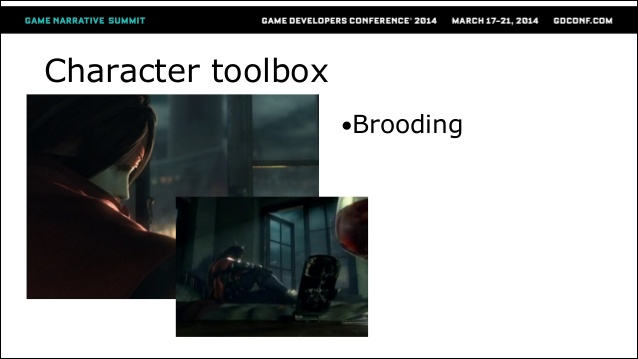
This is just my interpretation but what bothered me about this -- and the talk in general -- is the undertone that Clough's opinions and love of bishonen characters is "right" and to choose to create characters that don't appeal to her is "wrong". When you have sections called "who's doing it right?", it gives the impression that there's only one "correct" way of making sexually-appealing male characters. The same goes for when dimissing Max Payne as a brooding character done poorly while praising Final Fantasy VII's Vincent Valentine as a brooding character done well, while I would say the two characters are the other way around (although to Clough's credit she did use an image of Max Payne 3, which I've never played ... although after watching the first ten minutes on Youtube, that particular incarnation was one I could've done without seeing. What happened to all of Max's metaphors and similes? What happened to him making his peace with his family's deaths at the end of Max Payne 2?).
The problem with this assertion is that, obviously, there are women who find rugged male characters attractive and plenty of male gamers who don't relate to them at all. The opposite can obviously apply to bishonen characters, with not all female gamers being as enamored of them as Clough and it goes without saying that men can play as them without thinking twice about it. A female commenter on my last blog about Clough's talk actually said, "I never found the Sephiroth or Marluxia type of bishounen appealing.
Like maybe when I was 14." She also mentioned stumbling across some Call Of Duty yaoi once. If you have time, go to Google or DeviantArt and search for "call of duty yaoi". It exists!
It should be clear by now that there's no one big problem I had with Michelle Clough's presentation but a lot of small ones. For example, in my previous blog, I objected to Clough thinking that androgynous male characters were rare. Now that I've seen it, I've learned that the issue wasn't with sexualised being rare but them not being in any "core" games. To me, this led to a very muddled argument; firstly, Clough praised characters such as Thane (and others) in Mass Effect, which I would describe as a "core game". Secondly, she would go on to say "make sure sexualised characters are right for your game", before showing a mock-up of a Call Of Duty cover with a bunch of shirtless, muscular guys on the box, indicating an example of a game where it wouldn't be appropriate. I understand that Call Of Duty isn't the only "core" game out there but I would've been interested in hearing some suggestions from Clough. Thirdly, Final Fantasy VII was referred back to many times throughout the talk but the thing is ... the Final Fantasy series is still out there and still features androgynous characters. It's not exactly the fault of the developer that it's no longer the "core" series that it once was, so even though Clough is correct in that respect, it's also not through lack of trying that Final Fantasy isn't as popular as it used to be (or any game series for that matter; I'm sure most developers would give an arm and a leg for their games to be considered a "core" series like CoD or Assassin's Creed). So what point is being made by mentioning the lack of "core" games featuring sexualised male characters? Is someone to blame? Is it an example of how unfairly female characters have it in games, just because Square-Enix haven't been able to achieve the same success that they used to?
I don't want to ramble too much about this, particularly since it turns out I have as many criticisms as I do with the average Anita Sarkeesian video, but one final thing I noticed that disappointed me was how the slides on sexualised male characters were talked about with a light-hearted attitude while the rare occasions when sexualised female characters were the topic of conversation, Clough adopted a more serious tone; slides about Male Gaze,why sexualisation can be good while objectification is bad (focusing entirely on female characters, of course), comparing a male Starcraft character to a female one and comparing a shot of Jacob's buttocks in Mass Effect 2 to one of Miranda's were all treated as serious issues. Talking about male video game characters was the opportunity for Clough to crack some jokes and get a few chuckles from the audience.
My issue with that wasn't that jokes were being made at the expense of male characters. Having a funny presentation isn't the problem. It doesn't even bother me that the first talk about sexualised male characters ever wasn't taken seriously. Hell, you try condensing a subject down into twenty-five minutes when it's never been spoken about in such a prominent venue. It's not enough time to cover everything.
What bothers me is that it was purely from a feminist point-of-view. By that, I mean that Clough's stance wasn't one we haven't seen before. The idea of sexualised men was still a joke, in spite of Clough finding them appealing. In fact, it was considered a good thing, with Clough believing sexualised male characters could attract more women and gay men to gaming. Meanwhile, Clough reserved a modicum of seriousness when talking about female characters and I'd say the only time she mentioned them positively was in passing, when discussing how sexualised characters had to have traits other than their attractive appearance. Even then, it was glossed over, focusing on both Sephiroth and Tifa from Final Fantasy VII, rather than just Tifa.
I don't want it to seem like I'm against Clough having a feminist point-of-view just because it's a feminist point-of-view and give the impression that I'm foaming at the mouth with rage over it. I dislike it because it's a standpoint that seems dead-set against the idea that men can be portrayed negatively. One perfect example of it is when Michelle Clough mentions that when it comes to male nudity in games, it is always portrayed as "awkward or comedic". Hey, you'll get no argument on that from me. Where Clough and I differ, however, is where Clough sees the prominence of comedic nude male characters in games as being unequal treatment for women, as there were plenty of sexualised female characters but a lack of male ones, I see it as being unfair treatment of men.
This doesn't apply as much in games as it does in films, television shows and even real life but it's very rare for male sexuality to be treated as anything close to desirable, including in shows aimed at women; men are constantly portrayed as bumbling comedy figures when it comes to romance, someone for the down-to-earth female characters to roll their eyes at. Women are always portrayed as the desirable, effortlessly sexy party who useless male characters want to (and fail to) be with. Take a look at this advert from Wowcher in the UK for an example (which also portrays violence against men as comedy):
Or how about this advert for "Mullerlight Greek Style Luscious Lemon" yoghurt, which does show a male character as being desirable ... before he stumbles and the female main character (and narrator) laughs at his stupidity? I apologise but for some reason, the video isn't showing up when I try to embed it. Here's the link:
Then there's Harpic White & Shine, a lavatory cleaner. In this advert, a suave man in a white suit walks through some mist while words like "Dazzling", "Brilliant" and "Wow!" appear on the screen ... then he looks dejected as it turns out the words were referring to the lavatory cleaner and not him:
The reason I'm showing all of these television commercials is because Clough used a quote to make it seem as if the only reason why male sexuality is used as comedy is because "man is reluctant to gaze at his exhibitionist like". It's because of Male Gaze, in other words. However, these television commercials are all aimed at women; its "heroes" are female, the voiceover artists are female and hapless male figures are the butt of the joke. None of these adverts have anything to do with Male Gaze, so why does Clough believe that must be the case in games?
The funny thing is that treating male sexuality as comedy is actually the least offensive way of expressing a lack of desirability for men. When male sexuality is portrayed as being disgusting or even dangerous, it stops being comedy and actually creeps into prejudice; we end up with campaigns like "teach men not to rape", which is about as sexist as it gets and I'm not willing to go into it any further than that. This blog's long enough.
Finally, and this is a bit of a nitpick, but using Jin Kazama from Tekken as an example of a "power fantasy" when it comes to shirtless scenes? Literally any other shirtless Tekken character would've been a better option for Clough to pick if she wanted to make the "power fantasy" argument. Aside from Hwoarang, I'd say Jin fits Clough's criteria for a sexualised male character better than anyone else on the roster. He even has the same broodiness that Clough likes, which Namco Bandai plays up when Jin is the object of Ling Xiaoyu's affections:
Even though that ending turns out to be a dream, it's not that far from Jin's regular attitude.
I also have to point out something that I mentioned all the way back in September 2012; that Jin is one of several characters created to be a younger, better-looking successor to an existing character.
So like I said, it's nitpicking but I don't agree that Jin is close to a male power fantasy at all, particularly due to the standards that are usually used by feminists (Kratos and Marcus Fenix, for example).
Overall, and to summarise my problem with Michelle Clough's talk, in my previous blog on the presentation I gave her the benefit of the doubt because the topic of men being sexualised was never acknowledged. Now that I've watched the talk, I don't feel like it offered anything new at all. It didn't offer another side to the issue of sexualised characters, it just bolstered the position of the side that already controls the conversation on sexualisation (and other gender issues). And in spite of the fact that Clough was strapped for time, I have an unpleasant feeling that even if the presentation was twice as long, we wouldn't see sexualised male characters taken seriously (except to point out how good it is for straight women and gay men).
... The presentation was still more watchable than Tropes Vs Women though ...
-----
In other news, I finally took the plunge and joined Twitter. You can see my feed in the sidebar and I'm always happy for more followers.
You can also leave comments below or send me an e-mail at themalesofgames@gmail.com.