I apologise for not updating in January and I'd be lying if I said that wasn't due to feeling burned out on gender politics in gaming. Since I started this blog, I spent a lot of my time while writing each post seeking out information on the subject, often hunting down as many articles from the gaming media as I could on a particular subject. Even if those articles made me roll my eyes or cringe at the double standards the author happily promoted.
Now -- and I put this largely down to joining Twitter and becoming smothered by the issue -- I tend to avoid these articles and avert my gaze from the latest ridiculous statements from "pop culture critics", IGF judges and game journalists who seem to hate their own audience. I don't see a reason to read something that I know will irritate me but there'll be no point in responding because it will just be ignored. More high-profile figures than me have responded to these criticisms of gaming without any response. It didn't matter whether they were game developers, game journalists or women and minorities themselves (and obviously, there's plenty of overlap between those groups). Regardless of who they were, they were ignored, insulted, added to blocklists or dismissed for being white and male (even when they weren't, bafflingly).
It feels like each individual gamer's voice online matters less than ever before. Game journalists actively try and cultivate communities where nobody has the right to offer a dissenting opinion. Game journalism is basically one very big ivory tower, with journalists at the top bellowing what is "right" to the world while gamers are at the bottom, their criticisms going unheard.
With that said, growing discontent amongst gamers is clearly being felt by game journalists as well and it's interesting to see how it's affecting them. Take Dying Light, for example, which I know very little about other than "it's the zombie parkour game". Recently, Techland, the developer of Dying Light, chose not to feature a quote from a reviewer or game journalist on the posters forthe game, instead choosing to feature a quote from Pewdiepie, the Youtube Let's Player.
Seeing game journalists' seething reactions to this shows how petrified they are about their monopoly being broken. Severaldifferentsites referred to Techland's actions as "ridiculous", "shady" and "an ethical can of worms". This is ignoring the fact that PewDiePie's endorsement is no different from a celebrity endorsement in any other medium. Authors promote their books by putting quotes from other authors on the back cover. Films sometimes feature quotes from other directors on their posters (one that stands out in my mind was a Quentin Tarantino quote for Kevin Smith's Red State). I can't even turn on my television without seeing George Clooney advertising coffee and Kevin Bacon shilling for mobile phone networks.
What gets under the skin of game journalists is that they are becoming less and less relevant. Why would a game developer seek a quote from a reviewer or website who might give a game a lower score based on the size of its female characters' breasts or other issue unrelated to the game's quality? Or who only gave it a high score because of how many incentives they were given by the developer? When there's a gamer on Youtube with 34 million subscribers as of this writing, why wouldn't you reach out to that audience and use his quotes about your game? There's no reason not to.
This is basically gaming journalists behaving like children and throwing a tantrum because their parents aren't giving them the attention they want but, just like children, they're very, very loud. It seems as if they're afraid that gamers are listening to -- shock, horror -- other gamers, giving their opinions as they play games, rather than game journalists preaching about how horrible gamers are, how all games are sexist and then recommending you buy Gone Home.
Unfortunately, not everyone has the audience that PewDiePie does. I don't, so my voice doesn't get heard as much as I'd like. Game journalists are still the dominant voice in gaming. That's frustrating. Two weeks ago, a writer called Liana Kerzner wrote a five-part series called "Why Feminist Frequency almost made me quit writing about video games". Liana goes into a lot of analysis of Anita Sarkeesian's Tropes vs Women series so far and, as so many have done before her, pokes huge holes in her arguments. If you've read these types of arguments before, I recommend skimming Liana's articles but they're worth reading for her perspective on the matter.
I actually disagree with Liana on quite a few things but she comes at the topic in some important ways; not just as a woman but as a woman whose voice has been ignored and as a woman with a large chest who is being stereotyped by Sarkeesian for her views on women with large breasts in video games. I was surprised by how much it resonated with me; just as Liana is frustrated over her viewpoint being ignored and people speaking for her, in spite of the fact she belongs to the group being spoken for, I feel the same way when it comes to her flawed arguments about men. The gaming press listens to Sarkeesian but does not seek out different opinions as they should and not once have they suggested that peer review may be a good thing. In short, Liana and I are quite alike; we both write ridiculously long analyses on Anita's videos but ultimately, our feelings boil down to being the same. Liana was tempted to quit writing about video games due to Feminist Frequency, which is also a big part of the reason behind my long hiatus (although mine ties into game journalism as a whole but because Feminist Frequency's influence is largely responsible for the current climate, that's a circular argument).
Liana's arguments in part four of her series ties into what I want to write about today and, honestly, something I should've written about a month-and-a-half ago. The big news that in Final Fantasy XV, Cid -- a recurring name for different characters throughout the series -- will be given to a female character for the first time.
-----
The reaction to the latest version of Cid being female reminds me of a few other occasions when a piece of news that should have been considered a victory for female portrayals in games hasn't been welcomed as you would expect. Aliens: Colonial Marines' developer adding female characters was criticised by Carolyn Petit on Gamespot, for example. Anita Sarkeesian dismissed Princess Peach's inclusion in Super Mario Bros. 2 because it was "by accident" because it was a modified version of Japan's Yume Kōjō: Doki Doki Panic. It feels like a similar story with Final Fantasy XV.
I don't want to describe the female version of Cid as being "monumental" or "ground-breaking" for women in games but if you're a fan of the Final Fantasy series, it is significant. Having a Cid in a Final Fantasy game has been a theme since Final Fantasy II in 1988 and the size of the role each Cid plays varies depending on the game. However, they tend to have something in common; providing the protagonists with transport for getting around the world (often an airship). This seems to be the direction FFXV is heading in too, with Cid being a mechanic. It's likely that she provides -- or repairs -- the car we see the heroes travelling in during each of the gameplay trailers.
So what's the big issue with Cid?
I plan on keeping my criticism here very short; what we have here is several examples of people who care less about what a woman does and more about how a woman looks.
First of all, let's dispel the myth that Cid's design is "the typical Final Fantasy female character". Thinking about female Final Fantasy characters, your mind could go to any number of conservatively-dressed women, such as Aeris, Yuffie, Yuna, Penelo, Ashe and all of the female characters from Final Fantasy VIII, IX and XIII (unless bare midriffs or legs are considered sexualised. By Lightning Returns, some of Lightning's costumes were clearly designed with fanservice in mind but prior to that, her outfits were modest). That's without going back to the 2D era.
Even thinking about other characters, what constitutes being sexualised? Rikku was introduced in Final Fantasy X with a shot focused on her behind but she wasn't portrayed sexually throughout the rest of the game, nor was her outfit revealing. The same can be said of Lulu, who wore a dress that showed her cleavage but was far from being a sexualised character. Even though Tifa is sometimes held up as a sexualised character, you'd be hard pressed to find any examples of her being sexualised in Final Fantasy VII. I don't know if further games and movies changed that.
This is slightly off-topic but it bothers me somewhat that some people -- hopefully a vocal minority -- have stigmatised Final Fantasy with this label about women while BioWare sexualise the hell out of their female characters but receive nothing but praise for being a "progressive" developer. It doesn't make sense but by now, I've accepted that's often the case.
All-in-all, Cid's critics basically pushed aside the fact that for the first time in a Final Fantasy game, Cid is going to be female. They ignored the important point that she is working in a traditionally male-dominated profession. All they focused on was her body and her outfit. It staggers me that the critics can so unironically and harshly judge fictional women based on their breast size and their attire and then complain that there are no good female characters. When you judge women so cruelly that you think "revealing clothing = bad character" and "large breasts = zero worth", that's the type of conclusion you arrive at. The same critics have attempted to retcon Lara Croft from being a tough, intelligent, witty, independent icon of the PlayStation and most successful female video game character of all time -- the Guinness Book of World Records even says so -- into nothing but a sex object or teenage boy's fantasy.
Plus, male Final Fantasy characters are unrealistically attractive too. From around a dozen androgynous hunks to plenty of gents sporting the open-shirt look, men's bodies and clothing in the Final Fantasy series has long been as over-the-top as the women's, if not more so. Yet it gets ignored or dismissed as -- you guessed it -- a "male power fantasy". Lack of awareness and objectivity concerning male characters is always a stumbling block when these arguments are made about female characters.
Also, and this should go without saying -- in fact, many of these points should -- but there is nothing wrong with making any character attractive or giving them revealing clothing. That does not automatically make them a bad character, nor does it make them sexualised. From what we've seen so far, Cid is not sexualised.
I think with announcements of this nature, we see a significant divide between two groups of people; those who actually want to see more good female representation in games and the entitled bunch who think stomping their feet, playing the victim and demanding their own way will override a game developer's creative freedom. Final Fantasy XV's Cid is a better example of how to make a female character own a traditionally-male role than, say, Jason Aaron's female Thor, and deserves to be treated as such. She should be judged on her own merits as a character and not, as her critics want, as an object.
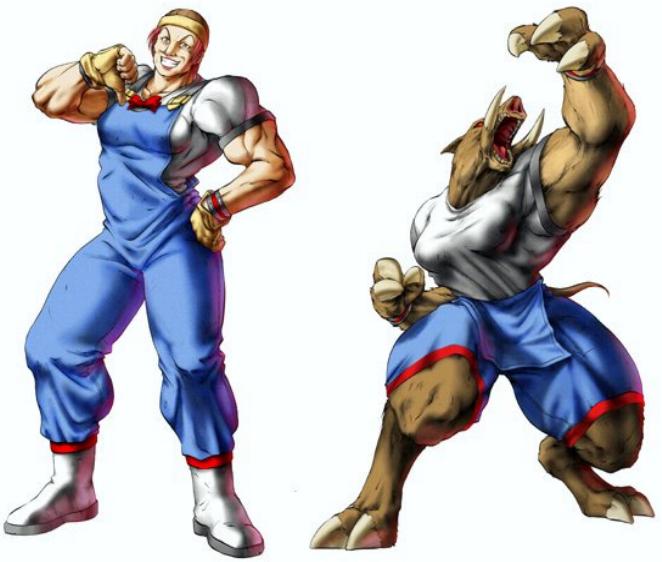
Besides, even if Cid was sexualised, God knows male blue collar workers have never been sexualised, right?
Finally, and I'm not going to go into this at all, if you want to see true hypocrisy, look up the reactions to the sexualised male hero of Mevius Final Fantasy, an upcoming mobile game. If you ever needed proof that gender equality is certainly not being argued for in games, go and read some of the celebrations by feminist gamers over a male character being sexualised. It doesn't come as a surprise how quickly they abandon their principles over sexualised characters when they're not the victim, nor can they deny it exists against men. Yay equality?
Leave a comment or e-mail me at themalesofgames@gmail.com. My posting may be more sporadic from now on.
The next Tropes Vs Women video is up, so let's take a look at it:
In this episode, Anita talks about three particular tropes that she feels are harmful towards women:
The Distaff Counterpart - A character that is basically the female equivalent of an existing male character.
The Smurfette Principle - When there is only a single female character in an otherwise all-male cast.
Tertiary Sexual Characteristics - Female characters have characteristics or items that indicate that they are female -- such as bows in their hair or makeup -- while male characters have none.
Funnily enough, I've actually been critical of the Distaff Counterpart on comic book forums before, just because I think it diminishes any real creativity. I think original female characters are more interesting and having unique powers (in the case of superheroes) is a greater incentive for a new audience to pick up the book than simply using a "name" character. In all honesty, that's probably not the case and is just a personal preference because otherwise, why would Distaff Counterparts/legacy characters exist if not to sell more products? That's the reason in comic books and it's more or less stated in Anita's own video that it was also the reason for Ms. Pac-Man.
However, in spite of the fact that I have a personal distaste for Distaff Counterparts, I find that Anita's representation of them in her video doesn't paint a fair picture. In fact, for once, I feel like I'm being critical of Anita because I want her to do better when critiquing a subject I dislike, rather than being critical of her because I disagree. I've noticed other supporters of better female portrayals in video games take this stance so it's interesting to find myself in the same boat.
I think several points Anita makes at the end of her video point out one of the pitfalls that she fell into during her damsel in distress videos; either failing or refusing to acknowledge the differences in gaming between retro games and the modern era. In the case of the damsel in distress, it was praising games like The Secret Of Monkey Island without pointing out that games with Monkey Island's clever writing and narrative were the exception, rather than the rule. Game developers at the time didn't have the luxury of being able to create complex stories in every single game. Using the damsel in distress plot device gave the player a simple and understandable idea of why the character they played as was on their quest.
In this case, Anita does not acknowledge the reasons behind the female characters she praises being free of "gender signifiers" -- her term for Tertiary Sexual Characteristics, as well as a term that I actually prefer -- and the (usually) retro ones she criticises for having them. Let's use Ms. Pac-Man as an example; unlike TowerFall, Ms. Pac-Man didn't have the freedom to create female characters in a brand new setting. She was created because Midway wanted a follow-up to Pac-Man, which Anita mentioned herself. Therefore, she was limited in the designs that could be used and still remain recognisably part of the Pac-Man universe. Plus, unlike Thomas Was Alone -- another game Anita praised for featuring a positive female character without any gender signifiers -- Ms. Pac-Man didn't have a narrative that would allow for the development of a deep female character, much like Elaine in The Secret Of Monkey Island compared to other, more "regressive", examples of the damsel in distress.
Basically, there were limitations to making a female character in 1982 who was intended to be a successor to the most popular game character in the world (at that time). There's only so much you can change when the character has to be as recognisable as Pac-Man himself and with both the storytelling and graphic limitations of the time period. I don't feel that's highlighted in the video above.
It's a similar story with other games Anita mentions, such as Ice Climber (1985), Bubble Bobble (1986) and Adventures Of Lolo (1989). Another aspect that stood out to me was the divide between examples used from Japanese games and Western games. When it comes to the heavy focus on Japanese games, I'm not saying that the cultural differences excuse poorer representations of women or any other group. However, to avoid mentioning those cultural differences is to refuse to paint the whole picture. In previous episodes, Anita has singled out Shigeru Miyamoto and, in Pac-Man's case, it's Toru Iwatani's turn to be painted with the sexist brush. Here's Iwatani's quote that Anita took issue with:
"When you think about things women like, you think about fashion, or
fortune-telling, or food or dating boyfriends. So I decided to theme the
game around “eating” — after eating dinner, women like to have dessert."
It's understandable that Anita would dislike the blanket stereotyping but the cultural differences between the West and Japan aren't delved into. In fact, it's glossed over in a sentence by being described as, "Iwatani's regressive personal or cultural notions about women". I can't help but feel like this dumbs down what was, in fact, a major attempt to garner a female audience for video games. Iwatani reached out rather than pushed away. Isn't that something Anita wants?
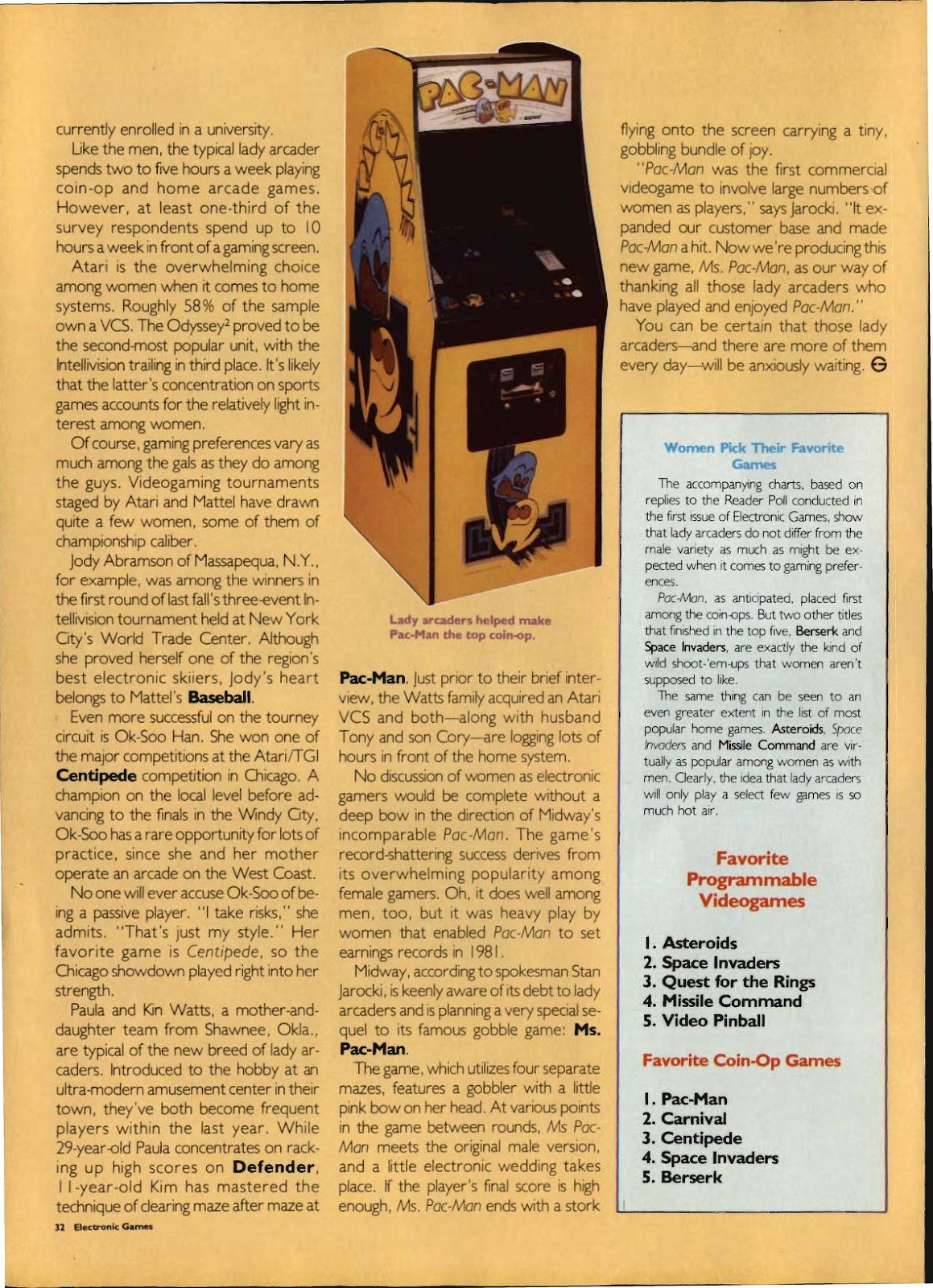
And make no mistake, it worked. Pac-Man's success and popularity amongst female gamers was one of the reasons why a female character was the protagonist in Ms. Pac-Man, according to Midway employee Stan Jarocki.
Electronic Games Magazine (May 1982). Left-click for larger view.
"Pac-Man was the first commercial videogame to involve large numbers of women as players," says Jarocki. "It expanded our customer base and made Pac-Man a hit. Now we're producing this new game, Ms. Pac-Man, as our way of thanking all those lady arcaders who have played and enjoyed Pac-Man."
In spite of my own feelings about Distaff Counterparts, there is a reason they exist; they work. They can be hugely popular in their own right, earning the ability to stand on their own two feet. To use superheroes as an example, Marvel's Carol Danvers -- better known as Captain Marvel, formerly Ms. Marvel -- is a far more prominent hero than her male predecessor, also known as Captain Marvel. In the case of Ms. Pac-Man, she was as capable as Pac-Man when it came to eating dots and ghosts and in an enormously popular game herself, to the point that she either matches Pac-Man's cultural relevance or is ridiculously close. So to have Ms. Pac-Man so passively dismissed and her contributions diminished with the following quote is only disheartening to see, regardless of Anita's claim that, "it’s entirely possible to be critical of some aspects of a piece of media while still finding other parts valuable or enjoyable":
"Ms. Pac-Man’s visual properties are simply an extension of Pac-Man’s
original design; she actually kind of is just Pac-Man with a bow. Her simple narrative reinforces the fact that she really only exists in
relationship to Pac-Man. She is both his love interest and also the
mother of his child."
Later on, Anita also provides this statement:
"Ms. Male Characters typically aren’t given their own distinctive
identities and are prevented from being fully realized characters who
exist on their own terms. This has the, perhaps unintended, effect of devaluing these characters
and often relegating them to a subordinate or secondary status inside
their respective media franchises, even when they are, on rare
occasions, given a starring role in a spin-off or sequel."
I don't know about anyone else but I feel like the only person devaluing characters such as Ms. Pac-Man is Anita. Prior to that particular quote, Anita was talking about Dixie Kong, star of Donkey Kong Country 3 and a playable character in fifteen games, and it's clear that the quote is aimed at characters such as her and Ms. Pac-Man. Dixie Kong was the start of her own title, having to save two male characters who were damsels in distress and why exactly is she receiving criticism? Because she wears pink. Because she has a ponytail. Because she's a Distaff Counterpart to Diddy Kong, according to Anita (which isn't actually true; they have similar designs but only because the two are similar in age, size and, y'know, they're apes. The two do not share abilities or similarities in their design more than that, in the same way the Pac-Man and Ms. Pac-Man do). So who, exactly, is devaluing the female characters here?
Truthfully, I'm having a hard time figuring out why, exactly, Anita takes issue with gender signifiers in games. Unless they lead to what she describes as "personality female syndrome" -- a series of characteristics that Anita believes stereotype women, including being, "vain, spoiled, bratty and quick to anger" -- I don't exactly see the issue. I thought I did but then this segment of the video completely threw me off:
"Now just to be clear, there’s no inherent problem with the color
pink, makeup, bows or high heels as design elements on their own. And of
course people of all genders may choose to wear any of them from time
to time in the real world and there is nothing necessarily wrong with
that either.
However, when designers choose to use the Ms. Male Character trope
and its associated visual stereotypes to specifically distinguish female
characters from the rest of the cast in a fictional context, it has a
few negative consequences.
One repercussion of constantly relying on feminizing signifiers for
character design is that it tends to reinforce a strict binary form of
gender expression. The gender binary is an entirely artificial and
socially constructed division of male and female into two distinctly
separate and opposing classes of human being. The gender binary also
erases the continuum of gender presentations and identities that fall
outside of the rigid masculine/feminine false dichotomy.
And within that strict binary women are “marked” while men get to remain largely “unmarked”."
In other words, Anita dislikes signifying a character's sex through certain clothing or accessories because (A) it singles out women as something different from men and (B) it automatically excludes people who don't identify as male or female, or who do but choose not to conform to gendered clothing.
The main reason this stood out to me is because, as understandable as it is to want more representations of genders outside the "gender binary" -- which simply means "male or female" -- I don't understand why it falls to gaming to show those representations. Gaming can but isn't Anita criticising the "entirely artificial and socially constructed division of male and female into two distinctly separate and opposing classes of human being" actually a criticism of society's attitudes instead?
Let's use Ms. Pac-Man as an example again. I'm not normally a person who says that Anita needs to provide good examples in addition to negative ones but in this case, I would love to hear an alternative solution to giving the character lipstick and a bow to show that she is a female character. Again, bear these factors in mind:
It's 1982 and there are "only a few pixels to work with" (Anita's own words).
The character has to look different from Pac-Man to avoid Ms. Pac-Man seeming like a knock-off.
The character has to look similar enough to show that the game is part of the same series.
I think it's reasonable, albeit not ideal, for a character designer to draw on real-life examples of women to create a female character in this case. Given that women are far more likely to wear bows and lipstick than men, it is completely fair for a character designer to use those elements for his/her female character. And that is so obvious that I can't believe I had to write it down.
On the Feminist Frequency Tumblr, the only solution, if you can call it that, was a gender-flipped version of Pac-Man and Mrs. Pac-Man that shows how the two characters would look if "Pac-Woman" became "Mr. Pac-Woman".
Personally, I don't think it's as "downright absurd" as Anita believes, not least because Pac-Man is a tricky character to take seriously in the first place. He -- or she, if we're talking about Pac-Woman -- is a yellow circle with a mouth. Putting a top hat and bow tie on it doesn't propel this light-hearted, cartoonish character into the realms of absurdity. What little ridiculousness there is only comes from the fact that, if anything, "Mr. Pac-Woman's" clothing looks very outdated. However, this still isn't a solution. It's just a gender flip.
I'm anxious to move on from this topic but I want to mention the idea that women are "marked" and men are "unmarked". I don't think Anita ever actually asked why it is done but she certainly, and probably unintentionally, provided an answer to that question:
"There are a few optional design accessories for men like neckties or
baseball caps but they don’t hold the same significance. They are not
ubiquitous or strictly enforced, and are never really used to “mark” men
as “not female” in larger fictional universes dominated by women."
First of all, I find it quite funny that Anita singled out Dixie Kong earlier in the video when both Donkey Kong and Diddy Kong wear a necktie and baseball cap respectively -- again, they're apes. It'd be tricky to tell the sex of those characters without gender signifiers -- but doesn't this quote sum up why gender signifiers aren't used as often for male characters? Certainly not because men are considered the default and women a deviation (which I'll come to later) but because there are so few gender signifiers available for male characters. Traditionally-male clothing is no longer restricted to men. Women are far less likely to receive odd looks if they went out in public in a man's suit than a man would if he did the same in a pink dress, with pigtails and makeup. The reason being that they still are items and fashions predominately associated with women. If Anita wants to take any steps changing society's perceptions on that score, I'll be right alongside her, but it's silly, pointless and actually rather petty to lay the blame of gender signifiers at the feet of video games. That goes for modern games as well as retro games.
In other words, women are more likely to have gender signifiers because they actually have them. Not because they need to be "marked" and singled-out as something different from "the norm".
Also, I actually find that turn of phrase bordering on offensive; I'm sure it was completely unintentional but think about other oppressed classes throughout history who have been marked -- literally -- as something different from what their oppressors considered "the norm" or ideal. I feel like it was a very poor choice of words to use when describing how hard female characters have it in video games, of all things.
One thing that I'm sure had everyone marvelling was Anita's analysis of Mass Effect 3's advertising. Let's deal with the mistake that even the non-Mass Effect fans probably picked up on:
"Still, the female version has a dedicated fanbase who frequently refers
to her as “FemShep”. And although this is meant as an affectionate
nickname, it does further highlight her designation as a Ms. Male
Character. She is the one with the qualifier attached to her name. She
is “Female Shepard” whereas the male version simply gets to be,
“Shepard”."
This is completely untrue. Although I hate to fall back on phrases that make it sound like Anita makes these kind of research mistakes all the time, this is a typical example of the lack of research that people criticise her videos for. It certainly is astounding that Anita can trawl through obscure mobile games and retro games to find examples but can't spend two minutes on a forum to find out information on a nickname for the main character of a AAA game.
For those of you who don't know, the male version of Mass Effect's Commander Shepard does have a nickname. Several, in fact; "MaleShep", "ManShep" and "BroShep" are all commonly used while "ShepLoo" and "VanderShep" are both used to refer to Commander Shepard's default male design, named after the Dutch model he was modelled after, Mark Vanderloo.
That's not all. Prior to this, Anita discussed the marketing of the Mass Effect series:
"In mainstream advertising of the franchise, the male commander is
used almost exclusively. His image is front and center on the box covers
for all releases including the special editions. He is the one featured
in the TV commercials, teasers, trailers, web banners, street posters
and print ads and his face appears on most of the magazine covers. All
of this positions the male Commander Shepard as the default protagonist
of the series. That is how Bioware is selling the Mass Effect experience. Nearly
everything about the advertising campaign explicitly tells players that
Commander Shepard is a man and by extension associates the official
storyline with the male version of the hero. This marketing strategy
contributes to the fact that only 18-20% of players choose the female
option (despite the fact that Jennifer Hale’s voice acting is widely
praised as being far superior)."
First of all, although the 18-20% statistic is apparently true, there's nothing to say that the marketing strategy is the reason for the 80% of players or so choosing to play as the male version of Shepard. Much like in previous videos, like assuming damsels in distress are considered property rather than people, this is a case of Anita reaching a conclusion that isn't backed up by any factual evidence. One may not neccessarily lead to the other but Anita is arguing as if that is the case.
Secondly, I take issue with the fact that Jennifer Hale's voice acting was considered "far superior". There are certainly people who make that claim but she also has her detractors (typically on the exact same forums as her supporters. There's always a healthy mix of opinions). I'm as big a fan of Jennifer Hale as the next person, particularly for her performance as Bastila Shan in Star Wars: Knights Of The Old Republic, but I wasn't a fan of her Mass Effect role. I agree with those who say her vocal performance as Commander Shepard was too butch. Trying too hard to be "badass", to fit a tough space marine persona rather than just a person. Meanwhile, Mark Meer -- the voice actor for the male version of Shepard -- had a voice that fit a wide range of races and facial features, as well as being suitably authoritative. Plus, he was widely praised for upping his performance in Mass Effect 3.
Then there's the advertising campaign, which focused only on the male version of Commander Shepard. To be more specific, the default male version of Commander Shepard, created using Mark Vanderloo's likeness. I certainly find it unusual and rather silly that BioWare -- creators of Mass Effect -- actually paid for a real person's likeness in a game where a character's facial features can be customised and that was the appearance focused on in all the marketing ... but since that's the case, why does Anita focus on the fact that he's male? Why not mention that non-whites are similarly ruled out or, for that matter, that the character customisation feature isn't shown off as much as it could be and is therefore rather poor marketing for not showing off an aspect of the game? The thing is, when only one of these points are argued -- "women aren't focused on" -- it sounds less like "not everyone is being given an equal share" and more like "it shouldn't be a male character". Something that is equally as exclusionary.
Plus, it has to be said ... the male Commander Shepard is the default protagonist of the series. "VanderShep" is the version of the character that players see when starting a new game. So criticising the series with the statement, "all
of this positions the male Commander Shepard as the default protagonist
of the series" doesn't make much sense. That's the case. Plus, for all I know -- or for all Anita knows -- having a default protagonist could help sell the game. I wouldn't want to make assumptions about why mainstream audiences bought Mass Effect.
Anita continues:
"During the advertising of Mass Effect 3, Bioware made a little more
effort to include female Shepard with items like an alternate reversible
slip cover for the game box (which features the male version by
default) as well as a special web only trailer but these gestures feel
like an afterthought or niche specialty marketing and hardly what I
would call a substantial or equitable inclusion."
This dismissive attitude when a developer makes a positive change in order to cater to women is reminiscent of Carolyn Petit's criticism of female characters being added to Aliens: Colonial Marines. All it does is send the message that the developer may as well not even try to cater to a feminist gaming audience because it's impossible to succeed. Much like Petit, Anita is creating a no-win situation by complaining about an effort BioWare made to appeal to feminist gamers in the first place. It also brings to mind the way Anita shrugged off Princess Peach's appearance as a playable character in Super Mario Bros. 2 in her damsel in distress videos because she was only in the game "by accident", since it was a makeover of Doki Doki Panic.
Finally, when talking about The Smurfette Principle, Anita argues that men are treated as the "default" sex:
"In a male identified society like ours, men are associated and become
synonymous with human beings in general. In other words, male tends to
be seen as the default for the entire species."
In all seriousness, there is some truth to this claim. Although it's more of a double-edged sword than is made out.
Let's use a real life example; political parties are always trying to gain "the female vote" by showing their support for women's issues, such as taking a pro-choice stance on abortion, pledging to stamp out the wage gap and sexism in the workplace, etc. Meanwhile, there's no "male vote". I don't think the phrase "men's issues" will ever come up in a political debate and, if it did, nobody would have a clue what it means. That's part of men being considered the "default" for the entire species. There's no need to cater to men because men are just ... there. The standard. Anything that appeals to society as a whole will be appealing to men because they don't have anything that specifically caters to them ... right?
In games, we don't care about legions of male enemies being gunned down by the player. In fact, it's not only accepted, it's expected for men to be the expendable gender. Meanwhile, we have developers committing self-flagellation over their portrayals of characters, even positive ones, thanks to criticism from the Tropes Vs Women in Video Games series, while men criticising portrayals that they feel are sexist are told to "Grow The F**k Up". Because men can't possibly be offended by portrayals because we're the default. Isn't that so?
So there's something to the idea that men are considered the default but -- and this isn't a knock on Anita -- I wouldn't expect the effects on both sexes to be covered by a video on gender issues in games. It's not an issue at the forefront of the gender issues debate, so it's not something I believe anyone would cover, regardless of their sex or involvement.
I'm hoping to read more articles on this video from others online but for the moment, that's all I have to say on it. I don't know if I was expecting Anita to change her presenting style for this video but I do know that I was disappointed to see all the flaws present in her previous videos to be back with a vengeance here; the blaming of specific developers, basing arguments off conclusions that she came to without evidence, dismissal of positive and progressive changes for women for rather shallow reasons, etc. On the plus side, she did reference a few examples this time around (although none of the gameplay videos, so it's still up in the air as to whether they were her own content or if they were taken from other Youtubers without permission or credit).
Anyway, as for what happens next ... I'm buying the Tomb Raider reboot in the near future, so hopefully I'll be able to provide another "The Sexism Of ..." blog post. I know it's a year old now but I don't often get the chance to delve into individual games anymore, so I'm looking forward to it.
Feel free to leave a comment or write to me at themalesofgames@gmail.com
Even though I spend a lot of my time agonising over the treatment and portrayal of male characters in video games, they're not the only ones who get the short end of the stick. There are lots of very strong, interesting and intelligent female characters in games. Lots of them. However, they're often dismissed because of the way they look, the way they're dressed or simply because they're not in a game made by Valve.
By now, I'm sure you know that Aliens: Colonial Marines wasn't well-received. Well, last week on Gamespot, writer Carolyn Petit posted an article of hers, "Fear of a Woman Warrior", that, among other things, criticised Aliens: Colonial Marines for adding female multiplayer characters late in development:
"First, there's the ill-fated Aliens: Colonial Marines. A Reddit post, picked up and reported on by Kotaku,
indicated that female marines, rather than being part of the game from
the earliest stages of development, were a last-minute feature request.
Let that sink in for a second. Female marines were a feature request, a
special addition, a change made to the game at the last minute. This is
difficult for me to wrap my head around. During Colonial Marines'
development, people working on the game declared their abiding reverence
for the film Aliens. It's hard for me to believe in this
reverence, not just because the game ultimately failed to deliver an
experience worthy of the Aliens name on any level, but because any
reasonable understanding and appreciation of what made Aliens a
great film acknowledges the important role of women in it. Women are not
hard to come by in the film. In fact, they're pretty damn important.
One might even say that they're the equals of their male counterparts.
Crazy, I know! The notion of a vision of the Aliens universe without
women in it seems like about as major a betrayal of the source material
as I can imagine.
And yet, somehow, for years and years, development on Aliens: Colonial
Marines progressed, apparently without anyone stopping to say, 'Hey. You
know how there are women in Aliens? Remember Vasquez, the
tough-as-nails marine? Remember Ferro, the dropship pilot who says, "We're in the pipe, five by five"? Remember how Sigourney Weaver was the
star of all the Alien movies? Well, I just had this crazy thought. What
if we put some women…in the game?!'
Women should not be an afterthought in an Aliens game."
The funny thing about this is that I already knew female marines were added to Aliens: Colonial Marines late in development and not because of a Reddit post, which was then reported on Kotaku. I knew about it because last July, Gamespot posted news about the fan petition to include female multiplayer characters in Aliens: CM. So how on earth did it take Carolyn this long and another website to learn about it when it was posted on her very own site, eight months ago?
That's besides the point though. For all of the failings of Gearbox Software, the developer of Aliens: Colonial Marines, adding female characters is not one of them. Ideally, yes, they would've had enough intelligence to realise the significance of women in the Alien series and added them early on, but they didn't. When it came to their attention that they'd dropped the ball,
however, they went out of their way to add them. And yet even that
effort is criticised in articles like this one. Why? They should be praised for listening to the fans and correcting their mistake, not criticised for the original error.
It isn't just the female characters in Aliens: Colonial Marines that suffer. Appearance is one of the major deciding factors for the critics about whether a female character is good or bad. In Carolyn's article, she praises Lara Croft and Samus for being two examples of female characters from highly successful franchises, only to dismiss them for their sex appeal just two paragraphs later. Or at least their sex appeal being used as a reward players/to advertise the game (which I find highly hypocritical, considering Gamespot has adverts for affiliate sites at the foot of the article, advertising features like "The 20 Hottest Daughters From The Sports World" and "Hottest WAG of Each NFL Team". Apparently, criticising female video game characters for their sex appeal is fine but Gamespot'll be damned if it's going to refuse to objectify real women to gain money from referrals!).
Lara Croft is a particularly strong example of this, much like the Aliens: Colonial Marines one. This is a character who, for years, has been held up as a (if not the) prime example of objectification in video games. In some circles, her appearance would be more important than the games she starred in. So when Crystal Dynamic made the effort to revamp her appearance, giving her a more realistic figure, it would presumably be well-received, wouldn't it? Not the case, at least for Tomb Raider. After the game was displayed at E3, she was immediately faced with criticisms such as "she suffers sexual assault" and "she makes orgasm noises when hurt". Neither of which are true, of course; it's the critics seeing what they want to see. It was the same with Aliens: Colonial Marines; if Gearbox Software leave out female marines, they're blamed for leaving out female
marines. If they include female marines, they're blamed for not having them in
the first place.
What feminist critics of the gaming industry, such as Carolyn Petit, are doing is creating a no-win situation. I don't want to spend too much longer on Carolyn's article but she goes on to write about a man I'm not familiar with called Ryan Creighton:
"In a blog entry
posted on Gamasutra last month, Ryan Creighton, a designer on
Spellirium, confessed that his game is dominated by white male
characters 'for fear of someone calling me out for my non-white or
non-male character being stereotypical, offensive, or - at the absolute
worst - outright racist or sexist.'
"The world of writing and designing games is tremendously male-dominated;
sadly, this absurd fear of creating complex, human women who star in
games is not limited to Creighton, but is a widespread problem."
Carolyn criticises Ryan Creighton's decision to leave out non-white and non-male characters, calling it "an absurd fear" but given that she just wrote an entire article about the pitfalls of creating female characters -- criticising some of the examples that fall into them -- how is it absurd in the slightest? At some point, game developers like Ryan Creighton just ask "why
bother?" and don't add female characters at all because women like
Carolyn Petit have created a no-win situation. And we're going to see a
lot more attitudes like Ryan Creighton's in the future if feminist gamers
don't start appreciating that the entire industry is bending over
backwards to make them feel welcome and all they're doing is throwing it back in the industry's face. They're biting the hand that feeds them, so developers will naturally start doing what's sensible and avoid female characters altogether because they don't want to navigate the minefield of getting female characters "right". As a result, female characters are the ones who are going to suffer, as feminist critics can't appreciate the good qualities of the characters that they're given.
That's enough about the article but certainly not the end of the good female characters. Let's talk about Soul Calibur because there's no shortage of good female characters there. Yet nobody ever praises Talim, Xianghua, Seung Mina, Hilde, Amy, Cassandra and (at a push) Tira because they're too busy criticising the breast sizes of Ivy, Taki and Sophitia. Three great characters, all dismissed by feminist critics because of the
way they look. It baffles me that women would do that, since they're
judging other women on their looks far, far more harshly than any male
gamer ever would. They're the ones seeing them as sex objects to get rid
of rather than interesting characters to keep. The same applies to the Dead Or Alive series, albeit to a lesser extent; the women are the poster girls for the series and the men receive far less recognition. However, the makers of Dead Or Alive have also made no effort to hide the titillating aspects of the series, with titles like Dead Or Alive: Extreme Beach Volleyball under their belts.
Women in fighting games in general tend to be given the "they're objectified, so they're no good" dismissive attitude. I'm going to take a moment to discuss the double-edged sword that comes with a phrase like that; male characters who are judged on their appearance aren't taken seriously. I think being a female character who is dismissed because of her appearance is much worse, however, because there are so many great ones out there who don't receive the recognition they deserve because of their outfit or breast size.
Take Tekken as an example. For Tekken Tag Tournament 2, Namco Bandai offered a swimsuit alternate costume for every character in the game as a pre-order bonus (and later through a free update). They did provide swimsuit costumes for both male and female characters, interestingly -- here's the trailer, if you want some examples -- but what surprised me was the differences between swimsuits for different male characters. Attractive, muscular male characters, like ninety percent of the Tekken cast, are given the skimpy fundoshi outfit (which you can see a real-life version of here, if you don't mind seeing a man's behind). Then there are the characters like Wang, Dr. Bosconovitch, Bob and Ganryu; old or overweight. Unattractive, in other words. They're given old-fashioned beachwear that completely covers their entire body, like the kind seen on this TV Tropes page.
As surprising as it might sound, I was actually mildly offended that they'd do something like that. The Ganryu outfit, in particular, is confusing, since he only wears a sumo mawashi for his regular costume anyway. It was the costume for Bob that irritated me though, in no small part because Tekken Tag 2 added Slim Bob; a thin version of the normally-overweight Bob. He first appeared in Bob's Tekken 6 ending and was added as a playable character in TTT2.
You can customise each character's appearance in Tekken Tag Tournament 2 and Slim Bob, like most of the other male characters, has an option to be shirtless. Regular Bob doesn't. As mentioned above, Slim Bob has a fundoshi swimsuit costume, like all the other attractive male characters. Regular Bob doesn't. Slim Bob even has an outfit reminiscent of Lee Chaolan's bondage outfit (which I've featured on this blog before), as it has a similar emphasis on his perfectly-sculpted abs:
Call me picky but I can't help feeling that there's something ... unjust about giving a thin version of a fat character some alluring costumes and not giving the fat version the same treatment. So for all the talk from feminist critics that male characters are a lot more varied than female ones, that's true but they also face the barbed treatment of being judged on their looks. Attractive men are given outfits to emphasise their physical attractiveness, unattractive ones are given a sheet to put over their hideousness, essentially. Maybe this is all just a personal gripe I have with Tekken.
Would I like to see more varied female characters in video games? Yes. Does that mean game developers are doing something wrong right now? No. They could just be doing things more right, if that makes sense (although I certainly will say that Gearbox Software messed up by not giving female characters a larger role in Aliens: Colonial Marines from the start). So I recommend feminist video game critics stop judging characters like Soul Calibur's Ivy based on their looks because they're only hurting female characters in general. We could certainly use a few more characters like the wonderful Mitsuko from Bloody Roar but that doesn't mean we need fewer Ivys. If appearance was taken out of the equation, I think feminist critics would be a lot more appreciative of how many great female characters there really are and how judging them on their appearance is actually very petty. Hell, even Nariko from Heavenly Sword has faced criticism for her appearance and the most skin she shows is her midriff. Small-chested, no shots of her rear, no sexual dialogue ... and yet I've still seen her turn up on lists of sexualised female characters, presumably by people who've never played the game. Although if you've read anything I've written on Heavenly Sword before, you'll understand why I don't consider her a great female character.
And that's before we get to the great female characters who don't face this kind of dismissive criticism. Chell from Portal. Jade from Beyond Good And Evil. Jennifer Mui from Mercenaries. Mona Sax from Max Payne. Elena Fisher from Uncharted. Alyx Vance from Half-Life. Zelda. Jill Valentine and Claire Redfield from Resident Evil. Almost every female Final Fantasy character.
A lot of these characters aren't given the recognition they deserve because they're overshadowed by talk of how video games feature nothing but women with big boobs and a tendency to get kidnapped. Not only do I think that does a disservice to the developers who worked so hard on these characters, I think it does a disservice to the characters. If great female characters are truly what you want in games, feminist critics, try to realise it when you have them. Understand that being sexually attractive doesn't negate the other qualities of a character and -- it's been said before but never hurts to hear it again -- male video game characters are sexually appealing too. Not because it's a "male power fantasy", which is an eye-rolling explanation I hear batted around far too often nowadays, but because traits given to our male heroes, whether muscular and square-jawed or androgynous with perfect hair, look appropriate to gamers in the West or Japan, depending on the game.
And if you're looking for more great female characters, Awesome Lady Tropes has you covered.
As always, feel free to leave a comment or send me an e-mail at themalesofgames@gmail.com.