Showing posts with label half-life. Show all posts

Thursday, 21 March 2013

Men are the Expendable Gender

Sorry I haven't updated for a while. I know I'm a slow updater anyway but I was sick all of last week.

It's a given that if a game developer needs some generic enemies to kill of in a game, men will be the ones to fill the role. Unless the game features monsters as the primary enemies, men are the ones who will be the main victims of the hero's gun-toting, sword-swinging adventure.

It's no secret why this is the case. If I may wear my Anita Sarkeesian historian hat for a moment, we're used to society portraying men in combat roles. In real life, men make up the majority of soldiers and the most hazardous jobs are performed predominately by men. In popular culture, we see men being gunned down by James Bond in movies, Jack Bauer on television and The Punisher in comic books, just to list a few examples. Of course, they occasionally fight a female villain or two but the average person they shoot or beat up is male. The standard enemies, usually without names and who only serve to provide token resistance for the hero, who quickly kills them to show off his/her abilities. It's so frequent and the audience is so used to seeing it by now that we don't bat an eyelid when they die. This is part of being expendable. The same goes for enemies in video games.

Right away, I'll say that this isn't necessarily a bad thing. I don't want it to sound like I'm crusading against violent games or even ones that predominately feature men as enemies. That attitude leads to things like the German version of Half-Life, which featured robots instead of marines (as well as no blood and doctors/security guards who sat down and shook their heads instead of dying). It's completely fine to use men as enemies in games. They're as good as anyone else, such as women, monsters, robots, etc.

The key words there are "as good as". The problem is when game developers go out of their way to portray violence against men as more acceptable than any other victim of it.

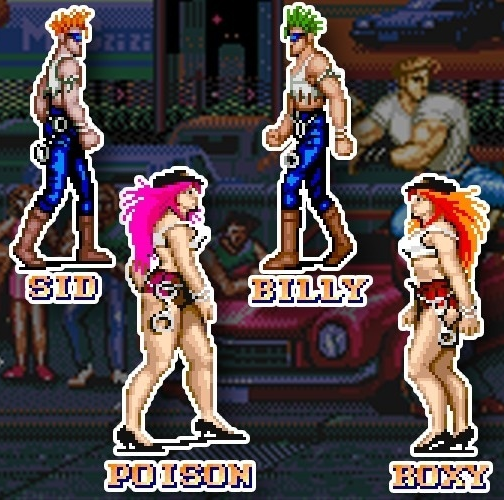
For example, back when the side-scrolling beat 'em up Final Fight was released in 1989, the Japanese version of the game featured two female enemies called Roxy and Poison. For the American release of the game, Roxy and Poison were removed from the game and replaced with two male punk characters called Sid and Billy, because "hitting women was considered rude". It was originally suggested that Roxy and Poison be considered male-to-female transsexuals -- this is how the famous confusion began over Poison's sex -- but supposedly, Capcom's developers figured that "wasn't enough" to deter critics of the two female enemies (wisely, in my opinion) so they replaced them entirely.


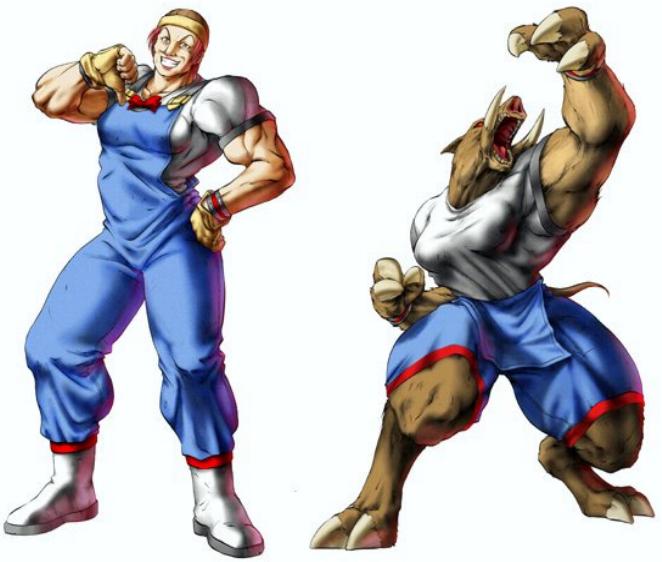
There's a site I found that has a good name for this trend; "Sidbillies". The writer of this article at ScrollBoss shows examples from other nineties' games like Sonic Blast Man, Ninja Warriors Again and Sunset Riders. The most interesting game mentioned, however, is Final Fight 2. The reason being that the second game in the Final Fight series had a playable female character, Maki. So it seems like the Final Fight series was embracing equality for the first time, having both heroic and villainous male and female characters ... but once again, the female enemies, Eliza and Mary, were removed in the American version and replaced with male ones, Robert and Leon.

In a way, this is actually worse than the German version of Half-Life replacing the marines with robots. That was done because someone determined that violence against human beings was completely wrong, so the human enemies were replaced with something non-human. It was ridiculous but morally, I can't fault them for it. The makers of Final Fight (and the other games listed on ScrollBoss) decided that violence against women was wrong ... but violence against men was completely fine, or at least more acceptable. It's one thing for this to be the case in the first Final Fight, where the three playable characters were all male, but it's quite another in the second, where one was female. You could justify having Sid and Billy in the first game if you were wary about encouraging male-on-female violence. The flipside to that, however, is because there's a female playable character in Final Fight 2 but there are no female enemies, Capcom are inadvertantly encouraging female-on-male violence. It makes me wonder why Maki was left in the game at all; is beating up men as a woman considered progressive in a way that men beating up women isn't?

Capcom aren't the only ones guilty of this and it certainly didn't die out with 2D games. Even though sprites are gone, so female characters can't simply be papered over with male ones, developers have come up with a much easier way of avoiding controversy; leaving out female enemies altogether. 

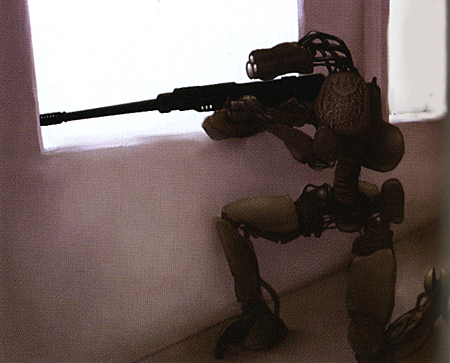
Lots of game developers seem to have (figuratively) taken their cues from Final Fight 2 by doing this. Back in one of my first blog posts, I said that the villainous Civil Protection in Half-Life 2 probably did feature women in its ranks but their voices were altered and their feminine physiques hidden underneath the Civil Protection’s bulky security outfits (or perhaps their bodies were altered too). However, this doesn't let Half-Life 2 off the hook because they still appear to be male to the audience, while the good guys -- resistance members -- feature both men and women in their ranks. During development, Valve apparently intended to make the Overwatch Sniper enemy female but, looking at the concept art, there's very little there that I could describe as "female". It looks very robotic, so there aren't many female qualities to be found. Unlike the Civil Protection in the final game, who still look human, act human and fall like human beings when they're killed.

An argument that I've heard both for and against female soldiers in games is about realism; people opposed to them argue that it'd be unrealistic because women only account for a small percentage of the military in real life (and only now in the US are being considered for combat roles). People in support of female soldiers in games point out that realism isn't really an issue when you're dealing with fiction, at least in a lot of games.

Personally, I think the realism argument doesn't make sense for either side when you think about games like Final Fight 2, Half-Life 2 or Final Fantasy VIII, which all featured female characters on the good side but only male characters on the evil one. Unless the developers of these games intended to make the villains out to be huge misogynists -- which they didn't -- there's no real reason for female characters to only be on the heroic side.

I would love to see more generic female soldiers and warriors in games, particularly on the opposing side. Because as it stands now -- and not just in the games mentioned above but Uncharted, Metal Gear Solid, Mercenaries, Tomb Raider and many, many others -- we're used to seeing men being killed. In all of those games, it's our objective to kill men, and only men (excluding the occasional boss). This is developers treating men as disposable and unimportant. So the realism argument falls flat when one side is single-sex and the other is co-ed. It's very unrealistic ... but it's also completely sexist because men are the only ones the player is meant to kill. That overshadows the realism argument.

Interestingly, Bethesda came up with another way to emphasise male disposability when making Fallout 3. One of the perks -- special abilities the player character could earn when levelling-up -- available to the player was to cause ten percent extra damage to characters of the opposite sex. However, because there were many, many more male enemies in Fallout 3 than female ones, the perk was a lot more useful if playing as a female character. It's minor but nevertheless puts a greater emphasis on killing men than women. As a result, two extra perks were added to Fallout: New Vegas to award the damage bonus against members of the same sex.

The Lady Killer and Black Widow perks.

Surprisingly, EA is one of the few developers I've seen with a decent split when it comes to the sexes of enemies in their games. Mass Effect, Dragon Age and Kingdoms Of Amalur: Reckoning all seemed to have a fair balance between male and female enemies (as well as aliens and monsters). Of course, Mass Effect heavily influenced the other two but they're all separate games nonetheless. They all serve to treat women the same as men.

There's an alternative to having an even split between male and female enemies; making everyone in the game only male or female. Surprisingly, it's not as crazy as it sounds. Starhawk only featured a single female character (who picked up a gun and joined the battle towards the end of the single-player mode, just like the men) but it worked for the setting; Starhawk was going for a "space western" theme and, given that most gunslingers were male, it suited the game. All the enemies seemed to be male too but they were just monstrous enough that it didn't really matter. Hunched over, with odd skin colours and bones that were on the outsides of their bodies. However, even though Starhawk managed to make it work, I wouldn't recommend it for every game. Although even that was better than emphasising male disposability with male enemies and mixed heroes.

Long story short, the idea that it's more acceptable to kill one sex over the other disturbs the hell out of me and I hope to see more female enemies in games in the future. This isn't a case of a lack of women in games anymore, as it was back in the days of Final Fight. Gaming has evolved to a point where women are in games now ... but developers are paranoid about making it the player's job to kill them in the same way they kill men.

To close, here's Lara Croft brutally killing men. Enjoy! 


Saturday, 2 March 2013

Good Female Characters

Even though I spend a lot of my time agonising over the treatment and portrayal of male characters in video games, they're not the only ones who get the short end of the stick. There are lots of very strong, interesting and intelligent female characters in games. Lots of them. However, they're often dismissed because of the way they look, the way they're dressed or simply because they're not in a game made by Valve.

By now, I'm sure you know that Aliens: Colonial Marines wasn't well-received. Well, last week on Gamespot, writer Carolyn Petit posted an article of hers, "Fear of a Woman Warrior", that, among other things, criticised Aliens: Colonial Marines for adding female multiplayer characters late in development:
"First, there's the ill-fated Aliens: Colonial Marines. A Reddit post, picked up and reported on by Kotaku, indicated that female marines, rather than being part of the game from the earliest stages of development, were a last-minute feature request. Let that sink in for a second. Female marines were a feature request, a special addition, a change made to the game at the last minute. This is difficult for me to wrap my head around. During Colonial Marines' development, people working on the game declared their abiding reverence for the film Aliens. It's hard for me to believe in this reverence, not just because the game ultimately failed to deliver an experience worthy of the Aliens name on any level, but because any reasonable understanding and appreciation of what made Aliens a great film acknowledges the important role of women in it. Women are not hard to come by in the film. In fact, they're pretty damn important. One might even say that they're the equals of their male counterparts. Crazy, I know! The notion of a vision of the Aliens universe without women in it seems like about as major a betrayal of the source material as I can imagine.
And yet, somehow, for years and years, development on Aliens: Colonial Marines progressed, apparently without anyone stopping to say, 'Hey. You know how there are women in Aliens? Remember Vasquez, the tough-as-nails marine? Remember Ferro, the dropship pilot who says, "We're in the pipe, five by five"? Remember how Sigourney Weaver was the star of all the Alien movies? Well, I just had this crazy thought. What if we put some women…in the game?!'
Women should not be an afterthought in an Aliens game."
The funny thing about this is that I already knew female marines were added to Aliens: Colonial Marines late in development and not because of a Reddit post, which was then reported on Kotaku. I knew about it because last July, Gamespot posted news about the fan petition to include female multiplayer characters in Aliens: CM. So how on earth did it take Carolyn this long and another website to learn about it when it was posted on her very own site, eight months ago?

That's besides the point though. For all of the failings of Gearbox Software, the developer of Aliens: Colonial Marines, adding female characters is not one of them. Ideally, yes, they would've had enough intelligence to realise the significance of women in the Alien series and added them early on, but they didn't. When it came to their attention that they'd dropped the ball, however, they went out of their way to add them. And yet even that effort is criticised in articles like this one. Why? They should be praised for listening to the fans and correcting their mistake, not criticised for the original error.


It isn't just the female characters in Aliens: Colonial Marines that suffer. Appearance is one of the major deciding factors for the critics about whether a female character is good or bad. In Carolyn's article, she praises Lara Croft and Samus for being two examples of female characters from highly successful franchises, only to dismiss them for their sex appeal just two paragraphs later. Or at least their sex appeal being used as a reward players/to advertise the game (which I find highly hypocritical, considering Gamespot has adverts for affiliate sites at the foot of the article, advertising features like "The 20 Hottest Daughters From The Sports World" and "Hottest WAG of Each NFL Team". Apparently, criticising female video game characters for their sex appeal is fine but Gamespot'll be damned if it's going to refuse to objectify real women to gain money from referrals!).

Lara Croft is a particularly strong example of this, much like the Aliens: Colonial Marines one. This is a character who, for years, has been held up as a (if not the) prime example of objectification in video games. In some circles, her appearance would be more important than the games she starred in. So when Crystal Dynamic made the effort to revamp her appearance, giving her a more realistic figure, it would presumably be well-received, wouldn't it? Not the case, at least for Tomb Raider. After the game was displayed at E3, she was immediately faced with criticisms such as "she suffers sexual assault" and "she makes orgasm noises when hurt". Neither of which are true, of course; it's the critics seeing what they want to see. It was the same with Aliens: Colonial Marines; if Gearbox Software leave out female marines, they're blamed for leaving out female marines. If they include female marines, they're blamed for not having them in the first place.

What feminist critics of the gaming industry, such as Carolyn Petit, are doing is creating a no-win situation. I don't want to spend too much longer on Carolyn's article but she goes on to write about a man I'm not familiar with called Ryan Creighton:
"In a blog entry posted on Gamasutra last month, Ryan Creighton, a designer on Spellirium, confessed that his game is dominated by white male characters 'for fear of someone calling me out for my non-white or non-male character being stereotypical, offensive, or - at the absolute worst - outright racist or sexist.'
"The world of writing and designing games is tremendously male-dominated; sadly, this absurd fear of creating complex, human women who star in games is not limited to Creighton, but is a widespread problem."
Carolyn criticises Ryan Creighton's decision to leave out non-white and non-male characters, calling it "an absurd fear" but given that she just wrote an entire article about the pitfalls of creating female characters -- criticising some of the examples that fall into them -- how is it absurd in the slightest? At some point, game developers like Ryan Creighton just ask "why bother?" and don't add female characters at all because women like Carolyn Petit have created a no-win situation. And we're going to see a lot more attitudes like Ryan Creighton's in the future if feminist gamers don't start appreciating that the entire industry is bending over backwards to make them feel welcome and all they're doing is throwing it back in the industry's face. They're biting the hand that feeds them, so developers will naturally start doing what's sensible and avoid female characters altogether because they don't want to navigate the minefield of getting female characters "right". As a result, female characters are the ones who are going to suffer, as feminist critics can't appreciate the good qualities of the characters that they're given.

That's enough about the article but certainly not the end of the good female characters. Let's talk about Soul Calibur because there's no shortage of good female characters there. Yet nobody ever praises Talim, Xianghua, Seung Mina, Hilde, Amy, Cassandra and (at a push) Tira because they're too busy criticising the breast sizes of Ivy, Taki and Sophitia. Three great characters, all dismissed by feminist critics because of the way they look. It baffles me that women would do that, since they're judging other women on their looks far, far more harshly than any male gamer ever would. They're the ones seeing them as sex objects to get rid of rather than interesting characters to keep. The same applies to the Dead Or Alive series, albeit to a lesser extent; the women are the poster girls for the series and the men receive far less recognition. However, the makers of Dead Or Alive have also made no effort to hide the titillating aspects of the series, with titles like Dead Or Alive: Extreme Beach Volleyball under their belts.

Women in fighting games in general tend to be given the "they're objectified, so they're no good" dismissive attitude. I'm going to take a moment to discuss the double-edged sword that comes with a phrase like that; male characters who are judged on their appearance aren't taken seriously. I think being a female character who is dismissed because of her appearance is much worse, however, because there are so many great ones out there who don't receive the recognition they deserve because of their outfit or breast size.

Take Tekken as an example. For Tekken Tag Tournament 2, Namco Bandai offered a swimsuit alternate costume for every character in the game as a pre-order bonus (and later through a free update). They did provide swimsuit costumes for both male and female characters, interestingly -- here's the trailer, if you want some examples -- but what surprised me was the differences between swimsuits for different male characters. Attractive, muscular male characters, like ninety percent of the Tekken cast, are given the skimpy fundoshi outfit (which you can see a real-life version of here, if you don't mind seeing a man's behind). Then there are the characters like Wang, Dr. Bosconovitch, Bob and Ganryu; old or overweight. Unattractive, in other words. They're given old-fashioned beachwear that completely covers their entire body, like the kind seen on this TV Tropes page.

As surprising as it might sound, I was actually mildly offended that they'd do something like that. The Ganryu outfit, in particular, is confusing, since he only wears a sumo mawashi for his regular costume anyway. It was the costume for Bob that irritated me though, in no small part because Tekken Tag 2 added Slim Bob; a thin version of the normally-overweight Bob. He first appeared in Bob's Tekken 6 ending and was added as a playable character in TTT2.

You can customise each character's appearance in Tekken Tag Tournament 2 and Slim Bob, like most of the other male characters, has an option to be shirtless. Regular Bob doesn't. As mentioned above, Slim Bob has a fundoshi swimsuit costume, like all the other attractive male characters. Regular Bob doesn't. Slim Bob even has an outfit reminiscent of Lee Chaolan's bondage outfit (which I've featured on this blog before), as it has a similar emphasis on his perfectly-sculpted abs:


Call me picky but I can't help feeling that there's something ... unjust about giving a thin version of a fat character some alluring costumes and not giving the fat version the same treatment. So for all the talk from feminist critics that male characters are a lot more varied than female ones, that's true but they also face the barbed treatment of being judged on their looks. Attractive men are given outfits to emphasise their physical attractiveness, unattractive ones are given a sheet to put over their hideousness, essentially. Maybe this is all just a personal gripe I have with Tekken.

Would I like to see more varied female characters in video games? Yes. Does that mean game developers are doing something wrong right now? No. They could just be doing things more right, if that makes sense (although I certainly will say that Gearbox Software messed up by not giving female characters a larger role in Aliens: Colonial Marines from the start). So I recommend feminist video game critics stop judging characters like Soul Calibur's Ivy based on their looks because they're only hurting female characters in general. We could certainly use a few more characters like the wonderful Mitsuko from Bloody Roar but that doesn't mean we need fewer Ivys. If appearance was taken out of the equation, I think feminist critics would be a lot more appreciative of how many great female characters there really are and how judging them on their appearance is actually very petty. Hell, even Nariko from Heavenly Sword has faced criticism for her appearance and the most skin she shows is her midriff. Small-chested, no shots of her rear, no sexual dialogue ... and yet I've still seen her turn up on lists of sexualised female characters, presumably by people who've never played the game. Although if you've read anything I've written on Heavenly Sword before, you'll understand why I don't consider her a great female character.

And that's before we get to the great female characters who don't face this kind of dismissive criticism. Chell from Portal. Jade from Beyond Good And Evil. Jennifer Mui from Mercenaries. Mona Sax from Max Payne. Elena Fisher from Uncharted. Alyx Vance from Half-Life. Zelda. Jill Valentine and Claire Redfield from Resident Evil. Almost every female Final Fantasy character.

A lot of these characters aren't given the recognition they deserve because they're overshadowed by talk of how video games feature nothing but women with big boobs and a tendency to get kidnapped. Not only do I think that does a disservice to the developers who worked so hard on these characters, I think it does a disservice to the characters. If great female characters are truly what you want in games, feminist critics, try to realise it when you have them. Understand that being sexually attractive doesn't negate the other qualities of a character and -- it's been said before but never hurts to hear it again -- male video game characters are sexually appealing too. Not because it's a "male power fantasy", which is an eye-rolling explanation I hear batted around far too often nowadays, but because traits given to our male heroes, whether muscular and square-jawed or androgynous with perfect hair, look appropriate to gamers in the West or Japan, depending on the game.

And if you're looking for more great female characters, Awesome Lady Tropes has you covered.

As always, feel free to leave a comment or send me an e-mail at themalesofgames@gmail.com.

Sunday, 2 December 2012

#1ReasonWhy

This has been an insane few days.

For anyone who isn't a member of Twitter, a few days ago, a man by the name of Luke Crane posted this tweet:


It's a simple enough question, with a simple enough answer (that we'll come to later on). I doubt Luke Crane, or anyone else, could've predicted the response he received to this single tweet. Many, many, many people waded in with their answers, each stating one reason why there were so few lady game creators (hence the hashtag "#1ReasonWhy"). These came from all manner of people from inside and outside the gaming industry.

Obviously, I didn't read them all. I don't even have a Twitter account, since I prefer to read long messages rather than short ones. Thankfully, however, there were plenty of articles on the subject, all showing some of the examples of #1ReasonWhy tweets. The hashtag even earned its own site. All-in-all, there's been an astounding outpouring of support for and from women in the gaming industry.

With it, there's also been an astounding outpouring of hypocrisy, biased arguments and double standards, to the point that its difficult to even know where to begin. Before we go into the tweets themselves, take a look at a couple of the articles that I've been perusing.

This article from Gamespot was where the #1ReasonWhy hashtag first caught my attention. This article, by Carolyn Petit and Laura Parker, does a decent job of explaining what the hashtag is but doesn't really go beyond the "we have to do something!" attitude. They don't reach any conclusions on what to do but overall, the attitude expressed is a step up from the sentiments expressed elsewhere.

Case in point: this article by Nathan Grayson on Rock, Paper, Shotgun. To sum up, it's one big call-to-arms "for men to stop acting like self-centered slobs. It’s time for men to stop turning every step of progress into an agonizing uphill battle". It has a rather disturbing, "you're either with us or against us" attitude, so men who disagree or just don't wish to help are targets of Grayson's ire. In spite of the writer's claim that he is "not trying to propose some damsel-in-distress “let’s handsomely save the day” argument," this may be one of the biggest examples of "White Knighting" I've ever seen online. It's a condescending pep talk that assumes the worst of men and, coincidentally, is a real-life example of what I mentioned in my previous two blog posts; it suggests that men are only valuable based on how useful they are to women. If they're not being useful to women, they're "self-centered slobs".

I haven't got into the actual reasons given by the #1ReasonWhy hashtags yet. Something I should make clear is that there isn't enough time in the world to go through every single tweet, obviously, and there may be some good, legitimate reasons that I haven't seen. However, just browsing through the reports on #1ReasonWhy, I didn't find a single tweet I cared for and most of them highlight exactly why people like myself take issue with the focus on women in gaming. Let's jump right in. What's a reason why there are so few lady game creators?


There's going to be more from Rhianna Pratchett before this blog is over with but this is as good a place as any to start. Creating appropriately-dressed female characters is a rarity, rather than the norm, according to Pratchett. This is a reason why there are so few lady game creators.

The first thought that sprung to mind when reading this was, "isn't that an incentive for women to join the video game industry rather than avoid it?" Presumably, if there's something women want to change in the gaming industry, staying out of it and complaining isn't as effective a method as getting involved and being able to influence things. So it doesn't make sense for the lack of appropriately-dressed female characters to be a reason why women aren't creating video games and, if Pratchett thinks it is, she paints women as a very illogical bunch.

The second thought I had about this was one that I had been thinking about before I ever saw the tweet. When having various debates about gender issues elsewhere online, it felt like the critics of the portrayal of women in video games would cherry pick their examples and use them of evidence of a wider issue. For example, using Ivy from Soul Calibur as an example of sexualised women while ignoring the same series' Talim, Cassandra, Hilde, Amy and Seung Mina. They'll acknowledge the notoriously misogynistic Metroid: Other M without necessarily singing the praises of Samus herself as an example of positive female portrayals in games. And no matter what great strides the industry makes in "appropriately-dressed female characters" -- Alyx Vance from Half-Life 2. Elena Fisher from Uncharted. Jennifer Mui from Mercenaries. Jade from Beyond Good & Evil. Amaterasu from Okami. Lara Croft's latest redesign. Various RPGs from both Japan and the West -- the industry will always, always, always still be stereotyped as one filled with scantily-clad female designs by the same women who should be pleased by the progress.

Next:


You might know Ashly Burch from the "Hey Ash, Whatcha Playin'" video series on Gametrailers (and maybe elsewhere; I don't follow them very closely). And after reading this tweet, you'd be forgiven for thinking that she's new to the internet.

Look, I'm not saying that threats of rape and violence isn't a good reason for women to avoid the video game industry. It's a good reason for anyone to avoid the industry of whoever is making those threats. However, like I said, this is the internet and these comments come with the territory. I've been on messageboards where I've suffered both threats before. Well, I can't quite recall a rape threat but I can recall other threats of sexual violence very vividly.

I dealt with this by using the ignore functions of certain forums and avoiding others entirely. It works well. Also, yes, I developed a thicker skin. Which is an argument I hate having to use because I've been given that "helpful" piece of advice before and it's an incredibly irritating thing to read. It implies there's something wrong with you rather than the obnoxious moron throwing you insults. However, keep something in mind here; Ashly Burch is a public figure, thanks to her videos. All public figures receive mindless insults. Did she think she'd escape the insults simply because she's female? More worryingly, does she think that's a good reason that she should?

If anyone wants to crack down on the trolls that make these comments, be my guest. However, you'd have to be a pretty despicable person to only do it for half the gaming population while leaving the other half to suffer the insults and threats.


Wow, talk about stereotypical.

While I'd certainly agree there's not enough investment in AAA games about something other than war -- I'm not sure about the other three. I can think of one AAA western, a few contenders for AAA racing games and absolutely no sports ones, let alone football -- there's some unfortunate implications here. There's a disturbing undertone that paints the majority of the "male-dominated" video game industry as being incredibly stereotypically male. For that matter, it paints the women already in the video game industry with the exact same brush.


I assume Samit Sarkar is talking about this particular press release:
What a Character 2 (400 Microsoft Points) – Kasumi hops into a black bunny swimsuit, Mila masquerades as Bass while Zack transforms into an alien, and Christie turns heads in black leather bondage gear.
First of all, let's get the obvious out the way; we've now completely ignored common, if stereotypical, criticisms of the gaming industry and devolved completely into speculation. Unless we're meant to assume that Sarkar knows the sexual interests of every woman interested in joining the gaming industry, I think he's clutching at straws here. Secondly, it's just like the Rhianna Pratchett example above; joining the industry would give women a better chance to have their voices heard. It's an incentive to join and the costume is hardly going to disappear simply because they choose to remain gamers rather than developers/journalists, is it?

Thirdly, and this is an important point, it's an example of the hypocrisy and lack of research done to support the #1ReasonWhy campaign (if it can be called that). Take a look at this Lee Chaolan costume from Tekken 6:


That's Lee in his "bondage gear" costume. I was searching for the Tekken Tag Tournament 2 version -- I didn't even know it appeared in Tekken 6 -- but the fact that it was featured in two games in the series supports my argument more; two Tekken games where Lee sports a costume that emphasies his abs and yet the one worn by a woman in a game known for its sexualised female characters is the eyebrow-raiser? Sex-negative feminists like to pounce on games that sexualise female characters but the poor research and hypocrisy shown by Sarkar above shows that they really couldn't care less about the men. "Oh, there are other examples of bondage gear in games? Oh, who cares, it's on a man."


This was actually one of the first tweets about the #1ReasonWhy issue I saw and, almost immediately, it made me realise why I disliked the campaign.

In spite of the fact that I criticise a lot of supposedly-feminist arguments here on this blog, I have a lot of love and respect for women. A lot. I think if women want to achieve their goals, they have the intelligence and talent to do so. That goes for the gaming industry as well. Although feminist arguments have always been subjects of my criticism, women themselves never have been. I'll come back to this in a second.

Going back to Rhianna's tweet; "But what if the player is female?" Let's assume she's talking about a stereotypically masculine game, such as Gears Of War. A squad of burly men who curse in every sentence, walking around in heavy sci-fi armour and blasting aliens. It seems like a game that would warrant Rhianna's question. "But what if the player is female?"

My response would have to be, "she'll enjoy the game as much as a male player". If I was a female gamer, I know that I would be tremendously insulted by Pratchett's statement that there's something different about me that needs to be catered to by developers. Simply because of my sex, a new question needs to be asked because there's an assumption that I should be treated differently. That unless something is added or changed to suit me, I'll see a gameplay video and say, "oh, I can't play this. I'm female!"

So although feminist arguments have always been subjects of my criticism, women themselves never have been and I would never hold such a low opinion of women to think that they can't adapt to play any game. This is what struck me about the #1ReasonWhy campaign as a whole; it treats women like children who need to be catered to rather than rational and mature adults who can adapt. These tweets are not asking for equality, for women to be treated the same as the men. These are asking for special treatment. They demand the industry adapt to them rather than they adapt to it.

In the sidebar, I link to a men's rights activist on Youtube called GirlWritesWhat. She once said something that I think describes this situation quite well: "Anti-feminism is the radical notion that women are adults". There is nothing in these tweets to make women seem strong or independent. If these tweets were to be listened to, the women demanding change would, effectively, be children; needing other people to give them change rather than changing things for themselves. And I completely despair at this whole fiasco because of it.

There are honestly so many eyebrow-raising tweets for #1ReasonWhy that I've had to decide against using some of them that I've had saved specifically for this blog. That's irritating but it's probably for the best; this blog post would never end if I took the time out to respond to every single one. There are a few other things I wanted to mention though.

First of all, it's worth reading this interview with Christine Phelan of Valve. I'll quote the relevant portion of the interview:
"It certainly seems as though Phelan’s experiences in the industry have been overwhelmingly positive thus far. And she’s not afraid to express her disgruntlement when FMV – referring to recent allegations that the video game industry is too male-dominated and even sexist – asks whether she has faced any particular challenges or obstacles in her career due to her gender.
“Aaaah, I really hate this question!” she replies. “I think asking it only serves to highlight the fact that I am a minority in my industry, and there are so many more interesting questions that could be asked instead!
“There are a ton of dudes in the games industry, yes – it’s a bit of a pickle jar.  I have never, however, been treated as anything but a team member and an equal by my coworkers and it’s a major disservice to them that folks automatically assume they will treat me differently because I am a woman.  At the end of the day I am the work I produce, not a pair of boobs.  It’s individuals who may or may not be sexist, and those are folks who reside in the broader ‘asshole’ category that applies to all things, not just games.
“I think the only challenge, if it can be called one, is that people assume I am challenged because I am a woman in this industry.  I am a game developer first, and my gender has nothing to do with it.”
I know for a fact people will say "well, it's Valve. They know how to treat people!" which I think does more to undermine Phelan's point than highlight it. I can't help thinking that painting all developers as sexist assholes except "internet-approved" ones is something to be avoided. As Phelan says, it's a disservice to her coworkers. She raises some other good points. "It's individuals who may or may not be sexist, and those are folks who reside in the broader ‘asshole’ category that applies to all things, not just games". For example, is Ashly Burch under the impression that it's only gamers who make impolite comments? Likewise, a bunch of tweets I didn't post mentioned being groped at conventions. Holding up the gaming industry as an example of this rather than specific "assholes" in every industry doesn't do anybody any favours. In fact, it's exactly what Jack Thompson used to do.

When I read the scapegoat reasons people use -- and that's really all the #1ReasonWhy campaign is -- I can't help but shake my head. Not because of the branding of an industry I love as "sexist" but the fact that it comes across as incredibly unprofessional. This might seem like an odd tangent but I'm a fan of The Apprentice (the UK version). A few seasons ago, one of the final five candidates was criticised by an interviewer for his reliance on "blame culture"; he blamed his parents for their lack of support and he blamed his former business partner for their business going under. He was unable to take responsibility for himself. That's what my mind kept going back to when reading some of these tweets; "blame culture" would be a perfect term to describe it.

Remember back at the start of this blog? Luke Crane asked "where are there so few lady creators?" I said this was a simple enough question with a simple enough answer. The simple enough answer is this: "there aren't enough women who are interested in games development enough to get involved in it". That's it. The #1ReasonWhy tweets are looking for reasons why women aren't interested in games development but in spite of the silly stereotyping of an entire sex based on things like outfits, hurtful comments and "but what if the player is female?" but while these people are all looking for scapegoats, the fact is that it's simply an industry that appeals to more men than women. Let's say I enrolled in a games development course and saw a greater number of men than women. Would my logical mind say, "more men than women. Must be sexism," or, "more men than women. Women mustn't have been as interested"?

Luckily, someone brought this point up on Twitter:


This is a Twitter user called Jason Clem talking to Kevin VanOrd, senior editor at Gamespot. First of all, I was glad to finally find out why Gamespot posts so many articles about women in games on their website, but I was a lot more pleased to find that someone called a #1ReasonWhy-er out on the illogical argument. What we see here is the typical treatment of women as children from the feminist, VanOrd, when the sensible, rational critic actually suggests a way to help them out. The whole argument can be summed up like this:

Clem: "Well, maybe more women should get involved and take more prominent roles in the industry then."
VanOrd: "No, no, they can't! The industry needs to be fixed first, those poor dears just can't handle it as it is!"

Looks very different when it's written down like that, doesn't it? Yet that's the message being sent out every time women in the video game industry play the victim card.

Clem himself gave me permission to post this conversation and, according to him, VanOrd blocked him after this short exchange. When looking through the #1ReasonWhy topic I spoke to him in, however, I came across this fantastic post by a fellow member of the AVoiceForMen forums (username "Crow"). Frankly, it blows my "simple enough explanation" out of the water:
"One of the largest issues I tend to come across in these sorts of communal outbursts is the complete and utter disregard for any notion of progression or any understanding of how time works. Yes, you read that right, feminists just don't seem to understand the notion of "time".

Yes, most game development is male-dominated. Why? It's pretty simple: Ten years ago, the individuals who developed games were almost 100% male because they grew up in the '70's and early 80's. They were raised and found their hobby in gaming at a time when it was very, very male dominated. These individuals grew up loving games, and then they
put in their time to work their way up the ladder or start their own studios. Simply put: how would we expect anything else?

Now these rants and raves about women in gaming is evidence of the
progress of the industry. They show that more women are involved now than ten or twenty years ago. This is progress, and it is easily evidence of greater diversity in gaming.

So what will happen now? give it another ten years and the legions of women who entered gaming as an industry in the last ten years (and even more contemporaneously) will
put in their time and get promoted and have a shot at making their own games.

This is the very sort of progress that the feminists are telling everyone doesn't exist.


Time + investment = change. It's simple. It's why media outlets aren't inundated with stories of homophobia, because that movement achieved it's goals wonderfully are is now in a post-achievement era where their injustices are acute and made up of smaller battles (of course not entirely finished, but comparatively). The Gay Rights movement won their battles a decade ago, and we're beginning to see the evidence and payoff for that community now.


A lot of this "gaming is sexist!" crud smells greatly of entitlement. The idea I get from wading through the articles, comments and Twitter hashtags is that women want the power, and they want it now. There's no concern that it takes time and investment, they're sick of being seen as what they are: overwhelmingly a younger, less-industry-advanced group who do not yet have power and control because very, very few women went into gaming as a career from the generation that sits in charge now. Give it ten years and it'll be very different.


Hell, it somewhat upsets me because there's no understanding that gaming has only been a very profitable industry for a short while. The individuals and companies who took the risks and often the awful results were men, and they paved the roads so that the entitled, whiny women of today can feel harassed and discriminated against in an industry that is profitable and popular."
So there we are. If there's a more sensible explanation for the lack of female creators in the video game industry, I've never read it. Crow's post highlights the logical reasons why there are so few female creators and does it without resorting to scapegoats.

There's more to be said on the bombardment of biased comments from the #1ReasonWhy campaign. A lot more. I'll leave it here for now though but before I do, I'd like to give some advice to any women who are in -- or thinking about getting into -- the video game industry.

First of all, just do it. There is no reason for you not to. #NoReasonWhy

Don't wait for things to change to suit you. There's a female comedian here in the UK called Sarah Millican who said something I think is appropriate here: "Don't look for the light at the end of the tunnel. Stomp along there and turn the fucker on yourself". You're a grown woman, not a child. You can change things.

There's a Margaret Thatcher quote I've been trying to work in here somewhere but could never find the right place for it. She famously said, "I owe nothing to women's lib". While searching for a good source for this quote, I actually found a better one:
American attorney, political commentator and Thatcher fan Carol Platt Liebau agrees. "Unfortunately feminism has become associated with a specific set of left-wing policy views centering around government-imposed solutions to perceived gender-based inequities, rather than simply with true female liberation – the opportunity, regardless of gender, to make one’s own choices and use one’s abilities to the fullest."
Whatever your stance on Thatcher's political career, I think both of these statements are appropriate. Thatcher's "I owe nothing to women's lib" made me think about Christine Phelan's view above. She, of course, didn't say that. The closest she said was, "at the end of the day I am the work I produce, not a pair of boobs," and, "I am a game developer first, and my gender has nothing to do with it." For all the begging for change and blaming of the current state of the game industry by the #1ReasonWhy-ers, there are women who have been successful in the industry. Not because things were changed to suit them but because of their own skills. Getting where they were on their own merits is something to be proud of and, believe it or not, exactly what the men in the industry have to do too. If I were female, I know I'd prefer that to the idea that I only got where I was because I had help.

So that's Thatcher's quote in a nutshell. Liebau's practically sums up the entire #1ReasonWhy campaign in a nutshell (but the critics in this case expect the gaming industry, rather than the government, to be the one with the solutions). "The opportunity, regardless of gender, to make one’s own choices and use one’s abilities to the fullest," is what everyone should bear in mind here. Women, you have that opportunity. You can use your abilities to their fullest in the video game industry and by insisting that you can't, that something must change, you're effectively creating your own glass ceiling.

Please feel free to leave a comment or write to me at themalesofgames@gmail.com.
Monday, 10 September 2012

The Violence Double Standard

I don't know if other men's rights activists had one specific moment where they became an MRA but I can remember one moment that significantly affected me more than any others I'd experienced. About six or seven years ago, I regularly watched a daytime television show here in the UK. Their content was always very varied and they usually had pieces about fashion, cookery, celebrity and soap "gossip", men's and women's health and the occasional celebrity interview. I'm guessing there are similar shows in the US. Obviously, it was aimed at a female audience but there were enough interesting celebrity interviews on there that I regularly watched too.

Occasionally, this show liked to have segments about important issues. Homelessness, drug addiction and suicide, for example. It was only natural that they covered domestic violence a few times. Now before anybody gets worried that a show aimed at women dismissed men's issues, they actually handled them very well. They pointed out the statistic of men being four times more likely to commit suicide than women and for the domestic violence segment, even though the presenters didn't focus on male victims, they did mention them. They mentioned the stigma of men coming forward and then made mention of the following statistic: even though there were five-hundred domestic violence shelters for women in the UK, men had a grand total of ... twelve. That was enough to encourage me to develop an interest in men's rights and, after some research online, a second statistic cemented it. I don't remember the figure but while UK domestic violence statistics showed that men were slightly less likely to be victims of DV than women, young men in my age group -- I believe the group was 16-20 year olds -- were slightly more likely to be victims than their female counterparts. So that's when I started looking at violence against men in a different light.

However, aside from the Hitman trailer in my previous post, I can't recall any gender issues in video games about the issue of violence. If there ever is a debate about violence in video games, gender doesn't factor into it; it's always the violence itself, such as Manhunt being controversial because of the executions and Mortal Kombat back when it was first released. So why is gender never an issue? The only answer I can come up with is that violence against women in video games is so rare that nobody has ever needed to speak up on it. That's why we hear far more about objectification of women instead. And violence against men? Well ... who cares? They're just men. I have a few examples that aren't filled with blood and gore at all but they are representative of a double standard of violence in video games, the reason being that if any of these examples featured women attacking men, there'd be a backlash. Some of these speak for themselves, others require explanations:

Final Fantasy XIII


I know people are going to hate me for this ... but I actually quite liked Final Fantasy XIII. I really did. Sure, compared to other Final Fantasies, it doesn't even measure up. The gameplay leaves a lot to be desired. I think the story held together for longer than other FFs did and it remains the only Final Fantasy game where I've actually liked the characters. As far as I'm concerned, Sazh is the best character in any FF game. I couldn't have asked for a finer example of a male character in a game and all credit has to go to the writers for portraying him as a father who wants nothing but his son to be safe.

However, while there were a few FFXIII characters I liked, main character Lightning was not one of them. According to Square-Enix, she was conceived as "a female version of Cloud", from Final Fantasy VII. I must've missed the version of Final Fantasy VII where Cloud clocks Tifa in the jaw angrily. Twice.

Uncharted: Drake's Fortune


Here's a quick rundown of what you're seeing above, for anyone who's never played Uncharted: basically, Elena Fisher is a filmmaker creating a documentary on Nathan Drake. Very early in the game, Nate and his partner ditch her while she's making a phone call. When they finally reunite, Elena takes Nate by surprise and punches him in the face for being a jerk and leaving her.

Sounds fair enough, right? Well, as is always the best thing to do in these situations, reverse the sexes. Can you ever recall a male character punching a female hero and still being allowed to remain as one of the good guys, no repercussions? Let's say Lara Croft ditched a "non-action guy" and when they finally came across each other again, he punched her. What would happen? I doubt he would remain as one of the good guys. That might be enough to turn him into the villain of the piece and have him search for the treasure on his own or, more probably, turn him into the cowardly weasel, the second-in-command to the real villain, hiding behind a bigger, scarier adversary so Lara couldn't get at him.

I came to this conclusion because there have been plenty of soap operas, drama series' and so forth where, no matter what else happens in a certain scene, everything grinds to a halt if there's violence by a man against a woman. She slaps him? Whatever, no problem. The slap is part of every woman's arsenal in a television show. He slaps her? Monster. The attitude of "he can take it, he's a man" waters down how significant an issue domestic violence against men is. Naturally, the reverse would wander into "don't hit a girl" territory, meaning any guy who did hit a girl in a video game would have to be portrayed as a monster or fear a backlash. The only real exception to this rule that comes to mind -- apart from fighting games, for obvious reasons, and free-roaming sandbox games because they would look odd without any women in the world -- is the Mass Effect series. I'm not quite sure why it gets a pass. Because Shepard can be a member of either sex? Because the player can choose not to punch the female reporter? The large female fanbase for Mass Effect?

Heavenly Sword

I have a lot I could write about Heavenly Sword. I'm almost certain I'll devote an entire blog post to it at some point, once I've played through it again. However, this is just about the violence against men.

Just watch this video. Start from around the 4:40 mark:


For anyone who's not quite sure what they're seeing there, each of the bosses in the game is defeated with a quick-time event. This is the final boss, King Bohan, being defeated by the main character, Nariko. And this quick-time event features, amongst other attacks, Nariko elbowing Bohan in the genitals from a great height, followed by stabbing him in the thighs twice. Up until recently, I actually thought Nariko stabbed him in the genitals twice, thanks to how close the camera is to Bohan. We don't get a clear look until the camera angle changes.

What's wrong with this should be obvious. Even if you don't agree with me about a male character punching a female one, similar to the Uncharted example above, how do you think a game would be perceived if a male character attacked a woman's genitalia and then appeared to stab her in the same region? I get the eerie feeling that someone will mention the crotch-punches in Saints Row 3 but come on, if it was a game where crotch attacks were meant to be taken seriously.

While that was the main groin attack in Heavenly Sword that stuck out in my mind, I came across this trailer while I was browsing, which I then uploaded to my YouTube channel:


So let's make something very clear; the developers of Heavenly Sword, Ninja Theory, didn't just feature genital mutilation in their game. They actually used it to advertise their game. Remind me; why did anyone ever say Heavenly Sword was sexist against women again? Oh, right, Nariko's clothes. Silly me.

Metal Gear Solid 4


In Metal Gear Solid 4, Meryl Silverburgh made her return to the series after being gone since the first game. She was different. Older. Tougher. She also had some cute lines like, "Men. Selfish, egotistical pigs". The reason she had this attitude? She found out that the man she thought was her uncle was actually her father, so she was pissed off at him. In spite of the fact that this same father ordered the main character to save his daughter's life, used his connections to get her a job in the military in the Middle East and help her become the leader of her own unit, which is where we're reintroduced to her in Metal Gear Solid 4. Not bad for a "womanizing piece of shit", as Meryl refers to him at one point. She goes so far as to blame him for being with a younger woman even though she was lusting after an older man in the first game.

So while Meryl has clearly grown into a misandrist in the time between Metal Gear Solid 1 and 4, it doesn't stop with verbal insults. There is one member of her team called Johnny Sasaki, who MGS fans will know as the series' comic relief character, the humour coming from him being stricken with diarrhoea at inopportune moments. In MGS4, his role is expanded greatly, so he's one of the members of Meryl's squad. He's so useless in this role that Meryl frequently punches him and the audience is supposed to laugh.

Now, never mind the fact that a man being punched by a woman is deplorable enough on its own. Being punched by a sexist woman without any repercussions is ridiculous. Honestly, remember that "selfish, egotistical pigs" line from above? Snake, a male character, only reacts to it with a grunt. We don't get a "screw you, Meryl. If it wasn't for men, you'd be dead by now," from Snake. Just a grunt! It's almost as if we're meant to sympathise or agree with Meryl; she's one of the good guys and nobody debates her sexist points, so what other conclusion are we supposed to come to? I've even been informed that Meryl's abuse of Johnny would be grounds for a court martial. Don't worry though, folks, it has a happy ending:


For those of you who've never played Metal Gear Solid 4, trust me, I was as stunned as you. Yes, the abusive woman and her victim get married in the ending sequence.

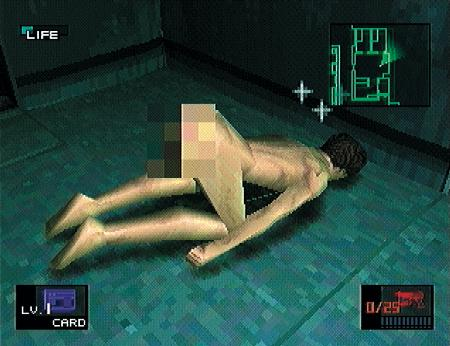
Amazingly enough, MGS4 isn't even the first time Meryl is abusive to Johnny. Here's an image from MGS1:


That's Johnny, immediately after being beaten unconscious by Meryl and having his uniform stolen. Now at the time, they were adversaries, so you could at least justify her treatment of him in this case. However, if MGS4 is to be believed, this is the moment that Johnny realised he was in love with Meryl.

So let's do what we always do in these situations and flip the sexes. This is how things are chronologically:
  • Man beats female guard into unconsciousness, steals her clothes and leaves her naked.
  • The female guard joins that man's squad later in life, where she's subjected to regular beatings for being inept and the man has an incredibly low opinion of women.
  • The female guard unmasks and the man stops beating her because she's pretty.
  • The female guard reveals she's loved how he's abused her all these years.
  • The two of them get married and live happily ever after.
This is a lot like the Uncharted example above but with all the dials turned up to eleven. Rather than just one punch, it's regular attacks. Rather than taking it out on the male character for being a jerk, the woman does it because the guy keeps making mistakes. And, of course, Elena wasn't a huge sexist, as Meryl was. Yet we're still supposed to see Meryl as a hero, as always in these cases.

There are many more games that feature a double standard when it comes to violence. Mirror's Edge and Faith's groin-kick. In addition to other sexist occurrences, Batman: Arkham City featured male enemies having their bones broken (by a woman, in some instances) while the female ones suffered knockout punches and kicks. How many games have you played that feature both men and women as members of the heroes' team/army but an all-male opposing force? Not main characters, just your standard NPCs and enemies. Final Fantasy VIII did this with Balamb Garden's heroic students of both sexes battling the all-male Galbadian army. In Half-Life 2, the villainous Civil Protection probably weren't all-male, if the disturbing experiments in the final chapter are anything to go by. However, they looked male and they sounded male. So to the casual observer, the final few chapters featured a mix of male and female freedom fighters battling an all-male totalitarian regime. Hell, if you don't count games with actual good armies and start including named characters, that list shoots up to include Uncharted 1 and 2, Metal Gear Solid 1-3 (where all the female villains turned good before their deaths or were just pretending to be evil all along) and even the Crash Bandicoot games technically qualify.

It's worth bearing in mind, too, that these are only the games I've played. I'm actually morbidly curious about games starring female characters such as Bayonetta, Lollipop Chainsaw and Wet. I've noticed a video on YouTube showing all the cutscenes from Lollipop Chainsaw so that's on my To Do list. If anybody has played those three and would like to educate me about them, I'd be happy to listen.

From the sounds of things, it doesn't seem as if violence against men is something that concerns developers in the slightest. Here's a Gamespot article about God Of War: Ascension. For anyone who didn't read the article, it's basically David Hewitt, the game design manager of Sony Santa Monica, briefly discussing about how the development team has "pulled back" from featuring violence against women in the God Of War series. So basically, Kratos, the murderous, amoral, psychotic, sadistic star of the God Of War series who has had no problems slaughtering people by the thousands throughout the series ... is now going to restrict his violence to people with penises?

This story, however, does have a happy ending. Looking at the comments below really reaffirms your faith in the gaming community. Take a look at a few of the comments and maybe we can end this blog on a happy note:

---
"As a Female Gamer i'm quiet disgusted with the amount of idiotic female "interest grops" out there putting their selfishness first before the freedom of expression in video-games."

"Oh right, because ripping a male apart is humane, but ripping a female apart is pure EVIL. I see the equality. So, ripping apart transgenders is what? Frowned upon?"

"am just waiting for Wonder Woman to come out and am complain about violence against men if lays even 1 finger on any man"

"Might it be more sexist to take such things out?  After all, in this modern age women deserve equal rights.  They deserve equal opportunity, equal pay, and, of course, an equal opportunity to get their heads pulled off by Kratos."

"What about violence against men?"

"Well thats just straight up BS. How many men have been brutally murdered by Kratos? Not to mention other games out there. A few female characters get killed and its some big freaking deal? Seems more like a pleasant change."

"Aren't men and women equal?"

"Message received.  It's morally ok to kill men.  Thanks game devs."
---

That'll do for now but I'd like to leave you with one final comment from a Gamespot member called MysteryJ0ker that perfectly sums up both Gamespot's recent slew of biased articles on sexism and my fears for the gaming industry as a whole.

"I like how the gaming industry is now fully turning into a political statement"

As always, if there are any topics you'd like me to write about or you have questions or feedback, leave a comment below or contact me at themalesofgames@gmail.com. All comments are welcome!