Showing posts with label heavy rain. Show all posts

Thursday, 30 May 2013

Damsel in Distress: Part 2 - Tropes vs Women in Video Games

Anita's back again, with the second part of her three-part series on the damsel in distress. Let's jump right back into it. Since this video deals with the deaths of characters, there will be spoilers throughout this blog post, mostly for older games but for some as recent as Bioshock Infinite. So read at your own peril.


I'm not a fan of Anita Sarkeesian. That should go without saying. Without going too deeply into why, let's just say that it's been a rocky road for Anita over the last year. She made a few too many questionable decisions for me to trust that her video series would be anything but one-sided. To my surprise, her latest video -- part two of three in her damsels in distress series, focusing mainly on damsels in distress who are killed, sometimes by the main character -- was one that I didn't find completely disagreeable. She hasn't won me over. I'm not convinced that Anita is a force for good in gaming and the negatives continue to outweigh the positives. What I am convinced of is that, when it comes to gender stereotypes, her heart is in the right place. Unfortunately, other points put forward by Anita are so biased and outright contradictory at times that having her heart in the right place doesn't help her case in the slightest.

Let's keep it positive though. I'll try not to quote Anita too much this time around and just give some basic summaries but at this point, I'd like to. Talking about male video game characters who lose their wives and daughters -- Max Payne and God Of War's Kratos are the two examples used -- Anita puts forward the idea that the reason these characters go on their roaring rampages of revenge is not because they're trying to avenge the loss of their wives and daughters, whom they loved very much.
"I’d argue that the true source of the pain stems from feelings of weakness and/or guilt over his failure to perform his “socially prescribed” patriarchal duty to protect his women and children.

In this way these failed-hero stories are really about the perceived loss of masculinity, and then the quest to regain that masculinity, primarily by exerting dominance and control, through the performance of violence on others.

Consequently violent revenge based narratives, repeated ad nauseum, can also be harmful to men because they help further limit the possible responses men are allowed to have when faced with death or tragedy. This is unfortunate because interactive media has the potential to be a brilliant medium for people of all genders to explore difficult or painful subjects."
That last paragraph is the important one. The one that I have plenty of praise for. Anita takes note of the fact that male gender roles are very limiting; aggression, dominance, protectiveness, chivalry, resourcefulness ... it's a risk for men to step out certain gender roles and can be frustrating for the ones who don't feel that they can.

One of the problems, however, is that Anita only seems to be stating this because she believes it supports her idea about women being objects rather than fully-rounded people that the protagonist cares about. They're property to get angry about being "taken" from them rather than people to miss. I don't think one guarantees the other. If I also might state the obvious for a moment, another problem is that these are video games. Revenge stories tend to work far better for gameplay purposes than stories about mourning and how to deal with loss. Max Payne and God Of War are based on film noir and violent Greek revenge-stroke-tragedy myths; not the kind of genres that have the heroes reaching for boxes of tissues. At the end of her video, Anita gives a few examples of games that she believes handle the subject of death in games more maturely (specifically Dear Esther, The Passage and To The Moon). Not that I hold anything against these games for doing that but they're not likely to become the standard. I adored To The Moon but haven't touched it ever since I completed it and I'm more likely to play Max Payne before I go near it again.

I'll come back to this later on but there's a much more significant reason why my goodwill towards Anita over acknowledging this hurtful gender stereotype didn't last. The big chunk of the video revolved around what Anita described as "the Euthanised Damsel". This is what happens in a game where a hero manages to catch up to a person he/she has been searching for -- usually a damsel in distress, as the name indicates -- only to find them begging the hero to kill him/her. Perhaps they've been turned into a monster or altered in some other way by the bad guys and they don't wish to live anymore. They'll beg for their rescuer to kill them and the rescuer will respect their wishes. That's the Euthanised Damsel in a nutshell.

The problem is that, while I don't want to say Anita was moving the goalposts at any time, it was a very large pool she was drawing from, based on a varied list of criteria. At one point, it was just women who were beyond saving. Then it was love interests who were too far gone and had to be killed. Then it was family members, mostly mothers. Then it was love interests who didn't have to be killed but did have to be fought to break them out of whatever spell or ailment it was that made them attack the heroes.

We have to wait for Anita's next video to hear her talk about male examples but I have a tendency to pick out a few male analogues to Anita's accusations while she's discussing them. Each time the Euthanised Damsel definition was expanded, there were a few examples that immediately sprang to mind, be they characters like Sinclair in Bioshock 2, Jecht from Final Fantasy X, Steve's father from Resident Evil: Code Veronica and plenty who only had to be attacked, rather than killed, such as Leon in Resident Evil 4 and Baralai in Final Fantasy X-2.


However, there were very few examples I could come up with featuring a male love interest being killed by a female hero. That's partly because, as Anita points out, there are so few female protagonists but even fewer with male love interests. This is slightly off-topic but I think the inclination to place female protagonists in the "strong, independent woman" archetype is a reason why male love interests aren't often featured; perhaps the belief that the heroine is motivated by a man betrays the "independent" part of that archetype. On-topic, however, I read a suggestion on a Youtube video that made me think that a woman euthanising a male "damsel" isn't the real analogue to men euthanising a female one. No, the real analogue is male heroes who die to save their damsels in distress; just like the female characters Anita brings up who request death rather than live as an abomination, male characters are often expected to have no thought for their own safety as long as the female characters are okay.

Capcom is very fond of doing this. In Onimusha 2, one of the story branches features Kotaro sacrificing himself to save Oyu, a woman who he has been largely antagonistic towards for most of the game. In Devil May Cry 4 -- which Anita brought up to point out the damsel in distress, in spite of the fact the game also features Nero being captured -- has Credo betraying his religious order in an attempt to save his sister, Kyrie, and it costs him his life. In Resident Evil: Code Veronica again, Steve is turned into an invincible monster at the end of the game but manages to fight off the transformation, his love for Claire Redfield is so strong. He dies shortly afterwards. This one is quite close to the love interest being killed by the heroine, in that Steve was a "damsel" moments earlier but he dies because his body can't take the transformation rather than because Claire pulled the trigger herself.

Then there's the huge sacrifice made by the hero of Shadow Of The Colossus (although he doesn't die). In Bioshock 2, the hero, Subject Delta, dies regardless of the ending the player receives, while the young woman he set out to save, Eleanor Lamb, lives on. Bioshock Infinite features a similar story, with many different incarnations of Elizabeth drowning her father, Booker DeWitt (who accepts his death willingly), so he doesn't go on to become the game's villain and kidnap her in the first place. That probably sounds confusing if you haven't played Bioshock Infinite and trust me, it's hard enough to understand even if you have.

One of the flaws in Anita's argument is also making the assumption that developers only use the Euthanised Damsel when they wish to shock people. I find that hard to believe. While there are doubtless examples that do exist just to be edgy, it seems like Anita isn't willing to consider the possibility that the writers wanted to create a tragic storyline. Or a storyline with a twist. I can't help but think Anita came to the conclusion that being edgy was the reason why the Euthanised Damsel existed before she looked at her many examples and then just found a way to make them fit her viewpoint.

Those are my thoughts on the "main" portion of Anita's video but in spite of my criticisms, I don't see much of a problem with Anita's dislike of the "Euthanised Damsel". Unlike her first video, Anita isn't as judgemental. There isn't any demonising of Shigeru Miyamoto, for one thing. The attitude is still there though; Anita explains why she dislikes the Euthanised Damsel -- and don't get me wrong, I completely understand why -- but I'm not really given a reason why I should care beyond conjecture and guesswork. The Jack Thompson parallels are still there, this time with regards to domestic violence. More on that later.

That's the important thing -- and, more to the point, the reason I can't get behind Anita as a force for good in gaming -- Anita states, "one of the really insidious things about systemic & institutional sexism is that most often regressive attitudes and harmful gender stereotypes are perpetuated and maintained unintentionally". Unfortunately, Anita herself had already reinforced and condoned harmful gender stereotypes herself at this point. Long story short, she talked at length about domestic violence but her definition followed the Duluth model.

If you know about domestic violence, that should say it all. For those of you who don't, however, the Duluth model is the assumption that domestic violence is "patriarchal"; domestic violence is an act done by men against women and children. If you've been following me for a long time, you'll know that hearing statistics about male victims of domestic violence on television was what interested me in men's rights in the first place. So domestic violence against men is a very prickly subject for me and I do not appreciate having male victims dismissed with gendered language in sentences like "people of all genders tend to buy into the myth that women are the ones to blame for the violence men perpetrate against them". Aside from ignoring male victims and female abusers, it also ignores violence in same-sex couples and doesn't acknowledge reciprocal violence. It is not a healthy, intelligent or accurate image of domestic violence to promote.

Aside from this major problem with Anita's argument, I find her videos peppered with smaller ones too. While Anita's latest video didn't have me shouting curses at my monitor, I did find myself sighing and shaking my head a lot. Her heart may be in the right place -- albeit deep, deep down -- but her solutions are impractical, biased and based on questionable logic and outright contradictory statements. For example, she criticises and dismisses Devil May Cry 4 (and others) for being a "crude, unsophisticated male power fantasy" but also does the same for Ico with "the most decidedly patronizing examples depictions of female vulnerability are used for an easy way for writers to trigger an emotional reaction in male players". That, in particular, made me cringe. Some time ago, Anita removed her video on Bayonetta from her channel because she thought she came across badly in it -- she shrugged off the story and dumbed it down to make it seem insignificant -- and as far as I'm concerned, she's doing the exact same thing with Ico here, with regards to the main gameplay element. You've probably already noted, as I did, Anita's inability to consider that perhaps female players could feel emotionally attached to the characters in Ico.

At one point, Anita repeats the same sentence over and over, wanting to get a point across about a trend: "In [game] your wife is brutally murdered and you then have to rescue your daughter." She seems to believe that the trend of daughters being captured is disempowering to women but apparently doesn't consider the possibility that the reason daughters are so frequently kidnapped instead of sons (and possibly husbands too) is because female characters are automatically more sympathetic than male ones, simply because they're female. Games like Heavy Rain, featuring a kidnapped son, are very rare. We feel more for Max Payne and Kratos because they lost daughters, not sons. In Bioshock 1 and 2, the reason for Little Sisters rather than Little Brothers was because it would be more difficult -- and morally questionable -- for the player to sacrifice little girls rather than little boys. In Bioshock 2 and Infinite, the protagonist's main mission is to find mistreated female characters, not male ones. It's the same principle behind "missing white woman syndrome", where the media is more willing to spotlight missing people if they're middle- or upper-class white women than if they're, say, a poor black male.

While it might seem like a good idea for Anita to decide against including violence against women who are treated as equals -- female soldiers and fighting game characters, for example -- there are a number of reasons why it carries some unfortunate implications for men. Back in February, I wrote about the sexism in Heavy Rain, comparing and contrasting two death scenes in particular; one of playable character Madison Paige, having a drill used on her genitals and one of Leland White, the villain of "The Taxidermist" DLC story, who has a chainsaw used on his. White's death is much more violent than Madison's, showing the genital mutilation in full, gory detail while Madison's is treated with more sensitivity; instead of showing the death, the camera cuts to the outside of the house and we hear a scream. The problem is that under Anita's definition, White's death is actually more acceptable than Madison's because he's not a damsel in distress at the time. The grisly nature of his death becomes irrelevant because he still has his agency. While Anita may believe helplessness is required for her definition of "violence against women", I'm afraid that I don't.

Time and again, we're asked to trust in Anita's word only because we're supposed to. We're told to believe the Euthanised Damsel is done for the sake of being edgy, just because that's what Anita thinks is the reason for it. We're told to see the damsels as objects instead of people, since that's the conclusion Anita has come to. While she points out that playing the games she features will not "magically transform players into raging sexists", she also says "media narratives do have a powerful cultivation effect helping to shape cultural attitudes and opinions". There's no explanation why she thinks video games/the trend of damsels and Euthanised Damsels contribute to these cultural attitudes though and that is when we get back into Jack Thompson territory.

This is becoming longer than I intended but I didn't want to leave anything out, so I'll wrap it up. Even without Anita's stance on domestic violence, I wouldn't be able to accept this video. There are just too many little details, too many conclusions drawn from questionable logic for me to support it. That's a shame and I genuinely mean that because, not enjoying depictions of violence against men, I can sympathise with the fact that she is so strongly against the idea of the Euthanised Damsel. However, when Anita says something like "violence against women is a serious global epidemic; therefore, attempts to address the issue in fictional contexts demands a considerable degree of respect, subtlety and nuance", she doesn't seem to realise that she's demanding special treatment. I agree that violence against women deserves to be treated respectfully but she's reading too much into a few too many situations; for example, I'm not sure how many people compare the hero having to kill his fused-with-a-monstrous-alien girlfriend when she asks him to do so in Prey with domestic violence.

Finally, it has to be said ... these are video games. As it happens, there are many important real-life issues that aren't treated with subtlety and nuance. War, for example, has been glamorised ever since Wolfenstein. To ask that all game developers consider how they treat the deaths of soldiers, however, isn't practical for video games. When all is said and done, I could be the most ardent anti-war protestor on the planet but not have any say in what developers should be doing with their own games. The final say is theirs, and rightfully so. The same goes for Anita and her feeling about violence against women in games. That's about all there is to say about it.

Addendum

If you only care about video games, you can stop reading now. This is where I put my investigative hat on and check out the resources Anita used for her video.

Anita posted the list of resources she used for this video on the Feminist Frequency site and they are very telling. Anita's sole resource for the idea that game developers must feature the deaths of women to be "edgy" is this blog post and video. If she actually believes the statement Daria makes in the video then she's actually being more judgmental than I gave her credit for earlier.

While I can't find anything that goes against the claim that "every 9 seconds a woman is assaulted or beaten in the United States and on average more than three women are murdered by their boyfriends husbands, or ex-partners every single day", the Every 9 Seconds website states "there are over 4700 U.S. women incarcerated for defending their lives". Let's just say that the founders of Every 9 Seconds may be playing fast and loose with their definition of the term "defending their lives"; I live in the UK but if any of you have been following the trial of Jodi Arias over there in the US, you may know that she claimed she was acting in self-defence and was a victim of domestic violence. Having followed a few cases of women on trial for murder or wounding charges over the years, Arias certainly isn't the first to make this claim.

One of the other resources Anita posts a link to is for the Wellspring Alliance, which looks fine. In fact, on their FAQ page, they mention that they take everyone, "regardless of race, color, national original, gender, sexual orientation, disability or age". Likewise, on the page linked to on Feminist Frequency's website, they state "Men are also victims of domestic violence, as are couples in same-sex relationships". Apparently, Anita decided to ignore that part when she talked about domestic violence herself.

The resource I'd like to focus on the most is "The normalization of violence in heterosexual romantic relationships: Women's narratives of love and violence" by Julia T. Wood. It's from looking at this study that Anita comes to the following conclusion, which she states in her video:
"Research consistently shows that people of all genders tend to buy into the myth that women are the ones to blame for the violence men perpetrate against them. In the same vein, abusive men consistently state that their female targets “deserved it”, “wanted it” or were “asking for it”."
Looking at the study itself, that is not what was said. First of all, this is a single study, with twenty heterosexual women who used to be in abusive relationships. "Consistently" and "people of all genders" are completely misleading. Nothing of the sort is written about this in Wood's research. Secondly, abusive men are not shown to have stated that their female targets "deserved it", "were asking for it" or anything similar. When these phrases come up in Wood's study, they're actually used as reasons why the female abuse victims stayed in abusive relationships:
"The women in this study described their partners' violence against them as understandable at the time it occurred. They justified it using a variety of reasons: 'I deserved it,' 'He didn't really mean it,' 'He was drinking,' 'It could have been worse,' and so forth."
It's very unpleasant, yes, but this isn't what Anita said. She made a claim about how "people of all genders" view abuse that research "consistently" shows but none of the sources provided on feministfrequency.com confirm Anita's claim. I don't know if Anita or her team at Feminist Frequency can provide sources that back up her claim but this, at least, is an outright fabrication.

Saturday, 9 February 2013

Anita's Back!

Hey again.

Before we go into Anita Sarkeesian -- don't worry, you haven't missed anything. Her Damsels In Distress video still hasn't been posted -- I'd like to thank a few people who've helped out the blog over the last week or so.

Permutation Of Ninjas - A great egalitarian blog that deals with a ton of injustices against men, including heavy-hitting topics like rape and domestic violence. I'm always impressed with anyone who can tackle real-life issues like that with the skill that the PoN writers do because I know that I never could. Sites such as theirs, that focus on (among other things) mainstream men's issues, are the reason that I feel like I can write about misandry in video games and not have it shrugged off with statements like "oh, men are oppressed in video games? Women are oppressed in real life!!!" So I have a great deal of respect for Permutation Of Ninjas and others like them for speaking so candidly and passionately about social injustices.

When describing this blog, they wrote "imagine Anita Sarkeesian if she a) could write, and b) had any clue what she was talking about." I grinned for the whole day when I read that. Plus, when they posted a link to this blog on their Tumblr, my number of viewers leapt by about twenty percent. That's huge.

I'd also like to give thanks to all the people who reblogged it but I have to single out a couple. Sorry if you're not mentioned, it's just that these ones made it onto my traffic sources page:

Special Snowflake Hall Of Fame - I can't say that everything on this Tumblr appeals to me but I am very interested in the "My critiques of Tropes vs Women in video games" page. I'll be keeping a close eye on that one and that's actually the subject of this blog post.

Bits of Tropes Supporting Women in Video Games - Or "Awesome Lady Tropes", if you want the short version. I love this Tumblr! You know how feminist critics of the gaming industry like to decry female characters for objectification, lack of agency and so on and so forth? It can often come across as if they're saying "female characters all suck, they're all damsels in distress, they're all sexualised", etc. Awesome Lady Tropes is the exact opposite of that. The creator of that site is saying "female characters are awesome, female characters are badass, let's celebrate female characters! Yay!"

It's such a simple idea too; a picture of a female character, followed by several Tropes that describe her (so if you're a Troper looking for positive female game characters, this is the ideal place for you). This Tumblr makes me want to play the game of every single female character listed. It's a testament to how many great female characters there are out there, instead of the typical "Alyx Vance, Chell and Faith" that you hear from most feminist critics. As far as I can tell, it's only been around a week and I love it already. I'm adding it to the sidebar.

I'm not under any illusions; I know that several of the female characters listed are probably damsels in distress at some point but, unlike the critics of female characters, I don't think that's a deal-breaker on what makes a good or bad female character. The same goes for sexualisation and, most ridiculous of all, being associated with male characters. I love this Tumblr and I can't recommend it highly enough.

Genderratic - Genderratic is a blog that I've visited from time to time, mainly because I'm a fan of Typhon Blue's Youtube videos. She offers a fun perspective on men's issues that a ton of other people don't, either by dressing as a hamster and smoking a pipe or playing her Tumblr feminist parody character, Raven Moon Dragon. It takes the edge off a touchy subject and makes her video more accessable. The Genderratic blog is a lot more serious and the lion's share of the writing seems to be done by Typhon's co-authors, Ginkgo and Xakudo. They do a good job and go so far as to call out misogyny where they see it, so it's worth checking out. They were kind enough to add me to their blogroll.

So, with the special thanks out of the way, it's time to move on to the subject of this blog: Anita Sarkeesian's making her return! Or that seems to be the case, at least.

After months of silence on the series' progress and a few updates for her backers' eyes only, Anita finally appears to be making some headway on her Tropes vs Women in Video Games project. Earlier this week, Anita set up a Tumblr account titled "Bits of Tropes vs Women in Video Games". She seems to be using it to store her findings of distressed damsels ... and it's everything we predicted it would be.

Let's start with the biased findings. Without Anita's video, we can't say whether or not she's considering male "damsels" but it certainly seems like she will, judging from the September update for her backers:

Image cropped. Shame more of Anita's backers-only updates weren't leaked.

However, nothing in the "Bits of Tropes vs Women in Video Games" Tumblr suggests that men are going to be focused upon. Maybe they'll be added later. Maybe they won't be added at all and Anita is limiting the Tumblr to just female examples. We don't know at this point and I don't really like to speculate; I'm very tempted to assume the worst and say that men will be added as afterthoughts in Anita's Damsels In Distress video but that could lead to me eating my words when the video is released. So let's just say that these are my first impressions and what I hope Anita will end up putting in the video.

Let's start with the obvious stuff; examples of damsels in video games where male characters are in distress too. Ashley Graham from Resident Evil 4, for example. I know people were irritated by having an escort mission at the centre of RE4 (although it never bothered me) and she's undoubtedly a damsel in distress. So I wonder if Luis Sera will make Anita's list too. For those who've never played Resident Evil 4, Luis was a character who was tied up in a closet the first time he appeared. He's quickly freed, then is tied up again within five minutes by one of the villains.

Of course, Ashley could get a pass because she's helpless for the majority of the game while Luis gets to defend himself with a gun from time to time. Ashley is often forced to hide (or can be commanded to) in order to stay safe. Okay, let's say that's fair enough. There are other odd choices on the list too though. I'd like to single out Princess Yuki from one of my favourite series', Onimusha. If you can find the trilogy on the PS2, I highly recommend you buy it.


Onimusha's story revolves around the hero, Samanosuke, rescuing Princess Yuki from a horde of demons. It's simple enough but, as you can see in the picture above, Princess Yuki isn't the only one being held captive. Her younger brother, Yumemaru, is also taken prisoner after an ill thought-out attempt to save his sister.

Now, in my opinion, child characters shouldn't really be held to the same standards as adult characters; there's a good reason why children can't defend themselves, after all, that can't be said for adults. They're children. If faced with evil characters, you expect them to be overpowered. Anita seems to disagree:

I've written about Dishonored before but it's interesting to see Princess Emily turn up on Anita's list. Not because Emily isn't a damsel in distress -- she is -- but it opens the list to child characters, such as Yumemaru in Onimusha. I wrote about Shaun Mars from Heavy Rain last time, so can we expect him to make the list? For that matter, the Tumblr features questionable examples such as "Many nameless women, Crime Fighters (1989)", so all the male child victims in Heavy Rain could make a male version of the list if those are the standards for inclusion.

To me, being a child in distress trumps being a damsel in distress. Children can't defend themselves because they're children; presumably, the reason Anita is compiling a database of damsels in distress is so she can say "look how prevalent these characters are. We need to have fewer of them and more women in stronger roles". If you include children in that, does that mean you want more children in stronger roles? The problem with that is the number of games set in realistic settings where it wouldn't be appropriate. Even in some games set in unrealistic settings, like Dishonored, it would be too unbelievable (although who knows? Maybe a sequel will feature child assassins). Video games can get away with imaginative scenarios much more easily than movies and television shows can and they have featured plenty of tough child characters -- young mages in Japanese RPGs, for example -- but let's be realistic; children are, and should be, damsels in distress more often than they should be heroes.

Plus, let's not forget that Dishonored featured several cases of male "damsels" in distress; Teague Martin in the first mission and the crime boss, Slackjaw, later in the game. It also occurred to me last night that the player character, Corvo, is a damsel in distress himself at the very start of the game, being imprisoned and subjected to torture with a hot iron. He only escapes with the help of the Loyalists.

Maybe we need some clarification on what does and doesn't constitute a damsel in distress; "damsel" implies helplessness and "distress" implies danger. Again, Ashley Graham would qualify but Luis would only fit the "damsel" part very briefly. Both Princess Yuki and Yumemaru would qualify. Samanosuke wouldn't when he's held captive ... but earlier in the game, there's a moment that every Onimusha player remembers and refers to as the water puzzle, where Samanosuke is stuck in a room with rising water and the player, as Kaede, has to solve a fiendishly difficult sliding-block puzzle within a time limit to free him. He'd qualify then.

Dishonored is where things get tricky; Emily could be described as being in danger at the very end of one ending. Teague Martin is in a similar situation; he's locked up and threatened but in no immediate danger. Slackjaw, on the other hand, is about to be killed and eaten. I've already mentioned Corvo being tortured too. It's even possible to attempt to torture one of the villains by filling his cell with plague-infested rats.

... Wait, why is it always male characters who are tortured? That's worth looking into ...

It might seem like I'm cherry-picking examples from the Tumblr but that's not the case at all; I just don't have the luxury of being able to play all of the games listed, thanks to a lack of both time and money. Even some of the games I own on the list are ones I haven't played in a while, such as Tenchu, so I can't comment on them. I noticed a few trends though.

I know Anita's a fan of TV Tropes, as am I, so it's worth mentioning a phrase that is often mentioned over there; "Tropes Are Not Bad". It's basically their way of saying that just because something is noteworthy enough to be listed as a trope, it doesn't mean that aspiring writers shouldn't use that trope in their stories for fear of them being clichéd or stereotypical. In the case of the damsel in distress, that's a trope that was used long before video games had writers, or at least writing as a main focus, and it was used as an excuse to put the main character on an adventure. For example, as thrilled as I was to see Chuck Rock make an appearance on the Tumblr, his wife Ophelia being kidnapped was simply an excuse to have Chuck fight dinosaurs for the next thirty minutes, or however long the game took to complete. The same goes for Double Dragon and numerous others.

Should these games be held to a different standard, just because they're old? Well, I'm not saying that but it's important to recognise that storytelling wasn't as important then as it is today and gameplay was everything. Going back to Tropes Are Not Bad, the damsel in distress trope in games from twenty years ago gave the player an objective, a reason why their character was fighting enemies rather than just for the sake of it.

It'd do the games listed a disservice if it wasn't mentioned that so many of them have gone to great lengths to eliminate damsels in distress from their games. Take Crash Bandicoot as an example. Tawna, Crash's girlfriend from the first game, is featured on Anita's Tumblr and it's also a classic case of primitive storytelling. The second game featured vastly superior writing, got rid of Tawna and added Crash's brainy little sister Coco to the roster too. In the third game, Coco became a playable character. Even Resident Evil has come along in leaps and bounds since Resident Evil 4, adding female co-op companions in 5 and 6 in place of Ashley Graham.

Speaking of which, I have a question: does having a damsel in distress in a game somehow negate the strong female characters? If Ashley Graham is a strike against the Resident Evil series, shouldn't Jill Valentine, Claire Redfield, Ada Wong and Rebecca Chambers all work in its favour? Isn't there some leeway given to games that have a good record for female characters? Because the problem with the way Anita is framing this trope -- and all the tropes she intends to talk about -- is "damsels in distress = bad". That's a problem. It's an attitude that limits creativity and reduces the number of elements writers are allowed to use.

I want to stress again that these are just my first impressions. So we'll wait and see what Anita actually delivers in her first video and I'll have more to say on the subject then. The Tumblr is a good sign that the video is on its way so we might not have long to wait

As always, feel free to leave a comment below or send me an e-mail at themalesofgames@gmail.com.

Addendum

Oh, great. I was just about to finish the blog when I noticed that the pictures on the "Bits of Tropes vs Women in Video Games" Tumblr have tags! And some of them are very interesting. I'll try to make this quick.

Let's start with Dishonored, since I've been writing about that for most of this blog. One of the tags is "womaninthefridge", which refers to the Empress, who is killed at the beginning of the game.


For those of you who don't know, being "stuffed in the fridge" is a comic book term for when a woman is killed off to create drama for a male character. That doesn't actually apply to Dishonored, so the tag is incorrect; Corvo is a mute character, so he doesn't mourn, rage and even relies on others to plot his revenge for him. If anything, the Empress' death creates drama for her daughter, Emily, and maybe the city of Dunwall itself; the Empress is revered and Dunwall's citizens wonder how on earth they'll get by without her. The only drama that comes Corvo's way is being falsely imprisoned and tortured. He's suffering just as much as the Empress, in other words.

Also, Dishonored is a game all about assassination and the Empress receives a lot more attention after her death than any of the assassination targets in the game. Most of the time, Corvo returns from a successful mission only to be told, "great! Here's your next target." I'm paraphrasing but that's more or less the case. Incidentally, all but one of the assassination targets are male.

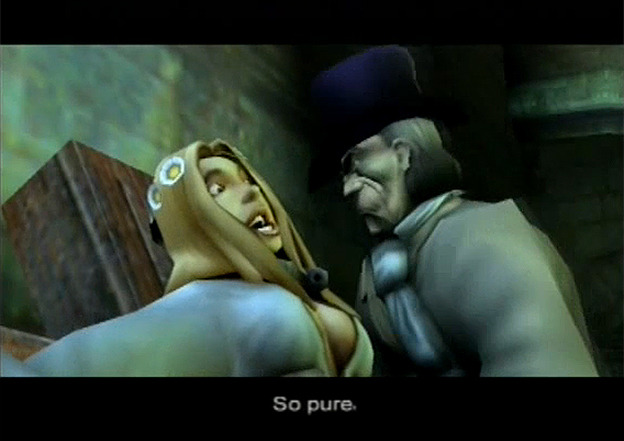
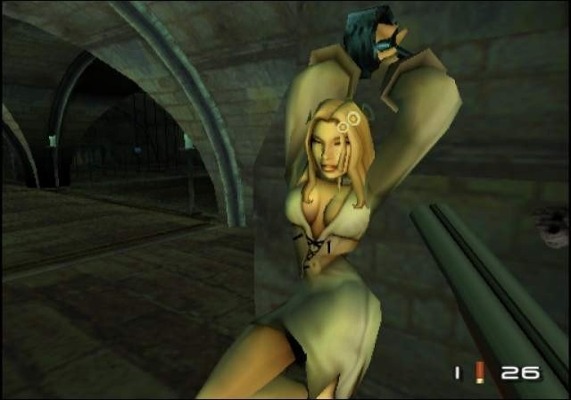
Let's move on to other games. The Timesplitters 2 pictures feature "sexualassault" as a tag, in spite of the fact that the Maiden characters -- the damsels in those pictures -- are a reference to the classic horror movie practice of occult artists sacrificing virgins for rituals. I've criticised people for complaining about sexual assault in games where there isn't any before -- Tomb Raider and Heavy Rain -- but this may be the most ridiculous example. Having the Maidens subjected to sexual assault would defeat the entire reason those characters exist! Their virginity. That's why Jacque de la Morte is saying "so pure" in that first picture.

Timesplitters 2 also offers a great example of how the damsel in distress trope can be used wonderfully. Freeing five Maidens from their shackles is an objective of the Notre Dame level ... but one of the Maidens is actually a monster called the Changeling that first-time players will probably unshackle by accident and be attacked by because they're so keen to complete the objectives. It was a clever addition and one that wouldn't exist without damsels in distress in Timesplitters 2. However, that doesn't seem to matter to Anita or one of her team operating the Tumblr; they're damsels in distress, ergo, they're bad.

Then there's Medievil 2 and the "damselinthefridge" tag.


To people who haven't played Medievil 2, this picture and tag is actually very misleading. While Kiya, the blue mummy pictured above and Sir Daniel Fortesque's love interest in Medievil 2, does die in the game, she's revived again within a few levels (well, she technically never died; using time travel, Sir Dan kills the monster who murdered her before she's murdered). Looking at the picture and tag, you would get the impression that she dies and that's all we see of her for the rest of the game. That's not the case. She dies in order to add a few extra levels to the game while Sir Dan works to save her.

There are probably lots more examples of misleading tags and I hope other people point out a few. We're discovering an inkling of the Tropes Vs Women in Video Games team seeing what they want to see though, rather than reporting examples accurately. They even take Duke Nukem 3D seriously ...

Friday, 1 February 2013

The Sexism Of Heavy Rain

The following blog post contains major spoilers about Heavy Rain.

Lately, I think I've been focusing more on sexism against men in the gaming community rather than any sexism in games themselves. With the exception of Far Cry 3, I haven't really delved into the content of any games for the last couple of months (and even my post on Far Cry 3 became more focused on the writer, Jeffrey Yohalmer, than the game itself). A while ago, I wrote "I'm tempted to write about the poor portrayals of men in Heavy Rain but the more I think about it, the more I think it'd just be a list of character names with a description next to them". I think now is the perfect time to write about Heavy Rain and I'll try to make it more than just a list of character names.

For anyone who has never played Heavy Rain, it's a very cinematic game by Quantic Dream about a father, Ethan Mars, whose young son has been kidnapped by a serial killer, known as the Origami Killer, and the harrowing ordeal he has to go through to rescue him. The game's strength is its story and it features an incredible number of characters, each based on the likeness of a real actor or actress (much like L.A. Noire). The big problem is that, out of this incredible number of characters, there are only six adult male characters who aren't complete scumbags. There are plenty of innocent male children but children can't really be held to the same standards as adults.

I should point out that while I enjoy putting pictures in my blog, there are far too many characters in Heavy Rain for me to post pictures of them all. Luckily, Giant Bomb has me covered, as does the Heavy Rain Wiki.. Unfortunately, neither one is a complete list but together, they cover most of the characters. There's definitely one that I'd like to mention who isn't featured on either list.

L-R - Norman Jayden, Scott Shelby, Ethan Mars, Madison Paige. Image: SiMPLExDESiGN
I think the easiest way of doing this will be to go through each character's story and mention the significant characters from each one. I'll stick to male characters for now but I'll write about the female characters towards the end. First though, the playable characters:

Ethan Mars: Ethan is the main character of the game and the father of Shaun Mars, the latest young boy that the Origami Killer has kidnapped. Ethan is one of the six good male characters in the game. He's portrayed very compassionately and the trials that the Origami Killer forces Ethan to go through to collect clues to Shaun's location are designed to make the player feel sympathetic for Ethan (as well as incredibly uncomfortable). Even though the player can make Ethan walk away from each trial, he's always portrayed as a good father and often talks about how much he loves his son.

Norman Jayden: Jayden is an FBI criminal profiler, brought in by the police to try and figure out the Origami Killer's identity. He's also the second good male character of the game (and my favourite character, incidentally). He has a very cool pair of glasses called ARI (Added Reality Interface), which acts as a "portable CSI" and allows Jayden to easily search for clues at crime scenes. Unfortunately, his addiction to the glasses leads him to indulge in the use of a drug called Triptocaine. In spite of this, he's shown to care deeply about the Origami Killer's victims and doesn't endorse the use of force against suspects.

Scott Shelby: Here's the big twist of the game: Scott Shelby is the Origami Killer. He's a former police officer who poses as a private investigator, investigating the Origami Killer case. While Jayden's storyline deals with suspects, Shelby's revolves around visiting the relatives of the victims. We later find out that this is to clean up any evidence left behind by the previous fathers of the children he killed, such as phones, messages or origami figurines. Needless to say, as a ruthless killer of children, Shelby is not one of the good male characters.

Madison Paige: A journalist looking into the Origami Killer case. We don't know this at first and it's revealed after she and Ethan get a little closer. It's a big shock to Ethan when he finds out but Madison is still portrayed sympathetically. Madison has to play nurse and help treat Ethan's various injuries over the course of the game and plans to ditch the story she was writing, since Ethan clearly isn't the Origami Killer. She develops feelings for Ethan and the two can either enter a relationship or Ethan can refuse to forgive her for her subterfuge. She's also responsible for at least one attack on a man's groin in the game and one of the endings of the DLC, "The Taxidermist", features Madison killing a man by using a chainsaw on his groin.

Characters in Ethan's story:

Ethan meets the fewest characters in his story, since he's not involved in an investigation like the other three, so this list will be quite short.

Clarence Dupré: Ethan's psychiatrist and the third of the good male characters in the game. It's a small role -- I didn't even know he was a named character until I looked at the wiki -- but Clarence tells Ethan he shouldn't blame himself for the death of his first son, Jason, and encourages him to move on for the sake of Shaun. He clearly cares about Ethan and, if that isn't enough to endear him to the player, being a victim of one of Carter Blake's (see below) beatings is sure to be.

Brad Silver: For Ethan's fourth trial, the Origami Killer wants him to kill a stranger to earn another clue to Shaun's location. Brad Silver is that stranger. Silver is a drug dealer who chases Ethan around his apartment with a shotgun in one of the game's quick-time events. Once he runs out of ammo, he pulls out a photograph of his two daughters and the player is given a choice whether or not to spare his life. When I read about other people who played this segment, I was actually surprised to learn that they suddenly felt sympathetic towards Silver once he showed Ethan the picture of his daughters. To me, any sympathy was lost after I learned he was a drug dealer and after he attempted to kill Ethan. That was the easiest trial for me to decide on; while the other four all threatened Ethan's life (or a part of his body, in the case of the third trial), this one only threatened the life of a drug dealer and attempted murderer. If Quantic Dream had wanted me to struggle with my conscience, I think they should've made the man Ethan had to kill be innocent rather than a criminal (although, with former police officer Scott Shelby as the Origami Killer, it does make sense that the man he wanted Ethan to kill was a criminal).

That's pretty much it for Ethan's story. There's an overlap with other characters but, since we learn more about the police officers in Jayden's story, I think it's more suitable to write about them there. There are two other characters Ethan meets who I don't think are really worth listing; a clown who Ethan buys something from at the start of the game and a mechanic who Ethan talks to during the first trial. Neither one is a major character and we don't learn anything about their personalities.

Characters in Jayden's story:

Carter Blake: Jayden's partner in the Origami Killer investigation. He's an amalgamation of every "bad cop" figure you've ever seen in movies. He's more than willing to use police brutality, being physically abusive to suspects to get answers without being sure that they even know anything. This includes Ethan himself, Clarence Dupré and Nathaniel Williams (see below). He's also verbally abusive, even towards Jayden, and mocks his more co-operative approach. Blake is so unpleasant that even the Origami Killer comes off more sympathetically than him ... and that's a character that murders children, bear in mind.

Leighton Perry: The police captain of the station that Jayden is assigned to. He seems to be more interested in socialising with the reporters that the Origami Killer case is attracting than catching the killer himself. In fact, Perry takes Blake at his word that Ethan Mars is the Origami Killer and doesn't seem to particularly care whether he is or not; calling a press conference to announce the killer's capture is the number one thing on Perry's mind. Perry doesn't seem to realise that he might be condemning an innocent man and leaving a child murderer to continue his killing spree. Or if he does, he's completely indifferent about it.

Nathaniel Williams: The fourth good male character, although this one is pushing it a bit. Nathaniel doesn't display anything that would really classify him as "nice" but he also doesn't do anything nasty either. Jayden and Blake suspect him of being the Origami Killer and he ends up on the receiving end of Blake's abusive methods. He's highly religious and seems to be mentally ill, believing Blake to be the Anti-Christ. Blake's treatment of him makes the audience sympathise with him, so I class him as a good male character.

Miroslav Korda: A very minor character but also an Origami Killer suspect. Jayden and Blake chase him through a market and have a fight with him. He later reveals that he fled because he was violating his probation. Interestingly, in the audition tape for Leon Ockenden (who plays Norman Jayden in the game), Korda is described as a child-killer. Presumably, this was removed because Quantic Dream didn't want a third child killer in the game, the other two being the Origami Killer and Gordi Kramer (see below). Still, as a criminal who violates his probation and attacks Jayden, he's hardly a good male character even without the child-killer background.

Jackson Neville, aka "Mad Jack": Runs a junkyard where the Origami Killer's car was serviced. Jayden discovers that he murdered a police officer in an acid bath and was more than happy to try and murder Jayden too.

Characters in Shelby's story:

Even though I said I'd go into female characters at the end, Scott Shelby's story features one female character quite significantly and, since there are no less than three bad male examples in her introduction, I think I need to mention her straight away.

Lauren Winter: Lauren seems to exist to be the character who plays the "all men are scum" card, or at least be the living embodiment of why all men are scum. She's a prostitute and the mother of one of the Origami Killer's victims. In her introduction, she makes sure to mention that cops have demanded "freebies" from her in the past. She describes her husband, Alan Winter, as "a loser without a job that liked to beat me after a few drinks". Alan himself makes no appearances throughout the game. He left around the same time his son went missing, so it seems likely he died facing the same trials as Ethan. However, that's not necessarily the case and given that Lauren's description of him is all we have to go on, it wouldn't be fair to class a wife-beater as a good character just because he may have set out to try to rescue his son. Anyway, Shelby leaves Lauren's apartment and, out in the hallway, sees an abusive client of Lauren's, Troy, force his way into her apartment. You can choose to stop him and, if you don't, Lauren will have a black eye when she shows up later in the game. So crooked cops who demand sex and two woman-beaters, all in Lauren's first scene. Oddly, this is the only one of Lauren's scenes in the game with any real misandry. In all of her others, she seems happy to play sidekick to Scott Shelby.

Hassan: Hassan is the fifth good male character. He's the father of one of the Origami Killer's victims and runs a convenience store. He isn't interested in answering Shelby's questions at first but is willing to help out if he survives until the end of the scene. When Shelby talks to him, he's still mourning the loss of his son, Reza. He apparently decided against going through the trials that Ethan did, or at least all of them, but is still portrayed as a loving father.

Andrew: A man who intends to commit armed robbery of Hassan's store. Depending on the outcome, he can either kill Hassan, shoot Shelby or put the gun away and leave the store. He has a young daughter. Although even if he can be convinced to put the gun away and leave, he can hardly be called a good male character. He's more than willing to pistol-whip Hassan when he refuses to open the till, for one thing.

Gordi Kramer: A rich playboy and Origami Killer suspect that Shelby interviews. Gordi raises Shelby's suspicions because a young boy named Joseph Brown was last seen entering his limousine. It's revealed that Gordi, obsessed with serial killers and looking for a thrill, drowned Joseph Brown in rainwater because he wanted to mimic the Origami Killer's modus operandi. Although supposedly, the death was an accident -- Gordi held Joseph's head underwater for too long -- Gordi is creepy and emotionless for his entire appearance and has no problems threatening Shelby's life.

Charles Kramer: Gordi Kramer's millionaire father. Charles is uncomfortable that Shelby's investigation led him to his son and offers to pay him off if he'll quit. Shelby refuses. Charles responds by having his henchmen knock out Shelby and Lauren when they return to Shelby's apartment. When Shelby wakes up, he finds himself and Lauren restrained in his car, which is at the bottom of a lake. It's possible for Lauren to die in this chapter. So Charles Kramer is either a murderer or an attempted murderer, depending on what the player does. Interestingly, Charles Kramer isn't entirely evil; he owns a building site where a young boy -- later revealed to be Scott Shelby's brother -- died and he lays flowers on the grave every year. He still feels guilty over that. So maybe Charles only becomes psychotic if you threaten his son's privacy.

Manfred: The sixth and final good male character. Manfred is a pleasant old man who runs a repair shop for items such as typewriters, clocks and music boxes. Shelby and Lauren visit him for information on a typewriter that was used for an address on an envelope. Since Shelby was the last client who asked for repairs on the typewriter in question, Shelby bludgeons Manfred to death to stop him from revealing anything incriminating.

Scott Shelby's Father: There are two flashback sequences in the game, where you play as Scott Shelby as a little boy and you see first-hand how his brother died and what led him to become the Origami Killer. His brother, John, drowned in rainwater and the one person Scott went to for help -- his father -- was an abusive alcoholic who refused. So John ended up dying and Scott ended up as a child murderer who came up with sadistic trials in order to find a good father.

I was going to wait until after Madison's characters to write this but this seems like the best time to write about fatherhood. So far, I've written about twelve bad male characters (don't forget the two examples in Lauren's description) and six good ones. Of the twelve bad ones, five of them are fathers. Of the six good characters, only two are fathers. Arguments could be made for Andrew the robber not being an evil father -- it's for his daughter that he decides to leave Hassan's store without harming anyone, if you're able to convince him -- and even Charles Kramer, for all his attempted murder and subverting the course of justice, is only doing so to protect his child-murdering son. Still, I don't think a case can really be made for him.

This is where Heavy Rain's theme of fatherhood falls apart, in my opinion. As far as I can tell, it aims to promote the value of fatherhood, through Ethan and the lengths he'll go to in order to rescue Shaun, but condemns fatherhood by portraying fathers as abusive, alcoholics or attempted murderers. We're meant to see the Origami Killer's trials as being twisted and sadistic but with the string of bad fathers in the game, how can he be considered anything but justified? It feels like Hassan is meant to be there to stop the player from feeling that way; to fill the role of a good, sympathetic father, in spite of the fact that he chose not to do the Origami Killer's trials. Without him in the game, the player could very well agree with the Origami Killer's motive, and Scott Shelby certainly is meant to be a sympathetic character, complicating the issue further. Ethan would be the exception to the "fathers are scumbags" rule, rather than a prime example of fathers being worthwhile, valuable human beings. Given that the number of bad fathers outweighs the number of good ones, any player could be forgiven for thinking that "fathers are scumbags" is the message Quantic Dream wanted to send out.

Characters in Madison's story:

The Motel Receptionist: The very first character Madison meets in Heavy Rain is a huge pervert, who calls Madison "sweetheart" and stares at her rear when she walks away. He really has to be seen to be believed. He makes a note that she's checking in alone ("single", he says suggestively) and talks in an incredibly annoying, nasal voice. In Heavy Rain, you can hear what your character is thinking by holding down L2 and pressing one of the face buttons. Immediately after meeting the receptionist, Madison thinks, "That obnoxious receptionist better not have a spare key to my room. The thought of it leaves me in a cold sweat".

Adrian Baker: A former surgeon who became a drug dealer after he retired. Madison visits him to get some answers about an apartment that he's renting to Paco Mendez (see below), the he rented to the Origami Killer. If Madison drinks something Baker offers her, or is caught snooping around his house, Madison is knocked out and wakes up on an operating table in the basement. Baker intends to torture and kill her and it's up to Madison to escape.

It's interesting to note that one of the ways Madison can die in Baker's basement is via Baker using a drill on her vagina. Remember when I mentioned that the "Taxidermist" DLC gives Madison the option of killing a man by using a chainsaw on his groin? Seems like Quantic Dream are happy to treat male and female genital mutilation as equal, right? Well, before we start praising the equality, compare the first minute of this video to the last three minutes of this one. Baker's drilling of Madison's genitals features a cutaway to the outside of his house and a scream. Madison's chainsawing of Leland White's genitals is seen in all its gory detail. There are huge fountains of blood and White's corpse twitches on the ground.

What's the message being sent out here? Genital mutilation is fine to display as long as you're doing it to a bad guy? I doubt it. Obviously, the message seems to be even when men and women are subjected to the same horrific form of violence, it's acceptable to see men suffering in extreme pain but not women. It's one of the most blatant double standards I think I've ever seen in a video game. It even seems like Quantic Dream want us to root for Madison while she's doing this: "she killed a serial killer, yeah! Go Madison!" There's nothing more I can really write about it. The evidence speaks for itself.

Paco Mendez: A nightclub owner and acquaintance of the Origami Killer. Forces Madison to strip for him at gunpoint. Madison hits him in the head with an object, ties him to a chair and squeezes his testicles painfully to force him to answer her questions. Ends up being killed by the Origami Killer.

Leland White: The antagonist of the "Taxidermist" DLC. He kills women and then stuffs them. Madison investigates his house and finds his victims posed like mannequins in odd positions upstairs. Oh, and one of the endings features Madison using a chainsaw on his genitals. Don't know if I mentioned that or not ...

The female characters

I saved the female characters until the end because it'd provide a good contrast; compared to all the male characters, the female characters are completely saintly and innocent people who would never hurt a fly.

Madison Paige: I know I've gone over Madison already but, in spite of the genital mutilation, she's a deeply caring and compassionate woman who nurses Ethan back to health twice in the game and ditches her story about the Origami Killer, valuing his and Shaun's lives over her journalism career. She puts herself in harm's way for their sake multiple times, proving herself to be both a brave and moral character.

Lauren Winter: I've gone over Lauren enough already. She works to catch the person who killed her son, so that immediately puts her on the side of good.

Grace Mars: Ethan's ex-wife and the mother of Shaun Mars. A lot of Heavy Rain players find Grace unsympathetic, based on a line she had shortly after Shaun was kidnapped; she says to Ethan, "wasn't it enough losing Jason?" in an aggressive tone of voice. Despite this, I get the feeling that Quantic Dream didn't want Grace to be unsympathetic. She's just a parent at the end of her tether, much like Ethan, and needed something to blame. She apologised to Ethan immediately afterwards and says that she didn't mean to say that.

Susan Bowles: The mother of an Origami Killer victim, investigated by Scott Shelby. I think I'm going to put Susan in the "bad female characters" category (even though she's the only person in there). Susan had another child besides the one that was murdered. A baby girl. In spite of this, when Scott Shelby enters Susan's house, he finds her in the bathroom, having slit her wrists. So it's fair to see why she's a bad female character. Having said that, she does have some redeeming qualities. When Shelby helps her recover, her thoughts immediately go to her baby. It seems like, with her son dead and her husband, apparently, another victim of the Origami Killer's trials, she tried to commit suicide out of desperation. I think this makes her seem a lot like Andrew the robber; both pushed to extreme circumstances because they didn't know what else to do. Even though she's not entirely without merit, her willingness to kill herself and leave her daughter an orphan (and probably end up dying herself had Shelby not intervened) has to qualify her as a bad female character.

Ann Sheppard: Scott Shelby's mother. Suffers from Alzheimer's disease but talks often about her love for her sons (especially John, the one who drowned). A very pleasant old lady.

That's pretty much it for the characters, excluding minor ones with only a few lines. Before writing this blog, I typed "Heavy Rain Sexism" into a search engine and, as well as a ton of apparent sexism against Madison (which I'll come to soon) there was this article on The Border House blog about fatherhood in games. One of the games it goes into is Heavy Rain and I think some of their criticisms are worth addressing:
"These three games all share a father whose main motivation through the story is to save their child. They are acting as caregivers and protectors who truly love their children. I mentioned previously, fathers are largely ignored in the role of caring parents so this trend to show loving fathers must be a good thing, right? As I played these games some problems with these game images became apparent.
In each of these experiences the mothers are largely ignored. [...] But the most glaring example of pushing out the mother’s storyline is in Heavy Rain. At the start of the story we meet Ethan’s wife and she clearly loves her family. We briefly see her anger and confusion at the kidnapping of her second son during a scene at the police station but after this scene she disappears from the game. The end of the story shows what happens with Ethan and his son but what of Shaun’s mother? How does she deal with the end results of the experience? She is not the only mother who gets pushed aside by this game. We know that the Origami Killer left behind women who had lost both their husbands and children through the killer’s actions but we never delve into their stories or their loss. We do get to see one mother’s pain in the character of Lauren Winter. But she becomes little more than an annoyance to Scott Shelby’s character. Lauren is portrayed as a grieving mother that will not leave the private detective alone. This shows another problem with these games: the mothers are simply grieving and hurt while the fathers are the heroes out to save the day.  Women are shown as weak and too hurt to rescue their children whereas men are strong figures that go out in the the unknown to rescue a child. This is not subversive, it is just feeding into stereotypes."
These paragraphs, particularly the last few sentences, seem to ignore much of Heavy Rain's content in my opinion; while Scott Shelby does consider Lauren Winter a hindrance at first, it's because he doesn't want a civilian accompanying him into dangerous areas and Lauren does almost get killed by Charles Winter. After learning that Scott Shelby is the Origami Killer, the player could also consider the possibility that he didn't want a partner who actually wanted to find the killer, since he was only collecting evidence to destroy it. Plus, as a woman who is desperate to stop the killer to the point of putting herself in harm's way, how is that not being a "hero out to save the day"? The whole reason she seeks Scott out in the first place is out of determination to find her son's killer. So how is Lauren an example of "women are shown as weak and too hurt to rescue their children"? The sentence "she becomes little more than an annoyance to Scott Shelby's character" is blatantly incorrect, however; Scott and Lauren actually develop feelings for each other, making for an intentionally uncomfortable moment when we realise that Lauren is kissing the man who murdered her son.

It also seems odd that the writer believes the women not going to rescue their children is a weakness and that reads like someone who has either never played the game or missed the main theme; fatherhood. The whole reason why it was fathers who the Origami Killer wanted to "save the day" was because they were the ones he specifically targeted, on account of his own father being abusive. Criticising Heavy Rain for focusing on fathers is like criticising a Martin Luther King biopic for focusing on the civil rights movement; it wouldn't make sense without it. Instead, this just comes off as someone who is annoyed at a game focusing on the male parent while they'd prefer it to focus on the female one. The mothers aren't too weak or too hurt. They're simply not the Origami Killer's targets.

To criticise the game for pushing aside mothers also ignores the number of times the game pushes aside fathers; we never see Alan Winter, for example. We never even learn Susan Bowles' husband's name (and Susan herself wasn't mentioned in the article). Of course, we've already been over the prevalence of bad fathers in Heavy Rain, as well as bad men, while mothers are usually angelic individuals. Grace Mars, Lauren Winter and Ann Sheppard all cared deeply about their children and Susan Bowles' first thoughts after Shelby resuscitated her were about her baby. Even with fewer female characters, the number of good female parents outnumbers the good male ones.

I also have to take the article to task for describing Heavy Rain's fathers as "heroes". Ethan's actions could definitely be described as heroic ... but it's not like he's taking down bad guys and stopping evil to save his son. All of his trials threaten his life and deeply affect him. We see Ethan in tears several times. He suffers from blackouts and agoraphobia. Madison has to patch up his wounds twice. So to describe him as "a strong figure that goes out into the unknown to rescue a child" is misinforming the readers; he's a regular man who is rendered weaker by the sadistic trials he's forced into. It's also worth mentioning that Ethan is not the first father who was forced into the trials but he is the first who passes them ... and depending on the player's choices, he might not even do that. Before Shaun, the Origami Killer murdered eight children. Removing Hassan, that's anywhere between one and seven fathers who were murdered by the trials. We know there was at least one because taking a wrong turning in Ethan's second trial -- crawling across broken glass in a labyrinth of narrow pipes -- will find you the body of an adult male in a suit. The Heavy Rain fandom has decided that this is Susan Bowles' husband but it could've been any of them. Yet the adult male victims (or disappearances, as far as the police know) of the Origami Killer aren't focused on. Couldn't that be described as fathers being pushed aside?

I know it sounds like I'm defending Heavy Rain now and I am. Believe it or not, I love Heavy Rain. Several moments of the game will stick with me forever, such as Madison being attacked in her apartment, every time Jayden used the ARI glasses and especially Ethan's third trial. I remember that one like it was yesterday. However, there are plenty of bad fathers in the game and I'd like to defend Heavy Rain when it comes under fire for featuring the good ones.

Speaking of Madison being attacked in her apartment, that's one of parts of the game that is criticised by people who want to claim that Heavy Rain is sexist against women. As does Madison playing nurse to Ethan after he's injured and being forced to strip for Paco. I had a few articles that I wrote out responses to about those but I decided it was far too long-winded in the end. As well as another Border House article, there were others that made claims about Madison's sections having "a tinge of sexual assault". It's impossible for Madison to be sexually assaulted in Heavy Rain (unless the genital mutilation counts and we've been over that already). It seemed like the Tomb Raider controversy before there even was one; the female character can't be sexually assaulted but people see what they want to see. One article even mentioned rape.

Several made mention of Madison's introduction -- where she fights off attackers in her apartment -- being "pointless" and "not adding anything to her character or the story". Firstly, this ignores the fact that Madison being unable to sleep in her apartment led her to the motel where she would meet Ethan. Secondly, aren't most elements of games "pointless"? Would these critics refuse to play a Final Fantasy game because "random battles add nothing to the story"? I mentioned Madison's introduction being one of my favourite parts of the game earlier, and for good reason; it's tense, exciting, atmospheric and her apartment is one of the most beautiful settings in the game. It's a shame it only appears once.

It's also worth noting that Quantic Dream don't want the player to objectify Madison. Both her and Ethan have shower scenes, only Madison's is optional while Ethan's isn't. The same parts of the body are shown; everything except the crotch area. It lasts around the same amount of time. Later in the game, when Paco forces Madison to strip at gunpoint, the player is rewarded with a trophy if they can knock him out without removing an article of clothing.

All this is better than writing lengthy replies to lengthy quotes from lengthy articles. However, those articles all did a very good job of displaying the double standard that exists when discussing sexism in games; always framing things in terms of how they affect women, without comparing them to the treatment of men. Women are prioritised, even if men suffer worse or more frequent treatment. In other words, Madison and the mothers are the important ones. Men and fathers? Who cares.

Feel free to leave a comment or e-mail me at themalesofgames@gmail.com