A sudden upswing in work to do over the holidays means this will
probably be the last blog post until January. I do my best to update
this blog three times a month but that's going to be tricky this month. I also have a completely different blog post half-written but just finding out about this story today made me switch topics. This one's a lot more interesting.
There's a funded project on Kickstarter by the name of Mighty No. 9, which is being developed by a company called Comcept and billed as a spiritual successor to the Mega Man series. You can see why too; not only are the character designs and gameplay practically identical but it has Keiji Inafune -- director behind Onimusha, Dead Rising and Mega Man itself -- heading up the project.
Recently, Comcept appointed a new community manager called Dina Abou Karam. Her job seems to be to listen to fan feedback and forward it to higher-ups at Comcept. She's also posts blogs and updates on the game, manages the forums and basically acts as a go-between for the fans and developer.
The trouble is that Dina being appointed raised a whole host of questions amongst the many, many backers of Mighty No. 9. Firstly, Dina presented a piece of fan art of a gender-flipped version of Beck -- the male protagonist of MN9 -- and stated:
"As someone who cares about gender representation in games, please make Call [the game's female character] a playable character, or even better, make Beck a female bot alltogether [sic]! It shouldn't and won't affect gameplay! I started on some Mighty No. 9 Fan Art myself as a way to promote this Kickstarter/express my wish:"
Other than that, Dina tweeted that she was "never a Mega Man player" but she supported MN9 because her friends and boyfriend were working on the game. Here's some screenshots of some of the entire situation:
Left-click for larger view.
The tweets were later deleted.
So what's the big deal? Well one of the reasons that fans of Mighty No. 9 and the Mega Man series are so frustrated by these developments is because they've been waiting a long time for a new iteration of the Mega Man series (and yes, this counts, albeit in a different form). There hasn't been a new Mega Man game since 2008 and none on a console since 2004. The fans have had to put up with cancellations of games like Mega Man Legends 3 and Mega Man Universe. A Western port of the iOS game Rockman X-over was cancelled because of negative feedback.
This video -- "Mighty Number Nope: The Dina Disaster" by a Youtuber called InternetAristocrat -- gives a more detailed account of why fans would be frustrated than I can and provides screenshots from the backers-only MN9 forum. It goes into detail about the social justice causes Dina is interested in according to her tweets and mentions that she stated her favourite Mega Man game is Mega Man X ... after saying that she wasn't a Mega Man player.
Basically, it's understandable that the fans would be angry that a non-MM fan made suggestions that Comcept change the game to suit a personal ideology -- and be hired following it -- when that's not what the backers agreed to when they donated. They have a right to be angry over someone being hired who has been forceful when expressing her political viewpoints in association with the game (and the video by InternetAristocrat shows that Dina herself stated that she was hired because her boyfriend worked for Comcept). It's not what they paid for. Nor is it the person they want speaking on behalf of the backers/the Western audience. Here are some of the responses when Dina was announced as community manager:
Left-click for larger view.
I should point out before I go any further that yesterday, Comcept released a statement saying that none of Dina's views actually effect the game in any way. Their statement can be viewed on Gameranx -- more on that site later -- but here's the important part:
"Will the community manager be skewing things the way they would
personally like to see the game? Will the community manager ignore views
that don’t match with their own personal ideals? Will the community
manager lose the community’s desires due to unfamiliarity with the type
of game we are making? Will the community manager be creating their own
robots and levels and programming, or changing the game in any way, from
what the core creative team wants?! A lot of these or similar questions
have been raised.
The good news is that the answer, in all cases, is no."
So all of the comments in this blog are outdated by now, when people weren't sure just how much influence Dina had, but I haven't seen any other updates on the subject since. Not sure what the response has been to Comcept's explanation.
I've never played a Mega Man game but personally, I think the backers who want a refund are completely justified, even with Comcept's clarification (and as clarifications go, it hits all the right notes).
There's a good reason why companies keep their business and personal lives separate -- in fact, in InternetAristocrat's video, it's stated that Dina deleted her tweets about never being a Mega Man player for that exact reason -- and the backers donated to this project in good faith. I don't want to sound overdramatic but Dina is an unknown quantity in this situation. It's fine to have feminists on development teams -- in fact, it'd be pretty hard to avoid and ridiculous not to -- and it's even fine to have people on a development team who are not fans of previous games in the series. Lord knows that having developers who are fans of the series doesn't always work; look at the Ninja Theory's DmC. However, that's not what the backers paid for. The Kickstarter page itself says the following [emphasis theirs]:
"Every aspect of development—art, level design, music, programming, etc.—is being handled by veteran Japanese game creators with extensive experience in the genre, and with Mega Man in particular, all the way up to and including the project’s leader, Keiji Inafune himself!"
Moreover, this is specifically someone who was hired following a suggestion of her own, game-altering ideas based on a personal, political agenda and who got her foot in the door due to her boyfriend putting in a good word for her in spite of being unfamiliar with the series. There's no real reason for her to be a part of Comcept any more than any of the other thousands (I assume) of bilingual Mighty No. 9 fans out there.
My issue with this entire controversy is Dina's initial suggestion of, "even better, make Beck a female bot alltogether! It shouldn't and
won't affect gameplay!" It's odd how if you said this about making Lara Croft or Samus male, all you would get is funny looks. Unusually, I've actually heard this suggestion before, about Link from the Legend Of Zelda series. I also heard the exact same thing when Peter Capaldi was announced as the next incarnation of the Doctor in Doctor Who. So why is it that when pushed for a reason why this should happen, the only response I ever see is "why not"?
If the only reason why you should change a character's gender is "why
not" or "because we can", then there's a problem. You could apply that
to any characteristic and make the same claim. "Why shouldn't the
character be from Paraguay?!" Again, you could also say the same thing
about gender-flipping female characters or making every non-white
character Caucasian.
The reason "why not" is because these are established characters -- or
at least characters with an appearance more-or-less figured out in the
artist's mindset prior to drawing them on a page -- and even in the case of a character who can change his appearance, such as the Doctor, doesn't it do more to establish new strong female characters rather piggybacking on the success of a one who has been male for half a century? What would that bring to the table except for tokenism?
Look, there are actually some quite plausible reasons for switching a character's traits during development, such as if the writer adds something to the mythology that would make it awkward for the character to be [insert race/sex/sexuality here]. Or perhaps it conflicts with something that was already there and needs to be changed to suit it. However, regardless of the reasons why, I would think we could all agree that two fans who "care about gender representation" are not a good enough reason to alter the character designer and game director's creative visions.
Having said all of that, hopefully Comcept's clarification puts a few minds at ease. It's probably the best thing they could've done and maybe it will do the trick.
Anyway, one of the wonderful things about this entire controversy is that even though the typical parties have come out of the woodwork to express their frustration with the "misogyny" towards Dina -- do me a favour and take a look at the comments pictured above. See any hatred of women? -- mainstream gamers don't seem to share that viewpoint. If you visited the Gameranx article above, you might've noticed that Ian Miles Cheong (yes, that one) disabled comments. It's hard not to believe he didn't do that because of the backlash against his previous article on the subject, the blatantly clickbait-titled "Be Respectful and Considerate - Mighty No. 9 Kickstarter Explodes With Misogynist Rage". Some of the comments are very satisfying to read, calling out Cheong for casually, and unprofessionally, making the Mighty No. 9 backers out to be misogynists.
Left-click for larger view.
And my personal favourite:
When a game journalist -- even one as biased as Cheong -- actually starts throwing around the term "misogyny" simply because people object to having the rug pulled out from under them on a product they paid for, game journalism really has hit its lowest point. I live in the UK and tracts like Cheong's are quite reminiscent of the snidely aggressive articles we see in the pages of tabloids like the Daily Mail.
In other words ... it's just a typical day on a gaming news site. Feel free to leave a comment or e-mail me at themalesofgames@gmail.com
I've noticed a spike in viewers today because Dragon's Crown has been released. I'd like to get around to making another blog about that but, unfortunately, I live in Europe and our release date for the game is "Q3/Q4 2013". Amazon's estimate is October. Still, it's my birthday soon so I'll probably import it for that.
Of the three damsel in distress videos that Anita Sarkeesian has planned, this is the one I've been looking forward to the most. To me, this is the one that could make or break her arguments. As this is the video that concerns male damsels in distress -- or the "dude in distress" as she calls them -- how Anita treats this issue could be what sets the tone for the whole series.
At least to Anita's critics, this video could be the turning point. Maybe she'll try to justify the existence of male captives and attempt to dismiss it as an issue entirely. If that's the case, it's nothing particularly new and her critics have been justified in calling her arguments and examples cherry-picked and biased. On the other hand, maybe she'll treat male captives with the analytical eye they deserve; maybe she'll notice that they're not that different from female captives and perhaps she'll notice that men are tortured more often to create sympathy. If that's the case, maybe Anita can win over a few cynics. Maybe her videos won't be seen as a propaganda piece anymore and instead a more reasonable, if deeply flawed, analysis of sexism in video games for both men and women. When writing about part two of Anita's damsels in distress series, I stated, "when it comes to gender stereotypes, her heart is in the right place". That opinion has wavered a bit since then but who knows? Maybe Anita can come good at last and her silencing of others, her plagiarism of other people's videos and her misquoting of studies will just be stumbling blocks along the way.
I just hope that Anita has kept her own tweet in mind while making this video:
As of this writing, I haven't seen the video. So let's see what Anita has for us ...
Before I watched this video, I wanted Anita to say one of two things in this video; the first would be, "the dude in distress is a horrible, damaging trope because male damsels often have to go through torture and unsympathetic treatment that female damsels often don't". That's not quite my position -- I don't particularly mind damsels in distress if it makes sense in terms of the story but I do question why male characters have to be tortured to gain player sympathy -- but that would be something. The other thing I was hoping Anita might say would be, "I think having male damsels in distress is great because it's a deconstruction of gender roles and shows that the damsel plot device isn't gender-specific. It's a sensible and progressive attitude for developers to take regarding kidnapped characters".
Anita didn't take either of these stances on the subject. In fact, she didn't say much on it at all; only a third of the twenty-three-and-a-half minute video focused on the "dude in distress" and it was sharply dismissed with nothing more than a, "it's sexist when it's a woman. It's fine when it's a man". The rest of the video focused on more damsels in distress, with some focus on the use of "ironic sexism" in games.
So it looks like Anita has, in fact, chosen to be sexist by
denying and dismissing the sexism against men that permeates our
culture. You'd think she'd know better.
The funny thing is just how few games featuring "dudes in distress" Anita listed. She mentioned a grand total of six. I'd also like to point out that this was the first time I was made aware of the fact that, in Anita's eyes, the "distressed" character has to be the opposite sex of the hero character. Before now, I was operating under the assumption that the sex of the "damsel" was important but the sex of the hero was completely irrelevant. Even so, six games is still an incredibly small number to highlight. There was no mention of any of the games with male damsels listed in KiteTales' response to Anita's first video, all of which did feature female characters saving male ones. She didn't go into, say, Onimusha, a series that featured women saving men in all three games of the original trilogy. She didn't mention Raiden in Metal Gear Solid 2, having to be released from his torture device by a woman. Oh, and she didn't bring up this blog's favourite go-to game for sexism; Heavenly Sword. It wasn't long after she mentioned these six games that she rattled off a lengthy list of indie and mobile games featuring damsels in distress, as if to lessen the significance of the six games featuring "dudes in distress" that she brought up.
Still, let's focus on Spelunky, a game that Anita focused on because she believed it highlighted the difference between the "dudes" and the "damsels". Here's a couple of points Anita made beforehand:
"First there’s been no shortage of men in leading or heroic roles in
video games or in any other creative medium for that matter. In fact one
recent study found that only about 4% of modern titles are exclusively
designed around a woman in the leading role. Since men are still largely
the default for protagonists, the rare dude in distress plotline does
not add to any longstanding gendered tradition in storytelling."
It's worth mentioning that the 4% statistic doesn't mean the other 96% of modern titles are exclusively designed around a male leading character; that 96% includes sports games and games where your character's sex is optional, bear in mind.
"Second, and perhaps more importantly, damsel’ed female characters tend
to reinforce pre-existing regressive notions about women as a group
being weak or in need of protection because of their gender, while
stories with the occasional helpless male character do NOT perpetuate
anything negative about men as a group since there is no long-standing
stereotype of men being weak or incapable because of their gender."
First of all, there's nothing to suggest that damseled female characters reinforce any stereotypes about women as a whole; individual damsels do not represent women as a whole. They're also not necessarily weak or in need of protection because of their gender (and I'd be surprised if there were any games out there that outright stated that). Those are both stigmas that Anita herself has attached to female damsels. Much like her declaration that damsels in distress are more like property than people, it's a conclusion that Anita has arrived at without evidence. The stereotype may exist but a damsel in distress doesn't perpetuate it simply by existing.
Anyway, Spelunky was singled-out by Anita because the 2012 HD remake of the game featured the ability to switch out the large-chested female damsel with a "Chippendales-style hunk" or even a dog. So it was the perfect game to focus on the differences between male and female damsels. In Anita's own words:
"Setting aside the fact that – if a female character is easily
interchangeable with a dog then its probably a pretty good indication
that something is wrong – Merely providing an optional gender-swap is
not a quick and easy fix, especially where stock character style damsels
are concerned.
The two may appear the same, but they don’t mean the same thing in
our culture. This [damsel] is still a problem while this [dude] is not.
Again because one reinforces pre-existing stereotypes about women,
while the other does not re-enforce any pre-existing stereotypes about
men."
Anita's argument is "these types of token role reversals do absolutely
nothing to diminish the issues inherent in using the trope in the first
place" but this is nothing more than her opinion. If anything, I think the fact that a female character being interchangeable with a man or a dog is a good indication that the gender (or even species) of the damsel isn't an issue; it is an easy fix, in that the damsel isn't particularly relevant to the story, nor is her gender and the fact is that she can't reinforce a pre-existing regressive notion about women as a group if she doesn't necessarily have to be a woman.
Not to mention that the hero doesn't have to be male, something that Anita failed to mention; even in the original game, the player could unlock a mode to play as a damsel and save spelunkers, rather than the other way around. The HD remake added playable female characters too.
This is another case of creating an unwinnable situation for developers. Regardless of the effort put in by the developer to create a more progressive game -- removing the gender issue entirely by providing the option of female playable characters and male (and animal) damsels in distress -- it's dismissed for its progressiveness and derided for its perceived sexism; when talking about "ironic sexism", Anita had no problem stating:
"In Spelunky the damsel can be knocked out, picked up, carried
around and thrown at enemies before rewarding the player with an extra
heart via a smooch of victory (if you manage to get her limp unconscious
body to the end of each level while still alive that is)."
However, doesn't this completely ignore the facts that Anita provided above? The damsel doesn't have to be female but Anita still uses the game as an example of "ironic sexism" (in this case, parodying the uselessness typically displayed by damsels in distress). Again, I have to ask why isn't the issue removed when the genders are switched? In fact, if Anita can hold up the female Spelunky damsel as an example of a character reinforcing stereotypes about being weak and incapable, couldn't I do the same for the male Spelunky damsel and say that being thrown at enemies is an example of male disposability and reinforces the fact that we don't care about men in games? Which wouldn't make any sense because the gender of both the protagonist and damsels can be picked by the player.
Putting aside all the specifics, I can't help but call this what it is; hypocrisy. An attempt to rid gaming of female damsels while coming up with flimsy justifications -- or excuses, more accurately -- to keep male ones. We have to go back to the tweet at the beginning of this blog post; she's denying and dismissing the sexism that permeates our culture. It's Anita wanting to have her cake and eat it too. To plant her flag on the moon of victimhood and claim it for womankind, if I may use a horrible metaphor.
While that might sound like a snarky and grandiose thing to accuse Anita of, here's a couple of examples that I think will clarify it; one of the six (six!) games that featured a male damsel was a game called Primal, featuring the female protagonist's boyfriend, Lewis, being kidnapped by evil forces. The protagonist, Jen, develops some powers and goes to get him back. That's a very simplified version of the game's events but it sums up the basics. What Anita didn't mention is that Lewis, in addition to being a damsel in distress, is also the final boss of the game, having been brainwashed (again, an oversimplification), and he dies shortly after his defeat. There's a hint that he could return after his death but, if the after-credits scene is anything to go by -- Jen reading to Lewis while he is comatose -- it isn't a certainty. There isn't any movement in Lewis to hint that he'll awaken.
My big problem with Anita's coverage of this is that, while there's a hint in her video that Lewis dies, there's no mention of him being the final boss. There's no mention of Jen being the one who kills him. Given that the meat of Anita's second damsels in distress video was about the implications of domestic violence when a male protagonist attacks his brainwashed (or otherwise coerced) girlfriend in a video game, mentioning these facts would be the minimum I'd expect her to do.
Also, it really does have to be said that the lack of focus on protagonists saving damsels of their own sex damages Anita's point; like I said earlier, up until this video I was under the impression that the sex of the damsel was the only important thing, rather than the sex of the damsel and the protagonist. I'm willing to wager that more men are in need of rescue in games starring male protagonists than in games starring female protagonists. Yes, I understand that's due to a lack of female protagonists -- and more varied protagonists is something I'm entirely in favour of -- but there's a plethora of male captives to be found in games with male protagonists and by refusing to include them, Anita isn't painting a complete picture. It makes the "dude in distress" out to be rarer than it actually is.
Even worse is one of the links Anita provided as a source on her website. It's a link to a PDF file called "Spelunky &
Sexism", archived from a site called "How To Not Suck At Game Design". It brings up the option to switch sexes (and species) of the protagonist and damsels in Spelunky and states "this is very progressive and forward-thinking. Great concept". After that, it quickly goes downhill (excuse the few spelling and grammatical errors. They were present in the original source):
"But in a concrete manner, it makes everything even worse. Since
saving is not an option, you get to choose not who to save, but who to exploit and
abuse. Since we do not have as much problems in pop culture and society with abuse
of men for being men, the buff guy is not that much problematic as a damsel style.
It still is kinda ugly to witness, but at least it does not endorse common real-life
abuse.
Animal abuse on the other hand is quite real, so smacking a dog
around and using the dog as shuriken, maybe accidentally killing him, really does
not feel any better, then doing it with another human being."
If you've read some of my previous posts, you might know that concern over domestic violence against men was the "main" issue that caused me to identify as a men's rights activist. To say that the paragraphs quoted above make me uncomfortable is an understatement. In fact, I don't think I've ever read anything quite as ignorant about gender issues in the many years I've followed video game websites. This is stating the obvious but domestic violence against men is also "quite real" -- without wanting to be especially preachy about the issue, hopefully this article can shine a small spotlight on an incredibly widespread issue -- and not only is the writer of the paragraphs not above treating the abuse of men as secondary to the abuse of women but also the abuse of dogs.
None of the scenarios outlined endorse any kind of abuse -- whether the damsel is a man, a woman or a dog -- but it's quite despicable that the writer treats male victims of abuse as non-existent. I would've thought it'd be worse that the abuse of men in popular culture wasn't considered an issue and that's why it should be criticised, rather than swept under the rug as "not that much problematic". Unfortunately, the writer of the paragraphs above takes an attitude of "if it ain't broke, don't fix it" or "if the masses don't consider it an issue, I won't make it one". How a site can completely unironically be titled "How To Not Suck At Game Design" and then provide such a blatant double standard, I'll never know.
So both Anita and her sources are determined to dismiss the poor treatment of men to perpetuate the victimhood of women. Even so, this may be the first time I've been more irritated by Anita's sources than her videos. Having said that, in spite of the speech I've written above, there wasn't very much in Anita's videos to feel annoyed by. Oh, it was bad; if you thought Anita was judgmental of Shigeru Miyamoto, wait until you see how she treats indie developers. Although apart from that, the rest of the content was just there and aside from Spelunky, I'm mostly critical of what wasn't in Anita's videos rather than what was. So her sources bother me a lot; there aren't any misquoted studies this time around (as far as I'm aware) but a couple of the sites linked to are just complaints about Fat Princess.
Which leads us to the content that makes up the second two-thirds of the video and honestly, I don't have much to say about it. There are only three things I want to write about regarding Anita's commentary on "ironic sexism".
One. Personally, I've always thought that no topic should be off-limits for comedy. I hope I'm not the only one who wonders how Anita would react if she watched a controversial stand-up comedian. It's certainly within an indie developer's right to portray the damsel in distress -- or anyone else -- satirically. It doesn't have to fall within the bounds of Anita Sarkeesian's narrow view of satire; "There is a clear difference between sexist parody and parody of sexism.
Sexist parody encourages the players to mock and trivialize gender
issues while parody of sexism disrupts the status quo and undermines
regressive gender conventions."
Some of the games listed certainly deconstructed and parodied the damsel in distress more than Anita gave them credit for but earned criticism because they didn't fit her definition of "parody". More on that in a second. This really is a case of "if you don't like it, don't play it" though. Satire is not Anita's to dictate and trying to do so just makes her seem entitled.
Two. When talking about indie games, Anita falls into the same traps as she did in her first episode when discussing retro games; rather than simply accepting that developers either don't have the time, the budget or just the wish to implement a deep storyline. Her accusations towards Super Meat Boy stand out in particular; she shows the game's intro sequence, which is an almost frame-for-frame remake of the the intro sequence from 1989's Adventures Of Lolo. Rather than accept it for the homage that it is, Anita brands it "a shallow meta-commentary" and criticises it for not "challenging or disrupting what the damsel in distress trope says about the role of women in such narratives".
... Who said the developer had to? Anita goes on to praise games such as Fez and Superbrothers: Sword & Sorcery EP simply because they don't fit this mould. The problem here is that there's nothing wrong with Super Meat Boy paying homage to a retro game with its intro sequence but it still faces Anita's ire because ... it's not the retro quality she wants to see in a game. Again, this comes across as very entitled on her part. Rather than listing examples of games with damsels in distress, she's passing judgment based on preferences. This isn't the critical analysis that Anita claimed on her blog. It's closer to a soapbox or pulpit.
Three. This quote:
"The bad ending of the indie game Eversion (2008)
features a similar joke; when the hero finally reaches the princess,
she turns into a monster and eats you alive.
A similar end game punchline can also be found in Castle Crashers
(2008). After you’ve saved the 4th princess, and then fought and
killed your friends over who gets to claim her, it turns out that she
has horrible clown face.
In each case the joke derives from the fact that after completing
the long and perilous journey to save his woman, our hero is
hilariously cheated out of his “rightful” reward."
When I watched the video for the first time, the exact thought that ran through my head was "okay, so the
male hero is the butt of the joke; he gets eaten in one ending and in
the other, he's deprived of any satisfaction when it turns out the
princess has a clown face (and therefore has probably tricked the
hero)". So how did Anita follow that up?
"In other words the comedy comes at the damsel’s expense."
... How? No, really, I mean how!? Only Anita Sarkeesian could see a princess eating a male hero as a sign that the damsel is being made fun of.
If I might go off on a tangent here, a few years ago I was watching any and all US comedy that I could to see if anything caught my attention. I became a fan of a few series that I'd never seen before, like Cheers and Scrubs, while some others fell by the wayside, like King Of Queens. One of the series that didn't make the cut was a sitcom called Just Shoot Me, starring David Spade. One episode featured Spade's character faced with the prospect of having a threesome with two women and as a result, he was able to persuade every male character he ran into that day to help him out because none of them wanted to ruin every man's dream (sarcasm) of being with two women at the same time. Here's the relevant part of the episode on Youtube. It ends with him being tricked, the two women who promised to have a threesome with him orchestrating an argument so they'd have an excuse to go back on the deal.
In this case, we're supposed to laugh at Spade's character. He's the butt of the joke. His sexuality and lack of sexual gratification is the butt of the joke. All the men who help him and appear at the end to applaud him are the butt of the joke too; they've all been fooled and we're meant to laugh at men for being so gullible.
The reason I'm writing all this about Just Shoot Me is because I heard a theory that Anita said "the comedy comes at the damsel's expense" because the damsel's value is supposedly lessened in the eyes of the male heroes because they turn out to be ugly (and therefore, not what the hero wants or expected). I couldn't disagree more; the damsels are no worse off than they were when the male protagonist thought they were just regular old princesses. The male protagonists, however, are David Spade's character in Just Shoot Me. They're the dorks and losers who don't get the reward they were hoping for and we're supposed to laugh at them for it. The damsels aren't devalued in any way. The damsels win.
The male protagonist is made to look stupid in these situations (or dead, in Eversion's case). While I see them as individual instances, the fact is that if Anita really is against "reinforcing pre-existing stereotypes", she really could do worse than starting with Castle Crashers. Given that Anita somehow manages to warp even that around to being offensive to women, however, that's obviously never going to happen.
Anyway, that brings this lengthy post to an end. I'd like to say that I won't watch another Feminist Frequency video but I think we all know that's a complete lie. Besides, with a brand new topic, the next time I write about a Feminist Frequency video, it'll seem more fresh. I really can't stress enough just how little of this video
interested me. If anything, I was just disappointed that Anita acted so predictably, dismissing "dudes in distress" without much of a fanfare or even an interesting argument. If not for Spelunky, this blog would be much, much shorter. Again, we just have to look back on Anita's hypocritical tweet -- which I honestly did take a screenshot of before I ever saw the video -- and realise that the chances of her ever giving men's issues a fair hearing are zero.
Well, whatever. Feel free to leave a comment or send me an e-mail at themalesofgames@gmail.com.
Before we go into Anita Sarkeesian -- don't worry, you haven't missed anything. Her Damsels In Distress video still hasn't been posted -- I'd like to thank a few people who've helped out the blog over the last week or so.
Permutation Of Ninjas - A great egalitarian blog that deals with a ton of injustices against men, including heavy-hitting topics like rape and domestic violence. I'm always impressed with anyone who can tackle real-life issues like that with the skill that the PoN writers do because I know that I never could. Sites such as theirs, that focus on (among other things) mainstream men's issues, are the reason that I feel like I can write about misandry in video games and not have it shrugged off with statements like "oh, men are oppressed in video games? Women are oppressed in real life!!!" So I have a great deal of respect for Permutation Of Ninjas and others like them for speaking so candidly and passionately about social injustices.
When describing this blog, they wrote "imagine Anita Sarkeesian if she a) could write, and b) had any clue what she was talking about." I grinned for the whole day when I read that. Plus, when they posted a link to this blog on their Tumblr, my number of viewers leapt by about twenty percent. That's huge.
I'd also like to give thanks to all the people who reblogged it but I have to single out a couple. Sorry if you're not mentioned, it's just that these ones made it onto my traffic sources page:
Bits of Tropes Supporting Women in Video Games - Or "Awesome Lady Tropes", if you want the short version. I love this Tumblr! You know how feminist critics of the gaming industry like to decry female characters for objectification, lack of agency and so on and so forth? It can often come across as if they're saying "female characters all suck, they're all damsels in distress, they're all sexualised", etc. Awesome Lady Tropes is the exact opposite of that. The creator of that site is saying "female characters are awesome, female characters are badass, let's celebrate female characters! Yay!"
It's such a simple idea too; a picture of a female character, followed by several Tropes that describe her (so if you're a Troper looking for positive female game characters, this is the ideal place for you). This Tumblr makes me want to play the game of every single female character listed. It's a testament to how many great female characters there are out there, instead of the typical "Alyx Vance, Chell and Faith" that you hear from most feminist critics. As far as I can tell, it's only been around a week and I love it already. I'm adding it to the sidebar.
I'm not under any illusions; I know that several of the female characters listed are probably damsels in distress at some point but, unlike the critics of female characters, I don't think that's a deal-breaker on what makes a good or bad female character. The same goes for sexualisation and, most ridiculous of all, being associated with male characters. I love this Tumblr and I can't recommend it highly enough.
Genderratic - Genderratic is a blog that I've visited from time to time, mainly because I'm a fan of Typhon Blue's Youtube videos. She offers a fun perspective on men's issues that a ton of other people don't, either by dressing as a hamster and smoking a pipe or playing her Tumblr feminist parody character, Raven Moon Dragon. It takes the edge off a touchy subject and makes her video more accessable. The Genderratic blog is a lot more serious and the lion's share of the writing seems to be done by Typhon's co-authors, Ginkgo and Xakudo. They do a good job and go so far as to call out misogyny where they see it, so it's worth checking out. They were kind enough to add me to their blogroll.
So, with the special thanks out of the way, it's time to move on to the subject of this blog: Anita Sarkeesian's making her return! Or that seems to be the case, at least.
After months of silence on the series' progress and a few updates for her backers' eyes only, Anita finally appears to be making some headway on her Tropes vs Women in Video Games project. Earlier this week, Anita set up a Tumblr account titled "Bits of Tropes vs Women in Video Games". She seems to be using it to store her findings of distressed damsels ... and it's everything we predicted it would be.
Let's start with the biased findings. Without Anita's video, we can't say whether or not she's considering male "damsels" but it certainly seems like she will, judging from the September update for her backers:
Image cropped. Shame more of Anita's backers-only updates weren't leaked.
However, nothing in the "Bits of Tropes vs Women in Video Games" Tumblr suggests that men are going to be focused upon. Maybe they'll be added later. Maybe they won't be added at all and Anita is limiting the Tumblr to just female examples. We don't know at this point and I don't really like to speculate; I'm very tempted to assume the worst and say that men will be added as afterthoughts in Anita's Damsels In Distress video but that could lead to me eating my words when the video is released. So let's just say that these are my first impressions and what I hope Anita will end up putting in the video.
Let's start with the obvious stuff; examples of damsels in video games where male characters are in distress too. Ashley Graham from Resident Evil 4, for example. I know people were irritated by having an escort mission at the centre of RE4 (although it never bothered me) and she's undoubtedly a damsel in distress. So I wonder if Luis Sera will make Anita's list too. For those who've never played Resident Evil 4, Luis was a character who was tied up in a closet the first time he appeared. He's quickly freed, then is tied up again within five minutes by one of the villains.
Of course, Ashley could get a pass because she's helpless for the majority of the game while Luis gets to defend himself with a gun from time to time. Ashley is often forced to hide (or can be commanded to) in order to stay safe. Okay, let's say that's fair enough. There are other odd choices on the list too though. I'd like to single out Princess Yuki from one of my favourite series', Onimusha. If you can find the trilogy on the PS2, I highly recommend you buy it.
Onimusha's story revolves around the hero, Samanosuke, rescuing Princess Yuki from a horde of demons. It's simple enough but, as you can see in the picture above, Princess Yuki isn't the only one being held captive. Her younger brother, Yumemaru, is also taken prisoner after an ill thought-out attempt to save his sister.
Now, in my opinion, child characters shouldn't really be held to the same standards as adult characters; there's a good reason why children can't defend themselves, after all, that can't be said for adults. They're children. If faced with evil characters, you expect them to be overpowered. Anita seems to disagree:
I've written about Dishonored before but it's interesting to see Princess Emily turn up on Anita's list. Not because Emily isn't a damsel in distress -- she is -- but it opens the list to child characters, such as Yumemaru in Onimusha. I wrote about Shaun Mars from Heavy Rain last time, so can we expect him to make the list? For that matter, the Tumblr features questionable examples such as "Many nameless women, Crime Fighters (1989)", so all the male child victims in Heavy Rain could make a male version of the list if those are the standards for inclusion.
To me, being a child in distress trumps being a damsel in distress. Children can't defend themselves because they're children; presumably, the reason Anita is compiling a database of damsels in distress is so she can say "look how prevalent these characters are. We need to have fewer of them and more women in stronger roles". If you include children in that, does that mean you want more children in stronger roles? The problem with that is the number of games set in realistic settings where it wouldn't be appropriate. Even in some games set in unrealistic settings, like Dishonored, it would be too unbelievable (although who knows? Maybe a sequel will feature child assassins). Video games can get away with imaginative scenarios much more easily than movies and television shows can and they have featured plenty of tough child characters -- young mages in Japanese RPGs, for example -- but let's be realistic; children are, and should be, damsels in distress more often than they should be heroes.
Plus, let's not forget that Dishonored featured several cases of male "damsels" in distress; Teague Martin in the first mission and the crime boss, Slackjaw, later in the game. It also occurred to me last night that the player character, Corvo, is a damsel in distress himself at the very start of the game, being imprisoned and subjected to torture with a hot iron. He only escapes with the help of the Loyalists.
Maybe we need some clarification on what does and doesn't constitute a damsel in distress; "damsel" implies helplessness and "distress" implies danger. Again, Ashley Graham would qualify but Luis would only fit the "damsel" part very briefly. Both Princess Yuki and Yumemaru would qualify. Samanosuke wouldn't when he's held captive ... but earlier in the game, there's a moment that every Onimusha player remembers and refers to as the water puzzle, where Samanosuke is stuck in a room with rising water and the player, as Kaede, has to solve a fiendishly difficult sliding-block puzzle within a time limit to free him. He'd qualify then.
Dishonored is where things get tricky; Emily could be described as being in danger at the very end of one ending. Teague Martin is in a similar situation; he's locked up and threatened but in no immediate danger. Slackjaw, on the other hand, is about to be killed and eaten. I've already mentioned Corvo being tortured too. It's even possible to attempt to torture one of the villains by filling his cell with plague-infested rats.
... Wait, why is it always male characters who are tortured? That's worth looking into ...
It might seem like I'm cherry-picking examples from the Tumblr but that's not the case at all; I just don't have the luxury of being able to play all of the games listed, thanks to a lack of both time and money. Even some of the games I own on the list are ones I haven't played in a while, such as Tenchu, so I can't comment on them. I noticed a few trends though.
I know Anita's a fan of TV Tropes, as am I, so it's worth mentioning a phrase that is often mentioned over there; "Tropes Are Not Bad". It's basically their way of saying that just because something is noteworthy enough to be listed as a trope, it doesn't mean that aspiring writers shouldn't use that trope in their stories for fear of them being clichéd or stereotypical. In the case of the damsel in distress, that's a trope that was used long before video games had writers, or at least writing as a main focus, and it was used as an excuse to put the main character on an adventure. For example, as thrilled as I was to see Chuck Rock make an appearance on the Tumblr, his wife Ophelia being kidnapped was simply an excuse to have Chuck fight dinosaurs for the next thirty minutes, or however long the game took to complete. The same goes for Double Dragon and numerous others.
Should these games be held to a different standard, just because they're old? Well, I'm not saying that but it's important to recognise that storytelling wasn't as important then as it is today and gameplay was everything. Going back to Tropes Are Not Bad, the damsel in distress trope in games from twenty years ago gave the player an objective, a reason why their character was fighting enemies rather than just for the sake of it.
It'd do the games listed a disservice if it wasn't mentioned that so many of them have gone to great lengths to eliminate damsels in distress from their games. Take Crash Bandicoot as an example. Tawna, Crash's girlfriend from the first game, is featured on Anita's Tumblr and it's also a classic case of primitive storytelling. The second game featured vastly superior writing, got rid of Tawna and added Crash's brainy little sister Coco to the roster too. In the third game, Coco became a playable character. Even Resident Evil has come along in leaps and bounds since Resident Evil 4, adding female co-op companions in 5 and 6 in place of Ashley Graham.
Speaking of which, I have a question: does having a damsel in distress in a game somehow negate the strong female characters? If Ashley Graham is a strike against the Resident Evil series, shouldn't Jill Valentine, Claire Redfield, Ada Wong and Rebecca Chambers all work in its favour? Isn't there some leeway given to games that have a good record for female characters? Because the problem with the way Anita is framing this trope -- and all the tropes she intends to talk about -- is "damsels in distress = bad". That's a problem. It's an attitude that limits creativity and reduces the number of elements writers are allowed to use.
I want to stress again that these are just my first impressions. So we'll wait and see what Anita actually delivers in her first video and I'll have more to say on the subject then. The Tumblr is a good sign that the video is on its way so we might not have long to wait
As always, feel free to leave a comment below or send me an e-mail at themalesofgames@gmail.com.
Addendum
Oh, great. I was just about to finish the blog when I noticed that the pictures on the "Bits of Tropes vs Women in Video Games" Tumblr have tags! And some of them are very interesting. I'll try to make this quick.
Let's start with Dishonored, since I've been writing about that for most of this blog. One of the tags is "womaninthefridge", which refers to the Empress, who is killed at the beginning of the game.
For those of you who don't know, being "stuffed in the fridge" is a comic book term for when a woman is killed off to create drama for a male character. That doesn't actually apply to Dishonored, so the tag is incorrect; Corvo is a mute character, so he doesn't mourn, rage and even relies on others to plot his revenge for him. If anything, the Empress' death creates drama for her daughter, Emily, and maybe the city of Dunwall itself; the Empress is revered and Dunwall's citizens wonder how on earth they'll get by without her. The only drama that comes Corvo's way is being falsely imprisoned and tortured. He's suffering just as much as the Empress, in other words.
Also, Dishonored is a game all about assassination and the Empress receives a lot more attention after her death than any of the assassination targets in the game. Most of the time, Corvo returns from a successful mission only to be told, "great! Here's your next target." I'm paraphrasing but that's more or less the case. Incidentally, all but one of the assassination targets are male.
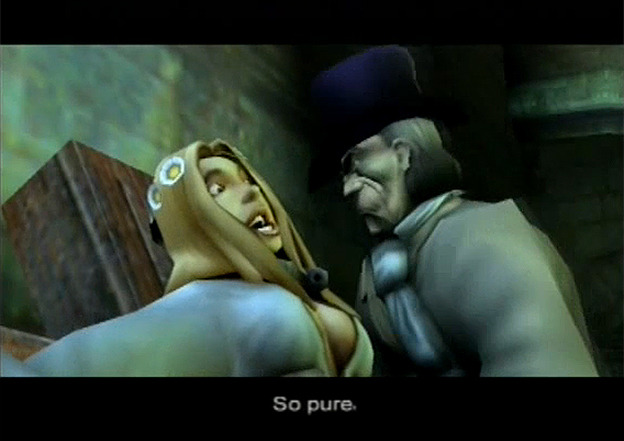
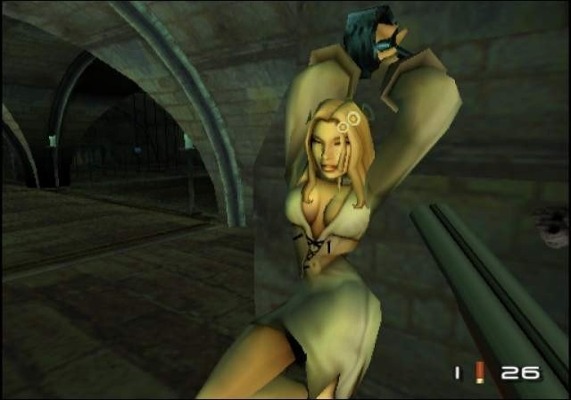
Let's move on to other games. The Timesplitters 2pictures feature "sexualassault" as a tag, in spite of the fact that the Maiden characters -- the damsels in those pictures -- are a reference to the classic horror movie practice of occult artists sacrificing virgins for rituals. I've criticised people for complaining about sexual assault in games where there isn't any before -- Tomb Raider and Heavy Rain -- but this may be the most ridiculous example. Having the Maidens subjected to sexual assault would defeat the entire reason those characters exist! Their virginity. That's why Jacque de la Morte is saying "so pure" in that first picture.
Timesplitters 2 also offers a great example of how the damsel in distress trope can be used wonderfully. Freeing five Maidens from their shackles is an objective of the Notre Dame level ... but one of the Maidens is actually a monster called the Changeling that first-time players will probably unshackle by accident and be attacked by because they're so keen to complete the objectives. It was a clever addition and one that wouldn't exist without damsels in distress in Timesplitters 2. However, that doesn't seem to matter to Anita or one of her team operating the Tumblr; they're damsels in distress, ergo, they're bad.
Then there's Medievil 2 and the "damselinthefridge" tag.
To people who haven't played Medievil 2, this picture and tag is actually very misleading. While Kiya, the blue mummy pictured above and Sir Daniel Fortesque's love interest in Medievil 2, does die in the game, she's revived again within a few levels (well, she technically never died; using time travel, Sir Dan kills the monster who murdered her before she's murdered). Looking at the picture and tag, you would get the impression that she dies and that's all we see of her for the rest of the game. That's not the case. She dies in order to add a few extra levels to the game while Sir Dan works to save her.
There are probably lots more examples of misleading tags and I hope other people point out a few. We're discovering an inkling of the Tropes Vs Women in Video Games team seeing what they want to see though, rather than reporting examples accurately. They even take Duke Nukem 3D seriously ...