Something a bit different this time. Bet you didn't expect an update so soon after the last one, eh?
Over the past few days, my patience with those who discuss gender issues in games has been wearing thin. I've already been over Jason Schreier and his attitude towards Dragon's Crown. Anita Sarkeesian added to my irritability when she posted a link to this short cartoon, titled "But I'm A Nice Guy", about a male character who rants about women because a female character took some ice cream that he wanted. Supposedly a parody about male entitlement and men's rights activists hating women. Although it made me roll my eyes, I was actually quite pleased that Anita was showing support for it; if anyone ever needed proof that Anita Sarkeesian doesn't plan on supporting any issues that affect men in her Tropes Vs Women In Video Games series -- i.e. doesn't plan on treating men equally -- this would be it.
Looking at Jason Schreier's complaints however, it seems like when gender issues affect gaming, men and women aren't individuals. We're faceless entities to be stereotyped. Men are an oppressive collection of immature, perverted "dudebros" who want to maintain a "boys' club". Women are delicate flowers; children who need to be protected from evil game content by their knights in shining armour (both male and female).
It's so obvious that I can't believe I actually have to write this but these stereotypes are highly damaging for both sexes.
There's a kernel of truth in both stereotypes -- some male gamers do want to maintain a boys' club and some female gamers take great offence to portrayals of female characters in games -- but the subject of gender issues in games has blown up so much over the past year that these stereotypes are being considered the norm. Jason Schreier isn't the only one responsible -- others include Jim Sterling, the writers at Rock, Paper, Shotgun and Anita Sarkeesian is, obviously, the poster girl -- but it was in his article that gaming journalism reached a new low. Not only did we have the typical mockery towards men but Schreier went so far as to insult the art director of Dragon's Crown too.
Why? Because his devotion to the stereotypically offended female was so strong. It wasn't real women he was defending in his criticism of Dragon's Crown. It was his imagined version of women, being victimised by an imagined version of men. Although George Kamitani was a real person being insulted and Dragon's Crown, a real game that Schreier was scapegoating.
I have to believe that the majority of gamers, male and female, don't accept this. If they do, it means they care more about gender issues than they do about game developers having creative freedom over their own games. Considering that we're all gamers because we enjoy video games, I have difficulty believing that.
Schreier, Anita and everyone else criticising the gaming industry are allowed to complain. They're allowed to be offended. However, they're in no position to demand things from developers. They aren't allowed to dictate what is right and wrong. It's a ridiculously entitled attitude to have but considered completely reasonable by far too many people; people who enjoy gaming as it is -- sexualised characters, damsels in distress, et al -- are rarely given the chance to air their views. When's the last time you saw a video game article called "Everything's Absolutely Fine"? In spite of the video game industry being scrutinised as closely as it can possibly be on gaming sites, there are plenty of people who feel that way. That maybe there's nothing wrong with damsels in distress and perhaps there's even a reason why gaming is a male-dominated industry. These people aren't radical for thinking that, they just haven't jumped on the "gaming is sexist" bandwagon like so many others. For example, these women (and one man):
Youtubers
InuitInua - http://www.youtube.com/watch?v=cj29-hepBiA (and others).
KiteTales - http://www.youtube.com/watch?v=HJihi5rB_Ek and http://www.youtube.com/watch?v=ZueOCLGt1tw
Gaijin Goomba and Aki - https://www.youtube.com/watch?v=Xqvjw3Z_-dA
MoarPewPewPlz - http://www.youtube.com/watch?v=PL8wJvlmpRI
Leahtastical - https://www.youtube.com/watch?v=41Dy-k1oNWA
cynthx - http://www.youtube.com/watch?v=idmkNdirYpE
meltheofcgamergirl - http://www.youtube.com/watch?v=VJNxVmjIdqs
Articles/Blogs/Comments
Janette Goering - #1ReasonWhy We Need to Change the Way We Fight Against Sexism
Christine Phelan - "Calling Games Industry Sexist Is A Major Disservice To Developers" (preview) or "Valve Want Our Only Concern To Be Making Great Games" (full article).
Gabrielle Toledano - Women And Video Gaming's Dirty Little Secrets
"Elsa" - Comment
Allisa James - Comment
I would like to point out that I don't want any of the women above to feel uncomfortable. On the off-chance that any of you are reading this, I'm not using you for some sinister men's rights activist purpose. If any of you aren't comfortable being listed here, feel free to send me an e-mail (themalesofgames@gmail.com) and I'll happily remove you. I want this to be a hub for fair-minded commentary on gender issues though, which is why you're all listed. I have nothing but praise for your work.
Why only women?
Don't get me wrong, I value men's and women's opinions equally. If I didn't value men's opinions highly, I probably wouldn't bother maintaining this blog. However, it's very easy for mainstream video game sites to dismiss dissenting opinions if they're made by men, especially if they're white and heterosexual. That's "equality" for you. It's much harder (but not impossible) to dismiss those opinions if they're made by women; critics can hardly say "you want to maintain a boys' club atmosphere" if the person defending the games industry is female. That wouldn't make any sense.
Plus, I've noticed in men's rights circles that people take more interest in why female MRAs support the movement. Men's opinions are valued, of course, but the reasons for getting involved tend to be different. I imagine it'd be the same for game journalists; they turn their noses up at men who disagree but will probably be curious about women who oppose the typical "sexualised women are wrong and damsels in distress lack agency" attitude. There's a chance that they'll listen to women making these points while they refuse to listen to men. However, there's a simpler reason why I singled out women.
Anita Sarkeesian doesn't speak for all women. She's not an everywoman.
However, she's the face and voice of the disgruntled female gamer. As far as gaming sites are concerned, she is the average female gamer. A lot of the women above make it clear that they think Anita supports a good cause but they disagree with her on some of her points. To make it clear, I think women are unfairly treated in some cases in the games industry (such as publishers thinking games won't sell with female characters on the front cover). Unfortunately, it's come to a point where Anita's voice and others like it are the only ones allowed to be heard and dissenting opinions -- even by other female gamers -- can be dismissed just like the male ones.
I'd be lying if I said I didn't want to feature men though; Instig8ive Journalism's videos on Anita Sarkeesian were the first ones I ever saw apart from the ones on Feminist Frequency itself. A user named LeoPirate gives his perspective as one of Anita's Kickstarter backers. TheAmazingAtheist gives a surprisingly fair-minded response. J. J. McCullough wrote a respectful rebuttal to Anita's first damsels in distress video. These aren't abusive men out to threaten Anita Sarkeesian with abusive threats to rape and murder her. These are reasonable responses that aren't being given the time of day, let alone by Anita herself who is still talking about how victimised she was. Just so you don't think I'm picking on Anita, Giuseppe Nelva of DualShockers perfectly countered Jason Schreier's reactionary response to the game's character designs. A writer for a Tumblr page titled 7Nights
also gave his support for the Sorceress and pointed out why we shouldn't be
tearing about sexualised characters just because they're sexual. I definitely
think he got across how shallow it ultimately is.
These arguments need to come to light. If Anita Sarkeesian wants to continue making shaky arguments, fine. If Jason Schreier wants to brag about how he got George Kamitani to apologise, he's welcome to. However, their opinions can't be treated like the gospel truth. Gaming sites need to follow the lead of people like Janette Goering up there, who bravely objected to the #1ReasonWhy movement when she became uncomfortable with it. She still supported it but wasn't afraid to point out the flaws as she saw them.
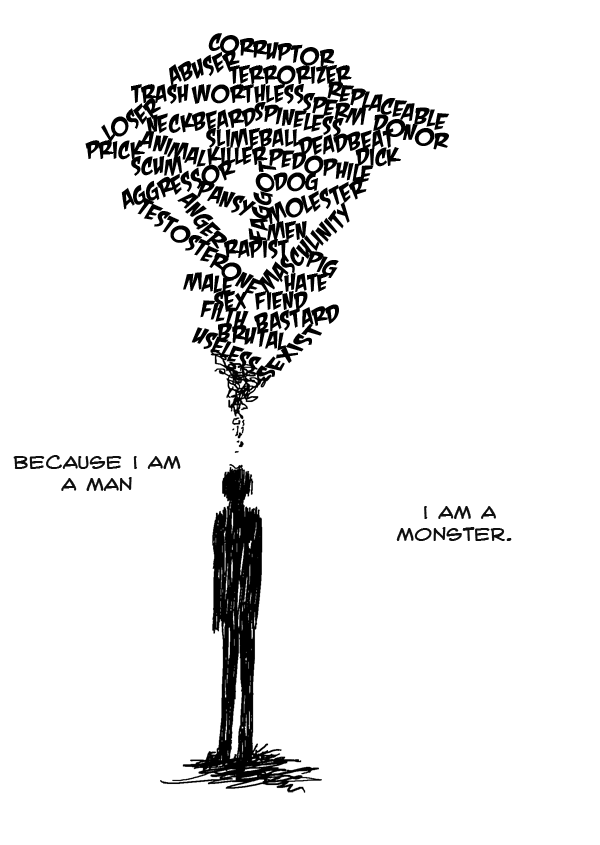
Finally, although it has nothing to do with gaming, I came across a Tumblr
called Shining
Things the other day and fell in love with this picture. Researching gender
issues online, I sometimes come across unpleasant sites that make me feel like
the chap in this picture. If you're on Tumblr, give the artist some support.
As always, feel free to leave a comment or contact me at themalesofgames@gmail.com
Showing posts with label #1ReasonWhy. Show all posts
Friday, 3 May 2013
Saturday, 19 January 2013
Finally! A Voice Of Reason!
I'm updating very soon after my previous post but it's just going to be another short one. Very short. It's basically just to promote an article by Gabrielle Toledano, executive vice president and chief talent officer of Electronic Arts. In this article that she wrote for Forbes, entitled "Women And Video Gaming's Dirty Little Secrets", Gabrielle offers her perspective on the lack of women in the gaming industry. It's certainly illuminating and a viewpoint that I didn't see much of last year, during the #1ReasonWhy campaign.
I don't want to delve into the article or analyse it too much, since I think it's better that everyone just reads it for themselves, but Gabrielle's three "Dirty Little Secrets" about women and the gaming industry are:
Speaking of which, Gabrielle makes it clear in her first two paragraphs that her viewpoint is very distinct from that of the women (and men) who were tweeting during #1ReasonWhy:
As always, feel free to comment or send me an e-mail at themalesofgames@gmail.com
I don't want to delve into the article or analyse it too much, since I think it's better that everyone just reads it for themselves, but Gabrielle's three "Dirty Little Secrets" about women and the gaming industry are:
- Women play games - a lot of them.
- The video game industry wants to hire more women.
- There aren't enough to hire ... yet.
"Remember back at the start of this blog? Luke Crane asked 'where are there so few lady creators?' I said this was a simple enough question with a simple enough answer. The simple enough answer is this: 'there aren't enough women who are interested in games development enough to get involved in it'. That's it. The #1ReasonWhy tweets are looking for reasons why women aren't interested in games development but [...] the fact is that it's simply an industry that appeals to more men than women."Gabrielle goes into much more detail, highlighting the lack of women working in the technology sector. She thinks the key to getting more women working in the gaming industry is to encourage them to enter technology fields, particularly engineering. I'm glad someone in such a prominent position has come at the issue of women in the gaming industry from such a mature, logical standpoint. I'm sorry to keep mentioning #1ReasonWhy but Gabrielle's views are a stark contrast to the tweets that we saw during that movement; Gabrielle adopts a mature and logical stance while #1ReasonWhy seemed to be all about determining what to scapegoat next.
Speaking of which, Gabrielle makes it clear in her first two paragraphs that her viewpoint is very distinct from that of the women (and men) who were tweeting during #1ReasonWhy:
"We’ve all heard the debate – many have accepted as an article of faith that sexism keeps women out of game studios.
As an insider, I find this argument is misguided. It’s easy to blame men for not creating an attractive work environment – but I think that’s a cop-out. If we want more women to work in games, we have to recognize that the problem isn’t sexism."I am eternally thankful towards Gabrielle Toledano for this part of her article. Be it about objectification, lack of female protagonists or being groped at conventions, there was a lot of male-blaming during #1ReasonWhy. I sincerely hope some of the women who cast blame back then read Gabrielle's article very closely and start treating the situation of the lack of women in game development with more intelligence and logic. Not just casting blame on male developers. Toledano isn't the only one; remember Christine Phelan of Valve, being interviewed for FMV Magazine?
"There are a ton of dudes in the games industry, yes – it’s a bit of a pickle jar. I have never, however, been treated as anything but a team member and an equal by my coworkers and it’s a major disservice to them that folks automatically assume they will treat me differently because I am a woman."A small part of me wonders how a male employee of a games company would be treated if he made the same claims that Toledano did ... but that's not important right now. I'm actually glad women like Toledano and Phelan have had the courage to come forward and say "actually, things aren't like that/aren't for the reasons you say". I'm certain they'll have their critics but, fingers-crossed, perhaps more women will take a leaf from their book and be inspired to consider the gaming industry as something other than an unrelenting mess of misogyny.
As always, feel free to comment or send me an e-mail at themalesofgames@gmail.com
Tuesday, 11 December 2012
An Open Letter to the Video Game Industry's Feminist Critics
I meant to write this blog much sooner, shortly after my piece on #1ReasonWhy. Unfortunately, I came down with an illness and I've spent most of the last week lying in bed. That's pushed back this blog by a few days and, more annoyingly, one of the sites reporting on #1ReasonWhy has updated the Twitter posts it had embedded in the article. Try as I might, I haven't been able to find the tweet I wanted to write about. It was a #1ReasonWhy about being afraid to read the comments sections on articles about feminism in gaming.
For all the people who are critical of those comments sections, this (informal) open letter is addressed to you.
I can't imagine there are many feminist critics of the video game industry who ask "why are the people who leave those comments so mean?" because gaming sites and high-profile figures have a habit of portraying them in very black-and-white groups; either they support the feminist argument being made, or they're misogynists. By the mainstream gaming sites, the logical arguments about men's issues in games -- the sensible, fair-minded ones -- either don't exist or they're not worthy of discussion and are dismissed along with the misogynists. I have a theory that this has a lot to do with why there are so many misogynist comments beneath feminist articles on gaming sites. I'll go into that towards the end.
On the off-chance that this post brings any new readers, I'd like to give a bit of backstory; this was the year that I decided to start a blog about misandry in video games because this was the first year I noticed such a dismissive attitude towards misandry in video games. Getting annoyed at a polarising game journalist like Jim Sterling is a bit like going to a KKK rally and then complaining that it's a tad on the racist side but earlier this year, he wrote this article in response to criticism of Anita Sarkeesian's upcoming video series, Tropes Vs. Women in Videogames. It highlights all the typical responses that men's rights activists receive when raising concerns about men's issues. Dismissiveness. Insults. Lack of counter-arguments to existing criticisms. The strange belief that these men's issues don't exist unless in response to someone raising issues about women. That one, in particular, is a head-scratcher; the only reason Sterling and the other critics think these issues don't exist without provocation is because they don't take an interest in men's issues. If they did, they'd see the concern, but because they don't, they don't. It's not rocket science.
Sterling wasn't the only one. There was a blog post earlier this year called "Straight White Male: The Lowest Difficulty Setting There Is" that focused on how it was impossible -- or ridiculously difficult -- for men to be discriminated against because they have "privilege" (although the article was written specifically to outline how easy straight white men had it without using that term. All it did was provide a rather smarmy definition of what privilege was). This blog post gained plenty of publicity in video game circles even though it didn't have anything to do with video games beyond the "difficulty setting" analogy. As for its content, it doesn't tell men's rights activists anything they're not already used to reading. Like the Sterling example, it doesn't state any counter-arguments or cite examples. It outlines why you, straight white male reader, have it better and it won't take "hold on, what about ..." for an answer.
The reason I'm bringing up these blogs and articles now, months after they were originally posted, is because the #1ReasonWhy movement and all the responses to it over the past two weeks has brought back all the same reactions to men's issues. The dismissiveness, the hostility, the insults and so on. There's also an oddly condescending attitude towards the people who disagree with the movement; a "the guys who don't get it" phrase tends to crop up and "guys who get it" are praised. The "lowest difficulty setting" blog post had a hint of this too.
For anyone with a morbid curiosity, take a look where that link leads to. A highly misandric "poem" by Carol Diehl that suggests men don't know what it's like for other men to be raped by women, have women promoted over them because of their sex or mock the appearance of their genitals. Looking at (video game journalist, Gameranx editor-in-chief) Ian Miles Cheong's tweets, he seems to believe every stereotype about men's rights activists without doing any research into men's issues. Once again, no counter-arguments. I hope my feminist readers are starting to notice a pattern here.
It seems like the critics think the only reason why anyone would disagree with the #1ReasonWhy movement -- or any previous feminist campaigns, such as Anita Sarkeesian's Tropes Vs. Women in Videogames -- is because they don't "get" it or they're misogynists. Again, it seems like an excuse to avoid acknowledging the genuine criticisms. Criticisms like the fact that women aren't the only people who face verbal abuse during online multiplayer games but sexist insults are the only insults acknowledged as a problem, for example. Much like, say, the unrealistic standards of beauty in games, it's an issue that faces both sexes but is treated as one that only affects women. That's before issues that predominately affect men are brought up, such as making up the majority of victims of violence.
I wanted to write about this because last week, Gamespot posted one of their Feedbackula videos -- as far as I can tell, a video series highlighting and examining their members' comments from previous articles, usually about upcoming games -- and the arguments left a lot to be desired, to say the least. Here it is, if you'd like to take a look:
Hosted by Gamespot UK's Johnny Chiodni, it was basically an excuse to mock the opinions of people who disagreed with them. Now, there are certain comments on every article about misogyny in gaming that I wouldn't mind receiving insults but what galls me is that Gamespot would sooner make a video criticising "easy" comments than -- you guessed it -- providing counter-arguments to sensible ones. In fact, for those who chose not to watch the video, at the mere mention of men suffering discrimination in games too, Johnny "humourously" bangs his shoe against his head, bemoaning "why'd you have to ruin it?"
Johnny himself doesn't even seem to have a very good grasp on the issues that affect women, let alone men; when discussing the sexualisation of women, we see a picture of a female Skyrim character wearing heavy armour. Johnny describes this as "titillating" because the armour has breasts. To me, this completely undermines every single other argument about sexualised women in games; what's the point in criticising the skimpy outfits and bouncing breasts in Dead Or Alive if an aesthetic choice to make the female characters visibly female in Skyrim suddenly counts as "titillating"? When that becomes an example of sexualised female characters, absolutely anything can be. I think a commenter on Gamespot called yamilvirginio said it best:
The list goes on and on. The #1ReasonWhy site itself is dismissive of men's issues in its FAQ (emphasis by me):
I have nothing but praise for Iara for having such a wise head on her shoulders and, thankfully, I didn't notice any "she might not even be female!" accusations in the PC Gamer comments section (and it wouldn't really matter if she wasn't; Tom Hatfield didn't seem to think so and his reaction is what's important, rather than Iara's gender). However, just in case there was any doubt about women taking issue with #1ReasonWhy too, the genuinely wonderful InuitInua steps in to remove all doubt:
In my last blog, I came to the same conclusion as InuitInua about the #1ReasonWhy movement being about special treatment rather than equality and she had a few specific topics from tweets she wanted to pick apart too. It deserves a watch.
Now, something that I imagine a lot of feminist video game commenters and critics don't get is that people who support men's issues in games support equality in games. That's important. I've heard people say, "people object to women entering a field that has been male-dominated for years and expecting it to immediately change to suit them". I don't think this is the case at all. None of us object to women being given the floor to air the issues that affect them in games, no matter how few there are or how short a time they've been a part of the industry. If they're here, they deserve their say. It's when women are the only ones who are given the floor that things become a problem.
Unfortunately, that is exactly what has happened to the video game industry. I'd like to go into two completely separate tangents to illustrate this point. Remember what happened to Ryan Perez? He was a writer for Destructoid who, to quote my own blog on the subject:
The second point I wanted to make was about our old friend Anita Sarkeesian, of Feminist Frequency. The latest blog post on her website outlines the talk she gave at this year's TEDxWomen in Washington, DC. Thankfully, she provides a transcript of her speech, which is predominately about the abuse she suffered when launching her Kickstarter project. As I've said before, I don't encourage that kind of abuse -- I looked over the comments again before writing this post and the racist language made me cringe -- but there are a few parts of her speech that I'd like to quote that highlight why people are critical of Anita:
So finally -- finally -- we come to my theory about misogynist comments in feminist articles on gaming sites. To every feminist reader of this blog who has ever wondered why so many of those comments exist, take a look at all the examples involving men and men's issues above. Where they've been ignored. Dismissed. Insulted. Where the men who make them have been told "grow up", "you don't get it" or "you have it easy". Meanwhile, women's issues are being given "air time" on every website that's reporting on Anita Sarkeesian and #1ReasonWhy.
Why do those misogynistic comments exist? Well with all this anti-male sentiment, how do you think people are going to react? What do you expect? With intelligent, well thought-out criticisms of these movements completely ignored, why would people bother writing them and just say "to heck with it" and throw out some misogynist comments to get a reaction? You can say it's immature but, hey, so is the attitude towards men's issues. The fact that plenty of the writers of this content are male is also pretty telling, in that male writers have carte blanche to say what they like about men in a way that female writers can't. I don't want that to sound like a paranoid cry of "the women forced the men to do it!" but rather an acknowledgement of how feminist critics frame things; a woman in the gaming industry can't very well write a scathing attack on male gamers who don't support, say, Anita Sarkeesian's Kickstarter project in the same way that Jim Sterling can because, if she does, all those misogynist comments will actually be easy to justify. If Jim Sterling writes the same thing, however, the worst insults that'll come his way are "white knight" and "mangina", making the commenters look a bit mental.
I have a second theory but this one needs to be tested. This is where any feminist readers of my blog will come in very handy, especially on the off-chance that any of you are in high-profile positions. Next time you run an article about sexism in video games, give the male point of view as well as the female one. If you intend to criticise Bayonetta for sexual poses, criticise Final Fantasy's trend of flawless teenage male characters at the same time. Don't just throw it in as a single "oh, yeah, men are sexualised too" at the end of the article either. Point out the lack of real-life teenagers who bear any resemblance to, say, Vaan and the unrealistic standard of beauty it promotes.
My theory? Acknowleding sexualisation of both sexes in video games will reduce a huge amount of the hostility towards the article in question. The frustrating thing is that there is no reason for feminists in the gaming industry not to do this, other than to claim victimhood as a specifically female trait. There are tons of sayings that justify supporting both men's and women's issues in games and you'll have heard them all before; "what's good for the goose is good for the gander". "You catch more flies with honey than with vinegar". Even the classic "do unto others as you would have them do unto you". You can even quote Jim Sterling (in the name of equality rather than misandry) and say "Start. Fucking. Sharing". So why do feminist critics of the gaming industry make it such an uphill battle for themselves? Why support women's issues and then complain about misogynist comments when you could support the same issues for both sexes and have your approval rating skyrocket?
Obviously, misogynist comments would never completely disappear, even if arguments about men's issues in games were taken seriously. There are always going to be some unsavoury characters in every industry, regardless of how much progress is made. Valve's Christine Phelan said much the same thing in her interview with FMV Magazine. That's certainly a shame but there are things that I think could be done right now to reduce the sexist comments (outlined in the two paragraphs above). If feminist critics are genuinely critical of these misogynist comments and genuinely support equality rather than special treatment, like I said, there's no reason not to support men's issues in interviews/comments/tweets too. Don't "pull a Sarkeesian" by claiming to find misogyny morally wrong but then choosing not to do anything about them just because having more misogynistic comments supports your viewpoint. Again, that just portrays women as children in need of help rather than adults who have the power to change things.
I suppose that's all I have to say. I'd like to finish by linking to a video that a friend of mine posted in the comments of my last blog, by a Youtuber called Billy Clement.
While I don't agree with everything Billy says, there are a few things I like about the video. His comparison to a man in the cosmetics industry is quite entertaining and, most importantly, he reads out a statement from a male developer in the video game industry who'd like to remain anonymous. Assuming it's true, it's quite a damning indictment of "equality" in the gaming industry and wouldn't look out of place on a male version of the #1ReasonWhy movement. One of his final lines sums up the #1ReasonWhy campaign's flaws in their entirety, however, and I'd like to quote it here:
Well, that's that. Now I suppose I'll just have to wait for my sexuality to be called into question by a "progressive" Gamespot personality.
Please feel free to leave a comment or write to me at themalesofgames@gmail.com.
For all the people who are critical of those comments sections, this (informal) open letter is addressed to you.
I can't imagine there are many feminist critics of the video game industry who ask "why are the people who leave those comments so mean?" because gaming sites and high-profile figures have a habit of portraying them in very black-and-white groups; either they support the feminist argument being made, or they're misogynists. By the mainstream gaming sites, the logical arguments about men's issues in games -- the sensible, fair-minded ones -- either don't exist or they're not worthy of discussion and are dismissed along with the misogynists. I have a theory that this has a lot to do with why there are so many misogynist comments beneath feminist articles on gaming sites. I'll go into that towards the end.
On the off-chance that this post brings any new readers, I'd like to give a bit of backstory; this was the year that I decided to start a blog about misandry in video games because this was the first year I noticed such a dismissive attitude towards misandry in video games. Getting annoyed at a polarising game journalist like Jim Sterling is a bit like going to a KKK rally and then complaining that it's a tad on the racist side but earlier this year, he wrote this article in response to criticism of Anita Sarkeesian's upcoming video series, Tropes Vs. Women in Videogames. It highlights all the typical responses that men's rights activists receive when raising concerns about men's issues. Dismissiveness. Insults. Lack of counter-arguments to existing criticisms. The strange belief that these men's issues don't exist unless in response to someone raising issues about women. That one, in particular, is a head-scratcher; the only reason Sterling and the other critics think these issues don't exist without provocation is because they don't take an interest in men's issues. If they did, they'd see the concern, but because they don't, they don't. It's not rocket science.
Sterling wasn't the only one. There was a blog post earlier this year called "Straight White Male: The Lowest Difficulty Setting There Is" that focused on how it was impossible -- or ridiculously difficult -- for men to be discriminated against because they have "privilege" (although the article was written specifically to outline how easy straight white men had it without using that term. All it did was provide a rather smarmy definition of what privilege was). This blog post gained plenty of publicity in video game circles even though it didn't have anything to do with video games beyond the "difficulty setting" analogy. As for its content, it doesn't tell men's rights activists anything they're not already used to reading. Like the Sterling example, it doesn't state any counter-arguments or cite examples. It outlines why you, straight white male reader, have it better and it won't take "hold on, what about ..." for an answer.
The reason I'm bringing up these blogs and articles now, months after they were originally posted, is because the #1ReasonWhy movement and all the responses to it over the past two weeks has brought back all the same reactions to men's issues. The dismissiveness, the hostility, the insults and so on. There's also an oddly condescending attitude towards the people who disagree with the movement; a "the guys who don't get it" phrase tends to crop up and "guys who get it" are praised. The "lowest difficulty setting" blog post had a hint of this too.
For anyone with a morbid curiosity, take a look where that link leads to. A highly misandric "poem" by Carol Diehl that suggests men don't know what it's like for other men to be raped by women, have women promoted over them because of their sex or mock the appearance of their genitals. Looking at (video game journalist, Gameranx editor-in-chief) Ian Miles Cheong's tweets, he seems to believe every stereotype about men's rights activists without doing any research into men's issues. Once again, no counter-arguments. I hope my feminist readers are starting to notice a pattern here.
It seems like the critics think the only reason why anyone would disagree with the #1ReasonWhy movement -- or any previous feminist campaigns, such as Anita Sarkeesian's Tropes Vs. Women in Videogames -- is because they don't "get" it or they're misogynists. Again, it seems like an excuse to avoid acknowledging the genuine criticisms. Criticisms like the fact that women aren't the only people who face verbal abuse during online multiplayer games but sexist insults are the only insults acknowledged as a problem, for example. Much like, say, the unrealistic standards of beauty in games, it's an issue that faces both sexes but is treated as one that only affects women. That's before issues that predominately affect men are brought up, such as making up the majority of victims of violence.
I wanted to write about this because last week, Gamespot posted one of their Feedbackula videos -- as far as I can tell, a video series highlighting and examining their members' comments from previous articles, usually about upcoming games -- and the arguments left a lot to be desired, to say the least. Here it is, if you'd like to take a look:
Hosted by Gamespot UK's Johnny Chiodni, it was basically an excuse to mock the opinions of people who disagreed with them. Now, there are certain comments on every article about misogyny in gaming that I wouldn't mind receiving insults but what galls me is that Gamespot would sooner make a video criticising "easy" comments than -- you guessed it -- providing counter-arguments to sensible ones. In fact, for those who chose not to watch the video, at the mere mention of men suffering discrimination in games too, Johnny "humourously" bangs his shoe against his head, bemoaning "why'd you have to ruin it?"
Johnny himself doesn't even seem to have a very good grasp on the issues that affect women, let alone men; when discussing the sexualisation of women, we see a picture of a female Skyrim character wearing heavy armour. Johnny describes this as "titillating" because the armour has breasts. To me, this completely undermines every single other argument about sexualised women in games; what's the point in criticising the skimpy outfits and bouncing breasts in Dead Or Alive if an aesthetic choice to make the female characters visibly female in Skyrim suddenly counts as "titillating"? When that becomes an example of sexualised female characters, absolutely anything can be. I think a commenter on Gamespot called yamilvirginio said it best:
- "Ironic" hipster beard and glasses: Check ✓
- Arrogant and annoying personality: Check ✓
- Putrid stench of white knight anyone can smell from their monitor: Check ✓
- Cherry-picking the most radical comments and reading them in a silly, ironic voice: Check ✓
- Homophobic undertone of the ending message ✓
Yep, everything clears out here. Thank you Gamespot® for enlightening these poor sheep!The homophobic undertone of the ending message, for anyone who didn't watch the video, was suggesting that anyone who had a problem supporting #1ReasonWhy go join the navy, while the song and video for The Village People's "In The Navy" played in the background. The implication being that if you don't support the women of #1ReasonWhy, you're gay.
The list goes on and on. The #1ReasonWhy site itself is dismissive of men's issues in its FAQ (emphasis by me):
Given the reaction of some of the other figures in the video game journalism industries, I'm actually slightly appreciative of the fact that the owner of 1reasonwhy.net thought to say he/she agreed. I'm no fool; I'm sure it was simply to mollify men's rights activists and to avoid an inundated inbox but frankly, I'm thankful even for that. Other people make no bones about dismissing and insulting people who dare to mention men's rights:
And there's an underlying idea, backed up by things like the Feedbackula video and the idea that guys "don't get it", that critique of movements like #1ReasonWhy isn't allowed.
I'd like to contrast this tweet with everything else in this blog; men complaining that women are complaining about sexism is wrong. Men complaining that men are complaining about sexism describes Jim Sterling's article, Johnny Chiodni's videos, David A Hill Jr's tweet, etc. I went into this quite a lot last time but, again, all these tweets, articles, videos and so forth, all this misandric "men can't be discriminated against" dismissiveness, it all has the unintended effect of making women seem like children. What's being said here is that women have the monopoly on victimhood and how dare those men try to claim otherwise.
Speaking of which, this isn't just men criticising #1ReasonWhy. Someone sent me a link to a PC Gamer article on #1ReasonWhy and directed my attention to one of the comments below. Read it yourself and see what you think:
What we have here is a woman called Iara who refuses to accept her status as a supposed victim and two men (I assume glix is male) who are telling her, "no. You're a victim". The conversation continued beyond these two replies but there wasn't much else of substance.
Let's break this down, bit by bit. First of all, glix's comment that Iara's experiences don't speak for everyone's. That's fair enough but on Twitter, we have thousands upon thousands of examples of people who are claiming that they're providing evidence of institutionalised sexism in the gaming industry. Now what exactly would happen if one of the critics of #1ReasonWhy actually pointed out that the experiences of the women using that hashtag weren't the same as everyone else's?
In fact, I think we might end up with a response much like the one I posted by Kevin VanOrd in my last post:
Maybe this is just my interpretation but it seems to me as if when a woman uses the #1ReasonWhy hashtag on Twitter, it's evidence. When a woman disagrees with the movement, it's subjective; we see the sentence "your experiences don't speak for everyone's".
It's much the same case with Tom Hatfield's comment. Tom has apparently read the "Straight White Male: The Lowest Difficulty Setting There Is" blog post, judging from his comment about guys having an "easy mode". That's neither here nor there though. What's important is how Tom's reply unintentionally highlights the hypocrisy of the #1ReasonWhy movement.
Put it this way; if a man objected to a #1ReasonWhy example written by a woman in the same way that Tom did, the backlash would be quite severe. Let's say a woman wrote a #1ReasonWhy where she stated she had been groped at a convention. Then, let's say a man wrote to her and said, "that's not sexism". Presumably, he'd receive lots of hate messages. I can imagine he'd be called a misogynist for not denouncing such an act as sexist and he'd be criticised for daring to tell a woman how to interpret her own experiences.
What we have here is a reversal of the positions on sexism. Iara is stating how she doesn't see the verbal abuse she's suffered as an example of sexism but no sooner has she done so than Tom Hatfield rushes in to say "that's sexism"! He's telling a woman how to interpret what she herself has experienced, just as in the first example. Do me a favour; quickly scroll back up and look at Tarryn van der Byl's tweet (@nxtrms). "Because we can't even complain about sexism in the industry without men complaining that we're complaining". That's a complaint about men thinking they know better than the women giving their experiences but isn't that exactly what Tom is doing here? Although just because Tom supports the "right" position on sexism ("everything is sexist, women are children, they need help") and Iara supports the "wrong" one ("everyone is verbally abused, I can deal with it, I refuse to play my victim card"), Tom doesn't suffer the same criticism that a man in Iara's shoes would.
I have nothing but praise for Iara for having such a wise head on her shoulders and, thankfully, I didn't notice any "she might not even be female!" accusations in the PC Gamer comments section (and it wouldn't really matter if she wasn't; Tom Hatfield didn't seem to think so and his reaction is what's important, rather than Iara's gender). However, just in case there was any doubt about women taking issue with #1ReasonWhy too, the genuinely wonderful InuitInua steps in to remove all doubt:
In my last blog, I came to the same conclusion as InuitInua about the #1ReasonWhy movement being about special treatment rather than equality and she had a few specific topics from tweets she wanted to pick apart too. It deserves a watch.
Now, something that I imagine a lot of feminist video game commenters and critics don't get is that people who support men's issues in games support equality in games. That's important. I've heard people say, "people object to women entering a field that has been male-dominated for years and expecting it to immediately change to suit them". I don't think this is the case at all. None of us object to women being given the floor to air the issues that affect them in games, no matter how few there are or how short a time they've been a part of the industry. If they're here, they deserve their say. It's when women are the only ones who are given the floor that things become a problem.
Unfortunately, that is exactly what has happened to the video game industry. I'd like to go into two completely separate tangents to illustrate this point. Remember what happened to Ryan Perez? He was a writer for Destructoid who, to quote my own blog on the subject:
"... Tweeted that he believed that actress, writer and internet 'celebrity' Felicia Day was 'a glorified booth babe' and asked the question, 'does she actually contribute anything useful to this industry, besides retaining a geek persona?'. After a massive outcry from many, many of Felicia's friends, fans and coworkers, Ryan lost his job."Now, the reason Ryan lost his job was because his comments were deemed "misogynistic", even though there was nothing sexist against women about them. He disliked Felicia Day and that, apparently, was enough to brand him a woman-hater. The point I want to make about Ryan is that he made those Twitter comments about Felicia Day in his private time and yet still ended up losing his job over them. Meanwhile, Jim Sterling professionally wrote an article expressing very misandric sentiments and presumably got paid by Gamefront to do so. I'd say that's a lot worse that Ryan's not-quite-misogynistic barbs that were directed at Felicia Day.
The second point I wanted to make was about our old friend Anita Sarkeesian, of Feminist Frequency. The latest blog post on her website outlines the talk she gave at this year's TEDxWomen in Washington, DC. Thankfully, she provides a transcript of her speech, which is predominately about the abuse she suffered when launching her Kickstarter project. As I've said before, I don't encourage that kind of abuse -- I looked over the comments again before writing this post and the racist language made me cringe -- but there are a few parts of her speech that I'd like to quote that highlight why people are critical of Anita:
"And whether it’s a cyber mob or just a handful of hateful comments, the end result is maintaining and reinforcing and normalizing a culture of sexism — where men who harass are supported by their peers and rewarded for their sexist attitudes and behaviors and where women are silenced, marginalized and excluded from full participation.
A ‘boys club’ means no girls allowed. And how do they keep women and girls out? Just like this. By creating an environment that is just too toxic and hostile to endure ...
... Everyday I am encouraged by the women who persevere, who continue to engage and who refuse to be silenced."To me, this seems like a biased view of things, probably the main criticism of Anita. One thing I hope I've achieved with this blog is build a case for a view of gaming culture where not only are men not supported by their peers for sexist attitudes and behaviour -- look at the Sterling article/Feedbackula video/the entire #1ReasonWhy movement and you'll realise the idea of men being rewarded for sexist behaviour is nothing but fantasy -- but sexism against men is overwhelmingly supported. Whether it's insulting men who support men's issues outright, dismissing the issues, ignoring them or portraying certain issues as only affecting women when they actually affect both sexes, there's a lot of examples of men being silenced and marginalised in the gaming industry. That's what I'd describe as a toxic environment. If that's what Anita considers a "boy's club", I'd hate to see what a "girl's club" looks like! Meanwhile, women had tens of thousands of #1ReasonWhy tweets, every high-profile gaming site (and several mainstream ones) supporting the cause and Anita Sarkeesian receiving $150,000 for a video series. Hardly what I'd call being "silenced", in spite of the abuse Anita received.
So finally -- finally -- we come to my theory about misogynist comments in feminist articles on gaming sites. To every feminist reader of this blog who has ever wondered why so many of those comments exist, take a look at all the examples involving men and men's issues above. Where they've been ignored. Dismissed. Insulted. Where the men who make them have been told "grow up", "you don't get it" or "you have it easy". Meanwhile, women's issues are being given "air time" on every website that's reporting on Anita Sarkeesian and #1ReasonWhy.
Why do those misogynistic comments exist? Well with all this anti-male sentiment, how do you think people are going to react? What do you expect? With intelligent, well thought-out criticisms of these movements completely ignored, why would people bother writing them and just say "to heck with it" and throw out some misogynist comments to get a reaction? You can say it's immature but, hey, so is the attitude towards men's issues. The fact that plenty of the writers of this content are male is also pretty telling, in that male writers have carte blanche to say what they like about men in a way that female writers can't. I don't want that to sound like a paranoid cry of "the women forced the men to do it!" but rather an acknowledgement of how feminist critics frame things; a woman in the gaming industry can't very well write a scathing attack on male gamers who don't support, say, Anita Sarkeesian's Kickstarter project in the same way that Jim Sterling can because, if she does, all those misogynist comments will actually be easy to justify. If Jim Sterling writes the same thing, however, the worst insults that'll come his way are "white knight" and "mangina", making the commenters look a bit mental.
I have a second theory but this one needs to be tested. This is where any feminist readers of my blog will come in very handy, especially on the off-chance that any of you are in high-profile positions. Next time you run an article about sexism in video games, give the male point of view as well as the female one. If you intend to criticise Bayonetta for sexual poses, criticise Final Fantasy's trend of flawless teenage male characters at the same time. Don't just throw it in as a single "oh, yeah, men are sexualised too" at the end of the article either. Point out the lack of real-life teenagers who bear any resemblance to, say, Vaan and the unrealistic standard of beauty it promotes.
My theory? Acknowleding sexualisation of both sexes in video games will reduce a huge amount of the hostility towards the article in question. The frustrating thing is that there is no reason for feminists in the gaming industry not to do this, other than to claim victimhood as a specifically female trait. There are tons of sayings that justify supporting both men's and women's issues in games and you'll have heard them all before; "what's good for the goose is good for the gander". "You catch more flies with honey than with vinegar". Even the classic "do unto others as you would have them do unto you". You can even quote Jim Sterling (in the name of equality rather than misandry) and say "Start. Fucking. Sharing". So why do feminist critics of the gaming industry make it such an uphill battle for themselves? Why support women's issues and then complain about misogynist comments when you could support the same issues for both sexes and have your approval rating skyrocket?
Obviously, misogynist comments would never completely disappear, even if arguments about men's issues in games were taken seriously. There are always going to be some unsavoury characters in every industry, regardless of how much progress is made. Valve's Christine Phelan said much the same thing in her interview with FMV Magazine. That's certainly a shame but there are things that I think could be done right now to reduce the sexist comments (outlined in the two paragraphs above). If feminist critics are genuinely critical of these misogynist comments and genuinely support equality rather than special treatment, like I said, there's no reason not to support men's issues in interviews/comments/tweets too. Don't "pull a Sarkeesian" by claiming to find misogyny morally wrong but then choosing not to do anything about them just because having more misogynistic comments supports your viewpoint. Again, that just portrays women as children in need of help rather than adults who have the power to change things.
I suppose that's all I have to say. I'd like to finish by linking to a video that a friend of mine posted in the comments of my last blog, by a Youtuber called Billy Clement.
"I'm not arguing against inclusion. Inclusion's good and we all want to see more female gamers. But exclusion is bad and what we really don't want is a games industry to turn into a mirror of television, with weak, stupid, ineffective male characters only appearing to make the superwomen look good."The part about inclusion and exclusion alone hits the nail on the head; just like I said last time and just like InuitInua says in the video above, it's special treatment -- not equality -- that people are recommending as a solution to the #1ReasonWhy movement's problems. That's exclusion, masquerading as equality.
Well, that's that. Now I suppose I'll just have to wait for my sexuality to be called into question by a "progressive" Gamespot personality.
Please feel free to leave a comment or write to me at themalesofgames@gmail.com.
Sunday, 2 December 2012
#1ReasonWhy
This has been an insane few days.
For anyone who isn't a member of Twitter, a few days ago, a man by the name of Luke Crane posted this tweet:
It's a simple enough question, with a simple enough answer (that we'll come to later on). I doubt Luke Crane, or anyone else, could've predicted the response he received to this single tweet. Many, many, many people waded in with their answers, each stating one reason why there were so few lady game creators (hence the hashtag "#1ReasonWhy"). These came from all manner of people from inside and outside the gaming industry.
Obviously, I didn't read them all. I don't even have a Twitter account, since I prefer to read long messages rather than short ones. Thankfully, however, there were plenty of articles on the subject, all showing some of the examples of #1ReasonWhy tweets. The hashtag even earned its own site. All-in-all, there's been an astounding outpouring of support for and from women in the gaming industry.
With it, there's also been an astounding outpouring of hypocrisy, biased arguments and double standards, to the point that its difficult to even know where to begin. Before we go into the tweets themselves, take a look at a couple of the articles that I've been perusing.
This article from Gamespot was where the #1ReasonWhy hashtag first caught my attention. This article, by Carolyn Petit and Laura Parker, does a decent job of explaining what the hashtag is but doesn't really go beyond the "we have to do something!" attitude. They don't reach any conclusions on what to do but overall, the attitude expressed is a step up from the sentiments expressed elsewhere.
Case in point: this article by Nathan Grayson on Rock, Paper, Shotgun. To sum up, it's one big call-to-arms "for men to stop acting like self-centered slobs. It’s time for men to stop turning every step of progress into an agonizing uphill battle". It has a rather disturbing, "you're either with us or against us" attitude, so men who disagree or just don't wish to help are targets of Grayson's ire. In spite of the writer's claim that he is "not trying to propose some damsel-in-distress “let’s handsomely save the day” argument," this may be one of the biggest examples of "White Knighting" I've ever seen online. It's a condescending pep talk that assumes the worst of men and, coincidentally, is a real-life example of what I mentioned in my previous two blog posts; it suggests that men are only valuable based on how useful they are to women. If they're not being useful to women, they're "self-centered slobs".
I haven't got into the actual reasons given by the #1ReasonWhy hashtags yet. Something I should make clear is that there isn't enough time in the world to go through every single tweet, obviously, and there may be some good, legitimate reasons that I haven't seen. However, just browsing through the reports on #1ReasonWhy, I didn't find a single tweet I cared for and most of them highlight exactly why people like myself take issue with the focus on women in gaming. Let's jump right in. What's a reason why there are so few lady game creators?
There's going to be more from Rhianna Pratchett before this blog is over with but this is as good a place as any to start. Creating appropriately-dressed female characters is a rarity, rather than the norm, according to Pratchett. This is a reason why there are so few lady game creators.
The first thought that sprung to mind when reading this was, "isn't that an incentive for women to join the video game industry rather than avoid it?" Presumably, if there's something women want to change in the gaming industry, staying out of it and complaining isn't as effective a method as getting involved and being able to influence things. So it doesn't make sense for the lack of appropriately-dressed female characters to be a reason why women aren't creating video games and, if Pratchett thinks it is, she paints women as a very illogical bunch.
The second thought I had about this was one that I had been thinking about before I ever saw the tweet. When having various debates about gender issues elsewhere online, it felt like the critics of the portrayal of women in video games would cherry pick their examples and use them of evidence of a wider issue. For example, using Ivy from Soul Calibur as an example of sexualised women while ignoring the same series' Talim, Cassandra, Hilde, Amy and Seung Mina. They'll acknowledge the notoriously misogynistic Metroid: Other M without necessarily singing the praises of Samus herself as an example of positive female portrayals in games. And no matter what great strides the industry makes in "appropriately-dressed female characters" -- Alyx Vance from Half-Life 2. Elena Fisher from Uncharted. Jennifer Mui from Mercenaries. Jade from Beyond Good & Evil. Amaterasu from Okami. Lara Croft's latest redesign. Various RPGs from both Japan and the West -- the industry will always, always, always still be stereotyped as one filled with scantily-clad female designs by the same women who should be pleased by the progress.
Next:
You might know Ashly Burch from the "Hey Ash, Whatcha Playin'" video series on Gametrailers (and maybe elsewhere; I don't follow them very closely). And after reading this tweet, you'd be forgiven for thinking that she's new to the internet.
Look, I'm not saying that threats of rape and violence isn't a good reason for women to avoid the video game industry. It's a good reason for anyone to avoid the industry of whoever is making those threats. However, like I said, this is the internet and these comments come with the territory. I've been on messageboards where I've suffered both threats before. Well, I can't quite recall a rape threat but I can recall other threats of sexual violence very vividly.
I dealt with this by using the ignore functions of certain forums and avoiding others entirely. It works well. Also, yes, I developed a thicker skin. Which is an argument I hate having to use because I've been given that "helpful" piece of advice before and it's an incredibly irritating thing to read. It implies there's something wrong with you rather than the obnoxious moron throwing you insults. However, keep something in mind here; Ashly Burch is a public figure, thanks to her videos. All public figures receive mindless insults. Did she think she'd escape the insults simply because she's female? More worryingly, does she think that's a good reason that she should?
If anyone wants to crack down on the trolls that make these comments, be my guest. However, you'd have to be a pretty despicable person to only do it for half the gaming population while leaving the other half to suffer the insults and threats.
Wow, talk about stereotypical.
While I'd certainly agree there's not enough investment in AAA games about something other than war -- I'm not sure about the other three. I can think of one AAA western, a few contenders for AAA racing games and absolutely no sports ones, let alone football -- there's some unfortunate implications here. There's a disturbing undertone that paints the majority of the "male-dominated" video game industry as being incredibly stereotypically male. For that matter, it paints the women already in the video game industry with the exact same brush.
I assume Samit Sarkar is talking about this particular press release:
Thirdly, and this is an important point, it's an example of the hypocrisy and lack of research done to support the #1ReasonWhy campaign (if it can be called that). Take a look at this Lee Chaolan costume from Tekken 6:
That's Lee in his "bondage gear" costume. I was searching for the Tekken Tag Tournament 2 version -- I didn't even know it appeared in Tekken 6 -- but the fact that it was featured in two games in the series supports my argument more; two Tekken games where Lee sports a costume that emphasies his abs and yet the one worn by a woman in a game known for its sexualised female characters is the eyebrow-raiser? Sex-negative feminists like to pounce on games that sexualise female characters but the poor research and hypocrisy shown by Sarkar above shows that they really couldn't care less about the men. "Oh, there are other examples of bondage gear in games? Oh, who cares, it's on a man."
This was actually one of the first tweets about the #1ReasonWhy issue I saw and, almost immediately, it made me realise why I disliked the campaign.
In spite of the fact that I criticise a lot of supposedly-feminist arguments here on this blog, I have a lot of love and respect for women. A lot. I think if women want to achieve their goals, they have the intelligence and talent to do so. That goes for the gaming industry as well. Although feminist arguments have always been subjects of my criticism, women themselves never have been. I'll come back to this in a second.
Going back to Rhianna's tweet; "But what if the player is female?" Let's assume she's talking about a stereotypically masculine game, such as Gears Of War. A squad of burly men who curse in every sentence, walking around in heavy sci-fi armour and blasting aliens. It seems like a game that would warrant Rhianna's question. "But what if the player is female?"
My response would have to be, "she'll enjoy the game as much as a male player". If I was a female gamer, I know that I would be tremendously insulted by Pratchett's statement that there's something different about me that needs to be catered to by developers. Simply because of my sex, a new question needs to be asked because there's an assumption that I should be treated differently. That unless something is added or changed to suit me, I'll see a gameplay video and say, "oh, I can't play this. I'm female!"
So although feminist arguments have always been subjects of my criticism, women themselves never have been and I would never hold such a low opinion of women to think that they can't adapt to play any game. This is what struck me about the #1ReasonWhy campaign as a whole; it treats women like children who need to be catered to rather than rational and mature adults who can adapt. These tweets are not asking for equality, for women to be treated the same as the men. These are asking for special treatment. They demand the industry adapt to them rather than they adapt to it.
In the sidebar, I link to a men's rights activist on Youtube called GirlWritesWhat. She once said something that I think describes this situation quite well: "Anti-feminism is the radical notion that women are adults". There is nothing in these tweets to make women seem strong or independent. If these tweets were to be listened to, the women demanding change would, effectively, be children; needing other people to give them change rather than changing things for themselves. And I completely despair at this whole fiasco because of it.
There are honestly so many eyebrow-raising tweets for #1ReasonWhy that I've had to decide against using some of them that I've had saved specifically for this blog. That's irritating but it's probably for the best; this blog post would never end if I took the time out to respond to every single one. There are a few other things I wanted to mention though.
First of all, it's worth reading this interview with Christine Phelan of Valve. I'll quote the relevant portion of the interview:
When I read the scapegoat reasons people use -- and that's really all the #1ReasonWhy campaign is -- I can't help but shake my head. Not because of the branding of an industry I love as "sexist" but the fact that it comes across as incredibly unprofessional. This might seem like an odd tangent but I'm a fan of The Apprentice (the UK version). A few seasons ago, one of the final five candidates was criticised by an interviewer for his reliance on "blame culture"; he blamed his parents for their lack of support and he blamed his former business partner for their business going under. He was unable to take responsibility for himself. That's what my mind kept going back to when reading some of these tweets; "blame culture" would be a perfect term to describe it.
Remember back at the start of this blog? Luke Crane asked "where are there so few lady creators?" I said this was a simple enough question with a simple enough answer. The simple enough answer is this: "there aren't enough women who are interested in games development enough to get involved in it". That's it. The #1ReasonWhy tweets are looking for reasons why women aren't interested in games development but in spite of the silly stereotyping of an entire sex based on things like outfits, hurtful comments and "but what if the player is female?" but while these people are all looking for scapegoats, the fact is that it's simply an industry that appeals to more men than women. Let's say I enrolled in a games development course and saw a greater number of men than women. Would my logical mind say, "more men than women. Must be sexism," or, "more men than women. Women mustn't have been as interested"?
Luckily, someone brought this point up on Twitter:
This is a Twitter user called Jason Clem talking to Kevin VanOrd, senior editor at Gamespot. First of all, I was glad to finally find out why Gamespot posts so many articles about women in games on their website, but I was a lot more pleased to find that someone called a #1ReasonWhy-er out on the illogical argument. What we see here is the typical treatment of women as children from the feminist, VanOrd, when the sensible, rational critic actually suggests a way to help them out. The whole argument can be summed up like this:
Clem: "Well, maybe more women should get involved and take more prominent roles in the industry then."
VanOrd: "No, no, they can't! The industry needs to be fixed first, those poor dears just can't handle it as it is!"
Looks very different when it's written down like that, doesn't it? Yet that's the message being sent out every time women in the video game industry play the victim card.
Clem himself gave me permission to post this conversation and, according to him, VanOrd blocked him after this short exchange. When looking through the #1ReasonWhy topic I spoke to him in, however, I came across this fantastic post by a fellow member of the AVoiceForMen forums (username "Crow"). Frankly, it blows my "simple enough explanation" out of the water:
There's more to be said on the bombardment of biased comments from the #1ReasonWhy campaign. A lot more. I'll leave it here for now though but before I do, I'd like to give some advice to any women who are in -- or thinking about getting into -- the video game industry.
First of all, just do it. There is no reason for you not to. #NoReasonWhy
Don't wait for things to change to suit you. There's a female comedian here in the UK called Sarah Millican who said something I think is appropriate here: "Don't look for the light at the end of the tunnel. Stomp along there and turn the fucker on yourself". You're a grown woman, not a child. You can change things.
There's a Margaret Thatcher quote I've been trying to work in here somewhere but could never find the right place for it. She famously said, "I owe nothing to women's lib". While searching for a good source for this quote, I actually found a better one:
So that's Thatcher's quote in a nutshell. Liebau's practically sums up the entire #1ReasonWhy campaign in a nutshell (but the critics in this case expect the gaming industry, rather than the government, to be the one with the solutions). "The opportunity, regardless of gender, to make one’s own choices and use one’s abilities to the fullest," is what everyone should bear in mind here. Women, you have that opportunity. You can use your abilities to their fullest in the video game industry and by insisting that you can't, that something must change, you're effectively creating your own glass ceiling.
Please feel free to leave a comment or write to me at themalesofgames@gmail.com.

For anyone who isn't a member of Twitter, a few days ago, a man by the name of Luke Crane posted this tweet:
It's a simple enough question, with a simple enough answer (that we'll come to later on). I doubt Luke Crane, or anyone else, could've predicted the response he received to this single tweet. Many, many, many people waded in with their answers, each stating one reason why there were so few lady game creators (hence the hashtag "#1ReasonWhy"). These came from all manner of people from inside and outside the gaming industry.
Obviously, I didn't read them all. I don't even have a Twitter account, since I prefer to read long messages rather than short ones. Thankfully, however, there were plenty of articles on the subject, all showing some of the examples of #1ReasonWhy tweets. The hashtag even earned its own site. All-in-all, there's been an astounding outpouring of support for and from women in the gaming industry.
With it, there's also been an astounding outpouring of hypocrisy, biased arguments and double standards, to the point that its difficult to even know where to begin. Before we go into the tweets themselves, take a look at a couple of the articles that I've been perusing.
This article from Gamespot was where the #1ReasonWhy hashtag first caught my attention. This article, by Carolyn Petit and Laura Parker, does a decent job of explaining what the hashtag is but doesn't really go beyond the "we have to do something!" attitude. They don't reach any conclusions on what to do but overall, the attitude expressed is a step up from the sentiments expressed elsewhere.
Case in point: this article by Nathan Grayson on Rock, Paper, Shotgun. To sum up, it's one big call-to-arms "for men to stop acting like self-centered slobs. It’s time for men to stop turning every step of progress into an agonizing uphill battle". It has a rather disturbing, "you're either with us or against us" attitude, so men who disagree or just don't wish to help are targets of Grayson's ire. In spite of the writer's claim that he is "not trying to propose some damsel-in-distress “let’s handsomely save the day” argument," this may be one of the biggest examples of "White Knighting" I've ever seen online. It's a condescending pep talk that assumes the worst of men and, coincidentally, is a real-life example of what I mentioned in my previous two blog posts; it suggests that men are only valuable based on how useful they are to women. If they're not being useful to women, they're "self-centered slobs".
I haven't got into the actual reasons given by the #1ReasonWhy hashtags yet. Something I should make clear is that there isn't enough time in the world to go through every single tweet, obviously, and there may be some good, legitimate reasons that I haven't seen. However, just browsing through the reports on #1ReasonWhy, I didn't find a single tweet I cared for and most of them highlight exactly why people like myself take issue with the focus on women in gaming. Let's jump right in. What's a reason why there are so few lady game creators?
There's going to be more from Rhianna Pratchett before this blog is over with but this is as good a place as any to start. Creating appropriately-dressed female characters is a rarity, rather than the norm, according to Pratchett. This is a reason why there are so few lady game creators.
The first thought that sprung to mind when reading this was, "isn't that an incentive for women to join the video game industry rather than avoid it?" Presumably, if there's something women want to change in the gaming industry, staying out of it and complaining isn't as effective a method as getting involved and being able to influence things. So it doesn't make sense for the lack of appropriately-dressed female characters to be a reason why women aren't creating video games and, if Pratchett thinks it is, she paints women as a very illogical bunch.
The second thought I had about this was one that I had been thinking about before I ever saw the tweet. When having various debates about gender issues elsewhere online, it felt like the critics of the portrayal of women in video games would cherry pick their examples and use them of evidence of a wider issue. For example, using Ivy from Soul Calibur as an example of sexualised women while ignoring the same series' Talim, Cassandra, Hilde, Amy and Seung Mina. They'll acknowledge the notoriously misogynistic Metroid: Other M without necessarily singing the praises of Samus herself as an example of positive female portrayals in games. And no matter what great strides the industry makes in "appropriately-dressed female characters" -- Alyx Vance from Half-Life 2. Elena Fisher from Uncharted. Jennifer Mui from Mercenaries. Jade from Beyond Good & Evil. Amaterasu from Okami. Lara Croft's latest redesign. Various RPGs from both Japan and the West -- the industry will always, always, always still be stereotyped as one filled with scantily-clad female designs by the same women who should be pleased by the progress.
Next:
You might know Ashly Burch from the "Hey Ash, Whatcha Playin'" video series on Gametrailers (and maybe elsewhere; I don't follow them very closely). And after reading this tweet, you'd be forgiven for thinking that she's new to the internet.
Look, I'm not saying that threats of rape and violence isn't a good reason for women to avoid the video game industry. It's a good reason for anyone to avoid the industry of whoever is making those threats. However, like I said, this is the internet and these comments come with the territory. I've been on messageboards where I've suffered both threats before. Well, I can't quite recall a rape threat but I can recall other threats of sexual violence very vividly.
I dealt with this by using the ignore functions of certain forums and avoiding others entirely. It works well. Also, yes, I developed a thicker skin. Which is an argument I hate having to use because I've been given that "helpful" piece of advice before and it's an incredibly irritating thing to read. It implies there's something wrong with you rather than the obnoxious moron throwing you insults. However, keep something in mind here; Ashly Burch is a public figure, thanks to her videos. All public figures receive mindless insults. Did she think she'd escape the insults simply because she's female? More worryingly, does she think that's a good reason that she should?
If anyone wants to crack down on the trolls that make these comments, be my guest. However, you'd have to be a pretty despicable person to only do it for half the gaming population while leaving the other half to suffer the insults and threats.
Wow, talk about stereotypical.
While I'd certainly agree there's not enough investment in AAA games about something other than war -- I'm not sure about the other three. I can think of one AAA western, a few contenders for AAA racing games and absolutely no sports ones, let alone football -- there's some unfortunate implications here. There's a disturbing undertone that paints the majority of the "male-dominated" video game industry as being incredibly stereotypically male. For that matter, it paints the women already in the video game industry with the exact same brush.
I assume Samit Sarkar is talking about this particular press release:
What a Character 2 (400 Microsoft Points) – Kasumi hops into a black bunny swimsuit, Mila masquerades as Bass while Zack transforms into an alien, and Christie turns heads in black leather bondage gear.First of all, let's get the obvious out the way; we've now completely ignored common, if stereotypical, criticisms of the gaming industry and devolved completely into speculation. Unless we're meant to assume that Sarkar knows the sexual interests of every woman interested in joining the gaming industry, I think he's clutching at straws here. Secondly, it's just like the Rhianna Pratchett example above; joining the industry would give women a better chance to have their voices heard. It's an incentive to join and the costume is hardly going to disappear simply because they choose to remain gamers rather than developers/journalists, is it?
Thirdly, and this is an important point, it's an example of the hypocrisy and lack of research done to support the #1ReasonWhy campaign (if it can be called that). Take a look at this Lee Chaolan costume from Tekken 6:
That's Lee in his "bondage gear" costume. I was searching for the Tekken Tag Tournament 2 version -- I didn't even know it appeared in Tekken 6 -- but the fact that it was featured in two games in the series supports my argument more; two Tekken games where Lee sports a costume that emphasies his abs and yet the one worn by a woman in a game known for its sexualised female characters is the eyebrow-raiser? Sex-negative feminists like to pounce on games that sexualise female characters but the poor research and hypocrisy shown by Sarkar above shows that they really couldn't care less about the men. "Oh, there are other examples of bondage gear in games? Oh, who cares, it's on a man."
This was actually one of the first tweets about the #1ReasonWhy issue I saw and, almost immediately, it made me realise why I disliked the campaign.
In spite of the fact that I criticise a lot of supposedly-feminist arguments here on this blog, I have a lot of love and respect for women. A lot. I think if women want to achieve their goals, they have the intelligence and talent to do so. That goes for the gaming industry as well. Although feminist arguments have always been subjects of my criticism, women themselves never have been. I'll come back to this in a second.
Going back to Rhianna's tweet; "But what if the player is female?" Let's assume she's talking about a stereotypically masculine game, such as Gears Of War. A squad of burly men who curse in every sentence, walking around in heavy sci-fi armour and blasting aliens. It seems like a game that would warrant Rhianna's question. "But what if the player is female?"
My response would have to be, "she'll enjoy the game as much as a male player". If I was a female gamer, I know that I would be tremendously insulted by Pratchett's statement that there's something different about me that needs to be catered to by developers. Simply because of my sex, a new question needs to be asked because there's an assumption that I should be treated differently. That unless something is added or changed to suit me, I'll see a gameplay video and say, "oh, I can't play this. I'm female!"
So although feminist arguments have always been subjects of my criticism, women themselves never have been and I would never hold such a low opinion of women to think that they can't adapt to play any game. This is what struck me about the #1ReasonWhy campaign as a whole; it treats women like children who need to be catered to rather than rational and mature adults who can adapt. These tweets are not asking for equality, for women to be treated the same as the men. These are asking for special treatment. They demand the industry adapt to them rather than they adapt to it.
In the sidebar, I link to a men's rights activist on Youtube called GirlWritesWhat. She once said something that I think describes this situation quite well: "Anti-feminism is the radical notion that women are adults". There is nothing in these tweets to make women seem strong or independent. If these tweets were to be listened to, the women demanding change would, effectively, be children; needing other people to give them change rather than changing things for themselves. And I completely despair at this whole fiasco because of it.
There are honestly so many eyebrow-raising tweets for #1ReasonWhy that I've had to decide against using some of them that I've had saved specifically for this blog. That's irritating but it's probably for the best; this blog post would never end if I took the time out to respond to every single one. There are a few other things I wanted to mention though.
First of all, it's worth reading this interview with Christine Phelan of Valve. I'll quote the relevant portion of the interview:
"It certainly seems as though Phelan’s experiences in the industry have been overwhelmingly positive thus far. And she’s not afraid to express her disgruntlement when FMV – referring to recent allegations that the video game industry is too male-dominated and even sexist – asks whether she has faced any particular challenges or obstacles in her career due to her gender.
“Aaaah, I really hate this question!” she replies. “I think asking it only serves to highlight the fact that I am a minority in my industry, and there are so many more interesting questions that could be asked instead!
“There are a ton of dudes in the games industry, yes – it’s a bit of a pickle jar. I have never, however, been treated as anything but a team member and an equal by my coworkers and it’s a major disservice to them that folks automatically assume they will treat me differently because I am a woman. At the end of the day I am the work I produce, not a pair of boobs. It’s individuals who may or may not be sexist, and those are folks who reside in the broader ‘asshole’ category that applies to all things, not just games.
“I think the only challenge, if it can be called one, is that people assume I am challenged because I am a woman in this industry. I am a game developer first, and my gender has nothing to do with it.”I know for a fact people will say "well, it's Valve. They know how to treat people!" which I think does more to undermine Phelan's point than highlight it. I can't help thinking that painting all developers as sexist assholes except "internet-approved" ones is something to be avoided. As Phelan says, it's a disservice to her coworkers. She raises some other good points. "It's individuals who may or may not be sexist, and those are folks who reside in the broader ‘asshole’ category that applies to all things, not just games". For example, is Ashly Burch under the impression that it's only gamers who make impolite comments? Likewise, a bunch of tweets I didn't post mentioned being groped at conventions. Holding up the gaming industry as an example of this rather than specific "assholes" in every industry doesn't do anybody any favours. In fact, it's exactly what Jack Thompson used to do.
When I read the scapegoat reasons people use -- and that's really all the #1ReasonWhy campaign is -- I can't help but shake my head. Not because of the branding of an industry I love as "sexist" but the fact that it comes across as incredibly unprofessional. This might seem like an odd tangent but I'm a fan of The Apprentice (the UK version). A few seasons ago, one of the final five candidates was criticised by an interviewer for his reliance on "blame culture"; he blamed his parents for their lack of support and he blamed his former business partner for their business going under. He was unable to take responsibility for himself. That's what my mind kept going back to when reading some of these tweets; "blame culture" would be a perfect term to describe it.
Remember back at the start of this blog? Luke Crane asked "where are there so few lady creators?" I said this was a simple enough question with a simple enough answer. The simple enough answer is this: "there aren't enough women who are interested in games development enough to get involved in it". That's it. The #1ReasonWhy tweets are looking for reasons why women aren't interested in games development but in spite of the silly stereotyping of an entire sex based on things like outfits, hurtful comments and "but what if the player is female?" but while these people are all looking for scapegoats, the fact is that it's simply an industry that appeals to more men than women. Let's say I enrolled in a games development course and saw a greater number of men than women. Would my logical mind say, "more men than women. Must be sexism," or, "more men than women. Women mustn't have been as interested"?
Luckily, someone brought this point up on Twitter:
This is a Twitter user called Jason Clem talking to Kevin VanOrd, senior editor at Gamespot. First of all, I was glad to finally find out why Gamespot posts so many articles about women in games on their website, but I was a lot more pleased to find that someone called a #1ReasonWhy-er out on the illogical argument. What we see here is the typical treatment of women as children from the feminist, VanOrd, when the sensible, rational critic actually suggests a way to help them out. The whole argument can be summed up like this:
Clem: "Well, maybe more women should get involved and take more prominent roles in the industry then."
VanOrd: "No, no, they can't! The industry needs to be fixed first, those poor dears just can't handle it as it is!"
Looks very different when it's written down like that, doesn't it? Yet that's the message being sent out every time women in the video game industry play the victim card.
Clem himself gave me permission to post this conversation and, according to him, VanOrd blocked him after this short exchange. When looking through the #1ReasonWhy topic I spoke to him in, however, I came across this fantastic post by a fellow member of the AVoiceForMen forums (username "Crow"). Frankly, it blows my "simple enough explanation" out of the water:
"One of the largest issues I tend to come across in these sorts of communal outbursts is the complete and utter disregard for any notion of progression or any understanding of how time works. Yes, you read that right, feminists just don't seem to understand the notion of "time".So there we are. If there's a more sensible explanation for the lack of female creators in the video game industry, I've never read it. Crow's post highlights the logical reasons why there are so few female creators and does it without resorting to scapegoats.
Yes, most game development is male-dominated. Why? It's pretty simple: Ten years ago, the individuals who developed games were almost 100% male because they grew up in the '70's and early 80's. They were raised and found their hobby in gaming at a time when it was very, very male dominated. These individuals grew up loving games, and then they put in their time to work their way up the ladder or start their own studios. Simply put: how would we expect anything else?
Now these rants and raves about women in gaming is evidence of the progress of the industry. They show that more women are involved now than ten or twenty years ago. This is progress, and it is easily evidence of greater diversity in gaming.
So what will happen now? give it another ten years and the legions of women who entered gaming as an industry in the last ten years (and even more contemporaneously) will put in their time and get promoted and have a shot at making their own games.
This is the very sort of progress that the feminists are telling everyone doesn't exist.
Time + investment = change. It's simple. It's why media outlets aren't inundated with stories of homophobia, because that movement achieved it's goals wonderfully are is now in a post-achievement era where their injustices are acute and made up of smaller battles (of course not entirely finished, but comparatively). The Gay Rights movement won their battles a decade ago, and we're beginning to see the evidence and payoff for that community now.
A lot of this "gaming is sexist!" crud smells greatly of entitlement. The idea I get from wading through the articles, comments and Twitter hashtags is that women want the power, and they want it now. There's no concern that it takes time and investment, they're sick of being seen as what they are: overwhelmingly a younger, less-industry-advanced group who do not yet have power and control because very, very few women went into gaming as a career from the generation that sits in charge now. Give it ten years and it'll be very different.
Hell, it somewhat upsets me because there's no understanding that gaming has only been a very profitable industry for a short while. The individuals and companies who took the risks and often the awful results were men, and they paved the roads so that the entitled, whiny women of today can feel harassed and discriminated against in an industry that is profitable and popular."
There's more to be said on the bombardment of biased comments from the #1ReasonWhy campaign. A lot more. I'll leave it here for now though but before I do, I'd like to give some advice to any women who are in -- or thinking about getting into -- the video game industry.
First of all, just do it. There is no reason for you not to. #NoReasonWhy
Don't wait for things to change to suit you. There's a female comedian here in the UK called Sarah Millican who said something I think is appropriate here: "Don't look for the light at the end of the tunnel. Stomp along there and turn the fucker on yourself". You're a grown woman, not a child. You can change things.
There's a Margaret Thatcher quote I've been trying to work in here somewhere but could never find the right place for it. She famously said, "I owe nothing to women's lib". While searching for a good source for this quote, I actually found a better one:
American attorney, political commentator and Thatcher fan Carol Platt Liebau agrees. "Unfortunately feminism has become associated with a specific set of left-wing policy views centering around government-imposed solutions to perceived gender-based inequities, rather than simply with true female liberation – the opportunity, regardless of gender, to make one’s own choices and use one’s abilities to the fullest."Whatever your stance on Thatcher's political career, I think both of these statements are appropriate. Thatcher's "I owe nothing to women's lib" made me think about Christine Phelan's view above. She, of course, didn't say that. The closest she said was, "at the end of the day I am the work I produce, not a pair of boobs," and, "I am a game developer first, and my gender has nothing to do with it." For all the begging for change and blaming of the current state of the game industry by the #1ReasonWhy-ers, there are women who have been successful in the industry. Not because things were changed to suit them but because of their own skills. Getting where they were on their own merits is something to be proud of and, believe it or not, exactly what the men in the industry have to do too. If I were female, I know I'd prefer that to the idea that I only got where I was because I had help.
So that's Thatcher's quote in a nutshell. Liebau's practically sums up the entire #1ReasonWhy campaign in a nutshell (but the critics in this case expect the gaming industry, rather than the government, to be the one with the solutions). "The opportunity, regardless of gender, to make one’s own choices and use one’s abilities to the fullest," is what everyone should bear in mind here. Women, you have that opportunity. You can use your abilities to their fullest in the video game industry and by insisting that you can't, that something must change, you're effectively creating your own glass ceiling.
Please feel free to leave a comment or write to me at themalesofgames@gmail.com.
Labels:
#1ReasonWhy,
beyond good and evil,
dead or alive,
double standard,
gears of war,
half-life,
mercenaries,
metroid,
okami,
real life,
rhianna pratchett,
soul calibur,
tekken,
twitter,
uncharted
Subscribe to:
Posts (Atom)