In spite of not following gender issues in gaming as closely as I used to, I still follow plenty of people on Twitter to keep myself informed of what gaming's most easily-offended critics are currently annoyed about and how gender issues play a part in gaming nowadays.
It isn't like there has been a shortage of issues to write about. For Street Fighter V, Capcom released an update that switched camera angles for two characters -- Cammy and R. Mika -- to make their poses less provocative. There have been two localisation changes for Xenoblade Chronicles X; adding more clothing to a bikini-clad thirteen-year-old character and removing a slider to change a custom female character's bust size. The Western release of the newest Fatal Frame game has several revealing alternate costumes omitted, replaced with costumes paying tribute to Samus and Zelda instead. And most recently, Koei Tecmo US has chosen not to releaseDead or Alive Xtreme 3 in the West, only for Play-Asia.com to criticise the move and pledge to sell the English-language version released in Asian markets through their website.
There are two reasons behind all of this censorship/refusal to ship games to the West. The first is specific to Xenoblade and Fatal Frame and it's due to Nintendo's steadfast family-friendly image. They're basically doing the exact same thing they did back in the late eighties and early nineties, when they would censor minor instances of nudity, as was the case in games like Final Fantasy VI, seen here:
Examples from the Japanese Super Famicom/GBA, American SNES and Western GBA releases of FFVI.
Where this falls apart is when games like Fatal Frame deal with horror, death and suicide and these are somehow considered less controversial than a woman in lingerie as an alternate costume. The number of games that feature dismemberment, disembowelings and beheadings are somehow considered acceptable compared to a game featuring women playing volleyball. The gaming media has stirred up a non-controversy to such an extent that Japanese developers are under the impression that all Western gamers are uncomfortable or offended by sexuality, rather than just a very vocal minority with high-profile positions. And no talented game developer wants to be called a 14-year-old boy by some talentless hack at Kotaku.
Which leads to the second reason: good ol' fashioned prudishness. I know I've said this before -- probably several times -- but it's remarkable that an audience who claim to want video games to "mature" as a medium have such a fundamentally immature attitude towards sexuality in games. What kind of adult feels threatened by a bunch of polygons on a screen? Essentially what we have here is a tiny contingent of critics who feel it is appropriate to bully and shame developers into making the games they want, based on what they feel is suitable for all Western audiences. Gaming critics have reached the peak of entitlement and the worrying thing is that they're the ones being pandered to by game developers now.
Obviously, there is nothing wrong with characters in games being sexually attractive. Developers have a right to create any kinds of characters they want and audiences, men and women, have the right to enjoy them (as a matter of fact, one of the criticisms against Xenoblade's removal of the bust size slider was that it prevented large-chested female gamers creating characters similar in appearance to themselves). Petty authoritarian bullies stomping their feet and throwing a tantrum because they feel uncomfortable is their issue. It isn't the developer's responsibility to change their game because of hurt feelings.
Regarding Dead or Alive Xtreme 3, game developer American McGee wrote this on Facebook regarding the whole issue. He isn't the only person to speak out against this type of censorship. Following the news that DOAX3 wasn't going to receive a Western release, a female voice actress tweeted this:
(The tweet has since been deleted so, out of respect for the voice actress, I've redacted her name. I wouldn't want her to suffer online harassment or lose voice acting work for speaking out against feminism.)
Apart from the obvious reasons why this is an issue -- games having content removed/not being localised because of puritanical outrage -- it's also an issue because of the recurring claim from gaming's Social Justice Warrior and feminist critics that "we're not coming to take your games away". Katherine Cross wrote about it on Polygon, also quoting Carolyn Petit saying the same thing. Jim Sterling said it about Anita Sarkeesian too.
Yet it's remarkable when censorship of games does occur, how quick this same crowd preaching about sexism from their soapboxes acts as if they don't have anyreal power whatsoever. As if these same journalists who have given countless column inches to Anita Sarkeesian for the past three years, who called game developers 14-year-old boys, awarded Bayonetta 2 lower scores due to being offended by a sexualised character rather than anything to do with the game's quality, warped #GamerGate to be about sexism rather than ethics in journalism and gleefully used a mass shooting to their advantage tell people to get over Dead or Alive Xtreme 3 not coming to the West are suddenly the least-influential people in the games industry.
As Anita Sarkeesian is so fond of telling us in her Tropes Vs Women videos, "these examples do not exist in a vacuum" and I've only mentioned a few examples. Do these people really think high-profile gaming sites and Kickstarter/Intel-funded Youtube critics who have been arguing against sexually-attractive women in games for years are completely unrelated to sexualised elements in games being removed for the West (or the games not being localised at all)?
If so, it sounds like another example of playing the victim to me; even with their monopoly on gaming journalism and the many years of hammering home the same warped sexism narrative, they still insist that they're helpless, silenced victims.
I actually planned on writing about Feminist Frequency's new video -- Jonathan McIntosh's "5 Ways Men Can Help End Sexism", the first video from Feminist Frequency I've watched in around two years -- but had more to say on this subject than I thought. I may write about McIntosh's video too because, even though it's more of what we've come to expect from McIntosh and Feminist Frequency -- Jonathan sounds more like Anita than Anita does, bizarrely -- it is a hilarious video.
Over the past two months or so, I've been "fortunate" enough to take part in a "Critical Approaches to Creative Media Products" unit that deals with many of the same issues that we have read about and heard talked about in the games industry over the past few years. I don't know if it's anywhere close to the same as the "Social and Political Thought" class that Anita Sarkeesian took but the themes and language used are very reminiscent of her videos. The class itself isn't horrible ... but all the thoughts you have ever had about "cultural criticism" not being a real job are reinforced by it.
Let's start with the biggest reason why: there are no wrong answers. Absolutely everything is open to interpretation. Your own ideology and how much you read into things are more important than being accurate; it doesn't matter if the content creator actually did put the same spin into their work that you claim, it only matters that you make the claim and are able to justify it in some way.
Some of you may have heard of a subject known as "semiotics"; the study of the meaning behind signs and symbols. This doesn't specifically refer to signs but can refer to a body of work (a text, like a movie, game or television series). It's all about the "decoder" (the viewer) figuring out the message and the reasons why the "encoder" (the content creator) created the work the way they did.
Is it correct? Doesn't matter. Can you read something into it? If the answer is yes, then you're on the right track.
If you think I'm exaggerating, I'll use an example given by the tutor herself; when talking about the 2001 Tomb Raider movie starring Angelina Jolie, she brought up a scene near the end where Lara Croft visits her father's grave. The tutor's "decoding" of this scene is that the filmmakers and audience are only comfortable accepting a woman in a "masculine" action role if she also sticks to "her place" as a woman and outwardly displays that she's still feminine.
There's a big problem with this. Let's say Lara attended her father's grave in a suit. Couldn't I interpret that as the filmmakers refusing to show that a woman can be an action hero while also being feminine? That she has to be masculine to be believable? Only today, I looked up Jupiter Ascending on Wikipedia and read the phrase "Hollywood typically portrays strong women in action films as "Arnold Schwarzenegger with boobs"," so couldn't that standpoint be argued and be just as valid?
Of course it could. Because there are no wrong answers.
This "no wrong answers" approach is a key aspect of critical approaches that isn't picked up on by gaming journalists. It's all interpretation, based on the decoder's ideology more than the text. Gaming journalists miss this and treat the critique of people like Anita Sarkeesian as fact. Which is unsurprising, since she herself seems to have failed to grasp the fact that the critical approaches subject is based entirely around interpretation. This is why we hear blunt, insulting statements from Anita about people like Toru Iwatani, who she claimed had "regressive personal or cultural notions about women". It's her interpretation but she's stating it as fact.
More than that, and this is another major point that both gaming journalists and Sarkeesian have not acknowledged, even if your interpretation is 100% correct and you've nailed the reasons behind why a game developer did what they did ... you can still be factually incorrect about the game's content. Anita has brought that to the table in spades, cherry-picking examples that support her argument and ignoring the ones that don't (strong female examples and negative male examples). No, violence against innocent female strippers in Hitman Absolution is not "implicitly encouraged". Yes, MaleShep does have his own nickname. No, NPC bodies disappearing does not reinforce women's status as disposable objects. Even if being a "cultural critic" allows you to say whatever you like about a content creator's ideology, you can't ignore facts and evidence in order to prove your point. That is an area where there certainly are some wrong answers.
I don't want it to sound like my Critical Approaches class was horrible and I have to give my tutor credit in some areas. She wasn't on board with the nonsensical "it's impossible to be sexist against men" attitude espoused by Anita and other high-profile feminists. One other significant point she made about sub-cultures vs. the mainstream. An "out-group" vs. an "in-group". Basically, as sub-cultures become more and more of an "out-group", they become more at odds with the mainstream.
You may also have heard a phrase that goes something along the lines of "the oppressors never see themselves as oppressors". Judging from their reactions over the last year, it seems as though there are a bunch of high-profile mainstream figures in the games industry who still see themselves as being part of a downtrodden sub-culture. People like Anita, Leigh Alexander and Brianna Wu see themselves as oppressed, helpless victims being piled on by their oppressors ... but then do a great job of killing that image by landing television interviews, college talks and articles in mainstream newspapers to talk about how oppressed they are. It doesn't matter that they're wealthy. Or funded by Intel. Or the heads of PR agencies. Or were given hundreds of thousands of dollars by their parents to start their own businesses. Or have friends in high places, like film directors and mainstream journalists who are happy to promote them as being victims. They still don't see themselves as being part of the mainstream. Or they do and know how well-off they are but have to keep up appearances for the sake of profiting off their victimhood.
I want to make it clear that I'm not limiting this to those three. Gaming journalism as a whole (more or less) seems to fit this mould. It seems to be a trend with feminism as a whole too; feminist writers and bloggers appear to think that feminism is the sub-culture when, in actual fact, it's the mainstream. In his interview with TechRaptor last year, Daniel Vavra talked about how, "there is a group of people that think they know what’s right and what’s
wrong and that they have a mission to make the world a better place and
protect the oppressed by any means. They don’t even care what the “oppressed” people think". This isn't specific to games either. It's in all forms of media and ridiculously common in comic books (such as the controversy over the Milo Manara Spider-Woman cover variant). "If you don't like it, don't buy it" is not a phrase they consider acceptable. The demand is that nobody should be allowed to buy it unless it suits their sensibilities. It's very immature. Feminist critique isn't a subculture. It's the mainstream and it has been for about thirty to forty years. Critics of feminist critique are the subculture.
*
I was surprised to find that I still get at least a hundred visitors to the blog a day, even when I haven't updated for months. I apologise for that but if you read my last update, you'll know that I don't keep in touch with mainstream gaming news anymore. I get by on word of mouth and a few smaller gaming news sites that care more about the games than the politics. We all want to like games and I feel like buying the games I'm interested in is the best way of doing that. If it annoys critics because it has "regressive" portrayals of women, even better.
Regardless of whether people love or hate what I have to say, I appreciate everyone who visits and feel guilty about not updating more often. My readers (and especially commenters) are all great people and I don't want to let you down after you've done so much for me. I'm not going to stop updating, I guarantee that, but as side projects go, this blog is actually pretty draining.
I have to give a long-overdue thank you to Adrian Chmielarz for his numerous links to this blog in his "Top Ten Critiques of Feminist Frequency" article in February. It's much appreciated and his article was a great read. Thanks a lot to Adrian.
I apologise for not updating in January and I'd be lying if I said that wasn't due to feeling burned out on gender politics in gaming. Since I started this blog, I spent a lot of my time while writing each post seeking out information on the subject, often hunting down as many articles from the gaming media as I could on a particular subject. Even if those articles made me roll my eyes or cringe at the double standards the author happily promoted.
Now -- and I put this largely down to joining Twitter and becoming smothered by the issue -- I tend to avoid these articles and avert my gaze from the latest ridiculous statements from "pop culture critics", IGF judges and game journalists who seem to hate their own audience. I don't see a reason to read something that I know will irritate me but there'll be no point in responding because it will just be ignored. More high-profile figures than me have responded to these criticisms of gaming without any response. It didn't matter whether they were game developers, game journalists or women and minorities themselves (and obviously, there's plenty of overlap between those groups). Regardless of who they were, they were ignored, insulted, added to blocklists or dismissed for being white and male (even when they weren't, bafflingly).
It feels like each individual gamer's voice online matters less than ever before. Game journalists actively try and cultivate communities where nobody has the right to offer a dissenting opinion. Game journalism is basically one very big ivory tower, with journalists at the top bellowing what is "right" to the world while gamers are at the bottom, their criticisms going unheard.
With that said, growing discontent amongst gamers is clearly being felt by game journalists as well and it's interesting to see how it's affecting them. Take Dying Light, for example, which I know very little about other than "it's the zombie parkour game". Recently, Techland, the developer of Dying Light, chose not to feature a quote from a reviewer or game journalist on the posters forthe game, instead choosing to feature a quote from Pewdiepie, the Youtube Let's Player.
Seeing game journalists' seething reactions to this shows how petrified they are about their monopoly being broken. Severaldifferentsites referred to Techland's actions as "ridiculous", "shady" and "an ethical can of worms". This is ignoring the fact that PewDiePie's endorsement is no different from a celebrity endorsement in any other medium. Authors promote their books by putting quotes from other authors on the back cover. Films sometimes feature quotes from other directors on their posters (one that stands out in my mind was a Quentin Tarantino quote for Kevin Smith's Red State). I can't even turn on my television without seeing George Clooney advertising coffee and Kevin Bacon shilling for mobile phone networks.
What gets under the skin of game journalists is that they are becoming less and less relevant. Why would a game developer seek a quote from a reviewer or website who might give a game a lower score based on the size of its female characters' breasts or other issue unrelated to the game's quality? Or who only gave it a high score because of how many incentives they were given by the developer? When there's a gamer on Youtube with 34 million subscribers as of this writing, why wouldn't you reach out to that audience and use his quotes about your game? There's no reason not to.
This is basically gaming journalists behaving like children and throwing a tantrum because their parents aren't giving them the attention they want but, just like children, they're very, very loud. It seems as if they're afraid that gamers are listening to -- shock, horror -- other gamers, giving their opinions as they play games, rather than game journalists preaching about how horrible gamers are, how all games are sexist and then recommending you buy Gone Home.
Unfortunately, not everyone has the audience that PewDiePie does. I don't, so my voice doesn't get heard as much as I'd like. Game journalists are still the dominant voice in gaming. That's frustrating. Two weeks ago, a writer called Liana Kerzner wrote a five-part series called "Why Feminist Frequency almost made me quit writing about video games". Liana goes into a lot of analysis of Anita Sarkeesian's Tropes vs Women series so far and, as so many have done before her, pokes huge holes in her arguments. If you've read these types of arguments before, I recommend skimming Liana's articles but they're worth reading for her perspective on the matter.
I actually disagree with Liana on quite a few things but she comes at the topic in some important ways; not just as a woman but as a woman whose voice has been ignored and as a woman with a large chest who is being stereotyped by Sarkeesian for her views on women with large breasts in video games. I was surprised by how much it resonated with me; just as Liana is frustrated over her viewpoint being ignored and people speaking for her, in spite of the fact she belongs to the group being spoken for, I feel the same way when it comes to her flawed arguments about men. The gaming press listens to Sarkeesian but does not seek out different opinions as they should and not once have they suggested that peer review may be a good thing. In short, Liana and I are quite alike; we both write ridiculously long analyses on Anita's videos but ultimately, our feelings boil down to being the same. Liana was tempted to quit writing about video games due to Feminist Frequency, which is also a big part of the reason behind my long hiatus (although mine ties into game journalism as a whole but because Feminist Frequency's influence is largely responsible for the current climate, that's a circular argument).
Liana's arguments in part four of her series ties into what I want to write about today and, honestly, something I should've written about a month-and-a-half ago. The big news that in Final Fantasy XV, Cid -- a recurring name for different characters throughout the series -- will be given to a female character for the first time.
-----
The reaction to the latest version of Cid being female reminds me of a few other occasions when a piece of news that should have been considered a victory for female portrayals in games hasn't been welcomed as you would expect. Aliens: Colonial Marines' developer adding female characters was criticised by Carolyn Petit on Gamespot, for example. Anita Sarkeesian dismissed Princess Peach's inclusion in Super Mario Bros. 2 because it was "by accident" because it was a modified version of Japan's Yume Kōjō: Doki Doki Panic. It feels like a similar story with Final Fantasy XV.
I don't want to describe the female version of Cid as being "monumental" or "ground-breaking" for women in games but if you're a fan of the Final Fantasy series, it is significant. Having a Cid in a Final Fantasy game has been a theme since Final Fantasy II in 1988 and the size of the role each Cid plays varies depending on the game. However, they tend to have something in common; providing the protagonists with transport for getting around the world (often an airship). This seems to be the direction FFXV is heading in too, with Cid being a mechanic. It's likely that she provides -- or repairs -- the car we see the heroes travelling in during each of the gameplay trailers.
So what's the big issue with Cid?
I plan on keeping my criticism here very short; what we have here is several examples of people who care less about what a woman does and more about how a woman looks.
First of all, let's dispel the myth that Cid's design is "the typical Final Fantasy female character". Thinking about female Final Fantasy characters, your mind could go to any number of conservatively-dressed women, such as Aeris, Yuffie, Yuna, Penelo, Ashe and all of the female characters from Final Fantasy VIII, IX and XIII (unless bare midriffs or legs are considered sexualised. By Lightning Returns, some of Lightning's costumes were clearly designed with fanservice in mind but prior to that, her outfits were modest). That's without going back to the 2D era.
Even thinking about other characters, what constitutes being sexualised? Rikku was introduced in Final Fantasy X with a shot focused on her behind but she wasn't portrayed sexually throughout the rest of the game, nor was her outfit revealing. The same can be said of Lulu, who wore a dress that showed her cleavage but was far from being a sexualised character. Even though Tifa is sometimes held up as a sexualised character, you'd be hard pressed to find any examples of her being sexualised in Final Fantasy VII. I don't know if further games and movies changed that.
This is slightly off-topic but it bothers me somewhat that some people -- hopefully a vocal minority -- have stigmatised Final Fantasy with this label about women while BioWare sexualise the hell out of their female characters but receive nothing but praise for being a "progressive" developer. It doesn't make sense but by now, I've accepted that's often the case.
All-in-all, Cid's critics basically pushed aside the fact that for the first time in a Final Fantasy game, Cid is going to be female. They ignored the important point that she is working in a traditionally male-dominated profession. All they focused on was her body and her outfit. It staggers me that the critics can so unironically and harshly judge fictional women based on their breast size and their attire and then complain that there are no good female characters. When you judge women so cruelly that you think "revealing clothing = bad character" and "large breasts = zero worth", that's the type of conclusion you arrive at. The same critics have attempted to retcon Lara Croft from being a tough, intelligent, witty, independent icon of the PlayStation and most successful female video game character of all time -- the Guinness Book of World Records even says so -- into nothing but a sex object or teenage boy's fantasy.
Plus, male Final Fantasy characters are unrealistically attractive too. From around a dozen androgynous hunks to plenty of gents sporting the open-shirt look, men's bodies and clothing in the Final Fantasy series has long been as over-the-top as the women's, if not more so. Yet it gets ignored or dismissed as -- you guessed it -- a "male power fantasy". Lack of awareness and objectivity concerning male characters is always a stumbling block when these arguments are made about female characters.
Also, and this should go without saying -- in fact, many of these points should -- but there is nothing wrong with making any character attractive or giving them revealing clothing. That does not automatically make them a bad character, nor does it make them sexualised. From what we've seen so far, Cid is not sexualised.
I think with announcements of this nature, we see a significant divide between two groups of people; those who actually want to see more good female representation in games and the entitled bunch who think stomping their feet, playing the victim and demanding their own way will override a game developer's creative freedom. Final Fantasy XV's Cid is a better example of how to make a female character own a traditionally-male role than, say, Jason Aaron's female Thor, and deserves to be treated as such. She should be judged on her own merits as a character and not, as her critics want, as an object.
Besides, even if Cid was sexualised, God knows male blue collar workers have never been sexualised, right?
Finally, and I'm not going to go into this at all, if you want to see true hypocrisy, look up the reactions to the sexualised male hero of Mevius Final Fantasy, an upcoming mobile game. If you ever needed proof that gender equality is certainly not being argued for in games, go and read some of the celebrations by feminist gamers over a male character being sexualised. It doesn't come as a surprise how quickly they abandon their principles over sexualised characters when they're not the victim, nor can they deny it exists against men. Yay equality?
Leave a comment or e-mail me at themalesofgames@gmail.com. My posting may be more sporadic from now on.
Three days ago, a new character was announced for Tekken 7. If you're familiar with Japanese idols, the new character, Lucky Chloe, appears to draw a lot of inspiration from them; her fun, unique outfit, bubbly personality and slightly forced use of English phrases ("Engrish") is somewhat reminiscent of idol stereotypes.
She looks like a fun character. Her moveset is entertaining to watch and, in my opinion, her outfit and personality both have a ton of charm.
Yet at the moment, there's a rumour going around that due to fan complaints, Lucky Chloe isn't going to be released in the U.S. Only Europe and Asia.
Because this is a rumour, it may be debunked in a few days and this will all become a moot point. For the time being though, it's started a conversation.
You can read TechRaptor's article on this story but basically, when the character trailer was released, there was a backlash against the character on both Youtube -- read the comments of the video above -- as well as NeoGAF and even directed at the games director, Katsuhiro Harada, on Twitter. I'll come to why this backlash occurred later on but Harada's response is the issue; responding to people bothering him on Twitter, he made the claim that Lucky Chloe would be exclusive to Europe and Asia.
I should say that I'm in Europe so even if this is true, it shouldn't affect me. Having said that, I feel bad for U.S. Tekken fans who aren't getting a character because of a vocal minority of complainers.
The complaints themselves were bafflingly varied. Some said that Lucky Chloe didn't fit in with the rest of Tekken's cast, which is ridiculous. As a long-time Tekken fan, Lucky Chloe wouldn't even be in my top ten ridiculous characters. From fighting bears, kangaroos and dinosaurs to robot girls and old men doing somersaults, Tekken's cast has always been more ludicrous than serious. The only reason we don't consider characters like Yoshimitsu and Devil more ridiculous is because they look cool.
For people making the claim that she doesn't fit in, Tekken has had cutesy, anime-esque female characters since 3. Just look at Ling Xiaoyu's Tekken 3 ending. The central Mishima family storyline and conflict is like something straight out of an anime. People acting like Lucky Chloe is a step too far seem to be making excuses. Being too "moe" or fanservice-y is not new to the series at all.
Those aren't the most worrying complaints though. Read this NeoGAF post:
Left-click to enlarge.
Once again, people have been complaining about how a female character in a game is dressed. In this case, this poster went as far as say she was only included to appeal to fetishists (specifically singling out Harada himself and claiming that's the reason for Lucky Chloe's inclusion). There's also a ton of cultural insensitivity towards Japan and Japanese gamers.
The reason I'm writing about this at all is because this is the same type of entitled attitude that we see from modern game critics. This demanding nature is becoming frighteningly common. I apologise for bringing up Anita Sarkeesian but in her case, she directed her ire at Toru Iwatani, creator of Pac-Man; in her "Ms. Male Character" video, Sarkeesian brought up Iwatani's desire to appeal to women by making a game based around food. In spite of the fact that this worked -- likely bringing more women into gaming than Anita herself ever will -- Anita referred to Iwatani's "regressive personal or cultural notions about women". Basically, saying either he or Japan as a whole had negative views about women. So either he's sexist or the entire nation is. Once again, cultural insensitivity (possibly outright xenophobia).
Another example that I think is most comparable to the Tekken 7 situation is when Kotaku's Jason Schreier lambasted Vanillaware's George Kamitani over the design of the Sorceress in Dragon's Crown. He referred to him as "a fourteen-year-old boy" and, in a follow-up article, laid the entirety of sexism towards women in the games industry at Kamitani's feet (including such issues as booth babes, yet Schreier himself had no problem dismissing male con-goers as "sweaty male attendees" and ranting about "male power fantasies"). I went over this at the time but there is no reason or excuse for insulting a developer just because you disagree with his creative direction. Again, as sexualisation is less of an issue in Japan, insulting him just because he's more used to drawing what he wants instead of what you want reeks of cultural insensitivity.
The reason I draw parallels between the situation with Harada and the Lucky Chloe critics is because after Schreier complained, Kamitani responded by posting a picture of three of the Dragon's Crown Dwarf's palette-swaps in a possibly-suggestive pose (it's a long story but I cover it in the previous paragraph's link. Schreier added to his insensitivity by branding Kamitani homophobic).
In this case, Harada has responded too and this is where I think Harada may just be playing a joke on the haters. His joke about giving the U.S. audience a "well-muscled skinhead" seems like the same kind of jab as Kamitani's towards Schreier, so don't be surprised if Lucky Chloe is included. On the other hand, his comment about the characters being region-exclusive seems sincere. It's hard to say at this point.
The point is that in the face of this kind of dogmatic insensitivity and outright bigotry towards an entire nation over something as ridiculous a female video game character that we've seen a total of 46 seconds of, who could blame Harada if he decided to take his ball and go home? He'd have every right to. In the face of insulting, entitled critics who think every game developer owes them a favour, why shouldn't he say "screw it" and do as he wants, rather than what they want? It isn't like Phil Fish, who had a Twitter blow-up every two weeks and supposedly cancelled projects left and right in the face of minor criticism, insulting sexual assault victims along the way. This is like a parent teaching his spoiled children some manners using the "'I want' never gets" phrase.
Honestly, what did the critics even think would happen? Did they believe that if they complained enough, Harada would change Lucky Chloe to suit them? Look at the entitlement on one of the comments Harada responded to: "Please add an option to delete any character you do not want to play against in Arcade battle". Did that person really expect that to happen?
I have every sympathy for American Tekken fans who wanted to play a complete version of Tekken 7 without having to import but at the same time, if this is true, it would be a good wake-up call to an entitled crowd who've never been told "no" in their lives. The same people who preach about not judging women on their attires or attitudes in real life are the same ones who love to dictate what women wear and how they act in fiction. I find that unacceptable.
UPDATE: As I was writing this, TechRaptor added a couple of updates in the article above. Still nothing concrete but it seems likely that Harada was referring only to the arcade versions of Tekken 7, rather than the console versions. Fingers crossed.
-----
I didn't update last month, which I'd like to apologise for. Very hectic schedule but on the plus side, I'm now decent at using Adobe Flash. Trying to figure out if I could use it for this blog, somehow. If I ever make a "gender issues in gaming"-related game, I'll post it here. Unlikely though.
I have to give a big, big thank you to Milo Yiannopoulos for linking to this blog in his article "An Open Letter to Bloomberg's Sheelah Kolhatkar, on the Delicate Matter of Anita Sarkeesian" on Breitbart. I've spoken to Milo a few times on Twitter -- although I doubt he remembered me, so him linking to this blog is just a coincidence -- and he's a nice guy. Give his article a read. It's excellent and very comprehensive. At this stage, why anyone continues to give Anita the time of day is a mystery to me.
Also, thank you to the influx of visitors who've stopped by over the past month due to wanting to learn more about Jonathan McIntosh. I've only written about McIntosh a couple of times because I've never thought of him as being especially significant. However, people have become more aware of him because of his penchant for posting unusual, often-nonsensical things on Twitter (such as "we need to see some games that are not fun" because he thinks that's the only way they'll be able to have as much depth and artistic merit as other forms of entertainment). More recently, he's become known for appearing in Feminist Frequency's "25 Invisible Benefits of Gaming While Male" video, which I haven't watched but I did post a brief rebuttal to it back when McIntosh wrote it as an article.
I don't have much to add, although I'm finding it very telling that many of the items they rattled off were less about describing "gaming while male" and more involved with talking about women's experiences. McIntosh and the others in the video seemed content to speak on behalf of female gamers and tell the world what they experience. TechRaptor have another good article on this where the female contributors to the site (and other female gamers) leave their responses to the video. Watch the Youtube videos posted in the comments section too. It's eye-opening stuff.
As time has gone on, it's becoming more and more clear the social justice method of being "pro-woman" makes zero sense. They have zero interest in listening to the voices of women who say there's nothing wrong with the games industry or the gaming community. Women like Christine Phelan (Valve) and Gabrielle Toledano (EA) both work in the games industry and say the industry is nothing but welcoming towards women. Likewise, female gamers speak up regularly about feeling nothing but welcomed into gaming communities. I'm currently enrolled on a games design course and can confirm that both are the case.
So why is it that the group considered "pro-woman" are the ones engaging in scaremongering? Telling women there's nothing but horrible portrayals, sexist male "virgin basement-dwellers" to abuse them and an industry that wants to drive them out? Likewise, consider the opposite; why is it that those of us who say "these female characters are great, female developers are awesome and gaming is a great pasttime for people no matter their physical characteristics" are considered "anti-woman"? Why is driving women out of the industry considered "progressive" by these people? Because we don't stomp our feet and throw tantrums about game content?
It's too late now but I was going to write about Polygon's Bayonetta 2 review, talking about this exact thing. A great game, featuring a strong female character, designed by a woman and appreciated by women on the development team ... yet a male Polygon reviewer dismisses her as "sexualised". Apparently, strong female characters and the hard work of women is irrelevant if a guy playing it feels offended and needs to preach about how hard women have it.
Akiko Kuroda, Producer on Bayonetta 2.
Leave a comment below, follow me @TheMalesOfGames on Twitter or send an e-mail to themalesofgames@gmail.com.
I know I wasn't the best at sticking to a schedule before I went to college but it feels like I'm falling behind on writing this blog more than usual. I'm trying to catch up on the games, films and television shows I've missed while at college but I'm also working on a short game for when I go back to college, so it looks like I've done something over the summer. Finding time to write as well as do all of that can be tricky.
Today's blog came to mind a couple of weeks after reading a comment on my post about the reaction to the Rainbow Six: Siege stage demo at E3. It took a while but the comment, by Jazzby Bass, made me think about the different ways male and female sex workers were portrayed in Fallout: New Vegas. The latest Tropes Vs Women video had just been posted, so that was a topic of conversation:
"Oddly enough, my biggest beef with
the video is Fallout: New Vegas, even though there's all of two seconds
of it in the entire half hour.
I haven't played some of the game
she's using as ammo, but FNV man. Showing off a female hooker for two
seconds while conveniently forgetting there are male
prostitutes(Santiago and Old Ben), and even a robot one.
[...]
My
thoughts are it's not exclusively women and even the prostitutes in
general aren't portrayed as sex objects in the first place. Old Ben even
says it himself with his line that he quit because he felt like a piece
of meat. These are, to some degree or another, fleshed out characters
that even voice their thoughts on the very subject."
It should be said that I still haven't watched the "Women as Background Decoration" video and still have no plans to. After all, as Jazzby Bass says, there's all of two seconds of it in the entire half hour. However, one thing I did do was hop over to the Feminist Frequency website to find the video's transcript and see where and when Fallout: New Vegas was mentioned. One of the two gigolos mentioned in the comment above -- Santiago and Old Ben -- were actually mentioned by Anita. See for yourself:
"There do exist a handful of games which include a few male gigolos, though they are extremely rare…
Clip: Dragon Age: Origins “Here they are. Aren’t they beautiful? Remember, thirty silver up front.”
Clip: Fallout: New Vegas “Santiago is here to please, my prarie flower. Just a few caps and I’m yours.”
…and more often than not, the design and characterization is played for laughs.
Clip: Fable II “I’m even nicer without these all clothes on.”
Clip: Fallout: New Vegas “I wouldn’t mind takin’ a bite of you.”"
I intend for this blog to be about Fallout: New Vegas and not the Tropes Vs Women videos but, completely unintentionally, the point about male sexuality being played for laughs was something I wrote about in my last blog post, a couple of weeks ago. Remarkable coincidence.
There was a paragraph in the transcript after those quotes that gave a bunch of reasons why portrayals of male sex workers, of course, cannot compare to female ones but like I said, it's not a Tropes Vs Women blog. It was actually pretty insulting towards female sex workers though, implicitly stating that they help to diminish women's role in our culture. Have to love how pro-woman Anita is.
The more I thought about the portrayal of sex workersin Fallout: New Vegas, the more I felt like the game didn't belong in any video called "Women as Background Decoration". Even ignoring Anita's penchant for arguing "female examples are bad, male examples don't count", it's an example of how ignoring context can give a completely imbalanced and factually-incorrect view of a game. Which is nothing new for Anita.
There are two characters from Fallout: New Vegas that I thought were great examples of how to do things right and they are Beatrix Russell and Old Ben:
These two characters are tied to a quest that involves recruiting three escorts for a casino; a smooth talker, a ghoul -- which is a type of mutant in the Fallout series, the result of being exposed to radiation over a long period of time. They take on a decaying, corpse-like appearance, as can be seen in Beatrix' picture above -- in a cowboy outfit and a robot capable of performing sexual acts. Beatrix is the only ghoul who qualifies whereas Ben is one of two "smooth talkers" that can be hired for the job. Both of these characters break stereotypes about male and female attitudes towards sex.
Starting with Beatrix, she's very open to the idea of working at the casino as a dominatrix because, as she puts it, "who doesn't enjoy a little pinch and squeal every once in a while?" However, she also makes sure to point out that she doesn't want to be "owned" by anyone and one of the ways the player can convince her is by telling Beatrix that she can be independent. Beatrix goes on to dictate her own terms -- choosing her own customers, getting to enjoy herself by being "a little rough" with them, receiving a fair cut of the money and a discount on drinks -- and then agrees to work as an escort.
Beatrix breaks the stereotype about women not enjoying sex or being more prudish than men but is also an excellent example of how positively sex workers can be portrayed. She is completely independent, isn't forced into sex work and there is more to her character than just sex. In fact, she works as a guard for a different faction when the player first meets her.
Old Ben's storyline is simpler but just as relevant; he says he's done "a bit of everything", from courier to butcher to gun-for-hire and one of the jobs he mentions is working as an escort. However, he says that he had to quit this job after a while due to feeling like a piece of meat. When attempting to hire him for the quest, he mentions that his first time doing the job left him feeling empty inside.
While Beatrix breaks stereotypes about women not enjoying sex, I feel like Ben breaks stereotypes about the assumption that men cannot be objectified and the idea that "guys are only after one thing". It's clear that he views his time as an escort negatively rather than positively.
I don't know whether Anita focused on these two examples or not but if so, it's clear that they aren't "background decoration". If not, while there are examples of strippers in Fallout: New Vegas who only add to the atmosphere -- such as at the Gamorrah casino -- there are male, female and even ghoul strippers. As with the escorts, it isn't limited to women.
The point is that Fallout: New Vegas is a game that should please everyone when it comes to gender issues, shouldn't it? It breaks down stereotypes for both sexes rather than enforces them. Everyone who is interested in equal treatment of the sexes should be pleased with Fallout: New Vegas, from sex-positive feminists to men's rights activists. However, it seems like even the inclusion of sex workers in Fallout: New Vegas is enough to warrant it a place in the "Women as Background Decoration" video.
It's one thing when a feminist critic of gaming neglects to mention examples that would damage their argument. It's another to use games with examples that are the exact opposite of their argument as examples that support their argument.
What we have here is a game that is progressive but is being branded as regressive.
This bothers me quite a lot because I don't want to see any more hand-wringing from developers about things they could've or should've done better when in reality, they haven't done anything wrong. This was the case last year, with Anthony Burch of Gearbox Software sheepishly stating that Anita was right to include Borderlands 2 in her second Damsels In Distress video (even though the player could use a female character, thereby invalidating Anita's argument about men committing violence against women). It wouldn't be right for anyone from Obsidian Entertainment to do the same when not only did they not do anything wrong, they actually did something right and are now facing a backlash from a sex-negative feminist for their inclusion in the first place.
One more kind of unrelated thing before I finish. There's a Tumblr and Facebook group called Women Against Feminism -- which posts pictures of women holding signs about why they choose not to be feminists -- that received quite a bit of attention from some not-quite-mainstream sites over the last few days, such as BuzzFeed and the Huffington Post. What I found most hilarious was the article on Raw Story by Amanda Marcotte, who seemed certain that the only reason any of the women pictured could be against feminism was because of some eeeviiil men behind the camera, forcing the women to say they disliked feminism! That's noted feminist, Amanda Marcotte, saying that these women are both (A) incapable of setting up a tripod or taking a selfie and (B) incapable of being intelligent, independent human beings who can form their own thoughts and opinions about feminism. Men must be forcing them to write bad things about feminism!
The upshot of all of this is that a lot more women have discovered Women Against Feminism and the group's Facebook page has received a lot more submissions from other women who don't identify as feminists. It's similar to the Streisand Effect in many ways; although the group hasn't been censored, attempts to point and laugh at them has only given them more publicity. I have nothing but respect and praise for the women who submitted their pictures. It's brave of them to do that at any time but it takes a special kind of courage to do so only a few days after a handful of sites showed their scorn for Women Against Feminism.
You can now follow me on Twitter @themalesofgames, send an e-mail to themalesofgames@gmail.com or leave a comment below.
Even though my pageviews always spike whenever I write about Anita Sarkeesian's videos, I've decided to follow in the footsteps of other Feminist Frequency critics and not watch the video. The fact is that at this stage, even if I did watch it, I would just be making the same arguments that I have for her previous four videos. Lack of context when providing examples. Cherry-picking examples. Not acknowledging male examples of the same issue, only focusing on women. Claiming something without evidence -- damsels in distress being considered property, for example -- and making further arguments based on that assumption.
However, I would like to thank beste36 and gwadahunter2222 for their comments about Anita's latest video on my last blog. It's interesting to hear that Anita managed to offend sex workers and supporters of sex workers by referring to them as "prostituted women" (while giving male sex workers the courtesy of being referred to as "gigolos"). This criticism isn't specific to Feminist Frequency but anti-feminists often criticise feminism for portraying women as being unequal to men; saying "women need help, such as specific programs to get into STEM fields" while someone who considered men and women equal would say "women make their own choices to stay out of STEM fields and are more than capable of making their own decisions to enter or not".
This is what Anita did by using the term "prostituted women" instead of "sex workers". She deprived women of their agency and portrayed them as helpless objects rather than capable adults. The thing is, Anita does this a lot -- before her Damsels in Distress videos, I had always heard "objectification" used in conjunction with sexualisation; Anita was the first person I'd heard posit the theory that female characters are basically objects to be taken and "won" back, rather than fully-rounded characters that the protagonist cares about because he/she does not want to see them harmed -- but she picked the wrong industry to do it with this time.
The reasons why are clear; Anita is a sex-negative feminist, having criticised the "SlutWalk" marches in Toronto and describing herself as feeling alienated from feminism for embracing the word "slut". She's also been criticised by sex-positive feminists on Youtube. The problem, which Anita seems to have missed, is that sex workers have received an extremely bad rap over the years, with the struggle to have sex work recognised as a legitimate occupation, as a legal occupation, the problems with higher rates of violence in such a career, the problems with non-consensual sex (rape) being recognised by law when you're in a career that provides consensual sex to clients and just the general stigma of earning money through sex work in the first place. For that matter, an issue discussed in feminist circles is how female sexuality is often not recognised, supported or taken seriously (which I would argue is not the case), with straight male sexuality being "the norm".
With all this in mind, it's no wonder there was a backlash against a prominent feminist like Anita Sarkeesian portraying sex workers as the very objects and victims they fight against being stereotyped and stigmatised as. Although I'm afraid I have some bad news for everyone who is annoyed with Anita for referring to sex workers as "prostituted women"; your criticism will never be acknowledged by Anita, in the same way that she has not responded to any criticism directed at her since she's leapt into the spotlight. You're now part of the group that goes completely ignored by Anita unless she needs a reason to talk about how abusive people are being.
The other thing I learned about Anita's latest video from my last blog's comments section was that she made the following statement:
"[NPC women's] status as disposable objects is reinforced by the fact
that in most games discarded bodies will simply vanish into thin air a
short time after being killed."
Yeah.
There are some occasions when watching the Tropes Vs Women series when I haven't played a certain game (this happened a lot with Mario and Legend of Zelda games) and need to read some other people's explanations to know how and why Anita is incorrect. However, this is one of those things that everyone has seen in games and everyone knows is not specific to women. It is the one thing in all of Anita's videos that every single person watching can point at and say, "I know that's complete nonsense". To say that disappearing bodies reinforces women's status as disposable objects is verifiably, demonstrably false by doing nothing more than observing the same thing happening to men. Unless Anita has magically come across a game where it only happens to women.
Weirdly, this is probably one of the few occasions where even non-gamers can understand the problem; understanding why bodies disappear in games is very, very simple. I've actually just finished writing a couple of essays detailing, amongst other things, why this happens but here's the TL;DR version, only three sentences long (and I'll explain it in greater detail if anyone cares that much): you know how, at E3, many developers were pushing the fact that their games will run in "1080p, 60 frames per second (fps)"? Well, if there are a lot of things on-screen at once, that can slow the game down. Making bodies disappear helps the game to run smoother and reach that 60fps framerate because there's less stuff on the screen.
Oh yeah, and it happens to both men and women. Okay, that was a fourth sentence.
-----
Without a new Tropes Vs Women video to watch, I decided to watch another video that I've been putting off for about a month, ever since I discovered it existed. At the end of March, I wrote about a talk at the Game Developers Conference called "Fewer Tifas or More Sephiroths: Male Sexualisation in Games" by Michelle Clough. At the time, I don't believe the video of Clough's presentation was online but it is now and I believe it has been for a while. If you're not interested in watching it, you can read Michelle Clough's notes for the speech here -- sorry, no transcript as far as I know -- and the slideshow is posted on its own here. If you're just interested in skimming through it, that could be the best option.
Back in March, I assumed the best of Clough's talk and gave her the benefit of the doubt. After watching it? Well, if I had to sum it up in a word, that word would be "entitled".
Looking back at the first blog post I wrote about this, prior to having seen the presentation, a lot of my initial assumptions about the talk haven't changed (the "male power fantasy" argument -- although more frequently referred to as "male gaze" here, "power fantasy" does get name-checked at the end -- the idea that Clough's talk didn't rise much higher than "I want more of these character types in games just because I like 'em" and I still object to the idea that androgynous male characters are rare). However, my position on quite a few things have changed after seeing the talk and, I'm disappointed to say that most of them have changed for the worse.
There were some things I liked about the talk, albeit only a couple. I liked the way Clough compared various types of male heroes from different cultures to their modern counterparts. I felt as if that dug a little deeper than most. I also think Clough gave a good explanation of "male gaze", being more comprehensive and logical than other people I've heard discuss the issue. Having said that, I ended up disliking Clough's take on both for the simple reason that I wasn't convinced by either one.
When discussing European examples of gallant male heroes, for example, Clough compared the dapper Mr. Darcy from Pride & Prejudice to the suave and sophisticated James Bond as an example of a male character of a similar archetype in the present day. The thing is though, this one example isn't especially representative of European male heroes as a whole and even Bond himself has undergone many reinventions over the years. Plus, I found it interesting that Pierce Brosnan was the Bond chosen for Clough's example. Speaking as a British citizen, the biggest "fangirling" (for lack of a better term) over Bond in recent memory was Daniel Craig's scene in Casino Royale where he emerges from the sea in a pair of tight swimming trunks. Yet Craig's Bond is definitely in the running for the most rugged, placing him further from Mr. Darcy and closer to action heroes from American culture. However, Clough doesn't expand beyond male characters from Westerns, even though there are plenty of male characters from modern films -- or at least the eighties -- who fit the mould. This could be due to a lack of time, as Clough went on to rush her talk towards the end, but it still wasn't as comprehensive as it could be.
I'd also like to say that when it comes to film, the UK's male protagonists again stray from the romanticised and elegant image of Mr. Darcy that Clough displayed during the presentation; if there's one genre that UK film has excelled in over the last few decades, it's the crime genre. It's also the genre that Bob Hoskins, Ray Winstone and Jason Statham got their starts in, thanks largely to the presence of "celebrity criminals" in the UK such as the Kray Twins. Could they be dapper at times? Sure. Were they even close to Mr. Darcy? Far from it. I understand that Clough was discussing European courtly narratives as a whole but I'm failing to see the parallel between those and male characters in the present day. Bond (and Mr. Darcy) could be the exceptions rather than the rules. It's only a minor thing and isn't actually about any sexualised male characters in games but it bothered me slightly.
As for not being convinced by Clough's explanation of male gaze, it's the same criticism that I had with some of Anita Sarkeesian's arguments; I have to take Clough's word for it being the case but I don't see a guarantee that it (A) exists, (B) is the reason why certain "rugged" male characters are designed the way they are and (C) is the reason why certain situations, either involving sexualised women, or "awkward or comedic" non-sexualised naked men exist. And once again, I have to take someone else's word for it that I want to be these rugged male characters and any attraction straight women or gay men may have to them is accidental (Clough's words).
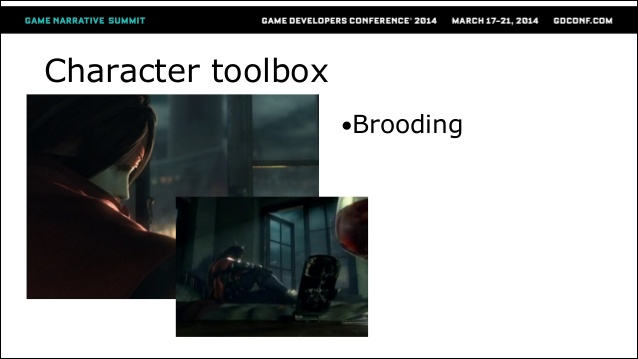
This is just my interpretation but what bothered me about this -- and the talk in general -- is the undertone that Clough's opinions and love of bishonen characters is "right" and to choose to create characters that don't appeal to her is "wrong". When you have sections called "who's doing it right?", it gives the impression that there's only one "correct" way of making sexually-appealing male characters. The same goes for when dimissing Max Payne as a brooding character done poorly while praising Final Fantasy VII's Vincent Valentine as a brooding character done well, while I would say the two characters are the other way around (although to Clough's credit she did use an image of Max Payne 3, which I've never played ... although after watching the first ten minutes on Youtube, that particular incarnation was one I could've done without seeing. What happened to all of Max's metaphors and similes? What happened to him making his peace with his family's deaths at the end of Max Payne 2?).
The problem with this assertion is that, obviously, there are women who find rugged male characters attractive and plenty of male gamers who don't relate to them at all. The opposite can obviously apply to bishonen characters, with not all female gamers being as enamored of them as Clough and it goes without saying that men can play as them without thinking twice about it. A female commenter on my last blog about Clough's talk actually said, "I never found the Sephiroth or Marluxia type of bishounen appealing.
Like maybe when I was 14." She also mentioned stumbling across some Call Of Duty yaoi once. If you have time, go to Google or DeviantArt and search for "call of duty yaoi". It exists!
It should be clear by now that there's no one big problem I had with Michelle Clough's presentation but a lot of small ones. For example, in my previous blog, I objected to Clough thinking that androgynous male characters were rare. Now that I've seen it, I've learned that the issue wasn't with sexualised being rare but them not being in any "core" games. To me, this led to a very muddled argument; firstly, Clough praised characters such as Thane (and others) in Mass Effect, which I would describe as a "core game". Secondly, she would go on to say "make sure sexualised characters are right for your game", before showing a mock-up of a Call Of Duty cover with a bunch of shirtless, muscular guys on the box, indicating an example of a game where it wouldn't be appropriate. I understand that Call Of Duty isn't the only "core" game out there but I would've been interested in hearing some suggestions from Clough. Thirdly, Final Fantasy VII was referred back to many times throughout the talk but the thing is ... the Final Fantasy series is still out there and still features androgynous characters. It's not exactly the fault of the developer that it's no longer the "core" series that it once was, so even though Clough is correct in that respect, it's also not through lack of trying that Final Fantasy isn't as popular as it used to be (or any game series for that matter; I'm sure most developers would give an arm and a leg for their games to be considered a "core" series like CoD or Assassin's Creed). So what point is being made by mentioning the lack of "core" games featuring sexualised male characters? Is someone to blame? Is it an example of how unfairly female characters have it in games, just because Square-Enix haven't been able to achieve the same success that they used to?
I don't want to ramble too much about this, particularly since it turns out I have as many criticisms as I do with the average Anita Sarkeesian video, but one final thing I noticed that disappointed me was how the slides on sexualised male characters were talked about with a light-hearted attitude while the rare occasions when sexualised female characters were the topic of conversation, Clough adopted a more serious tone; slides about Male Gaze,why sexualisation can be good while objectification is bad (focusing entirely on female characters, of course), comparing a male Starcraft character to a female one and comparing a shot of Jacob's buttocks in Mass Effect 2 to one of Miranda's were all treated as serious issues. Talking about male video game characters was the opportunity for Clough to crack some jokes and get a few chuckles from the audience.
My issue with that wasn't that jokes were being made at the expense of male characters. Having a funny presentation isn't the problem. It doesn't even bother me that the first talk about sexualised male characters ever wasn't taken seriously. Hell, you try condensing a subject down into twenty-five minutes when it's never been spoken about in such a prominent venue. It's not enough time to cover everything.
What bothers me is that it was purely from a feminist point-of-view. By that, I mean that Clough's stance wasn't one we haven't seen before. The idea of sexualised men was still a joke, in spite of Clough finding them appealing. In fact, it was considered a good thing, with Clough believing sexualised male characters could attract more women and gay men to gaming. Meanwhile, Clough reserved a modicum of seriousness when talking about female characters and I'd say the only time she mentioned them positively was in passing, when discussing how sexualised characters had to have traits other than their attractive appearance. Even then, it was glossed over, focusing on both Sephiroth and Tifa from Final Fantasy VII, rather than just Tifa.
I don't want it to seem like I'm against Clough having a feminist point-of-view just because it's a feminist point-of-view and give the impression that I'm foaming at the mouth with rage over it. I dislike it because it's a standpoint that seems dead-set against the idea that men can be portrayed negatively. One perfect example of it is when Michelle Clough mentions that when it comes to male nudity in games, it is always portrayed as "awkward or comedic". Hey, you'll get no argument on that from me. Where Clough and I differ, however, is where Clough sees the prominence of comedic nude male characters in games as being unequal treatment for women, as there were plenty of sexualised female characters but a lack of male ones, I see it as being unfair treatment of men.
This doesn't apply as much in games as it does in films, television shows and even real life but it's very rare for male sexuality to be treated as anything close to desirable, including in shows aimed at women; men are constantly portrayed as bumbling comedy figures when it comes to romance, someone for the down-to-earth female characters to roll their eyes at. Women are always portrayed as the desirable, effortlessly sexy party who useless male characters want to (and fail to) be with. Take a look at this advert from Wowcher in the UK for an example (which also portrays violence against men as comedy):
Or how about this advert for "Mullerlight Greek Style Luscious Lemon" yoghurt, which does show a male character as being desirable ... before he stumbles and the female main character (and narrator) laughs at his stupidity? I apologise but for some reason, the video isn't showing up when I try to embed it. Here's the link:
Then there's Harpic White & Shine, a lavatory cleaner. In this advert, a suave man in a white suit walks through some mist while words like "Dazzling", "Brilliant" and "Wow!" appear on the screen ... then he looks dejected as it turns out the words were referring to the lavatory cleaner and not him:
The reason I'm showing all of these television commercials is because Clough used a quote to make it seem as if the only reason why male sexuality is used as comedy is because "man is reluctant to gaze at his exhibitionist like". It's because of Male Gaze, in other words. However, these television commercials are all aimed at women; its "heroes" are female, the voiceover artists are female and hapless male figures are the butt of the joke. None of these adverts have anything to do with Male Gaze, so why does Clough believe that must be the case in games?
The funny thing is that treating male sexuality as comedy is actually the least offensive way of expressing a lack of desirability for men. When male sexuality is portrayed as being disgusting or even dangerous, it stops being comedy and actually creeps into prejudice; we end up with campaigns like "teach men not to rape", which is about as sexist as it gets and I'm not willing to go into it any further than that. This blog's long enough.
Finally, and this is a bit of a nitpick, but using Jin Kazama from Tekken as an example of a "power fantasy" when it comes to shirtless scenes? Literally any other shirtless Tekken character would've been a better option for Clough to pick if she wanted to make the "power fantasy" argument. Aside from Hwoarang, I'd say Jin fits Clough's criteria for a sexualised male character better than anyone else on the roster. He even has the same broodiness that Clough likes, which Namco Bandai plays up when Jin is the object of Ling Xiaoyu's affections:
Even though that ending turns out to be a dream, it's not that far from Jin's regular attitude.
I also have to point out something that I mentioned all the way back in September 2012; that Jin is one of several characters created to be a younger, better-looking successor to an existing character.
So like I said, it's nitpicking but I don't agree that Jin is close to a male power fantasy at all, particularly due to the standards that are usually used by feminists (Kratos and Marcus Fenix, for example).
Overall, and to summarise my problem with Michelle Clough's talk, in my previous blog on the presentation I gave her the benefit of the doubt because the topic of men being sexualised was never acknowledged. Now that I've watched the talk, I don't feel like it offered anything new at all. It didn't offer another side to the issue of sexualised characters, it just bolstered the position of the side that already controls the conversation on sexualisation (and other gender issues). And in spite of the fact that Clough was strapped for time, I have an unpleasant feeling that even if the presentation was twice as long, we wouldn't see sexualised male characters taken seriously (except to point out how good it is for straight women and gay men).
... The presentation was still more watchable than Tropes Vs Women though ...
-----
In other news, I finally took the plunge and joined Twitter. You can see my feed in the sidebar and I'm always happy for more followers.
You can also leave comments below or send me an e-mail at themalesofgames@gmail.com.
I know it's been another month without any activity and, unfortunately, I currently only have time to write another short post. Maybe I'll write a longer one over Easter.
The Game Developers Conference is currently taking place and on Reddit, I came across a link to a Game Developer's Conference talk called, "Fewer Tifas or More Sephiroths? Male Sexualization in Games". The description of it is short, so I'll just copy and paste the entire thing:
"Sexualized
female characters are hotly debated in the industry, but their
counterparts, sexualized male characters are rarely discussed, and even
more rarely written! This talk examines desirable men in video games,
how they contrast with current male character trends, and how they can
create a more welcoming atmosphere for straight women, gay men and
others. Attendees will learn how (and why) to move beyond "male gaze"
when writing male characters while avoiding "equal objectification."
We'll also discuss non-Western male idealization, traditional media
presenting men as fan service, and games that "get it right," to compile
a useful toolbox for writers and designers.
Takeaway
Attendees
will take away a greater understanding of how to approach writing more
desirable male characters, and why. Developers will have greater
awareness of how "gaze" affects character construction and design, and
writers will leave with practical, sex-positive tips and resources for
making male characters appealing to wider audiences."
If you're a long-time reader of this blog, you'll remember that I brought up how I had issues with sexualised male characters when I was a teenager. Regardless of whether you thought my issues were justified or not, you'll notice that the summary of the talk above speaks about male sexualisation in a way that would never be considered acceptable for female ones outside of an internet forum. The summary treats sexualised male characters as a positive in games.
According to the GDC page, there's a video recording of the talk but as far as I can tell, it isn't available online. I could only find two real pieces of information about the talk; the first is a Famitsu article, which features photos of each PowerPoint slide and gives the impression that the speaker, Michelle Clough, is actually very fair-minded about the subject (although if anyone can translate the article better than Bing Translator can, I'd be interested in reading the details about it). The second is directly from Clough's site and gives the exact opposite impression.
I don't want to make any assumptions about Clough's talk because those two sites seem to contrast each other; the photos in Famitsu's article suggests that Clough is sex-positive for both men and women rather than only being in favour of male sexualisation while her own site is very one-sided. Judging from the PowerPoint presentation alone, the talk itself seems to deal more with facts while the GDC summary and Clough's site both deal more with feelings. Come to your own conclusions about what the talk was actually like because at the moment, we just don't know.
As a result, the only aspect of this that can be properly examined is the way it is presented on the GDC site and on Clough's own website. I have plenty of objections to Clough presenting male sexualisation as, "[a way to] create a more welcoming atmosphere for straight women, gay men and others". I can't imagine someone being given the stage at a GDC conference to defend sexualised female characters with "hey, straight guys and lesbians like 'em!". When the world of gaming journalism has cast female gamers as a demographic to be helped and straight male gamers as an entitled, socially-awkward group who harasses anyone who isn't a straight male gamer like them, I can't see that argument convincing anyone. If anything, it would be taken as an example of male gamers being unwelcoming towards female ones, whereas praising the sexualisation of male characters is not treated the same way.
Likewise, I object to Clough's assertion that androgynous male characters are rare. Even in the PowerPoint presentation, she doesn't seem to stray outside of the Final Fantasy series except to show a piece of fanart (I assume) of Nero from Devil May Cry 4. It's not that Clough is wrong -- in fact, she's dead-on -- but if the way she briefly writes about "China, Korea and Japan" on her blog is anything to go by, it sounds as if she has a better grasp on Eastern games than most. I would've thought she would cast her net a bit wider when it came to selecting characters. Plus, I think Clough is a bit too dismissive of "the common Stubble McBadass archetype", as she calls it. It feels a bit too much like she's falling back on the idea that this archetype automatically appeals to straight men (which is not necessarily true) and nobody else (which is not necessarily true either). There's a good chance that young male gamers feel as self-conscious about those character archetypes as I did about bishonen characters in my teens.
I don't want it to sound like I have anything against Michelle Clough because, for all I know, her talk may have been completely fair about the sexualisation of both men and women. If anything, I have nothing but praise for acknowledging the fact that women are not the only sex who can be sexualised, contrary to popular opinion and the silly "male power fantasy" argument. I'd be very interesting in hearing more from her on the subject. It's simply the promotion of the talk that bothers me; with every single discussion about sexualisation in games being about how negatively-portrayed women are, it's difficult not to collectively roll our eyes and scoff when the one time the issue of sexualised men is brought up on a significant stage, it's about how positive it can be.
And not a male opinion in sight. That's part of the problem. Not that Clough shouldn't be allowed to speak but it's a men's issue. I think hearing how male gamers feel about it might be worthwhile.
Overall, I'm just disappointed in the GDC. Like I said, I can't imagine a talk like this ever taking place with the sexes reversed, especially if a male speaker wrote on his website, "I may have wanted an excuse to cram a slideshow full of Lara Croft pictures" and "how we can use sexualised women to greater advantage".
Also, I came across a few links on Reddit a while ago that should put the unproven "male power fantasy" claim to rest (although I know they won't). These articles feature some very interesting facts about how often men and boys suffer from body image issues:
That second one, in particular, struck a chord with me; it mentions that "by the age of eight children already had definite body ideals, which are
influenced by their peers, the media and gender stereotypes". The article goes on to say this is largely due to the influence of sports figures but, given that I was never interested in sports but gaming (particularly Final Fantasy) as a strong influence when I was around the same age, much of the article still managed to resonate with me. I also came across this infographic about eating disorders amongst men (I apologise for not knowing the original creator but if you leave a comment or send me an e-mail at themalesofgames@gmail.com, I'll be sure to credit you).
With these facts in mind, it's pretty clear that "muscular male characters are a male power fantasy" is a myth, existing solely to dismiss the issues of one sex while campaigning for the issues of the other. So regardless of Michelle Clough's love of sexualised male characters, I think the GDC, the gaming press and the industry needs to grow up and start telling the other side of the story.