Showing posts with label dragon age. Show all posts

Sunday, 20 April 2014

Comparing 2002 to 2014: How Have Things Changed?

This blog post features spoilers for The Wolf Among Us and Metal Gear Solid 2.

I apologise for not updating more regularly but, as you'll know by now, it's mainly due to college work building up at inopportune moments. The final five weeks are coming up soon and I sense that the assignments are all going to be crammed in at once. Plus, if that wasn't enough, I've been avoiding gaming sites like the plague because I was intentionally trying to stay away from any information about Dark Souls II, wanting to go in completely blind, so if any major news about gender issues in gaming cropped up, I haven't heard about it. I know Anita Sarkeesian accepted her GDC Ambassador award but I haven't watched her speech, and don't intend to.

Anyway, I'm finally able to finish this blog post that I started writing in early January. There'll be a few places where I write things like "lately" and "last week" but it's outdated in a few places. I even linked to the Penny-Arcade report at one point, which is no longer available. However, the majority of it was written today (and focuses on books from over ten years ago anyway), so it's not particularly important that it's a few months old:

Lately, I've had to scour a bunch of books on gaming as part of a written assignment, hoping to find anything that would help me with a hypothetical game proposal (e.g. - info on target audiences, costs, number of people in the development team, etc.). I found a few interesting perspectives from women working within the industry. Nothing groundbreaking but also not the typical opinions we read on gaming sites.

Marketing
"Additionally, as you’re proofreading, keep your audience in mind. Does the press release appeal to your audience? While your ultimate audience is the person reading the news, your first audience is the gaming press. Who are these people? Well, they’re males— mostly. When asked about the male/female ratio of game reviewers at Gamespot, Andrew Park noted that, “currently it’s infinity, which is what you get when you divide by zero.” While the age range of the gaming press is typically viewed as very young, Park reports the average age of Gamespot reviewers as mid-20s to early 30s. Aishoshi of IGN sees an age range of 16 to mid-50s. He also notes the male to female ratio as “about five males to one female over the course of our existence.” Take a glance down the editor photos in a PC Gamer and you’ll see a row of seven white, male faces and, at least at the time this article was written, one female face.

So, what does all that mean in terms of your press release? Not to say that these guys aren’t in touch with their feminine side, but your best bet will be to focus on the “dude!” elements of your story. How many levels? How many Mechs? How many weapons? Any intense bands on the soundtrack? While the number of female gamers appears to be growing, like it or not, until more women join the ranks of the gaming media, you should probably focus on the guy-appealing aspects of your game."
- Beverly Cambron, Secrets Of The Game Business (2002)

Last week, I was reading a blog over at Vicsor's Opinion about female representation in games and Vicsor brought up a game that I'd completely forgotten about over the last few months; Remember Me, the game that was at the centre of a Penny Arcade report about games starring female protagonists supposedly only being granted 40% of the marketing budget of a game starring a male protagonist. I don't think I mentioned that at the time but, if that's the case, it's pretty despicable that a publisher would actually designate more funding to games with male heroes. Yes, that is a significant case of women being held back in the games industry and everyone suffers because of it; we receive fewer interesting, varied protagonists and it shows a low opinion of the audience. Although I think it'd be interesting to see the budget breakdown of a game like Tomb Raider (2013), to see exactly how it can star a female character but need over five million sales to succeed. Although that's obviously the exception rather than the rule.

Vicsor's blog was in a similar vein. He took a look at the different representations of male and female characters and I like that we share the same opinions on varied characters. However, Vicsor did something that I can't believe so few others have thought to do, me included; look at the game sales. Although we'd need to look at more sales figures to see if there was a correlation, it did establish that in spite of the Penny Arcade report raising its stature, Remember Me still failed to sell. In spite of the criticism directed at cynical marketing teams, people didn't buy Remember Me to avoid turning the "people don't buy games with female protagonists" belief into a self-fulfilling prophecy.

The marketing and sales figures for games starring female protagonists is a chicken-and-egg situation; does a lack of marketing cause them to have low sales or do low sales lead publishers to give them a smaller marketing budget?

Beverly Cambron's quote above doesn't tell us anything we didn't already know but it's interesting to know that developers write press releases for the sake of the reviewers as well as the mainstream audience. It makes me wonder if and how marketing for games has changed since 2002. Part of me thinks that, with diversity and gender issues in gaming becoming a bigger issue, this kind of cynical stereotyping of audiences would've died down ... but with the prevalence of the "stubbled male protagonist, face-pointing-down, eyes-pointing-up" pose on box art, it feels like the opposite. As Cambron's quote above shows, this isn't an accident; it's clear that marketing teams know they're pandering to some "dudebro" audience and stereotyping gamers (particularly male ones) as a marketing tactic. Ken Levine said much the same thing when defending the box art for Bioshock Infinite, saying that the design was made following visits to "frathouses and places like that". The reason behind this is the same one that was directed at Anita Sarkeesian about why certain female portrayals and plot devices exist; because the games industry is a business, with developers intending to make money. It might be unfortunate but if something works, why change it? In fact, if the cover of Bioshock Infinite and other games are anything to go by, it must've been a marketing tactic that was so successful that developers begun to emphasise the "'dude!' elements" a lot more.

I have to admit, part of me also wanted to include the Beverly Cambron quote as a response to the people who used to tell me, "don't you know that negative male portrayals are made by men?!" as if that somehow made it justifiable. It's unrealistic to assume any situation in gaming we currently dislike is the fault of either sex specifically.

Currently, according to Beverly's Twitter feed, "My game industry days are (happily) over".

Portrayals & Character Design

"There are stereotypes that people in the past have gone with that we have moved away from now. I don’t know that it’s necessarily because we’re trying to appeal more to the female market, or whether we’re just growing up as an industry. In a role-playing game now you wouldn’t want to have a halfnaked barbarian girl be your reward for some victory or whatever. We try to keep really blatant sexism out of it. I think that’s come because we’re more grown up as an industry, but it may be because Stormfront in particular is very sensitive to gender issues. We always have been, from when the company started.

Still, we always try to make the player characters in games, the protagonists, feel heroic and be of heroic proportions. In other words, if I’m playing a game and I as a woman decide to play a male character, I don’t necessarily want to see a weedy, weak-looking guy. I want to play a big barbarian. And if I’m playing a female character, I want to play a very attractive, strong, dynamic-looking woman. I think no matter what gender a player character is, you want their representation on-screen to be heroic, to be superhuman. I don’t mean like Superman, but more idealized than a real human would be.

In game stories these days, stereotypes are being broken down a lot more. There aren’t just weak women and strong men. There are also strong women and weak men. There are evil women, there are evil men. It’s a lot more even. There are a lot more women in gaming now, more women players. So it may just be an evolution of the culture that we’re reflecting as well. I’ve read some figures that seem to indicate women players tend to dislike complex interfaces, and so it may be part of the broader movement towards making simpler interfaces that’s brought in a larger female audience."
- Sarah Stocker, Swords and Circuitry: A Designer's Guide to Computer Role-Playing Games (2002)

I think Sarah Stocker gets to the heart of what "escapism" is with these paragraphs. She describes exactly why we can (or should) accept exaggerated portrayals in games, in much the same way we do with comic book characters. I've heard female gamers on Youtube make the same comments about how characters of both sexes are exaggerated but it's refreshing to read these views from a woman actually working within the games industry.

I've been incredibly critical of the "male power fantasy" argument made by feminist critics in the past -- the idea that women in games are exaggerated because of sexism and objectification but men in games are exaggerated because "men want to look like that" -- and it's interesting to read Stocker's perspective on it. Unlike me, she supports the "power fantasy" argument but also states that it isn't gender-specific.

The theory that stereotypes are being broken down more and more is an interesting one. Remember that the above paragraphs were written in 2002 and, after a quick look at the games released in 2001 on Wikipedia, I can see why Sarah Stocker would make that claim. To be fair, I don't know when Stocker's piece for the book was written -- it could've been long before 2002, depending on how long it took for the book to be published -- but in 2001, we had prominent games such as:
  • Max Payne - Female antagonist.
  • Jak & Daxter - Male and female antagonist, featured a female mechanic as a supporting character.
  • Half-Life: Decay - The PS2 version of Half-Life, featuring an extra co-op mode where both playable characters were female.
  • Grand Theft Auto 3 - Female antagonist, "heroic" female criminals (such as Asuka, who provides the player with missions).
  • Onimusha: Warlords - Playable male and female characters, evil male and female characters, male and female damsels in distress.
  • Virtua Fighter 4 - Introduced female character Vanessa Lewis, with an unconventional muscular design.
  • Ico - Certainly broke stereotypes about protagonists and damsels in distress, making the player care about the characters involved.
  • Serious Sam - Parodied traditional stereotypes about big, strong, "manly" male heroes.
  • Alien Vs Predator 2 - Heroic male and female marines, female secondary antagonist in the marine storyline and, as in all Alien games, the Alien Queen is an antagonist.
  • Fatal Frame/Project Zero - Female hero, female antagonist, male damsel in distress.
  • Final Fantasy X - Several female protagonists, a female antagonist (Yunalesca), practically everyone is a damsel in distress at some point.
I'd also add Metal Gear Solid 2 to the list, since I think Olga, Fortune and Emma Emmerich are all strong female characters in their own way but that's more of a judgment call; they all die by the end of the game and I'm sure people would take issue with Olga being sexualised at the start of of the game (even though, y'know, the end of the game features the player controlling a naked Raiden). Oh, and there's also Oni, which has a female protagonist but I've never played it (so maybe she's portrayed horribly. Let me know in the comments if you've played Oni). I just thought I'd bring it up because that game looks awesome and I'm tempted to try it out ...

Anyway, what we should take away from all of this -- as well as the depression that comes from knowing we might never see a gaming year as good as 2001 again in our lifetimes -- is that Sarah Stocker's comments about stereotypes being broken is understandable because of the games on offer in 2001. I'm sure that people could just as easily point to Dead Or Alive 3 as an example of the opposite but that particular series skew the statistics regardless of the year we're looking at. As an example, if we look at the games released ten years later, in 2011, a Dead Or Alive game appears on the list again. It's fair to say that DOA is a series that is never going to break any stereotypes.

I'm not going to pretend that I've played as many games on the 2011 list as I have on the 2001 list but, from what I can see, I don't see as many stereotypes being broken. When it comes to gender issues, L.A. Noire, Final Fantasy XIII-2 and Batman: Arkham City seem to be reasonably by-the-numbers when it comes to stereotypical portrayals when it came to male heroes and villains -- sometimes remarkably, in the case of Arkham City -- but Dragon Age II and Uncharted 3 both featured female antagonists. The thing is, all of these games featured strong female characters (except perhaps L.A. Noire, from what I can recall), so that's certainly a quality that has stuck since Stocker's remarks in 2002.

However, when it comes to male portrayals, am I the only one who feels like things feel stagnant? The portrayals of female characters in Arkham City are very different from those in Final Fantasy XIII-2, which are just as different from those in Dragon Age II. With the exception of Nathan Drake -- a favourite protagonist of mine for being a character that doesn't take himself too seriously, which is a rare quality in the days where the "Stubble McBadass" archetype looms over the games industry (to use a term from Michelle Clough) -- I feel like stereotypes for men have become more entrenched rather than broken down. 2011 was also the year when we saw Call Of Duty: Modern Warfare 3 released, just to hammer the point home. The women are varied, the men are similar.

I don't want it to seem like I'm cherry-picking my examples here and this is by no means a comprehensive list or study; like I said, I haven't played as many games from 2011 and I'm sure that if we looked at the 2001 list, we could see plenty of examples of male protagonists that are incredibly similar to the ones picked from 2011. Unfortunately, it does feel like stereotypes are the order of the day for male characters. Why? Possibly due to a lack of a push for varied male characters as there has been for female ones or maybe it's for the same reasons that Beverly Cambron focused on the "'dude!' elements" and Ken Levine appealed to frathouse gamers; they're the characters that sell games. I find it hard to believe that having a few more male characters in the vein of Ico and a few less in the vein of gravelly-voiced Cole McGrath of Infamous would be the worst thing in the world. Although considering the difference in how those games performed, sales-wise, I may be wrong ...

As an example of how male stereotypes are still alive and well in the games industry, let's take a look at a series that is ongoing right now; The Wolf Among Us from Telltale Games, developer of The Walking Dead. Similar to TWD, The Wolf Among Us is released in different "episodes" and, as of the latest episode, there's only one female villain but every single adult male human character is a scumbag in one way or another. Whereas the women are level-headed, independent, strong-willed and often victimised, the men are pimps, thugs, torturers, murderers, perverts, thieves and stalkers. Again, it feels like stereotypes have been broken down for women -- who are often portrayed as just trying to make a living -- while the men are just brutish or slimy, fighting each other rather than getting things done. The women are mature, the men are neanderthals.

One final thing about that Sarah Stocker quote. This last part:

"I’ve read some figures that seem to indicate women players tend to dislike complex interfaces, and so it may be part of the broader movement towards making simpler interfaces that’s brought in a larger female audience."
I only included this due to the long-standing rumour that Anita Sarkeesian felt "a lot of female did not get into [Mirror's Edge] due to its difficult control scheme". I certainly don't believe that difficult controls will prevent any gamer, male or female, from playing a game -- and I'm not the only one -- and I think it's insulting towards female gamers to suggest that it is. However, I've pasted Sarah Stocker's quote about interfaces anyway, just because I thought it was relevant. I should also point out that it's not clear whether Anita did or didn't say that line about the controls in Mirror's Edge; due to the fact that she doesn't allow people to film her talks about gaming (only the talks about harassment), we have to rely on second-hand information and then wait for Anita's inevitable "don't believe everything you read online" tweet.

Sarah Stocker is formerly of Stormfront Studios and, as far as I can tell, currently works as a senior producer for Sony Computer Entertainment America.

*

Even though I haven't written anything for a month, I still read everyone's comments. I've had some very interesting ones lately, even though I haven't responded to them, so thank you for commenting. It's much appreciated. Feel free to do the same below or e-mail me at themalesofgames@gmail.com

Thursday, 21 March 2013

Men are the Expendable Gender

Sorry I haven't updated for a while. I know I'm a slow updater anyway but I was sick all of last week.

It's a given that if a game developer needs some generic enemies to kill of in a game, men will be the ones to fill the role. Unless the game features monsters as the primary enemies, men are the ones who will be the main victims of the hero's gun-toting, sword-swinging adventure.

It's no secret why this is the case. If I may wear my Anita Sarkeesian historian hat for a moment, we're used to society portraying men in combat roles. In real life, men make up the majority of soldiers and the most hazardous jobs are performed predominately by men. In popular culture, we see men being gunned down by James Bond in movies, Jack Bauer on television and The Punisher in comic books, just to list a few examples. Of course, they occasionally fight a female villain or two but the average person they shoot or beat up is male. The standard enemies, usually without names and who only serve to provide token resistance for the hero, who quickly kills them to show off his/her abilities. It's so frequent and the audience is so used to seeing it by now that we don't bat an eyelid when they die. This is part of being expendable. The same goes for enemies in video games.

Right away, I'll say that this isn't necessarily a bad thing. I don't want it to sound like I'm crusading against violent games or even ones that predominately feature men as enemies. That attitude leads to things like the German version of Half-Life, which featured robots instead of marines (as well as no blood and doctors/security guards who sat down and shook their heads instead of dying). It's completely fine to use men as enemies in games. They're as good as anyone else, such as women, monsters, robots, etc.

The key words there are "as good as". The problem is when game developers go out of their way to portray violence against men as more acceptable than any other victim of it.

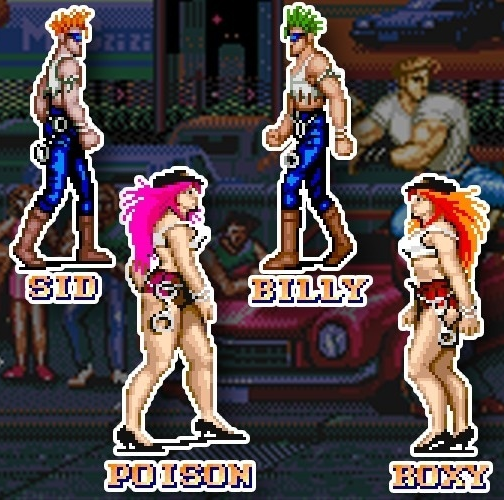
For example, back when the side-scrolling beat 'em up Final Fight was released in 1989, the Japanese version of the game featured two female enemies called Roxy and Poison. For the American release of the game, Roxy and Poison were removed from the game and replaced with two male punk characters called Sid and Billy, because "hitting women was considered rude". It was originally suggested that Roxy and Poison be considered male-to-female transsexuals -- this is how the famous confusion began over Poison's sex -- but supposedly, Capcom's developers figured that "wasn't enough" to deter critics of the two female enemies (wisely, in my opinion) so they replaced them entirely.


There's a site I found that has a good name for this trend; "Sidbillies". The writer of this article at ScrollBoss shows examples from other nineties' games like Sonic Blast Man, Ninja Warriors Again and Sunset Riders. The most interesting game mentioned, however, is Final Fight 2. The reason being that the second game in the Final Fight series had a playable female character, Maki. So it seems like the Final Fight series was embracing equality for the first time, having both heroic and villainous male and female characters ... but once again, the female enemies, Eliza and Mary, were removed in the American version and replaced with male ones, Robert and Leon.

In a way, this is actually worse than the German version of Half-Life replacing the marines with robots. That was done because someone determined that violence against human beings was completely wrong, so the human enemies were replaced with something non-human. It was ridiculous but morally, I can't fault them for it. The makers of Final Fight (and the other games listed on ScrollBoss) decided that violence against women was wrong ... but violence against men was completely fine, or at least more acceptable. It's one thing for this to be the case in the first Final Fight, where the three playable characters were all male, but it's quite another in the second, where one was female. You could justify having Sid and Billy in the first game if you were wary about encouraging male-on-female violence. The flipside to that, however, is because there's a female playable character in Final Fight 2 but there are no female enemies, Capcom are inadvertantly encouraging female-on-male violence. It makes me wonder why Maki was left in the game at all; is beating up men as a woman considered progressive in a way that men beating up women isn't?

Capcom aren't the only ones guilty of this and it certainly didn't die out with 2D games. Even though sprites are gone, so female characters can't simply be papered over with male ones, developers have come up with a much easier way of avoiding controversy; leaving out female enemies altogether. 

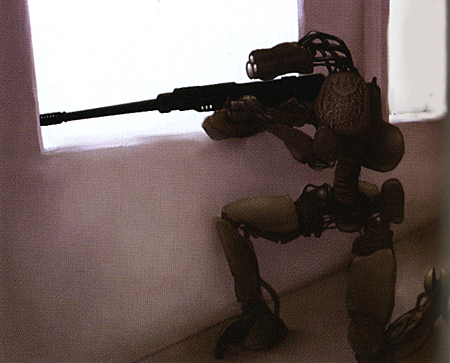
Lots of game developers seem to have (figuratively) taken their cues from Final Fight 2 by doing this. Back in one of my first blog posts, I said that the villainous Civil Protection in Half-Life 2 probably did feature women in its ranks but their voices were altered and their feminine physiques hidden underneath the Civil Protection’s bulky security outfits (or perhaps their bodies were altered too). However, this doesn't let Half-Life 2 off the hook because they still appear to be male to the audience, while the good guys -- resistance members -- feature both men and women in their ranks. During development, Valve apparently intended to make the Overwatch Sniper enemy female but, looking at the concept art, there's very little there that I could describe as "female". It looks very robotic, so there aren't many female qualities to be found. Unlike the Civil Protection in the final game, who still look human, act human and fall like human beings when they're killed.

An argument that I've heard both for and against female soldiers in games is about realism; people opposed to them argue that it'd be unrealistic because women only account for a small percentage of the military in real life (and only now in the US are being considered for combat roles). People in support of female soldiers in games point out that realism isn't really an issue when you're dealing with fiction, at least in a lot of games.

Personally, I think the realism argument doesn't make sense for either side when you think about games like Final Fight 2, Half-Life 2 or Final Fantasy VIII, which all featured female characters on the good side but only male characters on the evil one. Unless the developers of these games intended to make the villains out to be huge misogynists -- which they didn't -- there's no real reason for female characters to only be on the heroic side.

I would love to see more generic female soldiers and warriors in games, particularly on the opposing side. Because as it stands now -- and not just in the games mentioned above but Uncharted, Metal Gear Solid, Mercenaries, Tomb Raider and many, many others -- we're used to seeing men being killed. In all of those games, it's our objective to kill men, and only men (excluding the occasional boss). This is developers treating men as disposable and unimportant. So the realism argument falls flat when one side is single-sex and the other is co-ed. It's very unrealistic ... but it's also completely sexist because men are the only ones the player is meant to kill. That overshadows the realism argument.

Interestingly, Bethesda came up with another way to emphasise male disposability when making Fallout 3. One of the perks -- special abilities the player character could earn when levelling-up -- available to the player was to cause ten percent extra damage to characters of the opposite sex. However, because there were many, many more male enemies in Fallout 3 than female ones, the perk was a lot more useful if playing as a female character. It's minor but nevertheless puts a greater emphasis on killing men than women. As a result, two extra perks were added to Fallout: New Vegas to award the damage bonus against members of the same sex.

The Lady Killer and Black Widow perks.

Surprisingly, EA is one of the few developers I've seen with a decent split when it comes to the sexes of enemies in their games. Mass Effect, Dragon Age and Kingdoms Of Amalur: Reckoning all seemed to have a fair balance between male and female enemies (as well as aliens and monsters). Of course, Mass Effect heavily influenced the other two but they're all separate games nonetheless. They all serve to treat women the same as men.

There's an alternative to having an even split between male and female enemies; making everyone in the game only male or female. Surprisingly, it's not as crazy as it sounds. Starhawk only featured a single female character (who picked up a gun and joined the battle towards the end of the single-player mode, just like the men) but it worked for the setting; Starhawk was going for a "space western" theme and, given that most gunslingers were male, it suited the game. All the enemies seemed to be male too but they were just monstrous enough that it didn't really matter. Hunched over, with odd skin colours and bones that were on the outsides of their bodies. However, even though Starhawk managed to make it work, I wouldn't recommend it for every game. Although even that was better than emphasising male disposability with male enemies and mixed heroes.

Long story short, the idea that it's more acceptable to kill one sex over the other disturbs the hell out of me and I hope to see more female enemies in games in the future. This isn't a case of a lack of women in games anymore, as it was back in the days of Final Fight. Gaming has evolved to a point where women are in games now ... but developers are paranoid about making it the player's job to kill them in the same way they kill men.

To close, here's Lara Croft brutally killing men. Enjoy! 


Wednesday, 26 December 2012

Something pleasant for Christmas

First of all, Merry Christmas to all my readers!

I apologise for the lack of updates for the past two weeks. Between illness (yes, I'm still unwell) and some other duties I've had to take care of, I haven't had much time to blog. The length of my last one made me feel like taking a break anyway, so this one's going to be much shorter than usual.

Since it's Christmas, I thought I'd write about something positive rather than the frustrating and depressing issues I usually write about. For my birthday this year, I received Dragon's Dogma as a gift.


It's not an understatement to say that Dragon's Dogma may be my favourite game of this console generation. It's exactly the kind of free-roaming fantasy RPG that I'd always wanted to exist but never did. It was billed as a kind of cross between Dark Souls and Shadow Of The Colossus but there's so much more to it than that. It has my favourite character creation system of any game, allowing you to create characters who are tall, short, fat, thin, dwarves, elves, etc. You don't pick specific races like in other games but you can use your imagination to say "my character is a hobbit" because you have the tools to make one. There's a wide range of fun abilities that you get to control in ways that you don't in, say, Dragon Age, Fable or Skyrim. There's a feeling of freedom -- and, more importantly, fun -- when it comes to the combat that those games tend to lack.

Also, I was really glad to see a fantasy game that doesn't feel bogged down with mythology. Along with Dark Souls, it's one of the few fantasy games that doesn't beat you over the head with the names of various gods, races or countries of the world. It just puts you down in a fun environment and lets you play. I don't know about the rest of you but that's very appealing to me. I've played far too many fantasy games where the developers seemed to care more about making a fictional world than making a game. Dragon Age and Kingdoms Of Amalur: Reckoning are particularly guilty of this. Every person you talk to can't resist lecturing you on the customs of certain races or the terrible war that was fought ten years ago.

So Dragon's Dogma is a great game. In my opinion, it should be held up to developers as a prime example of why creating new IPs is a fantastic idea. I know Capcom face a lot of criticism nowadays for on-disc DLC and so on but when they get it right, they really get it right.

And then there's the cherry on the cake. Let's say you're playing Dragon's Dogma one day and one of your pawns -- your followers -- decides to speak up with advice, as they often do:

... Wait, what!?

Sorry about the quality. It's the best I could get off Youtube. I don't think anyone will have difficulty reading it but just in case, it says:
The Westron Labrys's base... Their leader is an infamous misandrist.
That's right, misandry was acknowledged by name.

For those who've never played Dragon's Dogma and who are curious, the misandrist in question was a woman named Ophis, who led an all-female bandit gang. You can perform quests for her and she doesn't actually have any misandrist dialogue, so it's not that big a deal. However, her all-female gang will attack you on sight if your party has any male members. This can be avoided by equipping them with dresses, which is actually quite funny. I imagine some of my readers might worry about the men being made the butt of the joke here but I wouldn't worry about it; the fact that Capcom, unlike other developers, went out of their way to include female enemies in Dragon's Dogma is the more significant point here, in my opinion. The female bandits are considered just as villainous as the male ones and will even attack an all-female party everywhere outside their encampment. Plus, I'm of the opinion that games could benefit from more crossdressing. It's a nice option to have.

Of course, misandry being acknowledged is the most important point of all here. I doubt it'll open the floodgates to more mentions of misandry in the future but it scores some serious points for Dragon's Dogma.

Merry Christmas everyone! I'll be back early next year.

Sunday, 14 October 2012

Nerdbaiting!

I came across an article a few weeks ago that I want to write about here but I have to give a bit of context first. There was a writer on Destructoid by the name of Ryan Perez. At some point, he Tweeted that he believed that actress, writer and internet "celebrity" Felicia Day was "a glorified booth babe" and asked the question, "does she actually contribute anything useful to this industry, besides retaining a geek persona?". After a massive outcry from many, many of Felicia's friends, fans and coworkers, Ryan lost his job. I'm not going to go into that too much because, (A) it happened four months ago and (B) I'm more interested in what happens in games than what happens outside of them. Although that piece of information will come up later on and on the off-chance that Ryan Perez ever reads this blog, he has my sympathies.

With that out of the way, let's get into the main point of this blog; what is nerdbaiting?

You know how a game comes along every so often featuring a character modelled on and voiced by a real-life actor or celebrity? Quantic Dream did this for most of the characters in Heavy Rain, for example, and they've picked out Ellen Page for its spiritual successor, Beyond: Two Souls. Other examples include Max Payne's character model in the second game being based on actor Timothy Gibb and, if I remember correctly, there was a Playstation 1 game called Apocalypse that starred Bruce Willis in the lead role. So this has been going on for a while.

Nerdbaiting has a few definitions but the one that has to do with gaming is connected to the paragraph above; imagine if the celebrity chosen wasn't based on their star status (like Page and Willis) or because they were right for the role (like Gibb and the Heavy Rain characters). Imagine if they were chosen just because they had a certain significance to a portion of the gaming audience.

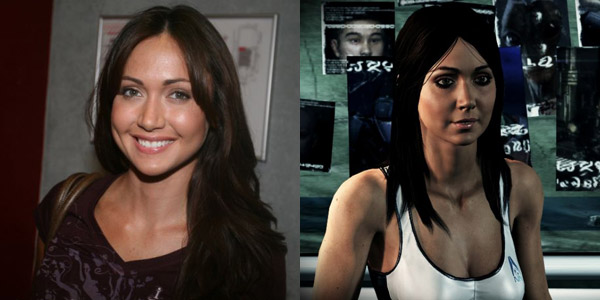
Much like Jessica Chobot, on-camera host and staff writer for IGN. She has also made appearances on G4 shows and writes a blog for Maxim. The character of Diana Allers in Mass Effect 3 was modelled on and voiced by Chobot.


There were only two reasons for Chobot to be chosen for this role; firstly, because BioWare wanted to appeal to IGN and secondly, to appeal to the tiny segment of the audience with a love of Jessica Chobot. I hate to make assumptions but I suspect the majority of Chobot's fans follow her work for IGN most closely and, of course, IGN deals with games, comic books, etc, so it's safe to say that it's a fine site for "nerds" to hang out (and I use the term positively. I'd describe myself as a nerd). Chobot has no acting or voice acting experience but was chosen to play Diana Allers nonetheless.

It's worth mentioning that Diana Allers plays no role in the Mass Effect 3 story. From what I recall, you don't need to talk to the character at all. Yet, in true Mass Effect fashion, you can completely pursue a romance with her. More on that later.

Then we have Felicia Day, who is a more acceptable choice in one respect ... and a much worse one in another:


Felicia Day is as sensible a choice for a video game voice actress as anyone else as, unlike Chobot, she's a professional actress and has experience as a voice actress. The top picture above is from an online web series she wrote and starred in called Dragon Age: Redemption and the picture below is the in-game model of Tallis, the character she played, in a Dragon Age expansion pack.

Now, strictly speaking, I have nothing against Felicia Day. I have no opinion of her, in fact. However, she was the focal point of Ryan Perez being removed from his position as a writer for Destructoid. As mentioned earlier, shortly after describing Day as a "glorified booth babe" and questioning what she added to the gaming industry, everyone from random Felicia Day fans to her coworker Wil Wheaton banded together to arbitrarily brand Perez' comments "misogynistic". Those comments were not misogynistic in the slightest. "Booth babe" may have been used derogatively but was it so bad that it was necessary to instigate a witch hunt (that really is the only suitable term for it) against Ryan Perez? Absolutely not. As far as I know, Day herself didn't respond to or comment about the Tweets from Perez and I commend her for not getting involved. I may be wrong about that, however, so feel free to correct me if so.

So, to recap, that's wealthy Star Trek and The Big Bang Theory alumni and reader of audio books, Wil Wheaton, leading the charge to have a man fired for making non-sexist comments against his co-worker.

This article at AVoiceForMen spoke on it further and is where I first learned of the issue, so you can go there to read more. I posted this back in my article about Anita Sarkeesian and Feminist Frequency but it's worth posting again. Make sure to watch the "4 Friendly Reminders About Women and Video Games" video posted in that article too. The final thing I'll say about this whole issue is that it made me completely ashamed to be a gamer. Getting a man fired goes far beyond a fandom reacting negatively to their favourite celebrity being criticised. It was downright amoral and, as I said before, a witch hunt.

Anyway, what does all this have to do with nerdbaiting? To answer that, we have to go back to the article I mentioned in the very first sentence of this blog. I came across an article a few weeks ago when looking for details about the Ryan Perez issue. I'm not going to link to it here because I don't want to give them free publicity -- even though their site is undoubtedly more popular than my little strip of rantings and ravings -- but if anyone dislikes that I don't provide a source, I'll be quoting directly from the article, so you can probably find it by using one of the sentences to search yourself.

First of all, the writer of this article actually made a couple of points I agreed with. "I don’t believe a woman’s place is anywhere other than where she wants to be," cropped up early in the article. Very good. "Now the question here is whether or not Perez would still be employed by them had he not caught the attention of people like Wheaton and Baldwin. The answer is, yeah, heprobably [sic] would," came later. Not half bad. Unfortunately, those are the only good things in the article. That's it.

To give you a quick rundown of what's said, the writer makes the same Tomb Raider/Hitman Absolution argument that I criticised in my second post on this blog. In his few paragraphs about Anita Sarkeesian, he had the typical reaction; acknowledging the abuse but none of the legitimate criticisms or concerns about her project. In fact, he actually said, "I will click the like button on every single video Anita Sarkeesian produces even if she says something that I completely and absolutely disagree with". He approved of Perez' firing. He used Hostel 2 as an example of sexism in Hollywood without acknowledging Hostel 1. Oh, and he stated "videogames are inherently misogynistic" towards the end.

Criticising all of the above would be pointless. While I've already written about a couple of the points, the "videogames are inherently misogynistic" line is what makes me just dismiss this one out of hand because the writer of the article and myself are operating on two completely different wavelengths. However, there is one paragraph from the article that I do want to closely critique, and that is the following about Ryan Perez' question about what Felicia Day contributes to the gaming industry:

I really shouldn’t have to explain this, but considering the amount of crap I’ve had to wade through while researching this bloody thing I’m going to anyway - it really is a very, very stupid question. Because Felicia Day is an actor. Not a game designer. Not a developer. Not a publisher. She’s an actor. So of course she doesn’t contribute to “the industry” by decoding the bugs from CoD or coming up with new and interesting ways to use a Wii nunchuk. Instead she contributes to gaming by, and pay attention because this will turn your entire life upside down, being a successful celebrity who happens to really like video games. She is a walking embodiment of all that should be right with gaming culture. She’s charming, articulate, and has a genuine passion for pixelated entertainment. Also she defies stereotypes of what a gamer should be, simply by being Felicia Day. In the seemingly never ending war between a mainstream media that will all too often portray gamers as hairy palmed, sweat filled, butter balls, Day is one of the few people walking the planet who is actually doing it right. She proves you can be successful, have social skills, and yet somehow also be a fan of video games at the same time. That is her contribution. She’s an ambassador for the rest of us.

Alright, let's look at this closely, particularly the second half. "She is a walking emodiment of all that should be right with gaming culture" and so on. From that point on, not only does this read as a rather creepy love letter that a stalker would shove through a letterbox, but it also does an absolutely wonderful job of summing up exactly why nerdbaiting is so insulting.

Let's compare Felicia Day to the people the writer compares her to; the "hairy palmed, sweat filled, butter balls". While the writer of that article was using them as an example of what the mainstream media thinks of gamers, the writer himself apparently agrees; "Day is one of the few people walking the planet who is actually doing it right". So those of us who aren't Felicia Day -- those of us who apparently lack the success and the social skills, in other words -- we're all doing it wrong and should bow down before the Almighty Felicia. And if we don't? We might just get fired too!

Now let's say that one of these "butter balls" was to write some Dragon Age fanfiction. Presumably, it'd sit on a website for a while and gather some comments. When a random gamer does something like that, that's what happens. When Felicia Day writes fanfiction? It's turned into a webseries and Felicia earns a Dragon Age expansion pack devoted to her character. Frankly, even the most successful Dragon Age fanfiction couldn't reach that height. Even if the writer was successful and had social skills, do you think he or she would get his/her own character in the game modelled on him/her if they were a "hairy palmed, sweat filled, butter ball"? Is there any chance of that happening?

Make no mistake; Felicia Day was not chosen for Dragon Age: Redemption or Dragon Age II's expansion pack just because she's an actress and voice actress. She was chosen because she is that popular amongst gamers (to the point that her co-workers were able to rally enough people to get a man fired). She was chosen because she's "nerdy". She was chosen because she's "hot". The same can be said for Jessica Chobot. Why isn't Geoff Keighley of GameTrailers appearing in any games? He's charming, he's articulate, he's good-looking! But as of this writing, he's yet to make an appearance.

So is it any wonder that -- surprise, surprise -- not everyone is going to shower Felicia Day with praise the same way the writer of that article did? It's nothing to do with petty jealousy over Day receiving the recognition and preferential treatment that, say, other Dragon Age fanfiction writers don't. It's simply the dislike that comes from the assumption that we should be in love with Day just because she's an attractive girl who likes gaming. That's why Ryan Perez was fired. He didn't. The same goes for Jessica Chobot, albeit to a lesser extent. She was just there because ... why not? Attractive, nerdy, popular. Bearing all this in mind, what's wrong with segments of the gaming population feeling insulted by their inclusion in Mass Effect 3 and Dragon Age II? Are we supposed to be happy about the developers painting us all with the same brush? Assuming we'll all love Felicia Day because we're all nerds and she apparently appeals to us? Sorry but that's blatant nerdbaiting.

As a bonus, it's worth pointing out that both of the games featuring these women allowed the player character to also pursue a romance with them too. This is going to sound very cynical but I can almost imagine an advertising campaign that says, "hey nerdy male gamer! Have you ever wanted to date a hot nerd girl like Jessica Chobot or Felicia Day? Well now you can!" Of course, that didn't happen.

I know that people reading this will take into account that both of the games above were made by BioWare, so these are actually isolated incidents. You're right about that, completely. I don't want to make out like this is indicative of gaming at large or in any way an epidemic. At the same time, I don't want this to become a wider issue. I'm actually using "nerdbaiting" in a lesser-used context; I've heard it used more often to describe something minor, like an internet meme being quoted in a game to make the "nerdy" players who get the reference laugh. So keeping in mind that this form of nerdbaiting is actually very rare, I want people to take two things away from this blog:

A) Developers; stop trying to so blatantly appeal to nerds with someone you perceive to be a popular (female, attractive) nerd icon. It's insulting to men and it's insulting to women. Use someone more appropriate for the role.
B) Gamers; reel in the rabid fanboy/girlism a bit. That doesn't go for many of you, obviously, but you might want to reconsider the next time you decide to start a backlash against someone just because they don't share your opinions.

I think that's it. As always, you can leave a comment below or send me a message at themalesofgames@gmail.com. I'll just leave you with one final thought from the writer of the article you've been reading about in this blog:

And when the history of games is etched in to stone, Felicia Day will probably be deemed to be more important than, oh I don’t know, an ill-conceived reboot of Tomb Raider.

... Yeah ... let's wait and see how that one works out ...