I wrote about damsels in distress last time but didn't write all I wanted to on the subject. I've been thinking about it quite a lot since then and have some thoughts I wanted to bring up.
In video games, as well as television shows, films and comic books, there's this idea that women are a motive for men to save the world/defeat the bad guy. In my previous blog post, I used this in reference to damsels in distress but it happens in other situations too. For example, I know comic book readers will be familiar with the idea of "women in refrigerators"; for those who have never heard of it, it's the idea that a female character is killed off solely to create drama for a male character. She becomes a plot device rather than a character in her own right (she lacks agency, something I wrote about in my last post). I'm not going to go into the concept any more than that -- this is a blog about video games rather than comic books and this is just an example anyway -- but just for the sake of this example, let's assume that the "women in refrigerators" concept is completely flawless. The reason it creates drama is because the woman is the catalyst for the man to do something, even if that "something" is get depressed. The problem is that a man is dependent on a woman for mental and emotional stability in this situation. He relies on her and that's what I want to write about today.
Having said that, "women in refrigerators" and women dying in general isn't a good example for this; that should illicit a strong reaction and it often does when male characters die too, right? Not only that but for me to criticise the lack of independent male characters in video games when female characters are being killed off left and right would be rather hypocritical; in my last blog, didn't I write that it irritated me that men were treated as expendable so often in games but feminist critics focused on women's lack of agency instead? So that's why I used the qualifier "let's assume that the 'women in refrigerators' concept is completely flawless". Because actually, it's very flawed. Not only does it ignore male character deaths for the same reasons (or trivialise them, or try to justify them) but has also been blown out of proportion by fans, often branding all female character deaths as examples and even rarely to the point where comic book fandom can deem a mischaracterisation or reducing a female character's exposure in a superhero team book to be an example of "women in refrigerators".
However, it's a fine example of a lack of independent men. So how does this apply to video games?
Well, think about the heroes who save damsels in distress. Mario. Corvo. Crash Bandicoot in his very first game, before Naughty Dog wised up and made the sequels' plotlines about saving the world instead. I briefly went into this about Dishonored but the damsels in distress in these situations are characters that feminist critics would describe as lacking in agency. Like I said last time though, how can Corvo be considered to have anything resembling "agency" if he lacks any mental and emotional independence? How can Mario and Crash?
These characters need their damsels in order to function as effective heroes; without the women, they're nothing. They may as well not exist. They are entirely reliant on the female characters in this situation. Maybe not physically, but certainly emotionally. It's the bumbling sitcom dad, needing his more-intelligent wife to constantly bail him out of the mess he's got himself into. He's reliant on her just like our heroes require the women in these situations to make them the heroes they are.
The women's necessity for mental and emotional stability is even there when men aren't involved. Let's go back to my old favourite, Heavenly Sword. Before the final battle, Nariko basically states that she only fights for Kai, her sort-of-adopted little sister. While Kai was very briefly a damsel in distress, she's also proven herself to be a more capable fighter than any of the all-male clanmembers, who also serve as damsels in distress at one point. She proves herself to be a more capable fighter than Nariko's father and the clan leader, Shen, who is a male version of a damsel in distress too. Nariko fights for none of them, even though they're more in need of her help. In fact, after Kai fends off Shen's attackers, she cartwheels right past him to go and help Nariko. Shen has no value; he provides no emotional or mental stability for either of the female heroines by that point. They look out for each other and nobody else.
Before anybody thinks that I'm just picking on Heavenly Sword (again), it's not the only one. Let's look at Final Fantasy XIII and its sequel, XIII-2. Lightning and Snow do everything for Serah, who is Lightning's sister and Snow's fiancée. This, in spite of the fact that Lightning spends a large chunk of the game partnered with Hope, a teenage boy who could really use her guidance rather than her cold indifference. Fang and Vanille are two women who are insanely protective of each other. In XIII-2, both the hero, Noel, and the villain, Caius, are set on their quests because of their adoration for Yuel, a teenage girl. The only male character from either game who earns this emotional/mental stability value is Dajh, the son of Sazh, and that's probably only because he's an innocent little boy. None of the other male characters receive this sympathy.
This even applies to female characters when it makes little-to-no sense; in the first inFamous game, Cole McGrath split up with his girlfriend, Trish, before the beginning of the game and runs into her a few times throughout the story. Even if you're going for an altruistic playthrough of the game, Trish is incredibly standoffish towards Cole. And if you're going for an evil run of the game, he still mourns her after her unavoidable death. She earns sympathy because she's female, nothing more. Her negative qualities are ignored and Cole, dependent on Trish for his emotional stability, is shown to be so smitten with her that it's remarkable he doesn't scribble "Cole + Trish 4 Eva" in a notebook during cutscenes. Again, a male character who is physically independent but mentally and emotionally helpless.
You might be wondering what my big problem with this is. I'd like to say that I'm not necessarily saying that the portrayal of men in these situations is worse than women so frequently being damsels in distress (although they don't always have to be damsels, as mentioned above). Over the course of debates with people online over men's issues, the phrase has often come up that "this isn't a zero-sum game". That's correct, of course. It isn't. Where feminists and men's rights activists differ is they have different opinions on which sex is in more urgent need of help, or believe that solving the problems of one sex will go further towards helping the other than just focusing on that sex in the first place would.
The problem is that female characters are motivation for others to continue on/succeed at their quest, in a way that male characters aren't. There's been such a huge rallying cry for characters who fit into the "strong, independent woman" archetype over the past fifteen to twenty years. Yet for all the talk of sexism not being "a zero-sum game", there's been no criticism of developers who make these male characters that basically pander to an outdated form of chivalry. The criticism of damsels in distress boils down to the idea that the female character shouldn't need a man to rescue her. However, the opposite isn't true; "men need women" is the message being sent out by a lot of these games. While our media happily hands women the "you don't need a man" attitude that is routinely applauded, even heroes in games -- and films and television series, lest we forget -- are tainted by developers that think the purpose of men is to cater to women. The men lack independence even while there's been a huge push for -- and focus on -- "strong, independent women". So if fixing gender issues isn't "a zero-sum game", why wasn't this male emotional dependence on women decried along with women's physical dependence on men?
If fixing gender issues isn't "a zero-sum game", goodness knows what it'd be like if it was. As always, leave a comment or send me a message at themalesofgames@gmail.com
Sunday, 25 November 2012
Saturday, 17 November 2012
No "Off Switch"
PLEASE NOTE: This post contains spoilers for Dishonored.
This one's not going to be an analysis of men's issues in video games but I'd like to spend at least one post writing about what goes through my mind when I come across a sexist issue in games. I started thinking about it when I saw this Tweet from Anita Sarkeesian:
Other games might have a different effect. If there was a sequel to Heavenly Sword, I'm confident that I'd think back to the sexism in the first game because it was so prominent. If the trailer for Metal Gear Solid: Ground Zeroes suddenly showed Meryl (which I know is impossible because of the time period), I'd probably think back to her misandric behaviour in Metal Gear Solid 4.
However, for the most part, gender issues don't cross my mind while purchasing games. I get the feeling critics of men's rights would say something along the lines of, "well that's because there are fewer men's rights issues to worry about in gaming" but the answer is simpler than that; I see games as entertainment first and worry about the gender issues second.
So I don't consider gender issues before buying the game, which leaves me to do it while playing, when it occurs. It isn't ideal, since real-life issues tend to take you out of the game's universe, but it can't be helped. There isn't an off switch where you decide not to consider gender issues. I'll give you an example of when this happened to me recently, with Dishonored. There will be spoilers ahead, so only read if you've completed the game or don't care about the game's story being spoiled.

Basically, Dishonored is about a group of evil politicians who conspire to murder an Empress and frame her Royal Protector, Corvo (the player character), in order to seize power for themselves. As Corvo, your job is to subdue or murder all the conspirators and rescue the Empress' daughter, Emily, so she can ascend to the throne.
Corvo isn't alone in his plan to save Emily. He's joined by the Loyalists, people who believe that Corvo wasn't responsible for the Empress' murder. Around three-quarters of the way through the game, the big twist is that the Loyalists betray Corvo because they want to further their own interests too.
At first, this took me out of the game because the "main" Loyalists were all male, so it seemed like we were going down the "all men are scumbags" route once again. It was as if Corvo was being set up as the only good male in the game, solely because he was loyal to women (the Empress and Emily). Luckily, this wasn't the case; the game changes depending on whether you cause a lot of chaos or not and in my Low Chaos playthrough, three male characters remained heroic. So it seems like I was worrying over nothing.
If anything, Bethesda, the makers of Dishonored, seemed to make an effort to avoid gender issues in Dishonored. As well as making sure there was a reasonable mix of good and evil with the men, they did the same with the women (although the evil men outnumber the evil women by a long way). While Emily is kidnapped twice in the game, two men are also held captive at certain points during the game. And with the Empress being lionised throughout the game and Emily being a tomboyish princess, it seems like the feminist audience don't need to worry about the lack of good female characters.
... Or do they?
To paraphrase someone from a forum I frequent, "the women in Dishonored are plot devices. The Empress does nothing but get killed. The princess gets captured. Things happen to them, they don't do things. Lack of agency".
The agency argument is always an odd one. It doesn't matter that so many men in the game are scumbags compared to only two women. It doesn't matter that the majority of deaths are of men, as always. Women lacking agency is considered to be a significant issue for feminists in games.
There's precisely one character in Dishonored who has anything that I could describe as "agency" and that's Corvo. Although he suffers the exact same pitfall that most men rescuing "damsels-in-distress" fall into; his worth is only defined by how valuable he is to women. Corvo has no personality of his own and exists solely to take orders from others (usually the Loyalists, although he does it all to benefit Emily). He could easily be compared to Mario, as could Emily be compared to Princess Peach. The female character is the valuable one in both of these situations and the man's worth is defined only by how useful he is at any given time. If he's about to rescue the Princess, he's valuable. If he's about to fall to his death, he's disposable. The woman is still the important one.
The lack of agency isn't necessarily true of the women in Dishonored anyway. A morally ambiguous character by the name of Granny Rags can be fought late in the game if you go off the beaten track and she's by far the most powerful enemy in the game. Likewise, one of the Loyalists who doesn't betray Corvo -- Cecelia -- was the only person sensible enough to create a safehouse away from the pub that the Loyalists use as a hideout. It comes in handy.
I didn't intend for this to be a lengthy analysis of Dishonored so I'll finish quickly; all-in-all, I concluded that Dishonored had a reasonably even split, favouring women slightly. In spite of the fact that the lone female assassination target reeks of tokenism, at least Bethesda made the effort to include a female target. That's something to be praised. The trio of male Loyalists who betray Corvo is questionable but the three remaining good male Loyalists are strong enough characters for it to be less of an issue. One male is killed during the betrayal but so is a female. Emily is kidnapped twice in the game but two male characters are held captive too.
Anyway, I went off on a bit of a tangent with the agency talk there. The point was that even though I've never considered gender issues while buying a game, like Anita, I've considered them while playing. In Dishonored's case, it was during the Loyalists' betrayal and occasionally when Emily made her tomboyish statements. Although if I was paid $160,000 to make videos about gender issues, like Anita, I'd probably think about about them more often.
As always, leave a comment below or send me an e-mail at themalesofgames@gmail.com.
This one's not going to be an analysis of men's issues in video games but I'd like to spend at least one post writing about what goes through my mind when I come across a sexist issue in games. I started thinking about it when I saw this Tweet from Anita Sarkeesian:
"Just waited in line to pick up a copy of Halo 4 at midnight. Gearing up for some serious Sexy Sidekick trope research!"It made me think about the different reaction I have to sexism in games compared to Anita. I don't know if this was a one-off for Anita or not but gender issues are probably the last thing on my mind whenever I pick up a game. You could say that it was more justified in Halo 4's case; Cortana is more prevalent in Halo than, say, Elena's punching of Drake was in Uncharted, so it makes sense that "Sexy Sidekick" is on Anita's mind while picking up Halo 4 more than female-on-male abuse was on mine when I purchased Uncharted 2.
Other games might have a different effect. If there was a sequel to Heavenly Sword, I'm confident that I'd think back to the sexism in the first game because it was so prominent. If the trailer for Metal Gear Solid: Ground Zeroes suddenly showed Meryl (which I know is impossible because of the time period), I'd probably think back to her misandric behaviour in Metal Gear Solid 4.
However, for the most part, gender issues don't cross my mind while purchasing games. I get the feeling critics of men's rights would say something along the lines of, "well that's because there are fewer men's rights issues to worry about in gaming" but the answer is simpler than that; I see games as entertainment first and worry about the gender issues second.
So I don't consider gender issues before buying the game, which leaves me to do it while playing, when it occurs. It isn't ideal, since real-life issues tend to take you out of the game's universe, but it can't be helped. There isn't an off switch where you decide not to consider gender issues. I'll give you an example of when this happened to me recently, with Dishonored. There will be spoilers ahead, so only read if you've completed the game or don't care about the game's story being spoiled.
Basically, Dishonored is about a group of evil politicians who conspire to murder an Empress and frame her Royal Protector, Corvo (the player character), in order to seize power for themselves. As Corvo, your job is to subdue or murder all the conspirators and rescue the Empress' daughter, Emily, so she can ascend to the throne.
Corvo isn't alone in his plan to save Emily. He's joined by the Loyalists, people who believe that Corvo wasn't responsible for the Empress' murder. Around three-quarters of the way through the game, the big twist is that the Loyalists betray Corvo because they want to further their own interests too.
At first, this took me out of the game because the "main" Loyalists were all male, so it seemed like we were going down the "all men are scumbags" route once again. It was as if Corvo was being set up as the only good male in the game, solely because he was loyal to women (the Empress and Emily). Luckily, this wasn't the case; the game changes depending on whether you cause a lot of chaos or not and in my Low Chaos playthrough, three male characters remained heroic. So it seems like I was worrying over nothing.
If anything, Bethesda, the makers of Dishonored, seemed to make an effort to avoid gender issues in Dishonored. As well as making sure there was a reasonable mix of good and evil with the men, they did the same with the women (although the evil men outnumber the evil women by a long way). While Emily is kidnapped twice in the game, two men are also held captive at certain points during the game. And with the Empress being lionised throughout the game and Emily being a tomboyish princess, it seems like the feminist audience don't need to worry about the lack of good female characters.
... Or do they?
To paraphrase someone from a forum I frequent, "the women in Dishonored are plot devices. The Empress does nothing but get killed. The princess gets captured. Things happen to them, they don't do things. Lack of agency".
The agency argument is always an odd one. It doesn't matter that so many men in the game are scumbags compared to only two women. It doesn't matter that the majority of deaths are of men, as always. Women lacking agency is considered to be a significant issue for feminists in games.
There's precisely one character in Dishonored who has anything that I could describe as "agency" and that's Corvo. Although he suffers the exact same pitfall that most men rescuing "damsels-in-distress" fall into; his worth is only defined by how valuable he is to women. Corvo has no personality of his own and exists solely to take orders from others (usually the Loyalists, although he does it all to benefit Emily). He could easily be compared to Mario, as could Emily be compared to Princess Peach. The female character is the valuable one in both of these situations and the man's worth is defined only by how useful he is at any given time. If he's about to rescue the Princess, he's valuable. If he's about to fall to his death, he's disposable. The woman is still the important one.
The lack of agency isn't necessarily true of the women in Dishonored anyway. A morally ambiguous character by the name of Granny Rags can be fought late in the game if you go off the beaten track and she's by far the most powerful enemy in the game. Likewise, one of the Loyalists who doesn't betray Corvo -- Cecelia -- was the only person sensible enough to create a safehouse away from the pub that the Loyalists use as a hideout. It comes in handy.
I didn't intend for this to be a lengthy analysis of Dishonored so I'll finish quickly; all-in-all, I concluded that Dishonored had a reasonably even split, favouring women slightly. In spite of the fact that the lone female assassination target reeks of tokenism, at least Bethesda made the effort to include a female target. That's something to be praised. The trio of male Loyalists who betray Corvo is questionable but the three remaining good male Loyalists are strong enough characters for it to be less of an issue. One male is killed during the betrayal but so is a female. Emily is kidnapped twice in the game but two male characters are held captive too.
Anyway, I went off on a bit of a tangent with the agency talk there. The point was that even though I've never considered gender issues while buying a game, like Anita, I've considered them while playing. In Dishonored's case, it was during the Loyalists' betrayal and occasionally when Emily made her tomboyish statements. Although if I was paid $160,000 to make videos about gender issues, like Anita, I'd probably think about about them more often.
As always, leave a comment below or send me an e-mail at themalesofgames@gmail.com.

Thursday, 8 November 2012
A Sexist Start for Halo 4
IMPORTANT: This was intended to be a blog about 343 Industries -- the developers of Halo 4 -- cracking down on misogynistic comments from online players. However, while writing this blog and looking over the Gamespot article, I realised that I was mistaken; the Gamespot article uses only gender-neutral terms, such as "sexism" and "gender-specific slanderous
comments". So I wrote much of this article based on my misunderstanding of the original article.
However, I don't wish to waste what I've written for several reasons; firstly, my issues with the idea of cracking down on sexist verbal abuse online may still turn out to be true. It may only be for misogynistic comments. We don't know at this point and I can't imagine many people actually receiving lifetime bans for being sexist against men, so my arguments here may still apply. I certainly respect 343 Industries more for using gender-neutral terms but we'll have to wait and see what the outcome is. Secondly, all the arguments about racism and homophobia are definitely relevant and I didn't want to discard them. Thirdly, and this might sound strange, but it felt misleading to backtrack and say "oh, no, really, I knew all along what they were going for". I didn't and I want you to read my honest thoughts on the subject as I wrote them. As of this writing, I still haven't finished writing this blog post, so I intend to continue under my original (presumably incorrect) assumption; if 343 Industries were only cracking down on sexism against women. Knowing what I know now, it's difficult to write as if I don't know the language used was gender-neutral -- it's a bit like trying to do an impression of myself -- but I'll do my best.
So here it is. Hope you enjoy it.
It should come as no shock to anybody reading this blog that verbal abuse during online multiplayer games is a big problem. So fortunately, 343 Industries, the developer of Halo 4, has finally decided to do something about the problem:
http://uk.gamespot.com/news/halo-4-devs-speak-out-against-sexism-6399205
You can probably tell what it's about from the name of the link but for those of you who didn't click it, it states that discriminatory language during online play will be punished with a lifetime ban ... but only if it's sexist. And by "sexist", I mean "sexist against women".
I don't play online very much but I've experienced plenty of online abuse. The one I recall most clearly is, "you, you're a butch lesbian and I'm going to stamp on your f***ing head". Being threatened by people during online games is easy to laugh about though -- if it wasn't, there wouldn't be so many Youtube videos featuring Call Of Duty players getting angry -- so it doesn't bother me. I'd be very surprised if there was anybody who played online who hadn't heard abuse at some point, if not experienced it themselves.
Now, I'm going to put the idea that men can be verbally abused online to one side for now. The only thing I'll say on that particular subject is that men are the vast majority of online players and as a result, receive the vast majority of the abuse. Picture the scene; someone hurling insult after insult towards a male online player, as harsh as they want for as long as they want, and the player being unable to make his abuser face a punishment. We don't know how many sexist insults a female player has to receive before her abuser receives the lifetime ban but the fact that the abuser can be banned in this scenario but not the previous one is discrimination based on sex in itself. So by attempting to crack down on sexism, 343 Industries are endorsing it in a much worse way.
The way the article is written, I actually have to question whether the developers have ever played a game online or not. Have they experienced any abusive language first-hand or are they going off the information of people who say "there's lots of sexist language against women online"? I can't believe that's the case ... but what are we meant to think, if not that? That's the only logical explanation.
The elephant in the room here is the discrimination of other groups, such as gay people and non-whites. I'm not quite sure how 343 Industries could be aware of abuse online but not be aware of discriminatory language against people with those characteristics. Because I certainly can't accept that they have heard that abuse and are simply refusing to take action against racists and homophobes.
This is the implication from the article that frustrates me the most; before now, I had no idea that developers had a way to punish the verbally abusive online players. I figured players could file complaints but I also believed verbal abuse was unable to be proven. If it could be, then why is it so prevalent? Wouldn't it have been stamped out earlier? So what we have now is an from a developer that they can punish verbally abusive people online ... but they will only cater to the groups that they care about. You're gay? Sorry, if someone calls you a "fag", they're allowed to do so as much as he or she wishes. You're black? If you were just called a "n*gger", you have no choice but to put up with it. You've been putting up with it for centuries now. You're female? Oh, excuse us while we put our cloaks over this puddle, so you don't get your shoes wet ...
This is when a case of supposedly "positive discrimination" -- or female privilege, to use its proper term -- is actually very damaging. It's this kind of special treatment of women that really irks me. The little things. The benefits that are granted to them when they aren't needed, solely because of their sex. If you want to frame this debacle in terms of how it affects women, it's cases like this where women are infantilised the most and treated like children who need protection. If 343 Industries want to do something about online verbal abuse, fine, but stamp out all verbal abuse. If they're cherry-picking the minority groups they want to support while they could help out the rest anyway, they might as well be insulting those people themselves.
One thing I'll say in defence of the above article on discrimination, if it could be called a defence, is that we don't have enough information on this yet. The article is vague enough that 343 Industries may be considering lifetime bans for other forms of discrimination. That's the closest that this issue gets to a silver lining. However, unlike with Rhianna Pratchett and Lara Croft's portrayal, this is a significant real-life issue rather than a quibble about a video game characterisation, so I'm not willing to give 343 Industries the benefit of the doubt on this one. Sexism is still the issue focused on, rather than racism or homophobia. Take a look at one of the turns of phrase used:
Maybe we don't know enough yet to come to a proper conclusion. If female online gamers make sexist comments against women, will they receive lifetime bans too? Or will they not be deemed sexist because it was a woman who made the comment?
If ever there were examples of why the stamping-out of verbal abuse online should (A) not be confined to a single sex, whether abuser or victim and (B) certainly not be confined to gender discrimination, here's a female Call Of Duty player who threatens a fellow player with violence and uses the homophobic slur "poofs" at one point. Even worse, here's a female CoD player who is apparently unable to string a sentence together without a homophobic or racist slur. Both videos feature strong language, so watch at your own discretion.
I'll leave it at that. Feel free to leave a comment or contact me at themalesofgames@gmail.com.
Reminder: Most of this article was written when I was under the assumption that 343 Industries considered "sexism" to be "misogyny", rather than something gender-neutral. This may still be the case, which is one of the reasons I posted the article. Everything after the Gamespot quote was written after I was made aware of the gender-neutral language used by Kiki Wolfkill and Bonnie Ross of 343 Industries. Although I tried to make it as accurate as possible, it may not reflect my original feelings on the matter.
However, I don't wish to waste what I've written for several reasons; firstly, my issues with the idea of cracking down on sexist verbal abuse online may still turn out to be true. It may only be for misogynistic comments. We don't know at this point and I can't imagine many people actually receiving lifetime bans for being sexist against men, so my arguments here may still apply. I certainly respect 343 Industries more for using gender-neutral terms but we'll have to wait and see what the outcome is. Secondly, all the arguments about racism and homophobia are definitely relevant and I didn't want to discard them. Thirdly, and this might sound strange, but it felt misleading to backtrack and say "oh, no, really, I knew all along what they were going for". I didn't and I want you to read my honest thoughts on the subject as I wrote them. As of this writing, I still haven't finished writing this blog post, so I intend to continue under my original (presumably incorrect) assumption; if 343 Industries were only cracking down on sexism against women. Knowing what I know now, it's difficult to write as if I don't know the language used was gender-neutral -- it's a bit like trying to do an impression of myself -- but I'll do my best.
So here it is. Hope you enjoy it.
It should come as no shock to anybody reading this blog that verbal abuse during online multiplayer games is a big problem. So fortunately, 343 Industries, the developer of Halo 4, has finally decided to do something about the problem:
http://uk.gamespot.com/news/halo-4-devs-speak-out-against-sexism-6399205
You can probably tell what it's about from the name of the link but for those of you who didn't click it, it states that discriminatory language during online play will be punished with a lifetime ban ... but only if it's sexist. And by "sexist", I mean "sexist against women".
I don't play online very much but I've experienced plenty of online abuse. The one I recall most clearly is, "you, you're a butch lesbian and I'm going to stamp on your f***ing head". Being threatened by people during online games is easy to laugh about though -- if it wasn't, there wouldn't be so many Youtube videos featuring Call Of Duty players getting angry -- so it doesn't bother me. I'd be very surprised if there was anybody who played online who hadn't heard abuse at some point, if not experienced it themselves.
Now, I'm going to put the idea that men can be verbally abused online to one side for now. The only thing I'll say on that particular subject is that men are the vast majority of online players and as a result, receive the vast majority of the abuse. Picture the scene; someone hurling insult after insult towards a male online player, as harsh as they want for as long as they want, and the player being unable to make his abuser face a punishment. We don't know how many sexist insults a female player has to receive before her abuser receives the lifetime ban but the fact that the abuser can be banned in this scenario but not the previous one is discrimination based on sex in itself. So by attempting to crack down on sexism, 343 Industries are endorsing it in a much worse way.
The way the article is written, I actually have to question whether the developers have ever played a game online or not. Have they experienced any abusive language first-hand or are they going off the information of people who say "there's lots of sexist language against women online"? I can't believe that's the case ... but what are we meant to think, if not that? That's the only logical explanation.
The elephant in the room here is the discrimination of other groups, such as gay people and non-whites. I'm not quite sure how 343 Industries could be aware of abuse online but not be aware of discriminatory language against people with those characteristics. Because I certainly can't accept that they have heard that abuse and are simply refusing to take action against racists and homophobes.
This is the implication from the article that frustrates me the most; before now, I had no idea that developers had a way to punish the verbally abusive online players. I figured players could file complaints but I also believed verbal abuse was unable to be proven. If it could be, then why is it so prevalent? Wouldn't it have been stamped out earlier? So what we have now is an from a developer that they can punish verbally abusive people online ... but they will only cater to the groups that they care about. You're gay? Sorry, if someone calls you a "fag", they're allowed to do so as much as he or she wishes. You're black? If you were just called a "n*gger", you have no choice but to put up with it. You've been putting up with it for centuries now. You're female? Oh, excuse us while we put our cloaks over this puddle, so you don't get your shoes wet ...
This is when a case of supposedly "positive discrimination" -- or female privilege, to use its proper term -- is actually very damaging. It's this kind of special treatment of women that really irks me. The little things. The benefits that are granted to them when they aren't needed, solely because of their sex. If you want to frame this debacle in terms of how it affects women, it's cases like this where women are infantilised the most and treated like children who need protection. If 343 Industries want to do something about online verbal abuse, fine, but stamp out all verbal abuse. If they're cherry-picking the minority groups they want to support while they could help out the rest anyway, they might as well be insulting those people themselves.
One thing I'll say in defence of the above article on discrimination, if it could be called a defence, is that we don't have enough information on this yet. The article is vague enough that 343 Industries may be considering lifetime bans for other forms of discrimination. That's the closest that this issue gets to a silver lining. However, unlike with Rhianna Pratchett and Lara Croft's portrayal, this is a significant real-life issue rather than a quibble about a video game characterisation, so I'm not willing to give 343 Industries the benefit of the doubt on this one. Sexism is still the issue focused on, rather than racism or homophobia. Take a look at one of the turns of phrase used:
"Speaking to GameSpot, Ross and Wolfkill said there is zero tolerance for Xbox Live players who are found to be making sexist or discriminatory comments against others, with a lifetime ban from the network as penalty."That's the one mention of discrimination that has nothing to do with sexism in the entire article. With the way gender issues dominate the article, I'm lost as to whether this includes all discriminatory language or not.
Maybe we don't know enough yet to come to a proper conclusion. If female online gamers make sexist comments against women, will they receive lifetime bans too? Or will they not be deemed sexist because it was a woman who made the comment?
If ever there were examples of why the stamping-out of verbal abuse online should (A) not be confined to a single sex, whether abuser or victim and (B) certainly not be confined to gender discrimination, here's a female Call Of Duty player who threatens a fellow player with violence and uses the homophobic slur "poofs" at one point. Even worse, here's a female CoD player who is apparently unable to string a sentence together without a homophobic or racist slur. Both videos feature strong language, so watch at your own discretion.
I'll leave it at that. Feel free to leave a comment or contact me at themalesofgames@gmail.com.
Reminder: Most of this article was written when I was under the assumption that 343 Industries considered "sexism" to be "misogyny", rather than something gender-neutral. This may still be the case, which is one of the reasons I posted the article. Everything after the Gamespot quote was written after I was made aware of the gender-neutral language used by Kiki Wolfkill and Bonnie Ross of 343 Industries. Although I tried to make it as accurate as possible, it may not reflect my original feelings on the matter.
Thursday, 1 November 2012
A subject that nobody likes to talk about ... (NSFW)
I've decided that today's topic won't be about male expendability after all but about something else: the subject of rape in video games.
Rhianna Pratchett's interview on Gamespot got me thinking about something. Specifically, she said this:

Rhianna Pratchett's interview on Gamespot got me thinking about something. Specifically, she said this:
"The world doesn't need any more Japanese rape-simulators."
And she's right. I completely agree, there's no argument there.
I would like to do a test though; for anyone reading this blog, without looking them up with a search engine or sneaking away to come up with an answer, can you name a game about rape or featuring a heavy amount of rape content that isn't RapeLay?
I may be wrong but it seems like the language Pratchett uses in the sentence above is ambiguous; one is too many rape-simulators, of course, but it could also sound like Pratchett believes the problem is more mainstream or prevalent than it is.
Before I wrote this blog, I did a search for articles on RapeLay and was
both relieved and thankful to see that, while there were many places
that pointed out it was misogynistic, there weren't any that stated it
was representative of gaming as a whole. I was concerned about that
cropping up but I think people were intelligent enough to realise that a
niche game released in one country for one system doesn't represent
gaming as a medium. However, there were plenty of articles that
parroted the old Jack Thompson rhetoric; "it influences gamers to
[insert crime here]". Completely untrue, of course. I mean, I'd question
the kind of person buying RapeLay in the first place, but I wouldn't
worry about your average gamer if they decided to play it to see the
controversy for themselves.
Let's get this out of the way first; there are a ton of video games that feature rape. I've started browsing The Visual Novel Database over the past month or so and they have a whole bunch of tags about rape. "Attempted Rape", "Avoidable Rape", "Comedy Rape" ... the list goes on, twenty-two of them in all. Interestingly, there are no tags that are explicitly about men being rape victims in their database. There are tags such as "Rape By Female", although the victim of that could be either sex, and "Rape Victim Heroine" and "Rape Victim Protagonist" are two separate tags, although, again, the victim of the latter could be male or female.
One of the tags is interesting; "High Amounts Of Rape", which obviously returns the list of games with a high amount of rape content. I didn't count up all the games because there were four whole pages devoted solely to that one tag. So even though there's no shortage of games featuring rape, why is RapeLay the most well-known? Why was this the one seized upon by Something Awful and Equality Now? I imagine it's because the game revolves around controlling a character while he rapes someone else but, looking at the list of games that features "High Amounts Of Rape" on the VNDB, I find that hard to believe that's a good enough reason. Although I guess visual novels aren't held to the same standards as other games.
That's neither here nor there though. I'd actually like to write about one of the games on the VNDB without the "High Amounts Of Rape" tag but one that really, really deserves it. It does have "Rape By Female" and "Unavoidable Rape" but I have to imagine how much rape has to be in a game before "High Amounts Of Rape" is added to the tags. Unlike some of my previous blogs, however, this isn't going to be an attack on feminist arguments and pointing out certain hypocrisies by using male examples, such as in "The Objectification Double Standard". I actually don't think there has been enough examination of rape in niche video game genres to form debates on the subject. For now, we're all in the same boat.
I like to play as many different game genres as I can, including dating sims. I've played LovePlus, Imodoki no Vampire: Bloody Bride, one of the Tokimeki Memorial games ... they're RPGs at heart. I'm not as big a fan of visual novels and the few of those I've played have been freely available online, made by visual novel enthusiasts. Last month, however, I was interested in playing another dating sim and came across this game online:
It's called Discipline: The Record Of A Crusade. And it's completely and utterly awful. For the love of God, don't play it.
First of all, it's not a dating sim. It's a visual novel. I was disappointed about that but I stuck with it. I'd never played an "eroge" game before Discipline but I figured I knew what to expect. I didn't. To start with, the sexual scenes were more graphic than I imagined they'd be. I know that sounds prudish but trust me, I was expecting something explicit and it exceeded my expectations. There are five endings -- one good and four bad -- but I only had the
stomach for the good ending and one bad one before uninstalling the
game. So this isn't as comprehensive as it could be. Sorry about that.
There are three counts of a woman being forced or coerced into having sex, at least from what I played. There are so many counts of a man being forced or coerced into having sex or performing sexual acts that I couldn't even make an educated guess. Off the top of my head, I can think of eleven different women who force the protagonist into sex or sexual acts but they each have sex with him multiple times, so it's difficult to put a number to. The protagonist isn't the only one; the game is set in a school and two male members of the faculty suffer the same fate.
In a way, it's pointless to get annoyed about the amount of rape in Discipline. The game clearly isn't for me -- because, like it or not, games like Discipline and RapeLay do appeal to people -- so being shocked by the content is like being shocked that the next Final Fantasy is going to feature feminine-looking males. Having said that, even if the game featured no rape and the sex was all consensual, I still wouldn't enjoy it; the sex would still be graphic and placing the protagonist into scenarios where he had sex came across as very forced. Even if there wasn't any sex, the game would still irritate me; there are six male characters in the game and all but one of them is completely useless. Although that one character who isn't completely useless also happens to be a colossal pervert, so he's hardly a role model either.
Not to mention the amount of non-sexual abuse the male characters suffer. There's a running gag about the Assistant Dean of the school suffering at the hands of the villainess (he's run over, hit by an explosion, shot) before finally being raped himself. The protagonist, too, is involved in a running joke where one of the few nice female characters has a habit of punching him whenever he accidentally finds her in compromising situations, although it comes to the point where she attacks him just to wake him up. The climax of the story features the protagonist's baseball team going up against the villainess' team and -- surprise, surprise -- the three male members of the team are the most pitiful batsmen on the team. So to compensate, one of the female members outright states that they should get hit by the ball thrown by the pitcher, so it counts as a hit (sorry to any Americans reading; living in the UK, I'm not familiar with baseball terminology). The male members of the team rightly express outrage about this, given that the opponent's team has a professional pitcher and they could actually be killed by the balls hitting them ... and then they go out and do it anyway. When asked why the less-useful female members of the team don't do the same, the response is simple: "we're girls! You can't expect us do that!"
Speaking of physical abuse, there are many characters in the game who I wanted to see the protagonist beat up, all of them female. However, the one character who he does beat up and we're meant side with him over? The poor transperson who has been brainwashed by the villainess into falling in love with him. The game's narration tells us "he's a guy!" in a horrified tone but it's clear to anyone civilised reading the story that the protagonist's anger is directed at the wrong person.
All-in-all, it's a horrible game to play. I know it probably seems odd that I'm going into such detail over a game that very few people will have heard of. It's true. I'm not really trying to get across a point in the same way I have for previous blogs. However, looking up RapeLay on Wikipedia, there are a few things I do want to address:
I have to say, I could find myself supporting that train of thought. As well as the point about murder being a worse crime, it's worth bearing in mind that there have always been games about sex. There's a site called Lemon Amiga, which is a wonderful place if you were once an Amiga-owner, like myself. It features a database of all games to ever be released on the Amiga and even there, we can find adult-oriented games.
Like I said earlier, I'm open to different genres and that includes the adult genre. I knew Discipline was an eroge game before I played it but I still played it. Even though it was too extreme for me and I can't recommend it to anyone else, I know there are people out there who would enjoy its content. Same goes for RapeLay. So I'm torn; I detested Discipline, I really did ... but even with regards to adult-oriented games, censoring them doesn't seem the way to go. They deserve varied content that appeals to everyone. Or we'd get a bunch of eroge games that are all the same. Like FPS games and Call Of Duty!
There is one point I want to make about RapeLay and for that, we have to go back to Wikipedia:
Having said that, if it was just RapeLay that was protested against and, say, removed from the shelves, I wouldn't miss it. I'd be grateful, in fact. I'd only be annoyed if all games featuring women being raped were hunted down but games like Discipline still remained. That's when we'd have a serious problem.
You know the score by now: leave a comment or write to me at themalesofgames@gmail.com.
In a way, it's pointless to get annoyed about the amount of rape in Discipline. The game clearly isn't for me -- because, like it or not, games like Discipline and RapeLay do appeal to people -- so being shocked by the content is like being shocked that the next Final Fantasy is going to feature feminine-looking males. Having said that, even if the game featured no rape and the sex was all consensual, I still wouldn't enjoy it; the sex would still be graphic and placing the protagonist into scenarios where he had sex came across as very forced. Even if there wasn't any sex, the game would still irritate me; there are six male characters in the game and all but one of them is completely useless. Although that one character who isn't completely useless also happens to be a colossal pervert, so he's hardly a role model either.
Not to mention the amount of non-sexual abuse the male characters suffer. There's a running gag about the Assistant Dean of the school suffering at the hands of the villainess (he's run over, hit by an explosion, shot) before finally being raped himself. The protagonist, too, is involved in a running joke where one of the few nice female characters has a habit of punching him whenever he accidentally finds her in compromising situations, although it comes to the point where she attacks him just to wake him up. The climax of the story features the protagonist's baseball team going up against the villainess' team and -- surprise, surprise -- the three male members of the team are the most pitiful batsmen on the team. So to compensate, one of the female members outright states that they should get hit by the ball thrown by the pitcher, so it counts as a hit (sorry to any Americans reading; living in the UK, I'm not familiar with baseball terminology). The male members of the team rightly express outrage about this, given that the opponent's team has a professional pitcher and they could actually be killed by the balls hitting them ... and then they go out and do it anyway. When asked why the less-useful female members of the team don't do the same, the response is simple: "we're girls! You can't expect us do that!"
Speaking of physical abuse, there are many characters in the game who I wanted to see the protagonist beat up, all of them female. However, the one character who he does beat up and we're meant side with him over? The poor transperson who has been brainwashed by the villainess into falling in love with him. The game's narration tells us "he's a guy!" in a horrified tone but it's clear to anyone civilised reading the story that the protagonist's anger is directed at the wrong person.
All-in-all, it's a horrible game to play. I know it probably seems odd that I'm going into such detail over a game that very few people will have heard of. It's true. I'm not really trying to get across a point in the same way I have for previous blogs. However, looking up RapeLay on Wikipedia, there are a few things I do want to address:
"Articles in defence have also been written, many noting that rape is a lesser crime compared to murder, yet there are thousands of legal video games in which the goal is to kill enemies."I'll be honest; if I had never played Discipline, I might've sided with the above statement with regards to RapeLay. I can definitely see where they're coming from with regards to murder being a worse crime than rape ... but just imagine an alternate universe where 99% of all games feature rape as the subject matter rather than death. It's hardly more appealing, is it?
I have to say, I could find myself supporting that train of thought. As well as the point about murder being a worse crime, it's worth bearing in mind that there have always been games about sex. There's a site called Lemon Amiga, which is a wonderful place if you were once an Amiga-owner, like myself. It features a database of all games to ever be released on the Amiga and even there, we can find adult-oriented games.
 |
| These are all real games. Yes, really. |
There is one point I want to make about RapeLay and for that, we have to go back to Wikipedia:
"Equality Now followed up on the game, urging activists to write to Illusion and Japanese Prime Minister Taro Aso in protest, arguing the game breaches Japan's obligations under the 1985 Convention on the Elimination of All Forms of Discrimination Against Women."I've noticed while writing this blog that I often come up with male examples of issues that supposedly only affect women in games (or where women are the only examples we ever hear of). This was especially the case for "The Objectification Double Standard". I kind of figure that if I show that males are affected too, it's hardly an issue of misogyny in gaming. I'd like to note that this blog entry, where I wrote predominately about a game that featured a lot of female-on-male rape, wasn't intended to be like that. Although it does come in quite useful now; all I'll say is that RapeLay actually doesn't breach Japan's "1985 Convention on the Elimination of All Forms of Discrimination Against Women" because there are games that feature men being raped too. It's not discrimination against women if there are games that feature men being raped too. Hell, for that matter, there are tons more games that feature women being raped according to the VNDB, so it's odd to single out RapeLay.
Having said that, if it was just RapeLay that was protested against and, say, removed from the shelves, I wouldn't miss it. I'd be grateful, in fact. I'd only be annoyed if all games featuring women being raped were hunted down but games like Discipline still remained. That's when we'd have a serious problem.
You know the score by now: leave a comment or write to me at themalesofgames@gmail.com.
Wednesday, 24 October 2012
A Criticism of Rhianna Pratchett
This post will be much shorter than some of the others I've written and, yes, we're back on the subject of Tomb Raider.
For those of you who don't know who Rhianna Pratchett is, she's a professional writer who has worked on games such as Heavenly Sword, Mirror's Edge and the Overlord games. She's also the daughter of Terry Pratchett, writer of the Discworld series. More to the point, she's the lead writer of the Tomb Raider reboot.
She did an interview with Gamespot a few days ago, discussing the game, and I have a few issues with it. Here's just a few of the quotes from the interview:
However, something I do take issue with is this assumption of what Lara is vs. what she should be. It's even more pronounced later in the interview. It reminds me of our old friend Anita Sarkeesian. Like Sarkeesian, Pratchett views a character in a certain way that others may not share. Unlike Sarkeesian -- at least for the time being -- Pratchett is in a position to change that character to be more to her liking.
That's a big, big problem. First of all, while I have no problems with characters being changed for legitimate reasons, I take issue with the idea that a character is in some way not "right" unless they're changed to fit a certain mould. Let's say Pratchett's right and Lara had lost her lustre in Anniversary and Underworld. If she wishes to restore Lara's personality as a witty archaeology-lover, that's fine. There's a chance she may want to do something else, however, that I'll take a moment to explain:
In a previous blog, I wrote, "I'm a member of a comic book forum, amongst others, and I rarely visit there any more because every other thread is about the portrayal of women in comics and more diversity on superhero teams". The threads about the portrayal of women in comic books ranges from their appearance (expect eye-rollingly hypocritical attitudes to the unrealistic appearances of men vs. the unrealistic appearances of women) to personalities. Normally, there'll be something along the lines of "DC is much better than Marvel in regards to female characters" and plenty of Marvel-blaming for not doing more to promote female heroes.
This is willfully ignoring the fact that whenever Marvel puts out a book starring a female character, it gets cancelled, often long after the sales numbers said it should be. Ms. Marvel, She-Hulk, X-23, S.W.O.R.D. ... the list goes on. Yet Marvel continue to do so, even though it's bad business to keep putting out books that get cancelled! Inevitably, the cancellation of these titles will be met with responses of "this just proves the inherent sexism of comic book readers" and "are male readers just incapable of relating to female characters?" This just ignores the fact that a ton of male superheroes have had their books cancelled too. Ghost Rider, Moon Knight and my old favourite, the critically-acclaimed Captain Britain & MI:13. Hell, Dr. Strange has never been able to hold down a series. Obviously, none of these examples are evidence of sexism against men, and they're not, but none of the cancellation of the superheroines' series are either. That doesn't stop the fans -- if you can call them that -- from crying misogyny at every opportunity.
Anyway, that's just to give you an idea of what comic book fandom has become. The point is that in the attempts to keep these female characters' series afloat, several superheroines -- Wonder Woman, the aforementioned Ms. Marvel -- are pigeonholed into the "strong, independent woman" archetype. Earlier this year, Ms. Marvel was rebranded as Captain Marvel and given a popular female writer (Kelly Sue DeConnick, who has also appeared at Comic-Con's deeply patronising "Women Of Marvel" panels) in the hope that her book would survive. Time will tell if she will but just take a look at Comic Book Resources' preview of the first issue. It's something to behold; the misogynist villain offset by Captain America's heroic obedience. It's particularly jarring if you're a comic book fan; the villain being fought in that issue, Absorbing Man, was actually part of a supervillain duo with his wife, Titania. So of all the villains to make a misogynist, the married man who reguarly worked alongside a woman was a bizarre choice.
Kelly Sue DeConnick and Rhianna Pratchett are completely different people, however. There's a very good chance Lara won't end up being the silly battler of misogyny that Ms. Marvel has become. Although there is a point in all this; Pratchett has this idea that there is something wrong with a female character that needs to be fixed and she has an idea about how to fix it. She also is rather outspoken about the industry as a whole, as the "developers have definitely forgotten about the brains bit [when dealing with female game characters]" sentence above states. There's also this quote from Wikipedia, from when she was featured in Edge magazine's 'Game Industry's 100 Most Influential Women' list:
Likewise, her view of the gaming industry. "It's getting better" is something you say about sick people after an operation, not about writing in the gaming industry. Plus, and this is my real issue with Pratchett, if the quality of her writing is anything to go by, to put down the industry's writing as a whole (as well as Lara's characterisation in previous Tomb Raider games) is the pot calling the kettle black.
I don't like writing this kind of criticism, as it's not strictly about the portrayal of men or women in video games. However, I've played three of the games Pratchett has been the lead writer for and taken issue with the content in all of them. I'd have to play Overlord 1 and 2 to refresh my memory but I can recall the big reveals of the final bosses receiving very little build up. Don't quote me on that, however, because it's been a long time since I played the games. The other Rhianna Pratchett game I've played was Heavenly Sword. And between the misandry and unexplained plot elements, I think I said all there was to say about Heavenly Sword a few posts ago.
So not only has this woman has taken it upon herself to brand a beloved gaming icon as "wrong" and as someone whose sexiness was "done in a purely 'tits for the lads' way", she's also been put in charge of writing for that character. How insulting is it towards men that Pratchett outright said Lara was no longer a good character and the only ones who would like her were men, because of her appearance? Why not just say "guys are perverts" and get it out of the way? While we're on the subject, I hate the fact that Gamespot -- always a paragon of "unbiased" reporting -- states "Pratchett has the task of finding a side to Lara's personality that has been lost over the years in favour of an increasingly clichéd male sexual fantasy" as if it's a fact rather than Pratchett's opinion and nothing more.
I'm not going to say anything as ridiculous or unfair as "Pratchett is a useless writer". She's not. Heavenly Sword had hope. Overlord 1 had some good ideas. If she cuts down on the arrogance and, in Heavenly Sword's case, the incredible amount of misandry, she might be onto something decent. We'll have to wait and see in Tomb Raider's case but I'm not hopeful for the moment. To sum up, this attitude that there's something "wrong" with storytelling in the gaming industry or with female characters that she dislikes is insulting to everyone in the gaming industry who's ever written a script. It's even more insulting to the previous writers of the Tomb Raider games. And remember guys, even if you like a female character's personality, if Rhianna Pratchett thinks there's something wrong with her, she'll think you just like her because she's sexy and you like ogling hot girls!
I'm posting less these days, I've noticed. Not because of a lack of stuff I could write about but some wouldn't make for very good reading. For example, I'm tempted to write about the poor portrayals of men in Heavy Rain but the more I think about it, the more I think it'd just be a list of character names with a description next to them. I could write about the expendability of males in games but where do you start with a topic that big? It would probably be the easiest blog I ever had to write, given how prevalent it is, but couldn't you just hold up gaming as a whole? We occasionally hear the laughable sentence "gaming is institutionally misogynistic", so it'd be the perfect counterpoint to that. But isn't it a bit too ... obvious? To the point where it doesn't even need to be written about?
Anyway, thanks for reading and, as always, you can leave a comment below or sent me an e-mail at themalesofgames@gmail.com. Feel free to suggest a topic. I'm off to play Dishonored!
For those of you who don't know who Rhianna Pratchett is, she's a professional writer who has worked on games such as Heavenly Sword, Mirror's Edge and the Overlord games. She's also the daughter of Terry Pratchett, writer of the Discworld series. More to the point, she's the lead writer of the Tomb Raider reboot.
She did an interview with Gamespot a few days ago, discussing the game, and I have a few issues with it. Here's just a few of the quotes from the interview:
Pratchett has the task of finding a side to Lara's personality that has been lost over the years in favour of an increasingly clichéd male sexual fantasy.I should state that the last Tomb Raider game I played was Tomb Raider: Legend. So maybe someone can enlighten me; in Anniversary and Underworld, did Lara Croft suddenly stop loving archaeology and stop being tough? Did she suddenly lack intelligence and wit? From the Tomb Raider games I played, Lara was not lacking in any of the areas Pratchett criticised her for but, who knows, maybe something happened in the two latest Tomb Raider games. We'll give her the benefit of the doubt and if anyone wants to inform me of how true Pratchett's statements are, that'd be very welcome.
"[The way Lara was portrayed] shifted the focus away from what was particularly cool about her: the tough, action heroine and archaeology lover," Pratchett says. "It made me feel that these were games aimed squarely at guys, and therefore weren't necessarily for me."
"In the past developers have definitely forgotten about the brains bit [when dealing with female game characters], mainly because that’s an aspect of a character that can’t be depicted visually, it has to be done through smart dialogue and appropriate action. There’s absolutely nothing wrong with a female character being attractive, even sexy, it’s just when it’s done in a purely 'tits out for the lads' way that it becomes rather embarrassing."
However, something I do take issue with is this assumption of what Lara is vs. what she should be. It's even more pronounced later in the interview. It reminds me of our old friend Anita Sarkeesian. Like Sarkeesian, Pratchett views a character in a certain way that others may not share. Unlike Sarkeesian -- at least for the time being -- Pratchett is in a position to change that character to be more to her liking.
That's a big, big problem. First of all, while I have no problems with characters being changed for legitimate reasons, I take issue with the idea that a character is in some way not "right" unless they're changed to fit a certain mould. Let's say Pratchett's right and Lara had lost her lustre in Anniversary and Underworld. If she wishes to restore Lara's personality as a witty archaeology-lover, that's fine. There's a chance she may want to do something else, however, that I'll take a moment to explain:
In a previous blog, I wrote, "I'm a member of a comic book forum, amongst others, and I rarely visit there any more because every other thread is about the portrayal of women in comics and more diversity on superhero teams". The threads about the portrayal of women in comic books ranges from their appearance (expect eye-rollingly hypocritical attitudes to the unrealistic appearances of men vs. the unrealistic appearances of women) to personalities. Normally, there'll be something along the lines of "DC is much better than Marvel in regards to female characters" and plenty of Marvel-blaming for not doing more to promote female heroes.
This is willfully ignoring the fact that whenever Marvel puts out a book starring a female character, it gets cancelled, often long after the sales numbers said it should be. Ms. Marvel, She-Hulk, X-23, S.W.O.R.D. ... the list goes on. Yet Marvel continue to do so, even though it's bad business to keep putting out books that get cancelled! Inevitably, the cancellation of these titles will be met with responses of "this just proves the inherent sexism of comic book readers" and "are male readers just incapable of relating to female characters?" This just ignores the fact that a ton of male superheroes have had their books cancelled too. Ghost Rider, Moon Knight and my old favourite, the critically-acclaimed Captain Britain & MI:13. Hell, Dr. Strange has never been able to hold down a series. Obviously, none of these examples are evidence of sexism against men, and they're not, but none of the cancellation of the superheroines' series are either. That doesn't stop the fans -- if you can call them that -- from crying misogyny at every opportunity.
Anyway, that's just to give you an idea of what comic book fandom has become. The point is that in the attempts to keep these female characters' series afloat, several superheroines -- Wonder Woman, the aforementioned Ms. Marvel -- are pigeonholed into the "strong, independent woman" archetype. Earlier this year, Ms. Marvel was rebranded as Captain Marvel and given a popular female writer (Kelly Sue DeConnick, who has also appeared at Comic-Con's deeply patronising "Women Of Marvel" panels) in the hope that her book would survive. Time will tell if she will but just take a look at Comic Book Resources' preview of the first issue. It's something to behold; the misogynist villain offset by Captain America's heroic obedience. It's particularly jarring if you're a comic book fan; the villain being fought in that issue, Absorbing Man, was actually part of a supervillain duo with his wife, Titania. So of all the villains to make a misogynist, the married man who reguarly worked alongside a woman was a bizarre choice.
Kelly Sue DeConnick and Rhianna Pratchett are completely different people, however. There's a very good chance Lara won't end up being the silly battler of misogyny that Ms. Marvel has become. Although there is a point in all this; Pratchett has this idea that there is something wrong with a female character that needs to be fixed and she has an idea about how to fix it. She also is rather outspoken about the industry as a whole, as the "developers have definitely forgotten about the brains bit [when dealing with female game characters]" sentence above states. There's also this quote from Wikipedia, from when she was featured in Edge magazine's 'Game Industry's 100 Most Influential Women' list:
"Games narrative is getting better, but we still have a long way to go. As the industry looks towards attracting a greater share of the mainstream audience, improving the way our games are told, as well as how they are played, will be more important than ever."Now here's my criticism of Pratchett; this idea that there's something wrong with games or with characters. In my experience, Lara Croft was not a broken character in need of reinvention. Perhaps the games themselves needed a boot up the backside to make them fresh again (speaking of which, has any of the Tomb Raider reboot gameplay footage convinced anyone of that? Or is it all focused on the narrative?) but Lara Croft has been an all-around well-received character since her creation in the mid-nineties. Pratchett saw this woman as someone who needed to be fixed.
Likewise, her view of the gaming industry. "It's getting better" is something you say about sick people after an operation, not about writing in the gaming industry. Plus, and this is my real issue with Pratchett, if the quality of her writing is anything to go by, to put down the industry's writing as a whole (as well as Lara's characterisation in previous Tomb Raider games) is the pot calling the kettle black.
I don't like writing this kind of criticism, as it's not strictly about the portrayal of men or women in video games. However, I've played three of the games Pratchett has been the lead writer for and taken issue with the content in all of them. I'd have to play Overlord 1 and 2 to refresh my memory but I can recall the big reveals of the final bosses receiving very little build up. Don't quote me on that, however, because it's been a long time since I played the games. The other Rhianna Pratchett game I've played was Heavenly Sword. And between the misandry and unexplained plot elements, I think I said all there was to say about Heavenly Sword a few posts ago.
So not only has this woman has taken it upon herself to brand a beloved gaming icon as "wrong" and as someone whose sexiness was "done in a purely 'tits for the lads' way", she's also been put in charge of writing for that character. How insulting is it towards men that Pratchett outright said Lara was no longer a good character and the only ones who would like her were men, because of her appearance? Why not just say "guys are perverts" and get it out of the way? While we're on the subject, I hate the fact that Gamespot -- always a paragon of "unbiased" reporting -- states "Pratchett has the task of finding a side to Lara's personality that has been lost over the years in favour of an increasingly clichéd male sexual fantasy" as if it's a fact rather than Pratchett's opinion and nothing more.
I'm not going to say anything as ridiculous or unfair as "Pratchett is a useless writer". She's not. Heavenly Sword had hope. Overlord 1 had some good ideas. If she cuts down on the arrogance and, in Heavenly Sword's case, the incredible amount of misandry, she might be onto something decent. We'll have to wait and see in Tomb Raider's case but I'm not hopeful for the moment. To sum up, this attitude that there's something "wrong" with storytelling in the gaming industry or with female characters that she dislikes is insulting to everyone in the gaming industry who's ever written a script. It's even more insulting to the previous writers of the Tomb Raider games. And remember guys, even if you like a female character's personality, if Rhianna Pratchett thinks there's something wrong with her, she'll think you just like her because she's sexy and you like ogling hot girls!
I'm posting less these days, I've noticed. Not because of a lack of stuff I could write about but some wouldn't make for very good reading. For example, I'm tempted to write about the poor portrayals of men in Heavy Rain but the more I think about it, the more I think it'd just be a list of character names with a description next to them. I could write about the expendability of males in games but where do you start with a topic that big? It would probably be the easiest blog I ever had to write, given how prevalent it is, but couldn't you just hold up gaming as a whole? We occasionally hear the laughable sentence "gaming is institutionally misogynistic", so it'd be the perfect counterpoint to that. But isn't it a bit too ... obvious? To the point where it doesn't even need to be written about?
Anyway, thanks for reading and, as always, you can leave a comment below or sent me an e-mail at themalesofgames@gmail.com. Feel free to suggest a topic. I'm off to play Dishonored!
Sunday, 14 October 2012
Nerdbaiting!
I came across an article a few weeks ago that I want to write about here but I have to give a bit of context first. There was a writer on Destructoid by the name of Ryan Perez. At some point, he Tweeted that he believed that actress, writer and internet "celebrity" Felicia Day was "a glorified booth babe" and asked the question, "does she actually contribute anything useful to this industry, besides retaining a geek persona?". After a massive outcry from many, many of Felicia's friends, fans and coworkers, Ryan lost his job. I'm not going to go into that too much because, (A) it happened four months ago and (B) I'm more interested in what happens in games than what happens outside of them. Although that piece of information will come up later on and on the off-chance that Ryan Perez ever reads this blog, he has my sympathies.
With that out of the way, let's get into the main point of this blog; what is nerdbaiting?
You know how a game comes along every so often featuring a character modelled on and voiced by a real-life actor or celebrity? Quantic Dream did this for most of the characters in Heavy Rain, for example, and they've picked out Ellen Page for its spiritual successor, Beyond: Two Souls. Other examples include Max Payne's character model in the second game being based on actor Timothy Gibb and, if I remember correctly, there was a Playstation 1 game called Apocalypse that starred Bruce Willis in the lead role. So this has been going on for a while.
Nerdbaiting has a few definitions but the one that has to do with gaming is connected to the paragraph above; imagine if the celebrity chosen wasn't based on their star status (like Page and Willis) or because they were right for the role (like Gibb and the Heavy Rain characters). Imagine if they were chosen just because they had a certain significance to a portion of the gaming audience.
Much like Jessica Chobot, on-camera host and staff writer for IGN. She has also made appearances on G4 shows and writes a blog for Maxim. The character of Diana Allers in Mass Effect 3 was modelled on and voiced by Chobot.
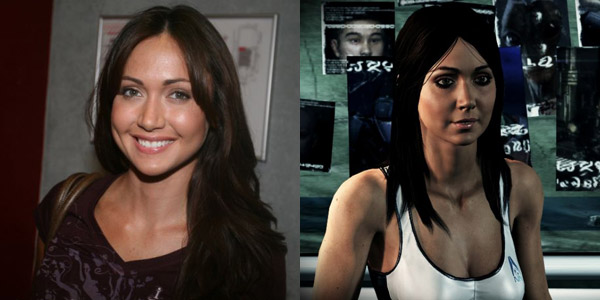
It's worth mentioning that Diana Allers plays no role in the Mass Effect 3 story. From what I recall, you don't need to talk to the character at all. Yet, in true Mass Effect fashion, you can completely pursue a romance with her. More on that later.
Then we have Felicia Day, who is a more acceptable choice in one respect ... and a much worse one in another:

Felicia Day is as sensible a choice for a video game voice actress as anyone else as, unlike Chobot, she's a professional actress and has experience as a voice actress. The top picture above is from an online web series she wrote and starred in called Dragon Age: Redemption and the picture below is the in-game model of Tallis, the character she played, in a Dragon Age expansion pack.
Now, strictly speaking, I have nothing against Felicia Day. I have no opinion of her, in fact. However, she was the focal point of Ryan Perez being removed from his position as a writer for Destructoid. As mentioned earlier, shortly after describing Day as a "glorified booth babe" and questioning what she added to the gaming industry, everyone from random Felicia Day fans to her coworker Wil Wheaton banded together to arbitrarily brand Perez' comments "misogynistic". Those comments were not misogynistic in the slightest. "Booth babe" may have been used derogatively but was it so bad that it was necessary to instigate a witch hunt (that really is the only suitable term for it) against Ryan Perez? Absolutely not. As far as I know, Day herself didn't respond to or comment about the Tweets from Perez and I commend her for not getting involved. I may be wrong about that, however, so feel free to correct me if so.
So, to recap, that's wealthy Star Trek and The Big Bang Theory alumni and reader of audio books, Wil Wheaton, leading the charge to have a man fired for making non-sexist comments against his co-worker.
This article at AVoiceForMen spoke on it further and is where I first learned of the issue, so you can go there to read more. I posted this back in my article about Anita Sarkeesian and Feminist Frequency but it's worth posting again. Make sure to watch the "4 Friendly Reminders About Women and Video Games" video posted in that article too. The final thing I'll say about this whole issue is that it made me completely ashamed to be a gamer. Getting a man fired goes far beyond a fandom reacting negatively to their favourite celebrity being criticised. It was downright amoral and, as I said before, a witch hunt.
Anyway, what does all this have to do with nerdbaiting? To answer that, we have to go back to the article I mentioned in the very first sentence of this blog. I came across an article a few weeks ago when looking for details about the Ryan Perez issue. I'm not going to link to it here because I don't want to give them free publicity -- even though their site is undoubtedly more popular than my little strip of rantings and ravings -- but if anyone dislikes that I don't provide a source, I'll be quoting directly from the article, so you can probably find it by using one of the sentences to search yourself.
First of all, the writer of this article actually made a couple of points I agreed with. "I don’t believe a woman’s place is anywhere other than where she wants to be," cropped up early in the article. Very good. "Now the question here is whether or not Perez would still be employed by them had he not caught the attention of people like Wheaton and Baldwin. The answer is, yeah, heprobably [sic] would," came later. Not half bad. Unfortunately, those are the only good things in the article. That's it.
To give you a quick rundown of what's said, the writer makes the same Tomb Raider/Hitman Absolution argument that I criticised in my second post on this blog. In his few paragraphs about Anita Sarkeesian, he had the typical reaction; acknowledging the abuse but none of the legitimate criticisms or concerns about her project. In fact, he actually said, "I will click the like button on every single video Anita Sarkeesian produces even if she says something that I completely and absolutely disagree with". He approved of Perez' firing. He used Hostel 2 as an example of sexism in Hollywood without acknowledging Hostel 1. Oh, and he stated "videogames are inherently misogynistic" towards the end.
Criticising all of the above would be pointless. While I've already written about a couple of the points, the "videogames are inherently misogynistic" line is what makes me just dismiss this one out of hand because the writer of the article and myself are operating on two completely different wavelengths. However, there is one paragraph from the article that I do want to closely critique, and that is the following about Ryan Perez' question about what Felicia Day contributes to the gaming industry:
Alright, let's look at this closely, particularly the second half. "She is a walking emodiment of all that should be right with gaming culture" and so on. From that point on, not only does this read as a rather creepy love letter that a stalker would shove through a letterbox, but it also does an absolutely wonderful job of summing up exactly why nerdbaiting is so insulting.
Let's compare Felicia Day to the people the writer compares her to; the "hairy palmed, sweat filled, butter balls". While the writer of that article was using them as an example of what the mainstream media thinks of gamers, the writer himself apparently agrees; "Day is one of the few people walking the planet who is actually doing it right". So those of us who aren't Felicia Day -- those of us who apparently lack the success and the social skills, in other words -- we're all doing it wrong and should bow down before the Almighty Felicia. And if we don't? We might just get fired too!
Now let's say that one of these "butter balls" was to write some Dragon Age fanfiction. Presumably, it'd sit on a website for a while and gather some comments. When a random gamer does something like that, that's what happens. When Felicia Day writes fanfiction? It's turned into a webseries and Felicia earns a Dragon Age expansion pack devoted to her character. Frankly, even the most successful Dragon Age fanfiction couldn't reach that height. Even if the writer was successful and had social skills, do you think he or she would get his/her own character in the game modelled on him/her if they were a "hairy palmed, sweat filled, butter ball"? Is there any chance of that happening?
Make no mistake; Felicia Day was not chosen for Dragon Age: Redemption or Dragon Age II's expansion pack just because she's an actress and voice actress. She was chosen because she is that popular amongst gamers (to the point that her co-workers were able to rally enough people to get a man fired). She was chosen because she's "nerdy". She was chosen because she's "hot". The same can be said for Jessica Chobot. Why isn't Geoff Keighley of GameTrailers appearing in any games? He's charming, he's articulate, he's good-looking! But as of this writing, he's yet to make an appearance.
So is it any wonder that -- surprise, surprise -- not everyone is going to shower Felicia Day with praise the same way the writer of that article did? It's nothing to do with petty jealousy over Day receiving the recognition and preferential treatment that, say, other Dragon Age fanfiction writers don't. It's simply the dislike that comes from the assumption that we should be in love with Day just because she's an attractive girl who likes gaming. That's why Ryan Perez was fired. He didn't. The same goes for Jessica Chobot, albeit to a lesser extent. She was just there because ... why not? Attractive, nerdy, popular. Bearing all this in mind, what's wrong with segments of the gaming population feeling insulted by their inclusion in Mass Effect 3 and Dragon Age II? Are we supposed to be happy about the developers painting us all with the same brush? Assuming we'll all love Felicia Day because we're all nerds and she apparently appeals to us? Sorry but that's blatant nerdbaiting.
As a bonus, it's worth pointing out that both of the games featuring these women allowed the player character to also pursue a romance with them too. This is going to sound very cynical but I can almost imagine an advertising campaign that says, "hey nerdy male gamer! Have you ever wanted to date a hot nerd girl like Jessica Chobot or Felicia Day? Well now you can!" Of course, that didn't happen.
I know that people reading this will take into account that both of the games above were made by BioWare, so these are actually isolated incidents. You're right about that, completely. I don't want to make out like this is indicative of gaming at large or in any way an epidemic. At the same time, I don't want this to become a wider issue. I'm actually using "nerdbaiting" in a lesser-used context; I've heard it used more often to describe something minor, like an internet meme being quoted in a game to make the "nerdy" players who get the reference laugh. So keeping in mind that this form of nerdbaiting is actually very rare, I want people to take two things away from this blog:
A) Developers; stop trying to so blatantly appeal to nerds with someone you perceive to be a popular (female, attractive) nerd icon. It's insulting to men and it's insulting to women. Use someone more appropriate for the role.
B) Gamers; reel in the rabid fanboy/girlism a bit. That doesn't go for many of you, obviously, but you might want to reconsider the next time you decide to start a backlash against someone just because they don't share your opinions.
I think that's it. As always, you can leave a comment below or send me a message at themalesofgames@gmail.com. I'll just leave you with one final thought from the writer of the article you've been reading about in this blog:
... Yeah ... let's wait and see how that one works out ...
With that out of the way, let's get into the main point of this blog; what is nerdbaiting?
You know how a game comes along every so often featuring a character modelled on and voiced by a real-life actor or celebrity? Quantic Dream did this for most of the characters in Heavy Rain, for example, and they've picked out Ellen Page for its spiritual successor, Beyond: Two Souls. Other examples include Max Payne's character model in the second game being based on actor Timothy Gibb and, if I remember correctly, there was a Playstation 1 game called Apocalypse that starred Bruce Willis in the lead role. So this has been going on for a while.
Nerdbaiting has a few definitions but the one that has to do with gaming is connected to the paragraph above; imagine if the celebrity chosen wasn't based on their star status (like Page and Willis) or because they were right for the role (like Gibb and the Heavy Rain characters). Imagine if they were chosen just because they had a certain significance to a portion of the gaming audience.
Much like Jessica Chobot, on-camera host and staff writer for IGN. She has also made appearances on G4 shows and writes a blog for Maxim. The character of Diana Allers in Mass Effect 3 was modelled on and voiced by Chobot.
There were only two reasons for Chobot to be chosen for this role; firstly, because BioWare wanted to appeal to IGN and secondly, to appeal to the tiny segment of the audience with a love of Jessica Chobot. I hate to make assumptions but I suspect the majority of Chobot's fans follow her work for IGN most closely and, of course, IGN deals with games, comic books, etc, so it's safe to say that it's a fine site for "nerds" to hang out (and I use the term positively. I'd describe myself as a nerd). Chobot has no acting or voice acting experience but was chosen to play Diana Allers nonetheless.
It's worth mentioning that Diana Allers plays no role in the Mass Effect 3 story. From what I recall, you don't need to talk to the character at all. Yet, in true Mass Effect fashion, you can completely pursue a romance with her. More on that later.
Then we have Felicia Day, who is a more acceptable choice in one respect ... and a much worse one in another:
Felicia Day is as sensible a choice for a video game voice actress as anyone else as, unlike Chobot, she's a professional actress and has experience as a voice actress. The top picture above is from an online web series she wrote and starred in called Dragon Age: Redemption and the picture below is the in-game model of Tallis, the character she played, in a Dragon Age expansion pack.
Now, strictly speaking, I have nothing against Felicia Day. I have no opinion of her, in fact. However, she was the focal point of Ryan Perez being removed from his position as a writer for Destructoid. As mentioned earlier, shortly after describing Day as a "glorified booth babe" and questioning what she added to the gaming industry, everyone from random Felicia Day fans to her coworker Wil Wheaton banded together to arbitrarily brand Perez' comments "misogynistic". Those comments were not misogynistic in the slightest. "Booth babe" may have been used derogatively but was it so bad that it was necessary to instigate a witch hunt (that really is the only suitable term for it) against Ryan Perez? Absolutely not. As far as I know, Day herself didn't respond to or comment about the Tweets from Perez and I commend her for not getting involved. I may be wrong about that, however, so feel free to correct me if so.
So, to recap, that's wealthy Star Trek and The Big Bang Theory alumni and reader of audio books, Wil Wheaton, leading the charge to have a man fired for making non-sexist comments against his co-worker.
This article at AVoiceForMen spoke on it further and is where I first learned of the issue, so you can go there to read more. I posted this back in my article about Anita Sarkeesian and Feminist Frequency but it's worth posting again. Make sure to watch the "4 Friendly Reminders About Women and Video Games" video posted in that article too. The final thing I'll say about this whole issue is that it made me completely ashamed to be a gamer. Getting a man fired goes far beyond a fandom reacting negatively to their favourite celebrity being criticised. It was downright amoral and, as I said before, a witch hunt.
Anyway, what does all this have to do with nerdbaiting? To answer that, we have to go back to the article I mentioned in the very first sentence of this blog. I came across an article a few weeks ago when looking for details about the Ryan Perez issue. I'm not going to link to it here because I don't want to give them free publicity -- even though their site is undoubtedly more popular than my little strip of rantings and ravings -- but if anyone dislikes that I don't provide a source, I'll be quoting directly from the article, so you can probably find it by using one of the sentences to search yourself.
First of all, the writer of this article actually made a couple of points I agreed with. "I don’t believe a woman’s place is anywhere other than where she wants to be," cropped up early in the article. Very good. "Now the question here is whether or not Perez would still be employed by them had he not caught the attention of people like Wheaton and Baldwin. The answer is, yeah, heprobably [sic] would," came later. Not half bad. Unfortunately, those are the only good things in the article. That's it.
To give you a quick rundown of what's said, the writer makes the same Tomb Raider/Hitman Absolution argument that I criticised in my second post on this blog. In his few paragraphs about Anita Sarkeesian, he had the typical reaction; acknowledging the abuse but none of the legitimate criticisms or concerns about her project. In fact, he actually said, "I will click the like button on every single video Anita Sarkeesian produces even if she says something that I completely and absolutely disagree with". He approved of Perez' firing. He used Hostel 2 as an example of sexism in Hollywood without acknowledging Hostel 1. Oh, and he stated "videogames are inherently misogynistic" towards the end.
Criticising all of the above would be pointless. While I've already written about a couple of the points, the "videogames are inherently misogynistic" line is what makes me just dismiss this one out of hand because the writer of the article and myself are operating on two completely different wavelengths. However, there is one paragraph from the article that I do want to closely critique, and that is the following about Ryan Perez' question about what Felicia Day contributes to the gaming industry:
I really shouldn’t have to explain this, but considering the amount of crap I’ve had to wade through while researching this bloody thing I’m going to anyway - it really is a very, very stupid question. Because Felicia Day is an actor. Not a game designer. Not a developer. Not a publisher. She’s an actor. So of course she doesn’t contribute to “the industry” by decoding the bugs from CoD or coming up with new and interesting ways to use a Wii nunchuk. Instead she contributes to gaming by, and pay attention because this will turn your entire life upside down, being a successful celebrity who happens to really like video games. She is a walking embodiment of all that should be right with gaming culture. She’s charming, articulate, and has a genuine passion for pixelated entertainment. Also she defies stereotypes of what a gamer should be, simply by being Felicia Day. In the seemingly never ending war between a mainstream media that will all too often portray gamers as hairy palmed, sweat filled, butter balls, Day is one of the few people walking the planet who is actually doing it right. She proves you can be successful, have social skills, and yet somehow also be a fan of video games at the same time. That is her contribution. She’s an ambassador for the rest of us.
Alright, let's look at this closely, particularly the second half. "She is a walking emodiment of all that should be right with gaming culture" and so on. From that point on, not only does this read as a rather creepy love letter that a stalker would shove through a letterbox, but it also does an absolutely wonderful job of summing up exactly why nerdbaiting is so insulting.
Let's compare Felicia Day to the people the writer compares her to; the "hairy palmed, sweat filled, butter balls". While the writer of that article was using them as an example of what the mainstream media thinks of gamers, the writer himself apparently agrees; "Day is one of the few people walking the planet who is actually doing it right". So those of us who aren't Felicia Day -- those of us who apparently lack the success and the social skills, in other words -- we're all doing it wrong and should bow down before the Almighty Felicia. And if we don't? We might just get fired too!
Now let's say that one of these "butter balls" was to write some Dragon Age fanfiction. Presumably, it'd sit on a website for a while and gather some comments. When a random gamer does something like that, that's what happens. When Felicia Day writes fanfiction? It's turned into a webseries and Felicia earns a Dragon Age expansion pack devoted to her character. Frankly, even the most successful Dragon Age fanfiction couldn't reach that height. Even if the writer was successful and had social skills, do you think he or she would get his/her own character in the game modelled on him/her if they were a "hairy palmed, sweat filled, butter ball"? Is there any chance of that happening?
Make no mistake; Felicia Day was not chosen for Dragon Age: Redemption or Dragon Age II's expansion pack just because she's an actress and voice actress. She was chosen because she is that popular amongst gamers (to the point that her co-workers were able to rally enough people to get a man fired). She was chosen because she's "nerdy". She was chosen because she's "hot". The same can be said for Jessica Chobot. Why isn't Geoff Keighley of GameTrailers appearing in any games? He's charming, he's articulate, he's good-looking! But as of this writing, he's yet to make an appearance.
So is it any wonder that -- surprise, surprise -- not everyone is going to shower Felicia Day with praise the same way the writer of that article did? It's nothing to do with petty jealousy over Day receiving the recognition and preferential treatment that, say, other Dragon Age fanfiction writers don't. It's simply the dislike that comes from the assumption that we should be in love with Day just because she's an attractive girl who likes gaming. That's why Ryan Perez was fired. He didn't. The same goes for Jessica Chobot, albeit to a lesser extent. She was just there because ... why not? Attractive, nerdy, popular. Bearing all this in mind, what's wrong with segments of the gaming population feeling insulted by their inclusion in Mass Effect 3 and Dragon Age II? Are we supposed to be happy about the developers painting us all with the same brush? Assuming we'll all love Felicia Day because we're all nerds and she apparently appeals to us? Sorry but that's blatant nerdbaiting.
As a bonus, it's worth pointing out that both of the games featuring these women allowed the player character to also pursue a romance with them too. This is going to sound very cynical but I can almost imagine an advertising campaign that says, "hey nerdy male gamer! Have you ever wanted to date a hot nerd girl like Jessica Chobot or Felicia Day? Well now you can!" Of course, that didn't happen.
I know that people reading this will take into account that both of the games above were made by BioWare, so these are actually isolated incidents. You're right about that, completely. I don't want to make out like this is indicative of gaming at large or in any way an epidemic. At the same time, I don't want this to become a wider issue. I'm actually using "nerdbaiting" in a lesser-used context; I've heard it used more often to describe something minor, like an internet meme being quoted in a game to make the "nerdy" players who get the reference laugh. So keeping in mind that this form of nerdbaiting is actually very rare, I want people to take two things away from this blog:
A) Developers; stop trying to so blatantly appeal to nerds with someone you perceive to be a popular (female, attractive) nerd icon. It's insulting to men and it's insulting to women. Use someone more appropriate for the role.
B) Gamers; reel in the rabid fanboy/girlism a bit. That doesn't go for many of you, obviously, but you might want to reconsider the next time you decide to start a backlash against someone just because they don't share your opinions.
I think that's it. As always, you can leave a comment below or send me a message at themalesofgames@gmail.com. I'll just leave you with one final thought from the writer of the article you've been reading about in this blog:
And when the history of games is etched in to stone, Felicia Day will probably be deemed to be more important than, oh I don’t know, an ill-conceived reboot of Tomb Raider.
... Yeah ... let's wait and see how that one works out ...
Wednesday, 3 October 2012
The Sexism Of Heavenly Sword
Hey all. Another long blog.
I know it sometimes seems like I fall back on the same games on this blog -- Heavenly Sword and Tomb Raider, or at least Lara Croft -- but trust me, it's not intentional. I actually intended to write about something else in this post but, thanks to a slow internet connection, I wasn't able to get onto YouTube to do some research. So we end up back at Heavenly Sword, which I've finally played through again.
First of all though, an apology; I stated a few posts back, and elsewhere online, that Heavenly Sword features only male enemies. That turned out not to be true and I'm sorry for misleading anyone who's never played the game. Ninety-nine percent of Heavenly Sword's enemies are male but there's that one percent that isn't. That's actually important because, for all my talk of how much I dislike the groin attacks against the "all-male" army in HS, the groin attacks can all be done against female opponents too. I want my research on this blog to be accurate, so I have no problem setting the record straight.
That aside, there's still plenty of stuff in Heavenly Sword worth talking about. I hope people who've played Heavenly Sword forgive me for this but since a lot of the sexism in the game takes place in cutscenes, I'm going to be explaining the whole story for people who've never played the game. Expect heavy spoilers. So first things first, here are the characters you need to know about:

Top Row, L-R:
Nariko: The game's main character and narrator. Wields the Heavenly Sword for most of the game.
Kai: Also a playable character. Uses a crossbow. She became Nariko's "kind of" adopted little sister at some point before the game's beginning, after her mother was killed (more on that later). I'm not sure if she has mental disabilities or if she's simply "quirky" but she treats battles as if they're a game.
Shen: Nariko's father. Leads the clan that Nariko and Kai are a part of. The clan's job is to protect the Heavenly Sword at all costs. Described by Nariko as "a tutor first, a father second". That'll be important later on.
Clan Member: Honestly, I just included the clan member in this picture because I didn't want an odd number of faces. Clan members are all male and all serve the same role; to be selfish, cowardly, helpless and sexist against Nariko.
Bottom Row, L-R:
Bohan: The game's main villain. A rapist. Played by Andy Serkis.
Flying Fox: One of Bohan's "generals". Really annoying voice. Killed Kai's mother.
Roach: Bohan's son. He suffers from mental disabilities and Bohan hates Roach calling him "daddy". Frequently suffers verbal abuse at the hands of Bohan but loves him anyway.
Whiptail: Bohan's "consort". I have a theory on Whiptail's role and treatment in the game that I'll go into at the end.
Now onto the game's story. It opens with Nariko narrating about a prophecy that stated, "a deity would be reborn, in the body of a mortal man". Nariko was born instead and many of her people view her as a curse because she was born female rather than male. At the start of the game, Bohan's army attacks the clan because he wants the Heavenly Sword. One of the clanmembers voices his displeasure with this turn of events and states it's because of Nariko, since she's a curse. This earns him a choking from Nariko.

Now basically, even if you've only played this far, it kind of sets the tone for the game; we've already received the message that "being female is a curse". Even her fellow clanmembers voice this opinion, earning themselves a choking from Nariko in return. Let's start with the "being female is a curse" part; already, the more "Genre Savvy" player will know what's going to happen. It removes any doubt that Nariko will screw up in some way or fail at her quest. Now, I'm not specifically blaming Heavenly Sword for that, since the hero rarely fails in any game, but it actually stops Nariko from being a hero just because she can be; her sex is being insulted and degraded by being described as a curse and that makes her a representative of womankind in this fictional universe.
The choking is unpleasant for more obvious reasons; a male hero could never choke a female hero and still be considered heroic. Even if a woman referred to the man as a "curse", you wouldn't see him choke her in response. The only example I can think of in gaming is in Resident Evil 4, where Leon becomes possessed by the parasite infesting his body and attempts to choke Ada (who isn't even especially heroic). This earns Leon a knife to the leg and a swift knee in his midriff, to free him of his possession. The clanmember didn't do the same to Nariko, obviously.
Anyway, at some point during Bohan's attack, the clan flee their base but Shen tells Nariko to stay behind to fend off the attackers. She's also left in charge of the Heavenly Sword, which seems like a bizarre thing to do, since the clan is running away from the attackers but she's standing her ground against them and she's all alone. It works, however, and she survives the assault while the clan make their escape. Once she's done, Nariko has to escape too, and it's during this part of the game that we get a truly excellent piece of dialogue.
The first time I played this part of the game, five years ago or so, one of the enemies you ran into mocked Nariko for being "an under-dressed angel". I actually really liked that. It was clever and self-deprecating, willing to joke about one of the minor features that so many messageboards would be up in arms over; yes, the main character is female and yes, she's wearing somewhat "inappropriate" clothing for battle. It was what TV Tropes would call a "Lampshade Hanging". However, that was five years ago. This time I played the game, the enemy said something even better: "Take that carving knife back to the kitchen, wench". A "stay in the kitchen" insult! Just in case you weren't aware that women in Heavenly Sword are treated like crap, there's that hi-larious line of dialogue. So if you think Ninja Theory were being unfair by making Nariko's clan sexist, don't worry, a soldier in Bohan's army managed to top it by being more sexist.
I know it sometimes seems like I fall back on the same games on this blog -- Heavenly Sword and Tomb Raider, or at least Lara Croft -- but trust me, it's not intentional. I actually intended to write about something else in this post but, thanks to a slow internet connection, I wasn't able to get onto YouTube to do some research. So we end up back at Heavenly Sword, which I've finally played through again.
First of all though, an apology; I stated a few posts back, and elsewhere online, that Heavenly Sword features only male enemies. That turned out not to be true and I'm sorry for misleading anyone who's never played the game. Ninety-nine percent of Heavenly Sword's enemies are male but there's that one percent that isn't. That's actually important because, for all my talk of how much I dislike the groin attacks against the "all-male" army in HS, the groin attacks can all be done against female opponents too. I want my research on this blog to be accurate, so I have no problem setting the record straight.
That aside, there's still plenty of stuff in Heavenly Sword worth talking about. I hope people who've played Heavenly Sword forgive me for this but since a lot of the sexism in the game takes place in cutscenes, I'm going to be explaining the whole story for people who've never played the game. Expect heavy spoilers. So first things first, here are the characters you need to know about:

Top Row, L-R:
Nariko: The game's main character and narrator. Wields the Heavenly Sword for most of the game.
Kai: Also a playable character. Uses a crossbow. She became Nariko's "kind of" adopted little sister at some point before the game's beginning, after her mother was killed (more on that later). I'm not sure if she has mental disabilities or if she's simply "quirky" but she treats battles as if they're a game.
Shen: Nariko's father. Leads the clan that Nariko and Kai are a part of. The clan's job is to protect the Heavenly Sword at all costs. Described by Nariko as "a tutor first, a father second". That'll be important later on.
Clan Member: Honestly, I just included the clan member in this picture because I didn't want an odd number of faces. Clan members are all male and all serve the same role; to be selfish, cowardly, helpless and sexist against Nariko.
Bottom Row, L-R:
Bohan: The game's main villain. A rapist. Played by Andy Serkis.
Flying Fox: One of Bohan's "generals". Really annoying voice. Killed Kai's mother.
Roach: Bohan's son. He suffers from mental disabilities and Bohan hates Roach calling him "daddy". Frequently suffers verbal abuse at the hands of Bohan but loves him anyway.
Whiptail: Bohan's "consort". I have a theory on Whiptail's role and treatment in the game that I'll go into at the end.
Now onto the game's story. It opens with Nariko narrating about a prophecy that stated, "a deity would be reborn, in the body of a mortal man". Nariko was born instead and many of her people view her as a curse because she was born female rather than male. At the start of the game, Bohan's army attacks the clan because he wants the Heavenly Sword. One of the clanmembers voices his displeasure with this turn of events and states it's because of Nariko, since she's a curse. This earns him a choking from Nariko.

Now basically, even if you've only played this far, it kind of sets the tone for the game; we've already received the message that "being female is a curse". Even her fellow clanmembers voice this opinion, earning themselves a choking from Nariko in return. Let's start with the "being female is a curse" part; already, the more "Genre Savvy" player will know what's going to happen. It removes any doubt that Nariko will screw up in some way or fail at her quest. Now, I'm not specifically blaming Heavenly Sword for that, since the hero rarely fails in any game, but it actually stops Nariko from being a hero just because she can be; her sex is being insulted and degraded by being described as a curse and that makes her a representative of womankind in this fictional universe.
The choking is unpleasant for more obvious reasons; a male hero could never choke a female hero and still be considered heroic. Even if a woman referred to the man as a "curse", you wouldn't see him choke her in response. The only example I can think of in gaming is in Resident Evil 4, where Leon becomes possessed by the parasite infesting his body and attempts to choke Ada (who isn't even especially heroic). This earns Leon a knife to the leg and a swift knee in his midriff, to free him of his possession. The clanmember didn't do the same to Nariko, obviously.
Anyway, at some point during Bohan's attack, the clan flee their base but Shen tells Nariko to stay behind to fend off the attackers. She's also left in charge of the Heavenly Sword, which seems like a bizarre thing to do, since the clan is running away from the attackers but she's standing her ground against them and she's all alone. It works, however, and she survives the assault while the clan make their escape. Once she's done, Nariko has to escape too, and it's during this part of the game that we get a truly excellent piece of dialogue.
The first time I played this part of the game, five years ago or so, one of the enemies you ran into mocked Nariko for being "an under-dressed angel". I actually really liked that. It was clever and self-deprecating, willing to joke about one of the minor features that so many messageboards would be up in arms over; yes, the main character is female and yes, she's wearing somewhat "inappropriate" clothing for battle. It was what TV Tropes would call a "Lampshade Hanging". However, that was five years ago. This time I played the game, the enemy said something even better: "Take that carving knife back to the kitchen, wench". A "stay in the kitchen" insult! Just in case you weren't aware that women in Heavenly Sword are treated like crap, there's that hi-larious line of dialogue. So if you think Ninja Theory were being unfair by making Nariko's clan sexist, don't worry, a soldier in Bohan's army managed to top it by being more sexist.
At the end of this part, it turns out that the clan didn't escape after all. Bohan makes his first speaking appearance, with Shen as his prisoner. Shen is badly beaten and Nariko appears sympathetic. She decides to make use of the Heavenly Sword (which mustn't be done) rather than just protect it. Bohan sends some soldiers to attack Nariko, as an excuse to give the player a tutorial on how to use the sword. During this fight, you can hear Bohan say, "Bring me that sword. If she still happens to be
attached to it, so much the better." Yes, Bohan is implied to be a rapist. This becomes even more overt later on.
Nariko runs, unable to defeat every single one of Bohan's army there and then. As Shen and the rest of the clan are taken back to Bohan's base to be held captive, Nariko is reunited with Kai, who managed to escape by hiding. Now, it's reasonable to think that Kai is better at hiding than the rest of the clan, which is why they didn't hide (or maybe they did, but were found) but let's recap; all the male clanmembers are taken prisoner. Both the female clanmembers were able to escape. Worst of all? This isn't even the male clanmembers' lowest point in the game. In any other game, it might be, but not Heavenly Sword. The epitome of their uselessness comes up shortly afterwards.
We get a cutscene introducing us to the villains. This is meant to be an analysis rather than a review but it comes across as a bit forced; they spend time talking about each villain, then moving onto the next without so much as a line of dialogue explaining why. We have Flying Fox, a creepy teleporting man who speaks in a very irritating voice. There's Whiptail, a scantily-clad snake-fish lady who is also Bohan's "consort". Many of her lines are about how much she admires him. And there's Roach, who is a huge overweight beast with mental disabilities and suffers verbal abuse from his father, Bohan, and the occasional object thrown at his head. However, he loves Bohan and can't seem to grasp that Bohan hates him.
 Nariko is able to rescue the male clanmembers, except Shen. The first thing they do is thank Nariko for rescuing them but, when she suggests they help her find Shen, they selfishly refuse. They only care about their own lives. Then, the same
clanmember that thanked Nariko says Shen was foolish to trust her with the
Heavenly Sword … even though she just used it to rescue them. So the clan
continues to be sexist towards Nariko and now decide to show their true
cowardly colours. This is the epitome of their uselessness.
Nariko is able to rescue the male clanmembers, except Shen. The first thing they do is thank Nariko for rescuing them but, when she suggests they help her find Shen, they selfishly refuse. They only care about their own lives. Then, the same
clanmember that thanked Nariko says Shen was foolish to trust her with the
Heavenly Sword … even though she just used it to rescue them. So the clan
continues to be sexist towards Nariko and now decide to show their true
cowardly colours. This is the epitome of their uselessness.

Shen is found by Nariko soon enough, being held captive by Whiptail. Earlier in the game, Nariko narrates a tale of a
recurring dream she has of her father, Shen, killing her. After Shen is freed,
Whiptail reveals that this stems from a moment when Shen wanted to kill Nariko
at birth but couldn’t. Nariko actually reacts angrily at Shen not killing her and tells him to leave
her. Somehow, I can’t imagine Mario basically telling Princess Peach to piss
off after rescuing her. Combined with the rescue of her fellow clanmembers, there seems to be a recurring theme of Nariko rescuing men who she then
deems unworthy of rescue. According to the game, Nariko and Kai are the only heroic souls in a sea of
complete jerks.
Shen makes his escape, having suffered injuries while being held prisoner. Kai uses her crossbow to kill all of Shen's attackers. When he's finally to safety, Shen holds his arms out for a hug but Kai runs past him because she only cares about saving Nariko. Shen says, "I have led hundreds of men through life and
death. Why do these girls never listen to a word I say?" It's kind of amusing but also sad because of how true it is and how little it makes sense; even before basically giving him a big "screw you" after rescuing him, Nariko was disobedient and disrespectful towards Shen. She ignored his orders to help Kai and it turned out that she was right to do so. I have no idea why it was so important to have Shen come off as wrong in that situation. Why not have him tell Nariko to go and help Kai? Without it, and with his capture, he comes across as an ineffective leader. Bear in mind that this is a man who was described as "a tutor first and a father second" and who tried to murder his own daughter at birth. So he's hardly winning father of the year but apparently, he's no good at being a leader either. He's portrayed as useless so the two women can be portrayed as wonderful. Lionising women at the cost of men.
Meanwhile, Nariko is fighting Whiptail. Heavenly Sword shows cutscenes during boss battles and during one of Whiptail's cutscenes, Nariko mocks the gashes on her cheeks with the sentence, "Was it your master who turned you into a
slit-faced psycho?" Whiptail reacts with a shocked expression but that doesn't necessarily mean that Bohan did cut her cheeks. She could've been shocked at the insult in general. She neither confirms nor denies that Bohan made her look
the way she did but the implication is that someone
sliced those markings on her cheeks. I'm inclined to think it was Bohan but, without it being conclusive, I'll leave that one alone.
Anyway, Nariko defeats Whiptail but is knocked out in the process, meaning Bohan can finally get his hands on the sword, which is lodged in Whiptail's chest. Bohan taunts Nariko's actions by saying, "You’d never see me rescuing my father, the crusty old pervert", continuing the trend of bad fathers. Bohan runs his hands suggestively across Whiptail’s legs even while she’s dying and then, after exchanging a few "sympathetic" words, he snaps
her neck and turns his attention back to the sword without a second’s thought. Remember earlier, I said that Flying Fox killed Kai's mother? There seems to be another trend in Heavenly Sword of the villains showing how evil they are by killing women. That's the threshold that turns regular bad guys into complete monsters. Whiptail wasn't exactly good but she was probably the least evil of Bohan's generals and, frankly, by being the victim of Bohan's uncaring murder, she becomes a martyr; all of a sudden, this horrible man she loved shows his true colours and how little he cares for women by murdering the woman closest to him. Honestly, the only thing worse would be if Whiptail switched sides and joined the good guys. That would really hammer the "men are evilz" point home. Actually, as I come to think of it now, Whiptail may be the only character Bohan kills in the game. Ditto for Kai's mother and Flying Fox.
With Nariko taken prisoner, Bohan taps his codpiece with his
fingers suggestively and mentions to Nariko that they should “get to know each
other a little better”. This is the more overt display of Bohan's wish to rape Nariko I mentioned earlier.

Bohan puts the Heavenly Sword in his armory and makes the classic villain mistake of leaving the hero alone rather than killing her on the spot. So Kai has snuck into Bohan's base and she visits Nariko in prison. Nariko wants Kai to get the Heavenly Sword back and Nariko says, "I don’t have anyone else", because, of course,
the male clansmen were too injured, selfish or cowardly to help. This is an interesting bit: during the conversation, Nariko mentions being alone. Kai says, "Kai was alone once.
But then Nariko found Kai. And Kai wasn’t alone. And Nariko wasn’t alone
either". Wait a second … unlike Kai, Nariko was never
alone. She always had Shen and the clan. So the only explanation for Kai’s "Nariko wasn’t alone either" remark is that men don’t count as company and either Nariko, Kai or both
only value women as companions.
So Kai goes to get the Heavenly Sword back from the armory but to do that, she needs a password. And to get that, she finds the guard captain who knows the password, points her crossbow at his crotch and threatens to fire. Obviously, this is treated as comedy.
I'd like to pause for a moment because I'm sure people will point out that other games/films/television shows have treated groin attacks as comedy. Heavenly Sword is nothing new on that front. Why single out Heavenly Sword?
Well, I don't want people to think I'm singling out Heavenly Sword because there are other games with uses of groin attacks that I object to. However, it is slightly different in a number of ways. Most notably, it actually serves a purpose in the storyline; unlike, say the one-hit-kill groin shots in Metal Gear Solid and Johnny Cage's crotch-punch from Mortal Kombat, Kai threatening the guard in Heavenly Sword with genital mutilation earned her the password. She was actually rewarded for threatening to destroy a man's genitalia. What's the reward in Mortal Kombat and Metal Gear Solid? Removing a bit of your opponents health and a one-hit-kill, respectively. There are other ways to do those things in those games. However, even after Kai destroyed his hiding place, the guard captain refused to talk. He spoke up immediately as soon as his genitalia was threatened. So the message, apparently, is "women, you can get what you want from men if you threaten to mutilate their genitals. And it's not a bad thing to do, it's funny!"
You also have to take into account that because this happens during a cutscene, it's not comparable to the MGS or MK examples; those serve a purpose in gameplay while the scene pictured above could've been completely avoided if Ninja Theory didn't want it in the game. There is no equivalent in Metal Gear Solid or Mortal Kombat. Remember the keycards in Metal Gear Solid 1? You usually received a new one after each boss fight, to access new areas. Imagine if Snake had to threaten every boss' genitals while saying funny lines to get them. Sniper Wolf's death would certainly be a lot less depressing, although to say it would be in bad taste is an understatement.
There's also the issue of the misandrist themes in the rest of the game. Unlike MGS and MK, there aren't any positive male characters in Heavenly Sword. On its own, the threat of a groin attack from the quirky comic relief character of the game might serve as the fun little one-off joke that it was meant to be. Combined with the rapist, woman-killing villain (who later gets a completely serious elbow to the groin), his woman-killing sidekick general, the ineffective leader and father of the heroine, the sexist bad army, the sexist good army and the flawless heroines, a far worse light is shed on the supposedly-funny threat of genital mutilation.
Anyway, back to the game. Kai gets the Heavenly Sword back but Flying Fox attacks her. This is where we learn that he killed Kai's mother and kept her corpse on display in the armory as a trophy. So Kai has a flashback to this and runs away from Flying Fox, who she's terrified of.
For his own entertainment, Bohan pits Nariko against her
clanmates – who were apparently recaptured off-screen, without mention – and
states this simple outcome; “last man standing lives, everyone else dies”. For
some odd reason, however, there’s no in-fighting between any of the male
members of the clan. As soon as you gain control of Nariko, it’s everyone vs.
her. I think this was just to make the game less hectic than a free-for-all but
it certainly comes across as odd. All the male clansmen want to kill Nariko but
she’s given the option to kill or paralyse all of them. Maybe they figured she
was bound to win unless they banded together against her? It's probably best to not read too much into that one, since I think it was a deliberate gameplay choice rather than just to show how sexist the clan was against Nariko. Again.
So, Nariko wins, Kai gives her the sword back and Nariko goes on to fight Roach. Not much to say here. Nariko wins but Roach survives. Nariko escapes. Flying Fox almost kills Kai, Nariko fights him, Kai ends up with enough life left in her to land the killing shot on Flying Fox, as revenge for killing her mother.
Nariko finally returns to the clan, carrying an injured Kai
in her arms. She gives Shen the cold shoulder when he greets her. While Kai was
kidnapped, Nariko narrates that when she found Kai, she didn’t want her to face
a life of battle. So when Nariko returns to the clan, we get this exchange:
Nariko: "That is why I have returned."
Shen: "To fight for us?"
Nariko: "No. To fight for her."
In other words, it’s only Kai’s future that Nariko cares
about. Not the other male clanmembers. Strictly speaking, hasn’t Nariko already
failed to save Kai from a life of
battle? Surely, there are better examples of innocents than a girl who has
murdered hundreds but no; it’s Kai, and only
Kai, that Nariko cares about.
Bohan's army attacks again and during a cutscene, Shen acknowledges his failure to be a father to Nariko with
the sentence, "I know that in my desire to be your tutor, I neglected you as a
father. It was a poor decision, for me and for you". Nariko replies with, "if
you hadn’t, I probably would’ve died a long time ago". It’s pretty much the
only moment of father-child bonding you see in Heavenly Sword but it also has
what TV Tropes refers to as "unfortunate implications"; Nariko outright says
that she values Shen more as a tutor than a father. Combined with Bohan’s
verbal and physical abuse of Roach, the game practically sends the message that "fatherhood isn’t needed". At best, there’s no value in it and at worst,
fathers are abusive scumbags. Shouldn't the game have pointed out that teaching a child to protect themselves is part of being a father?
Anyway, typical final battle stuff happens; Nariko fights army, then fights Bohan, elbows Bohan in the groin during the final quick-time event and wins the fight. During the final cutscene, Bohan gets his eyes pecked out by a Raven-God that he worships (it's complicated) and, just as Nariko wants to kill him, Roach shows up and begs her to stop. He says he wants to take care of Bohan and finally, Bohan seems to acknowledge him as his son. So maybe I need to amend my previous paragraph; fathers are worthwhile people after they've suffered severe injuries. Only incredibly severe though. Shen is captured and beaten? Not good enough. Bohan has his eyes pecked out? Yeah, alright.
Nariko dies at the end of the game -- the sword eventually kills whoever uses it -- and she gives it to Kai to hide. That's that.
So let's look over the characters again. Nariko and Kai are flawless. Shen is useless as a father and ineffective as a leader. Bohan is an abusive father, a rapist and a woman-killer. Flying Fox is a woman-killer too. The bad army is sexist. The good army is sexist. Out of all these characters, Shen is slightly sympathetic but you only sympathise with him because Bohan's treatment of him is so brutal. You could fit any character in his place and the audience reaction would be the same. There's literally no other reason to care about Shen; he tried to kill Nariko at birth and Nariko herself admitted he was better as a tutor rather than a father; emotionless rather than emotional. Roach, who I haven't written much about in this blog, is actually the only male character who's sympathetic and that's because he suffers from mental disabilities and has an abusive father. Plus, lest we forget, even though I learned that there are female enemies in the game and you can perform the same groin-attacking moves on them that you can on the males, the ratio of male-to-female enemies really is more than 100:1. The female enemies are so few in number that I had to replay an area with female enemies just to do more groin-attacking moves, to make sure they could be used. So 99% of the enemies you slaughter are male.
What about Whiptail? Well she's an interesting one because I have a theory that she represents everything that feminists criticise in games. She's scantily-clad. Her dialogue is sexual. She only exists to serve a man. She's even the first boss and the first character to be killed. Just to make it clear that all these things are bad, she's a villain. Nariko and Kai are everything that Whiptail isn't. In spite of what feminist critics of Nariko might say, she's not an example of an over-sexualised female character. The only skin she shows is on her arms, legs and midriff. She's reasonably small-chested. Her outfit doesn't reveal her cleavage. There are no gratuitous shots of her rear. None of her dialogue is sexual. The same goes for Kai and, being a teenage girl, her outfit is even less sexual, covering her midriff. The heroines are complete opposites of the villainess; they are enlightened while she is stuck in a dark age.
The thing is, I've heard certain works described derisively as "a male fantasy". Usually any show or film where an unattractive man ends up with an attractive woman. So why isn't something like Heavenly Sword described as "a feminist fantasy" or at least "a misandrist fantasy"? I don't think I've ever heard those phrases used outside of stories featuring female-only utopias. However, if I had to come up with a mainstream work that fit that description, Heavenly Sword would be it.
So is Heavenly Sword an awful game that you should never, ever play? No, actually, it's not. It's worth playing once. Rent it, if you can. I said in a previous post that games can feature content that deeply offends you, but you can still enjoy them if the gameplay is good enough. Heavenly Sword is one of those games. It won't keep you playing for months on end but it's fun for a little while. I like the blocking system and the quick-time events are nowhere near as annoying as I remember them being. Probably because I played games featuring much worse QTEs since then.
Phew! So that's finally over and done with. Sorry that this blog took so long, by the way. As always, contact me at themalesofgames@gmail.com or leave a comment below if you want to give feedback or suggest a topic for a blog post.
Subscribe to:
Posts (Atom)