Perhaps "my lack of dealings with Feminist Frequency" would be a better title, since getting into contact with either Anita Sarkeesian herself or any of the colleagues she works with on her video series is more difficult than performing brain surgery, but I think it's worth writing about my attempts to do so. It's probably more accurate to say that this blog post is about Anita's propensity to silence her critics not through rebuttals and counter-arguments but through stonewalling and dismissal.
Why is this so important to spotlight? Well, Anita has made a lot of self-congratulatory statements about how the abusive comments on her video "failed to silence her", such as at her TEDxWomen talk and on her blog. Let's put aside the fact that Anita faced an obligation from Kickstarter to continue with her project or she could've faced legal action according to the site's terms and conditions -- so she could've ended up on the receiving end of a lawsuit if she was "silenced" -- and focus on how Anita and/or her Feminist Frequency colleagues don't have any issue with silencing others.
There are a few problems with this; Anita's fans probably think it's petty of me to bring this up and are sure that Anita only silences people who send abusive messages in her direction. Anita's critics, meanwhile, have probably already seen that the comments on her Youtube videos have been disabled, so there's no point in writing about this. I'm preaching to the choir.
Well to Anita's fans, I promise I'm not pointing this out to be petty. There is a serious point to be made and I have proof that Anita does not only silence abusive messages. As for Anita's critics, I understand why you'd be skeptical but there's a lot more to Feminist Frequency's censorship than disabling Youtube comments, so maybe there'll be some new information you're unfamiliar with.
Let's start with that though; if you've been following Anita's videos at all, you'll know that she disables comments on her Youtube videos, ostensibly because she doesn't want to receive abusive comments. She does the same on feministfrequency.com too.
You probably already know about those two but that's just the start. There's a contact page on feministfrequency.com where, obviously, you can get in touch with Anita. In the middle of last year, before I started writing this blog, that's exactly what I did.
Since this was before I knew I'd be writing a blog like this, I didn't take any screenshots of my message to Anita (and because contacting Anita involves filling out a form, there isn't a record in my own "sent" folder). Basically, I wrote a message to Anita that was very respectful and asked if she would be interested in answering a few questions and I did make it clear that they would involve facing some of the criticism that had been sent in her direction. Also, because Anita specifies that members of the press and people who want to book her for lectures and workshops should say so in their messages, I wrote that I was interested in reading her answers to a few questions because I was hoping to get a job with my regional newspaper. At the time, that was true; my regional newspaper rarely updated its "Games & Technology" section, so I figured I'd be a good fit. As it turned out, neither they nor Anita responded to my e-mails, so it was all a moot point anyway.
As it stands now, nothing I've written above sounds like too big a deal; Anita is free to do what she likes with her videos and website, so disabling comments is her prerogative, isn't it? As for the e-mails, perhaps Anita's inbox was so clogged with messages that she never had a chance to read mine, or maybe she read it and wasn't interested, so she never sent a reply. She doesn't owe me a reply, after all.
While that's all true, things take a darker turn when we look at the Feminist Frequency Facebook page. The Facebook page is significant because it's the only place online that's run by Anita or her Feminist Frequency colleagues where you can actually comment on Feminist Frequency. The comments are open, unlike on the Feminist Frequency Youtube videos and feministfrequency.com. Unfortunately, they're also heavily moderated and very quick to start blocking people and not just to stamp out abuse.
The first time I noticed the comments on the Feminist Frequency page were open, it had just been updated with a link to an article on "Mansplaining" and I decided to stop by to voice my opinion. I was blocked after three comments. Once again, I'm sorry, but I didn't take any screenshots of my comments; it was only after this that I realised I should keep a record every time I was in contact with Feminist Frequency because it might not be there the next time I looked. Firstly, I asked if it was "mansplaining" to suggest that Anita answered the criticism that had been directed towards her. I received a reply saying that Anita didn't have to answer my criticism, to which I responded that I was actually referring to criticism from LeoPirate -- one of Anita's backers that left criticism of her on Youtube -- and not my own criticism. That was the first comment to be deleted and the person that responded to me deleted their own comment.
The third comment I left was in response to someone else, a male commenter called Nick -- his comment has since been deleted but I managed to find mine in my history -- who was full of praise for Anita but disagreed with the term "mansplaining". He felt like it was too confrontational. He would've preferred it if it was called something else, something more gender-neutral. Immediately, Nick was leapt on, he was called a mansplainer himself, I believe they questioned his right to have any say, since he was male and "mansplaining" was a term that described him perfectly according to the responses. I decided to come to his defence, with this:
"'Scuse me, Nick, I have to mansplain your response to the people below you ...
All Nick was doing was questioning if the word was helpful to the
feminist movement. Are you really all jumping on him for not falling in
line and pledging unquestioning allegiance to a word? That sounds closer
to fascism than feminism."
I'll admit that my comments were a bit snarky but I thought it was on-point. This was the comment that ultimately got me blocked from the Feminist Frequency Facebook page. Nick replied to my comment before it was deleted and said thank you for understanding, which I was pleased about, and also made sure to repeat that he was a feminist. His comments were removed too before long and I haven't seen a comment of his since.
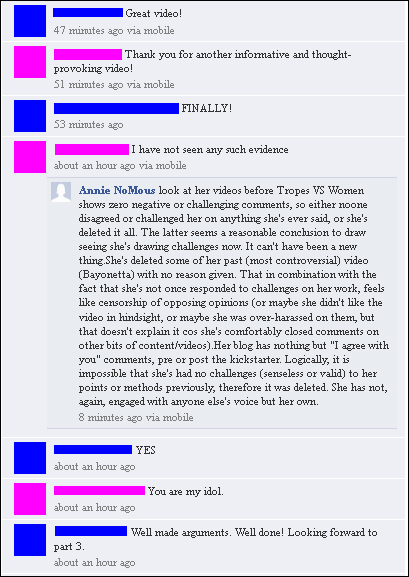
After this, I started keeping an eye out for any other comments that were likely to be removed but weren't abusive. I'm very happy to say that I found some. Spot the difference between these two screengrabs from Facebook. For the sake of privacy, I've blocked the identities of the people listed (blue for comments by men, pink for comments by women, purple if I wasn't sure):
It seems like "Annie NoMous" is a pseudonym -- not only does it sound very close to "anonymous" but I checked this person's profile at the time and it was completely blank -- but still, I can't see any reason why their comment was deleted other than the fact that it dared to question Anita Sarkeesian. "Annie" isn't alone either. Take a look at this. The first picture was taken on the 27th of May and the second one was taken yesterday:
Jason Wilkins here is an interesting case because even though his original comment was deleted, he wasn't blocked from commenting on the Facebook page. Anita -- or, if not her, whoever runs the Feminist Frequency Facebook page -- took issue with the suggestion that the Tropes Vs Women videos could be improved by (shock! Horror!) pointing out violence against men in the games featured in the video series. Incidentally, if you're interested, the video he linked to in his comment (twice, accidentally) was KiteTales' rebuttal to Anita's second Damsels In Distress video.
Regardless of how you felt about the comment from "Annie NoMous", can you honestly say that Jason Wilkins' comments deserved to be deleted? He was nothing but courteous and showered Anita's goals with praise. However, because he pointed out that Anita could be doing a better job than she was -- and a more equal job at that -- his comments were quietly, unceremoniously deleted. So how does it work? If Anita is showered with praise, her critic gets off with a warning but if they outright oppose her, they're given the full Stalin-esque "unperson" treatment?
For all of Anita's boasts about abusive comments "failing to silence" her, she has no qualms about silencing others at the drop of a hat. It's about as hypocritical as it gets but it's also no secret why she does it; if it makes Anita look bad, it's getting deleted. Think about it:
Youtube comments
feministfrequency.com comments
E-Mails
Facebook comments
Oh, and case you didn't know, Anita Sarkeesian's Wikipedia page is completely missing a "Criticism" section, unlike the vast majority of other public figures who analyse anything, not just popular culture. I'd also like to post the relevant part here, just on the off-chance that her page is updated with a Criticism section in the future but someone happens to read this blog afterwards.
(Left-click for a larger view.)
As if all that wasn't enough, Anita has censored herself on occasions when she feels like she's made herself look bad; she removed her Bayonetta video from Youtube after she realised that her dumbing-down of the story, missing the point of the main character's sexualisation and clear lack of experience actually playing the game made her come off poorly. It seems to be a similar case with her university research paper, "I'll Make A Man Out Of You: Strong Women In Science Fiction And Fantasy Television", where her famous take on masculine and feminine traits came from. It was once hosted on feministfrequency.com but she has since removed it. Feel free to download it here!
You see, Feminist Frequency is built on censorship and silencing. It's very image-based, with Anita portraying herself as an almost-flawless central figure. On its own, without Anita's boasts about the abusive critics "failing to silence her", disabling Youtube comments and not answering e-mails seems fine. That's up to her to do. With those boasts, however, censoring perfectly polite and rational criticism is the most hypocritical thing Anita could've done. People telling others that Anita's aren't all cracked up to be? That's a failing on her part, sure, but it's one that can be fixed. Censoring the people who are bringing that up, after singing your own praises about failing to be silenced? Hypocrisy.
Let's finish with something fun. After I was blocked from Facebook, I took a screenshot of the comments section of the "mansplaining" article that Anita linked to and it's interesting to see the comments that made the cut when mine were deleted. If you thought the comment Jason Wilkins was replying to above was ridiculous -- I was astounded to find that someone out there actually uses the word "womyn" -- take a look at a selection of the others that made it. I'd post all of them but the picture would be far too big:
Yeah, criticising Anita is off-limits but "going crazy with a baseball bat" is welcomed under the Feminist Frequency banner. You should see some of the comments I had to cut.
As always, feel free to leave a comment below (you won't be silenced!) or send me an e-mail at themalesofgames@gmail.com (I ... might ignore that. I don't check it every day).
This isn't what I planned to write but I've been thinking about it all morning and I've got more to say on the subject than I realised. For those of you who don't know, Microsoft showed footage from the upcoming Killer Instinct reboot (sequel?) on stage for its conference a couple of days ago and during a match between a man and a woman, this joke was made:
Basically, the female player was losing heavily and her male opponent at one point uses the phrase "just let it happen, it'll be over soon". Cue internet outrage.
First of all, although I didn't find the "joke" funny, I didn't think it was about rape either. That, however, was the conclusion that legions of gamers and game journalists came to immediately after it happened. The idea being that the phrase "just let it happen, it'll be over soon" sounded like something a rapist would say during a rape.
Or possibly something a torture victim would be told during torture. Or a doctor might tell you during an uncomfortable medical procedure. Or a colleague might jokingly tell you during an awkward lunch with your boss. I can recall being told something similar by my parents when I went to a wedding as a kid and got bored during the speeches.
People are free to interpret that line as a rape joke if they like though. Even though it shows an unwillingness to accept different interpretations and give the benefit of the doubt, the phrase being interpreted as a rape joke isn't what bothers me. It's fine and, if that's how you feel, I'm also sorry if it offends you. I hate being offended myself and don't enjoy other people feeling offended. What does bother me is people thinking it's indicative of a larger epidemic of sexism in the gaming industry. That's what thesetwo articles claim, unfortunately.
On its own, I probably wouldn't have much to say about the claim that rape jokes represent sexism against women in the games industry. At this point, I think we've come to expect that reaction. What I want people to take note of is just how low an opinion of women the writers of those two articles have decrying the rape joke.
Personally, when I saw the Killer Instinct gameplay, I figured that maybe the female gamer hadn't played it before. Maybe blocking in Killer Instinct is a fiddly thing to do; I found blocking to be tricky when I played the Injustice: Gods Among Us demo, so my mind immediately went to that. I thought the female player's difficulty was either to do with her opponent's experience, her own inexperience or Killer Instinct itself.
Those two articles I linked to, on the other hand, decide to bring gender into things. Take a look at these quotes:
"In this scripted event the man, of course, kicks the woman's ass at the
fighting game. "I can't even block correctly and you're too fast," she
says, playing a video game like a girl."
"There's another layer of troubling to this - bringing out a man who
worked on the game to beat on a woman (the only woman presenter, I've
read, but I did not watch the entire presentation to be sure) feels an
awful lot like an attempt to reinforce the 'girls can't play games'
elitism that permeates the lower strata of game culture."
These two articles, from The Atlantic Wire and Badass Digest, are quick to try and brand the woman a victim, as well as judge her skills as a gamer and enforce gender stereotypes about the way she plays. They're quickest to draw conclusions about Microsoft's intent, the male player and the male audience members who laughed at the joke:
"That this is the trash talk that a man feels comfortable
directing at a woman on a stage in front of thousands of people says an
awful lot about that man. That people laughed says an awful lot about
that crowd."
"And even if it's not conscious, there's a boy's club mentality to gaming that ends up making women feel very uncomfortable."
Essentially, the writer of the Badass Digest article, Devin Faraci, is quick to brand people sexists because they laughed at something he didn't find funny. Nothing more.
I'm not defending a rather petty, unfunny joke but I am willing to defend a bunch of innocent people from being victimised for enjoying some playful trash talk. Faraci writes about elitism and goes on to say that the rape joke was "indicative of a larger cancer eating away at the gaming community". The only cancer eating away at the gaming community is the game journalists who feel increasingly comfortable insulting people who they disagree with, whether it's George Kamitani of Dragon's Crown fame, the male player of Killer Instinct at E3 or even the portion of the audience who enjoyed the joke.
As for the female player, Ashton "Vulcan" Williams, what did she think of the joke?
I came across the Williams' name in this follow-up article from The Atlantic Wire, which is a mess of contradictions; the writer, Rebecca Greenfield, acknowledges that Williams doesn't care. She quotes this progressive female poster from Reddit, who didn't care. Yet Greenfield, still has the gall to write, "this kind of 'smack talk' not only alienates female would-be gamers but
also mimics the rampant sexual harassment in gamer culture". She still makes assumptions about why Williams doesn't care with, "so maybe Ashton Williams doesn't mind the rape joke because she's so
used to putting up with that kind of stuff just to make it in the gamer
world".
Greenfield's justification for this attitude?
"Yes, gamers talk like this all the time. Others
responding to the Xbox exchange, particularly on Reddit, note that
gamers — even girl gamers — tend to use similar phrasing all the time
while playing, which by their logic makes the E3 incident acceptable."
Okay, so why is their logic wrong but your logic right? They're both opinions so why does Rebecca Greenfield's call for a moratorium on rape jokes make more sense than simply telling people not to care about a throwaway phrase between friends while playing a game? Given that the person on the receiving end of the "rape joke" didn't care, that seems like the more sensible option.
There's a tone involved in articles like these that suggests if you don't agree with their opinion, you're wrong. No room for negotiation. Personally, I don't mind if they're offended by the joke and if that was all they criticised, I could sympathise with them. Unfortunately, their stance being "our opinion is fact" and their insistence on insulting anyone who disagrees has diminished any sympathy I could possibly have for them. Here's a few facts that Rebecca Greenfield and Devin Faraci might want to take into account; men aren't all sexists if they laugh at something you dislike. Women aren't helpless children who need to be mollycoddled even when they don't want to be. Although you can say a lot about the XBox One -- and trust me, I have -- Microsoft having a male player defeat a female player in an on-stage demonstration doesn't mean they're horrible people enforcing a "boys' club" in mainstream gaming. Quite the opposite, actually; they're encouraging female participation of mainstream games by featuring a female player during their biggest conference of the year.
Speaking of that, back when Sony announced the Playstation 4, they were criticised for having no female presenters. Does anyone else find it a little odd that when Microsoft does feature a female presenter, they're hugely criticised for not being a good enough gamer. Not only is it very reminiscent of the supposed attitude towards "fake" geek girls -- having to prove their worth as a gamers (or knowledge of whatever fandom they enjoy) before being accepted by other gamers -- but it comes across as moving the goalposts. There were no claims from the critics of the lack of female presenters that the female presenters had to be good at gaming (and I'm not saying that Ashton "Vulcan" Williams isn't) so this is another case of feminist critics -- you guessed it -- creating a no-win situation. While also being far more critical and judgmental of Ashton Williams than the supposed "boys' club" that they speak out against.
Still, both Greenfield and Faraci are fans of Feminist Frequency. I think we know where they get it from.
As always, feel free to leave a comment below or write to me at themalesofgames@gmail.com
Hey all. Sorry that I didn't update sooner. I've been very busy over the past week but I'm pleased to report that my last post was the most-read that this blog's ever had! Not that it's been much of a horse race but nevertheless, it gave me a thrill to look at the pageview stats, so thanks to everyone who contributed.
I'm working on a longer post but here's a short webcomic for today, courtesy of For Lack Of A Better Comic:
Author's comment: "If your Privilege stat is above 20, you are forced to roll a Privilege Check before each conversation."
As always, feel free to leave a comment or send me an e-mail at themalesofgames@gmail.com
Anita's back again, with the second part of her three-part series on the damsel in distress. Let's jump right back into it. Since this video deals with the deaths of characters, there will be spoilers throughout this blog post, mostly for older games but for some as recent as Bioshock Infinite. So read at your own peril.
I'm not a fan of Anita Sarkeesian. That should go without saying. Without going too deeply into why, let's just say that it's been a rocky road for Anita over the last year. She made a few too many questionable decisions for me to trust that her video series would be anything but one-sided. To my surprise, her latest video -- part two of three in her damsels in distress series, focusing mainly on damsels in distress who are killed, sometimes by the main character -- was one that I didn't find completely disagreeable. She hasn't won me over. I'm not convinced that Anita is a force for good in gaming and the negatives continue to outweigh the positives. What I am convinced of is that, when it comes to gender stereotypes, her heart is in the right place. Unfortunately, other points put forward by Anita are so biased and outright contradictory at times that having her heart in the right place doesn't help her case in the slightest.
Let's keep it positive though. I'll try not to quote Anita too much this time around and just give some basic summaries but at this point, I'd like to. Talking about male video game characters who lose their wives and daughters -- Max Payne and God Of War's Kratos are the two examples used -- Anita puts forward the idea that the reason these characters go on their roaring rampages of revenge is not because they're trying to avenge the loss of their wives and daughters, whom they loved very much.
"I’d argue that the true source of the pain stems from feelings of
weakness and/or guilt over his failure to perform his “socially
prescribed” patriarchal duty to protect his women and children.
In this way these failed-hero stories are really about the perceived
loss of masculinity, and then the quest to regain that masculinity,
primarily by exerting dominance and control, through the performance of
violence on others.
Consequently violent revenge based narratives, repeated ad nauseum, can also be harmful to men because
they help further limit the possible responses men are allowed to have
when faced with death or tragedy. This is unfortunate because
interactive media has the potential to be a brilliant medium for people
of all genders to explore difficult or painful subjects."
That last paragraph is the important one. The one that I have plenty of praise for. Anita takes note of the fact that male gender roles are very limiting; aggression, dominance, protectiveness, chivalry, resourcefulness ... it's a risk for men to step out certain gender roles and can be frustrating for the ones who don't feel that they can.
One of the problems, however, is that Anita only seems to be stating this because she believes it supports her idea about women being objects rather than fully-rounded people that the protagonist cares about. They're property to get angry about being "taken" from them rather than people to miss. I don't think one guarantees the other. If I also might state the obvious for a moment, another problem is that these are video games. Revenge stories tend to work far better for gameplay purposes than stories about mourning and how to deal with loss. Max Payne and God Of War are based on film noir and violent Greek revenge-stroke-tragedy myths; not the kind of genres that have the heroes reaching for boxes of tissues. At the end of her video, Anita gives a few examples of games that she believes handle the subject of death in games more maturely (specifically Dear Esther, The Passage and To The Moon). Not that I hold anything against these games for doing that but they're not likely to become the standard. I adored To The Moon but haven't touched it ever since I completed it and I'm more likely to play Max Payne before I go near it again.
I'll come back to this later on but there's a much more significant reason why my goodwill towards Anita over acknowledging this hurtful gender stereotype didn't last. The big chunk of the video revolved around what Anita described as "the Euthanised Damsel". This is what happens in a game where a hero manages to catch up to a person he/she has been searching for -- usually a damsel in distress, as the name indicates -- only to find them begging the hero to kill him/her. Perhaps they've been turned into a monster or altered in some other way by the bad guys and they don't wish to live anymore. They'll beg for their rescuer to kill them and the rescuer will respect their wishes. That's the Euthanised Damsel in a nutshell.
The problem is that, while I don't want to say Anita was moving the goalposts at any time, it was a very large pool she was drawing from, based on a varied list of criteria. At one point, it was just women who were beyond saving. Then it was love interests who were too far gone and had to be killed. Then it was family members, mostly mothers. Then it was love interests who didn't have to be killed but did have to be fought to break them out of whatever spell or ailment it was that made them attack the heroes.
We have to wait for Anita's next video to hear her talk about male examples but I have a tendency to pick out a few male analogues to Anita's accusations while she's discussing them. Each time the Euthanised Damsel definition was expanded, there were a few examples that immediately sprang to mind, be they characters like Sinclair in Bioshock 2, Jecht from Final Fantasy X, Steve's father from Resident Evil: Code Veronica and plenty who only had to be attacked, rather than killed, such as Leon in Resident Evil 4 and Baralai in Final Fantasy X-2.
However, there were very few examples I could come up with featuring a male love interest being killed by a female hero. That's partly because, as Anita points out, there are so few female protagonists but even fewer with male love interests. This is slightly off-topic but I think the inclination to place female protagonists in the "strong, independent woman" archetype is a reason why male love interests aren't often featured; perhaps the belief that the heroine is motivated by a man betrays the "independent" part of that archetype. On-topic, however, I read a suggestion on a Youtube video that made me think that a woman euthanising a male "damsel" isn't the real analogue to men euthanising a female one. No, the real analogue is male heroes who die to save their damsels in distress; just like the female characters Anita brings up who request death rather than live as an abomination, male characters are often expected to have no thought for their own safety as long as the female characters are okay.
Capcom is very fond of doing this. In Onimusha 2, one of the story branches features Kotaro sacrificing himself to save Oyu, a woman who he has been largely antagonistic towards for most of the game. In Devil May Cry 4 -- which Anita brought up to point out the damsel in distress, in spite of the fact the game also features Nero being captured -- has Credo betraying his religious order in an attempt to save his sister, Kyrie, and it costs him his life. In Resident Evil: Code Veronica again, Steve is turned into an invincible monster at the end of the game but manages to fight off the transformation, his love for Claire Redfield is so strong. He dies shortly afterwards. This one is quite close to the love interest being killed by the heroine, in that Steve was a "damsel" moments earlier but he dies because his body can't take the transformation rather than because Claire pulled the trigger herself.
Then there's the huge sacrifice made by the hero of Shadow Of The Colossus (although he doesn't die). In Bioshock 2, the hero, Subject Delta, dies regardless of the ending the player receives, while the young woman he set out to save, Eleanor Lamb, lives on. Bioshock Infinite features a similar story, with many different incarnations of Elizabeth drowning her father, Booker DeWitt (who accepts his death willingly), so he doesn't go on to become the game's villain and kidnap her in the first place. That probably sounds confusing if you haven't played Bioshock Infinite and trust me, it's hard enough to understand even if you have.
One of the flaws in Anita's argument is also making the assumption that developers only use the Euthanised Damsel when they wish to shock people. I find that hard to believe. While there are doubtless examples that do exist just to be edgy, it seems like Anita isn't willing to consider the possibility that the writers wanted to create a tragic storyline. Or a storyline with a twist. I can't help but think Anita came to the conclusion that being edgy was the reason why the Euthanised Damsel existed before she looked at her many examples and then just found a way to make them fit her viewpoint.
Those are my thoughts on the "main" portion of Anita's video but in spite of my criticisms, I don't see much of a problem with Anita's dislike of the "Euthanised Damsel". Unlike her first video, Anita isn't as judgemental. There isn't any demonising of Shigeru Miyamoto, for one thing. The attitude is still there though; Anita explains why she dislikes the Euthanised Damsel -- and don't get me wrong, I completely understand why -- but I'm not really given a reason why I should care beyond conjecture and guesswork. The Jack Thompson parallels are still there, this time with regards to domestic violence. More on that later.
That's the important thing -- and, more to the point, the reason I can't get behind Anita as a force for good in gaming -- Anita states, "one of the really insidious things about systemic & institutional
sexism is that most often regressive attitudes and harmful gender
stereotypes are perpetuated and maintained unintentionally". Unfortunately, Anita herself had already reinforced and condoned harmful gender stereotypes herself at this point. Long story short, she talked at length about domestic violence but her definition followed the Duluth model.
If you know about domestic violence, that should say it all. For those of you who don't, however, the Duluth model is the assumption that domestic violence is "patriarchal"; domestic violence is an act done by men against women and children. If you've been following me for a long time, you'll know that hearing statistics about male victims of domestic violence on television was what interested me in men's rights in the first place. So domestic violence against men is a very prickly subject for me and I do not appreciate having male victims dismissed with gendered language in sentences like "people of all genders tend to buy into the myth that women are the ones to blame for the violence men perpetrate against them". Aside from ignoring male victims and female abusers, it also ignores violence in same-sex couples and doesn't acknowledge reciprocal violence. It is not a healthy, intelligent or accurate image of domestic violence to promote.
Aside from this major problem with Anita's argument, I find her videos peppered with smaller ones too. While Anita's latest video didn't have me shouting curses at my monitor, I did find myself sighing and shaking my head a lot. Her heart may be in the right place -- albeit deep, deep down -- but her solutions are impractical, biased and based on questionable logic and outright contradictory statements. For example, she criticises and dismisses Devil May Cry 4 (and others) for being a "crude, unsophisticated male power fantasy" but also does the same for Ico with "the most decidedly patronizing examples depictions of female vulnerability
are used for an easy way for writers to trigger an emotional reaction in
male players". That, in particular, made me cringe. Some time ago, Anita removed her video on Bayonetta from her channel because she thought she came across badly in it -- she shrugged off the story and dumbed it down to make it seem insignificant -- and as far as I'm concerned, she's doing the exact same thing with Ico here, with regards to the main gameplay element. You've probably already noted, as I did, Anita's inability to consider that perhaps female players could feel emotionally attached to the characters in Ico.
At one point, Anita repeats the same sentence over and over, wanting to get a point across about a trend: "In [game] your wife is brutally murdered and you then have to rescue your daughter." She seems to believe that the trend of daughters being captured is disempowering to women but apparently doesn't consider the possibility that the reason daughters are so frequently kidnapped instead of sons (and possibly husbands too) is because female characters are automatically more sympathetic than male ones, simply because they're female. Games like Heavy Rain, featuring a kidnapped son, are very rare. We feel more for Max Payne and Kratos because they lost daughters, not sons. In Bioshock 1 and 2, the reason for Little Sisters rather than Little Brothers was because it would be more difficult -- and morally questionable -- for the player to sacrifice little girls rather than little boys. In Bioshock 2 and Infinite, the protagonist's main mission is to find mistreated female characters, not male ones. It's the same principle behind "missing white woman syndrome", where the media is more willing to spotlight missing people if they're middle- or upper-class white women than if they're, say, a poor black male.
While it might seem like a good idea for Anita to decide against including violence against women who are treated as equals -- female soldiers and fighting game characters, for example -- there are a number of reasons why it carries some unfortunate implications for men. Back in February, I wrote about the sexism in Heavy Rain, comparing and contrasting two death scenes in particular; one of playable character Madison Paige, having a drill used on her genitals and one of Leland White, the villain of "The Taxidermist" DLC story, who has a chainsaw used on his. White's death is much more violent than Madison's, showing the genital mutilation in full, gory detail while Madison's is treated with more sensitivity; instead of showing the death, the camera cuts to the outside of the house and we hear a scream. The problem is that under Anita's definition, White's death is actually more acceptable than Madison's because he's not a damsel in distress at the time. The grisly nature of his death becomes irrelevant because he still has his agency. While Anita may believe helplessness is required for her definition of "violence against women", I'm afraid that I don't.
Time and again, we're asked to trust in Anita's word only because we're supposed to. We're told to believe the Euthanised Damsel is done for the sake of being edgy, just because that's what Anita thinks is the reason for it. We're told to see the damsels as objects instead of people, since that's the conclusion Anita has come to. While she points out that playing the games she features will not "magically transform players into raging sexists", she also says "media narratives do have a powerful cultivation effect helping to shape cultural attitudes and opinions". There's no explanation why she thinks video games/the trend of damsels and Euthanised Damsels contribute to these cultural attitudes though and that is when we get back into Jack Thompson territory.
This is becoming longer than I intended but I didn't want to leave anything out, so I'll wrap it up. Even without Anita's stance on domestic violence, I wouldn't be able to accept this video. There are just too many little details, too many conclusions drawn from questionable logic for me to support it. That's a shame and I genuinely mean that because, not enjoying depictions of violence against men, I can sympathise with the fact that she is so strongly against the idea of the Euthanised Damsel. However, when Anita says something like "violence against women is a serious global epidemic; therefore, attempts
to address the issue in fictional contexts demands a considerable
degree of respect, subtlety and nuance", she doesn't seem to realise that she's demanding special treatment. I agree that violence against women deserves to be treated respectfully but she's reading too much into a few too many situations; for example, I'm not sure how many people compare the hero having to kill his fused-with-a-monstrous-alien girlfriend when she asks him to do so in Prey with domestic violence.
Finally, it has to be said ... these are video games. As it happens, there are many important real-life issues that aren't treated with subtlety and nuance. War, for example, has been glamorised ever since Wolfenstein. To ask that all game developers consider how they treat the deaths of soldiers, however, isn't practical for video games. When all is said and done, I could be the most ardent anti-war protestor on the planet but not have any say in what developers should be doing with their own games. The final say is theirs, and rightfully so. The same goes for Anita and her feeling about violence against women in games. That's about all there is to say about it.
Addendum
If you only care about video games, you can stop reading now. This is where I put my investigative hat on and check out the resources Anita used for her video.
Anita posted the list of
resources she used for this video on the Feminist Frequency site and
they are very telling. Anita's sole resource for the idea that game developers must feature the deaths of women to be "edgy" is this
blog post and video. If she actually believes the statement Daria makes in the video then she's actually being more judgmental than I gave her credit for earlier.
While I can't find anything that goes against the
claim that "every 9 seconds a woman is assaulted or beaten in the United
States and
on average more than three women are murdered by their boyfriends
husbands, or ex-partners every single day", the Every 9 Seconds website
states "there are over 4700 U.S. women incarcerated for defending their
lives". Let's just say that the founders of Every 9 Seconds may be
playing fast and loose with their definition of the term "defending
their lives"; I live in the UK but if any of you have been following the trial of Jodi Arias over there in the US, you may know that she
claimed she was acting in self-defence and was a victim of domestic
violence. Having followed a few cases of women on trial for murder or
wounding charges over the years, Arias certainly isn't the first to make
this claim.
One of the other resources Anita posts a link to is for the Wellspring Alliance, which looks fine. In fact, on their FAQ page, they mention that they take everyone, "regardless of race, color, national original, gender, sexual orientation, disability or age". Likewise, on the page linked to on Feminist Frequency's website, they state "Men are also victims of domestic violence, as are couples in same-sex relationships". Apparently, Anita decided to ignore that part when she talked about domestic violence herself.
"Research consistently shows that people of all genders tend to buy into
the myth that women are the ones to blame for the violence men
perpetrate against them. In the same vein, abusive men consistently
state that their female targets “deserved it”, “wanted it” or were “asking for it”."
Looking at the study itself, that is not what was said.First of all,this is a single study, with twenty heterosexual women who used to be in abusive relationships. "Consistently" and "people of all genders" are completely misleading. Nothing of the sort is written about this in Wood's research. Secondly, abusive men are not shown to have stated that their female targets "deserved it", "were asking for it" or anything similar. When these phrases come up in Wood's study, they're actually used as reasons why the female abuse victims stayed in abusive relationships:
"The women in this study described their partners'
violence against them as understandable at the time it occurred. They justified
it using a variety of reasons: 'I deserved it,' 'He didn't really mean it,' 'He
was drinking,' 'It could have been worse,' and so forth."
It's very unpleasant, yes, but this isn't what Anita said. She made a claim about how "people of all genders" view abuse that research "consistently" shows but none of the sources provided on feministfrequency.com confirm Anita's claim. I don't know if Anita or her team at Feminist Frequency can provide sources that back up her claim but this, at least, is an outright fabrication.
I'm going to be upfront about this; I don't own Lollipop Chainsaw. Partly to do with having a limited budget to buy games with but mainly because I just don't want it in my collection. I wasn't very impressed with the look of the gameplay and I'm very tired of games with zombies in them. Plus, even though I know Grasshopper Manufacture made the game, it was directed by Suda 51 and I haven't played a Suda 51 game since Killer7 (which I wasn't a fan of, to say the least). Plus, while I know what the game is about and know why there's a scantily-clad cheerleader on the front of the box, not everyone else would. It's the kind of game I wouldn't want my parents or non-gaming friends to look at too closely.
I know people might dislike the idea of me criticising a game that I don't own. It sounds bad to say "I've never played this game but here's what's wrong with it". I'm certainly not going to argue that I can give a more comprehensive analysis of the game than someone who owns it. Much like I did with Far Cry 3, I'll be honest about what I've seen and what I haven't seen and, if I get anything incorrect, feel free to correct me. I suspect that might happen when Juliet or another character elaborates on something during the game that I haven't seen, because I've only watched the cutscenes (and a very small amount of gameplay, which I'll get to eventually). So if I end up quoting things out of context -- pieces of dialogue that are later expanded or retracted -- it's accidental.
The reason I wanted to look into Lollipop Chainsaw in the first place was because of an article written by Jim Sterling on Destructoid last year, all about his interpretation of some of the events that take place in the game, revolving around Juliet's boyfriend, Nick. At the very beginning of Lollipop Chainsaw, Juliet Starling is getting ready to meet up with Nick but she ends up running late and, as a result, Nick ends up bitten by a zombie. Juliet, being from a family of demon hunters, has an idea; she cuts off Nick's head and performs a ritual to keep him alive, but only as a head. Jim Sterling compares Nick's treatment as a literal object to the objectification of female characters in other games. I recommend you read that first because I might refer to it occasionally.
I don't think I need to go through the entire story scene-by-scene like I did with Heavenly Sword because only certain cutscenes are important. Basically, the story revolves around a student named Swan who is determined to break down the barrier between the human world and "Rotten World" (Lollipop Chainsaw's equivalent to hell). To do this, he summons Rotten World's five generals -- the Dark Purveyors -- who serve as the game's boss fights. They each utter an incantation when they're defeated, which serves to open a gateway and summon the final boss.
Most of that isn't important for this blog. All the important stuff concerns Nick and how he takes to being lugged around on the hip of his girlfriend. The reason I take issue with Jim Sterling's opinions on Lollipop Chainsaw is that, much like Jeffrey Yohalem did with Keith's rape in Far Cry 3, he can acknowledge instances where men are victims but think that they must be representative of female issues.
Not that every cutscene where Nick is mistreated is sexist or a men's issue. For example, shortly after the first boss fight, Nick is talking to Juliet about how he doesn't like being just a head. Juliet defends it by saying that she can sneak him into movie theatres so he doesn't have to pay and that no other girls have a boyfriend who is just a head, which leads Nick to say that he doesn't want to be an accessory. It's mildly insulting to Nick but the main point it gets across is how shallow Juliet is. For the moment, Nick's frustration over just being a head is secondary to establishing what a ditzy individual Juliet is.
One of the areas where I feel Jim Sterling really misses the mark, however, is with these two paragraphs:
"The scene that truly made me stop and think about Nick's role in the
story was one that involved the entire Starling family, consisting of
Juliet, her two sisters, and her father. While the Starlings plan their
raid on the next undead target, Juliet's youngest sister, Rosalind, is
forcing makeup onto Nick's face. Holding him forcefully in place and
delivering a humiliating makeover, neither Rosalind or her sisters are
capable of understanding why Nick is upset by his treatment -- treatment
made all the more worse when Juliet's father tells Nick off for
screwing around and threatens to deal with him if he continues being
disruptive. It's all played for laughs, of course, and is quite
funny, but when you look at what is happening to Nick, you see him
suffering through several issues that commonly affect women, especially
in the game industry.
Mr. Starling in particular seems to embody a particularly alarming
issue in modern culture, made all the more pertinent by the fact that he
is a male character -- victim blaming. Blaming the victim is something
that people seem to love doing more and more these days, especially when
women are concerned. Whether it's guys insinuating that a woman dressed
as a "whore" was asking to be raped, or that someone being made
uncomfortable by sexual harassment should have "said something" despite
the pressure she was under to keep her mouth shut or politely smile,
there's a lot of blame being thrown around by society's peanut gallery,
and a less than deserved portion of it ever seems to reach the person
who started whatever problem occurred."
Putting aside the fact that Sterling jumps from "comical makeover cutscene" to "rape victim blaming" alarmingly quickly, not once did I ever feel like that cutscene was an analogue for the treatment of women in the gaming industry. Nick's treatment was too light-hearted to carry the weight that Sterling gives it and I can't say I spotted anything to link it to victim-blaming, particularly that of women.
No, instead I think Nick's treatment during this cutscene has a lot to say about male disposability. During this cutscene, Rosalind is casually throwing Nick around before giving him a makeover, without any consideration for his well-being. By this point, Nick has already been bitten, beheaded and used as a weapon by Juliet in-game and Rosalind's lackadaisical attitude towards Nick's suffering reflects the average gamer's apathy towards slaughtering the men who make up the majority of enemies in most games. Rosalind is playing games with Nick's head and is completely blind to the fact that Nick is a human being. She's as relaxed about mistreating him while playing her games as we are towards men when we play ours.
There's also a lot to be said about Rosalind giving Nick a makeover; one of the stereotypes of men is that we all have to be strong, brave and protective of women. Except for Nick, the heroic male characters in Lollipop Chainsaw -- Juliet's father (named Gideon but usually referred to as just "Dad") and her sensei, Morikawa -- embody these qualities. They both have the chance to show off their zombie-killing skills, whereas Nick is bitten at the first opportunity because Juliet was running late and wasn't there to protect him. So Nick is "unmasculine" and Rosalind's treatment of him is a constant reminder; she refers to Nick as "it" repeatedly, rather than "him" -- dehumanising him and not even using male pronouns to refer to him -- and gives him a humiliating makeover to entertain herself, in spite of Nick's protests. Obviously, this ends with Nick looking incredibly feminine, further emphasising his lack of masculinity. His failure to live up to male "standards".
I don't think Juliet's father blaming Nick for "screwing around" is as big an issue -- in context, it's actually very clearly the "overprotective dad" cliché taken to its logical (and funny) extreme, blaming Nick when he clearly has no control over what happens to him -- but it could be argued that he represents the fear of what happens if men come forward about their mistreatment. If Sterling wants to bring rape into the equation, it could be said that Juliet's father's blame represents the fear that male rape victims won't be taken seriously if they report that they've been raped. The fear of being dismissed or mocked for "coming out" about their abuse is unsurprisingly common.
The most questionable moment comes up later. I'll let Jim explain it:
"The sheer selfishness of the heroines seems to mirror the attitudes
that many men can have towards women, an attitude typified by Juliet
when she refuses to kill Nick. At one point, her disembodied boyfriend
begs for abandonment (and the inevitable death it would result in),
having zero quality of life and feeling like he's lost everything that
made him a person. Even as he asks for mercy, Juliet refuses, and gives a
reason that sums up the relationship between them perfectly -- "I love
you." Her reason for keeping Nick alive in a state that's less than
human is because of her feelings and what she wants.
It reminds me of certain justifications for problems that have arisen
in the gamer community before. It's been said by some that sexual
harassment is just a "part of the culture" of online gaming, as if to
say that anybody who has a problem with it needs to go away and not
express their feelings of discomfort."
I do think there's something to this but there's a big problem with the way it's portrayed in Lollipop Chainsaw; let's just say that even though Nick is annoyed with Juliet at first, he ends up telling her how much he loves her, sacrifices himself for her and is resurrected with his head on Morikawa's body (don't ask) at the end of the game, with the two of them staying together. So while Juliet's selfishness could very well be an allegory for selfish sexual harassment at conventions, the outcome of Lollipop Chainsaw apparently encourages exactly what Jim Sterling is discouraging; the idea that it's completely fine and the victim should just accept it.
I should point out that this may be where my lack of insight into the actual game lets me down. I get the feeling Juliet and Nick exchanged some dialogue in-game between this cutscene and the next that explains just why Nick is so willing to forgive Juliet and tell her he loves her. If that's the case, feel free to call me out on it.
Let's focus on the cutscene where Juliet refuses to leave Nick behind to die, however. It's not just the fact that Juliet is selfishly unwilling to let Nick make his own decisions simply because "she loves him". It also has a whole host of grim implications because of Nick's "condition". It's ableist because Juliet is forcing the helpless Nick to accompany her when he doesn't want to. It borders on stalking because Nick can't get rid of Juliet, even though he asked her to leave him. To me, this is less of an analogue to sexual harassment of women in real life and more of a gender-flipped parody of books such as Twilight; a knowingly-sexualised female character stalking a powerless male one. Unlike Twilight, however, Lollipop Chainsaw's abuse isn't treated as romantic -- not by Nick, anyway -- but it's not described as abusive either. Between this and the relationship between Meryl and Johnny in Metal Gear Solid 4, I have to wonder if we'll ever see abusive relationships actually described as abusive in-game. Particularly if they break the taboo of acknowledging men as victims.
Jim Sterling's view seems to be that if there's a situation where Nick is mistreated, it's representative of real-life issues that affect women. I disagree, for reasons that Sterling didn't go into; Nick isn't the only male character in this game who is portrayed negatively.
All the male characters in Lollipop Chainsaw are either evil or perverts. Juliet's father is introduced rubbing his wife's behind. Each character is introduced with a retro comic-book drawing of themselves with a list of a few facts about them, such as their favourite food and their hobbies. One of the activities listed among Nick's hobbies is "masturbation". Juliet's Sensei, Morikawa, is the biggest offender, however. One of his hobbies is "collecting women's underwear" and much of his dialogue reflects this. Even the short amount of gameplay I saw featured male perverts; one of Juliet's in-game objectives is to save civilians being attacked by zombies. At school, some of the people being attacked are her fellow students and even they are given sexually suggestive (or even just plain blatant) lines of dialogue, such as "maybe we can hang out after school," and "I never thought I'd be saved by someone with such great tits". All spoken in nasally nerd voices, of course. Even a few zombies sneak in a suggestive line from time to time.
The thing is, I have a hard time accepting the idea that the mistreatment of male characters in Nick's case is simply parody while the stereotyping of male characters in the case of the perverted characters is played completely straight. Jim Sterling may very well be correct and Nick's treatment is an allegory for the treatment of women. In which case, Suda 51 and Grasshopper Manufacture couldn't care less about how they treat male characters in their games. On the other hand, maybe they were genuinely trying to tell a dramatic story with Nick and possibly say something about the overall treatment of men too. If that's the case, then the perverted portrayals of male characters are completely counter-productive. It's contradictory to the story they wanted to tell with Nick.
Unfortunately -- and I do mean unfortunately -- I think Suda 51 and GM were going for the former rather than the latter. Even if they weren't necessarily trying to say something significant about the treatment of women, there was nothing in Lollipop Chainsaw that said they cared at all about men. You'd be hard-pressed to find a positive male character in the game. Even Nick, in spite of being sympathetic and slightly more sane than the rest of the group, isn't very bright and is rather weak-willed. Not that the female characters are much better but I could probably find more to praise in the three Starling sisters than in Nick, Morikawa and Juliet's father.
As for Lollipop Chainsaw itself, I can't say I'm disappointed that I didn't buy it. I like that it doesn't take itself seriously and that it features zombies brought to life by mystical means rather than scientific ones (it might seem like a small quibble but I'm so tired of scientific zombies). Other than that, it didn't win me over.
As always, feel free to leave a comment or send me an e-mail at themalesofgames@gmail.com.
Something a bit different this time. Bet you didn't expect an update so soon after the last one, eh?
Over the past few days, my patience with those who discuss gender issues in games has been wearing thin. I've already been over Jason Schreier and his attitude towards Dragon's Crown. Anita Sarkeesian added to my irritability when she posted a link to this short cartoon, titled "But I'm A Nice Guy", about a male character who rants about women because a female character took some ice cream that he wanted. Supposedly a parody about male entitlement and men's rights activists hating women. Although it made me roll my eyes, I was actually quite pleased that Anita was showing support for it; if anyone ever needed proof that Anita Sarkeesian doesn't plan on supporting any issues that affect men in her Tropes Vs Women In Video Games series -- i.e. doesn't plan on treating men equally -- this would be it.
Looking at Jason Schreier's complaints however, it seems like when gender issues affect gaming, men and women aren't individuals. We're faceless entities to be stereotyped. Men are an oppressive collection of immature, perverted "dudebros" who want to maintain a "boys' club". Women are delicate flowers; children who need to be protected from evil game content by their knights in shining armour (both male and female).
It's so obvious that I can't believe I actually have to write this but these stereotypes are highly damaging for both sexes.
There's a kernel of truth in both stereotypes -- some male gamers do want to maintain a boys' club and some female gamers take great offence to portrayals of female characters in games -- but the subject of gender issues in games has blown up so much over the past year that these stereotypes are being considered the norm. Jason Schreier isn't the only one responsible -- others include Jim Sterling, the writers at Rock, Paper, Shotgun and Anita Sarkeesian is, obviously, the poster girl -- but it was in his article that gaming journalism reached a new low. Not only did we have the typical mockery towards men but Schreier went so far as to insult the art director of Dragon's Crown too.
Why? Because his devotion to the stereotypically offended female was so strong. It wasn't real women he was defending in his criticism of Dragon's Crown. It was his imagined version of women, being victimised by an imagined version of men. Although George Kamitani was a real person being insulted and Dragon's Crown, a real game that Schreier was scapegoating.
I have to believe that the majority of gamers, male and female, don't accept this. If they do, it means they care more about gender issues than they do about game developers having creative freedom over their own games. Considering that we're all gamers because we enjoy video games, I have difficulty believing that.
Schreier, Anita and everyone else criticising the gaming industry are allowed to complain. They're allowed to be offended. However, they're in no position to demand things from developers. They aren't allowed to dictate what is right and wrong. It's a ridiculously entitled attitude to have but considered completely reasonable by far too many people; people who enjoy gaming as it is -- sexualised characters, damsels in distress, et al -- are rarely given the chance to air their views. When's the last time you saw a video game article called "Everything's Absolutely Fine"? In spite of the video game industry being scrutinised as closely as it can possibly be on gaming sites, there are plenty of people who feel that way. That maybe there's nothing wrong with damsels in distress and perhaps there's even a reason why gaming is a male-dominated industry. These people aren't radical for thinking that, they just haven't jumped on the "gaming is sexist" bandwagon like so many others. For example, these women (and one man):
I would like to point out that I don't want any of the women above to feel uncomfortable. On the off-chance that any of you are reading this, I'm not using you for some sinister men's rights activist purpose. If any of you aren't comfortable being listed here, feel free to send me an e-mail (themalesofgames@gmail.com) and I'll happily remove you. I want this to be a hub for fair-minded commentary on gender issues though, which is why you're all listed. I have nothing but praise for your work.
Why only women?
Don't get me wrong, I value men's and women's opinions equally. If I didn't value men's opinions highly, I probably wouldn't bother maintaining this blog. However, it's very easy for mainstream video game sites to dismiss dissenting opinions if they're made by men, especially if they're white and heterosexual. That's "equality" for you. It's much harder (but not impossible) to dismiss those opinions if they're made by women; critics can hardly say "you want to maintain a boys' club atmosphere" if the person defending the games industry is female. That wouldn't make any sense.
Plus, I've noticed in men's rights circles that people take more interest in why female MRAs support the movement. Men's opinions are valued, of course, but the reasons for getting involved tend to be different. I imagine it'd be the same for game journalists; they turn their noses up at men who disagree but will probably be curious about women who oppose the typical "sexualised women are wrong and damsels in distress lack agency" attitude. There's a chance that they'll listen to women making these points while they refuse to listen to men. However, there's a simpler reason why I singled out women.
Anita Sarkeesian doesn't speak for all women. She's not an everywoman.
However, she's the face and voice of the disgruntled female gamer. As far as gaming sites are concerned, she is the average female gamer. A lot of the women above make it clear that they think Anita supports a good cause but they disagree with her on some of her points. To make it clear, I think women are unfairly treated in some cases in the games industry (such as publishers thinking games won't sell with female characters on the front cover). Unfortunately, it's come to a point where Anita's voice and others like it are the only ones allowed to be heard and dissenting opinions -- even by other female gamers -- can be dismissed just like the male ones.
I'd be lying if I said I didn't want to feature men though; Instig8iveJournalism's videos on Anita Sarkeesian were the first ones I ever saw apart from the ones on Feminist Frequency itself. A user named LeoPirate gives his perspective as one of Anita's Kickstarter backers. TheAmazingAtheist gives a surprisingly fair-minded response. J. J. McCullough wrote a respectful rebuttal to Anita's first damsels in distress video. These aren't abusive men out to threaten Anita Sarkeesian with abusive threats to rape and murder her. These are reasonable responses that aren't being given the time of day, let alone by Anita herself who is still talking about how victimised she was. Just so you don't think I'm picking on Anita, Giuseppe Nelva of DualShockers perfectly countered Jason Schreier's reactionary response to the game's character designs. A writer for a Tumblr page titled 7Nights
also gave his support for the Sorceress and pointed out why we shouldn't be
tearing about sexualised characters just because they're sexual. I definitely
think he got across how shallow it ultimately is.
These arguments need to come to light. If Anita Sarkeesian wants to continue making shaky arguments, fine. If Jason Schreier wants to brag about how he got George Kamitani to apologise, he's welcome to. However, their opinions can't be treated like the gospel truth. Gaming sites need to follow the lead of people like Janette Goering up there, who bravely objected to the #1ReasonWhy movement when she became uncomfortable with it. She still supported it but wasn't afraid to point out the flaws as she saw them.
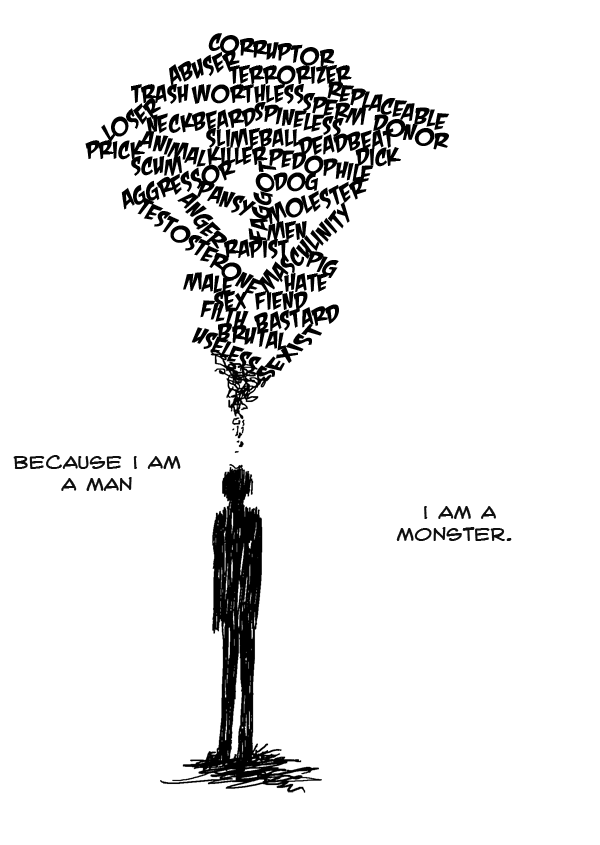
Finally, although it has nothing to do with gaming, I came across a Tumblr
called Shining
Things the other day and fell in love with this picture. Researching gender
issues online, I sometimes come across unpleasant sites that make me feel like
the chap in this picture. If you're on Tumblr, give the artist some support.
As always, feel free to leave a comment or contact me at themalesofgames@gmail.com
Another lengthy gap between updates. Sorry about that.
Dragon's Crown is an upcoming action RPG by Vanillaware, as a spiritual successor to a 1997 Atlus game called Princess Crown. The gameplay is reminiscent of old side-scrolling beat-em-ups like Golden Axe and Streets Of Rage and a big part of the game's appeal is that all of the characters and enemies are hand-drawn.
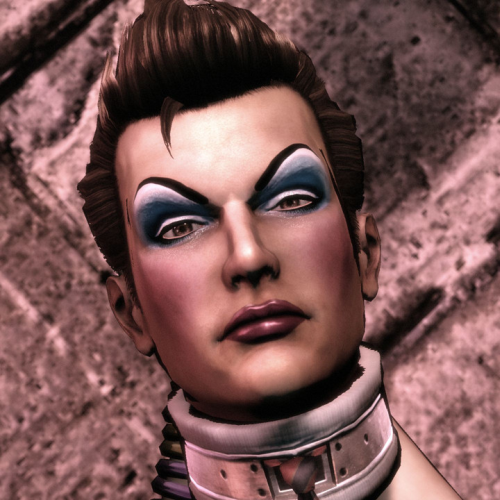
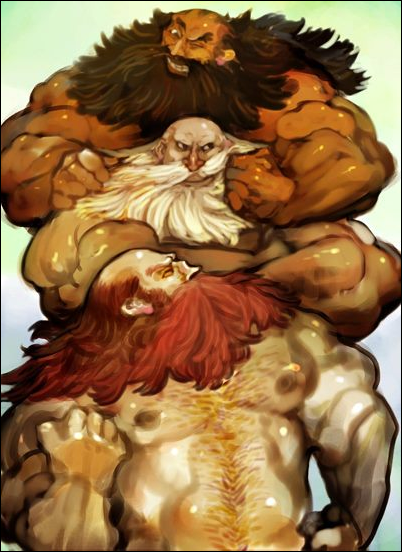
Male characters, top to bottom - Wizard, Fighter, Dwarf. Female characters, top to bottom - Sorceress, Elf, Amazon.
They look phenomenal. In an age where most video game characters are bland, shaved-headed space marines, such exaggerated characters are a very welcome break. You don't often see characters so varied anymore. Muscular female characters extremely rare, for example, and although you can't see it underneath that helmet, the Fighter has more feminine features than we usually associate with such muscular characters, similar to the typical bishounen Japanese hero. Surely, in an age where, I'd say, ninety percent of characters belong to a standard "realistic" archetype with very little variation, everyone would welcome some fun character designs like these.
As if. A big deal was made over the Sorceress (and, to a lesser extent, the Amazon) character for her large breasts. Jason Schreier of Kotaku fired the most significant shot at the character but mainly, it was an insult towards the Art Director of Dragon's Crown, George Kamitani. In a very short piece, Schreier stated, "as you can see, the sorceress was designed by a 14-year-old boy".
Kamitani responded on Twitter by posting a message on Twitter saying, "It seems that Mr. Jason Schreier of Kotaku is pleased also with neither sorceress nor amazon. The art of the direction which he likes was prepared." It accompanied the following image:
It should be pointed out that while Kamitani's message and the above image might seem like a gay joke, that's apparently not what he intended; his message was translated from Japanese using an online translator and, according to Kamitani:
"In regards to the Dwarf image I posted on my Facebook page: This image
was never intended to attack Jason. Originally, it was a promotional
image that I created for my fan base in Japan, which I posted to the
official Vanillaware Twitter account earlier.
We receive many requests from companies to create publicity
illustrations for the game, but we never received any requests for the
Dwarf. Also, as the game’s street date nears, most retail shops start
requesting exclusive art for their retailer-exclusive bonus items. In
Japan, these illustration requests can even be as specific as something
like female characters in swimwear. In these requests as well, the
Dwarf was nowhere to be seen.
So, I decided to unofficially draw a sweaty Dwarf in a bathing
suit, with a bit of cynicism towards those retailer requests. I drew 3
of them to show that there are character color variations available."
So the image predated the tweet and, while there may be homosexual undercurrents, it's meant to be a jab at retailers who didn't show enough love for the Dwarf character.
Anyway, following the image being posted but before Kamitani's explanation, Jason Schreier released a follow-up article to explain his position on the Sorceress character more clearly. It was titled "The Real Problem With That Controversial, Sexy Video Game Sorceress".
In this one, Schreier singles out this one character, the Sorceress ... and proceeds to rant illogically about gaming being a "boy's club", about #1ReasonWhy, about women in the gaming industry being mistaken for receptionists at PAX East and how the Sorceress is representative of a much bigger problem. He does apologise for calling George Kamitani a fourteen-year-old boy but goes on to deliver far worse -- and more questionable -- criticism. Also, believe it or not, Schreier does use the phrase "male power fantasy" while writing about the Dwarf:
"Some have pointed out that the dwarf character—a
shirtless warrior with disproportionate muscles—is just as sexualized
and over-exaggerated as the sorceress. That's true. He's also straight
out of a straight male power fantasy, tailored for men just like the
sorceress's skimpy clothing and ridiculously jiggly breasts. The design
comes across as juvenile, like a hackneyed comic book or a God of War game."
As ridiculous examples of "male power fantasies" go, the Dwarf really takes the cake. This is not an attractive character or, as far as we know, a popular character or a particularly powerful character. It's a short old man with so many muscles that he'd have difficulty moving his limbs in real life. Yet he's a fantasy for men?
However, the main point of Schreier's rant is to portray the Sorceress' design as representative of all the sexism against women in the video game industry. At one point, Schreier goes so far as to say, "hordes of sweaty male attendees trample one another in order to get the best photos of booth babes". So in trying to denounce a fictional female character for being sexist, Schreier uses sexist insults against men in real life.
Let's start with that; Schreier already made it clear that he wasn't above insulting others, including people in the gaming industry like George Kamitani -- which is about as unprofessional as it gets, in my opinion -- and cements this reputation by going on to stereotype male con-goers. Why? To protect the integrity of fictional women. Jason Schreier wants to see a change; he's fed up of the stereotype of the large-chested female video game character. So fed up, in fact, that he's willing to sell everyone down the river for the sake of this principle; original video game art, the artist responsible for them and male gamers.
Schreier's justification for this is "I don't want to look at this game in a vacuum, or laugh off the
sorceress as harmless sexual exaggeration, or accept that this is just
Vanillaware's style". However, the big question is, why Dragon's Crown? All Schreier has done by complaining about it is give publicity to a game that likely would've slipped under most people's radars before he criticised it. I certainly intend to buy it. Trying to make Dragon's Crown into some kind of anti-martyr -- using the game's art style to rant about the treatment of women in the game industry -- all Schreier has done is shoot himself in the foot. People who weren't going to buy it before still won't and plenty of new people will.
It has to be pointed out that Schreier is not even right; we're used to seeing this response by now. It's reminiscent of Anita Sarkeesian and the idea that "I don't like it so it must be wrong". While female characters in gaming may be stereotyped as simply being large-chested sexualised objects, it's nowhere close to the truth; I'm sure anyone reading this right now could come up with at least ten video game series featuring small-chested and non-sexualised female characters. Mario, Zelda, Metroid, the Final Fantasy series, Half-Life, Portal, Uncharted, the Tomb Raider reboot, Resident Evil, The Sims ... and those are just the high-profile ones I could come up with. Lesser-known series, take your pick; just looking at the small collection of games next to my PC, I spy Freedom Force, Star Wars: Knights Of The Old Republic and Fable.
Going back to Dragon's Crown, the problem with Schreier's reaction -- and he's not the only one -- is that his opinion stops dead in its tracks as soon as he sees that the game has a sexualised female character. It happens often. People see what they want to see, to maintain a victimhood narrative; it's why there was a backlash against Bayonetta, in spite of the fact that the character's sexualisation was meant to be over-the-top to the point of parody. It's why people heard Lara Croft making "orgasm noises" when she got hurt in the Tomb Raider reboot. And now ... Dragon's Crown.
With three male and three female characters, all with varied body types, and all the focus from Jason Schreier is on one of them (or two of them at the most; the Amazon sometimes receives flack, for the same reasons as the Sorceress). It doesn't matter that the men are as exaggerated as the women or that two characters -- the Wizard and the Elf, male and female respectively -- aren't exaggerated at all (and never mentioned by Schreier, incidentally), the mission seems to be "stamp out all examples of sexualised female characters", even if there are non-sexualised examples in the same game and men are treated the same way. I saw a comment on Kotaku that pointed out that the Sorceress would have back problems if she had breasts that large in real life. Nobody pointed out that the Fighter's legs wouldn't even be able to carry his colossal torso. People don't seem to realise that these characters are meant to be exaggerated; that's the point.
Thankfully, in spite of many Kotaku comments agreeing with Schreier, there are plenty of people who disagree with him. Schreier himself said that he likes the art style, just not the Sorceress' and Amazon's character designs. I have two big problems with this; firstly, it's completely sex-negative. In spite of Schreier's insults towards Kamitani about being a fourteen-year-old boy, isn't Schreier's reaction towards a woman with large breasts rather childish? Isn't being unable to handle mildly erotic content in a game a sign of immaturity? If a game developer goes so far as to put pornographic content in their games, I think it'd be fine to complain. I wouldn't consider that sex-negative at all. That's not the case here, however. In this case, the art director for Dragon's Crown created one character with deliberately exaggerated sexual characteristics and several people are now reacting like he should be ashamed for drawing what he wanted instead of what they wanted. After the controversy above, George Kamitani even went on to apologise in an e-mail to Kotaku. That's not right. It leads me to my second point.
My second point is why did Jason Schreier think he knew better? In fact, why was he given the time of day? It disturbs me to know that game journalists have the power to sway game developers just by throwing a few insults in their direction. It certainly seems that way from Kamitani's e-mail to Kotaku:
"I am not sure if I can implement the critiques from him and others
around the internet into my future artistic creations, but I will
definitely keep in mind that these opinions are out there and affect
people on a personal level."
Those of you who weren't following the Dragon's Crown controversy at the time might find this hard to believe but there was something deeply shameful about the way Kamitani was treated; first as a sexist, then as a homophobe. Although it was Schreier's entitlement that started it all. In spite of the fact that there was at least one other female character without a large chest, Schreier felt that this one also shouldn't ... because he didn't like it. And the sake of all the women in gaming was at stake!
As for the Sorceress? She wasn't necessarily intended to be sexualised anyway. In George Kamitani's own words:
"I exaggerated the silhouettes of all the masculine features in the male
characters, the feminine features in female characters, and the
monster-like features in the monsters from many different angles until
each had a unique feel to them. I apologize to those who were made
uncomfortable by the art’s appearance, and did not see the same
light-hearted fantasy in my designs."
So there you have it. More than that, however, someone on Kotaku named RPGFan copied a post by a blogger named HokutoAndy that shed a lot of light on Dragon's Crown's character designs. The level of detail is astounding; for both the Dwarf and the Sorceress, HokutoAndy brings up imagery from historical works and other Vanillaware games. An incredible trend that he noticed is that in many of George Kamitani's works -- Odin Sphere, Grim Grimoire and now Dragon's Crown -- several women with something in common have large breasts; the Queen of the Underworld, two professors of necromancy and now, the skeleton-summoning Sorceress. Why? Well in his words; "the functional purpose of breasts in mammals is to provide milk for offspring, they give life. George Kamitani uses this motif for his characters who give life to the dead." He compares them to fertility statues and analyses the poses. It's remarkable. I can say without any fear of contradiction that it gives better counter-arguments to Schreier's complaints than my petty rant.
As for Jason Schreier, and all video game journalists, in fact, I'd like to say this; if you want to change the video game industry, learn to write, draw or code and do it yourself. Just don't use high-profile websites as a soapbox to air your personal issues. You don't speak for everyone. While I was looking for the Sorceress picture above, I came across a lot of fanart for Dragon's Crown, even at this early stage. There were even some Sorceress and Elf cosplayers. There are people, women included, who are mature enough to deal with characters who have large breasts and even -- shock, horror -- like them. Stop insulting your audience. Stop trying to "dumb down" character design.
Edit: Everyone must read this article from Giuseppe Nelva of DualShockers. It's perfect. It encapsulates what an ugly situation Jason Schreier created and I think "when an artist feels compelled to apologize for his art style it’s a clear sign that video game journalism has reached a new low" says it all.
Let's finish with something cheerful; a video of Dragon's Crown! For the love of God, buy this gamein August!