Saturday, 3 August 2013

Damsel in Distress: Part 3 - Tropes Vs Women in Video Games

I've noticed a spike in viewers today because Dragon's Crown has been released. I'd like to get around to making another blog about that but, unfortunately, I live in Europe and our release date for the game is "Q3/Q4 2013". Amazon's estimate is October. Still, it's my birthday soon so I'll probably import it for that.

Of the three damsel in distress videos that Anita Sarkeesian has planned, this is the one I've been looking forward to the most. To me, this is the one that could make or break her arguments. As this is the video that concerns male damsels in distress -- or the "dude in distress" as she calls them -- how Anita treats this issue could be what sets the tone for the whole series.

At least to Anita's critics, this video could be the turning point. Maybe she'll try to justify the existence of male captives and attempt to dismiss it as an issue entirely. If that's the case, it's nothing particularly new and her critics have been justified in calling her arguments and examples cherry-picked and biased. On the other hand, maybe she'll treat male captives with the analytical eye they deserve; maybe she'll notice that they're not that different from female captives and perhaps she'll notice that men are tortured more often to create sympathy. If that's the case, maybe Anita can win over a few cynics. Maybe her videos won't be seen as a propaganda piece anymore and instead a more reasonable, if deeply flawed, analysis of sexism in video games for both men and women. When writing about part two of Anita's damsels in distress series, I stated, "when it comes to gender stereotypes, her heart is in the right place". That opinion has wavered a bit since then but who knows? Maybe Anita can come good at last and her silencing of others, her plagiarism of other people's videos and her misquoting of studies will just be stumbling blocks along the way.

I just hope that Anita has kept her own tweet in mind while making this video:


As of this writing, I haven't seen the video. So let's see what Anita has for us ...


Before I watched this video, I wanted Anita to say one of two things in this video; the first would be, "the dude in distress is a horrible, damaging trope because male damsels often have to go through torture and unsympathetic treatment that female damsels often don't". That's not quite my position -- I don't particularly mind damsels in distress if it makes sense in terms of the story but I do question why male characters have to be tortured to gain player sympathy -- but that would be something. The other thing I was hoping Anita might say would be, "I think having male damsels in distress is great because it's a deconstruction of gender roles and shows that the damsel plot device isn't gender-specific. It's a sensible and progressive attitude for developers to take regarding kidnapped characters".

Anita didn't take either of these stances on the subject. In fact, she didn't say much on it at all; only a third of the twenty-three-and-a-half minute video focused on the "dude in distress" and it was sharply dismissed with nothing more than a, "it's sexist when it's a woman. It's fine when it's a man". The rest of the video focused on more damsels in distress, with some focus on the use of "ironic sexism" in games.

So it looks like Anita has, in fact, chosen to be sexist by denying and dismissing the sexism against men that permeates our culture. You'd think she'd know better.

The funny thing is just how few games featuring "dudes in distress" Anita listed. She mentioned a grand total of six. I'd also like to point out that this was the first time I was made aware of the fact that, in Anita's eyes, the "distressed" character has to be the opposite sex of the hero character. Before now, I was operating under the assumption that the sex of the "damsel" was important but the sex of the hero was completely irrelevant. Even so, six games is still an incredibly small number to highlight. There was no mention of any of the games with male damsels listed in KiteTales' response to Anita's first video, all of which did feature female characters saving male ones. She didn't go into, say, Onimusha, a series that featured women saving men in all three games of the original trilogy. She didn't mention Raiden in Metal Gear Solid 2, having to be released from his torture device by a woman. Oh, and she didn't bring up this blog's favourite go-to game for sexism; Heavenly Sword. It wasn't long after she mentioned these six games that she rattled off a lengthy list of indie and mobile games featuring damsels in distress, as if to lessen the significance of the six games featuring "dudes in distress" that she brought up.

Still, let's focus on Spelunky, a game that Anita focused on because she believed it highlighted the difference between the "dudes" and the "damsels". Here's a couple of points Anita made beforehand:
"First there’s been no shortage of men in leading or heroic roles in video games or in any other creative medium for that matter. In fact one recent study found that only about 4% of modern titles are exclusively designed around a woman in the leading role. Since men are still largely the default for protagonists, the rare dude in distress plotline does not add to any longstanding gendered tradition in storytelling."
It's worth mentioning that the 4% statistic doesn't mean the other 96% of modern titles are exclusively designed around a male leading character; that 96% includes sports games and games where your character's sex is optional, bear in mind.
"Second, and perhaps more importantly, damsel’ed female characters tend to reinforce pre-existing regressive notions about women as a group being weak or in need of protection because of their gender, while stories with the occasional helpless male character do NOT perpetuate anything negative about men as a group since there is no long-standing stereotype of men being weak or incapable because of their gender."
First of all, there's nothing to suggest that damseled female characters reinforce any stereotypes about women as a whole; individual damsels do not represent women as a whole. They're also not necessarily weak or in need of protection because of their gender (and I'd be surprised if there were any games out there that outright stated that). Those are both stigmas that Anita herself has attached to female damsels. Much like her declaration that damsels in distress are more like property than people, it's a conclusion that Anita has arrived at without evidence. The stereotype may exist but a damsel in distress doesn't perpetuate it simply by existing.

Anyway, Spelunky was singled-out by Anita because the 2012 HD remake of the game featured the ability to switch out the large-chested female damsel with a "Chippendales-style hunk" or even a dog. So it was the perfect game to focus on the differences between male and female damsels. In Anita's own words:
"Setting aside the fact that – if a female character is easily interchangeable with a dog then its probably a pretty good indication that something is wrong – Merely providing an optional gender-swap is not a quick and easy fix, especially where stock character style damsels are concerned.
The two may appear the same, but they don’t mean the same thing in our culture.  This [damsel] is still a problem while this [dude] is not. Again because one reinforces pre-existing stereotypes about women, while the other does not re-enforce any pre-existing stereotypes about men."
Anita's argument is "these types of token role reversals do absolutely nothing to diminish the issues inherent in using the trope in the first place" but this is nothing more than her opinion. If anything, I think the fact that a female character being interchangeable with a man or a dog is a good indication that the gender (or even species) of the damsel isn't an issue; it is an easy fix, in that the damsel isn't particularly relevant to the story, nor is her gender and the fact is that she can't reinforce a pre-existing regressive notion about women as a group if she doesn't necessarily have to be a woman.

Not to mention that the hero doesn't have to be male, something that Anita failed to mention; even in the original game, the player could unlock a mode to play as a damsel and save spelunkers, rather than the other way around. The HD remake added playable female characters too.

This is another case of creating an unwinnable situation for developers. Regardless of the effort put in by the developer to create a more progressive game -- removing the gender issue entirely by providing the option of female playable characters and male (and animal) damsels in distress -- it's dismissed for its progressiveness and derided for its perceived sexism; when talking about "ironic sexism", Anita had no problem stating:
"In Spelunky the damsel can be knocked out, picked up, carried around and thrown at enemies before rewarding the player with an extra heart via a smooch of victory (if you manage to get her limp unconscious body to the end of each level while still alive that is)."
However, doesn't this completely ignore the facts that Anita provided above? The damsel doesn't have to be female but Anita still uses the game as an example of "ironic sexism" (in this case, parodying the uselessness typically displayed by damsels in distress). Again, I have to ask why isn't the issue removed when the genders are switched? In fact, if Anita can hold up the female Spelunky damsel as an example of a character reinforcing stereotypes about being weak and incapable, couldn't I do the same for the male Spelunky damsel and say that being thrown at enemies is an example of male disposability and reinforces the fact that we don't care about men in games? Which wouldn't make any sense because the gender of both the protagonist and damsels can be picked by the player.

Putting aside all the specifics, I can't help but call this what it is; hypocrisy. An attempt to rid gaming of female damsels while coming up with flimsy justifications -- or excuses, more accurately -- to keep male ones. We have to go back to the tweet at the beginning of this blog post; she's denying and dismissing the sexism that permeates our culture. It's Anita wanting to have her cake and eat it too. To plant her flag on the moon of victimhood and claim it for womankind, if I may use a horrible metaphor.

While that might sound like a snarky and grandiose thing to accuse Anita of, here's a couple of examples that I think will clarify it; one of the six (six!) games that featured a male damsel was a game called Primal, featuring the female protagonist's boyfriend, Lewis, being kidnapped by evil forces. The protagonist, Jen, develops some powers and goes to get him back. That's a very simplified version of the game's events but it sums up the basics. What Anita didn't mention is that Lewis, in addition to being a damsel in distress, is also the final boss of the game, having been brainwashed (again, an oversimplification), and he dies shortly after his defeat. There's a hint that he could return after his death but, if the after-credits scene is anything to go by -- Jen reading to Lewis while he is comatose -- it isn't a certainty. There isn't any movement in Lewis to hint that he'll awaken.


My big problem with Anita's coverage of this is that, while there's a hint in her video that Lewis dies, there's no mention of him being the final boss. There's no mention of Jen being the one who kills him. Given that the meat of Anita's second damsels in distress video was about the implications of domestic violence when a male protagonist attacks his brainwashed (or otherwise coerced) girlfriend in a video game, mentioning these facts would be the minimum I'd expect her to do.

Also, it really does have to be said that the lack of focus on protagonists saving damsels of their own sex damages Anita's point; like I said earlier, up until this video I was under the impression that the sex of the damsel was the only important thing, rather than the sex of the damsel and the protagonist. I'm willing to wager that more men are in need of rescue in games starring male protagonists than in games starring female protagonists. Yes, I understand that's due to a lack of female protagonists -- and more varied protagonists is something I'm entirely in favour of -- but there's a plethora of male captives to be found in games with male protagonists and by refusing to include them, Anita isn't painting a complete picture. It makes the "dude in distress" out to be rarer than it actually is.

Even worse is one of the links Anita provided as a source on her website. It's a link to a PDF file called "Spelunky & Sexism", archived from a site called "How To Not Suck At Game Design". It brings up the option to switch sexes (and species) of the protagonist and damsels in Spelunky and states "this is very progressive and forward-thinking. Great concept". After that, it quickly goes downhill (excuse the few spelling and grammatical errors. They were present in the original source):
"But in a concrete manner, it makes everything even worse. Since saving is not an option, you get to choose not who to save, but who to exploit and abuse. Since we do not have as much problems in pop culture and society with abuse of men for being men, the buff guy is not that much problematic as a damsel style. It still is kinda ugly to witness, but at least it does not endorse common real-life abuse.

Animal abuse on the other hand is quite real, so smacking a dog around and using the dog as shuriken, maybe accidentally killing him, really does not feel any better, then doing it with another human being."
If you've read some of my previous posts, you might know that concern over domestic violence against men was the "main" issue that caused me to identify as a men's rights activist. To say that the paragraphs quoted above make me uncomfortable is an understatement. In fact, I don't think I've ever read anything quite as ignorant about gender issues in the many years I've followed video game websites. This is stating the obvious but domestic violence against men is also "quite real" -- without wanting to be especially preachy about the issue, hopefully this article can shine a small spotlight on an incredibly widespread issue -- and not only is the writer of the paragraphs not above treating the abuse of men as secondary to the abuse of women but also the abuse of dogs.

None of the scenarios outlined endorse any kind of abuse -- whether the damsel is a man, a woman or a dog -- but it's quite despicable that the writer treats male victims of abuse as non-existent. I would've thought it'd be worse that the abuse of men in popular culture wasn't considered an issue and that's why it should be criticised, rather than swept under the rug as "not that much problematic". Unfortunately, the writer of the paragraphs above takes an attitude of "if it ain't broke, don't fix it" or "if the masses don't consider it an issue, I won't make it one". How a site can completely unironically be titled "How To Not Suck At Game Design" and then provide such a blatant double standard, I'll never know.

So both Anita and her sources are determined to dismiss the poor treatment of men to perpetuate the victimhood of women. Even so, this may be the first time I've been more irritated by Anita's sources than her videos. Having said that, in spite of the speech I've written above, there wasn't very much in Anita's videos to feel annoyed by. Oh, it was bad; if you thought Anita was judgmental of Shigeru Miyamoto, wait until you see how she treats indie developers. Although apart from that, the rest of the content was just there and aside from Spelunky, I'm mostly critical of what wasn't in Anita's videos rather than what was. So her sources bother me a lot; there aren't any misquoted studies this time around (as far as I'm aware) but a couple of the sites linked to are just complaints about Fat Princess.

Which leads us to the content that makes up the second two-thirds of the video and honestly, I don't have much to say about it. There are only three things I want to write about regarding Anita's commentary on "ironic sexism".

One. Personally, I've always thought that no topic should be off-limits for comedy. I hope I'm not the only one who wonders how Anita would react if she watched a controversial stand-up comedian. It's certainly within an indie developer's right to portray the damsel in distress -- or anyone else -- satirically. It doesn't have to fall within the bounds of Anita Sarkeesian's narrow view of satire; "There is a clear difference between sexist parody and parody of sexism. Sexist parody encourages the players to mock and trivialize gender issues while parody of sexism disrupts the status quo and undermines regressive gender conventions."

Some of the games listed certainly deconstructed and parodied the damsel in distress more than Anita gave them credit for but earned criticism because they didn't fit her definition of "parody". More on that in a second. This really is a case of "if you don't like it, don't play it" though. Satire is not Anita's to dictate and trying to do so just makes her seem entitled.

Two. When talking about indie games, Anita falls into the same traps as she did in her first episode when discussing retro games; rather than simply accepting that developers either don't have the time, the budget or just the wish to implement a deep storyline. Her accusations towards Super Meat Boy stand out in particular; she shows the game's intro sequence, which is an almost frame-for-frame remake of the the intro sequence from 1989's Adventures Of Lolo. Rather than accept it for the homage that it is, Anita brands it "a shallow meta-commentary" and criticises it for not "challenging or disrupting what the damsel in distress trope says about the role of women in such narratives".

... Who said the developer had to? Anita goes on to praise games such as Fez and Superbrothers: Sword & Sorcery EP simply because they don't fit this mould. The problem here is that there's nothing wrong with Super Meat Boy paying homage to a retro game with its intro sequence but it still faces Anita's ire because ... it's not the retro quality she wants to see in a game. Again, this comes across as very entitled on her part. Rather than listing examples of games with damsels in distress, she's passing judgment based on preferences. This isn't the critical analysis that Anita claimed on her blog. It's closer to a soapbox or pulpit.

Three. This quote:
"The bad ending of the indie game Eversion (2008) features a similar joke; when the hero finally reaches the princess, she turns into a monster and eats you alive.
A similar end game punchline can also be found in Castle Crashers (2008). After you’ve saved the 4th princess, and then fought and killed your friends over who gets to claim her, it turns out that she has horrible clown face.
In each case the joke derives from the fact that after completing the long and perilous journey to save his woman, our hero is hilariously cheated out of his “rightful” reward."
When I watched the video for the first time, the exact thought that ran through my head was "okay, so the male hero is the butt of the joke; he gets eaten in one ending and in the other, he's deprived of any satisfaction when it turns out the princess has a clown face (and therefore has probably tricked the hero)". So how did Anita follow that up?
"In other words the comedy comes at the damsel’s expense."
 ... How? No, really, I mean how!? Only Anita Sarkeesian could see a princess eating a male hero as a sign that the damsel is being made fun of.

If I might go off on a tangent here, a few years ago I was watching any and all US comedy that I could to see if anything caught my attention. I became a fan of a few series that I'd never seen before, like Cheers and Scrubs, while some others fell by the wayside, like King Of Queens. One of the series that didn't make the cut was a sitcom called Just Shoot Me, starring David Spade. One episode featured Spade's character faced with the prospect of having a threesome with two women and as a result, he was able to persuade every male character he ran into that day to help him out because none of them wanted to ruin every man's dream (sarcasm) of being with two women at the same time. Here's the relevant part of the episode on Youtube. It ends with him being tricked, the two women who promised to have a threesome with him orchestrating an argument so they'd have an excuse to go back on the deal.

In this case, we're supposed to laugh at Spade's character. He's the butt of the joke. His sexuality and lack of sexual gratification is the butt of the joke. All the men who help him and appear at the end to applaud him are the butt of the joke too; they've all been fooled and we're meant to laugh at men for being so gullible.

The reason I'm writing all this about Just Shoot Me is because I heard a theory that Anita said "the comedy comes at the damsel's expense" because the damsel's value is supposedly lessened in the eyes of the male heroes because they turn out to be ugly (and therefore, not what the hero wants or expected). I couldn't disagree more; the damsels are no worse off than they were when the male protagonist thought they were just regular old princesses. The male protagonists, however, are David Spade's character in Just Shoot Me. They're the dorks and losers who don't get the reward they were hoping for and we're supposed to laugh at them for it. The damsels aren't devalued in any way. The damsels win.

The male protagonist is made to look stupid in these situations (or dead, in Eversion's case). While I see them as individual instances, the fact is that if Anita really is against "reinforcing pre-existing stereotypes", she really could do worse than starting with Castle Crashers. Given that Anita somehow manages to warp even that around to being offensive to women, however, that's obviously never going to happen.

Anyway, that brings this lengthy post to an end. I'd like to say that I won't watch another Feminist Frequency video but I think we all know that's a complete lie. Besides, with a brand new topic, the next time I write about a Feminist Frequency video, it'll seem more fresh. I really can't stress enough just how little of this video interested me. If anything, I was just disappointed that Anita acted so predictably, dismissing "dudes in distress" without much of a fanfare or even an interesting argument. If not for Spelunky, this blog would be much, much shorter. Again, we just have to look back on Anita's hypocritical tweet -- which I honestly did take a screenshot of before I ever saw the video -- and realise that the chances of her ever giving men's issues a fair hearing are zero.

Well, whatever. Feel free to leave a comment or send me an e-mail at themalesofgames@gmail.com.

Wednesday, 24 July 2013

Women Are More Innocent (and more on Anita Sarkeesian)

Women aren't as evil as men. Everyone knows that! Although in case you didn't, game developers have a helpful way to educate you; if there's a female villain in a game, she's the most likely of the bunch to switch to the heroic side or she'll have been hypnotised or brainwashed into being evil instead. One of the two.

Although I try to avoid referring to TV Tropes too often -- I'm a fan of the site but I know Anita Sarkeesian is criticised for taking it at its word a few too many times -- but it has some information on this on the "High Heel Face Turn" and "Females Are More Innocent" pages. The "Sorting Algorithm Of Face Heel Turning" is also worth a quick look ("face" and "heel" are the professional wrestling terms for "good guy" and "bad guy" respectively, in case you didn't know).

The "High Heel Face Turn" trope gets the basic point across but I think it's missing something; going by the definition on that page, the female villain would have to be the lone female on a team of villains to qualify. Not that it's incorrect or any better when it's only a single female villain rather than several but I can think of a game series where all the female villains either switch sides, aren't as villainous, are coerced into being evil via brainwashing or repent how evil they are shortly before death. If you don't want to be kept waiting, I'm thinking of Metal Gear Solid.

Let's start with some others though. Back when I blogged about Batman: Arkham City, I wrote the following:
"There are barely any bad women in the game. Catwoman is an anti-hero. So is Talia Al-Ghul and her all-female army of assassins. Poison Ivy keeps to herself. Harley Quinn is the closest thing to "evil" a woman gets in the game and she plays the comic relief role."
Meanwhile, Mr. Freeze is the closest the game has to a male villain switching sides. He's a lot like Poison Ivy, in that he wants to keep to himself. Even so, he acts pretty selfishly; while Poison Ivy only attacked when Catwoman entered her territory, Mr Freeze shattered a vial of a cure that could save Batman from the illness that plagues him throughout the game purely out of spite. Well, leverage supposedly -- he wanted Batman to help get his wife back but there was nothing to suggest Batman wouldn't have done so anyway -- but clearly spite.

One of the traits that is always present in Mortal Kombat's messed-up canon is Kitana shaking off her brainwashing and joining the good guys. She's raised to believe that she is the daughter of the villain, Shao Kahn, but it doesn't take long for her to find out the truth; that Shao Kahn killed her father, forced her mother, Sindel, into marrying him and adopted Kitana himself. Kitana switches sides, as does her best friend, Jade. Jade was only siding with the villains to keep watch over her best friend. Depending on the timeline you look at for the Mortal Kombat games, Sindel may follow suit and join the heroic side too (but in that particular timeline, so do Ermac and Smoke ... and Raiden turns evil. It's a bit of a mess as the series continues). Kitana and Jade's side-switching is a mainstay of both the old and new Mortal Kombat timelines though, so it looks like there's no way of keeping them evil.

Even in games where the male and female villains are evil for the same reasons, there can be subtle differences. Take the first Mass Effect game, for example. Saren (a male Turian) and Matriarch Beneziah (a genderless Asari but physically female, like all Asari) are both evil because they're in the thrall of Sovereign, a massive ship-slash-AI with mind-controlling powers. Even then, however, Beneziah is given a more sympathetic backstory than Saren.

Then there's Metal Gear Solid, a series where all the female villains have excuses for being evil. In Metal Gear Solid 2, Olga Gurlukovich switched sides because her daughter had been taken from her by the real bad guys (which is an oversimplification but for the sake of this blog, a longer explanation isn't needed). Fortune also turned against at least one of her former villainous colleagues, going so far as to save the good guys' lives before dying of a gunshot wound. In Metal Gear Solid 3, we had The Boss. Long story short, she was never evil. She posed as being evil but the actions of one of the villains led to her plan spiralling out of control and she eventually had to be killed. In Metal Gear Solid 4, there's an all-female team of villains called the Beauty & The Beast Corps. All four women share the same backstory; they all suffer from post-traumatic stress disorder. Their fragile mental state was exploited and they were each given hi-tech suits to make them deadly soldiers. They're tragic figures more than anything else (or they would be, with a bit more character development).
Sniper Wolf from Metal Gear Solid is the only female villain who didn't either switch sides before dying or get her start by being coerced or brainwashed. Even she is given the noble death that she wants and isn't as much of an extremist as some of the other MGS villains. A few other male villains receive treatment along the same lines as Sniper Wolf -- Vulcan Raven, for example, and Grey Fox is probably more of a tragic figure than anyone in the B&B Corps -- but none along the same lines as, say, Olga or Fortune. Even characters who are supposedly doing good things resort to extremist tactics to do so; this turned out to be Revolver Ocelot's schtick by the end of the series.

This isn't to say that you won't find male villains switching sides or female heroes crossing over to join the bad guys. These few examples aren't the be-all and end-all of female turncoats either. All the games listed do have examples of male characters either switching sides or being coerced into being evil ... but often, the subtle differences between the male and female villains send out different messages. On its own, a female villain switching sides wouldn't matter very much but it raises questions when male and female villains are evil for the same reasons -- like Saren and Beneziah -- but the woman comes across more sympathetically than the man. It's hard not to wonder if there's a motive when, in a game with an even split between male and female villains -- like Arkham City or the Metal Gear Solid series -- the male villains are more evil than the female ones. There's no real reason for it and it can feel like a slightly insulting gesture.

Anyway, onto other things; there are two big important pieces of news this week. Firstly, the blog has a banner! It doesn't fit properly! I'm too lazy to fix it!

Secondly, a blog called Vicsor's Opinion rooted out something surprising about Anita Sarkeesian's damsel in distress videos; none of the game footage shown in the videos were recorded by Anita herself. They all come from Let's Play videos on Youtube and the owner of the blog, Vicsor, has comparison screenshots to prove it. He also made sure to contact some of the owners of the channels hosting the Let's Play videos and posted a reply on his blog to confirm that Feminist Frequency did not contact them to request permission to use their videos in her series.

So what does this mean for Feminist Frequency? Well it doesn't confirm anything except for the fact that Anita didn't use any of the $158,922 she received from Kickstarter to invest in a capture card. It throws up a lot of questions about how the money is being spent, however; we don't know whether there's been any investment in audio/video equipment at all, given that there's no visible or audible change in the quality of Anita's videos. The only difference is a new introduction logo. We also have to wonder if the many months in-between Anita's videos are spent playing games or simply watching Let's Plays. I know it sounds cynical and before this information came out, I wouldn't have even suggested it but hey, who's to say now that it turns out Anita didn't use her own footage?

This is just another addition to a long line of Anita's screw-ups. Questionable money-making methods. Flawed, occasionally sexist arguments with cherry-picked examples. Complete bastardisation of a study to fit the point she wanted to make. And now, stolen footage.

Anita's supporters may think I'm being too harsh. Maybe she doesn't own the games she took footage from. Maybe some were too old to get hold of and it wasn't wise to invest in dated games and consoles. Maybe they were released after she went on the initial spending spree that produced this famous picture. Even so, none of those points explain why she didn't ask permission to use other footage from other people's Let's Play videos. The only explanations for that is that she was either hiding behind "fair use", she didn't think she'd get caught or she arrogantly didn't think she had to ask permission. It's also worth mentioning that on Feminist Frequency's Kickstarter page, Anita states that she plans to reward large donations with a DVD featuring all the episodes of her Tropes Vs Women In Games series. It isn't clear whether she actually plans on selling these DVDs -- personally, I doubt it, considering how large a donation it takes for just one to be given away -- but even giving them away will probably be difficult if even one person takes offence to Anita using their footage in her series.

You know what else this means? Any one of the people whose footage was taken has a legitimate reason to flag Anita's videos as inappropriate and have them removed. I don't believe their case will be watertight but as far as I can see, they may have a chance with factor one of the fair use guidelines. Time will tell.

As always, feel free to leave a comment or e-mail me at themalesofgames@gmail.com

Tuesday, 16 July 2013

The Problem With Patriarchy

I'd like to take a short break from writing about video games specifically and focus on another often-mentioned feminist theory that is constantly brought up when discussing gender issues; patriarchy theory. I thought I'd switch to a different topic because (a) this blog is meant to be about gender issues and video games, albeit focusing on one more than the other and (b) I'm having trouble finding a video online of a cutscene -- and obscure postgame (I believe) cutscene from Star Ocean: The Last Hope -- for a topic that I wanted to write about. I could write the blog without it but it wouldn't be as good.

I normally steer clear of using any feminist/men's rights activist terms on this blog because I want it to feel accessable to the average reader. "Hypoagency". "Privilege". "Rape culture". I've probably mentioned a couple of them before and I know I've brought up "agency" a few times but generally, I stay away from those terms if I can. Although I know that my main traffic comes from people interested in gender issues in the first place, I want the average gamer to be able to take something from it too.

"Patriarchy" is a term that comes up time and time again when discussing gender issues and, irritatingly, it's a term I've heard about half a dozen definitions of. It's a system designed to keep men in power and oppress women. It's a system designed to keep men in power and oppress women and some men. At its least offensive, I've heard it described as "a social system where men act as primary authority figures central to social organisation" (although this was immediately followed-up with the short-sighted "as a result men have privilege and control, and other men and women are subjugated"). I've also heard it described as intentionally malicious or just accidentally oppressive. Thankfully, I was linked to "A Basic Definition Of Patriarchy" yesterday, so maybe that can clear things up a bit.

When it comes up in conversations about gender issues, patriarchy is the umbrella that other gender issues fall under; rape culture is part of patriarchy. Objectification is part of patriarchy. Unequal pay is part of patriarchy, etc, etc. In gaming circles, you might hear phrases like "patriarchal gender roles" or the damsel in distress plot device being due to patriarchy.

Let's get this out of the way now; patriarchy theory is an attempt to put a face and a name to oppression. While both men and women have suffered in different ways throughout history, it's supposedly not enough to say that's simply due to the way society evolved to treat the sexes or because of our culture. There has to be an oppressor ... and the face and name that the oppressor has been given in this case are both male. Using patriarchy theory in an argument has a ton of benefits for the person making it; it frees the person from any acknowledgment of female privilege while simultaneously arguing that males have been swimming in privilege since the dawn of time ("men have the privilege of not knowing they're privileged" sometimes comes up). It also frees up responsibility from any other factors, such as the class system, nationality (Irish, for example) and religion (being Protestant under Mary I springs to mind). It's a huge, cookie-cutter oversimplification of a string of issues concerning social standing and privilege. It's anti-intellectual, shows an ignorance towards historical context and the different definitions of patriarchy only muddy the waters while debating gender issues, rather than clear them.

I think those are sensible enough reasons to rule out arguments about patriarchy but even without them, the real reason I couldn't take it seriously is because it has absolutely no bearing on real life.

A couple of months ago, I watched this video, featuring Erin Pizzey -- founder of one of the world's first women's shelters in 1971 -- discussing domestic violence. She talked about how, in her case, it was generational. She made an effort to get to the root of the problem in a way that simply saying "it's because of patriarchy" doesn't do. I took a few minutes to make a couple of images showing how I would examine men's issues to how someone who believes in patriarchy theory would examine women's issues. Here's mine, first of all:


It's not in-depth or comprehensive by any means -- it had to be small enough to fit in the blog column -- but there's a few men's issues and a few possible causes, or at least possible reasons why they're perpetuated. Lots of different possibilities. Some speculation and uncertainty. With a gender issues board for someone who believes in patriarchy theory, on the other hand:


... There is only certainty. If you think that picture is an exaggeration, take a look at this article from Jezebel. Or maybe you'd prefer hearing it read out at the University Of Toronto protest a few months ago, with added abuse! If you frequent Tumblr, you probably saw it reposted thousands of times too. There's a stereotype of men's rights activists that says they blame all their problems on feminism, which isn't the case, as you can see above. So it's surprising that there are feminists who legitimately do the same thing with patriarchy.

Of course, they have good reason to; passing everything off as the result of patriarchy, feminist groups -- or any other perpetrator of gender issues, for that matter -- don't have to take responsibility for their own role role in perpetuating or even helping to cause gender issues. It's much easier to say "it's patriarchy's fault" than acknowledge intolerance against men instigated by feminists, such as the Duluth model of domestic violence, which treats domestic violence as something solely done by men to women. Or the tender years doctrine, which set a precedent for mothers gaining sole custody of children. Or the National Organization for Women's opposition to a "shovel-ready" stimulus program after the recession hit simply because the workforce would be predominately male (since male-dominated industries were the most badly affected). "Patriarchy hurts men too" is, as well as being an oversimplification, an attempt to rewrite history.

In short, people need to stop using patriarchy as the go-to scapegoat to attack when wanting to fix gender issues. "Demolishing the patriarchy" is like "stamping out the plague of vampiric chickens". It's not something that can be done because it doesn't exist and, even if it could be done, "patriarchy" is such a vast, overarching term that it'd be better to focus on individual gender issues anyway. Instead of saying "patriarchal gender roles", just say "gender roles". It's not like people won't know what you're talking about, you just won't be conjuring up an image of a cackling bogeyman, tapping his fingers together while oppressing women.

Comments welcome. E-mail: themalesofgames@gmail.com. You know what to do by now.

Actually, although I don't respond to all of them, I really do appreciate receiving comments. In fact, if I don't respond, it's usually because I agree and don't just want to add "yep, you're right". So a big "thank you" to everyone who has left a comment in the past.

Friday, 5 July 2013

The Sexism Of The Last Of Us

This post contains major spoilers about The Last Of Us. Only read on if you've already completed the game or don't care about knowing what happens.

I wasn't looking forward to The Last Of Us while it was in development. I've bought games based on the promise of a good story and beautiful environments in the past and been disappointed with them. Lately, I've stuck to Japanese RPGs, solely based on the fact that I know they'll last longer than ten-to-twenty hours. I feel like I've moved past the stage where I can be impressed by developers showing off their graphics, story or environments. Oh, and if it has a cover system, count me out.

So like I said, The Last Of Us wasn't thrilling me during development but a friend let me borrow his copy a few days ago, I played it and I actually enjoyed it more than I thought I would. I was impressed with the way Naughty Dog combined the cover system with the stealth, much like they did in Uncharted with the climbing/platforming. They're one of the few developers I can trust to do cover systems well. I really enjoyed the item crafting, scavenging and weapon upgrading. They added some depth to what I figured would be a very linear game and I wish I'd heard more about it during development.

The story, on the other hand ... hit-and-miss.

To fans of The Last Of Us, I will say that it isn't really sexist against men. Comparing it to something like Heavenly Sword or Lollipop Chainsaw, it's not even in the same league. There were a few things that stood out though. I don't want this to seem like a review of The Last Of Us but I feel like I have to criticise a few things about the game in order to properly explain my points.


First of all though, the story; the game stars Joel, a father whose twelve-year-old daughter is killed on the first night of a zombie outbreak. Twenty years later, when the world is in a post-apocalyptic state, he meets Ellie, a teenage girl who is immune to the infection that has consumed the rest of humanity. Joel is tasked with taking Ellie to a group called the Fireflies, who have been searching for a cure to the infection.

One of the problems I had with The Last Of Us is that almost everyone in the game is a scumbag. Almost everyone. The only real exceptions are Joel's brother, Tommy, some friends and coworkers of his that he's trying to rebuild a small town with and a young boy called Sam. Everyone else, for one reason or another, has an unpleasant quality or two that makes them hard to like. It isn't all bad though and, in fact, in a world where everybody is a scumbag, Joel comes out of it rather well. That's a credit to Naughty Dog's writers; Joel may murder people in cold blood and torture others with knives before killing them too ... but in this world, where everyone is a scumbag, the fact that he eventually grows to show a fatherly instinct towards Ellie actually makes him surprisingly relateable. It's a remarkably positive portrayal of fatherhood.

The Last Of Us does a good job of switching gender roles for the most part. While Joel is a compassionate character (eventually; he's stony when we first see him twenty years after the outbreak but he softens over the course of the game), his female partner at the start of the game, Tess, has some of the qualities of typically (but not always) male anti-heroes, such as stoicism, resourcefulness and facing death with determination and anger rather than fear. She also doesn't bat an eye at killing helpless, unarmed enemies that she dislikes but that seems like a given in The Last Of Us. Later on, Joel and Ellie meet a pair of brothers called Henry and Sam. By this point, Ellie has already handled a gun and saved Joel's life but Henry -- the older brother -- refuses to let Sam do the same. In most aspects, Sam is a male version of Ellie, being born after the outbreak began, being unable to swim but he's also more shy and reserved. It's been noted that it's usually female characters occupying Sam's quieter, more passive role. Plus, the final character killed in the game -- and main "villain", if you can call her that -- is female. Her death is just as graphic as anyone else's too.

It's certainly not perfect though and I had as easy a time spotting the differences as I did the similarities. For one thing, the game falls into the old trap of featuring both men and women as heroes but the only female enemies we see being fought (not including zombies) are Marlene, the aforementioned "villain", and a surgeon that the player can choose to kill at the very end of the game. For the entire rest of the game, men make up the murderers, enemy scavengers and cannibals that the player is tasked with killing. People have put forward the idea that the enemies likely rape and/or kill any women they find, so they're kept out of sight and off the front lines but isn't it just a lazy cliché to assume that all the bad guys are murdering rapists and use that as a justification? There was a lot of hype over at least one positive female character during development -- and the game certainly provides several female characters on the good side who are handy with guns, such as Ellie, Tess and Maria (Tommy's wife) -- so why fall back on a typical stereotype when it comes to deciding the sexes of the good and bad guys?

Then there's Ellie.

One of the big appeals of The Last Of Us during development was the promise that Ellie would be a strong and relateable female character. Since the game's release, reviews have been praising her as "likeable" and a positive portrayal. Personally, I couldn't disagree more.

I came to a few realisations about Ellie; one of them was that female characters can get away with a lot more than male ones and still be considered likeable. There are lots of little qualities that Ellie has that I suspect would have a gender-flipped version of the character branded as a burden or an annoyance. Being unable to swim. Being foul-mouthed. Making snarky comments about a man's weight (and imagine if he was gender-flipped too and it was an attractive male teenager mocking a woman's weight instead).

Speaking of which, that was the moment Ellie stopped being likeable to me. Joel and Ellie are travelling to meet up with a man called Bill, a paranoid survivalist who they think will be able to help them acquire a car. They meet up in the middle of a chaotic scene with a dozen zombies or so and, since this is before Ellie learns how to use a gun, Bill helps the duo fight their way to his safehouse. Once inside, he handcuffs Ellie and begins searching Joel for zombie bites (which Ellie has on her arm, but she's immune to the infection). Ellie escapes her handcuffs quickly and starts beating Bill with a pipe, simply because he handcuffed her. Obviously she was petrified about her bite mark being discovered and if it was just that single attack, I'd be fine with it ... but she maintains her snarky attitude until Bill disappears from the story. This, in spite of the fact that he saved her and Joel from zombies, gave them shelter and helped them find a car. This wasn't pointed out during the game. Later on, I also felt like she ignored Joel's wishes and overstepped her bounds when talking about his deceased daughter, Sarah, so my opinion of her dropped several notches when that cropped up too.

The thing is, while female teenage characters may have a reserved personality like Sam's more than male ones do, it doesn't necessarily mean male teenage characters more frequently have Ellie's brash and snarky personality either. Or if they do, it can instantly make them unlikeable (specifically, I'm thinking of John Connor in the first half of Terminator 2. Not that Ellie was as unsociable but she certainly had a few choice curse words here and there, as well as a rather unpleasant description of something she found in a pornographic magazine).

Then there's the whole chapter with David. While Joel is injured, Ellie searches for food and antibiotics to help him recover. She meets up with a man called David, who, long story short, turns out to be both a cannibal and a pedophile, with an attraction towards Ellie. Ellie ends up killing him after a stealthy boss fight by violently -- although the camera focuses on Ellie, to spare us from the gore -- slicing away at his head with a knife shortly after David tries to rape her. Joel, now on the mend, arrives in time to pull Ellie off him and comfort her.

Now, I'm not one of those people who says that rape doesn't have any place in video games. While I don't think it's as good a threat as death during gameplay -- it'd be a very dark game that had the player escaping rape instead of escaping death -- I think it has its place in a story. Looking at it in the larger context of The Last Of Us though, I think it comes off worse than if it was on its own. For one thing, although The Last Of Us isn't crawling with villains, the male ones, especially David, come off worse than the lone female one; believing that she can find a cure for the infection by operating on Ellie's brain, Marlene authorises some of the Fireflies' surgeons to do so, knowing that it'll kill her. However, not only does she think that curing humanity is worth Ellie's death (which is possibly justifiable in itself), she agonises over it. She's sincere when she talks about how much it hurts her, because she's known Ellie since she was born and was a close friend of her mother's.

The male villains, on the other hand, don't get any sympathetic or morally justifiable reasons for doing what they do. We have Robert, a gun-runner who was supposed to sell guns to Joel and Tess but sold them to the Fireflies instead. He opens fire on them when they came to talk to him, runs away like a coward and makes excuses for why he sold their guns. He ends up having Tess hit him in the leg with a pipe, Joel break his arm and finally gets shot in the head while he's unarmed, injured, helpless and pleading to make a deal for his life. See what I mean when I say that almost everyone in the game is a scumbag? They're supposed to be the good guys. The only other notable villains who receive any focus are an all-male group who fake injuries in order to mug and kill unsuspecting travellers who take sympathy on them. They can hardly justify their actions morally and David, cannabilistic pedophile that he is, speaks for himself. The only hint we get that David is perhaps an extreme example is an enemy conversation that can be overheard that describes how tired his "townspeople" are of indulging him.


David's death irritated me too. People have been saying that it was good that Ellie could handle herself and that, I agree with. She was never a damsel in distress. However, hacking away at David's head with a knife just before he intended to rape her was far too reminiscent of a Lifetime Movie of the Week, in my opinion. Again, on its own, it would be fine but combined with the fact that David was a pedophilic cannibal who attempted to rape Ellie right before being killed makes it seem a bit ... cheap. A bit too blatant an attempt to make the player feel something, if that makes sense.

It's interesting because I had an idea about what I thought would happen that the game's writers decided not to go with; this is off-topic but at one point, David goes to strap Ellie to a table in order to kill her and use her to feed his community and Ellie bites him. She shows David the bite mark on her arm in order to try and trick him into believing that she's infected (and therefore David would be too) but David is too smart to fall for it; not only has he known her for too long that she would've shown signs of becoming a zombie but, as he says, "nobody infected fights that hard to stay alive". Ellie manages to escape in the kerfuffle. Now, I figured that Ellie biting David would lead to his townspeople turning against him and killing him to make sure he didn't become a zombie, while Ellie stealthily made her escape. David's friend, James, had already shown himself to be more gullible than David regarding the bite on Ellie's arm (and given that he'd never met anyone immune to the infection, understandably so) so it wouldn't be a big stretch to assume the townspeople could feel the same way. Even Joel and Tess doubted Ellie's claim that her bite mark was three weeks old when they met her. All that didn't happen though.

I don't want it to seem like I'm too down about The Last Of Us because, like I said, it actually exceeded my expectations. It even has a positive portrayal of a father in Joel and, if feminist gamers and critics are happy with Ellie, fine with me. There are a few pitfalls that the game stumbles into though and at least one of them -- all-male enemies but male and female heroes -- seems very basic to me. Still, it flips a few character archetypes on their heads ... and who could be annoyed about that?

Why, Carolyn Petit, of course! Dismissing the deaths of male characters because they damage her argument that women die to fuel a man's story. Sam. Henry. Robert. David. James. The two guys Joel tortured and murdered (and how likely do you think it is that we'll ever see women receive that treatment in video games?). The many, many male enemies. I'm not going to go into it any more than that but I highly recommend reading the comments (and sorting them by popularity). Aside from the occasional transphobic comment (which I do not approve of at all), members of Gamespot aren't short on common sense. This is another no-win situation Carolyn Petit has created and the long-time members who've seen this from her before are happy to call her out on it. She's basically sending the message that no matter how hard a developer tries -- and believe me, Naughty Dog tried their hearts out -- it'll never be good enough for her.

For a better feminist opinion on The Last Of Us (albeit one that I still don't entirely agree with), Memoirs of a Soulless Ginger has a more balanced, less entitled viewpoint.

Oh, and before I forget, a new anti-feminism-and-gaming blog has made an appearance that is a fantastic read. It's called Virtually Anti-Feminism and it's written by a female programmer in the games industry. Check it out. Her first blog post was about an Anita Sarkeesian happening that I didn't write about because it seemed to slip under everyone's radar and I thought that was a good place to leave it. As it happens though, the post she wrote was longer, more in-depth and better-written than mine would've been, so I highly recommend it and I've already added a link to her blog in the sidebar.

By the way, has anyone else noticed that The Last Of Us is basically a post-apocalyptic, zombie-infested version of The Happening? Think about it!

As always, feel free to leave a comment below or send me an e-mail at themalesofgames@gmail.com.

Monday, 24 June 2013

My Dealings With Feminist Frequency

Perhaps "my lack of dealings with Feminist Frequency" would be a better title, since getting into contact with either Anita Sarkeesian herself or any of the colleagues she works with on her video series is more difficult than performing brain surgery, but I think it's worth writing about my attempts to do so. It's probably more accurate to say that this blog post is about Anita's propensity to silence her critics not through rebuttals and counter-arguments but through stonewalling and dismissal.

Why is this so important to spotlight? Well, Anita has made a lot of self-congratulatory statements about how the abusive comments on her video "failed to silence her", such as at her TEDxWomen talk and on her blog. Let's put aside the fact that Anita faced an obligation from Kickstarter to continue with her project or she could've faced legal action according to the site's terms and conditions -- so she could've ended up on the receiving end of a lawsuit if she was "silenced" -- and focus on how Anita and/or her Feminist Frequency colleagues don't have any issue with silencing others.

There are a few problems with this; Anita's fans probably think it's petty of me to bring this up and are sure that Anita only silences people who send abusive messages in her direction. Anita's critics, meanwhile, have probably already seen that the comments on her Youtube videos have been disabled, so there's no point in writing about this. I'm preaching to the choir.

Well to Anita's fans, I promise I'm not pointing this out to be petty. There is a serious point to be made and I have proof that Anita does not only silence abusive messages. As for Anita's critics, I understand why you'd be skeptical but there's a lot more to Feminist Frequency's censorship than disabling Youtube comments, so maybe there'll be some new information you're unfamiliar with.

Let's start with that though; if you've been following Anita's videos at all, you'll know that she disables comments on her Youtube videos, ostensibly because she doesn't want to receive abusive comments. She does the same on feministfrequency.com too.


You probably already know about those two but that's just the start. There's a contact page on feministfrequency.com where, obviously, you can get in touch with Anita. In the middle of last year, before I started writing this blog, that's exactly what I did.

Since this was before I knew I'd be writing a blog like this, I didn't take any screenshots of my message to Anita (and because contacting Anita involves filling out a form, there isn't a record in my own "sent" folder). Basically, I wrote a message to Anita that was very respectful and asked if she would be interested in answering a few questions and I did make it clear that they would involve facing some of the criticism that had been sent in her direction. Also, because Anita specifies that members of the press and people who want to book her for lectures and workshops should say so in their messages, I wrote that I was interested in reading her answers to a few questions because I was hoping to get a job with my regional newspaper. At the time, that was true; my regional newspaper rarely updated its "Games & Technology" section, so I figured I'd be a good fit. As it turned out, neither they nor Anita responded to my e-mails, so it was all a moot point anyway.

As it stands now, nothing I've written above sounds like too big a deal; Anita is free to do what she likes with her videos and website, so disabling comments is her prerogative, isn't it? As for the e-mails, perhaps Anita's inbox was so clogged with messages that she never had a chance to read mine, or maybe she read it and wasn't interested, so she never sent a reply. She doesn't owe me a reply, after all.

While that's all true, things take a darker turn when we look at the Feminist Frequency Facebook page. The Facebook page is significant because it's the only place online that's run by Anita or her Feminist Frequency colleagues where you can actually comment on Feminist Frequency. The comments are open, unlike on the Feminist Frequency Youtube videos and feministfrequency.com. Unfortunately, they're also heavily moderated and very quick to start blocking people and not just to stamp out abuse.

The first time I noticed the comments on the Feminist Frequency page were open, it had just been updated with a link to an article on "Mansplaining" and I decided to stop by to voice my opinion. I was blocked after three comments. Once again, I'm sorry, but I didn't take any screenshots of my comments; it was only after this that I realised I should keep a record every time I was in contact with Feminist Frequency because it might not be there the next time I looked. Firstly, I asked if it was "mansplaining" to suggest that Anita answered the criticism that had been directed towards her. I received a reply saying that Anita didn't have to answer my criticism, to which I responded that I was actually referring to criticism from LeoPirate -- one of Anita's backers that left criticism of her on Youtube -- and not my own criticism. That was the first comment to be deleted and the person that responded to me deleted their own comment.

The third comment I left was in response to someone else, a male commenter called Nick -- his comment has since been deleted but I managed to find mine in my history -- who was full of praise for Anita but disagreed with the term "mansplaining". He felt like it was too confrontational. He would've preferred it if it was called something else, something more gender-neutral. Immediately, Nick was leapt on, he was called a mansplainer himself, I believe they questioned his right to have any say, since he was male and "mansplaining" was a term that described him perfectly according to the responses. I decided to come to his defence, with this:
"'Scuse me, Nick, I have to mansplain your response to the people below you ...
All Nick was doing was questioning if the word was helpful to the feminist movement. Are you really all jumping on him for not falling in line and pledging unquestioning allegiance to a word? That sounds closer to fascism than feminism."
I'll admit that my comments were a bit snarky but I thought it was on-point. This was the comment that ultimately got me blocked from the Feminist Frequency Facebook page. Nick replied to my comment before it was deleted and said thank you for understanding, which I was pleased about, and also made sure to repeat that he was a feminist. His comments were removed too before long and I haven't seen a comment of his since.

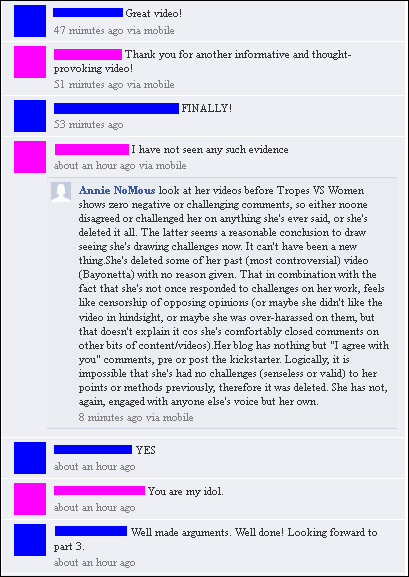
After this, I started keeping an eye out for any other comments that were likely to be removed but weren't abusive. I'm very happy to say that I found some. Spot the difference between these two screengrabs from Facebook. For the sake of privacy, I've blocked the identities of the people listed (blue for comments by men, pink for comments by women, purple if I wasn't sure):


It seems like "Annie NoMous" is a pseudonym -- not only does it sound very close to "anonymous" but I checked this person's profile at the time and it was completely blank -- but still, I can't see any reason why their comment was deleted other than the fact that it dared to question Anita Sarkeesian. "Annie" isn't alone either. Take a look at this. The first picture was taken on the 27th of May and the second one was taken yesterday:


Jason Wilkins here is an interesting case because even though his original comment was deleted, he wasn't blocked from commenting on the Facebook page. Anita -- or, if not her, whoever runs the Feminist Frequency Facebook page -- took issue with the suggestion that the Tropes Vs Women videos could be improved by (shock! Horror!) pointing out violence against men in the games featured in the video series. Incidentally, if you're interested, the video he linked to in his comment (twice, accidentally) was KiteTales' rebuttal to Anita's second Damsels In Distress video.

Regardless of how you felt about the comment from "Annie NoMous", can you honestly say that Jason Wilkins' comments deserved to be deleted? He was nothing but courteous and showered Anita's goals with praise. However, because he pointed out that Anita could be doing a better job than she was -- and a more equal job at that -- his comments were quietly, unceremoniously deleted. So how does it work? If Anita is showered with praise, her critic gets off with a warning but if they outright oppose her, they're given the full Stalin-esque "unperson" treatment?

For all of Anita's boasts about abusive comments "failing to silence" her, she has no qualms about silencing others at the drop of a hat. It's about as hypocritical as it gets but it's also no secret why she does it; if it makes Anita look bad, it's getting deleted. Think about it:
  • Youtube comments
  • feministfrequency.com comments
  • E-Mails
  • Facebook comments
Oh, and case you didn't know, Anita Sarkeesian's Wikipedia page is completely missing a "Criticism" section, unlike the vast majority of other public figures who analyse anything, not just popular culture. I'd also like to post the relevant part here, just on the off-chance that her page is updated with a Criticism section in the future but someone happens to read this blog afterwards.

(Left-click for a larger view.)
As if all that wasn't enough, Anita has censored herself on occasions when she feels like she's made herself look bad; she removed her Bayonetta video from Youtube after she realised that her dumbing-down of the story, missing the point of the main character's sexualisation and clear lack of experience actually playing the game made her come off poorly. It seems to be a similar case with her university research paper, "I'll Make A Man Out Of You: Strong Women In Science Fiction And Fantasy Television", where her famous take on masculine and feminine traits came from. It was once hosted on feministfrequency.com but she has since removed it. Feel free to download it here!

You see, Feminist Frequency is built on censorship and silencing. It's very image-based, with Anita portraying herself as an almost-flawless central figure. On its own, without Anita's boasts about the abusive critics "failing to silence her", disabling Youtube comments and not answering e-mails seems fine. That's up to her to do. With those boasts, however, censoring perfectly polite and rational criticism is the most hypocritical thing Anita could've done. People telling others that Anita's aren't all cracked up to be? That's a failing on her part, sure, but it's one that can be fixed. Censoring the people who are bringing that up, after singing your own praises about failing to be silenced? Hypocrisy.

Let's finish with something fun. After I was blocked from Facebook, I took a screenshot of the comments section of the "mansplaining" article that Anita linked to and it's interesting to see the comments that made the cut when mine were deleted. If you thought the comment Jason Wilkins was replying to above was ridiculous -- I was astounded to find that someone out there actually uses the word "womyn" -- take a look at a selection of the others that made it. I'd post all of them but the picture would be far too big:

Yeah, criticising Anita is off-limits but "going crazy with a baseball bat" is welcomed under the Feminist Frequency banner. You should see some of the comments I had to cut.

As always, feel free to leave a comment below (you won't be silenced!) or send me an e-mail at themalesofgames@gmail.com (I ... might ignore that. I don't check it every day).

Wednesday, 12 June 2013

The Microsoft "Rape" Joke at E3

This isn't what I planned to write but I've been thinking about it all morning and I've got more to say on the subject than I realised. For those of you who don't know, Microsoft showed footage from the upcoming Killer Instinct reboot (sequel?) on stage for its conference a couple of days ago and during a match between a man and a woman, this joke was made:


Basically, the female player was losing heavily and her male opponent at one point uses the phrase "just let it happen, it'll be over soon". Cue internet outrage.

First of all, although I didn't find the "joke" funny, I didn't think it was about rape either. That, however, was the conclusion that legions of gamers and game journalists came to immediately after it happened. The idea being that the phrase "just let it happen, it'll be over soon" sounded like something a rapist would say during a rape.

Or possibly something a torture victim would be told during torture. Or a doctor might tell you during an uncomfortable medical procedure. Or a colleague might jokingly tell you during an awkward lunch with your boss. I can recall being told something similar by my parents when I went to a wedding as a kid and got bored during the speeches.

People are free to interpret that line as a rape joke if they like though. Even though it shows an unwillingness to accept different interpretations and give the benefit of the doubt, the phrase being interpreted as a rape joke isn't what bothers me. It's fine and, if that's how you feel, I'm also sorry if it offends you. I hate being offended myself and don't enjoy other people feeling offended. What does bother me is people thinking it's indicative of a larger epidemic of sexism in the gaming industry. That's what these two articles claim, unfortunately.

On its own, I probably wouldn't have much to say about the claim that rape jokes represent sexism against women in the games industry. At this point, I think we've come to expect that reaction. What I want people to take note of is just how low an opinion of women the writers of those two articles have decrying the rape joke.

Personally, when I saw the Killer Instinct gameplay, I figured that maybe the female gamer hadn't played it before. Maybe blocking in Killer Instinct is a fiddly thing to do; I found blocking to be tricky when I played the Injustice: Gods Among Us demo, so my mind immediately went to that. I thought the female player's difficulty was either to do with her opponent's experience, her own inexperience or Killer Instinct itself.

Those two articles I linked to, on the other hand, decide to bring gender into things. Take a look at these quotes:
"In this scripted event the man, of course, kicks the woman's ass at the fighting game. "I can't even block correctly and you're too fast," she says, playing a video game like a girl."
"There's another layer of troubling to this - bringing out a man who worked on the game to beat on a woman (the only woman presenter, I've read, but I did not watch the entire presentation to be sure) feels an awful lot like an attempt to reinforce the 'girls can't play games' elitism that permeates the lower strata of game culture."
These two articles, from The Atlantic Wire and Badass Digest, are quick to try and brand the woman a victim, as well as judge her skills as a gamer and enforce gender stereotypes about the way she plays. They're quickest to draw conclusions about Microsoft's intent, the male player and the male audience members who laughed at the joke:
"That this is the trash talk that a man feels comfortable directing at a woman on a stage in front of thousands of people says an awful lot about that man. That people laughed says an awful lot about that crowd."
"And even if it's not conscious, there's a boy's club mentality to gaming that ends up making women feel very uncomfortable."
Essentially, the writer of the Badass Digest article, Devin Faraci, is quick to brand people sexists because they laughed at something he didn't find funny. Nothing more.

I'm not defending a rather petty, unfunny joke but I am willing to defend a bunch of innocent people from being victimised for enjoying some playful trash talk. Faraci writes about elitism and goes on to say that the rape joke was "indicative of a larger cancer eating away at the gaming community". The only cancer eating away at the gaming community is the game journalists who feel increasingly comfortable insulting people who they disagree with, whether it's George Kamitani of Dragon's Crown fame, the male player of Killer Instinct at E3 or even the portion of the audience who enjoyed the joke.

As for the female player, Ashton "Vulcan" Williams, what did she think of the joke?


I came across the Williams' name in this follow-up article from The Atlantic Wire, which is a mess of contradictions; the writer, Rebecca Greenfield, acknowledges that Williams doesn't care. She quotes this progressive female poster from Reddit, who didn't care. Yet Greenfield, still has the gall to write, "this kind of 'smack talk' not only alienates female would-be gamers but also mimics the rampant sexual harassment in gamer culture". She still makes assumptions about why Williams doesn't care with, "so maybe Ashton Williams doesn't mind the rape joke because she's so used to putting up with that kind of stuff just to make it in the gamer world".

Greenfield's justification for this attitude?
"Yes, gamers talk like this all the time. Others responding to the Xbox exchange, particularly on Reddit, note that gamers — even girl gamers — tend to use similar phrasing all the time while playing, which by their logic makes the E3 incident acceptable."
Okay, so why is their logic wrong but your logic right? They're both opinions so why does Rebecca Greenfield's call for a moratorium on rape jokes make more sense than simply telling people not to care about a throwaway phrase between friends while playing a game? Given that the person on the receiving end of the "rape joke" didn't care, that seems like the more sensible option.

There's a tone involved in articles like these that suggests if you don't agree with their opinion, you're wrong. No room for negotiation. Personally, I don't mind if they're offended by the joke and if that was all they criticised, I could sympathise with them. Unfortunately, their stance being "our opinion is fact" and their insistence on insulting anyone who disagrees has diminished any sympathy I could possibly have for them. Here's a few facts that Rebecca Greenfield and Devin Faraci might want to take into account; men aren't all sexists if they laugh at something you dislike. Women aren't helpless children who need to be mollycoddled even when they don't want to be. Although you can say a lot about the XBox One -- and trust me, I have -- Microsoft having a male player defeat a female player in an on-stage demonstration doesn't mean they're horrible people enforcing a "boys' club" in mainstream gaming. Quite the opposite, actually; they're encouraging female participation of mainstream games by featuring a female player during their biggest conference of the year.

Speaking of that, back when Sony announced the Playstation 4, they were criticised for having no female presenters. Does anyone else find it a little odd that when Microsoft does feature a female presenter, they're hugely criticised for not being a good enough gamer. Not only is it very reminiscent of the supposed attitude towards "fake" geek girls -- having to prove their worth as a gamers (or knowledge of whatever fandom they enjoy) before being accepted by other gamers -- but it comes across as moving the goalposts. There were no claims from the critics of the lack of female presenters that the female presenters had to be good at gaming (and I'm not saying that Ashton "Vulcan" Williams isn't) so this is another case of feminist critics -- you guessed it -- creating a no-win situation. While also being far more critical and judgmental of Ashton Williams than the supposed "boys' club" that they speak out against.

Still, both Greenfield and Faraci are fans of Feminist Frequency. I think we know where they get it from.

As always, feel free to leave a comment below or write to me at themalesofgames@gmail.com

Sunday, 9 June 2013

Just a short post for today

Hey all. Sorry that I didn't update sooner. I've been very busy over the past week but I'm pleased to report that my last post was the most-read that this blog's ever had! Not that it's been much of a horse race but nevertheless, it gave me a thrill to look at the pageview stats, so thanks to everyone who contributed.

I'm working on a longer post but here's a short webcomic for today, courtesy of For Lack Of A Better Comic:


Author's comment: "If your Privilege stat is above 20, you are forced to roll a Privilege Check before each conversation."

As always, feel free to leave a comment or send me an e-mail at themalesofgames@gmail.com