Sunday, 16 February 2014

A Quick Update

I haven't created any new posts in a while so, just so everyone doesn't think I've disappeared off the face of the earth, I thought I'd give an update on what's going on. The short answer is "college work" but the bigger issue is the amount that has been heaped onto the entire games course for the end of February is remarkable. Basically, this happened because a lot of deadlines extended due to everyone being behind on a 2D game project. As great as that sounds, it quickly became an issue when all the students realised that now, assignment deadlines for every class except two are due in the same week. Still, I got to try out the Oculus Rift yesterday, so it's not all bad.

So what have I missed in the time that I haven't been blogging? Actually, before Christmas, I watched Indie Game: The Movie for college and was a lot more interested in it than I thought I'd be. For those of who haven't seen or heard of the film, it's a documentary that follows three indie games during different stages of development: Super Meat Boy, Fez and Braid. Early on in the documentary, Phil Fish (developer of Fez) and Jonathan Blow (developer of Braid) talk candidly about the abuse they received from the online community. I'd recommend the film even without that part but it stood out to me because of how often gaming sites promote the idea that online abuse is something that only affects women. This 2013 article from Polygon goes into online harassment in more detail, including other developers and harassment against women.

Around the same time, there was the harassment of Zoe Quinn over her game, Depression Quest, that she put on Steam Greenlight. Much like with Anita Sarkeesian, I have to say that the abuse she received was horrible. However, what immediately sprung to mind when I saw several articles claiming the usual harassment against female developers was Indie Game: The Movie and comments telling Phil Fish to "kill himself". Judging by the format, the comments also came from 4chan (or one of its similarly-unpleasant sister forums, like 7chan and 420chan); as we know, 4chan isn't known for being a welcoming place. Plus, Depression Quest is largely text-based; it's described as "interactive fiction" more than a game so I would've been surprised if there wasn't a backlash of some sort.

It sounds a lot like I'm defending this behaviour but in actuality, I just want to get two points across; there were circumstances surrounding the abuse unrelated to Quinn's gender and that women are not always the only ones affected. Oh, but actually giving her abusive phone calls? I've had abusive phone calls before, so that really annoys me. Hopefully, Quinn actually reported this and didn't just change her number because it bothers me that people -- even trolls -- would resort to criminal behaviour because they didn't like a game (if that is why it was happening; supposedly, the phone calls were erotic in nature, so I think this goes far beyond your typical internet troll).

What else? Oh yeah, Anita Sarkeesian is receiving a Game Developer's Choice Award!

I wasn't going to go into this too much. I've reached a point where I'm somewhat "over" Anita Sarkeesian, so I was just going to write "click Gamespot's 'Top Comments' button to see how I feel about this" and then more-or-less move on. However, I checked my e-mail and noticed that a reader had sent me a link to this report on another site, GamesIndustry.biz, which is a site where industry professionals (or those studying to get a job in the industry) post comments under their real names. Specifically, the e-mailer directed me to a commenter, whose name I won't write here for his own sake, who had left a comment that has since been edited but had been suspended and was told -- by a producer at BioWare, no less -- "don't expect any of us to be racing to snap you up when you've finished [studying games design]".

Here's his original comment:
"Anonymous rape and death threats on twitter are utterly meaningless and I expect a very high percentage of them are just trolls, if all these women just ignored these trolls then they would stop but they don't, what they do is play the victim "ohh look at me im getting all these death and rape threats over twitter poor me my life is hard!" I have no idea why they do this (I would love to know if they are attention whores or just very naive). Then of course video game sites/SJW blogs pick up on it (because real journalism is to hard) and it turns into a shitstorm which just amplifies the trolling towards that person."
The thing is, it seems like the e-mailer wanted me to defend this person but I have to say, I don't find him particularly sympathetic. Now, I get what he was trying to say. Having said that, there are right ways and wrong ways to discuss it and throwing around terms like "attention whores" is a wrong way. Is saying a game developer won't hire him after he graduates fair? Almost certainly not but hey, at this point in time, who can blame the BioWare producer for writing that?

So I'm not interested in defending this person's post but there are a lot of very reasonable comments on that GamesIndustry.biz article that are being unfairly criticised. There's the typical "too many white guys" comments, dismissing people's arguments based on their sex and colour of their skin (even though there wouldn't actually be much of a discussion without them in that comments section). One critic of Anita's writes "I now have about 20 tweets about me as a woman hater", even though his "edgiest" comments involved referring to Anita as a "troublemaker" and recommending that people report sexism to the authorities instead of complaining about it online. In fact, that same person gave an excellent rebuttal to the "too many white guys" commenters:
"There is an appropriate word to describe people who make sweeping statements and generalisations based on just gender and colour, and I'm guessing he won't like it when he figures out what it might be"
What bothers me the most about all this is the assumption that criticising Anita Sarkeesian's views is comparable to promoting sexism. Obviously, it's no surprise. It isn't the first time that opposing a feminist viewpoint has been treated as unacceptable and it won't be the last. Having said that, these opinions are about as reasonable as it gets without outright agreeing with the opposite viewpoint.

With so many perfectly reasonable comments being so heavily scrutinised, I'm not willing to post in the GamesIndustry.biz comments section. For one thing, I am interested in entering the games industry at some point. Technically, I could join, either with the title "Blogger" or "Studying Game Design". I used to have my real name in the sidebar of this very blog but removed it when I realised that, as passionate as I am about men's rights, my anti-feminist viewpoints may be frowned upon by people who automatically assume that criticism of feminism is the same thing as sexism. Plus, the conversation has stopped over there and I would likely be repeating arguments I've made here.

So I'll say what I'd like to say here, rather than there; I'm sure this won't sway a single person but for anyone who thinks that any of the critics of Anita Sarkeesian or feminism in general in that GamesIndustry.biz thread are against equality, you're incorrect. Those critics are as in favour of equality as you are but are more realistic in how it's being lobbied for and would prefer to see it done properly -- with more inclusivity and fewer faulty arguments -- than a video series that is very easy to pick apart by someone who does not face up to the criticism received.

A big issue that I've had in mind for a while now is the praise Anita receives for "creating a discussion" around gender issues in games. However, I don't see how on earth she can be credited with that when she is so intent on shutting down any criticism against her and her supporters seem all-too-happy. The thing about a discussion is there has to be "back-and-forth". Arguments from both sides. With Anita, there is only "forth". No "back".

The fact is that there are some severely closed-minded attitudes on display in that comments section, many of them not coming from the "attention whores" commenter I quoted above. The thing is, you have Mike Bithell -- developer of Thomas Was Alone -- writing comments that include statements like this:
"Young men looking to get into industry: Leave your phobias and gamer bro bullshit off of sites read by future employers. Ideally, grow out of it. Sooner or later you're going to have to step away from the computer and into an environment filled with human beings. Human beings of beautiful variation and awesome differences. It's not scary, it rocks. And you will be so embarrassed by the silly little opinions you had on feminist theory in your late teens."
This is ignorant of every single criticism against Anita that was posted and the ad hominem attacks -- insisting that all of her critics are teenagers, male, "gamer bros", fearful of variation, computer-obsessives and carrying nothing but "silly little opinions" -- come across as defensive. I think it shows that Bithell doesn't really have an appropriate response to the criticisms against Sarkeesian, so he has to sling insults against the people making them instead. It hasn't occurred to Bithel -- or it has and he's dismissed the idea -- that other people could have formed their opinions of feminism due to greater knowledge and study of the movement and not less.

Edited 16th February 2014: Interestingly, Mike Bithell linked to my blog on Twitter. Here's what he wrote (and two other tweets that I assume are directed at me):


What Mike calls "selective quoting", I call "relevant quoting". People are free to check out Mike's full comment on the website I linked to and at no point did I indicate that the above quote was Mike's full comment. However, that's the part where Mike so clearly displays his unwillingness to accept any information that doesn't fit his set-in-stone worldview. Case in point: "college aged chap" and "teenage pursuit". Not that I particularly care about someone getting my age wrong but I can only assume that Mike is as egotistical as he joked about and scrolled right past the "About Me" to find his own name.

The fact is that up until my late teens, I probably would've called myself a feminist. I didn't have a concept of what "men's rights activism" was and, except for negative portrayals of men in US sitcoms -- hardly something worth campaigning against -- there weren't any "men's issues" that I was aware of. Then I became aware of things such as a lack of domestic violence shelters for men in the UK. I visited Refuge's website -- Refuge is the name of a series of women's shelters in the UK -- and saw constant references to abusers as "he" and victims as "she", which I thought not only undermined male victims but also female victims in same-sex relationships. I became a frequenter of Glenn Sacks' site (Mike, he's not a teenager) and, in recent years, Karen Straughan -- GirlWritesWhat on Youtube -- has been my favoured source for news about men's rights activism (again, Mike, not a teenager. Or male. Or straight. Or a "gamer bro").

I find the thing that Mike, for all his fun jabs at this blog on Twitter, is capable of but actually unwilling to understand is that people who disagree with Anita Sarkeesian can still be supportive of equality. Better portrayals in games, less online abuse, equal marketing budgets regardless of the sex of the protagonist, etc, etc. I've even agreed with Anita on occasion. I suppose only glancing at a few paragraphs doesn't communicate that very well. However, I, and other gamers like me, have our own issues with game content and the industry that is ignored and belittled when we try to bring it up.We care about accuracy in our arguments and fair treatment for gamers regardless of race, sex, sexuality, religious beliefs and disability. The problem is that this sometimes involves saying phrases like, "you know, men have exaggerated body types in games too". This isn't saying that women don't have exaggerated body types and it doesn't do anything to diminish the argument that they are but, when this is brought up, we're accused of "derailing" the issue.

In other words, wanting both sexes to receive equal treatment goes against the grain of "women are victims, men are not". Yet that's all we're interested in; equal treatment. This blog's been in existence for a year and a half now and there's a plethora of posts that say the exact same thing, on a variety of different issues (and if you would like to see the logical arguments I've written against Anita's views, they can be found here, here, here and here). However, to quote one of Mike Bithell's own tweets, "I'm not sure idiots like this really care though :)"

End of Edit.

The short version of this is "Anita Sarkeesian receives an award that some people think she didn't deserve. Their reasonable viewpoints are met with dismissiveness based on their race and sex, as well as belittling insults and accusations of bigotry".

I've written about ten more paragraphs on that than I would like to and what was intended to be a short, not-too-serious blog post has turned into a lengthy one that has made me incredibly irritable. So I'll try to finish on the light-hearted note that I had originally planned; Anita herself retweeted something from a fan of hers yesterday:


"So what's the big deal?" you ask. Well let's just say that this isn't the first time that Feminist Frequency has been used in an assignment for a class:

 (Screencapped, rather than copied & pasted, just in case of programs and websites that check to see if assignments have been copied online. It's mine but I just don't want to have to go over it with my tutor.)

Yep, I used Anita's misrepresentation and failure to cite sources as an example of the difference between primary and secondary research. Better yet, for that particular assignment, I got a Distinction grade. So a big thank you to Vicsor, for uncovering all the stolen videos in the first place and an even bigger thank you to Anita Sarkeesian! Without you, I don't think I'd have been able to come up with a gaming-related example.

Feel free to leave a comment or e-mail me at themalesofgames@gmail.com. I still visit frequently, even if I haven't been able to post as often.

Saturday, 18 January 2014

Game Revolution Asks the Right Questions

Sorry I haven't updated in a while. This was meant to be posted a few days ago but I was suddenly hit with an influx of work. Actually, I still have a half-finished blog post featuring quotes that I found while writing assignments but that one's taking some effort to get back into, since I'd basically be rehashing some stuff I did for college only a month ago.

This one will be short but it's also something I find very interesting; there's a huge gap between the number of male enemies we slaughter in games compared to female enemies, which I've written about before. Specifically, this was about the number of generic, cannon fodder mooks that players slaughter in their hundreds without giving it a moment's thought, rather than named villains and villainesses. The majority of these enemies are male, or at least are male in appearance.

Thankfully, it seems like a gaming journalist has been thinking along the same lines as me; a few days ago, Nicholas Tan of Game Revolution uploaded an article he wrote titled "Can Women Be Video Game Enemies En Masse?"

I don't want to nitpick too much because I think it's a good article. It's the kind of article that needs to be seen more on mainstream gaming sites, something that is thought-provoking and acknowledges that equality for women in gaming isn't all about stomping out online abuse and reducing breast size. You also have to acknowledge that men are unfairly portrayed too and equality works both ways; unless you take the hit and have women killed as often as men (give or take; I'm not asking for a 50/50 split. That would be ridiculous), things will be unequal.

Even so, while the article gives a good overview and I hope will be enough to start a discussion, it isn't as in-depth as I would like. It would've been nice to see some more examples from games, since the only one focused on is Fallout: New Vegas (as an example of a game that gets it right). There are screenshots of Final Fight and Final Fantasy VIII but the author doesn't elaborate on either one. The picture of FFVIII's Edea raises questions, since she isn't specifically a female enemy to be killed "en masse", in the same way that Roxy and Poison from Final Fight are. Not that FFVIII isn't guilty of a lack of female enemies but I think Nicholas Tan could've provided context about why it was included.

Having said that, the author hits the nail on the head with two statements about why we don't see more female enemies in games. After writing about how enemies are more likely to be male in games designed to be realistic, Tan says the following:
"Now since most video games are not meant to be absolutely realistic, it's unnecessary that they need to follow this rule. I've blasted the heads off numerous female raiders in Fallout: New Vegas. But it's a rule that carries over, if but subconsciously, from video game developers who are predominantly men."
Apart from the "predominately men" part -- I haven't seen anything to suggest that either sex would be more or less willing to female enemies -- but the lack of female enemies in unrealistic games is due to real-world gender norms. Think of it this way; developers can introduce any number of fantastical elements into a fictional world, such as magic and monsters, but they can only do so much when it comes to subverting gender roles. If they do, it will only be to elevate the role of women and reduce the role of men; for those of you who have played the Shivering Isles expansion for The Elder Scrolls IV: Oblivion, think about the gender roles of the Golden Saints and Dark Seducers. Both are armies where the highest ranks are made up of women while males don't rise above being grunts.

So that's one of the reasons why we don't see women making up the majority of enemies in games and the second quote I'd like to use from Tan's article shows why we probably won't:
"Then of course, could you imagine a game where a male protagonist goes around murdering women and exclusively women and not just demons like harpies and hagravens? Even if the gameplay is groundbreaking and the story is told with an attention to context, it will become easy prey for the mainstream press. I mean, talk about making yourself a target and bad marketing. At best, the game would be considered a joke and be turned into an infamous meme. (Perhaps such a game would need a female protagonist killing a whole lot of other women to work.)"
Not much to say about that, other than it's correct. There's no chance of a game featuring a male protagonist massacring an all-female army being released and not becoming a target for the gaming press (or the mainstream, as Tan points out). Back when Resident Evil 5 received its first trailer, it faced controversy for featuring a white protagonist -- Chris Redfield -- gunning down black enemies, as the game is set in Africa. With gender issues being a major topic on gaming news sites, is there any way a game like the one described could exist and face a similar controversy? Is there any way it could not become the gaming community's whipping boy (or girl, if you prefer)?


As good as the rest of the Nicholas Tan article is, it ends on a silly note:
"That said, a video game where women are the primary antagonists would be an interesting experiment, so long as it's handled well (say, a devilish male scientist creates a virus that targets women because he thought it was THIS BIG but she said it was only this big)."
It's a reference to penis size, in case you don't get the joke.

I realise I'm overanalysing this but there are four things wrong with that idea:

1) It paints the male scientist as the bad guy. Nothing necessarily wrong with that, since games with all-male enemies have had female antagonists (such as Final Fantasy VIII again) but I think Tan could've used a better example.

2) I don't see how that could be considered "handled well". Surely, the best way to handle a game with women as the primary enemies would be to avoid referencing it at all. We don't acknowledge men as the primary enemies being "the norm", so why reference the female enemies as being out of the ordinary?

3) It doesn't put the female enemies in control of their own actions. Having a virus that makes them evil is a lot different than the women choosing to be evil (or at least members of the evil army, whether it's because they were intimidated into joining, they signed up because they needed money, etc.). There's already criticism from feminist circles about female characters lacking "agency"; being active participants in the game's story, rather than passive ones. So if the game is going for true equality, the women have to choose to be the bad guys.

4) The male scientist lashed out at women because a woman said he had a small penis? Really? That's like Lara Croft's quest beginning because a guy said she was fat.

I don't want it to sound like I'm criticising Nicholas Tan or the article here. Instead, let's pretend we're playing "Fantasy Video Game Storyline Writer" and coming up with our own ideas for how predominately female enemies would work instead. That's more along the lines of what I'm criticising rather than the article itself.

Like I said, I've overanalysing but there are more sensible reasons to have a character gunning down hundreds upon hundreds of men rather than hundreds upon hundreds of women. That could just be part of the fictional universe's mythology rather than for any reason for it occurring in storyline.

So if you haven't read the article, go and read it and feel free to praise Nicholas Tan for writing about a subject we don't often hear about on gaming sites. I hope it receives more exposure and makes a few more mainstream gamers think outside the box.

Sunday, 5 January 2014

The Good & Bad of Remember Me

This blog post will contain spoilers for Remember Me.

Remember Me has been available to download for free on PlayStation Plus for a while and, as luck would have it, I had a code for a free month-long trial of Plus that had to be used before 2014. I was interested in downloading the game partly because I think it would give me something to write about on this blog. It's a series that has been at the centre of a controversy about female protagonists, after all, so it seems like a game I should write about. I barely knew anything about it, so what if it was a game as misandric as Heavenly Sword? Or at the very least, what if the sites reporting on the lower marketing budget for games starring female protagonists were only giving half the story and there were other reasons behind the lower budget for the game?

The only thing I found out was how undeserving Remember Me was to be involved in such a controversy; it's actually a very good game and it's disappointing that the lower marketing budget articles overshadowed it to an extent. The main thing I took away from it -- and the big reason why I couldn't title this blog "The Sexism of Remember Me", like I tend to when I examine games for sexism -- is because it gets a lot more right than it does wrong. I sincerely hope that more games starring female protagonists take their cues from Remember Me.


In a lot of ways, Remember Me borrows from a lot of other popular series. The combat is straight out of the Batman: Arkham series (albeit with more user-friendly controls and a cool combo-construction system), navigating around the city is exactly like Uncharted and the ending is kind of predictable and anticlimactic too. There are even quick-time events, although thankfully they were very rare. One for each boss fight. The same goes for the main character, Nilin. In my opinion, she was only marginally better than the majority of generic, quippy action heroes we see starring in every other game these days. She was at her best when she showed some real emotions rather than typical one-liners, which didn't seem as prevalent as they are with some other modern protagonists.

It's not like the game handles any of these things badly. The combat's pretty good. The climbing is pretty good. The story's pretty good. Although she isn't exceptional, Nilin is a bit more likeable than some other protagonists I could mention. So it does it well but doesn't leap to any new heights on any of those fronts.

However, maybe the fact that Remember Me doesn't try to reinvent the wheel is part of the reason it works so well. It might not be breaking any new ground but from a gender issues standpoint, it sends the message of "yes, we have a female protagonist. No, it's not a big deal", because it offers as entertaining an experience as the other games next ot it on the shelf.

It does a good job of removing the issue of gender in several ways; there are evil male characters and evil female ones. Sympathetic men and sympathetic women. The only time Nilin's gender is referenced is when she receives a few sleazy comments from a guy in the slums at the start of the game. Thankfully, that's just a one-off occurrence. Nilin is never thought of as any more or less capable because she's a woman and the game's enemies don't treat her differently than they would any other terrorist (or "Errorist", as memory-hunters like Nilin are referred to in the game).

If I have one criticism of the game, it's that it falls back into the old pattern of having all-male generic enemies but a mix of male and female Errorists (in the short prison-break scene we see them in, that is). I may be wrong about that; it's possible that some of the Leapers -- mutated humans with deformed faces, kind of like the Splicers from Bioshock -- were female but it was difficult to tell. If pushed for an answer, I'd say the Leapers were all male too.

There were some named female villains in the game. Three of them, in fact. However, because Nilin is able to alter memories, she is able to enter the memories of two of the women and change significant events in their life in such a way to convince them to become good. It's a trend that none of the people Nilin does this to are full-blown villains. Instead, they're misunderstood and sympathetic individuals (to an extent) who we're led to believe are villains before entering their memories. Nilin alters the memories of two men and two women but, when she's done, there are still plenty of male villains but only one female one. Thankfully, the number of sympathetic characters is more evenly split between the sexes.

Other than that, there isn't much to say about gender issues in Remember Me, which is actually a good thing; no news is good news, isn't it? If anything, it's just a shame that this was the game at the centre of the marketing budget controversy and not something less deserving of success. Although, in spite of poor sales -- only 300,000 worldwide according to VG Chartz -- maybe it's similar to Dragon's Crown; perhaps the controversy helped the game's sales, in spite of how low they are.

One thing I wish had happened following Remember Me's release is I wish I had seen discussion about the game outside of boards and threads specifically devoted to it. I'd have liked to have seen it mention in gaming articles too, particularly ones about good female characters. I've probably heard the phrase, "there are hardly any good female protagonists" twenty times more than I have, "Nilin from Remember Me is a pretty good female protagonist" since Remember Me's release.

I have some other thoughts on the game, since this blog will be pretty short otherwise; the real areas where it excels are the music and the environments. If I take anything away from Remember Me, it's going to be how unbelievable the environment artists made the city of Neo-Paris look. Honest-to-God, it is astounding. It's the kind of futuristic sci-fi environment I've always wanted to see in a game but never did until now. I loved the little details added to make it seem like a "real" futuristic world, with advertisements for toys, books, television shows and the evil Memorize corporation making Neo-Paris feel like a place with a history. The only other game I can think of that used fictionial brands to build its world so effectively is The World Ends With You on Nintendo DS.

I'll be interested in seeing if anyone else has played Remember Me and what they thought of it. I'm very pleased I tried it out and I'd recommend it to other people. Hopefully I'll be able to get around to playing Tomb Raider and Mirror's Edge too, to cross those two off the list of games praised for their female protagonists that I still need to experience.

I've been attempting to bring this up in a couple of blogs now, including one that I have half-written (so it may come up again in the future) but if you haven't already done so, go over to Vicsor's Opinion and read his blog post entitled "A Diverse Cast of Characters". It delves into the Remember Me marketing budget controversy -- which now seems to have been removed from Penny-Arcade for some reason, which is why I didn't link to it here -- the actual sales figures and what it's like to be on "the side of the fence" that wants more varied protagonists but disagrees with the arguments made by the more critical and dogmatic supporters of female protagonists.

Feel free to leave comments below or contact me at themalesofgames@gmail.com.

Wednesday, 18 December 2013

Mighty No. 9's Feminist Community Manager Controversy


A sudden upswing in work to do over the holidays means this will probably be the last blog post until January. I do my best to update this blog three times a month but that's going to be tricky this month. I also have a completely different blog post half-written but just finding out about this story today made me switch topics. This one's a lot more interesting.

There's a funded project on Kickstarter by the name of Mighty No. 9, which is being developed by a company called Comcept and billed as a spiritual successor to the Mega Man series. You can see why too; not only are the character designs and gameplay practically identical but it has Keiji Inafune -- director behind Onimusha, Dead Rising and Mega Man itself -- heading up the project.

Recently, Comcept appointed a new community manager called Dina Abou Karam. Her job seems to be to listen to fan feedback and forward it to higher-ups at Comcept. She's also posts blogs and updates on the game, manages the forums and basically acts as a go-between for the fans and developer.

The trouble is that Dina being appointed raised a whole host of questions amongst the many, many backers of Mighty No. 9. Firstly, Dina presented a piece of fan art of a gender-flipped version of Beck -- the male protagonist of MN9 -- and stated:

"As someone who cares about gender representation in games, please make Call [the game's female character] a playable character, or even better, make Beck a female bot alltogether [sic]! It shouldn't and won't affect gameplay! I started on some Mighty No. 9 Fan Art myself as a way to promote this Kickstarter/express my wish:"


Other than that, Dina tweeted that she was "never a Mega Man player" but she supported MN9 because her friends and boyfriend were working on the game. Here's some screenshots of some of the entire situation:

Left-click for larger view.
The tweets were later deleted.

So what's the big deal? Well one of the reasons that fans of Mighty No. 9 and the Mega Man series are so frustrated by these developments is because they've been waiting a long time for a new iteration of the Mega Man series (and yes, this counts, albeit in a different form). There hasn't been a new Mega Man game since 2008 and none on a console since 2004. The fans have had to put up with cancellations of games like Mega Man Legends 3 and Mega Man Universe. A Western port of the iOS game Rockman X-over was cancelled because of negative feedback.

This video -- "Mighty Number Nope: The Dina Disaster" by a Youtuber called InternetAristocrat -- gives a more detailed account of why fans would be frustrated than I can and provides screenshots from the backers-only MN9 forum. It goes into detail about the social justice causes Dina is interested in according to her tweets and mentions that she stated her favourite Mega Man game is Mega Man X ... after saying that she wasn't a Mega Man player.

Basically, it's understandable that the fans would be angry that a non-MM fan made suggestions that Comcept change the game to suit a personal ideology -- and be hired following it -- when that's not what the backers agreed to when they donated. They have a right to be angry over someone being hired who has been forceful when expressing her political viewpoints in association with the game (and the video by InternetAristocrat shows that Dina herself stated that she was hired because her boyfriend worked for Comcept). It's not what they paid for. Nor is it the person they want speaking on behalf of the backers/the Western audience. Here are some of the responses when Dina was announced as community manager:

Left-click for larger view.

I should point out before I go any further that yesterday, Comcept released a statement saying that none of Dina's views actually effect the game in any way. Their statement can be viewed on Gameranx -- more on that site later -- but here's the important part:

"Will the community manager be skewing things the way they would personally like to see the game? Will the community manager ignore views that don’t match with their own personal ideals? Will the community manager lose the community’s desires due to unfamiliarity with the type of game we are making? Will the community manager be creating their own robots and levels and programming, or changing the game in any way, from what the core creative team wants?! A lot of these or similar questions have been raised.

The good news is that the answer, in all cases, is no."
So all of the comments in this blog are outdated by now, when people weren't sure just how much influence Dina had, but I haven't seen any other updates on the subject since. Not sure what the response has been to Comcept's explanation.

I've never played a Mega Man game but personally, I think the backers who want a refund are completely justified, even with Comcept's clarification (and as clarifications go, it hits all the right notes).

There's a good reason why companies keep their business and personal lives separate -- in fact, in InternetAristocrat's video, it's stated that Dina deleted her tweets about never being a Mega Man player for that exact reason -- and the backers donated to this project in good faith. I don't want to sound overdramatic but Dina is an unknown quantity in this situation. It's fine to have feminists on development teams -- in fact, it'd be pretty hard to avoid and ridiculous not to -- and it's even fine to have people on a development team who are not fans of previous games in the series. Lord knows that having developers who are fans of the series doesn't always work; look at the Ninja Theory's DmC. However, that's not what the backers paid for. The Kickstarter page itself says the following [emphasis theirs]:
"Every aspect of development—art, level design, music, programming, etc.—is being handled by veteran Japanese game creators with extensive experience in the genre, and with Mega Man in particular, all the way up to and including the project’s leader, Keiji Inafune himself!"
Moreover, this is specifically someone who was hired following a suggestion of her own, game-altering ideas based on a personal, political agenda and who got her foot in the door due to her boyfriend putting in a good word for her in spite of being unfamiliar with the series. There's no real reason for her to be a part of Comcept any more than any of the other thousands (I assume) of bilingual Mighty No. 9 fans out there.

My issue with this entire controversy is Dina's initial suggestion of, "even better, make Beck a female bot alltogether! It shouldn't and won't affect gameplay!" It's odd how if you said this about making Lara Croft or Samus male, all you would get is funny looks. Unusually, I've actually heard this suggestion before, about Link from the Legend Of Zelda series. I also heard the exact same thing when Peter Capaldi was announced as the next incarnation of the Doctor in Doctor Who. So why is it that when pushed for a reason why this should happen, the only response I ever see is "why not"?

If the only reason why you should change a character's gender is "why not" or "because we can", then there's a problem. You could apply that to any characteristic and make the same claim. "Why shouldn't the character be from Paraguay?!" Again, you could also say the same thing about gender-flipping female characters or making every non-white character Caucasian.

The reason "why not" is because these are established characters -- or at least characters with an appearance more-or-less figured out in the artist's mindset prior to drawing them on a page -- and even in the case of a character who can change his appearance, such as the Doctor, doesn't it do more to establish new strong female characters rather piggybacking on the success of a one who has been male for half a century? What would that bring to the table except for tokenism?

Look, there are actually some quite plausible reasons for switching a character's traits during development, such as if the writer adds something to the mythology that would make it awkward for the character to be [insert race/sex/sexuality here]. Or perhaps it conflicts with something that was already there and needs to be changed to suit it. However, regardless of the reasons why, I would think we could all agree that two fans who "care about gender representation" are not a good enough reason to alter the character designer and game director's creative visions.

Having said all of that, hopefully Comcept's clarification puts a few minds at ease. It's probably the best thing they could've done and maybe it will do the trick.

Anyway, one of the wonderful things about this entire controversy is that even though the typical parties have come out of the woodwork to express their frustration with the "misogyny" towards Dina -- do me a favour and take a look at the comments pictured above. See any hatred of women? -- mainstream gamers don't seem to share that viewpoint. If you visited the Gameranx article above, you might've noticed that Ian Miles Cheong (yes, that one) disabled comments. It's hard not to believe he didn't do that because of the backlash against his previous article on the subject, the blatantly clickbait-titled "Be Respectful and Considerate - Mighty No. 9 Kickstarter Explodes With Misogynist Rage". Some of the comments are very satisfying to read, calling out Cheong for casually, and unprofessionally, making the Mighty No. 9 backers out to be misogynists.

Left-click for larger view.

And my personal favourite:


When a game journalist -- even one as biased as Cheong -- actually starts throwing around the term "misogyny" simply because people object to having the rug pulled out from under them on a product they paid for, game journalism really has hit its lowest point. I live in the UK and tracts like Cheong's are quite reminiscent of the snidely aggressive articles we see in the pages of tabloids like the Daily Mail.

In other words ... it's just a typical day on a gaming news site. Feel free to leave a comment or e-mail me at themalesofgames@gmail.com

Sunday, 1 December 2013

The Marketing Double Standard

In advertising, much like in sitcoms, it's not uncommon for men to be portrayed as bumbling, useless figures while women are the down-to-earth, intelligent beings who make all the right decisions and often have to clean up whatever mess the man in their life has made. There's an entire series on Youtube called Misandry In The Media that shines a spotlight on commercials featuring stupid, hapless, perverted, irritating male characters and the women who have to put up with them.

Even though commercials for gaming don't fall back on the same sexist portrayals of men as often as other products do, it does occasionally still crop up. Last year, I mentioned how mind-boggling it was that Ninja Theory used male genital mutilation to advertise Heavenly Sword at E3 2006 (in the appropriately-named "Groin" trailer) in a way that no game developer would ever dream of doing with women:


Over the last couple of weeks, the double standard has cropped up again. The Xbox One has given us a couple of very clear examples of how acceptable it is to mistreat men while being unacceptable to use negative portrayals of women.

It started with a light-hearted letter on the Xbox website, supposedly for people to customise and send to their significant others to persuade them to buy an Xbox One. It's only available in the US, so I haven't been able to view the letter itself, but I believe it can be viewed here if you're in the US and want to check it out. For anyone who can't, here's a screenshot:

Left-click for larger view.
Immediately, this letter faced a backlash on Twitter and from journalists, who believed that the letter pandered to stereotypical viewpoints about women; lines like "you'd rather knit than watch me slay zombies" and "did I mention how beautiful you are" indicate that this is supposedly a man speaking to a woman.

... Except it doesn't. The letter uses completely gender-neutral terms and any words or phrases with green text can be customised with different ones. "Beautiful", for example, can be changed to "handsome" instead. Both the sender and the recipient can be either male or female, in other words, so it's astounding that so many journalists reporting on the letter -- some of whom even acknowledge that the letter is customisable, making their outrage all the more baffling -- immediately believe that this is a man sending the letter to his female partner when it could be addressed to either sex, from someone of either sex:
"What was intended to be a cute, customizable form meant for men to convince their girlfriends to buy XBox One consoles instead brought Internet ire to Microsoft."
- Michael Thomas, Digital Journal - "'Sexist' Xbox One ad forces Microsoft to rewrite"
"Microsoft put together an online letter template to help men ask their significant others for Xbox One consoles — either as a holiday gift or requesting permission to get the system for the household.
The ad tries to be cute with the thinking an 'explanation (and a little sucking up)' will get the woman to budge. But some see the effort as sexist and enforcing gender stereotypes."
- Samantha Murphy Kelly, Mashable - "Microsoft's 'Sexist' Xbox One Ad Stirs Controversy"
"Microsoft changed the default language Wednesday on a fill-in-the-blanks form on an Xbox website, which appears to give men talking points to sell women on the merits of the new Xbox One videogame console."
- Shira Ovide, Ian Sherr & Evelyn M. Rusli, Wall Street Journal - "Xbox Changes Wording of ‘Hey Honey’ Letter After Sexism Complaints"
"Microsoft has created the most insanely sexist ad for the Xbox One after presumably binge-watching Mad Men and missing the point entirely.
Or at least that's the only explanation I can come up with for its comically regressive US web-based ad for Xbox One that assumes its audience is full of males attached to sneering harpies who like to knit, love fitness, and hate video games.
The ad in question suggests that men want an Xbox One, but their female significant other will chide them for it. To counter this oppressive, domestic force, Microsoft has written a letter to your stereotypical shrew explaining the benefits of Xbox One to women who never lived past 1912."
- Jeffrey Matulef, Eurogamer - "Microsoft slammed for sexist Xbox One ad"
"“Man,” you may have said recently, “I wish my girlfriend/wife/mistress would let me buy one of those cool new Xbox One consoles.” “If only there was someone who could talk to her about it for me,” you may have exclaimed! Well good news, gamer guy: Microsoft has a shamelessly sexist open letter you can email to the non-gaming lady in your life."

Some articles are less reactionary than others but it's hard to believe so many of them take the stance of "it's sexist against women". As marketing campaigns go, I can't see it being particularly successful -- is the customisable letter going to persuade anyone any better than a list of the Xbox One's features would? -- and, honestly, the idea of poking fun at a partner not being interested in gaming is a silly way to sell a games console. Having said that, Microsoft made an effort to make the letter gender-neutral. There's nothing to say that it's not a female gamer sending this to her male partner who would "rather knit than watch me slay zombies" (which I think is too over-the-top to be taken seriously anyway). So it's an example of dumb advertising but Microsoft at least took steps to avoid offending people, something they made clear when they apologised and changed the letter.

If only the same could be said for their "His & Hers" Xbox One commercial:


In this video, a man is watching sports on the Xbox One. His girlfriend enters the room, uses the Kinect's voice commands to switch to Dead Rising 3, to the man's protests, and then orders him to get her a beer. He complies but finds that they're out of beer. His girlfriend orders him to go to the store. He does so. The "joke" is that the girlfriend can command her boyfriend as easily as she can with the Xbox One's voice recognition.

Basically, Microsoft have fallen back on the same sitcom stereotypes that I mentioned at the start of the blog; a useless doormat of a boyfriend with the same "yes dear" attitude that sitcom husbands typically have when confronted by their by-the-numbers "strong, independent" wife. However, and I can't quite believe I'm writing this, the advert has been praised for subverting stereotypes.

Before I get into that, let's read some of the Youtube comments from that particular video, shall we?

Left-click for larger view.
I apologise for that picture being so large that it won't fit on the blog unless resized but basically, the vast majority of comments on that video imply that the only people who dislike the video are stupid, illiterate, fat, ugly, whiny, sexists, virgins, "butthurt", "fucksticks" and/or "dudebros".

Man, we're so lucky that gaming is a boy's club, aren't we? Who knows what kind of abusive, sexist things would be said about men if it wasn't!

Basically, their interpretation is that the commercial subverts stereotypes because it's a woman telling a man to get back in the kitchen and get her something, in the same way that women face online abuse by people who tell them to "get back in the kitchen and make me a sandwich".

I'm sure that was the intention, just as I'm sure the commercial was intended to subvert stereotypes. It doesn't work, in as much as the man in this particular relationship is as stereotypical as the majority of men in both sitcoms and advertising but, as is always the case, the woman's portrayal is the important one. The man is irrelevant.

So let's say that by having a woman tell a man to get back in the kitchen, the commercial attempted to subvert stereotypes. Do Microsoft truly think that making misandric jokes about men is somehow making a point or striking a blow against sexism towards women? Or are they just running the risk of normalising "get back in the kitchen" jokes for the sake of a very petty commercial? By using sexist advertising to market their product, feminist critics of the games industry have lost what little weight the "women are often faced with 'get back in the kitchen' jokes while playing online" argument had; I know for a fact that, when faced with that argument in the future, I'm going to respond with, "so what? Microsoft used that same 'joke' against men to help sell the Xbox One". It's Heavenly Sword all over again. When anyone points to the website Fat, Ugly or Slutty for examples of the ways women are mistreated online, there's an entire comments section of a Youtube video we can point to for examples of men being described using phrases like "fat little man-dodos", "14-year-old virgins" and "man tears". The commercial hasn't made any strides towards equality.

For all the misandric comments about "man tears", there are actually very few people criticising the commercial, leading me to suspect that the comments section of the video is heavily-moderated. However, I did manage to find this comment thread:

Left-click for larger view.
In this particular comments thread, one feminist Youtuber says that they are offended by the commercial because it doesn't promote gender equality. Others tell them that they are not a feminist.

I think Julie De Santos hits the nail on the head here, before being quickly dismissed by people claiming she "misses the point". My criticism of this commercial and the Youtube comments honestly has nothing to do with the content but rather the reactions to it; the blatant double standard where an explicitly misandric advertisement is praised while an implicitly misogynistic (if that) letter promoting the Xbox One is decried. Microsoft gave an apology for one but not the other and I'm sure nobody is guessing which one. Where's the consistency? Where's the backlash against the "His & Hers" Xbox One commercial and the comments to it?

The only article that I could find even mentioning the "His & Hers" advertisement was from Gameranx, in a piece that praised the commercial while pointing out how the makers of the customisable letter were guilty of "not getting it".
"[On the customisable letter] However, despite the lack of gender specific pronouns, many have noticed that the structure still comes off as a stereotype: the ole "gotta ask the ball and chain" trope that permeates heteronormal relationships. It's almost as if the initial ad was rejected and key phrases switched in the interest of not coming off as sexist. A noble pursuit, to be sure, but one rather clumsily executed in this case.
This attempt at gender neutrality seems to follow a new strategy for Microsoft, who recently released a commercial that adequately challenged some of the general preconceived notions about the target audience for the Xbox One. Entitled "His and Hers," the following ad features a woman gamer who kicks her boyfriend off the couch while he's watching sports to play a video game.
It almost boggles the mind how a company that came up with the advertisement above could also be responsible for the former ad copy. But gotta give 'em props for trying."
- Ian Miles Cheong, Gameranx - "Is This Xbox One Ad Sexist?"

Little wonder that this particular article was written by Gameranx editor-in-chief, Ian Miles Cheong; someone who, back during the #1ReasonWhy movement, posted a link on Twitter to his Tumblr, featuring a very misandric poem by Carol Diehl, which suggested everything from men being unable to know what it's like to be raped to being oblivious to the feeling of having the appearance of their private parts mocked.


On occasion, I've defended game journalists for the lack of coverage about certain issues if I feel like they're not significant enough to be covered but this isn't like a few sexist comments on an obscure Facebook page that aren't a big enough issue for journalists to cover. This is an advertisement for a major next-gen console. I would expect some coverage for it beyond Ian Miles Cheong's brief praise. It isn't like I think this issue deserves special treatment but the fact is that a lot less significant gender issues in gaming have been given a lot more coverage because, typically, they involved women as the victims and not men.

Take Carolyn Petit as an example. Back when the backlash occurred over the 9.0 score she awarded to Grand Theft Auto V, some people started up a petition on Change.org called "Gamespot Staff: Fire Carolyn Petit". That particular petition was taken down incredibly quickly and a new one started up that, as of this writing, has a grand total of 46 signatures (and several people only signed it to comment on how stupid it was). It's a far cry from the 22559 comments currently on Gamespot's review of Grand Theft Auto V and not what I'd call indicative of any kind of sexism in the gaming community.

Left-click for larger view.

So why is it that this particular non-issue was covered by sites such as MCV UK, Las Vegas Guardian Express, Chaos Hour and System Wars Magazine? A couple of months ago, I criticised a video on Youtube by Jamin Warren and PBS Game/Show that compared Anita Sarkeesian to Rosa Parks. In that particular video, Warren brought up the petition as a reason why "we need Anita Sarkeesian's feminism". While these aren't sites or videos I regularly read people discussing online, they still covered the subject. That's more than I can say about this.

Likewise, something I'm fairly sure I've never written about is the "Beat Up Anita Sarkeesian" game that sprang up around the time of her Kickstarter campaign. Some of you may have heard about it, since it's one of the subjects constantly brought up whenever the abuse Anita suffered is mentioned. It's been talked and written about by Anita herself. Basically, it was a game hosted on newgrounds.com where the player clicked on a photograph of Anita repeatedly until her face became more and more bruised. Given that it's had such a long-lasting legacy when the subject of sexism in the gaming community comes up, you wouldn't think it was made by just one person and taken down from Newgrounds within a day. Does it make the motive or feelings behind it any less despicable? No. Is it undeserving of the reputation it received? Yes. I'm not going to link to any sites because I don't particularly want to give them traffic but just type "Beat Up Anita Sarkeesian" into a search engine and you'll find articles on it by the Huffington Post, New Statesmen, Destructoid and more.

Then there's an article from The Wire, titled "Gamers Can't Handle the New Female Head at Xbox" by Rebecca Greenfield. Greenfield's justification for this claim? A handful of comments from gamers, several of which aren't even sexist.

So again, I don't think the "His & Hers" commercial deserves special treatment. However, because of the blatant double standard when it comes to male portrayals, it isn't receiving even basic treatment. Misandric marketing combined with single-minded journalism focused only on politically-correct articles leaves us with a sexist commercial I'll be surprised if anyone covers.

The odd thing is that the "His & Hers" video posted above was actually a mirror. The one on Xbox's Youtube channel has more views, more comments and yet a lot less sexism in the comments section. I've no idea how that worked out the way it did.

Finally, although I know that engaging with Youtube commenters is a fool's errand no matter what, there is one from the comments section above that I'd like to mention, from a Youtuber called Nimbose:
"What's funny is that some of the guys who hate this commercial are probably those who tell women 'shut up and get me a sandwich' on a daily basis.
Hmn.  Looks like someone can't take what they dish out."
That final line, about not being able to take what they dish out, is the part I'm interested in. Using that same logic, does that mean it's now open-season on making "get back in the kitchen" jokes, since Microsoft have done it with the Xbox One? It's been "dished out" towards men ... so presumably, male gamers can "dish it out" towards women as they please from now on and female gamers won't be allowed to complain because Microsoft already insulted men in the same way? Or at least any complaints will be met with, "well, it looks like some people can't take what they dish out".

I'm guessing that won't happen.

Abusive online comments towards women aren't going to end because a console manufacturer created an advert featuring an insulting portrayal of men. If anything, it'll just encourage more abusive comments and, as long as the "His & Hers" advert goes uncriticised, all the misandric advertising has done is remove any way of defending against the "get back in the kitchen" comments! If nobody steps up to criticise the advert that shows men getting back in the kitchen funny, why would anyone step up to criticise the "get back in the kitchen" jokes aimed at women that the online trolls find funny? If you're willing to promote the sexist advertisting double standard -- criticising the letter, not criticising the commercial -- why would anyone bother to help women?

Simply put, if nobody criticises the "His & Hers" advertisement in the same way they did the customisable letter ... I don't know how gaming can ever be referred to as "a boy's club" with a straight face and it's clear why blogs like this one need to exist.

Saturday, 23 November 2013

Ms. Male Character - Tropes Vs. Women in Video Games

The next Tropes Vs Women video is up, so let's take a look at it:


In this episode, Anita talks about three particular tropes that she feels are harmful towards women:
  • The Distaff Counterpart - A character that is basically the female equivalent of an existing male character.
  • The Smurfette Principle - When there is only a single female character in an otherwise all-male cast.
  • Tertiary Sexual Characteristics - Female characters have characteristics or items that indicate that they are female -- such as bows in their hair or makeup -- while male characters have none.
Funnily enough, I've actually been critical of the Distaff Counterpart on comic book forums before, just because I think it diminishes any real creativity. I think original female characters are more interesting and having unique powers (in the case of superheroes) is a greater incentive for a new audience to pick up the book than simply using a "name" character. In all honesty, that's probably not the case and is just a personal preference because otherwise, why would Distaff Counterparts/legacy characters exist if not to sell more products? That's the reason in comic books and it's more or less stated in Anita's own video that it was also the reason for Ms. Pac-Man.

However, in spite of the fact that I have a personal distaste for Distaff Counterparts, I find that Anita's representation of them in her video doesn't paint a fair picture. In fact, for once, I feel like I'm being critical of Anita because I want her to do better when critiquing a subject I dislike, rather than being critical of her because I disagree. I've noticed other supporters of better female portrayals in video games take this stance so it's interesting to find myself in the same boat.

I think several points Anita makes at the end of her video point out one of the pitfalls that she fell into during her damsel in distress videos; either failing or refusing to acknowledge the differences in gaming between retro games and the modern era. In the case of the damsel in distress, it was praising games like The Secret Of Monkey Island without pointing out that games with Monkey Island's clever writing and narrative were the exception, rather than the rule. Game developers at the time didn't have the luxury of being able to create complex stories in every single game. Using the damsel in distress plot device gave the player a simple and understandable idea of why the character they played as was on their quest.

In this case, Anita does not acknowledge the reasons behind the female characters she praises being free of "gender signifiers" -- her term for Tertiary Sexual Characteristics, as well as a term that I actually prefer -- and the (usually) retro ones she criticises for having them. Let's use Ms. Pac-Man as an example; unlike TowerFall, Ms. Pac-Man didn't have the freedom to create female characters in a brand new setting. She was created because Midway wanted a follow-up to Pac-Man, which Anita mentioned herself. Therefore, she was limited in the designs that could be used and still remain recognisably part of the Pac-Man universe. Plus, unlike Thomas Was Alone -- another game Anita praised for featuring a positive female character without any gender signifiers -- Ms. Pac-Man didn't have a narrative that would allow for the development of a deep female character, much like Elaine in The Secret Of Monkey Island compared to other, more "regressive", examples of the damsel in distress.

Basically, there were limitations to making a female character in 1982 who was intended to be a successor to the most popular game character in the world (at that time). There's only so much you can change when the character has to be as recognisable as Pac-Man himself and with both the storytelling and graphic limitations of the time period. I don't feel that's highlighted in the video above.

It's a similar story with other games Anita mentions, such as Ice Climber (1985), Bubble Bobble (1986) and Adventures Of Lolo (1989). Another aspect that stood out to me was the divide between examples used from Japanese games and Western games. When it comes to the heavy focus on Japanese games, I'm not saying that the cultural differences excuse poorer representations of women or any other group. However, to avoid mentioning those cultural differences is to refuse to paint the whole picture. In previous episodes, Anita has singled out Shigeru Miyamoto and, in Pac-Man's case, it's Toru Iwatani's turn to be painted with the sexist brush. Here's Iwatani's quote that Anita took issue with:
"When you think about things women like, you think about fashion, or fortune-telling, or food or dating boyfriends. So I decided to theme the game around “eating” — after eating dinner, women like to have dessert."
It's understandable that Anita would dislike the blanket stereotyping but the cultural differences between the West and Japan aren't delved into. In fact, it's glossed over in a sentence by being described as, "Iwatani's regressive personal or cultural notions about women". I can't help but feel like this dumbs down what was, in fact, a major attempt to garner a female audience for video games. Iwatani reached out rather than pushed away. Isn't that something Anita wants?

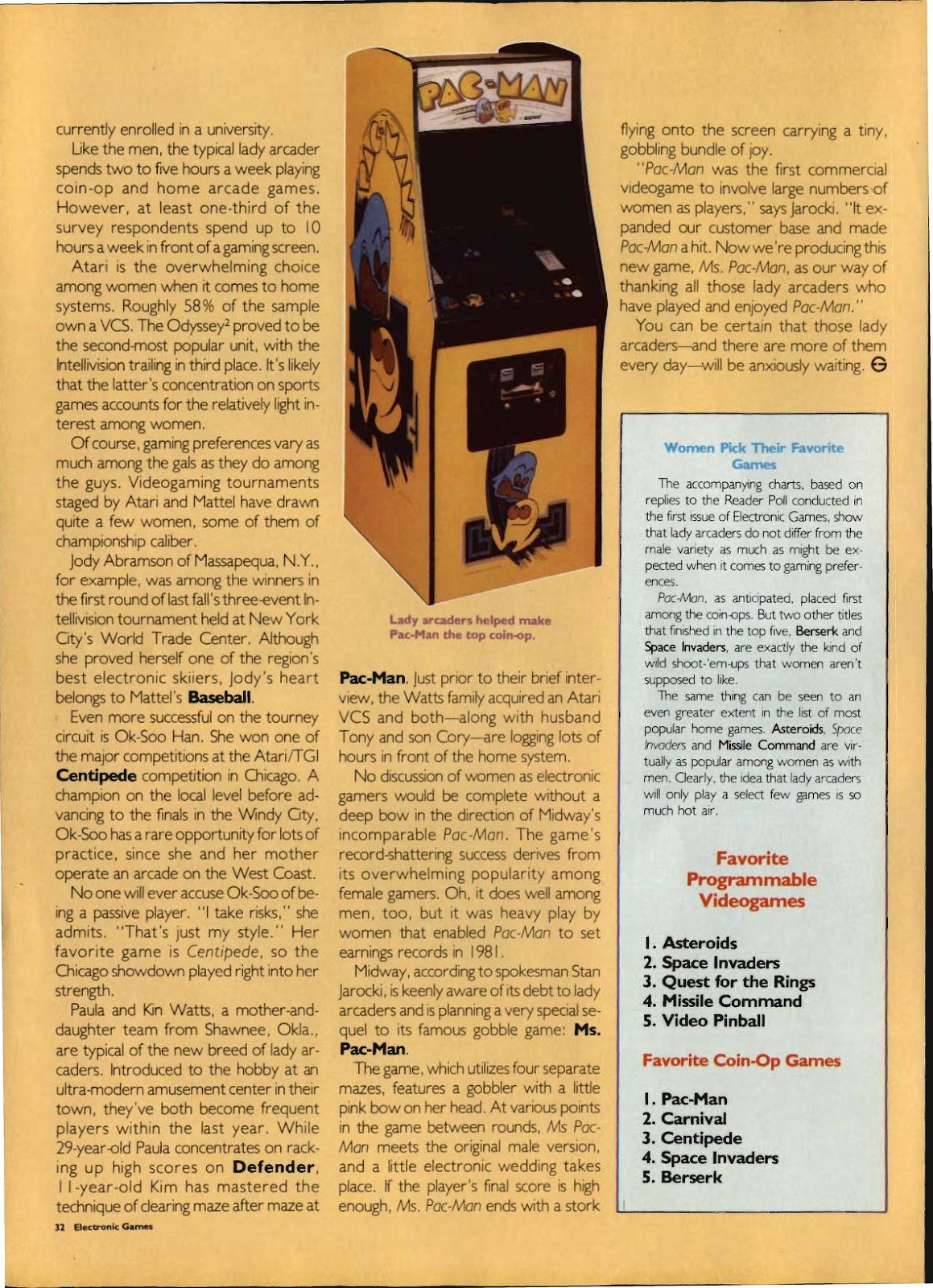
And make no mistake, it worked. Pac-Man's success and popularity amongst female gamers was one of the reasons why a female character was the protagonist in Ms. Pac-Man, according to Midway employee Stan Jarocki.

Electronic Games Magazine (May 1982). Left-click for larger view.
"Pac-Man was the first commercial videogame to involve large numbers of women as players," says Jarocki. "It expanded our customer base and made Pac-Man a hit. Now we're producing this new game, Ms. Pac-Man, as our way of thanking all those lady arcaders who have played and enjoyed Pac-Man."
In spite of my own feelings about Distaff Counterparts, there is a reason they exist; they work. They can be hugely popular in their own right, earning the ability to stand on their own two feet. To use superheroes as an example, Marvel's Carol Danvers -- better known as Captain Marvel, formerly Ms. Marvel -- is a far more prominent hero than her male predecessor, also known as Captain Marvel. In the case of Ms. Pac-Man, she was as capable as Pac-Man when it came to eating dots and ghosts and in an enormously popular game herself, to the point that she either matches Pac-Man's cultural relevance or is ridiculously close. So to have Ms. Pac-Man so passively dismissed and her contributions diminished with the following quote is only disheartening to see, regardless of Anita's claim that, "it’s entirely possible to be critical of some aspects of a piece of media while still finding other parts valuable or enjoyable":
"Ms. Pac-Man’s visual properties are simply an extension of Pac-Man’s original design; she actually kind of is just Pac-Man with a bow. Her simple narrative reinforces the fact that she really only exists in relationship to Pac-Man. She is both his love interest and also the mother of his child."
Later on, Anita also provides this statement:
"Ms. Male Characters typically aren’t given their own distinctive identities and are prevented from being fully realized characters who exist on their own terms. This has the, perhaps unintended, effect of devaluing these characters and often relegating them to a subordinate or secondary status inside their respective media franchises, even when they are, on rare occasions, given a starring role in a spin-off or sequel."
I don't know about anyone else but I feel like the only person devaluing characters such as Ms. Pac-Man is Anita. Prior to that particular quote, Anita was talking about Dixie Kong, star of Donkey Kong Country 3 and a playable character in fifteen games, and it's clear that the quote is aimed at characters such as her and Ms. Pac-Man. Dixie Kong was the start of her own title, having to save two male characters who were damsels in distress and why exactly is she receiving criticism? Because she wears pink. Because she has a ponytail. Because she's a Distaff Counterpart to Diddy Kong, according to Anita (which isn't actually true; they have similar designs but only because the two are similar in age, size and, y'know, they're apes. The two do not share abilities or similarities in their design more than that, in the same way the Pac-Man and Ms. Pac-Man do). So who, exactly, is devaluing the female characters here?


Truthfully, I'm having a hard time figuring out why, exactly, Anita takes issue with gender signifiers in games. Unless they lead to what she describes as "personality female syndrome" -- a series of characteristics that Anita believes stereotype women, including being, "vain, spoiled, bratty and quick to anger" -- I don't exactly see the issue. I thought I did but then this segment of the video completely threw me off:
"Now just to be clear, there’s no inherent problem with the color pink, makeup, bows or high heels as design elements on their own. And of course people of all genders may choose to wear any of them from time to time in the real world and there is nothing necessarily wrong with that either.
However, when designers choose to use the Ms. Male Character trope and its associated visual stereotypes to specifically distinguish female characters from the rest of the cast in a fictional context, it has a few negative consequences.
One repercussion of constantly relying on feminizing signifiers for character design is that it tends to reinforce a strict binary form of gender expression. The gender binary is an entirely artificial and socially constructed division of male and female into two distinctly separate and opposing classes of human being. The gender binary also erases the continuum of gender presentations and identities that fall outside of the rigid masculine/feminine false dichotomy.
And within that strict binary women are “marked” while men get to remain largely “unmarked”."
In other words, Anita dislikes signifying a character's sex through certain clothing or accessories because (A) it singles out women as something different from men and (B) it automatically excludes people who don't identify as male or female, or who do but choose not to conform to gendered clothing.

The main reason this stood out to me is because, as understandable as it is to want more representations of genders outside the "gender binary" -- which simply means "male or female" -- I don't understand why it falls to gaming to show those representations. Gaming can but isn't Anita criticising the "entirely artificial and socially constructed division of male and female into two distinctly separate and opposing classes of human being" actually a criticism of society's attitudes instead?

Let's use Ms. Pac-Man as an example again. I'm not normally a person who says that Anita needs to provide good examples in addition to negative ones but in this case, I would love to hear an alternative solution to giving the character lipstick and a bow to show that she is a female character. Again, bear these factors in mind:
  • It's 1982 and there are "only a few pixels to work with" (Anita's own words).
  • The character has to look different from Pac-Man to avoid Ms. Pac-Man seeming like a knock-off.
  • The character has to look similar enough to show that the game is part of the same series.
I think it's reasonable, albeit not ideal, for a character designer to draw on real-life examples of women to create a female character in this case. Given that women are far more likely to wear bows and lipstick than men, it is completely fair for a character designer to use those elements for his/her female character. And that is so obvious that I can't believe I had to write it down.

On the Feminist Frequency Tumblr, the only solution, if you can call it that, was a gender-flipped version of Pac-Man and Mrs. Pac-Man that shows how the two characters would look if "Pac-Woman" became "Mr. Pac-Woman".


Personally, I don't think it's as "downright absurd" as Anita believes, not least because Pac-Man is a tricky character to take seriously in the first place. He -- or she, if we're talking about Pac-Woman -- is a yellow circle with a mouth. Putting a top hat and bow tie on it doesn't propel this light-hearted, cartoonish character into the realms of absurdity. What little ridiculousness there is only comes from the fact that, if anything, "Mr. Pac-Woman's" clothing looks very outdated. However, this still isn't a solution. It's just a gender flip.

I'm anxious to move on from this topic but I want to mention the idea that women are "marked" and men are "unmarked". I don't think Anita ever actually asked why it is done but she certainly, and probably unintentionally, provided an answer to that question:
"There are a few optional design accessories for men like neckties or baseball caps but they don’t hold the same significance. They are not ubiquitous or strictly enforced, and are never really used to “mark” men as “not female” in larger fictional universes dominated by women."
First of all, I find it quite funny that Anita singled out Dixie Kong earlier in the video when both Donkey Kong and Diddy Kong wear a necktie and baseball cap respectively -- again, they're apes. It'd be tricky to tell the sex of those characters without gender signifiers -- but doesn't this quote sum up why gender signifiers aren't used as often for male characters? Certainly not because men are considered the default and women a deviation (which I'll come to later) but because there are so few gender signifiers available for male characters. Traditionally-male clothing is no longer restricted to men. Women are far less likely to receive odd looks if they went out in public in a man's suit than a man would if he did the same in a pink dress, with pigtails and makeup. The reason being that they still are items and fashions predominately associated with women. If Anita wants to take any steps changing society's perceptions on that score, I'll be right alongside her, but it's silly, pointless and actually rather petty to lay the blame of gender signifiers at the feet of video games. That goes for modern games as well as retro games.

In other words, women are more likely to have gender signifiers because they actually have them. Not because they need to be "marked" and singled-out as something different from "the norm".

Also, I actually find that turn of phrase bordering on offensive; I'm sure it was completely unintentional but think about other oppressed classes throughout history who have been marked -- literally -- as something different from what their oppressors considered "the norm" or ideal. I feel like it was a very poor choice of words to use when describing how hard female characters have it in video games, of all things.

One thing that I'm sure had everyone marvelling was Anita's analysis of Mass Effect 3's advertising. Let's deal with the mistake that even the non-Mass Effect fans probably picked up on:
"Still, the female version has a dedicated fanbase who frequently refers to her as “FemShep”. And although this is meant as an affectionate nickname, it does further highlight her designation as a Ms. Male Character. She is the one with the qualifier attached to her name. She is “Female Shepard” whereas the male version simply gets to be, “Shepard”."
This is completely untrue. Although I hate to fall back on phrases that make it sound like Anita makes these kind of research mistakes all the time, this is a typical example of the lack of research that people criticise her videos for. It certainly is astounding that Anita can trawl through obscure mobile games and retro games to find examples but can't spend two minutes on a forum to find out information on a nickname for the main character of a AAA game.

For those of you who don't know, the male version of Mass Effect's Commander Shepard does have a nickname. Several, in fact; "MaleShep", "ManShep" and "BroShep" are all commonly used while "ShepLoo" and "VanderShep" are both used to refer to Commander Shepard's default male design, named after the Dutch model he was modelled after, Mark Vanderloo.


 That's not all. Prior to this, Anita discussed the marketing of the Mass Effect series:
"In mainstream advertising of the franchise, the male commander is used almost exclusively. His image is front and center on the box covers for all releases including the special editions. He is the one featured in the TV commercials, teasers, trailers, web banners, street posters and print ads and his face appears on most of the magazine covers. All of this positions the male Commander Shepard as the default protagonist of the series.

That is how Bioware is selling the Mass Effect experience. Nearly everything about the advertising campaign explicitly tells players that Commander Shepard is a man and by extension associates the official storyline with the male version of the hero. This marketing strategy contributes to the fact that only 18-20% of players choose the female option (despite the fact that Jennifer Hale’s voice acting is widely praised as being far superior)."
First of all, although the 18-20% statistic is apparently true, there's nothing to say that the marketing strategy is the reason for the 80% of players or so choosing to play as the male version of Shepard. Much like in previous videos, like assuming damsels in distress are considered property rather than people, this is a case of Anita reaching a conclusion that isn't backed up by any factual evidence. One may not neccessarily lead to the other but Anita is arguing as if that is the case.

Secondly, I take issue with the fact that Jennifer Hale's voice acting was considered "far superior". There are certainly people who make that claim but she also has her detractors (typically on the exact same forums as her supporters. There's always a healthy mix of opinions). I'm as big a fan of Jennifer Hale as the next person, particularly for her performance as Bastila Shan in Star Wars: Knights Of The Old Republic, but I wasn't a fan of her Mass Effect role. I agree with those who say her vocal performance as Commander Shepard was too butch. Trying too hard to be "badass", to fit a tough space marine persona rather than just a person. Meanwhile, Mark Meer -- the voice actor for the male version of Shepard -- had a voice that fit a wide range of races and facial features, as well as being suitably authoritative. Plus, he was widely praised for upping his performance in Mass Effect 3.

Then there's the advertising campaign, which focused only on the male version of Commander Shepard. To be more specific, the default male version of Commander Shepard, created using Mark Vanderloo's likeness. I certainly find it unusual and rather silly that BioWare -- creators of Mass Effect -- actually paid for a real person's likeness in a game where a character's facial features can be customised and that was the appearance focused on in all the marketing ... but since that's the case, why does Anita focus on the fact that he's male? Why not mention that non-whites are similarly ruled out or, for that matter, that the character customisation feature isn't shown off as much as it could be and is therefore rather poor marketing for not showing off an aspect of the game? The thing is, when only one of these points are argued -- "women aren't focused on" -- it sounds less like "not everyone is being given an equal share" and more like "it shouldn't be a male character". Something that is equally as exclusionary.

Plus, it has to be said ... the male Commander Shepard is the default protagonist of the series. "VanderShep" is the version of the character that players see when starting a new game. So criticising the series with the statement, "all of this positions the male Commander Shepard as the default protagonist of the series" doesn't make much sense. That's the case. Plus, for all I know -- or for all Anita knows -- having a default protagonist could help sell the game. I wouldn't want to make assumptions about why mainstream audiences bought Mass Effect.

Anita continues:
"During the advertising of Mass Effect 3, Bioware made a little more effort to include female Shepard with items like an alternate reversible slip cover for the game box (which features the male version by default) as well as a special web only trailer but these gestures feel like an afterthought or niche specialty marketing and hardly what I would call a substantial or equitable inclusion."
This dismissive attitude when a developer makes a positive change in order to cater to women is reminiscent of Carolyn Petit's criticism of female characters being added to Aliens: Colonial Marines. All it does is send the message that the developer may as well not even try to cater to a feminist gaming audience because it's impossible to succeed. Much like Petit, Anita is creating a no-win situation by complaining about an effort BioWare made to appeal to feminist gamers in the first place. It also brings to mind the way Anita shrugged off Princess Peach's appearance as a playable character in Super Mario Bros. 2 in her damsel in distress videos because she was only in the game "by accident", since it was a makeover of Doki Doki Panic.

Finally, when talking about The Smurfette Principle, Anita argues that men are treated as the "default" sex:
"In a male identified society like ours, men are associated and become synonymous with human beings in general. In other words, male tends to be seen as the default for the entire species."
In all seriousness, there is some truth to this claim. Although it's more of a double-edged sword than is made out.

Let's use a real life example; political parties are always trying to gain "the female vote" by showing their support for women's issues, such as taking a pro-choice stance on abortion, pledging to stamp out the wage gap and sexism in the workplace, etc. Meanwhile, there's no "male vote". I don't think the phrase "men's issues" will ever come up in a political debate and, if it did, nobody would have a clue what it means. That's part of men being considered the "default" for the entire species. There's no need to cater to men because men are just ... there. The standard. Anything that appeals to society as a whole will be appealing to men because they don't have anything that specifically caters to them ... right?

In games, we don't care about legions of male enemies being gunned down by the player. In fact, it's not only accepted, it's expected for men to be the expendable gender. Meanwhile, we have developers committing self-flagellation over their portrayals of characters, even positive ones, thanks to criticism from the Tropes Vs Women in Video Games series, while men criticising portrayals that they feel are sexist are told to "Grow The F**k Up". Because men can't possibly be offended by portrayals because we're the default. Isn't that so?


So there's something to the idea that men are considered the default but -- and this isn't a knock on Anita -- I wouldn't expect the effects on both sexes to be covered by a video on gender issues in games. It's not an issue at the forefront of the gender issues debate, so it's not something I believe anyone would cover, regardless of their sex or involvement.

I'm hoping to read more articles on this video from others online but for the moment, that's all I have to say on it. I don't know if I was expecting Anita to change her presenting style for this video but I do know that I was disappointed to see all the flaws present in her previous videos to be back with a vengeance here; the blaming of specific developers, basing arguments off conclusions that she came to without evidence, dismissal of positive and progressive changes for women for rather shallow reasons, etc. On the plus side, she did reference a few examples this time around (although none of the gameplay videos, so it's still up in the air as to whether they were her own content or if they were taken from other Youtubers without permission or credit).

Anyway, as for what happens next ... I'm buying the Tomb Raider reboot in the near future, so hopefully I'll be able to provide another "The Sexism Of ..." blog post. I know it's a year old now but I don't often get the chance to delve into individual games anymore, so I'm looking forward to it.

Feel free to leave a comment or write to me at themalesofgames@gmail.com