Sunday, 24 August 2014

The Zoë Quinn Story

If you've been following the story of Zoë Quinn over the past few days, it's been an almost unbelievable period for the gaming community. In short, a story came out about Zoë Quinn's personal life that was only mildly interesting and noteworthy but due to selfishness, stupidity and needless censorship from many different parties, it became a much bigger issue than it should've been.

For those of you who don't know, Zoë Quinn is the indie game developer who worked on Depression Quest, a text-based "adventure" game (for lack of a better genre) that is up on Steam. It received quite a lot of publicity at the end of last year because Quinn allegedly received a lot of abuse for creating something that is arguably not a "game" in the sense of the word we're all familiar with. More on that later.

Since then, Zoë Quinn has enjoyed the same kind of minor celebrity that many women in the games industry share, due to being a representative of the struggles that women in the industry face. However, following the release of Depression Quest, she stayed out of the spotlight. Until last week.

Zoë Quinn
On August 16th, an ex-boyfriend of Quinn's named Eron Gjoni created a Wordpress blog called "The Zoe Post", which chronicled a chunk of his relationship with Quinn. He went into great detail about their time together, showing a video featuring both himself and many of Quinn's messages to him for proof that his story was authentic and screengrab after screengrab of his conversations with her. The big story is that while they were together, Quinn cheated on Gjoni with five different men and -- something I don't feel has been focused on enough when this topic is discussed -- had unprotected sex with Gjoni without him knowing about her other sexual partners, putting him at risk of sexually-transmitted diseases.

Now, if you're hearing this story for the first time, you're probably thinking the same thing that me and literally every single other person who heard this story thought; "you know, that's not that interesting. The Zoe Post is a good read but so what? I'm not into gossip about indie developers' private lives". You're right. On its own, this story probably wouldn't have amounted to very much. It was its own contained affair, which would probably blow over very quickly after some people altered Quinn's Wikipedia page for fun and got the usual insulting messages towards her out of their system.

There are two big problems with that; 1) one of the people she slept with was Nathan Grayson, a games journalist who has written for Kotaku and Rock, Paper, Shotgun and 2) the horrible, unbelievable handling of this problem by Quinn, the gaming press and even completely unrelated forums like Reddit and NeoGAF have caused it to spiral out of control.

The real meat of the issue is that Quinn had sex with a member of the gaming press. This is what's caused the majority of the outrage and is why this isn't just a story about Quinn's personal life that fizzled out after it had run its course. There's a lot I will mention here for people who don't know but a good place for all the facts about this is a Youtube video called "Quinnspiracy Theory: The Five Guys Saga" by Internet Aristocrat. He gives an excellent, detailed rundown of how all this ties to the gaming press and, at 24 minutes, will probably take less time to watch than this blog will take to read. With half a million views as of this writing, it's practically required viewing at this point:


I have to admire Internet Aristocrat's hard-hitting style, particularly when setting his sights on clickbait and social justice articles on gaming sites like "Straight White Male: The Lowest Difficulty Setting There Is" and Jonathan McIntosh's "Playing with privilege: the invisible benefits of gaming while male". I've discussed these articles here before and it's a relief to see a video calling them out receiving so much attention.

I don't think the link between Quinn's sexual encounters with Nathan Grayson and social justice articles are quite as clear-cut as Internet Aristocrat makes out and, although I think Depression Quest and Gone Home are sorry excuses for games, that particular opinion is irrelevant. However, he does raise some good points that I want to bring up. There are several parties who screwed up on a large scale and I'm interested in examining what they did wrong and how it's led to the issue spiralling out of control.

Let's start with what happened before breaking this down into the different groups. Basically, everything you need to know is that Zoë Quinn slept with the following five guys:
  1. Robin Arnott - Indie developer.
  2. Joshua Boggs - Zoë's boss and a married man.
  3. Nathan Grayson - Game journalist. Writer for Kotaku and Rock, Paper, Shotgun.
The accusation from Internet Aristocrat (which I believe he got from others) is that the other two men were Kyle Pulver, indie developer, and Brandon McCartin, indie developer who worked on Fez. I'm not sure how these two names came out because Gjoni intentionally covered up the names of the last two men in The Zoe Post, assuring readers that he didn't think they were the type to sleep with a woman while knowing that she had a boyfriend. Interestingly, Pulver is the only one who says the accusation towards him is unfounded:


Make of that what you will. I haven't seen any evidence to the contrary (although I'm happy to be convinced) and this is pretty much what I expected everyone in his situation would do in the face of such an accusation. McCartin, on the other hand, posts links to Polygon articles about Twitter harassment, so he doesn't seem quite so innocent. Regardless of all this, Grayson's the important one. Keep him in mind.

Got all that? After this, it gets a bit more complicated, due to the ridiculous number of stories that came out in a short space of time.

Before we go any further, let's make this explicitly clear; this is not about attacking Zoë Quinn, nor anybody else. There are lots of people who ended up creating a mountain out of a mildly-interesting molehill and the lack of responsibility from all of them is what has driven to an overwhelming backlash from gamers.

Let's start with Quinn though and look at how her actions led to this story becoming bigger than it was originally.

Zoë Quinn

I'll try to cover as much as I can for newcomers to this story but since there's a lot of branching information, I have to limit some stories to just the relevant parts. I'll save Quinn's Tumblr response until the end, since I have some stuff I want to write about it.

After this story broke others began to come forward with their own stories about Zoë Quinn. One of these people was from a group known as The Fine Young Capitalists, who were interested in having women worldwide suggest ideas for games, having everyone go to their website to vote on the best one and female developers would create it. Even better, the profits from the game go to charity! Here's the story from Reddit:

Left-click for larger view
Plus, this is a legitimate cause; The Fine Young Capitalists have their own website, where you can vote on the best game idea and their own IndieGoGo page for the project. Quinn maintains that it didn't happen as the Young Capitalist member describes it; she says there was no doxxing or banning from Twitter (yet didn't follow up on my helpful suggestion to donate to the project):

Left-click for larger view.
Also quite funny to note that Anita Sarkeesian hasn't donated either. 4chan, on the other hand, have responded overwhelmingly, leading The Fine Young Capitalists to praise them on Twitter. Interestingly, 94% of donations come from men.

Update: Now TFYCapitalists have accepted a character design from 4chan for one of the games too! And she is excellent.

Update #2: And now the IndieGoGo page has been hacked and shut down. It isn't clear by who yet but you can read TFYCapitalists' statement here.

Update #3: And as it turns out, someone has provided a helpful picture showing that Zoë Quinn's backlash against TFYCapitalists was considerably more than she was making out:

Left-click to enlarge.

There's an issue with Zoë Quinn's claim in the tweet above; "if you're sad women aren't making more games, why ask for 6 months unpaid labor from them?" For new readers -- I'm sure I'll get a few from this post -- I studied game design at college and one thing that was instilled in all the students was how the games industry is largely portfolio-based. Any artwork from the Fine Young Capitalists five game projects would look great in a portfolio. Any programmers would have a brand new game to place in a showreel. It goes without saying that making a game for charity would be an excellent thing to put on a resumé.

It isn't as if the female creators working on the Fine Young Capitalists' game are walking away empty-handed. If their own money was going into the project, I could see Quinn's point. As it is, this is a project where everyone wins. It's an excellent idea and a very worthy cause.

Then, there was this tweet:


The first person in the conversation, Wolf Wozniak, claims that Zoë Quinn sexually harassed him and Phil Fish, developer of Fez, inadvertantly confirms it. Rather than staying quiet and pretending he didn't know what on earth Wozniak was talking about, he confirmed that he knew what this person was talking about. His tweets were then favourited by Quinn and Robin Arnott, one of the men Quinn had slept with. There was also a long series of tweets leading up to the revelation that Wozniak was sexually harassed by Quinn, discussing how he feared being stigmatised by the indie developer community. His tweets are now private but there was an image featuring the entire discussion (although I couldn't find a version where all the tweets were large enough to read), including Fish's reply.

Update: Someone posted this picture in the comments section of a Gamespot article. This is the one I was looking for:

Left-click to enlarge.


Here's where I want you to do something for me, readers; pick a male game developer. Gabe Newell. Peter Molyneux. Will Wright. Imagine a scandal breaking out where it was revealed that they had sexually harassed a woman at a wedding and had unprotected sex with their wife/girlfriend after cheating on them with five different women.

How long do you think it would take before you went onto a gaming website and read the headline, "Gabe Newell steps down as Managing Director of Valve in the wake of sexual harassment and multiple affair scandal"?

How quickly do you think calling the victim of the sexual harassment a "little shit" would get called out as typical internet misogyny?

Why do people leap to Quinn's defence when she harasses and knowingly puts her boyfriend at risk of sexually-transmitted diseases -- I cannot stress that point enough -- in a way that they wouldn't if the perpetrator was male and the victims were female?

I used to like Phil Fish, after seeing Indie Game: The Movie. Phil deleted his Twitter account late last night, claiming that he was hacked and Polytron and Fez 2 were up for sale. He left while ranting about Quinn's critics being "cowards" and "ball-less manboobs". I don't really want go into the debacle any more than that.

I've only written about Quinn once before on this blog and it was actually defending her in the face of the abuse that she allegedly received. I don't know how recently these were created but a series of images has been doing the rounds that show how unlikely it is that the perpetrators of the harassment were actually the culprits. I can't really comment on it more than that; I don't know Wizardchan well enough to say whether this is accurate and I don't know whether Quinn had evidence of phone calls that she didn't bring up (or just weren't included in the images) but that's a convincing overview.

Finally, we come to Quinn's reply on Tumblr, which can be read here or you can take a look at an Imgur version here, in case the main version is removed (or you don't want to give Quinn's Tumblr any views).

Quinn's blog was one of the reasons I went from being only mildly interested in this story to giving it more attention. I feel as if there were two ways she could've handled this when talking about it on her blog; the mature, responsible way or the aggressive, uncompromising way. She chose the latter.

The big issue that I have with Quinn's response is that she insists on describing the events as "personal issues" but the way she responds is anything but personal. Rather than this being solely about Quinn herself, she holds herself up as an example of all women; she talks about what it's like to be a woman no fewer than five times throughout the blog post:
"[...] all of these things are inexcusable and will continue to happen to women until this culture changes. I’m certainly not the first. I wish I could be the last."
"Sexuality is one of the most personal, hurtful, and easy things to demonize a woman over, and also has nothing to do with my games."
"This is another example of gendered violence, whereby my personal life becomes a means to punish my professional credentials and to try to shame me into giving up my work. I’m still committed to doing my small part to create a world where no woman is at risk of experiencing this."
"These kinds of accusations have been levied against any woman of status in any industry, ever."
"I have been judged because, if you are a woman, you are expected to constantly “prove” yourself, and even mere accusations can somehow undo all the good you’ve done and justify any measure of depraved brutality against you. Meanwhile, I see major support thrown the way of my male colleagues when they are accused of any sort of wrongdoing."
If you've ever seen responses from content creators like Anita Sarkeesian, you'll have probably seen arguments very similar to these ones. Rather than taking responsibility for her own actions, Quinn shifts the focus onto her critics. It stops being something she has to acknowledge about herself and paints those who disagree with her actions -- including her ex-boyfriend -- as people who want to attack her because she's a woman.

I'd also like to address that last quote; first of all, these aren't accusations, it's proof. The message logs on The Zoe Post show Quinn herself admitting that she's slept with other men. Secondly, Quinn really sees "major support" thrown the way of male colleagues? Men are actually supported when cheating on their partners? Because all I see is the opposite; Zoë Quinn has received overwhelming support for her actions and has had the gaming press defending her. More on that later.

Thirdly, men in the media have been reprimanded for a lot less. While it's the gaming press rather than the industry itself, a while ago I briefly wrote about how Destructoid writer Ryan Perez was fired for referring to Felicia Day as a "booth babe" on Twitter. This dislike of one female celebrity was apparently enough for him to be branded a misogynist and get fired from his job after a witch hunt spearheaded by Wil Wheaton. However, Perez is not representative of all men any more than Quinn is representative of all women.

Quinn's tumblr post also started a trend of victim-blaming towards her ex-boyfriend that continued throughout the majority of articles I've read about this whole affair. In spite of the fact that Eron Gjoni himself acknowledges that The Zoe Post is written "almost entirely in shitty metaphors and bitter snark", Quinn and others dismiss him as just "an angry/vindictive/jilted ex-boyfriend", depending on the article you read, and a Daily Dot article reducing his issues down to "nasty, post-breakup gripes".

I'm not going to let this particular point go; Zoë Quinn had unprotected sex with Eron Gjoni after cheating on him, knowingly putting him at risk of sexually-transmitted diseases. This is not a minor issue. If I went through that, I'd probably be "angry" and "vindictive" too but justifiably so.

The idea that Quinn puts forward about this being a personal matter is also flawed. This is going off-topic quite a bit but there was a phrase used here in the UK by a journalist and satirist called Ian Hislop, during a political scandal involving the Defence Secretary. On a show he's part of, he said, "he blurred the line between his personal and professional lives. Surely that means we're entitled to ask questions about the personal one", which led to a minor debate about legitimate areas of enquiry and overstepping those bounds. I know I certainly have delved into personal details here but it's honestly due to the way it's been handled. The insistence by both Quinn and her supporters that she is the victim in all of this. Imagine, instead, if she wrote something more PR-friendly and professional sounding, apologetic and full of humility. Something like:
"I was in a relationship with Eron Gjoni and, as with many relationships, did things I regretted. My actions did not impact my professional career in any manner. I apologise to anyone who was hurt during this period due to my behaviour. I appreciate your continued support and understanding."
Even with something like that, Quinn wouldn't reveal anything about her personal life but would also remain mature and professional. That's the type of response we've come to expect. Not a rant about how hard she had it following the reveal of details of a relationship where she was arguably emotionally abusive towards her boyfriend.

There's probably more that I could nitpick about this but I can leave it there. Again, I want to point out that, in spite of the fact that I've been critical of Quinn's actions, I don't want this to be an attack on her. She is right about one thing; this being her personal life does entitle her to a significant amount of privacy and as critical as I am of her behaviour, handling it properly could've gone a long way. Which is the theme of this entire scandal, if "scandal" isn't too strong a word.

The Gaming Press

We all know that game journalism is awful. It's not a secret. There aren't many mainstream gaming sites that don't feature clickbait articles now. Internet Aristocrat highlights several of these in his video above. Articles about Social Justice themes have become a lot more common. That'd be fine on sites devoted to the subject but, if you've read the many different blog posts I've written about these types of articles, you'll know that it's difficult not to see these "journalists" as being entitled to the point of insulting their audience and attacking developers when they see something they don't like (like George Kamitani being outright insulted for Dragon's Crown's female character designs or Hideo Kojima facing a backlash for Quiet's revealing outfit in Metal Gear Solid V).

Then there's the constant focus on AAA games, particularly on story and cinematic presentation over gameplay. It's similar with indie games, such as Gone Home. I don't begrudge any game a review or previews but when Gamespot has twenty features on The Last Of Us in July of 2014, including one called "The Test of Time: Looking Back at The Last Of Us" -- only thirteen months after its release -- you can't expect a chunk of your audience not to roll their eyes at the preferential treatment. Think of all the time everyone wasted on Watch Dogs. One of my biggest pet peeves when browsing gaming sites is the lack of attention given to titles that don't fit either the big-budget or indie mould. When's the last time you read about Dynasty Warriors? Disgaea? The Atelier series? They're all still going. Unfortunately, in the case of gaming sites, Yellow Journalism is the order of the day.

That's a minor complaint when we consider the long-standing accusations of corruption in the gaming press. In 2012, Rab Florence wrote an excellent article for Eurogamer that called out the nature of the relationships between games journalists and people working in games PR; going from a famous picture of Spike TV's Geoff Keighley (although I was most familiar with his GameTrailers work) sitting between a Halo 4 poster and a table of Doritos and Mountain Dew, Florence also criticised game journalists winning free PlayStation 3s from a competition at the Game Media Awards.

While searching for information for a college paper, I came across an article on CinemaBlend, quoting from a Q&A that an anonymous publisher did for Kotaku. Here's the part they quoted:
"Reviews only have an impact if they're 90+, and then the impact is huge.

We don't take steps to get good reviews, we take steps to make good games. Then we invite reviews to fancy promotional events to warm them up on the game before they play it on their own.

I think of our launch parties as warm-up comedians for the main act. Warm-up comedians are there to get you laughing and excited, so when the star performer walks onstage, you're primed and ready to enjoy the set. Our promo events are the same way. We bring out media to a fancy location, wine and dine them, show them the best parts of our game, and generally build anticipation for release. The theory is that, once they get the game and play it privately, they already have a positive association with the game, which may influence their final score."
Although the article made it clear that there isn't any money exchanging hands, it's unquestionable that game reviews are influenced by factors other than just game quality. While I'm sure professional journalists would insist that these types of fancy events don't sway their opinion, how can they remain impartial following the experience? Honestly, this is something I don't blame the publisher for; it could be argued that if the publisher is rich and dumb enough to offer it, the game journalist should take it. I see it the other way around; if the journalist is unethical enough to accept lavish gifts from someone whose game they'll be reviewing in the near future, a publisher rich enough to throw these kind of events might as well.

With that, we come to Nathan Grayson. As mentioned earlier, he's one of the men Zoë Quinn had sex with. He's a games journalist and has written for Kotaku and Rock, Paper, Shotgun. I looked back over my blog and was surprised to find I'd written about him twice before, as small parts of larger posts. Once criticising a #1ReasonWhy article he wrote where he referred to men as "self-centered slobs" and another where he interviewed the lead writer of Dragon Age III and had a closing statement that would have a six-year-old rolling their eyes at the immaturity. Interestingly, I wasn't aware that he'd written both articles until now but both times I criticised him for an "us vs. them" mentality when it came to sexism in games.

(Note: I'm using DoNotLink for both of the Rock, Paper, Shotgun articles in that paragraph, so don't panic if you're redirected.)

The accusation is that Zoë Quinn slept with Nathan Grayson to get publicity for her game on the sites that he writes for. Now, let's deal with the elephant in the room: there is no evidence of that being the case. That's just the way it is. He's only written about her twice. Once on Kotaku, about a game jam-themed reality show she was involved in and another on RPS, featuring Depression Quest in a list of greenlit releases on Steam. No reviews of Depression Quest. Also, no word from Rock, Paper, Shotgun as of this writing but for once, I have to give credit to Kotaku for actually responding to the accusation towards one of their writers. In a mature fashion, no less.

So without any actual positive coverage for Depression Quest from Grayson, that means game journalism is in the clear, doesn't it? If only.

Some people have linked to the Code of Ethics page on the site of the Society of Professional Journalists. This is an amazing list that clearly explains unethical journalistic acts and it's mind-boggling to go down the list and mentally cross off every one that the gaming press is guilty of committing. Take note of the points underneath the "Act Independently" header, particularly the first three:
  • Avoid conflicts of interest, real or perceived.
  • Remain free of associations and activities that may compromise integrity or damage credibility.
  • Refuse gifts, favors, fees, free travel and special treatment, and shun secondary employment, political involvement, public office and service in community organizations if they compromise journalistic integrity.

The fact is that Grayson was in a position to help Quinn and who knows if he talked about positive coverage for her game behind the scenes? Likewise, Quinn was the perfect font of conflict for Grayson's Social Justice-themes and rants. Regardless of the fact that Grayson didn't write a Depression Quest review, he could have. This was a conflict of interest. This was an association that comprised Grayson's integrity and damaged his credibility. And, as pointed out by the anonymous publisher from the CinemaBlend article, games journalists certainly do not refuse gifts and special treatment that compromise journalistic integrity.

Putting Grayson to one side, you only have to look at how the gaming press has responded to this Zoe Quinn story to see more examples of a lack of ethics. They adopt one of two extreme stances; not mentioning the story at all or going on the defensive in the same way Quinn did (blaming her critics, her boyfriend, using it as an example of misogyny in gaming, etc.). The obvious problem with not mentioning the story at all is that it's a big story to ignore. In a way, games journalists have shot themselves in the foot. Yes, it's about Quinn's personal life, which protects her from attention. However, when games journalists don't have any qualms about calling male gamers "self-centered slobs" (Grayson, RPS), insulting developers by calling them "14-year-old boys" and going on to lay all of sexism in gaming at their feet (Schreier, Kotaku) or the following Ben Kuchera (editor at Polygon) tweet, they have no excuse for the Zoe Quinn story being off-limits.


All of this, in itself, crumples up the SPJ Code of Ethics and throws it away. "Seek Truth and Report It" and "Be Accountable" are completely alien concepts.

When it comes to the number of articles that take Quinn's side, I don't even know where to begin. For the sake of consistency, here are the links to several articles I've rounded up but I recommend not viewing them.
These all pander to their readers with the same arguments we've seen again and again but Motherboard is the worst of the bunch; Quinn was harassed (with only her word as evidence), this is an example of misogyny in "predominately male communities", she was compared to Anita Sarkeesian and, worst of all, Quinn was slut-shamed.

I'm going to say this one more time, hopefully for the last time in this blog post. Feel free to say it with me: Zoë Quinn had unprotected sex with her boyfriend after sleeping with five other guys. If you want to act like criticising her over that is slut-shaming, I think you have a lot to learn about sexual health. If this was as by-the-numbers as the author of that article paints it -- "A woman should be able to engage in sexual relations with her peers and not be publicly smeared for it." -- Quinn wouldn't have been smeared for it outside of the usual trolls. That's not what happened.

However, one thing that eats away at me about that Motherboard article is the following paragraph-and-a-half:
"To make matters even more ridiculous, a digital mob has taken to accusing Quinn, not ironically, of creating "a negative image for all current and future female game devs with her actions" and "[setting] back women in the video game industry."
Actually, what keeps women from the gaming industry (and other tech related fields) are online incidents like this one."
Firstly, as a quick aside, most women choose to stay out of the gaming industry. There's nothing actively keeping women out. It's likely the same as other engineering majors. You can't say women are being kept out of the gaming industry any more than you can say men are being kept out of social work, performing arts and psychology.

Secondly, and this is the part that bothers me, the author of that Motherboard article wrote that paragraph ... but didn't find any quotes from female developers to see what they thought. As it happens, here's two female devs who were very vocal about the issue (names and dates obscured, just for the sake of safety):


You wouldn't think it would be difficult for the writer of the Motherboard article to actually consider asking a female developer's opinion, rather than being so arrogant as to speak for them. Even the creator of the Tumblr they linked to -- kc-vidya-rants -- was female but the author automatically assumed they were male! Apparently, an appeal to victimhood is more important than acknowledging that female developers may object to Quinn's behaviour too (and by "behaviour", I mean her Tumblr and Twitter responses as well as the events that started the entire controversy).

Finally, there's the claim that "Women are not welcome on the internet", a statement that was around long before the Zoë Quinn story ever existed. To that, all I have to say is look at the outpouring of support for TFYCapitalists' IndieGoGo project, featuring an all-female development team and game concepts from women all over the world. Look at the money that 4chan is putting towards it! Over the past month, I've been frequenting the Women Against Feminism Facebook page and Tumblr and the only people telling them they weren't welcome were -- you guessed it -- feminists. Here's a quick screengrab I took of a comment before it was deleted for strong language (opinions are welcome but strong language is moderated):


If you think that's a one-off, you should see the sheer number of comments belittling the anti-feminist women by telling them how uneducated they are. Especially last month. Meanwhile, would you like to read my favourite reason why a woman was against feminism?


This speaks for itself. I'm not going to elaborate on it. I'll end this section here.

Discussion Forums

I'll keep this last section much shorter than the others. Discussion forums are places that shouldn't have had any involvement in the Zoë Quinn debacle, other than allowing their members to discuss it and moderating appropriately (no doxxing, no threats, no insults if the forum is the type of place that doesn't allow that, etc.). It's a gaming topic so it has its place on gaming forums.

Some places took exception to that. Amongst some communities, discussions started when a Youtube game reviewer named TotalBiscuit (or The Cynical Brit) wrote a blog post about the situation, expression his confusion about the situation and decrying both Quinn for using the Digital Millennium Copyright Act (DMCA) to take down a video by a Youtuber called MundaneMatt and game journalists for nepotism. The DMCA gives users the right to claim copyright infringement and can be used to remove copyrighted material from Youtube. The problem was that MundaneMatt only used a single, publicly-available image from Depression Quest in his video, so it was theorised that Quinn (or someone else) abused the use of the DMCA to censor material she disliked and didn't want to be spread. You can see this in Internet Aristocrat's video. This could certainly be backed up by an e-mail from Quinn that was screengrabbed (see her reply at the bottom) ...

Left-click for larger view.
... Which she immediately claimed was the result of her e-mail being hacked.

TotalBiscuit's blog post became a talking point on Reddit, with its own thread on /r/gaming. This makes sense, since not only was Quinn a figure in the games industry but TotalBiscuit's has a popular Youtube channel where he reviews games, with over 1.7 million subscribers.

So a thread was created about everything TotalBiscuit wrote about in his blog post, rather than specifically about Quinn, but every single comment in the entire thread was deleted. Over 21,000 of them:

Left-click to enlarge.


Reddit has rules that prohibit the doxxing of individuals -- giving out their addresses, telephone numbers, etc. -- which is the excuse they used for deleting every new comment in the thread as soon as it was posted. It's obvious that not all 21,000 were doxxing Zoë Quinn. In fact, when I first came across that topic -- when they had about 17,000 comments -- every new comment was a copy-and-paste round-up of links and information about "Zoegate" as they took to naming it. No doxxing, just links and screenshots. That thread is where I got most of my information about this topic when I was starting to learn about it. Since then, the thread has been deleted entirely.

How did this happen? Well, these screenshots paint a link between the senior moderator of /r/gaming and Zoë Quinn:

Left-click to enlarge.
Then, when someone mentioned this fairly concrete evidence of personal bias in a private message to another moderator:

... They were told to fuck off.

It's the same story on NeoGAF. In this case, it wasn't even a request as extreme as removing someone's moderator status. No, this was two people simply asking the moderators for the opportunity to discuss a gaming issue on a games forum. Read the requests yourself to see how reasonable they are. The responses, on the other hand, act as if the requests are the most outlandish and sexist things the moderator has ever read and he only gives sarcastic responses:

Left-click to enlarge.

Left-click to enlarge.

It apparently didn't occur to either of the moderators on either site that if they had just let their members discuss this issue, it probably would've blown over by now. Instead, they inadvertantly stirred the pot even further. By censoring perfectly legitimate discussion and abusing moderator privileges, didn't they realise that they were turning this into a much bigger issue than it would've been otherwise? Moderators are supposed to keep the peace. Instead, this type of silencing and censorship is closer to the internet version of a police state (albeit one used to cover up a really boring scandal).

This entire affair is one of the biggest examples of the Streisand effect I've ever seen. How can it be described, other than an example of how greed, selfishness, stupidity, censorship and a sense of victimhood can cause a more-or-less uninteresting story to become a full-blown scandal? It's too early to see how Quinn will come out of this -- my bet is that she'll probably be fine, if not even more successful than she was before -- but there's a Tumblr suggesting a PAX protest against a lack of integrity from games journalists. It'll be interesting to see if anything comes of that. Unfortunately, the owner of that Tumblr left an update today saying they plan on closing it down due to harassment so here's the relevant information:

Left-click to enlarge.

Left-click to enlarge.
And they suggest you spread this image around every single forum you know.

In closing, I think we're all agreed that gamers deserve a higher standard from game journalists than what they've been given. Hopefully, game journalists can get over feeling sorry for themselves and start being more interested in issues more important to gamers. The gulf between gamers and the press in incredibly wide right now and the actions over the past week have only made that chasm wider. It's my impression that game journalists believe they have some "ownership" over gaming. It's their sandbox and they'll get angry at anyone else trying to play in it. They may be developers designing female characters in ways they dislike, female devs who don't toe the line when it comes to "women in gaming" conversations or straight white guys for daring to be straight white guys. The accusations that sometimes crop up about gaming being a "boy's club" are blatantly false. It's a game journalist's club. It's fuelled by their self-interest. From the articles that are published or not published based on personal bias to accepting gifts from publishers to sway opinion. This is unacceptable.

Instead of my usual closing, I'll just say thanks for reading and leave a comment below. I'm interested in reading your opinions on this.

Update: Internet Aristocrat posted a second part to his Quinnspiracy Theory video, featuring a lot of new information that's been gathered over the past week. You can watch it here:


Saturday, 9 August 2014

The Do's and Don'ts of Genital Mutilation in Games (with Outlast: Whistleblower)

Apologies for the lack of updates lately. I mentioned in my last blog post that I've been working on a short game for when I go back to college and it's been pretty much non-stop work on that, learning as I go. It's the kind of thing that I would love to be able to share with my readers but with people like Mike Bithell (hi Mike!), creator of Thomas Was Alone, slinging insults at people who disagree with feminism, I think it's best that I keep that type of thing away from prying eyes. It might be needed for a portfolio one day and, with people like Mike in the industry who aren't willing to listen to differing opinions, I feel like posting screenshots here could come back to haunt me.

Anyway, I'm a bit behind on this but Outlast: Whistleblower was the DLC prequel/sequel for Outlast that was released in May. As with the main game, the goal is for the player to make their way through an asylum while avoiding psychopaths who want to kill them. One of these psychopaths is Eddie Gluskin, also known as "The Groom". The Groom has an insane obsession with finding a bride and he sees all his victims as women, even if they're male. One of the ways he tortures and kills his prisoners -- all male in the game, although he apparently had a history of killing women prior to entering the asylum -- is by violently removing their genitals and surgically-modifying their bodies to give them breasts. Some of this "procedure" is seen in-game and is very graphic (but I won't show any screenshots here):

The reason why I'm bringing up Outlast: Whistleblower a few months after it's been released rather than closer to the time is because the genital mutilation is handled about as tastefully as a genital mutilation theme in a violent game can be handled, in that it's clear that the Groom mutilates men but unless you find out all the backstory, it's actually ambiguous to whether any of his victims are female; there's a Female Ward and the breasts and genitals of each victim are often obscured enough for it to be possible that the Groom murdered women as well as men.

It wasn't until I came across this review (Continue-Play.com) a couple of weeks ago, which states:
"Just as it was in Outlast, there are no women in Whistleblower. We’re actually pleased; we’re unsure of how we would handle some of the more controversial scenes if they depicted women as well as men. But if you search hard enough within Mount Massive, you may just find what we did – a single case file explaining why women are not present, despite the female ward that was seen in Outlast. Well played, Red Barrels. Well played."
I took a look at the Outlast Wiki after reading this and found that there were indeed a bunch of notes in the game that explained that the only inmates (is that the right term? I'd say they were prisoners more than they were patients) of the asylum were male. This is most explicit in a document called "Gender Selection in Mount Massive Contractors" but others, specifically about the Groom's victims, can be read here, here and here. I can remember reading most of these but I must've glossed over or misinterpreted some aspects of either the notes or game environment that led me to believe the Groom's victims were both male or female.

Just in case this entire blog will be taken out of context, I have to clarify that I'm not arguing, "why doesn't this game feature the brutal mutilation of women's genitals!?" For one thing, I actually didn't have a problem with Outlast: Whistleblower only featuring violence against men, for reasons I'll come to later on. The double standard of violence against men being considered "acceptable" when the reverse would not be seems to be present

Since the Continue-Play review mentioned how pleased they were that Outlast: Whistleblower didn't feature any women, I took a look at a few other reviews. To their credit, most reviewers took the content very seriously, expressing the kind of revulsion you'd expect. Others, like Jim Sterling for The Escapist, took the opportunity to make light of the idea:
"Our plucky little tattler soon finds himself a video camera, because that's the conceit of the game, and tries to escape with his limbs - and penis - intact. Oh lord, the penis."
[...]
"... suffice to say that men everywhere will be shuddering every time they recall this particular bad guy's scenes."

While GameFront's Phil Hornshaw's attempts at examining the thought process behind the developer's decision to feature the Groom made me cringe more than the genital mutilation did in the game itself:
"In fact, I found the whole section personally uncomfortable on a lot of levels, which is probably the point (it is, after all, a horror story). At this point, I’m torn on the depiction; there are degrees to the idea of presenting a character inflicting this sort of violence on people that feels insensitive to the fact that similarly awful violence is inflicted on people in the real world — especially on women. (Outlast contains no women, a point which is noted in a story aside if you find the right file hidden in The Whistleblower.) Even more than just, you know, murder, this is a deeply horrific thing that feels like it’s being exploited for a shock moment.

At the same time, my own very visceral reaction to the scene — as a male in a country where such a thing is very likely never to happen to me — may well be the point Red Barrels had in mind. The language and imagery used, at least under the immediate surface of blood and death, screams at a presentation of violence against women to be experienced by a male character. And while that’s not to suggest that violence against women must be portrayed in a male way in order to make it “understood” by male players and male characters, nonetheless, the scene presents a very particular kind of menace not often experienced by male players, and which was created by an all-male team at Red Barrels. There’s a predatory man searching for a defenseless character, cooing about love and marriage, bent on rape, torture and murder; it’s a kind of fear that women may be familiar with, but men are infinitely less so. Whether that’s exploited purely for novelty and shock, or something deeper, is tough to say."
There are a bunch of things I would like to tell Phil Hornshaw about real-life violence towards men, from the customary practice of male circumcision in the West and men being more likely to be the victims of violent crime to sexual violence in the Democratic Republic of the Congo and forced circumcision in Kenya (note that those articles don't feature pictures but do have graphic descriptions of sexual violence against men. The disturbing idea of sexual violence causing male victims to "lose" their manhood is also a theme that crops up in Outlast: Whistleblower, although obviously it's altered to fit a survival horror game and isn't as tragic or depressing as the real-life experiences). However, it's not only the ignorance of the issues themselves that bother me. I feel like Hornshaw's review dumbs-down a lot of real-life issues. I understand that he specified "as a male in this country" when talking about genital mutilation but does he also think that women can relate to the idea of being hunted by "predatory men bent on rape, torture and murder"?

If those are the reasons why Red Barrels -- the developer of Outlast: Whistleblower -- then it's similar to the problem that Far Cry 3 had; diminishing a real-life problem for men for the sake of imitating one for women in fiction. That may not be the case but Hornshaw apparently finds it tricky to see men portrayed as victims because they're male. Just like Jeffrey Yohalem for Far Cry 3, men being victims has to be representative of violence against women.

Personally, I think the genital mutilation in Outlast: Whistleblower is certainly shocking but not really something to be frustrated over. That would be a bit like watching an episode of Jackass and complaining about the "gross-out" nature of some of the stunts. There are all kinds of shocking things to see in Outlast, including naked, still-living people who look as if they've been sewn back together but without any genitals intact. It could certainly be argued that complaining about the violent content is completely different to complaining about the double standard -- the genital mutilation of men in Outlast: Whistleblower while women are unlikely to receive this kind of graphic mistreatment in games -- and if that's the stance you take on it, I understand.

However, in my opinion, it's clear that the double standard itself is to blame here rather than Red Barrels themselves. Look at the response of the reviewers, breathing collective sighs of relief, cracking jokes or trying to justify the genital mutilation just because men are the victims. Even though Red Barrels exploited this double standard, they were developing downloadable content for an already-shockingly violent game and I think to blame them just for adding more shockingly violent content would be a bit like -- if I can use the Jackass analogy again -- criticising Jackass: The Movie for going further than the television show.

The thing is, maybe Red Barrels were just playing it safe, as the Continue-Play.com review hinted at. Hypothetically, assume that someone like Jack Thompson re-emerges and picks Outlast: Whistleblower as a target of his anger, criticising it for violence against women. Maybe he assumes that the victims are all female or, like me, thinks that there's a mix of male and female victims but sees it as anti-woman rather than pro-equality. If this controversy was to crop up, Red Barrels have plenty of in-game documents as a defence against accusations of violence against women, which would make the whole controversy disappear (in a perfect world; in reality, logic doesn't mean anything to people with a vendetta against video games).

It's frustrating that the genital mutilation of men isn't considered a controversy but, again, the real-life double standard is the problem.

You can send me an e-mail at themalesofgames@gmail.com, follow me on Twitter @themalesofgames -- I'm starting to regret that long Twitter handle now -- or leave a comment below.

Thursday, 17 July 2014

Why Fallout: New Vegas is an Awesome Game for Gender Equality

I know I wasn't the best at sticking to a schedule before I went to college but it feels like I'm falling behind on writing this blog more than usual. I'm trying to catch up on the games, films and television shows I've missed while at college but I'm also working on a short game for when I go back to college, so it looks like I've done something over the summer. Finding time to write as well as do all of that can be tricky.

Today's blog came to mind a couple of weeks after reading a comment on my post about the reaction to the Rainbow Six: Siege stage demo at E3. It took a while but the comment, by Jazzby Bass, made me think about the different ways male and female sex workers were portrayed in Fallout: New Vegas. The latest Tropes Vs Women video had just been posted, so that was a topic of conversation:
"Oddly enough, my biggest beef with the video is Fallout: New Vegas, even though there's all of two seconds of it in the entire half hour.

I haven't played some of the game she's using as ammo, but FNV man. Showing off a female hooker for two seconds while conveniently forgetting there are male prostitutes(Santiago and Old Ben), and even a robot one.

[...]

My thoughts are it's not exclusively women and even the prostitutes in general aren't portrayed as sex objects in the first place. Old Ben even says it himself with his line that he quit because he felt like a piece of meat. These are, to some degree or another, fleshed out characters that even voice their thoughts on the very subject.
"
It should be said that I still haven't watched the "Women as Background Decoration" video and still have no plans to. After all, as Jazzby Bass says, there's all of two seconds of it in the entire half hour. However, one thing I did do was hop over to the Feminist Frequency website to find the video's transcript and see where and when Fallout: New Vegas was mentioned. One of the two gigolos mentioned in the comment above -- Santiago and Old Ben -- were actually mentioned by Anita. See for yourself:
"There do exist a handful of games which include a few male gigolos, though they are extremely rare…
Clip: Dragon Age: Origins
“Here they are. Aren’t they beautiful? Remember, thirty silver up front.”
Clip: Fallout: New Vegas
“Santiago is here to please, my prarie flower. Just a few caps and I’m yours.”
…and more often than not, the design and characterization is played for laughs.
Clip: Fable II
“I’m even nicer without these all clothes on.”
Clip: Fallout: New Vegas
“I wouldn’t mind takin’ a bite of you.”"
I intend for this blog to be about Fallout: New Vegas and not the Tropes Vs Women videos but, completely unintentionally, the point about male sexuality being played for laughs was something I wrote about in my last blog post, a couple of weeks ago. Remarkable coincidence.

There was a paragraph in the transcript after those quotes that gave a bunch of reasons why portrayals of male sex workers, of course, cannot compare to female ones but like I said, it's not a Tropes Vs Women blog.  It was actually pretty insulting towards female sex workers though, implicitly stating that they help to diminish women's role in our culture. Have to love how pro-woman Anita is.

The more I thought about the portrayal of sex workers in Fallout: New Vegas, the more I felt like the game didn't belong in any video called "Women as Background Decoration". Even ignoring Anita's penchant for arguing "female examples are bad, male examples don't count", it's an example of how ignoring context can give a completely imbalanced and factually-incorrect view of a game. Which is nothing new for Anita.

There are two characters from Fallout: New Vegas that I thought were great examples of how to do things right and they are Beatrix Russell and Old Ben:


These two characters are tied to a quest that involves recruiting three escorts for a casino; a smooth talker, a ghoul -- which is a type of mutant in the Fallout series, the result of being exposed to radiation over a long period of time. They take on a decaying, corpse-like appearance, as can be seen in Beatrix' picture above -- in a cowboy outfit and a robot capable of performing sexual acts. Beatrix is the only ghoul who qualifies whereas Ben is one of two "smooth talkers" that can be hired for the job. Both of these characters break stereotypes about male and female attitudes towards sex.

Starting with Beatrix, she's very open to the idea of working at the casino as a dominatrix because, as she puts it, "who doesn't enjoy a little pinch and squeal every once in a while?" However, she also makes sure to point out that she doesn't want to be "owned" by anyone and one of the ways the player can convince her is by telling Beatrix that she can be independent. Beatrix goes on to dictate her own terms -- choosing her own customers, getting to enjoy herself by being "a little rough" with them, receiving a fair cut of the money and a discount on drinks -- and then agrees to work as an escort.

Beatrix breaks the stereotype about women not enjoying sex or being more prudish than men but is also an excellent example of how positively sex workers can be portrayed. She is completely independent, isn't forced into sex work and there is more to her character than just sex. In fact, she works as a guard for a different faction when the player first meets her.

Old Ben's storyline is simpler but just as relevant; he says he's done "a bit of everything", from courier to butcher to gun-for-hire and one of the jobs he mentions is working as an escort. However, he says that he had to quit this job after a while due to feeling like a piece of meat. When attempting to hire him for the quest, he mentions that his first time doing the job left him feeling empty inside.

While Beatrix breaks stereotypes about women not enjoying sex, I feel like Ben breaks stereotypes about the assumption that men cannot be objectified and the idea that "guys are only after one thing". It's clear that he views his time as an escort negatively rather than positively.

I don't know whether Anita focused on these two examples or not but if so, it's clear that they aren't "background decoration". If not, while there are examples of strippers in Fallout: New Vegas who only add to the atmosphere -- such as at the Gamorrah casino -- there are male, female and even ghoul strippers. As with the escorts, it isn't limited to women.

The point is that Fallout: New Vegas is a game that should please everyone when it comes to gender issues, shouldn't it? It breaks down stereotypes for both sexes rather than enforces them. Everyone who is interested in equal treatment of the sexes should be pleased with Fallout: New Vegas, from sex-positive feminists to men's rights activists. However, it seems like even the inclusion of sex workers in Fallout: New Vegas is enough to warrant it a place in the "Women as Background Decoration" video.

It's one thing when a feminist critic of gaming neglects to mention examples that would damage their argument. It's another to use games with examples that are the exact opposite of their argument as examples that support their argument.

What we have here is a game that is progressive but is being branded as regressive.

This bothers me quite a lot because I don't want to see any more hand-wringing from developers about things they could've or should've done better when in reality, they haven't done anything wrong. This was the case last year, with Anthony Burch of Gearbox Software sheepishly stating that Anita was right to include Borderlands 2 in her second Damsels In Distress video (even though the player could use a female character, thereby invalidating Anita's argument about men committing violence against women). It wouldn't be right for anyone from Obsidian Entertainment to do the same when not only did they not do anything wrong, they actually did something right and are now facing a backlash from a sex-negative feminist for their inclusion in the first place.

One more kind of unrelated thing before I finish. There's a Tumblr and Facebook group called Women Against Feminism -- which posts pictures of women holding signs about why they choose not to be feminists -- that received quite a bit of attention from some not-quite-mainstream sites over the last few days, such as BuzzFeed and the Huffington Post. What I found most hilarious was the article on Raw Story by Amanda Marcotte, who seemed certain that the only reason any of the women pictured could be against feminism was because of some eeeviiil men behind the camera, forcing the women to say they disliked feminism! That's noted feminist, Amanda Marcotte, saying that these women are both (A) incapable of setting up a tripod or taking a selfie and (B) incapable of being intelligent, independent human beings who can form their own thoughts and opinions about feminism. Men must be forcing them to write bad things about feminism!

The upshot of all of this is that a lot more women have discovered Women Against Feminism and the group's Facebook page has received a lot more submissions from other women who don't identify as feminists. It's similar to the Streisand Effect in many ways; although the group hasn't been censored, attempts to point and laugh at them has only given them more publicity. I have nothing but respect and praise for the women who submitted their pictures. It's brave of them to do that at any time but it takes a special kind of courage to do so only a few days after a handful of sites showed their scorn for Women Against Feminism.

You can now follow me on Twitter @themalesofgames, send an e-mail to themalesofgames@gmail.com or leave a comment below.

Wednesday, 2 July 2014

"Fewer Tifas or More Sephiroths" - The Video (and some stuff about Tropes Vs Women)

Even though my pageviews always spike whenever I write about Anita Sarkeesian's videos, I've decided to follow in the footsteps of other Feminist Frequency critics and not watch the video. The fact is that at this stage, even if I did watch it, I would just be making the same arguments that I have for her previous four videos. Lack of context when providing examples. Cherry-picking examples. Not acknowledging male examples of the same issue, only focusing on women. Claiming something without evidence -- damsels in distress being considered property, for example -- and making further arguments based on that assumption.

However, I would like to thank beste36 and gwadahunter2222 for their comments about Anita's latest video on my last blog. It's interesting to hear that Anita managed to offend sex workers and supporters of sex workers by referring to them as "prostituted women" (while giving male sex workers the courtesy of being referred to as "gigolos"). This criticism isn't specific to Feminist Frequency but anti-feminists often criticise feminism for portraying women as being unequal to men; saying "women need help, such as specific programs to get into STEM fields" while someone who considered men and women equal would say "women make their own choices to stay out of STEM fields and are more than capable of making their own decisions to enter or not".

This is what Anita did by using the term "prostituted women" instead of "sex workers". She deprived women of their agency and portrayed them as helpless objects rather than capable adults. The thing is, Anita does this a lot -- before her Damsels in Distress videos, I had always heard "objectification" used in conjunction with sexualisation; Anita was the first person I'd heard posit the theory that female characters are basically objects to be taken and "won" back, rather than fully-rounded characters that the protagonist cares about because he/she does not want to see them harmed -- but she picked the wrong industry to do it with this time.

The reasons why are clear; Anita is a sex-negative feminist, having criticised the "SlutWalk" marches in Toronto and describing herself as feeling alienated from feminism for embracing the word "slut". She's also been criticised by sex-positive feminists on Youtube. The problem, which Anita seems to have missed, is that sex workers have received an extremely bad rap over the years, with the struggle to have sex work recognised as a legitimate occupation, as a legal occupation, the problems with higher rates of violence in such a career, the problems with non-consensual sex (rape) being recognised by law when you're in a career that provides consensual sex to clients and just the general stigma of earning money through sex work in the first place. For that matter, an issue discussed in feminist circles is how female sexuality is often not recognised, supported or taken seriously (which I would argue is not the case), with straight male sexuality being "the norm".

With all this in mind, it's no wonder there was a backlash against a prominent feminist like Anita Sarkeesian portraying sex workers as the very objects and victims they fight against being stereotyped and stigmatised as. Although I'm afraid I have some bad news for everyone who is annoyed with Anita for referring to sex workers as "prostituted women"; your criticism will never be acknowledged by Anita, in the same way that she has not responded to any criticism directed at her since she's leapt into the spotlight. You're now part of the group that goes completely ignored by Anita unless she needs a reason to talk about how abusive people are being.

The other thing I learned about Anita's latest video from my last blog's comments section was that she made the following statement:
"[NPC women's] status as disposable objects is reinforced by the fact that in most games discarded bodies will simply vanish into thin air a short time after being killed."
Yeah.

There are some occasions when watching the Tropes Vs Women series when I haven't played a certain game (this happened a lot with Mario and Legend of Zelda games) and need to read some other people's explanations to know how and why Anita is incorrect. However, this is one of those things that everyone has seen in games and everyone knows is not specific to women. It is the one thing in all of Anita's videos that every single person watching can point at and say, "I know that's complete nonsense". To say that disappearing bodies reinforces women's status as disposable objects is verifiably, demonstrably false by doing nothing more than observing the same thing happening to men. Unless Anita has magically come across a game where it only happens to women.

Weirdly, this is probably one of the few occasions where even non-gamers can understand the problem; understanding why bodies disappear in games is very, very simple. I've actually just finished writing a couple of essays detailing, amongst other things, why this happens but here's the TL;DR version, only three sentences long (and I'll explain it in greater detail if anyone cares that much): you know how, at E3, many developers were pushing the fact that their games will run in "1080p, 60 frames per second (fps)"? Well, if there are a lot of things on-screen at once, that can slow the game down. Making bodies disappear helps the game to run smoother and reach that 60fps framerate because there's less stuff on the screen.

Oh yeah, and it happens to both men and women. Okay, that was a fourth sentence.

-----

Without a new Tropes Vs Women video to watch, I decided to watch another video that I've been putting off for about a month, ever since I discovered it existed. At the end of March, I wrote about a talk at the Game Developers Conference called "Fewer Tifas or More Sephiroths: Male Sexualisation in Games" by Michelle Clough. At the time, I don't believe the video of Clough's presentation was online but it is now and I believe it has been for a while. If you're not interested in watching it, you can read Michelle Clough's notes for the speech here -- sorry, no transcript as far as I know -- and the slideshow is posted on its own here. If you're just interested in skimming through it, that could be the best option.

Back in March, I assumed the best of Clough's talk and gave her the benefit of the doubt. After watching it? Well, if I had to sum it up in a word, that word would be "entitled".

Looking back at the first blog post I wrote about this, prior to having seen the presentation, a lot of my initial assumptions about the talk haven't changed (the "male power fantasy" argument -- although more frequently referred to as "male gaze" here, "power fantasy" does get name-checked at the end -- the idea that Clough's talk didn't rise much higher than "I want more of these character types in games just because I like 'em" and I still object to the idea that androgynous male characters are rare). However, my position on quite a few things have changed after seeing the talk and, I'm disappointed to say that most of them have changed for the worse.

There were some things I liked about the talk, albeit only a couple. I liked the way Clough compared various types of male heroes from different cultures to their modern counterparts. I felt as if that dug a little deeper than most. I also think Clough gave a good explanation of "male gaze", being more comprehensive and logical than other people I've heard discuss the issue. Having said that, I ended up disliking Clough's take on both for the simple reason that I wasn't convinced by either one.

When discussing European examples of gallant male heroes, for example, Clough compared the dapper Mr. Darcy from Pride & Prejudice to the suave and sophisticated James Bond as an example of a male character of a similar archetype in the present day. The thing is though, this one example isn't especially representative of European male heroes as a whole and even Bond himself has undergone many reinventions over the years. Plus, I found it interesting that Pierce Brosnan was the Bond chosen for Clough's example. Speaking as a British citizen, the biggest "fangirling" (for lack of a better term) over Bond in recent memory was Daniel Craig's scene in Casino Royale where he emerges from the sea in a pair of tight swimming trunks. Yet Craig's Bond is definitely in the running for the most rugged, placing him further from Mr. Darcy and closer to action heroes from American culture. However, Clough doesn't expand beyond male characters from Westerns, even though there are plenty of male characters from modern films -- or at least the eighties -- who fit the mould. This could be due to a lack of time, as Clough went on to rush her talk towards the end, but it still wasn't as comprehensive as it could be.

I'd also like to say that when it comes to film, the UK's male protagonists again stray from the romanticised and elegant image of Mr. Darcy that Clough displayed during the presentation; if there's one genre that UK film has excelled in over the last few decades, it's the crime genre. It's also the genre that Bob Hoskins, Ray Winstone and Jason Statham got their starts in, thanks largely to the presence of "celebrity criminals" in the UK such as the Kray Twins. Could they be dapper at times? Sure. Were they even close to Mr. Darcy? Far from it. I understand that Clough was discussing European courtly narratives as a whole but I'm failing to see the parallel between those and male characters in the present day. Bond (and Mr. Darcy) could be the exceptions rather than the rules. It's only a minor thing and isn't actually about any sexualised male characters in games but it bothered me slightly.

As for not being convinced by Clough's explanation of male gaze, it's the same criticism that I had with some of Anita Sarkeesian's arguments; I have to take Clough's word for it being the case but I don't see a guarantee that it (A) exists, (B) is the reason why certain "rugged" male characters are designed the way they are and (C) is the reason why certain situations, either involving sexualised women, or "awkward or comedic" non-sexualised naked men exist. And once again, I have to take someone else's word for it that I want to be these rugged male characters and any attraction straight women or gay men may have to them is accidental (Clough's words).

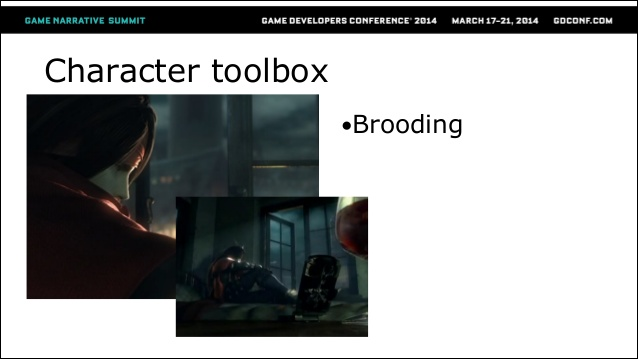
This is just my interpretation but what bothered me about this -- and the talk in general -- is the undertone that Clough's opinions and love of bishonen characters is "right" and to choose to create characters that don't appeal to her is "wrong". When you have sections called "who's doing it right?", it gives the impression that there's only one "correct" way of making sexually-appealing male characters. The same goes for when dimissing Max Payne as a brooding character done poorly while praising Final Fantasy VII's Vincent Valentine as a brooding character done well, while I would say the two characters are the other way around (although to Clough's credit she did use an image of Max Payne 3, which I've never played ... although after watching the first ten minutes on Youtube, that particular incarnation was one I could've done without seeing. What happened to all of Max's metaphors and similes? What happened to him making his peace with his family's deaths at the end of Max Payne 2?).


The problem with this assertion is that, obviously, there are women who find rugged male characters attractive and plenty of male gamers who don't relate to them at all. The opposite can obviously apply to bishonen characters, with not all female gamers being as enamored of them as Clough and it goes without saying that men can play as them without thinking twice about it. A female commenter on my last blog about Clough's talk actually said, "I never found the Sephiroth or Marluxia type of bishounen appealing. Like maybe when I was 14." She also mentioned stumbling across some Call Of Duty yaoi once. If you have time, go to Google or DeviantArt and search for "call of duty yaoi". It exists!

It should be clear by now that there's no one big problem I had with Michelle Clough's presentation but a lot of small ones. For example, in my previous blog, I objected to Clough thinking that androgynous male characters were rare. Now that I've seen it, I've learned that the issue wasn't with sexualised being rare but them not being in any "core" games. To me, this led to a very muddled argument; firstly, Clough praised characters such as Thane (and others) in Mass Effect, which I would describe as a "core game". Secondly, she would go on to say "make sure sexualised characters are right for your game", before showing a mock-up of a Call Of Duty cover with a bunch of shirtless, muscular guys on the box, indicating an example of a game where it wouldn't be appropriate. I understand that Call Of Duty isn't the only "core" game out there but I would've been interested in hearing some suggestions from Clough. Thirdly, Final Fantasy VII was referred back to many times throughout the talk but the thing is ... the Final Fantasy series is still out there and still features androgynous characters. It's not exactly the fault of the developer that it's no longer the "core" series that it once was, so even though Clough is correct in that respect, it's also not through lack of trying that Final Fantasy isn't as popular as it used to be (or any game series for that matter; I'm sure most developers would give an arm and a leg for their games to be considered a "core" series like CoD or Assassin's Creed). So what point is being made by mentioning the lack of "core" games featuring sexualised male characters? Is someone to blame? Is it an example of how unfairly female characters have it in games, just because Square-Enix haven't been able to achieve the same success that they used to?

I don't want to ramble too much about this, particularly since it turns out I have as many criticisms as I do with the average Anita Sarkeesian video, but one final thing I noticed that disappointed me was how the slides on sexualised male characters were talked about with a light-hearted attitude while the rare occasions when sexualised female characters were the topic of conversation, Clough adopted a more serious tone; slides about Male Gaze, why sexualisation can be good while objectification is bad (focusing entirely on female characters, of course), comparing a male Starcraft character to a female one and comparing a shot of Jacob's buttocks in Mass Effect 2 to one of Miranda's were all treated as serious issues. Talking about male video game characters was the opportunity for Clough to crack some jokes and get a few chuckles from the audience.

My issue with that wasn't that jokes were being made at the expense of male characters. Having a funny presentation isn't the problem. It doesn't even bother me that the first talk about sexualised male characters ever wasn't taken seriously. Hell, you try condensing a subject down into twenty-five minutes when it's never been spoken about in such a prominent venue. It's not enough time to cover everything.

What bothers me is that it was purely from a feminist point-of-view. By that, I mean that Clough's stance wasn't one we haven't seen before. The idea of sexualised men was still a joke, in spite of Clough finding them appealing. In fact, it was considered a good thing, with Clough believing sexualised male characters could attract more women and gay men to gaming. Meanwhile, Clough reserved a modicum of seriousness when talking about female characters and I'd say the only time she mentioned them positively was in passing, when discussing how sexualised characters had to have traits other than their attractive appearance. Even then, it was glossed over, focusing on both Sephiroth and Tifa from Final Fantasy VII, rather than just Tifa.

I don't want it to seem like I'm against Clough having a feminist point-of-view just because it's a feminist point-of-view and give the impression that I'm foaming at the mouth with rage over it. I dislike it because it's a standpoint that seems dead-set against the idea that men can be portrayed negatively. One perfect example of it is when Michelle Clough mentions that when it comes to male nudity in games, it is always portrayed as "awkward or comedic". Hey, you'll get no argument on that from me. Where Clough and I differ, however, is where Clough sees the prominence of comedic nude male characters in games as being unequal treatment for women, as there were plenty of sexualised female characters but a lack of male ones, I see it as being unfair treatment of men.

This doesn't apply as much in games as it does in films, television shows and even real life but it's very rare for male sexuality to be treated as anything close to desirable, including in shows aimed at women; men are constantly portrayed as bumbling comedy figures when it comes to romance, someone for the down-to-earth female characters to roll their eyes at. Women are always portrayed as the desirable, effortlessly sexy party who useless male characters want to (and fail to) be with. Take a look at this advert from Wowcher in the UK for an example (which also portrays violence against men as comedy):


Or how about this advert for "Mullerlight Greek Style Luscious Lemon" yoghurt, which does show a male character as being desirable ... before he stumbles and the female main character (and narrator) laughs at his stupidity? I apologise but for some reason, the video isn't showing up when I try to embed it. Here's the link:

Müllerlight Greek Style Luscious Lemon Lifeguard

Then there's Harpic White & Shine, a lavatory cleaner. In this advert, a suave man in a white suit walks through some mist while words like "Dazzling", "Brilliant" and "Wow!" appear on the screen ... then he looks dejected as it turns out the words were referring to the lavatory cleaner and not him:


The reason I'm showing all of these television commercials is because Clough used a quote to make it seem as if the only reason why male sexuality is used as comedy is because "man is reluctant to gaze at his exhibitionist like". It's because of Male Gaze, in other words. However, these television commercials are all aimed at women; its "heroes" are female, the voiceover artists are female and hapless male figures are the butt of the joke. None of these adverts have anything to do with Male Gaze, so why does Clough believe that must be the case in games?

The funny thing is that treating male sexuality as comedy is actually the least offensive way of expressing a lack of desirability for men. When male sexuality is portrayed as being disgusting or even dangerous, it stops being comedy and actually creeps into prejudice; we end up with campaigns like "teach men not to rape", which is about as sexist as it gets and I'm not willing to go into it any further than that. This blog's long enough.

Finally, and this is a bit of a nitpick, but using Jin Kazama from Tekken as an example of a "power fantasy" when it comes to shirtless scenes? Literally any other shirtless Tekken character would've been a better option for Clough to pick if she wanted to make the "power fantasy" argument. Aside from Hwoarang, I'd say Jin fits Clough's criteria for a sexualised male character better than anyone else on the roster. He even has the same broodiness that Clough likes, which Namco Bandai plays up when Jin is the object of Ling Xiaoyu's affections:


Even though that ending turns out to be a dream, it's not that far from Jin's regular attitude.

I also have to point out something that I mentioned all the way back in September 2012; that Jin is one of several characters created to be a younger, better-looking successor to an existing character.


So like I said, it's nitpicking but I don't agree that Jin is close to a male power fantasy at all, particularly due to the standards that are usually used by feminists (Kratos and Marcus Fenix, for example).

Overall, and to summarise my problem with Michelle Clough's talk, in my previous blog on the presentation I gave her the benefit of the doubt because the topic of men being sexualised was never acknowledged. Now that I've watched the talk, I don't feel like it offered anything new at all. It didn't offer another side to the issue of sexualised characters, it just bolstered the position of the side that already controls the conversation on sexualisation (and other gender issues). And in spite of the fact that Clough was strapped for time, I have an unpleasant feeling that even if the presentation was twice as long, we wouldn't see sexualised male characters taken seriously (except to point out how good it is for straight women and gay men).

... The presentation was still more watchable than Tropes Vs Women though ...

-----

In other news, I finally took the plunge and joined Twitter. You can see my feed in the sidebar and I'm always happy for more followers.

You can also leave comments below or send me an e-mail at themalesofgames@gmail.com.

Monday, 16 June 2014

E3 2014: "Rainbow Six: Sexism"? Far from it.

My first year of game development at college has come to an end and, although I haven't yet received my grades for the entire year, they're expected to be first-rate (although I don't wish to sound as if I'm bragging; if they're good, it's because I agonised over the work every day rather than because I'm necessarily more intelligent than the other students. I noticed that an insane level of commitment seemed to be a trend with the mature students). I can't say that I'm any closer to entering the games industry than when I started but it's only one year of college, so it isn't unexpected that I haven't come out of it "industry-ready".

Enrolling on a game development course also didn't give me the opportunity to discuss sexism as much as I had hoped. I think I had around three conversations about it in the entire year but other than that, as you'd probably expect, most people -- male and female -- didn't care about gender issues in games. Which is fine and completely understandable; in spite of all the articles about gender issues in games online, it has to be said that it is not an issue that the majority of gamers care about. A few people did seem interested in how Wil Wheaton spearheaded a movement that ended with Destructoid writer Ryan Perez being fired though, so that's something.

E3 took place last week and I really enjoyed it. I didn't have much interest in any of the current-gen consoles but with Bloodborne, Mortal Kombat X and No Man's Sky being the games that made a big impression on me, I suspect I'll buy a PS4 at some point (probably next year). Oh, and the Metal Gear Solid V: The Phantom Pain trailer blew me away.

Anyway, speaking of E3 and articles about gender issues, I suppose it was too much to hope for to think that E3 might pass without an accusation of sexism being aimed at someone or something. Off the top of my head, "scandals" I can recall include a lack of female presenters, a lack of games featuring female characters and, in case anyone has forgotten, the "rape" joke during the Killer Instinct presentation last year.

I followed the conferences on Gamespot and on June 10th, before the event was even finished, Tom McShea took it upon himself to write an editorial called "The Disturbing Representation of Women in the Rainbow Six: Siege E3 Demo". Tom's big problem? In the stage demo for Rainbow Six: Siege, a female character was a hostage. That's it. That's the entire issue. You can watch the demo at the link above but here's a Youtube version if you prefer:


Before I go into Tom McShea's article, what I took away from E3 with regards to gender issues was how many positive portrayals of female characters there were. All of them got their share of the spotlight. I'm sure I'm going to forget some but we had Bayonetta 2. Mirror's Edge 2. Alien: Isolation. Infamous: First Light. Rise of the Tomb Raider. Lara Croft and the Temple of Osiris. Plus, think of the games that had a mix of male and female characters, like Mortal Kombat X. Fable Legends. The Sims 4. Hyrule Warriors. If the predecessors of Bloodborne, Dragon Age: Inquisition and Mass Effect 4 are anything to go by, they'll all have the option to play as male or female characters too. Hell, it seemed like most games had a choice of male and female characters, from Broforce to the Dead Rising 3 DLC. In fact, would you like to know another game that had a positive female portrayal in the stage demo? Rainbow Six: Siege!

In case you didn't watch the video above, the demo -- which features the disclaimer "the following is pre-alpha footage captured from a multiplayer match" but is very blatantly staged -- features five online players trying to rescue the female hostage from their five opponents. Of the five players whose voices we hear, one of them -- playing as a sniper -- is female. She is portrayed as being just as capable as the male players on her team.

The point is that E3's representations of female characters should've been cause for celebration (or, if you're part of the "they shouldn't be praised for doing what's expected of them" crowd, at least it shouldn't have been cause for criticism). Yet Tom McShea, being a glass half-empty kind of chap, focused on the one example from the show that featured a woman in a damsel-in-distress role and argued:
"It was their decision to have a woman presented as an object, something to be fought over--to be won--so that's the message that was hammered home. So I can only look at the reality of this demonstration and wonder why it's once again a woman placed in such a sad position."
The main reasons I still visit Gamespot are (A) habit and (B) the majority of people who post comments seem to be sensible and rational. In this case, I was impressed with how this excerpt from a comment by "tonkins22" got to the heart of the matter:
"Sexism in games needs to be tackled, and deserves a billion-word discussion. But you can't use a non-example as your launchpad into that point, or it makes the argument itself look thin, which is bad for the cause. The author is writing an article about a serious forest fire and tries to get your attention by panicking about a lit match."
This is the central problem with McShea's article. It's a perfect example of making a mountain out of a molehill. McShea refers to women in games as "prizes", "rewards", "objects", "plot points" and "second-class citizens" throughout his editorial but the main thrust of his argument is based on this lone female hostage from Rainbow Six: Siege. There is no evidence that she is any of those things and the rescue team in the video are intending to rescue this hostage, not claim her in any way. That's McShea's own interpretation. He's the only one seeing her as an object rather than a human being. It's little wonder that the Gamespot members collectively roll their eyes at this when there is a positive female portrayal in the same video, many positive female portrayals in other games at E3 and there will be male hostages in Rainbow Six: Siege too.

Speaking of male hostages, McShea notably didn't mention Huey Emmerich being taken hostage and tortured in the Metal Gear Solid V: The Phantom Pain trailer (from 2:20 to 2:40 in that video). Both the protagonist and his "plus one" are taken hostage in the Far Cry 4 villain trailer (from 4:45 until the very end in that video). None of those three male characters are shown as being anything other than helpless, much like the female hostage in the Rainbow Six: Siege demo. However, McShea insists that "it's once again a woman placed in such a sad position". He even mentions Far Cry 4 in the final paragraph, using it as an example of "white male protagonists [being] placed front and center" (which is wrong because ... ?) without mentioning that the white male protagonist in question gets a bag placed over his head before being taken captive.

It's disappointing that this type of blatant misrepresentation of the facts has become so commonplace but that's what happens when people are desperate to promote an agenda that doesn't have any grounding in reality. There are gender issues that should be talked about and the portrayal of women in games is by no means perfect -- as tonkins22 said, "sexism in games needs to be tackled, and deserves a billion-word discussion" -- but McShea took what should've been a success for women in games and turned it into a failure.

Then again, this is the same person who wrote "The Santa Barbara Killer Is a Product of Our Culture, and We Shouldn't Hide From That Fact".

-----

(When I began writing this part, I didn't plan on it being as long as it became. If you just care about gaming, you can stop reading now because this is related to real life.)

Hopefully, I won't go into this too much because it seems like I've discussed nothing else since it happened at the end of May. For those who don't know, on May 23rd a college student named Elliot Rodger murdered four men and two women and injured thirteen others. There were many reasons behind it; Rodger was a misanthrope. He loathed men, describing them as "obnoxious brutes" and left forum comments fantasising about a virus wiping out every man on earth except him so he could have his pick of the women. He loathed women too, referring to "blonde sluts" and fantasising about wiping all of them out too while sitting in a tower and watching at all. Rodger was also a racist, recoiling at interracial couples and showing disgust towards full-Asian men (Rodger himself was half-white, half-Asian and referred to himself as Eurasian several times. Three of the six victims were also Asian and, given that they were the three who were stabbed in his apartment rather than shot, these were apparently the predetermined murders).

It should also be mentioned that Rodger suffered from a mental illness. At times online, I've seen people react to that point with aggression, thinking that just pointing it out means he's being held up as an example of all sufferers of mental illness but that isn't the case any more than he's an example of all virgins or half-Asians. The point is that without acknowledging that Rodger suffered from a mental illness, the severity and significance of mental illness cannot be understood.

The reason I'm bringing this up isn't just because of Tom McShea's article on the subject. In fact, if Tom's editorial is the first you've read about the Isla Vista killings, you might be confused about why he's focusing so much on misogyny and violence against women. The fact is that in this case, McShea was just following in the footsteps of over a dozen other, more mainstream news sites that ignored every single motivating factor in the murders ... except for Rodger's hatred of women (although the blog itself was about how misinformation can be spread and perpetuated, the women of Honey Badger Radio have a decent list of around fifteen sites that focused specifically on violence against women. As they mention at the end, they're only a fraction of the total number).

Without wanting this to turn into a rant, the most disgusting aspect of the Santa Barbara killings if you followed the coverage was how it instantly and blatantly it became an event to promote an agenda ... and it wasn't just to raise awareness about violence against women. Men's rights activists were blamed, even though Elliot Rodger wasn't an MRA. White men were blamed, even though Elliot Rodger wasn't white. In the Huffington Post article I just linked to, feminist blogger Anne Theriault actually states:
"We have no evidence yet that he suffered from any kind of mental illness or was under any sort of treatment. Immediately claiming that with no proof to back that fact up leads to the further stigmatization of the mentally ill, and contributes to the (incorrect) assumption that mental illness equals violence, and vice versa."
This is in spite of the fact that the day before, Rodger's own father (speaking through an attorney) stated, "the 22-year-old was being treated by multiple therapists and was a student at Santa Barbara City College".

Phrases like "male entitlement", "male privilege" and "male rage" all became commonplace, effectively painting all men with the same Elliot Rodger-shaped brush. If you have the time, you can go through the Honey Badger Radio list of articles and find the number of pieces that use the phrase "six people were killed" before launching into a rant about Rodger's misogyny, entitlement and violence against women rather than say "four men and two women". That isn't a coincidence. Feminist bloggers and journalists leapt on the opportunity to use the deaths of a tragedy where more men were killed than women to promote awareness about an unrelated viewpoint.

I want to make it clear that I'm not just disappointed about the deaths of the four young men being used (or, more accurately, ignored) to further an agenda that attacked men on a regular basis. None of the six, including the two women, deserved to have their deaths used in this manner. They were people. Their deaths were not something to be politicised for personal gain. It's safe to say that over the last month, feminism reached full Jack Thompson territory.

Credit to Europa-Phoenix. This comparison went through my mind over the course of the last month too.
One reason I'm bringing this up is because mass shootings in the U.S. have affected me in a few different ways. When the 2012 Aurora cinema shooting happened, I was so unbelievably shaken that I intentionally (and probably selfishly) avoided reading anything about the Sandy Hook shooting when it occurred in case it affected me in a similar way.

Something that I've tried to keep up on this blog -- which I've admittedly been back and forth on at different times -- is avoiding using "feminists" as a blanket term. Sometimes I haven't used it at all, other times I've tried to soften the blow by saying "some feminists" or "the feminist argument", to try to communicate that I'm not blaming the movement as a whole. I've always been swayed by the "not all feminists are like that" (NAFALT) argument that comes up repeatedly when men's rights activists point out some of the ways that feminism has had a hand in the poor treatment of men.

Now? Well, as you might've noticed over the last half-dozen paragraphs or so, I'm not particularly concerned about sparing the feelings of the NAFALT crowd any more. While I reacted to the Aurora shooting with horror, I ended up reacting to the Isla Vista killings with anger and not just directed at Rodger. Some of the most despicable people -- making the most unpleasant, untruthful arguments -- came crawling out of the woodwork and every one of them was a feminist ... and too few feminists responded to these articles with anger, disappointment or disgust. The quiet, half-hearted opposition on forums and in comments sections doesn't do much to combat the loud dogmatism of feminist journalists like Laurie Penny, dismissing violence against men while telling me that I'm "part of the problem" ... for saying that not all men are like Elliot Rodger because that dismisses violence against women. Somehow.

On the plus side, she makes Tom McShea look like a saint.

Okay, so I had a lot more to say on this issue than I thought but it's probably better that I got all of this off my chest here and not just in the comments section of a news article. This may be primarily a games blog but a few occasions have been set aside to talk about men's issues in general. It annoys me that this shouldn't have been a men's rights issue -- Rodger wasn't even remotely related to the men's rights movement but that didn't stop Anne Theriault and others from branding him one -- but it became one, so it's worth being brought up.

Hope you all had a happy Father's Day! Feel free to comment or e-mail me at themalesofgames@gmail.com.

Tuesday, 13 May 2014

What am I supposed to do about "Gaming While Male"?

I'll be keeping this one short, although I'd like to start updating more regularly again. Practically all work I'm busy with should be completed by the end of the month and I'd like to get back to the more regular updates that I used to produce, pre-college games development course. I feel less involved with gender issues in the games industry and could do with being more active. I have to admit, I feel a twinge of envy when I visit Vicsor's site and see how involved he is with some cool, creative people on Twitter, like devi ever and even Tamara Smith (cowkitty), back when the whole Anita Sarkeesian art theft issue broke. Not being a fan of Twitter, I'll have to make do with updating this blog more frequently.

A couple of weeks ago, Jonathan McIntosh -- producer of Anita Sarkeesian's Feminist Frequency video series -- wrote an article for Polygon magazine titled "Playing with privilege: the invisible benefits of gaming while male". I'm not going to link to that particular article because, if you've ever seen a "male privilege checklist" article anywhere online, it's basically the same regurgitated information, only tailored to gaming. It's pointless to argue against McIntosh's points because, just like the ones seen in male privilege checklists, they're written based on assumptions and beliefs rather than evidence. I could provide every counter-argument in the world but it's clear that anyone who writes something like ...
"I can be relatively sure my thoughts about video games won’t be dismissed or attacked based solely on my tone of voice, even if I speak in an aggressive, obnoxious, crude or flippant manner."
... Isn't interested in facts.

I wasn't that interested in writing about this topic at all until I came across McIntosh's article mentioned on NPR. At the top of the page is a picture of Nathan Drake from Uncharted -- which isn't mentioned in the article at all -- with the following caption:
"Nathan Drake (foreground) is the lead protagonist of the Uncharted series of games for the Sony PS3. His character is just one in a long line of games where the dominant figure is a white male action hero."
If you're anything like me, the first thought that crossed my mind was "so?" and I'm still not sure what point Steve Mullis, the writer of that article, is trying to make. Is it a criticism of all games with white men in the leading role? If so, what's wrong with white men as action heroes or being the "dominant figure"? And if someone does think there's something wrong with it, again, so what? The developer does not have any responsibility to cater to a demanding audience -- regardless of the entitled Jason Schreiers and Tomodachi Life same-sex relationship campaigners of the world -- because their personal tastes are irrelevant to the project.

That one screenshot got me thinking about how I felt about "Gaming While Male" and, right off the bat, I'll say that I loathe the term (much like I did when I first read "Interneting While Female" from Anita Sarkeesian). The reason being that it's obviously derived from the term "Driving While Black".

For those of you who don't know "Driving While Black" is a term for the racial profiling of black motorists by police officers, pulling them over based on the colour of their skin alone. Discrimination under the law based on skin colour is obviously a hugely serious issue, which is why I hate terms that trivialise it like "Interneting While Female". Sorry for stating the obvious but black drivers also cannot change their skin colour to avoid the "crime" of "Driving While Black". There's nothing they can do to avoid it, which is why it's such a despicable act of discrimination.

So ... what am I supposed to do about "Gaming While Male"? Just like "Driving While Black", it's not something I can easily change, nor should I have to. Inadvertently, it feels like Jonathan McIntosh has made male gamers out to be victims; in this scenario, male gamers are the driver while McIntosh is the bigoted cop, tapping on the window and ready to give us an earful about a characteristic we can't change.

Now, McIntosh doesn't want to perform an arrest. All he wants is for male gamers to "become aware" of their privilege. Part of the problem with this issue -- once again, apart from McIntosh's arguments being based on feelings rather than facts -- is the same problem with every single "privilege" argument out there; denigrating the "dominant" group for their "privilege" does not help the "unprivileged" group in any way. What does it accomplish, except for some brief catharsis of the "I sure told them!" variety for the person making the argument? If McIntosh and others who make the privilege argument spent half as much time helping the "unprivileged" as they do disparaging the "privileged", equality in gaming could probably be achieved within a week ...

McIntosh touched upon the idea of men being "blissfully unaware" of their privilege or knowing about it but failing to understand it. However, maybe McIntosh would like to read "Why I'll Never Apologise for My White Male Privilege" by Tal Fortgang, published in TIME magazine. It's an excellent piece, with Fortgang facing the idea of "privilege" throughout his ancestry, basically facing proponents of privilege theory on their own terms. If McIntosh reads that piece, maybe he'll consider the idea that not only are men aware of privilege theory and understand it perfectly but just refuse to accept it. And with good reason.

In other news, the BBC recently aired a documentary called "Blurred Lines: The New Battle of the Sexes", which I watched in its entirety. If it covered any new ground with regards to gender issues then I would be happy to write about it extensively here but, as it happens, it was all the typical go-to non-issues for gender issues online nowadays; a lack of women on bank notes in the UK, rape jokes in stand-up comedy and, yes, Anita Sarkeesian. She did a few minutes, basically repeating everything from her TEDxWomen talk, her Conference talk, her CNN interview, etc. At this point, it feels like Anita has become a parody of herself. I'm just going to link to a Youtube response by a woman named Vipersword100, who perfectly sums up the issues with Anita's portion of the documentary.