Friday, 20 September 2013

Anita Sarkeesian is Not a Real Gamer

I should've written about this sooner but, for the very first time, I can legitimately say, "I have a lot going on in my personal life right now", which is the blog-writer's way of saying, "college is time-consuming".

So let's get right into it with this: Anita Sarkeesian is not a real gamer. In her own words.


Back in 2010, Anita gave a lecture at Santa Monica College in California, where she stated, "I would love to play video games but I don't want to go around shooting people and ripping off their heads. It's just gross". So there we have it. In her own words, Anita states she doesn't -- or didn't, at least -- play video games. In spite of the photo of herself playing a Nintendo game as a child that she likes to show at every opportunity.

The video above became popular enough to gain 140,000 views (and counting). I'm a bit out of the loop so I don't know how this happened or who linked to it but I'm pleased it has received so much attention. In fact, it was popular enough for Anita to actually make a response (of sorts) to it.


A bunch of other tweets followed these that were in a similar vein. If you want to read them all, Anita helpfully posted the tweets to her Tumblr account, for reasons I'm not quite clear about. To clear the air, perhaps? Regardless of the reasons, it's silly that even while Anita herself said she wasn't a gamer and the original uploader of the video made it very clear he didn't hold any malice towards her, she still feels the need to blame "angry gamer dudes" (and games themselves, later on). I suppose it's natural to want to go on the attack when you're against the ropes.

It's worth noting that Anita may be telling the truth when she says she fell in and out of love with gaming. It's possible but we just don't know and the video footage of her saying "I would love to be a gamer" is greater evidence against her being a gamer than her word is for her being a gamer.

So what does this prove? Well, as the creator of the original video said, no, the fact that Anita isn't a gamer doesn't disprove or debunk her arguments in any way. People with no prior involvement in a subject can still research and investigate it. So if her arguments could be acceptable one way or the other, why go as far as to pretend to be a gamer?

My theory is that it adds legitimacy to her claims. Critics of Anita, like myself, have compared her to Jack Thompson in the past because of her insistence that video games have some non-descript influence on real-life behaviours and attitudes. However, Anita's arguments have been accepted and praised by mainstream sites and publications while Jack's were condemned and ignored. There are a few reasons for this; Anita doesn't make claims as outlandish as Jack's, for example, and isn't as aggressive in her delivery. There's still plenty of hostility and condescension but no claims that video games are "murder simulators". Her view is also politically correct, while Jack was openly homophobic. That's a big reason for it.

Anita being a gamer is certainly a factor here though; let's say someone was in her shoes who admitted to not being a gamer. "Feminist gamer criticises sexist tropes in games" is going to be given more coverage than "feminist criticises sexist tropes in games, in spite of having never held a controller in her life".

I've already ran into comments on Youtube defending Anita, obviously, although I suspect the ones I've seen are trolls. Naturally, I haven't seen any mainstream gaming sites pick up on this -- although the number of views for the video suggests that somewhere with a large readership reported on it -- and I doubt they will. They'll just quietly file it alongside the misquoted studies and use of other people's footage to continue to portray Anita as a figure who can do no wrong.

Still, at least we know why Anita doesn't like her lectures to be filmed now.

In other news, I've been doing a bunch of gender issues-related things at college. Today, we dealt with the stereotyping of certain groups in games. It wasn't at all in-depth, unfortunately, and men weren't mentioned. It was just basic stuff and the reason we were told not to do it, rather than because we should care about offending people, was because large-chested female characters simply aren't used in a portfolio when trying to get a job in the games industry. The same goes other things, including T-Rexes, for reasons that we haven't been told yet.

Also in college, a prick ruined GTAV for the entire class by revealing parts of the story. Just thought I'd mention that.

Oh, and I found an eyebrow-raising Jade Raymond quote from Develop magazine that I'll write about next time.

Thursday, 12 September 2013

News from College!

Hey all. I know I updated a lot last month so I'm sorry that things have slowed down this month. This is actually the first time I've even logged in for a week.

As you probably know, I've started my games development course at college and, to be brutally honest, I hate it. What little I've done so far has been a mixed bag; playing with 3ds Max and Maya has been pretty good but the more academic side of things leaves me feeling cold. The course tutors have outlined the projects for the year and workload is overwhelming. I shouldn't have a problem writing essays, given the length of some of my blog posts, but I inject a lot of myself into this blog and when I have to cite references, I just link to other places. Plus, there's no strict deadline. It doesn't translate very well to a course where we have to examine market trends in the gaming industry and give examples of different ways digital art is used. Maybe it's just because I'm older or because I have little patience for hand-written notes and using "Harvard Referencing" to cite sources but I'm certainly not as passionate about the theory rather than the practical. If I feel like it isn't helping me improve my skills of creating content, it gets a thumbs-down from me.

There are a few little things to say about gender issues but nothing major yet. First of all, the number of boys on the course obviously outweighs the number of women but by how many, it's hard to say. There are over two hundred students on this particular course, each doing different levels and in different groups, so I couldn't begin to give you any numbers. What I do know is that my own group has three girls in it, out of a class of seventeen. However, two of the girls -- a pair of sisters -- have been absent for the last two days and, although I don't like to assume, I suspect a pair of sisters both being absent at this early stage means they decided the course wasn't for them. They are the only people in my group that did this.

I'd also like to say that I am not knocking either their ability or willingness to stay on the course. Partly because, as I mentioned above, I hate the course so far and have thought about dropping out myself already but also because they were the two people in the class I got on best with. In fact, I'm switching groups next week -- all the timetables are pretty screwed up and, living over an hour away from the college, it wasn't practical to stick with the group I'm in right now -- and the possibility of the two of them coming back was actually one of the reasons I was tempted to stay with my group. Unfortunately, if I'm to survive this course, switching timetables was a must, but I want to make it clear that I'm not saying that their leaving (if they have left) is representative of either women's or even their own lack of enthusiasm in the games industry. The course is just a pain. I'm only pointing it out because people tend to obsess over how "male-dominated" certain fields are or how sexist the games industry is but maybe the reality is that people just decide the course isn't for them.

So it's fair to say I haven't been making too many friends and no conversation about gender issues in video games has cropped up yet. In fact, aside from a wide-ranging discussion in a particularly laid-back substitute class today, games haven't come up much at all. However, while flicking some subject briefs for a class I had today -- Understanding Industry, an academic and homework-heavy class that I suspect I'm going to really hate -- I came across what looks like the lesson plan for the entire year. Listed for the week of 2/12/13 and 13/1/14 are a pair of lessons titled "Ethics - Games Debate". I'm going to take a wild guess and say that one of them will be about violence and the other will be about gender issues, based on something the tutor mentioned in the class; when talking about current trends she casually threw out, "maybe a current trend is about having more females working in the industry". At the foot of another brief, when giving an example of how to use Harvard Referencing, the book she happened to use was "Feminist Film Studies: Writing the Woman into Cinema" by Janet McCabe. It could be coincidence but possibly not.

Unfortunately, that means I have to wait until December (at the very least) to actually voice my opinions about gender issues in games in a real-life forum. By then, I'll be neck-deep in essays and probably as stressed as I can possibly be, so I certainly have to suffer through a few things to get to that slight improvement. And I do mean slight; as optimistic as I am that I can talk about this with a new audience, the drawbacks of the course are keeping me from jumping for joy.

Update: As it turns out, the two girls didn't drop out, which I'm happy about. We chatted a little, they seem nice, they're still the two people I find easiest to get along with at the college. Unfortunately, now that I've switched groups, I won't be able to spend time with them as often.

Having said that, the group I'm in right now seems okay too. Remember "Understanding Industry", the class that I said I suspected I would hate? Today, I had my first "real" Understanding Industry class and I really enjoyed it. The students were split into four groups and each given a different market trend to discuss and brainstorm. Believe it or not, the market trend that my particular group was asked to discuss was Diversity.

Me!

We didn't get to go as in-depth as I would've liked but I had all the information I needed at my fingertips. The class was so varied that I heard the names "Pewdiepie" and "Anita Sarkeesian" within fifteen minutes of each other. The female tutor even raised a point about portrayals of men, which I was pleased to hear.

Speaking of Anita, even though there hasn't really been any "real" discussion of her work yet, I did manage to sneak in a quick minute-long conversation about her with another guy in the class. All I really said was "I'm surprised you've heard of Anita Sarkeesian. I didn't think she was that well-known". This was based off a few posts and comments I've seen around the internet that more or less just said "I've never heard of her". This young man, on the other hand, summed her up with the following (paraphrased) sentence: "it's clearly a business that she's running but she's saying 'I don't know what I'm doing'. I just think 'yes you clearly do, you lying f*cking b*tch'."

As always, I'm not exactly condoning abuse but considering it wasn't publicly aimed at Anita, we weren't having an in-depth discussion about her and we're talking about informal, earthy teenagers here, it makes sense to let this one slide. He was one of the people in my group and actually raised plenty of good points about diversity, so if I was ever under any doubts that someone being anti-Anita doesn't make them anti-woman, that would have reassured me. This gentleman also said that he'd watched most of Anita's other Youtube videos and couldn't see where the money went. One other person -- the only girl -- in the class had also heard of Anita Sarkeesian but I didn't have the opportunity to speak with her about it.

As for the lesson, I'm sure some of the essays will frustrate me and when I have to deal with non-gender-related topics, I'll struggle. For the moment, however, this particular lesson seems tailor-made for me. Let's just hope I don't get so wrapped up in being a know-it-all that I end up missing crucial pieces of information and gaining fewer marks.

Thursday, 5 September 2013

I sense an incoming Metal Gear Solid backlash.

Earlier today, Hideo Kojima -- creator of the Metal Gear Solid series -- tweeted about wanting some of the characters of MGSV redesigned to be more "erotic". He cited appealing to cosplayers and selling more figurines of the game's characters as the reasons why he wanted these redesigns.

I suspect we'll be seeing some vexed responses to this in the next few days. Personally, I'm delighted.

First of all, I love how different the attitude towards sexualisation is in Japan compared to the West. When I wrote about Dragon's Crown, I brought up how the most sexualised characters broke my immersion in the game. From what I hear, the only mention of the exaggerated character designs in Japan was joking about how big a deal was made of it outside the country. Unfortunately, I haven't been able to find any Japanese articles saying that directly (obviously because the Japanese language isn't my forté and English isn't much use at finding Japanese articles in search engines) but I'd like to read some of them first-hand if I get the chance.

I'd love to be able to have that same nonchalant attitude towards sexualised characters in the media that they have in Japan. Logically, I can see why people would argue that living in a culture with so much fiction featuring sexualised women would lead people within that culture to have a lower opinion of real women; women being sex objects in games could lead to people viewing them as such in real life. Having said that, I completely disagree. If anything, I think that Japan's line between fiction and reality is more distinct; Dragon's Crown's art style can be joked about because it's clear that a sexualised, anime-esque mermaid doesn't represent real women in any way. The connection hasn't been made between reality and fiction in the same way it has in the West, so it's easier to view sexualised characters purely as entertainment.

That's just a guess, so don't quote it as if it's fact. The point is that I see the integration of sexual characters in everyday media to be a far healthier attitude than trying to stamp it out because we dislike it. There are times when I don't think it'd be appropriate but providing it fit in with the setting/art style and wasn't aimed at kids, I think it'd be fine.

Luckily, Metal Gear Solid isn't a series that has ever had to worry about a Dragon's Crown-level of controversy but it's odd to see so many people in the comments section on Gamespot condemning Hideo Kojima for his decision. I'm surprised at that and, even though I don't like to play the "they've probably never played the game" card, I feel it's appropriate in this case; for those of you who don't know, the Metal Gear Solid series has always had a light-hearted, almost Benny Hill-esque approach to eroticism. From figuring out which soldier is female by staring at their behinds to distracting lustful guards with non-nude erotica magazines, the Metal Gear Solid series, more often than not, treats eroticism as being funny. So why this response to Metal Gear Solid V?

Assuming Kojima's critics have played previous games in the Metal Gear series, it could simply be because Kojima is being so blatant. "I want to appeal to cosplayers and to sell figurines". Making decisions based on merchandising has left a bitter taste in the mouths of fanbases in the past, most notably for Star Wars. Perhaps it's because he joked that the CG model for Quiet -- the female sniper seen in the Metal Gear Solid V trailer -- being revealed this Friday would be "uncosplayable". Personally, I think that statement was just to create some hype for the reveal and possibly to get a rise out of people. If that's the case, it seems to have worked.

Quiet is dressed beneath the border of this picture, I should point out.

It's also very possible that they think eroticism has no place in video games; there are certainly a few comments underneath that Gamespot article that make the typical comments we saw during the Dragon's Crown controversy, such as erotica "only appealing to twelve-year-olds". There's also at least one mention of this kind of attitude preventing games from being "art".

I've never been particularly interested in the "are games art?" debate because, to me, it seems inconsequential; I enjoy games and that's all that really matters. I don't particularly care if they're recognised as art or not. Having said that, I have to wonder why featuring eroticism is enough to categorise a game as not being art. Not that I think the Metal Gear Solid V erotica -- if there is any, apart from Quiet's character design -- is going to be at all serious, in which case I have to ask why should MGSV change? If you've played the previous games in the series, noticed the light-hearted attitude towards sex (as well as other immature content like one character being the victim of constant diarrhoea jokes), then why should the next game in the series be any different?

As for erotica "only appealing to twelve-year-olds", I've often thought that an inability to handle erotica -- especially the comedic take MGS puts on it -- is a greater sign of immaturity than enjoying it. The Metal Gear Solid series is for adults, so why shouldn't adult themes be present? I can't help but feel that not featuring the light-hearted erotica in MGS would be comparable to putting your hands over a child's ears whenever you mention something sexual. Or trying to convince people that storks deliver babies. It exists, we might as well laugh at it.

I'd also quickly like to mention that Kojima stated he'd be revealing Quiet's CG model on Friday but he may not have been talking about her when he mentioned the erotic redesign; anyone who remembers MGS2's naked Raiden will know that the gentlemen of Metal Gear Solid aren't immune to comedic sexualisation either. I'd still place bets on Quiet but you never know.

Anyway, it'll be interesting to see how this develops over the next couple of days, before Quiet's CG model is revealed, and the fallout afterwards, until it's engulfed (hopefully) with news from the Tokyo Game Show.

Thanks for all the comments last time, by the way. Very interesting reading.

Added on 6th September 2013 - And, to the surprise of absolutely nobody, someone has complained! Someone rather high-profile too.

David Ellis, a designer on Halo, commented on Twitter after seeing Quiet's design "our industry should be better than this" and the "industry is full of man-babies". Take a look at the article here and I highly recommend reading the highest-rated comments below. They say everything better than I could. I'd never heard of David Ellis before this article but when I was in high school, Halo was the game that everyone talked about playing online. It was the precursor to games played by so-called "man-baby" audiences such as Call Of Duty so who is David Ellis to point the finger at anyone else?

And remember, boys and girls; designing a scantily-clad female sniper who works in the middle of the desert is wrong. On the other hand, designing a needlessly large-chested and scantily-clad female character who is literally an object is just fine!


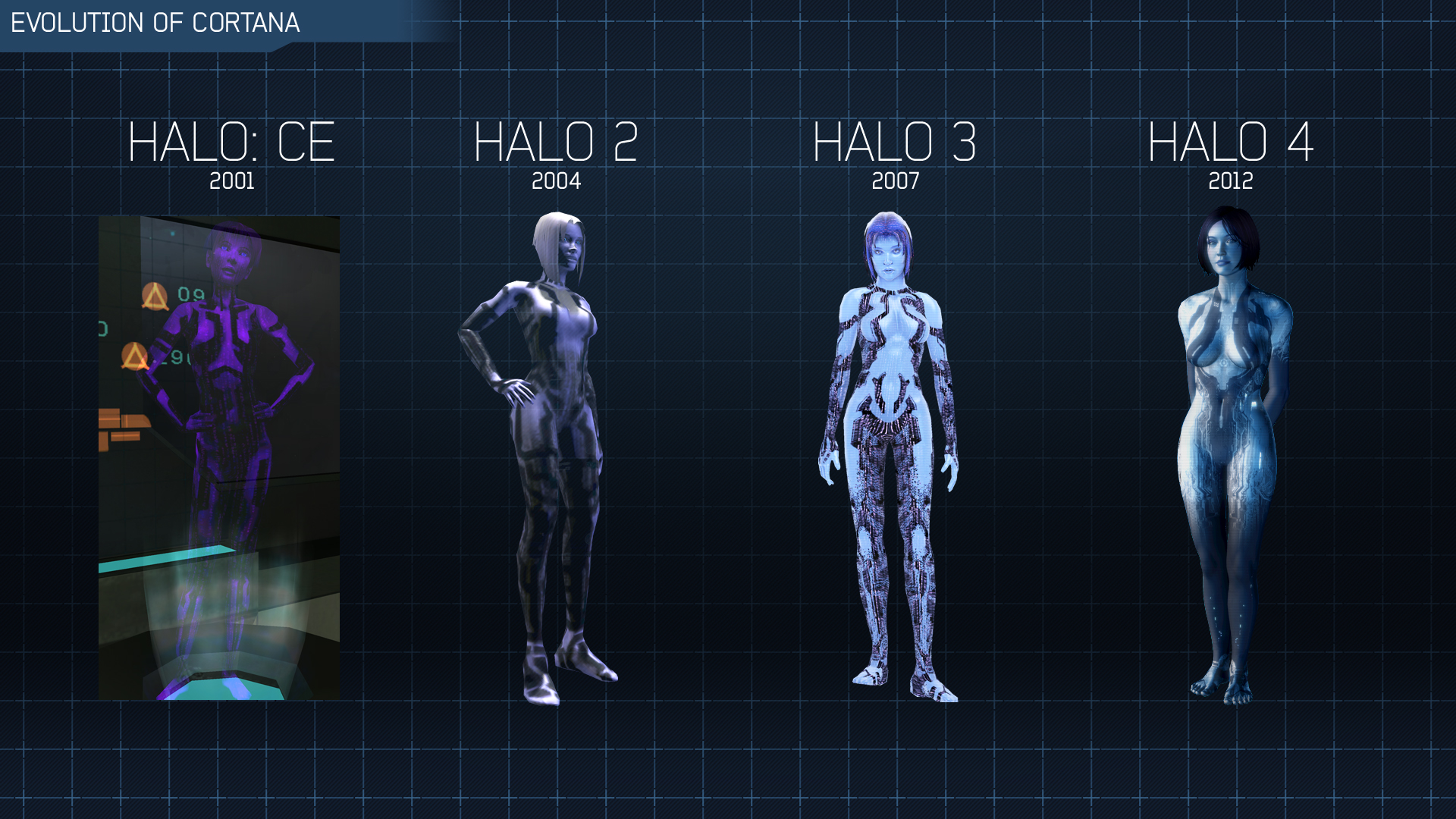
This picture is worth looking at if you want to see how Cortana became more sexualised when David Ellis and 343 Industries got their hands on Halo. A member of the NeoGAF forums also made a short and simple post about male sexualisation in the Metal Gear Solid series that didn't even mention naked Raiden. It's worth pointing to if anyone ever thinks Hideo Kojima only ever sexualises female characters.

As for David Ellis, I have no idea how anyone can be so hypocritical and yet so completely unaware, about both his own series' character designs and its "man-baby" influence. Speaking of which, it's disheartening to see just how many gamers, journalists and even developers casually throw out insults about immaturity towards people who have a different opinion to them.

I'm sorry for stating the obvious but there is nothing immature about people holding opinions different from your own, regardless of what the subject is. Insulting those people for having a different opinion, on the other hand, is very immature. That's something children do in playgrounds. If David Ellis really wants to talk about how "our industry should be better", I'd start with that.

Saturday, 31 August 2013

Is Jonathan McIntosh behind Anita Sarkeesian's views?

No. That's the short answer to that question.

In case you don't follow, one of Anita's critics conducted something of an investigation into her internet past, uncovering little details about her former website, former career and a look into a man called Jonathan McIntosh. Up until now, McIntosh's name didn't mean much other than being a name that showed up next to Anita's in the credits of the Tropes Vs Women in Games series with the credits "Produced By" and "Written By". Looking into his other sites more, there's more to it than that.

[It seems this video has since been removed.]

In short, McIntosh was already expressing strong feminist viewpoints while Anita was still selling PR services online, before her own viewpoints ever became known. She went as far as to use some of his statements about Lego in her own videos. They've apparently known each other for at least five years or so. Today, McIntosh still expresses the same viewpoints on Twitter, still works with Anita Sarkeesian and you can see if you scroll far enough down his Twitter page, uses very similar language as Anita when talking about gender issues, albeit more argumentative.

There was a lot more revealed on a Tumblr page than in that video above but I'm afraid I won't be linking to that page here; there's a lot that can be said about Anita Sarkeesian -- and trust me, before the end of this blog, I will be saying plenty -- but when you're posting links to her mother's website, you really have to call it a day.

So why do I think McIntosh isn't responsible for Anita's arguments? Well in short, it isn't conclusive. I absolutely think Anita was influenced by McIntosh's viewpoints but there's nothing to say that she didn't already have feminist views herself. It isn't like McIntosh had a background in feminism, Anita had a background in pyramid schemes and one fateful day, the two met and Feminist Frequency was born. Anita has also performed college talks by herself and I'm sure she wouldn't be going out there on her own if she didn't think she could handle any questions on gender issues tossed in her direction. Not that I think she's been asked any challenging questions, mind you, and the no-recording policy is obviously in place just in case she ever is.

I don't want it to sound like I'm being too harsh on anyone who is in full support of the information dug up on Anita. In fact, she could learn a lot from people so thorough and hey, for all we know, I could be wrong and McIntosh really could be pulling the strings. However, I think the desire to uncover information on the notoriously closed-off Anita Sarkeesian won out over the need to argue sensibly in this case.

It's also worth noting that Anita acknowledged the discovery on Twitter:


In a way, she has a point. Except for the victim blaming, which is complete twaddle. I'm not even sure who the "victim" is that she's describing here. Jonathan McIntosh? Herself?

Something I've noticed is that, even though I've said before that Anita doesn't respond to criticism, that's not quite true; she actually responds to criticism that's very easy to dismiss. For example, it's incredibly easy to dismiss the information that people dug up on her either because it doesn't appear to be relevant to her current videos -- I don't want to speculate on how much or how little of Anita's slightly shady "Success Secrets Of Self-Made Millionaires" course have influenced her current work, although the case is certainly building -- or because it really does sound like a conspiracy theory. Still, it certainly is the pot calling the kettle black when a person who blames everything on the patriarchy blames other people for concocting conspiracy theories ...

It isn't the first time Anita has responded to the "easy" criticism. Earlier this month, Doug Walker, who some of you may know as The Nostalgia Critic, posted a criticism of Anita on his Facebook page where he expressed his disappointment that Anita hadn't focused on any strong female characters yet. Now I'm happy that Doug, as a high-profile internet personality, is voicing his concerns over the Tropes Vs Women in Games series but I think most of us know that Anita will be devoting an episode of her series to positive female examples.

So naturally, this was one of the few criticisms that could easily be answered and dismissed:


And the only video response to the Damsel in Distress videos that Anita has made the wider audience aware of is MovieBob's reply, which was full of praise and dismissed the critics as trolls and abusers. It didn't break any new ground, in other words.

On-topic, it doesn't really matter if McIntosh is behind all of Anita's arguments. The fact that such biased and one-sided arguments are being given such recognition by the mainstream gaming media is the larger problem. In the last two weeks alone, she's been featured in Wired magazine and gave a talk at The Conference 2013 in Sweden. The online abuse crops up in what little of the Wired article is available to read online -- as does her example of Dinosaur Planet from the first Damsel In Distress video, with zero mention of the male playable character this time around -- and Anita's talk at The Conference revolved around it.

So yes, I know it's frustrating. We're talking about a person who has refused to face up to the majority of criticism aimed in her direction for the last year and a third, yet has been making the most of whatever publicity she can garner from the original abuse in that entire time. I know it's frustrating that mainstream gaming sites have never printed an article critical of Anita in the slightest (although the Wired article is the first in some time, so I guess no news is good news apart from that) or posted links or interviews with anyone who disagrees with her.

Although even with all that, we shouldn't go looking for a quick-fix to discredit Anita. You could say that bits and pieces of the information have merit but the fact is that educating people on why Anita's arguments are flawed, hypocritical and biased is always going to be necessary, if a pain in the neck more often than not. The thing is, as stupid as this sounds -- and writing it down now, it occurs to me that maybe I'm making a bigger deal out of this than is necessary -- I think that if we're not going to be listened to, we shouldn't be listened to for all the right reasons rather than the wrong ones.

Besides, having chatted to Anita's supporters online, we could uncover evidence that she's a killer robot from the future and they'd try to find a way to justify it. That's what they did after the video-stealing affair and the Randy Pitchford murder fanfic hypocrisy.

In other news, I got banned from the TV Tropes forum a while ago for talking about Anita Sarkeesian ... in a Feminist Frequency thread. Seriously, that was more or less the reason ("derailing" was the actual term used, in spite of the fact that I didn't start the derail and other members weren't talking about Feminist Frequency anyway). I wouldn't normally broadcast that here but I know I have at least one private message that I'm unable to answer. So I'm sorry to that person.

Also, I start my game development course at college in a little over a week. I've been playing around with Unity and the Unreal Development Kit and they're both terrifyingly daunting. I also don't get much information from the college, so I'm petrified that other students will be better than me even though I figured we'd all be at the same level. I'm hoping that's not the case.

Saturday, 24 August 2013

Reversing The Sexes

I've been really bored lately, even with Dragon's Crown. I played Gone Home recently too but thought that was a letdown. While I suspect there'll be something to write about following Gamescom, it's all very slow-going right now. Not that there's a shortage of gender issues concerning men in video games to write about but, it has to be said, it's so much easier to write about current issues and have links at my fingertips than it is to hunt down pictures and videos myself. Still, with nothing else to do, let's talk about reversing the sexes.

A few days ago, I read a comment on Youtube that said something along the lines of "reversing the sexes is  a standard defensive, kneejerk response to accusations of sexism in video games". I can't recall the video I saw it under (and after spending most of the day searching, can't find it either) but that statement left me scratching my head. Hypothetically reversing the sexes of a situation has always, to me at least, seemed like an easy and effective way to examine whether it's sexist or not. In fact, people like me who get involved in the bubble of gender issues can forget how easy it is to become bogged-down with complicated terms (like "patriarchy", "hypoagency", "rape culture" and other phrases that I like to steer clear of while writing this blog) so reversing the sexes is actually an incredibly useful, accessable tool to people who aren't as interested in gender issues; it's easy to do and doesn't overcomplicate any issues. So let's try a few.

There's a moment in Star Wars: Knights Of The Old Republic that always confused me; the player character meets a hunter on Tatooine who is stranded and needs the player's help. The wife of this hunter has rigged his hunting droids to explode if he takes another step. He had no choice but to wait for help, possibly dying of thirst in the process. The hunter isn't smart enough to figure out how to disarm them, so he asks the player character for help. It isn't the situation itself that's questionable -- even if it is the Star Wars equivalent of a bumbling husband being at the mercy of his more intelligent wife -- but if the player chose Bastila Shan, a female Jedi and something of a mentor to your own character, to accompany them, she has some eyebrow-raising things to say about the hunter's situation:


Bastila says, "I say leave him". The hunter replies with, "you're pretty heartless for such a pretty lady, you know?" Bastila responds, "I take it back. Let's congratulate his wife".

To me, this always seemed like a huge overreaction, especially for the supposedly good-natured Bastila. So much for "the Jedi do not believe in killing their prisoners", as she states earlier. Leaving prisoners to die of thirst, however, is apparently completely acceptable.

The uploader of that Youtube video comments that, as out-of-character as it may seem, it hints at Bastila having anger issues that would later be used to turn her to the dark side. Personally, I find it a bit hard to connect "irritation over clumsy come-ons" with "dark lord of the Sith". Not that I think the uploader is incorrect but it seems like an odd thing to foreshadow side-switching with.

So do you think it's sexist? I'm torn. The hunter isn't portrayed as a sympathetic character; using droids to hunt is a no-no in KOTOR and he has a habit of flirting with women in spite of being married. Plus, in spite of Bastila's comments, the player earns Light Side points for helping the hunter, so it doesn't seem like the game is encouraging punishing the hunter for his comments. On the other hand, it takes a lot to advocate murder (and congratulate the murderer) just because you're irritated over someone's pick-up lines.

Reverse the sexes and I think there's only one big difference; it sounds a lot more harsh to me to think of a male Jedi offering to congratulate an unintelligent woman's husband for plotting to murder her. It would come across as unbelievably petty for a male character to be so irritated by some (admittedly obnoxious) come-ons to advocate such a serious act of domestic violence. As we know, however, domestic violence against men isn't awarded the same seriousness as it is against women. Having said that, I'm still coming down on the side of "not sexist", solely because the player is rewarded with Light Side points for helping the hunter.

Helpfully, there are a few games that provide surprisingly accurate gender-flipped counterparts to each other in spite of the fact they're more-or-less unrelated. Take Heavenly Sword and Resident Evil 4 as an example:


And back when I wrote "The Violence Double Standard", I brought up a moment in Final Fantasy XIII when Lightning punched Snow -- her sister's boyfriend -- twice in the face for failing to keep her sister safe.


I went on to say, "according to Square-Enix, she was conceived as "a female version of Cloud", from Final Fantasy VII. I must've missed the version of Final Fantasy VII where Cloud clocks Tifa in the jaw angrily. Twice." It was only this month that I received a long reply in the comments that ended with a link to this video from Final Fantasy VII, where Cloud attacks Aeris in a moment of stress. Skip to 14:40:


Comparing these four moments is a good way to highlight the differences when violence is portrayed against colleagues in games. They are, more or less, gender-flipped versions of each other.

The big difference, first of all, is that the men aren't in control of their actions when they attack the women. In Resident Evil 4, Leon is being controlled by the parasite inside his body and in Final Fantasy VII, Cloud's stress causes him to have an out-of-body experience; literally, a ghostly image of Cloud appears that the player controls while the corporeal Cloud attacks Aeris and the player is unable to stop him in any way. In contrast to the two of them, both Nariko in Heavenly Sword and Lightning in Final Fantasy XIII are well aware that they're harming their own colleagues. So it's acceptable for female characters to hit male ones (which is shocking, I know) but for male ones to hit female ones requires a trance of some kind.

It's also worth noting the reaction to each one. Nariko's choking of her fellow clanmember is broken up quickly but there isn't any concern shown for the man. Lightning punching Snow is practically ignored by their fellow teammates. Certainly, no concern is shown for Snow. On the other hand, Ada reacts to being choked by kneeing Leon in the ribs and stabbing him in the thigh to break him out of his trance. He ends up thanking her for this. So no matter who is being choked and who is doing the choking, violence against the male character ends up being acceptable in both situations. In Final Fantasy VII's case, the remaining party member (Barret, in the video above) quickly rushes in to knock Cloud out and prevent him from hurting Aeris any further.

It seems like trances are an easy way to have violence stay reasonably inoffensive; reverse the sexes of either the Leon or Cloud attacks and they're practically the same. The hero doesn't come across as any worse because of the attack, regardless of his/her sex or the sex of the victim. Part of the reason for that is because the attack isn't the important part, whereas the trance is; both Leon and Cloud attack women because it's such an extreme action, it shows how far their sanity is slipping. Women attacking male characters on their own side is just ... a quality. Game audiences aren't supposed to think anything of it, except perhaps "I'm glad that guy got taught a lesson". As a result, reversing the sexes of the Heavenly Sword and Final Fantasy XIII attacks does make things seem worse; a male character in complete control of his faculties choking or punching a woman who refuses to fight back is just asking to be called out for its misogyny.

I suspect its moments like these -- strikes against male characters by female ones -- that make up the majority of examples that don't really stand out until we reverse the sexes. They're so quickly dismissed when they're against a male character that either we ignore them or we're supposed to ignore them. Take Bioshock Infinite. It's a very basic example but Elizabeth strikes Booker DeWitt in the face with a wrench that isn't brought up again after it happens. It knocks him out-cold, giving Elizabeth enough time to flee but Booker still doesn't have a word to say about it.


I don't know if the gaming public is prepared to see a male character doing this to a woman, although I think it's possible to give gamers a bit more credit. Take the Mass Effect series as an example. It's possible for the main character, Commander Shepard, to punch a female reporter attempting to smear his/her (although for this example, let's go with "him") reputation in all three games. Sure, it's not the same thing, in quite a few significant ways; the reporter isn't on Shepard's side, punching her is a "Renegade" option and, as previously mentioned, Shepard can be either male or female. Each of those points lessens the impact and controversy of a male character punching a woman. Even so, there doesn't seem to have been any backlash at all against the Mass Effect series for this. In fact, it's been praised because the reporter is intentionally unlikeable. Who knows if a male character intentionally punching, choking or bludgeoning a stubborn (like Snow) or sexist (like the clanmember) woman on their side could be as accepted as women doing it to men is now (irritatingly)?

As always, feel free to leave a comment or send me an e-mail at themalesofgames@gmail.com.

Thursday, 15 August 2013

Dragon's Crown: Impressions So Far (NSFW)


I want to get a lot of this out now, while it's still fresh in my mind; Dragon's Crown arrived through my door today. I've played it for a few hours and I think it's ... kind of repetitive, actually (although that may be because I'm playing as the Fighter; I briefly played as the Dwarf and had a great time but replaying all the levels I've already completed is a hassle). Certainly not the must-buy I thought it'd be based on gameplay videos. It's certainly not bad ... but it's not great. I haven't completed it yet though so hopefully I'll enjoy it more later on.

Right off the bat, I'd like to say this: I can see why some people are offended. I'm happy to defend Dragon's Crown's art style and character designs but only up to a certain point. When the artwork actually breaks my immersion from the game because the sexualisation is so blatant, that point is reached.

To explain, I think there are acceptable levels of sexualising characters in games and ... I don't want to say "unacceptable" levels -- I'm not in charge of what should and shouldn't be in games, nor would I want to be -- but levels where it seems less like the sexualisation is part of the game's universe and more part of our universe but an artist wanted to put it into the game anyway.

I'll give you some examples from other games. While I've heard a lot of criticism against the scantily-clad women of Soul Calibur, I've never had an issue with any of the series' content. Take Ivy, for example. Possibly the most heavily-criticised character but as far as I'm concerned, her dominatrix-esque outfit matches her dominant personality. Her dialogue is sexualised but she's the only character in the game with sexual lines. She's deliberately set up as the "fanservice" character, in spite of the large chests and "jiggle physics" of the rest of the female roster.

In my opinion, Ivy and the rest of the female characters in Soul Calibur are examples of acceptable sexualisation. Well, I could do without the chests expanding game after game but the female characters are more than just their sexualisation. Ivy included! Their backstories, fighting styles, relationships, etc. go towards making them fully-rounded. Plus, it's worth bearing this in mind when talking about sexualisation in fighting games:


I've played plenty of fighting games and noticed this a lot, particularly in games where you can customise/create your own fighters. I never got to enjoy them because I was always looking at my opponent.

Then there are moments of sexualisation that detract from the game. I don't feel like Ivy or any other female character in Soul Calibur detracts from the game because their sexualisation isn't focused on. I can't say the same for a game like ... Resonance Of Fate.

Resonance Of Fate is a Japanese RPG that came out a few years ago but I only bought this year. There's a minor character in the game called Cardinal Barbarella who only appears in one cutscene (although she can be spoken to and gives a few missions later on in the game) and that one cutscene sexualises the hell out of her.


(Blogspot's Youtube search was acting funny, so I had to download this, then upload it again myself. Credit to ReneidKlein for the video. Click his username if you'd prefer to watch on Youtube.)

For those of you who don't want to watch, the heroes -- three guns-for-hire -- visit the young and sexy Cardinal Barbarella and heroic pervert Vashyron is so overcome by her jiggling breasts and orgasm noises that he agrees to go into harsh danger to fetch her a bottle of wine.

Even though Barbarella's sexiness did serve a purpose -- Vashyron wouldn't have accepted the mission if Barbarella wasn't so attractive -- it was still enough to break my immersion from the game world. I don't usually mind "jiggle physics" but in this case, Barbarella's breasts had a mind of their own. Her orgasm noises were uncalled for. Vashyron, too, is the classic anime pervert archetype turned up to eleven. It certainly made playing as him for the rest of the game uncomfortable (and the other two characters were annoying in their own little ways too).

Dragon's Crown is closer to Resonance Of Fate than Soul Calibur. In fact, it's probably worse.

Now, in all the same ways that sexualisation didn't matter in Soul Calibur, they don't matter in Dragon's Crown either; you're not paying any attention to the Sorceress' jiggling breasts when you're in the middle of a hectic battle that takes up the entire screen. During the quieter moments, such as in the town, you start to notice a few things. The jiggling breasts while running around, for example. The one female civilian who always starts outside the tavern who has jiggling breasts while walking too. Morgan, the female shopkeeper who wears little more than strips of flowing cloth.

Truth be told, I could probably deal with all of that if they were the only examples. Unfortunately, there are times where the sexualisation goes even further than that. I can think of no better example than when the mermaid shows up in the middle of a level:


Every single mermaid I've seen before this one was very specifically "a fish from the waist-down" (or sometimes from the waist-up, when writers wanted to buck the trend). This mermaid, however, is a fish from the buttocks-down. As soon as I saw this, I immediately thought about how the "mermaid problem" -- mermaids are beautiful but men can't mate with them because they lack the appropriate parts -- probably doesn't apply to her. Which made the picture even less wholesome and made me wonder if that's why she was designed this way.

Like Barbarella, the mermaid doesn't play any significant role in the game (at least not as far as I've played) but she's not the only one. It struck me that a lot of Dragon's Crown is similar to a visual novel, especially when shopping or taking quests. We normally see a bright and colourful character taking up the entire screen and the narrator explaining the situation. As a result, we have a few characters cropping up out of the blue in the middle of missions. The mermaid is one. A hobgoblin chef is another. A female warrior monk in a very suggestive pose is another. She, in particular, looks like she was traced from a pornographic picture, something that artists such as Greg Land have been criticised for in the past. I may like George Kamitani's art far more than Greg Land's but I wouldn't let Greg off the hook. I can't do the same for George, no matter how impressive his art is.

Take it from me, his art is impressive. Especially in motion. It's phenomenal, in fact. There are occasions in Dragon's Crown when I won't progress the dialogue just because I want to see the animation repeat itself (like seeing the wizard Lucain smoking his pipe). I'm glad I bought the game just to see a few of the characters alone, such as the Phantom Knight. Unfortunately, some of these characters, such as the three mentioned in the previous paragraph, only play a very small role in the quest the player meets them in. So characters like the sexualised mermaid -- and the hideous hobgoblin -- showing up can feel like they're there just for the sake of being there.

So again, I understand why people can be offended by Dragon's Crown. It doesn't offend me but it does break my immersion in the game world when a naked mermaid shows up in the middle of the quest just for a chat.

I hope my regular readers aren't too disappointed in me for not fighting Dragon's Crown's corner on this particular issue but what can I say? This all just occurred to me while playing, so I thought I'd let you know. Still, maybe I'm being premature. Maybe my view has been tainted from not being enthused with the gameplay. Maybe I'll stop seeing it as an issue in time. I can only hope, for the sake for immersion, that it's the case.

So where does this leave male characters? Well, every criticism against journalists such as Jason Schreier is still valid and my blog post about the game during development is still correct; with regards to the six playable characters, the men are just as exaggerated as the women. George Kamitani's art is still incredible and, even though I feel some of the pictures are too blatantly inserted into the game, I'm more convinced than ever that he's an unparalleled artist and certainly not deserving of the insults Schreier fired in his direction. Nothing has changed.

Other than that, there isn't much to say about the male characters. There are exaggerated examples, the most prominent being Roland The Brave; a hulking, barbarian-esque man with a lantern jaw and the hair from a L'Oréal commercial. The majority of the other male characters are built like Greek Gods too, from Samuel the Guildmaster to the Monk who offers resurrection services in the temple. It has to be said though, it's not the same. In my opinion, those characters are closer to the Soul Calibur example of sexualisation; acceptable because there's more to them than the sexualisation, with Roland as the Ivy of Dragon's Crown (if the Fighter hasn't already taken that spot). In fact, it's closer to say that Roland is the only one sexualised, with the others being victims of unrealistic body standards.

Then again, it's Dragon's Crown. Everyone is exaggerated. That's the argument I used when it was in development and I have to hold my own criticisms to the same standard.

I've been enjoying the comments I've received lately, so I'm looking forward to seeing what I get for this.

Important Note: I wrote this yesterday but thought I'd wait a day to see how I felt after I'd continued playing. After playing for a few hours today, I'm happy to say that firstly, I'm enjoying Dragon's Crown a lot more. It's a game that takes a while to introduce every element and now, the gameplay is starting to feel a lot less linear and a lot more challenging. It's closer to what I was hoping for at the start.

As for the objectification, I really have got used to it a lot more. The sexualised characters do break my immersion in the game but not as much as they used to. A few characters, like Morgan the shopkeeper, don't bother me at all anymore. Plus, I've played as the Amazon a little and she may be my favourite character.

Do I wish there were a few fewer sexualised characters? Yeah, sure. Particularly the mermaid. I wish there was more variation in the female character designs too, since I'm a big fan of the Amazon having a different body type from what we usually see on female characters. Having said that, just playing through the game a bit more has helped me to stop seeing the exaggerated designs as a hindrance and more as part of the charm. There are exceptions but for the most part, that's the case. It just took some time. Imagine jumping into a cold swimming pool; at first, you're freezing but you become used to it in time and it stops bothering you. It's the same thing with Dragon's Crown; the sexualisation stands out a lot at first but the more you play, the more you accept it as part of the game world that George Kamitani created.
Monday, 12 August 2013

"The Legend of the Last Princess" (and a ton of news)

I'm making a start on this blog a bit earlier than usual because even though I've imported Dragon's Crown from the US, the expected delivery date isn't until the middle of the month. So playing that to exhaustion and then writing a blog about it -- as I expect I'll have to, if what I'm hearing is correct -- before the end of August requires me to write something now, so I'm not strapped for time.

It's important that I get it done before the end of August because in September, I'm actually going to college to begin a game development course. Not that the course will take up all my time and don't worry, the blog will continue. In fact, I'm looking forward to hearing a few different perspectives on sexism in video games and keeping my fingers crossed that I'm not the only person in the class who has heard of Anita Sarkeesian. Still, it's best to get this done now rather than rushing at the end of the month.

I got a lot of new visitors after my last post, so if you're still reading, welcome! I also found myself in a huge debate in the comments of my very third blog post after it was linked to extensively on the forums of Escapist Magazine, so go here if you're interested in reading it.

This isn't to do with video games but visiting Reddit this last week, I was drawn to two topics that I thought were pretty important. The first one highlights the lack of safe spaces to talk about men's issues and rather succinctly explains why people interested in fighting for men's issues may also become anti-feminist. Given that a large chuck of the mens rights movement seems to be made up of former feminists, it makes for a worthwhile read. It's very rare that this blog deals with serious real-world issues but the second thread features men going over incidents where they were raped and sexually assaulted. It chilled me to the bone and I had to stop reading because I was afraid I would cry if I continued. It's heartbreaking. The least I can do is link to it here and hope that a very serious issue can be given more exposure, if only a little.

Onto today's topic; I know it probably seems like I write about nothing but Anita Sarkeesian nowadays -- and, being sick of writing about the same topics myself, I'm sorry about that -- but before we put Feminist Frequency's "Damsel In Distress (Part 3)" video behind us for good, I'd like to write a little about the "hypothetical game concept" made by Anita and co.; "The Legend of the Last Princess".


Or if you don't want to watch the video, here's a transcript of the narration:
"Like many fairy tales, this story begins once upon a time with the kidnapping of a princes. [sic] She dutifully waits for a handsome hero to arrive and rescue her. Eventually, however, she grows tired of the damseling and decides it’s high time to save herself. Of course if she’s going to be the protagonist of this particular adventure she’s going to need to acquire a slightly more practical outfit. After her daring escape, she navigates the forbidden forest, leveling up her skills along the way. Upon reaching her kingdom, she discovers the inevitable yet unexpected plot twist; the royal counsel has usurped power and were responsible for her kidnapping. Branded a traitor and an outlaw in her own land, she unlocks new disguises and stealth abilities to infiltrate the city walls. She makes her way through the final castle to confront the villainous council, and abolish the monarchy forever."
Let's not go overboard; I know this is only a minute-long video. Not every point Anita wishes to make can be told in a minute. I am going to be scrutinising it as heavily as I would any other game but I'm well aware that a full game may not have the problems that I'm being critical of.

First of all, I have to say that I don't have any problems with the basic concept; a princess-slash-damsel in distress becoming the hero seems like a decent enough idea to found a game upon. Earning new abilities and disguises is fine too; done right, it could be comparable to games like Okami and Batman: Arkham City, with certain places being off-limits before finding the right ability or disguise.

All that is fine. The problems start to creep in when we look at the plot. First of all, I've heard the "powerless female character quickly adapts to defend herself" foundation compared to the Tomb Raider reboot, although in my opinion the entire plot is practically lifted from Dishonored. In fact, it's basically "Dishonored if Princess Emily was the hero". Although in Dishonored, the protagonist was framed for the princess' kidnapping, whereas that point is glossed over in "The Legend Of The Last Princess" (although yes, I know, it's only a minute long). Even the twist of the council taking over the throne is the same.

Speaking of which, why does the princess want to abolish the monarchy? I suppose I can picture her wishing to prohibit groups such as the evil council taking advantage of the power that the throne provides. It's a stretch but it's the most sensible explanation I have. Having said that, there are lots of reasons why the princess would not want to do this: without the monarchy, the princess wouldn't be at all significant in the LotLP universe. She wouldn't have any power and wouldn't be able to use her influence -- and newfound skills -- to defend the kingdom from further traitorous schemes. Presumably, other forms of government could be taken advantage of just as easily as the monarchy was. It doesn't make any sense.

There is an out-of-universe reason for the monarchy being abolished; Anita Sarkeesian dislikes princesses:


Personally, I think that line of thinking is a little sensitive -- kids are kids, I think we should let them pretend to be what they want -- but that tweet is besides the point; I get how tempting it must be to put a piece of yourself into your characters but giving a princess an anti-monarchist viewpoint is rather silly, isn't it? Although the title of the game couldn't be "The Legend Of The Last Princess" if the monarchy was still present by the end of the game.

Let's talk about the gender issues the video brings up. First of all, how did the princess escape from her cell? According to the narration, she escaped because "she grew tired of the damseling". How did she beat up the trained guard and steal his uniform? According to the narration, she was able to defeat him simply because she was going to be the protagonist.

Again, there might be more to this than the minute-long video had time to mention but when these are the princess' reasons for escaping, it seems like Anita is only interested in making a game that says, "damseling is wrong, see?" and, "look, we have a female protagonist!" I'm sure a full version of "The Legend Of The Last Princess" wouldn't resort to storytelling like this but the video did have time to go into the mechanics of learning new abilities and finding new disguises, so was it really too much to ask to say the princess had a lockpick to escape the cell and had been taught self-defence from a young age? If this game concept really is just a sensible game concept and not a game to satisfy a stereotype-subverting fantasy, having the princess break out of her cell and beat up a guard "just because" needs to go.

The other gender issue is simple; all the bad guys are male. From the guards to the three evil council members seen at the end of the video, there isn't an evil female character in sight. With men as evil and disposable as ever, it's hardly breaking any new ground when it comes to gender roles, including female ones; there have been strong women in games before, not to mention strong princesses (although rarely as the sole protagonist, I'll admit. Then again, I'm in favour of more varied protagonists, so I'm fine with a princess being playable).

The reason I'm bringing up Legend Of The Last Princess now rather than during my post about Anita's Damsel In Distress - Part 3 video was because it didn't particularly matter at that point. Like I said at the time, there wasn't much to write about the content of that video with the exception of Spelunky. Since then, there's something about the way Anita has been spotlighting the fanart for the game that makes me think she's keen to make more of this than just a "hypothetical game concept".

So could it ever be made into a real game? Well possibly. In spite of what we hear about publishers not spending as much on advertising for games starring female heroes as they do with male ones, gender issues in games are a hot-button issue right now; there are certainly developers who would be keen to score some points with a demographic that has so much clout in gaming right now. With game journalism catering to a feminist viewpoint as much as they are -- from Dragon's Crown's George Kamitani apologising to Jason Schreier after Schreier's immature insults to Naughty Dog being "surprised" by the backlash to the gender roles in The Last Of Us (thank you, Carolyn Petit) -- don't you think a developer would be happy to earn some instant good publicity by working with Anita Sarkeesian herself?

I'm not saying that it will happen, just that it's possible. There are reasons for developers to do so.

By the way, while I was on the Feminist Frequency Tumblr, I noticed that Anita had reblogged and linked to this flowchart. It's a great way to ignore the arguments while insulting people and pretending to prove a point at the same time. See which ending fits you the best.

As always, feel free to leave a comment or send me an e-mail at themalesofgames@gmail.com. Thanks for all the comments last time, by the way.